Is organised government already on the same downward spiral as organised religion?
Faith in government is low. Without exception, the system has weakened and is clearly broken. The same power corruption that is bringing down organised religion is weighing heavy on governments.
In the US, Canada, and the UK, governments have become polarising entities, and most participants don’t even try to practise statesmanship. Perhaps not the governments, per se, but the forces trying to wrest control. It’s usually us versus them. This has been going on for about half a century and accelerating. Regarding religion, we hear many say they are spiritual or have faith, but they eschew the structure of religion. What is the parallel for government?
Its easy to support the concept of government—or at least of governance—and still complain about the particular instantiation: Trump’s Republicanism is good, but Biden’s Democracy is bad, and vice versa. But I’ll argue that organised government as an institution is as fatally flawed as organised religion.
organised government as an institution is as fatally flawed as organised religion
Government participation like that of religion attracts sociopaths and power-mongers. Are there acceptions. Yes. Are these people corruptable? Yes. Do the become corrupted? Some. Many simply become complacent.
In religion, some defend that they are spiritual but not religious. In politics, we have quasi- and pseudo- anarchists and Libertarians who just haven’t yet realised the source of their malaise, so they tilt Quixotically.
People haven’t quite sussed it out and can’t really seem to put their collective fingers on it, but it’s not governance most of us don’t like, it’s the misuse and abuse of power—as rendered by the NASCAR-themed political meme.
In the current environment, it’s ‘the other party’ that’s the problem. I hope that as with religion, we’ll see a turning point where people realise that it’s the system, the organisation, that’s the problem, not some aspect of it. It’s not a few bad apples. Like in a Stephen King novel, it’s the barrel that’s possessed. That barrel is the system.
I can’t count how many times I’ve seen takes on this equality versus equity meme. One appeared on by LinkedIn feed this morning and I wanted to comment. I thought I’d have posted on this before and wanted to link to it. If I did, I couldn’t find it, so here’s a fresh accounting. I searched Google for the original image and cobbled together my own versions, if only for visual continuity.
L’homme est né libre, et partout il est dans les fers.
Jean-Jacques Rousseau
Social Equality vs. Equity Meme
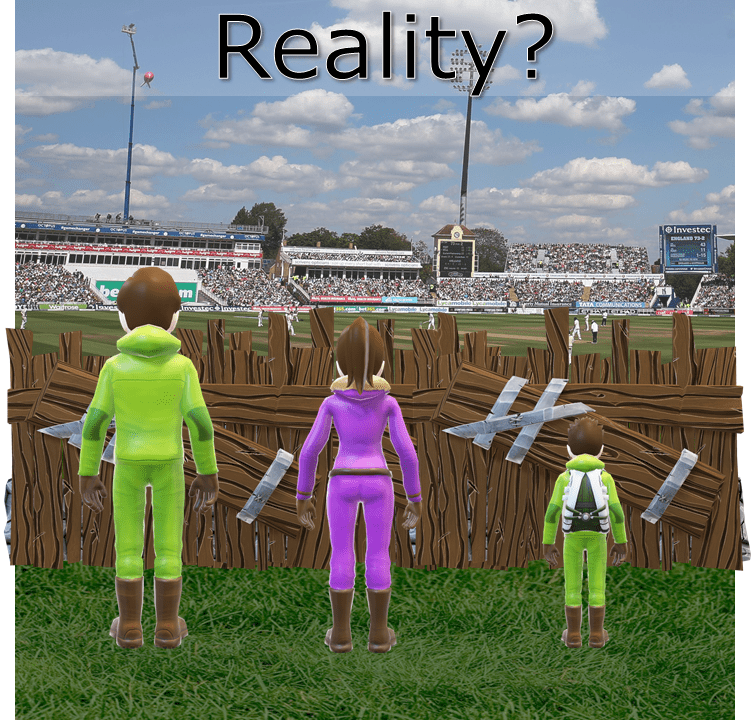
The meme renders something like this:
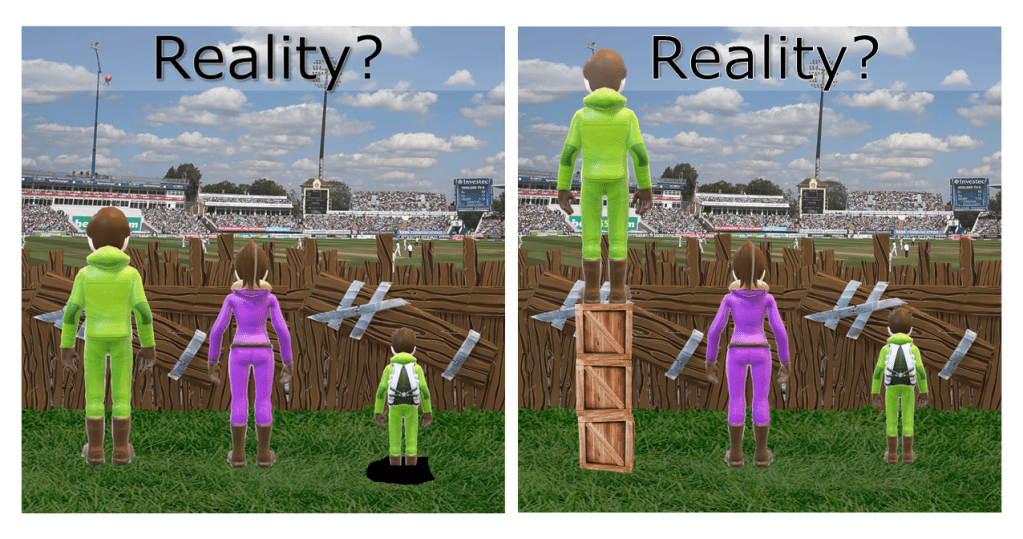
There are two frames being compared—equality and equity. In both, we see three people trying to view an event, but a barrier obstructs their view. The people are of different heights—tall, medium, and short—, metaphorically representing some intitial social status.
In one we see a representation of equality. In the spirit of equality, each person has one crate upon which to stand. This represents equality of condition. Each person is ensured to start the game on equal social footing. At a glance, it’s easy to discern that this intervention allows two of the people to see the event but leaves one of the three at a disadvantage and unable to view.
In the other, we see a representation of equity. In this frame, we see the same three people and a redistribution of the three crates. Equity is more in tune with equality of opportunity if not of outcomes. The taller person who had been standing on a crate had no need for it as he was tall enough to see over the barrier without it. The mid-size person, who could see the event with the crate but not without it, retained the crate. The shortest person was given the crate from the tallest person, now standing on a stack of two. The result is that each of the three people can now view the event unimpeded.
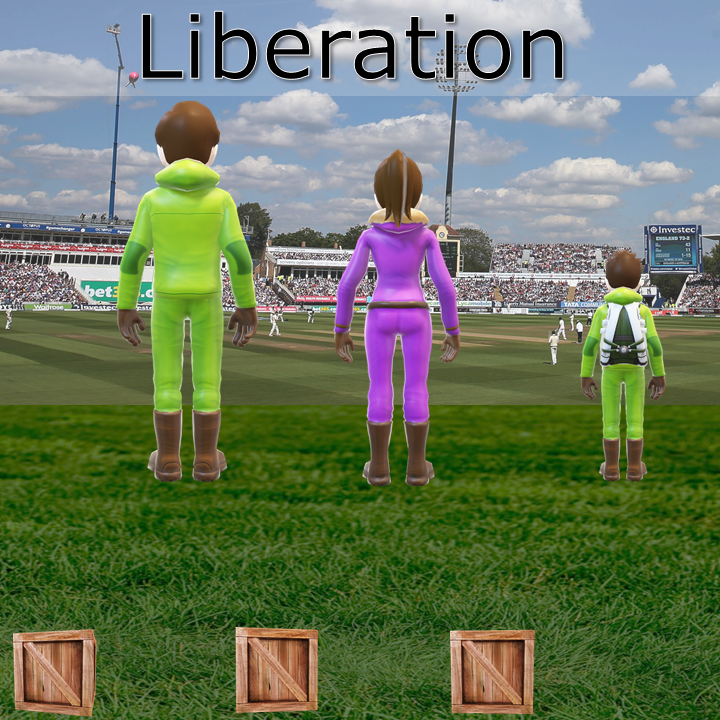
This comparison is such a nice conversation starter. It’s a hot button topic for some—and I’ll get to that presently. For me, it illustrates the concept of framing. There are several things left out of frame—at least one literally. In this meme, we are given a binary frame, but we can pull the shot back and there’s a third option: egality. This term has fallen out of favour in English, but the French retain it—égalité. In this frame, there is no need for crates, and the plank barrier is replaced by a chain-link fence.
Social Equality
Yet there’s the matter of metanarrative device. Why should there be any barrier? Why focus on these three in the foreground? Do the seated people represent the haves and those standing represent the have-nots? Might we interpret this as bourgeois versus proletariat with the focus on the struggle between the prols distracting from the broader issue? —being further distracted by the circus event? Have we lost the forest for the trees?
As it happens, people along the way have inserted their own social commentary through like-memes. I’ve similarly reconstructed these.
Societal Common Ground
In the beginning there are no crates. They are simply a device. At the start, only the tallest person can see over the barrier. At some point three crates appear ex nihilo and each person obtains one as depicted in the equality of condition frame, which leaves one of our participants better off and the other in no different of a social status, though a bit off the ground in the event of flash flooding. Small wins.
Past Burdens and Generational Wealth Transfer
Some shared the opinion that at least we all start on common ground, and yet others—likely Left- or Liberal-leaning—propose that some people start in a hole. Others might have noted that whilst some start out in a hole others start out with inherited boxes—or houses or networks—showcasing the transfer of generational wealth . Another might be able to view if there was a crate available. Given the negative starting place, the third would likely require three boxes to be on par to view, so even a redistribution of the three boxes would be insufficient.
For my first diversion, I’d like to spend a few moments defending a common response for the Right and Libertarians. Firstly, no one who supports this level-setting is suggesting that the advantaged be put into a hole like the disadvantaged. Nor is anyone asking for The Prince and the Pauper treatment where they trade places. This is a silly attempt at a strawman attack. Secondly, in a similar vein, no one is asking for the best off to relinquish everything and now be unable to see whilst the meek inherit the earth. As if that could ever happen.
Some people were overly optimistic—presumably representing the ‘if some is good, more must be better’ contingent. Why don’t we give everyone two boxes? Aside from the fact that only three are necessary for everyone to view the event, there was no mention where the original three crates came from let alone these additional three. I suppose they might have fashioned them from the fence. Who knows? But this leads us into contributions from the advocates of Capitalism.
Capitalism: Libertarian Vantage
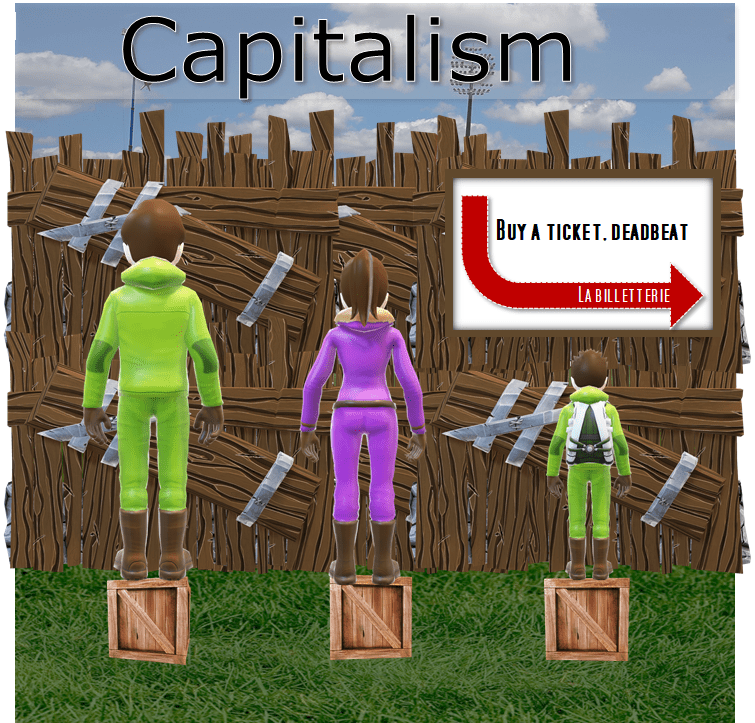
Let’s chalk this up to the Right can’t meme syndrome. To this cohort, Capitalism is the solution. In fact, there will be more crates than one could possibly use. A rising tide rises all boats—and crates. None are left behind. In fact, this is what Capitalism is known for. Of course, this suffers from several cognitive biases: survivorship, selection and availability. But who’s really counting?
For this less fond of Capitalism, this illustrates excess and waste. We needed three crates, yet we produce over thirty. Moreover, these less-fond likely also notice a capital distribution challenge with Capitalism.
Capitalism: Democratic Vantage
The prevailing view by one cohort is that some of the excess crates ‘owned’ by the tallest person should be redistributed whilst the polar perspective holds that this person ‘earned’ those crates and is entitles to keep them. And why can’t that woman just hold her child so he can see? Don’t get me started.
Capitalism for Sale
You really do have to love Capitalists. The solution is always ‘you just have to pay for it. Duh’. Without going too far off track, many of these people—likely vastly most of them—can’t afford what they want, yet they stand by this mechanism.
Socialism Kills
Some people who despise Socialism have a rather macabre perspective on how socialism operates. To them, equality can only be acheived via some Harrison Bergeron mechanism—primarily because they choose not to distinguish between social and physical equality. And maybe they are simply sadistic and enjoy watching people suffer.
My personal favourite is the one for liberation.
Liberation is Liberating
We don’t need no fences. No barriers. No boundaries. Sit on the boxes. Fill them with food for the hungry.
But in the end, if all you are fighting for is free access to cricket matches and other circus events, you aren’t really liberated anyway. You are the slave that Rousseau wrote about, ‘Man is born free but everywhere is in chains’.
Disclaimer: For the record, I have been using the term, Capitalism idiomatically equivalent to a market economy because Americans just don’t want to separate them. I think they feel that if they can pretend they are the same, that criticising Capitalism would be tantamount to criticising market economics. This is wrong on so many levels, but, at least in North America, the terms are inextricable. The fact that Capitalism is a means of production, and the other is a distribution mechanism, people—from syndicalists and worker coöperatives to Mercantilists, tradesmen, and craft-workers—could choose to distribute goods and services through a market system without consequence. It’s not even worth expending a breath. Even English dictionaries have given up and conflated the concepts. Economic textbooks are the last bastion of academic sanity.
« Democracy is the worst form of government – except for all the others that have been tried. »
— Winston Churchill
Those of us in the West defending Capital-D Democracy with passion know this quote by Winston Churchill. We accept the inherent frailties in the system of Democracy because at least we get to participate. The sentiment generally follows a path of (1) it’s not perfect, but it’s the best we have, and (2) if we could have a benevolent dictator, things would be so much easier to tidy up around the edges—only we can’t trust the succession of the benevolent dictator; (3) a Republic is Democracy levelled up. This solves many of the weaknesses of Democracy. Plato said that Socrates said so. So it must be true. Always trust men in togas.
Let’s unwind this ball of twine. Taking the quote in context, Churchill had just been voted out as Prime Minister so he was feeling a bit of a sting of democracy in action. He was being conciliatory whilst attempting to euphemise his sour grapes sentiment.
At a casino, the odds are stacked against you. As with casinos, you can raise your fist and rail at the casino for not making you better off exiting the system than when you entered it, but everyone will tell you that you should have known better. Some will encourage you with ‘Better luck next time’. Casinos and Democracy alike, if you are relying on luck for positive outcomes, you may need to consider taking another look.
At the start, Democracy is untenable even in a classroom textbook context with no frictions. At any scale, it can’t yield optimal results. What this means is that even if Democracy was operated with the precision of dispassionate AI logic, it would still be suboptimal. By extension, this means that outcomes move from suboptimal to less than mediocre when we add humans and emotions to the equation. On top of all this, what it is that we are optimising compounds these challenges. Coming to accord here is paramount. In American baseball lets consider this to be strike three.
So what about this proverbial benevolent dictator. This actually adds nothing to the equation. If the ideas of the dictator happen to align with everything our hearts desire as individuals, it does nothing to the dissenters. They are left in the same position, which is to say disenfranchised—effectively outvoted. If we are the dissenters, thus we are disenfranchised. Not that we will have been enfranchised in any case, but our desires will remain as unmanifest as if we had lost the vote.
A Republican construction, not the trademark, circle-R, Republicans, who are the Tories of the United States of America. Let Freedom ring, and don’t tread on me Republicans. These follow the Platonic franchise. This Republican construction merely kicks the tin up the alley. We’ve got fewer voters with the same suboptimal outcomes, but now we’ve exacerbated it with principle-agency problems. Not only might one’s vote not be heard, but this agent may have secured office on the promise of delivering our wants only to take the ball and run with it in another direction. Off the playground. No universal healthcare for you lot. Yoink!
In the end, Democracy offers nothing but hope. Pandora’s box hope and empty promises. It’s a specious proposition of smoke and mirrors. And to be honest it’s more smoke than mirrors. Echoing the words of a wise poet, and the feeling that it’s all a lot of oysters, but no pearls.
So, wait. What do I mean by mathematically untenable? Kenneth Arrow demonstrated that no voting systems, whether in theory or in practice, will yield optimal results. Again, this is before humans are introduced into the equation. No form, whether all or nothing, instant run-off, proportional, ranked, and so on. There’s simply no way. With as few as 3 voters and 3 initiatives, voting fails. Add voters and initiatives and it fails harder. Add human voters and it fails miserably. Many of us rail at the candidates and aspects of the system such as disenfranchisement and gerrymandering, but it had already failed prior to this. We’ve been sold a bill of goods, and the contents are rotten.
In closing, my point is that Democracy is over-sold. It’s hype appealing to emotion. We’ve got illusions of self and personal agency intertwined with illusions of control. And it is used to lull people into believing they have an impact. Instead, they complain when things don’t quite work out. A near-perfect analogy is railing at the casino when you don’t get the payout you had expected. Or that lottery ticket. It’s not that Democracy is a bad system. It’s just not all it’s cracked up to be.
And it’s not like you are being over-billed and getting ninety-nine per cent of what you bargained for. You are more likely getting less than half, and the rest is filler. You are paying for filet mignon, and you are getting bologna. You’d not accept that outcome at a restaurant, yet with Democracy, the best one can defend is that it’s imperfect.
And do politicians exploit these at every opportunity? No, as hard as they try, they miss some opportunities to exploit, but they are yet another nail in the coffin of the dream of democracy.
Whilst Popper is correct in saying that you may (seemingly) resolve conflicts if you ignore definition alignment and go with a subjective approach. Just assume you are talking about the same thing and find accord. This is problematic because once instantiated, it will be realised that there was no common centre, and so the next round commences.
In some ways this comports with my language insufficiency postion—these terms are undefinable, so waiting for full agreement will require an infinite amount of time—, but pretending that one can ignore this step is fool’s play.
One approach might be to atomise a concept such as justice, thereby attempting to resolve a portion, but I’ll posit that this atomic approach will yield protons, neutron, electron, and then quarks and subatomic particles and quantum strangeness, so all we’ve managed is to kick the can down the road.
The best this attempt at a pragmatic approach yields is a pregnant pause, but it won’t remain resolved. It’s easy to blame the instability on the dynamism of society—and this does likely exascerbate the issue—, but this issue is inherently unstable at the start. Like an isotope, it’s just ready for any disturbance.
So this happened. I was working on a video response to a video on the Incoherence of Subjective Morality when I got distracted by the general concept of objective morality. And this video was the result.
I thought that this would be a short detour, but it wasn’t for a few reasons. First, it just wasn’t. Second, it takes a long time to composit even the simplest of digital image assets. Third, it takes a long time to scrounge around the internet for image and video assets. Fourth, creating videos takes longer when you aren’t set up to create them. Fifth, when your project file get corrupted 80 per cent of the way through. Sixth, when you realise that 80 per cent complete was really 60 percent complete. And seventh, when you take the opportunity to start over to upgrade your video editing software only to realise that the vendor has made substantial changes to the interface—some for the better, some for the worse.
For those preferring to read, here’s the source script.
What is objective morality? In this segment, I outline the challenges with the claim of objective morality, primarily through the lens of a subjective moralist.
In the simplest terms, objective morality is the belief that morality is universal, that it’s not up for interpretation. So let’s start there by framing the concept.
Let’s agree that there is some objective morality out there, beyond subjective experience. Following the Biblical account of Genesis. God created the earth from the void, and somewhere in these seven days, objective morality was created. Time, which was also created, presumably at the start of this endeavour, passed, until such time that humans were objectively subjected to this morality waiting in the wings. I suppose that this objective morality might have been created when God imparted the decalogue to Moses. Who’s to say. It feels like morality is bigger than the Ten Commandments, which, for the record, feels more like a highlight real. For our purposes, this objective moral code existed prior to our existence, and we are bound by it. Let’s continue.
This thing existed.
Let’s call this thing morality.
Because it exists independent of observers or subjects, we can further consider it to be objective. We’ve got objective morality. I think we are on to something.
And then god created the heavens and earth. I’m not sure where He was living before that time or why He felt it necessary to establish this. But reasons. Whatever. Let’s march onward, Christian soldiers.
Finally, the part we’ve all been waiting for. Humans. That’s us! Adam, Eve, Cain, Abel, begetting and begotten. Wandering and wondering, pandering and pondering, we discover morality. Cain oft Abel, giving us evidence that this morality thing predated Moses on the mount. See how that works?
Let’s rewind a bit, and check out this objective morality thing. We’ve got morality springing from the void. It had to have even predated the heavens and the earth. Before the light. Before the first dawn. I’m not sure this is important to our narrative, so let’s ignore the actual when.
Eventually, there were humans that needed to adhere to this code. Non-humans are not required to abide by this code. But don’t be that dog who attacks a human, because you’ll be taken down as sure as you were subject to this code.
These wandering wondering humans were just chillin in the Garden, and someone ate an apple, a forbidden fruit. Thee forbidden fruit. No names. We all know the story. No reason to linger. Time to let bygones be bygones and leave the past in the past. Obviously, someone should have known about this objective morality. Shaking my head.
There it was. Apples. Figleaves. Objective morality. Apples, bad. Serpents, evil. We’ve got it all sussed out. Or do we. At this point we’ve got all that is, and then what is bad. Or evil. Take your pick. I’m not wholly sure I’ve got the distinction. Love the sinner. Hate the sin. Now I’m just confused. Time to leave this behind. No need to dawdle.
Humans are sensate beings. We sense things with perception. We perceive things. Generally speaking, we consider humans to have five senses. sight, sound, smell, touch, and taste. To simplify the narrative, I’ll employ sight as a stand-in for all sense-perceptions.
The narrative goes like this: a thing we call morality exists objectively in the world, and then we discover it. Like a tree or a tiger, we perceive it. As said, our eyes are sense organs. They act as lenses. Light reflects off objects and our eyes collect this light, via rods and cones, but that’s TMI. The vertically inverted image is cast on our retina. But wait. There’s more.
Eyes are sense organs, but they don’t actually perceive anything. I hope I didn’t lead you astray. Eyes connect to a brain via an optic nerve. The brain translates sense-perceptions, and this is how we make sense of the world.
Now, back in the day, there was a cat named Descartes. He was meditating on how he could know if he existed. In doing so, he determined that if he was thinking that he was here to do the thinking, that at least he existed.
His thought experiment went along these lines.
He acknowledged that he perceived via input through sense organs.
Eyes, for seeing—scale, shape, contrast, and colour.
Ears, for hearing—amplitude, pitch.
Nose, for smelling. He had a large nose.
Tongue, for alimentary tasting. Sweet, sour, salty, bitter, and umami.
And skin. Fingers, toes, and so on, for touching. Smooth, rough, and so on.
Humans don’t get senses for echolocation like bats and cetaceans , electroreception like sharks, magnetoreception like migratory birds, infrared vision like snakes or ultraviolet vision like some birds.
Descartes reflected on his sense organs and commenced enumerating sensory processing disorders.
He recognised that the eyes were fallible. Among animals, visual acuity is fairly mediocre. Eagles can see more clearly at twice the distance than humans. Beyond this, the eyes or visual perception could be tricked by hallucinations. Magicians routinely fool the eyes with legerdemain. Humans perceive a series of still frames as moving, whence motion pictures. We don’t have to mention dreams and chemically-induced visual perception challenges. It seemed real enough. Right? Had Descartes have the Internet in his day, he may have had an opinion on the blue versus gold dress debate.
The ears are fallible as well. We can’t hear sounds as low as elephants and ferrets or as high as bats, dogs, and whales. I’m not sure if he’d even consider the Yanni and Laurel debate.
Aside from anosmia and hyposmia, respectively the inability and diminished ability to smell, olfactory perception has as many challenges as sight and sound. Interestingly enough, smell and taste are tightly linked, so a problem with smelling can affect taste.
Speaking of taste. Like the nose, the tongue can experience similar deficits as ageusia or hypogeusia, the inability and diminished ability to taste . Dysgeusia, which is where a person’s taste senses to be confused, is estimated to occur in about 15 percent of the population, but few people actually seek treatment. Still, Descartes accounted for its fallibility.
Finally, we’ve got the sense of touch. Yet again, we’ve got phantom limb sensations for amputees, and many other somatosensory disorders. We all likely know the pins and needles feeling when our leg ‘falls asleep’, and as we get older neuropathic sensations and discomfort becomes more probable.
Descartes didn’t even mention synesthesia, where auditory cues are processed and interpreted as visual information, so musical tones might have taste; sounds and shapes have colour, and so on. Even so, Descartes came to the realisation that our senses are crap. And don’t get him started on challenges with other cognitive functions or memory degradation. Now where were we?
Right. To throw a spanner in the works, morality isn’t actually a thing. It’s an abstract concept. But, that’s not fair. That’s from a subjectivist’s point of view. Not to put words into the mouths of a moral objectivist, but I’ll suggest that, rather than label it as an abstract concept, they might be more comfortable referring to it as something outside of the material realm. Not to be snide, but that’s a typical fallback. If you want to refer to something otherwise unreferenceable, just make a claim that it is outside of the material sense-perception realm.
The challenge for an objectivist, now, is to reconcile how this non-material sense-perception content is perceived. For the subjectivist, it’s simple. It’s a culturally transmitted social construction. But this isn’t about subjectivists, so let’s forge on.
The claim of objective morality isn’t merely a conceptual claim. It’s a truth claim. It wouldn’t be meaningful to make an argument for objective morality if it weren’t a claim about the truth of an objective morality.
Here, we have a challenge. There is some objective morality out there. Following the logic, it doesn’t exist in the material world, so we have multiple subjects, with all of the inherent sensory processing fallibilities. As with the blue and gold dress or the Yanni-Laurel debate, how do we mediate this truth? Who is the arbiter of Truth? Let’s consider another couple examples.
Whether morality is subjective or not, perception is. There is no way to determine if you and I perceive anything the same way.
Colour is experiential. Besides this point that different cultures and languages name colours differently. I don’t mean that the colour of this cylinder is red in English, rouge in French, and roho in Spanish. In essence, colours are the categorisation of the visual spectrum, arbitrarily dividing the spectrum in ranges. These colour ranges don’t align perfectly. Some languages don’t have colour names for colours that otherwise exist, and some languages derive colour names by attributes not based on frequencies. Some cultures have no colour names. Moreover, what Newton referred to as blue in his colours of the rainbow, we now consider to be cyan, so colour names can drift. I could produce an entire series on colour and perception, so I’ll stop here and share some anecdotes.
Aside from this inconvenience, I’ll convey a personal story. I had a mate who had a colour perception disorder. What I saw as the colour red, he perceived as mustard.
What I perceived as mustard. A colour in the dark yellow portion of the spectrum, known in English as flax, or mustard-colour by the uninitiated, he also considered to be mustard. Check out this cool mustard car.
To put a bit of a spin on it, he perceived the condiments, mustard and ketchup, as the same colour. In a dish, he couldn’t tell the difference without smelling or tasting.
Another mate of mine had a visual disorder. Although he could see, he was legally blind. Also. His eyes functioned perfectly. They would have made a nice organ donor gift. His disorder was caused by a deteriorated optic nerve due to medical malpractice at birth. He also has anosmia and ageusia, but I’ll share his optical challenges.
His disorder resulted in, firstly, his visual perception reduced everything to a 20 percent scale. Think of it as what the world would look like if you viewed in through the wrong end of a telescope. He would perceive a 182 centimetre person as about 35 centimetres, a 5-foot person would appear as 1-foot-tall to him.
Related to this disorder, he had no depth perception. This made perambulation particularly difficult. Practically speaking, he can’t distinguish between a line on a sidewalk and a step, and vice versa. Subjective perception.
But these people are not normal in this regard. Their perception is atypical. I admit that this is true. Let’s continue.
I’ve rendered a red cylinder on the screen. The red I perceive is the red I always perceive as red.
Perhaps you perceive the red cylinder as this. I can’t know how you see red, or blue, or chartreuse, or flax. And vice versa.
You might defend that the colours evoke some emotional response. Red represents fire and passion. Blue is calm and cool.
The problem is that these emotions are just attached to the colour attribute. That firetruck is always red to you, and the ocean and sky are always blue. But it doesn’t have to match mine or anyone else’s rendition.
Where were we? Oh yeah. Perception is Subjective. Let’s take the popular example of the blind men and the elephant. Like objective morality, let’s consider this to be a conceptual elephant and not a physical, material elephant.
I suppose an objectivist might argue that the objective morality is perceived at once and for all, interpreted perfectly, but I’m going to push back with the defence that there is no evidence that it even exists in the first place. To stretch this to being fully grasped in one fell swoop, feels a bit much. This said, I’ll continue as if this objective morality exists, but I am going to entertain that one might suss out what it is through the experience of trial and error, which feels like it might parallel how we or other animals, figured out which plants and berries were edible. Sorry Grog. Rest in Peace.
In this scenario, the elephant is a metaphor for objective morality. These blind persons have never encountered or imagined an elephant to date, so they’ve got no experience. One blind person feels the trunk and perceives it as a snake whilst the other perceives the tail as a rope. I supposed these guys could taste or smell the elephant for a better assessment. Or walk around the elephant, feeling different aspects. But this didn’t happen. They never experienced this elephant holistically.
In the extended director’s cut, there are more blind people, each with restricted experience. Even if they are communicating amongst each other, it’s still a guessing game. And even if they create a sort of map to the terrain of this previously uncharted elephant territory. They have some aggregated collection of facts, a bunch of object nomenclature, yet they likely remain in the dark as to its purpose. Elephants have no moral truth value.
Let’s take some time to look at maps and terrains by example.
Rene Magritte created a famous postmodern painting, La trahison des images, The Treachery of Images. There is a representation of a smoking pipe. Written under the image are the words forming the sentence, Ceci, n’est pas une pipe. This is not a pipe.
Upon reflection, it’s almost immediately apparent that Magritte is letting his viewing audience into a secret. This is not a pipe because it is a picture of a pipe. This is a map, not the terrain, which is the object named pipe.
In The Matrix, the Wachowskis rendered a scene where the adept boy informs Neo, the protagonist and proto-saviour, that there is no spoon. Neo perceives the spoon, but it doesn’t exist. In fact, the Matrix is an immaterial world. Everything is a figment. This is not the simulacrum of Baudrillard, but it is a simulation. This is not a map and terrain problem so much as the map has replaced a terrain that has never existed in the first place.
Now we go from Ceci, n’est pas une pipe to Ceci, n’est pas un éléphant. This argument is not following Magritte’s claim that it’s a representation of the object, and it’s not pursuing the Wachowskis’ line of logic, that it is somehow simulated. This reasoning is more along the path of Saussure. It’s merely a reference to the object itself, which Saussure deems a sign.
If we accept that anything exists in the world, this object exists in it, but is it an elephant or un éléphant. This object is a sign, an icon. We can assign this sign a nominative reference, and we can assign it all sorts of attributes,— scale, mass, colour, and composition, such as those discovered by the blind people. We can describe physiology and behaviour patterns, create lineages and hierarches. We can even categorise and differentiate these things. In fact, one major functional purpose of language is precisely differentiation. And we can classify all elephants into a bin and then sort them into Indian and African varieties. We can construct a concept such as time and then again a sub-concept such as age. And we can generalise these.
We can group in any number of ways. Elephants is one way. Large mammals is another, to liken them to whales or plesiosaurs. Or as land mammals, we can relate them to mice and men. Grey things liken them to my favourite jumper or pavement. Tusked animals sorts them with walruses and boars. Quadrupeds with horses, with whom they share lineage and DNA, as do their whale brethren. Sistren?
What we perceive as an elephant is a signifier, a symbol. Elephants only exist conceptually. Any description has been assigned to it. We can assign it a name with spoken or written words. Me Tarzan. You elephant. We can render a likeness through photography, by other art media. We can even represent it as a shadow puppet or by other reference, such as mimicking their telltale trumpeting sound or reproducing it onomatopoeically.
It’s important to note that a sign is only a sign if it is recognised as a sign. Conversely, I can create any number of meaningless, orphaned signifiers.
Finally, we have the signified. If the signifier is denotative, the signified is connotative. What is evoked when you see or hear a signified. For elephants, I envisage Hannibal crossing the Alps. I think of nurturing animals, who never forget, who will exact revenge, and who are afraid of mice. I also think of Dumbo and Jiminy Cricket. And, of course, the colour grey, poaching, circuses and zoos, and the attributes they’re known for having, a trunk, tusks, large floppy ears, and the rest.
Let’s return to see how this works for the notion of objective morality.
We’re back with our two subjects observing some object. Only they aren’t observing anything. They are moderating a concept. If our two subjects have the same, let’s call it an opinion, on the Truth of the matter, we are in a relatively good place. But only relatively speaking.
The problem is that just because two people agree on something, doesn’t make it so. Just because a million or two-million people or even seven-billion people agree on something, it doesn’t make it true. There was a time when most people thought that slavery was a good idea. Even the Bible was cool with slavery, but let’s not stray into theological territory.
Objectivists have a solution for this dilemma. It’s the single source of Truth we started with. The one that not only predates humans, it likely pre-dates dates. Take that subjectivists.
Wait. What’s that. My producer is telling me I’ve still got a problem. Let’s see if I can work this through.
Our subjects are stuck in their own perspective, but there is a True Truth to be found. It’s just immaterial. Without exception. everyone is subject to the limitations noted by Descartes. Everyone is fallible. ahem. Apologies to the Pope.
I guess I can’t escape a theological account. Let’s see how that might play out. Let’s rewind back to before time, before it all began. Just the void. And God.
We’ve seen this already. God creates this objective reality. Time passes. More time passes.
Christ. God hasn’t yet created time.
Now time passes, and more time passes.
Our subjects appear. Bicker a bit about morality.
God appears to one of them. In a vision, I suppose. Perhaps it was someone else. In any case, the voice in the visions tells the visionary, ‘This is the moral code. Remember it. You’re not gonna forget it in the morning. For My sake. Write it down. Here. I’ll write it down.’
Stone tablet and all. 3-D printed in stone. Very edgy. ‘Now go tell your friends, Romans, and countrymen.’
‘Romans?’ you ask yourself.
God sniggers to himself thinking, ‘Oh, just you wait’.
Later. This smug visionary waits for the opportunity.
‘The way I see it…’
Bam! Right. ‘The way you see it. Mate, listen. It’s not about you. I’ve got the inside scoop. No reason to argue. I heard it straight from the horse’s mouth.’
‘Talking horses?’, your mate scoffs incredulously.
‘It’s a saying. I just made it up.’
‘Right. Cuz, I’ve never even heard of horses.’
‘Yeah, well. These are the rules. I’m calling it a code. And it’s not what you said.’
‘Wot?’
‘It’s what I was saying all along.’
‘That’s bollocks, mate. And you know it.’
‘Nope. I had a dream. It’s all true. And it’s all written down.’
‘You can’t write.’
‘Didn’t have to. Geezer in the dream did it for me.’
‘But you can’t read. No one can. Writing hasn’t even been invented yet.’
‘Then I suppose we can start with this.’
‘With wot?’
‘This stone tablet. It was just here. Well anyway, I remember what it said is all that matters.’
And so it goes.
All we’ve done is kicked the tin into the long grass. We’ve shifted focus from one incorporeal object to another. Introducing God into the equation did nothing to promote objectivity, if only because any God experience is just as subjective and just as unverifiable. It’s a veritable chain of evidence problem.
To add insult to injury, we’ve got some other blokes a few blocks down claiming that their god laid down some different laws. And it has to be true because the entire neighbourhood is in agreement.
And so it goes. Even if there were an objective moral truth, it is inaccessible, so the argument over its speculative existence it pointless. The defence that it’s immaterial doesn’t help the objectivists cause. This is akin to the parent telling the insubordinate child, because I said so.’ That doesn’t advance the argument or get us very far.
One final point. I know, right?
As Nietzsche pointed out. In a world with no objective morality, it will be difficult to maintain order. But just because it’s easier to control populations when they perceive a single unadulterated source of order and power, it doesn’t follow that it exists. As I illustrate in another video on moral subjectivism, you may have run out of petrol and are stranded in the desert, but it doesn’t follow that your inconvenience can conjure this need into petrol in the material world. You are just as stranded. Just because you can imagine a solution on an imaginary plane doesn’t mean it’s real or has any impact on the material world. Just as you can imagine throwing the winning hail Mary touchdown with seconds remaining in the Superbowl to bring your underdog ragtag bunch of misfits, a come from behind victory, you shouldn’t be surprised to discover it yields you nothing in this material world, for I am just a material girl.
Much of jurisprudence is based on logic founded on faulty premises of regurgitated theological concepts shrouded in naturalistic theory and pseudoscience. This is not about the defund the police social trend of 2020. This is to say that the justice system is smoke and mirrors writ large. It’s ostensibly built on anachronistic concepts such as volition, evil, soul, blame, and forgiveness that should be tossed into the dustbin of history along with phrenology, humours, and will.
The titleof this post is taken from Robert Spapolsky’s proposed chapter concept for Behave, published in 2017, where until now, it’s languished on my Want to Read list, having entered via the vector of my interest in behavioural economics. Chapter 16 was eventually published with the title of Biology, the Criminal Justice System, and (Oh, Why Not?) Free Will.
I’ve been writing for years about the nonesensical attachment to these notions, so it gives me comfort in solidarity to discover others who share, at least to some degree my perspective, knowing, of course, that this doesn’t make this perspective any more correct.
To be fair, I’ve held a low opinion of so-called justice (and government) systems pretty much since I was taught about them almost 50 years ago. In the US, much teaching is really propagandising about how fair these systems are and how peers and reasonable persons concepts make is superior. In my mind, those were the being failings. Later, when I hopped onto my language insufficiency bandwagon, it only fell apart more. Kafka’s The Trial represents the internal workings of most justice systems than the logic and reason of propogated but proponants.
Stopping here. Much to do. I recommend reading Behave. If you’ve read it, I’d love to see what you thought about it.
This is why I dedicate time to watching YouTube. Although this essay was published in 2007, I had not been aware of it or its author. This work and David Guignion’s presentation is an excellent reminder of the relevance and intersection between feminism and post-modern perspectives. In the West, at least in North America, we often hear the term ‘privileged’, and many of us defend that we don’t feel very privileged. Sunera Thobani shows us how we are complicit in exacerbating world problems, particularly reminding us that not all women are ‘Western women’, and not all women need to be rescued by the West. Moreover, even women who identify with the West as a privileged or modern lens do a disservice to women who don’t hold this worldview.
Don’t let David, a male who is delivering the message, be a distraction. It feels like he is authentically trying to represent Thobani’s perspective. I provide a link to Thobani’s original article if you’d rather just read the unfiltered source.
As I wrote earlier, free will is a vestige of bygone days—an anachronism. Even though though I’ve got a very low opinion of psychology as a discipline, if we introduce behaviourism into the equation, we can see how little agency a person really has.
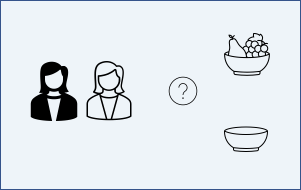
Mary’s parents have fed her porridge for breakfast her entire life. She loves porridge.
When Mary is away, she freely chooses porridge.
Even as she ages, she chooses porridge.
One day, she is dating someone who she knows prefers fruit to porridge, so Mary chooses fruit instead.
Is this free will? At first, Mary is conditioned to eat porridge, and she develops a preference for it. Given choice, she chooses porridge. But is this a choice? Yes, she can break the cycle and choose something else. Still is that her choiced, or an act of rebellion against her upbringing?
When dating, she chooses fruit—perhaps even going against her own preference, her preference to make a good impression taking priority.
If we rewind we can see that her parents fed her porridge because that’s what they chose.
Another more charged choice is religion. Most people with a religion share the same religion as their parents. In some cases, they choose a different religion or no religion, but these are minority cases. And some of these instances are to differentiate from their parents, to assert their individuality. But is this a choice, or is this pathology? How can you determine the difference?
Thisis not meant to serve as some exaustive treatment. I am merely jotting down thoughts as I continue to distract myself from higher-value outpout. 😉
Full Disclosure: I consider myself to be a determinist. I looked for something like Dawkins’ spectrum of theistic probability to evaluate where one might be oriented on a scale of free will to determinism to fatalism whilst also considering compatibilism.
Dawkins’ spectrum of theistic probability
Let’s lay some groundwork by establishing some definitions from most constrained to least:
Fatalism : a doctrine that events are fixed in advance so that human beings are powerless to change them
Compatibilism : a doctrine that maintains that determinism is compatible with free will
Determinism : a theory or doctrine that acts of the will, occurrences in nature, or social or psychological phenomena are causally determined by preceding events or natural laws
Freewill : freedom of humans to make choices that are not determined by prior causes or by divine intervention
It seems that freewill and fatalism are bookends with compatibilism attempting to moderate or synthesise freewill and deteminism. But it also seems that one’s selection may be contexual. Ultimately, this argument is fraught with semantic challenges insomuch as some underlying concepts are yet unresolved.
Crash Course Philosophy does provides a nice summary of the challenges in defending even compatibilist positions away from detemininism and even fatalism.
As this video notes, our choices may appear to be free, but it doesn’t take much effort to perform a 5-whys investigation to remove anything but homoeopathic amounts of agency.
Taking a short example, let’s look at the cases of the trial judges mentioned by Sapolsky (Behave) and Kahneman (Noise). Given all of the factors entering into sentences, prior offences, sex or gender of either the defendant or the judge, education, income, and so on, but far the largest factor in determining the length or severity of a sentence was the time between the sentencing and the judge’s last meal—effectively their blood glucose levels.
Some may argue that this is a short interval, but behaviourists would argue that a person now is a culmination of all of their experiences to date. That the decision of the so-called criminal to rob the liquor store (going for the stereotype here) was not the result of low blood sugar. This may be true, but there is still an unbroken chain of confluent events that brought them to that place.
From a culpabilty perspective, even absent true agency, the offender should still be incarcerated or whatever to prevent this behaviour from repeating. Of course, if you believe in rehabilitation, you are necessarily a behaviourist in soem shape or form: the idea is to effectively repattern experience impressions. The other problem is one of probability. That you did X once, are you lilkey to do it again? If not, then there is no further risk to society, as it were. Given the probability of recitivism—and some argue that mass incarceration increases the probability or attempting criminal actions post-release—, is this even an effective deterence? It’s time to get out of the rabbit hole.
From my position, it is impossible to reconcile experience and freewill. The best you can argue is that one is free in the moment—like some strange improv exercise, where you are shown a film that stops abrutly, and you are instructed to act out the remainder of the scene. Is this free, or is this extrapolating on your experience.
Skipping to fatalism, how probable is it that absolutely everything is determined. Reality is just a film we are both in and observing or experiencing, but all of it is already laid down. We are just unawares. Every strange plot twist and early exit was not only already scripted, but it’s already been captured. There is no room for improvisation or flubbed lines. There is no opportunity to go off-script. Even these words are predestined. Even unpublished thoughts were not meant to be published.
There is no way to test this sort of system from inside the system, and there is no way to get a vantage above it, so here we are.
The notion of determinism affords humans some modicum of agency, perhaps akin to one part in a trillion trillions. Practically, we are taking credit for a butterfly effect—and punishing for this degree of freedom. As Sapolsky has noted, most instances of perceived agency are trivial. We can ‘instruct’ finger movement with our brain. Ostensibly, we think: move finger; bend; point; stop. And even so, what was the cause of the thought to move the finger? Was there truly a non-causal event?
Cognotive dissonance ensures that we can’t allow ourselves to be NPCs or automotons. We have to omuch hubris for that. We must have some free will. Some religions say we not only have agency here in this life but that we chose the life to begin with. Even so, we’ve not seen the script in advance; we’ve merely chosen which lessons we want learnt.
So what about compatibilism? Sort of, who cares? Whilst I can define some interstitial state between free will and determinism, it seems that it would not be even tempered or would otherwise skew heavily toward determinism.
What keeps me from being a hard determinist is that I hold out hope for statistics, chaos, and stochasticism. One might argue in return, that these, too, are determined; we just don’t see the underlying connection. And that’s my cognitive cross to bear.
To be fair, it seems that the notion of free will or even compatibilism are secondary, let’s say, reactions to the need for culpability, for moral responsibility. Societies are built upon these notions, as are legal systems. Necessary ingredients to invent are:
‘Individual’
Agency and Volition
Choice, Motivation, and Intent
Responsibilty and Blame
None of these actually exist, so they need to be invented and constructed in order to associate self-control to actions. In fact, we have insanity escape clauses to recognise that there are cases where control is lost, whether temporarily or permanently, or never had in the first place for any number of ‘reasons’. At core, these attributes are necessary to exert power in a society. The next goal is to convince the actors or subjects that these things are ‘real enough’— as the saying goes, ‘good enough for the government’.
Even if we accept these things at face value, the interpretation and processing of these are different animals still. The notion of Will itself is likely speceous or another fabricated notion. Perhaps, I’ll address Will on another day. Probably not, as all of this is distracting me from my language insufficiency work.
When I think about free will, it is foisted on humanity in the same manner as gods and religion. With gods, we have been defending against theism for millennia. The gods fetish and free will are inextricably linked. As with the chicken and egg connundrum, the question is whach came first. Is God a reaction to fee will, or is it the other way around. Did we create free will to allow for responsibility and then fabricate Supreme busy bodies to act as ultimate judges? Or did we create the gods and build out the myth of free will to accommodate punishment of deviant behaviour. Or are these just parallel constructions? Enquiring minds want to know.
Markus Gabriel was brought to my attention, and I immediately thought of Lance at The Dog Walks.
In essence, part of his argument touches on the insufficiency of language, but his key rationale for this claim is anchored arount Kant and set theory. He published a book by the same name on this topic in 2015. This TedX talk is from 2013. I haven’t read it and am unlikely to do so in the near term, but it might be interesting if it expands upon the notion presented here.















 Philosophics