Nontonomy

Being critical of freedom, liberty, and autonomy is likely to make one the subject of scorn and derision. Most people tend to feel these things are self-evident attributes and goals, but they are all simply rhetorical functions. I was reading a passage in Mills’ On Liberty, where he posits

That the only purpose for which power can be rightfully exercised over any member of a civilized community, against his will, is to prevent harm to others. His own good, either physical or moral, is not a sufficient warrant … Over himself, over his body and mind, the individual is sovereign.

On Liberty, John Stuart Mill

It should come as no surprise that I question a position adopted by the Enlightenment Age. These geezers posited that many things were self-evident, but all of this is self-serving magical thinking, and there is no reason to have truck with any of it. These are all normative claims being dressed as positive, non-normative, ones, hoping to skirt scrutiny by employing a position of self-evidence.

I am generally critical of any notions of identity and self from the start, so affixing some attribute of power to it seems just silly.

It seems that I again am distilling this notion to a power equation. As a person, I want to claim power, if anything, over my self however that might be defined. And though, I would like this, too, it is nothing more than some emotional reaction.

Without delving into the depths of autonomy quite yet, on a proverbial desert island—as necessarily the case with any social constructs, where these notions are meaningless without a social context—adding a second person creates friction. Person A seemed to have full autonomy on this island—notwithstanding the other life forms on this island that are somehow never granted autonomy—now has had this autonomy reduced by the presence of Person B.

Firstly, Person A may have claimed this island to be their own. Given this, Person B is infringing on this autonomous decision, having arrived sequentially. Is Person B tresspassing? Does their presence harm Person B, be limiting their autonomy however slightly?

Mills’ concept is one of no harm: one is free to do what one chooses as so long as it doesn’t harm another. Accordingly, it says one is free to harm one’s self—essentially treating the self, the corpus, as personal property. Just as one could damage a piece of personal furniture, one could damage themself. I am not sure if Mills intend this to extend to suicide, but that’s not an important distinction here, so I’ll move on.

Let’s return to Person A on the island—only Person A is a woman and Person B is a fetus. What rights and autonomy does Person B now possess? For some, it has full autonomy; full personhood. Still, Person B is ostensibly trespassing, so does this autonomy even matter if it exists?

If you are Person X and own a house, and I, as Person Y, enter into it, how does this differ from A and B? Can you justify disallowing Person Y from exercising autonomy whilst supporting Person B? I don’t want to make this about abortion, so I’ll keep stop here.

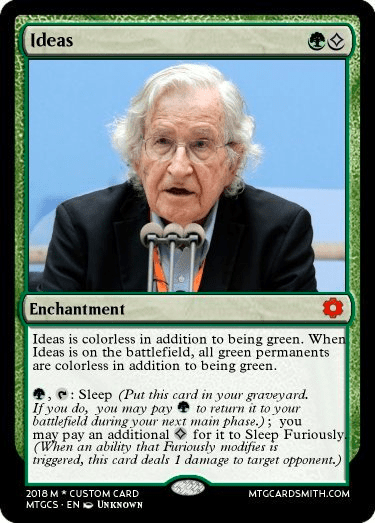
Colourless Green Ideas Sleep Furiously

I was thinking about a story idea, but it seems too daunting to attempt. Call it a mind experiment tethered to solipsism. The conceptual framework is this:

The premise is that ‘reality’ is generated in real-time—except there is no time; there is no space. All of this is constructed. Think of the sort of dream you may have experienced where physics-defying events occur. These dreams don’t care about the continuity of time or space. You can instantly be here and then there irrespective or where here and there are. One may even be in both places at once or nowhere at all. One can transform from one state to another or even be stateless. One doesn’t require an ego or a sense of I; rather, the I may shift without effort or it might dissolve. We are not encumbered by bodies. Vonnegut’s short story Unready to Wear—that for some reason indexed in my recollection as Pas prêts à porter.

In this world, perception is loaded into memory. But unlike a typical video game, the rest of the world is not a telos. It’s rather procedurally generated. In fact, even this is a poor analogy because the generation could be some stochastic process with no need to connect event 0 to event 1.

Empirically, events rely on preceding events. This is the world of cause and effect—a snooker ball collides with another and causes it to fall into a pocket; a stock price rises or falls, but these are not random events as they are inexorably linked to the past. As no one expects an unperturbed ball to jump into a pocket any sooner than one would expect a stock price to be truly random–to jump from 100 to 2 to 999 to 42. But with dreaming, all of this is possible.

Returning to the video game metaphor, what you see in the moment is all that is real. If you look in a particular direction, a table with a lamp and book on it might appear to be situated next to a chair; that registers as reality. But if you look away and then back, none of this needs to remain there. There needn’t be a table or a chair. Or there could be, but they don’t have to be the same table and chair; and there needn’t be a book.

In this reality, the mind—label it as you will—continually reconstructs whatever it wants to, simultaneously—apologies for the temporal terminology, but communication is restricted to the convention of shared meaning—and whatever it generates arrives with a plausible backstory. Given this, any history or relationships are always part of this fiction. Cognitive devices would be active to ensure this backstory appears to have continuity with our sense of the past; rather, it generates this plausible past. This past only has to be plausible in the moment—enough to hold the illusion together.

Consider a nebulous dream. These dreams don’t need to conform to conventions of time and space. But when we occasion to convey these dreams to a journal, a mate, or a therapist, we are forced to fit into a conventional spatiotemporal structure–first, this happened and I was here, and then that happened and I was there. But this was not the reality of the dream. This is subjectively experiential and so cannot be conveyed. In these dreams, there are no rules, but we apply structure that wasn’t really there in the first place; but we interpret time and space linearly and contiguously—even where no such structure exists. I think it would tedious to write and difficult to follow….. Perhaps better suited for an AI author.

To put a finer point on it, I’ll leave with a snippet. Let’s begin with the chair next to a table with a lamp and a book set upon it. You are a nuclear scientist on your way to a job interview at 3:30pm because why not?


A scheduled alarm awakens you. A clock on a bedside table reads 8 a.m. Your focus is on an interview this afternoon at 3:30, so you don the suit you’d set out the night before.

In the kitchen, you decline your partner’s offer of the soup he’s heated for lunch. He routinely eats soup for lunch on Thursdays.

The engine is still making a ticking sound, but you are distracted by the woman fussing with her makeup on the commuter train.

You’ve always preferred to take notes by hand with a fountain pen, having found the mass of the implement to add weight to your ideas.

Your wife, sipping café au lait on the sofa, smiles adoringly at you as you walk through the living room. She’s wearing that azure sweater she bought in Anchorage—or was it Chicago? The telephone rings.

“The captain has asked all passengers to fasten their seatbelts and prepare for a landing. We’ll be arriving at London Heathrow in about 20 minutes.” You close your laptop and acknowledge the flight attendant as she walks past.

You hang up the phone and tell your girlfriend it was a wrong number. You’re not sure that she believes you, but the barking dog distracts you. You don’t prefer to take lunch in public parks. You prefer the beach.

You pay for the trousers and accept the recommendation to purchase a leather belt. You’ve got to get back to your office. There’s not usually traffic at this hour. That’s why you left before 11.

Out of the corner of your eye, you catch a glimpse of your husband. What’s he doing in Sydney? You tell yourself that you must be mistaken and eat the last morsel on your plate, the waiter hovering with the check.

Ten more minutes you tell yourself as you glance at the clock on the wall. Don’t go off you plead with the alarm clock, but the cat walking across the bed tells you that this ten minutes will not be used catching up on sleep.

“Four. Seven minus three is four,” you offer.

“Very good. And what is seven plus three?”

This is your favourite part of Phantom, but you wonder what became of your date. On one hand, he seemed like a nice guy.

“There are only eleven. It says a dozen.”

You continue to read the same paragraph over and again but it doesn’t seem to make sense.

Why is that guy looking at you? He must know that you know that he’s staring.

You are trying to find the heat of the stage light so you can get into the shot. “Line?” you ask.

You lock the door of your hotel room behind you as imagine crashing on the bed in front of you, but you’ve just noticed that you’d forgotten your luggage.


As I just took a stream of consciousness approach save for actively quashing any semblance of contiguity. To be honest, I seriously considered entering snippets into a spreadsheet and then randomising the concepts. Another thought was to approach it like Mad Libs, but I opted for a more organic approach.

In the end, my goal was to dissolve concepts of sex or gender of time and place and of context in general. Looking back, it seems one could create continuity differently. In dreams I’ve experienced, I’ve awakened to discover an element in the environment likely inspired the events in a dream, so perhaps the ticking of the engine could have derived from the ticking of the alarm clock.

My initial goal was not one of continuity, but reading ex post facto, it might need something to keep attention—rather a string to follow out of the labyrinth. On the other hand, that is more of a testament to a need for some narrative.

And so it goes…

Shout out to Nick Bostrom’s essay Are You Living In a Computer Simulation?

Covid Casualties

I’ve got several things on my mind, but they are ostensibly unrelated. I’ll post separately as time allows, but this is a personal story.

My sister has been visiting a dialysis centre three times a week for the past 5 years awaiting a matching kidney donor. She rang me the other day to tell me she was en route to hospital as they had found a donor. Found is probably a poor word choice. Some person had died, rendering the kidney superfluous for all intents and purposes.

My sister was excited to regain some control over her life. She was told that the host of this kidney had been diagnosed with Hepatitis C and was informed of the risks. The official cause of death was Covid—perhaps owing to a compromised immune system. No matter. My sister accepted the risk. It was evening, and the transplant was scheduled for the morning after running some test panels.

That morning, she was devastated by the news that she had tested positive for Covid, so she was no longer a candidate for a transplant. This is a reminder that Covid is not just about the effects of having caught it. She’d go back on the list and wait. Perhaps it wouldn’t take 5 years this next time, though there are no guarantees.

This is not my first experience with Covid. My 20-something-year-old daughter was hospitalised for over a week due to Covid. I’ve had friends and acquaintances get it, but they all survive–long-Covid effects notwithstanding.

I thought I’d written about the death of my last girlfriend who was another Covid casualty of the indirect variety. She died in June 2020. Her plight was sealed by deferring treatment of an infection for fear that hospitalisation would increase the probability of her contracting Coronavirus. This decision turned out to be fatal.

To be fair, there is a lot of information, misinformation, and disinformation abound, and it’s a challenge to sift out the relevant material. And neither is the ambient fear helpful. And so it goes…

Memento Mori

Some art just catches my eye and resonates. Here is an image of a robotic arm. Nothing quite captures the Modern human condition quite so poignantly. This is the plight of Sisyphus but not so pedestrian as Camus’ version. One can’t imagine this one happy. This robot was built intentionally to bleed the hydraulic fluid that is its lifeblood, as it toils to retain that sanguineous fluid. But as with life and humans, the task is futile.

In this shot, we see human spectators watching its eventual demise. Memento Mori. No one gets out alive.

The Instagram copy captures my sentiments pretty well, so I’ll end this here.

Still a Slave

“Wage slavery is not the same as slavery, and this diminishes the experience of plantation slaves in the antebellum Southern US states” is a sentiment I’ve heard repeated over the years.

I’ll argue that it is the same. Saying wage slavery is like when the then-president of the United States, Bill Clinton, denied that oral sex was sex despite it being an obvious part of the name. When one says wage slavery is still slavery, s/he is making a commentary on the lack of agency, a lack of personal control. That the worker has a choice over which master to slave under is hardly a consolation. That a plantation slave has a choice of picking cotton or tobacco is of no consequence.

To disqualify wage slavery as slavery is to disqualify a 3-month pregnant woman as being not as pregnant as a 6-month pregnant woman. One might be closer to term, but they are equally pregnant.

That a plantation slave may have had less freedom and run the risk of physical beatings, torture, or even death is a sad commentary. That they may have separated from their families and have no autonomy is a matter of degree.

The slavery connexion occurs where the human needs to comply. Sure, a wage slave can opt out and live as a transient—ostensibly homeless; perhaps s/he can home-surf. Perhaps s/he can beg or live off the land.

Wage slavery is not the same as slavery

To me, the common missing element is to be able to operate as a functioning society, that as communities, we might contribute however we see fit. Of course, that narrative will quickly provoke an appeal to Tragedy of the Commons. People are selfish and act only in their own self-interests. And this is accepted uncritically as fact rather than evaluating whether this worldview is a consequence of Modernity or Capitalism, whichever nomenclature one has opted to adopt.

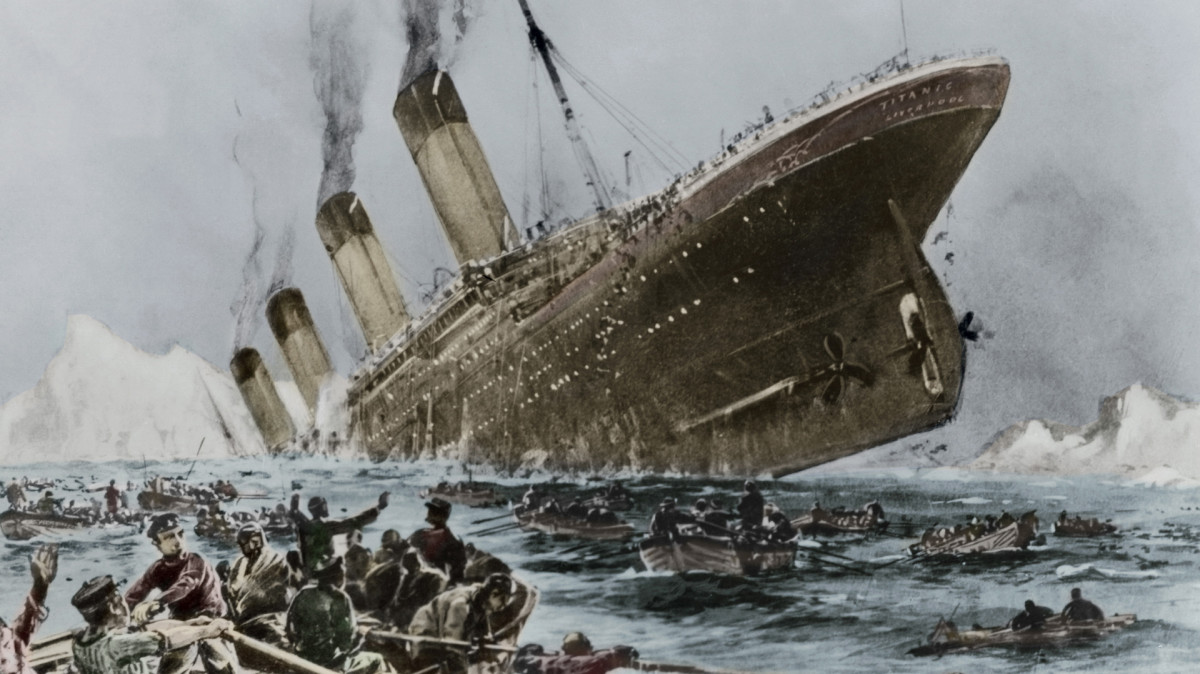
Wage slavery is slavery. Depending on the information source bout 50 per cent of Americans are a paycheque away from needing to deplete savings to survive; some have assessed a single paycheque from homelessness without intervention. One paycheque from poverty. Over two-thirds of Americans have been living paycheque-to-paycheque since the Covid-19 pandemic hit. If this describes you, it likely provides little solace that you are not alone. Who on the Titanic was relieved to know that other people shared their plight? Is there a silver lining for those who are paid fortnightly or monthly? And God forbid the ones whose paycheque arrive daily—perhaps in cash from the till.

Research from the Federal Reserve found that 4 in 10 Americans couldn’t afford a $400 emergency, and 22 per cent say they expect to forgo payments on some of their bills. It’s not much better in the UK, where the runway appears to end at 2.5 months rather than 1, although about two-thirds of renters would expect to make it more than a month.

Slavery, like turtles, all the way down. Just be thankful the worst that can happen is that one starves to death or pursues the life of Valjean. Dissociating wage slavery from plantation slavery is like separating the abbatoire from the butcher’s shop. When you’re the chattel it makes little difference.

Identifying Identity

“Si Dieu n’existait pas, il faudrait l’inventer.”

— Voltaire

God knows that I am not interested in God, but in the quoted sentence, ‘If God did not exist, it would be necessary to invent him‘, Voltaire has established a pattern: If X did not exist, it would be necessary to invent X. Identity is a possible X. Time and now are other possible Xs.

I’ll focus on identity. That identity is a social construct may be technically correct, but so what? My position is that identity doesn’t exist, yet people–including me–identify. We search for identities that don’t exist. What I was when I looked is no longer there. And if someone invents a new attribute of identity, we tend to evaluate how we relate to it. Among other things, cognition is a difference engine.

“The mirror is a worthless invention. The only way to truly see yourself is in the reflection of someone else’s eyes.”

— Voltaire

When the concept of race is brought up—as invalid of a concept as it may be—, we assess how we relate to it. Sex, gender, self—it’s all the same pattern.

I’ve written on race identity in the past. Given it’s a fiction for the human species, it’s a moving target even within the realm of identity, a moving target in its own right. In my estimation, race is a conflation of colour, class, and culture—evidently, the 3Cs. So, although I don’t believe the concept of race is valid for homo sapiens sapiens, I still have a sense of what the users of this term mean. Besides colour, which I feel is the primary attribute, couched in this notion is cultural affinity as proxied by national original, another nonsensical notion.

In my case, I was raised as a WASP. My family background is white, Anglo-Saxon (Norwegian), and Protestant (Northern Baptist), so in the US I am afforded privilege. Were I to play it up, I should be able to parlay this into better jobs, better housing in better neighbourhoods, with access to better networks, and on and on. And even though I don’t play that game, I still accrue some of these benefits. Others I eschew. But I have options. This is the nature of privilege.

I don’t identify as white, nor do I identify as black or brown. This mantle is cast upon me. I can deny the notion, but I am helpless. Just as the black person can’t escape being identified as being black, the white person is similarly chained to their whiteness. In the United States, historically, a white person can deny the attribute of white, but simpletons will still consider them as white. But this is not a disadvantage to overcome. Some might argue that with a shifting colour landscape these days are coming to an end, but they haven’t ended yet, to the chagrin of the white folk who want to continue to ride the wave of privilege. People of colour, on the other hand, likely want to see this wave crash (and burn, if that’s possible).

But I’ve gone off the plantation—or is that reservation? No matter. Identity is nothing more than a connected locus of stateless states. It’s an n-dimensional snapshot of everchanging moments. The relationship between identity and identification might be viewed by analogy as the relationship between sex and gender, both social constructions in their own right. As with sex, identity is assigned. Except in rare cases, one doesn’t have the option of denying their biological sex. As with gender, identification is a space where you can self-assess. It’s just as pointless, but it somehow makes us feel better.

As with Voltaire’s quip, if the Self did not exist, it would be necessary to invent it. And invent, we do. As with objects in physical space, there is more absent than there, but that doesn’t prevent us from imagining it as real and present. In the end, identification is a heuristic that has survived as an evolutionary fitness trait. For what it’s worth, it affords us the capacity to differentiate between friends and enemies, us and them. But it also can be over-indexed and lead to unwanted or at least unexpected results. The question is how much energy should one expend on identity formation and assessment?

Roland Barthes on Rereading

Roland Barthes explains that rereading is difficult because when you reread, you are performing a deeply counter-cultural act. He writes that « the commercial imperatives of our society, oblige us to squander the book, to throw it away on the pretext that it is deflowered, so that we may buy another. »

Barthes writes that « rereading is no longer consumption, but play », and that probably says it best.

The new book you’re looking for is probably already on the shelf – right where you left the old one. « Rereading, an operation contrary to the commercial and ideological habits of our society, which would have us “throw away” the story once it has been consumed (“devoured”), so that we can then move on to another story, buy another book, and which is tolerated only in certain marginal categories of readers (children, old people, and professors), rereading is here suggested at the outset, for it alone saves the text from repetition (those who fail to reread are obliged to read the same story everywhere), multiplies it in its variety and its plurality: rereading draws the text out of its internal chronology (“this happens before or after that”) and recaptures a mythic time (without before or after); it contests the claim which would have us believe that the first reading is a primary, naïve, phenomenal reading which we will only, afterwards, have to “explicate,” to intellectualize (as if there were a beginning of reading, as if everything were not already read: there is no first reading, even if the text is concerned to give us that illusion by several operations of suspense, artifices more spectacular than persuasive); rereading is no longer consumption, but play (that play which is the return of the different) ».
— Roland Barthes, SZ : An Essay, Translated by Richard Miller, Hill and Wang 1974

With few exceptions, I don’t reread entire books. I do refer to complex and favourite passages. My justification is that there is so much I haven’t even touched, so is it better to master once-experienced material over the expansion of material? In defence of rereading, sometimes perspective has changed and additional experiences provide different facets for reflection—and this has happened to me—, but how does one determine the value of retrod paths?

No Better Time Than Now

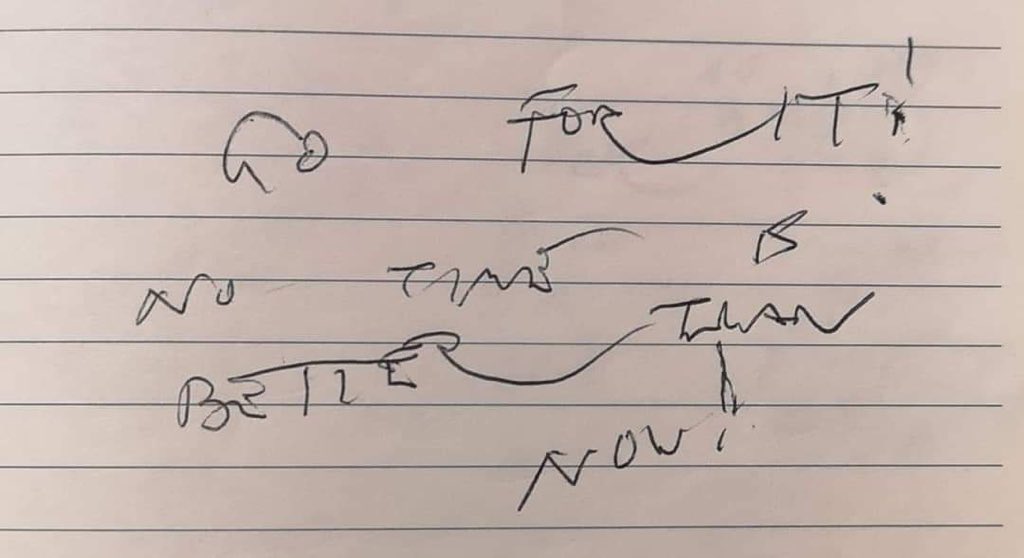
I saw this first on LinkedIn—that Instagram for personal promotion in a sea of vanity and hubris of all flavours—and had been sourced from Twitter, a more free-form universe.

Image

As the narrative went, this was written by a Parkinson’s-afflicted father to his daughter. There are many ways to interpret this. Ostensibly, it’s in line with Nike’s Just Do It tagline of a few decades back or perhaps Joseph Campbell’s advice to follow your bliss, but what is it?

To me, the it involves socially sanctioned activities, whether in commerce or the arts. If the it is robbing banks or shooting fentanyl, perhaps the drive should rather be suppressed. So the do it or go for it operates within boundaries. Nothing new here.

Then there’s the ‘no time is better than now’—exclamation—bit. Why privilege now? Why wouldn’t it have been a better yesterday or last week or tomorrow?

I love quotes—or they pique my interest—if they interest me. But vapid platitudes annoy me to no end. They are beyond being trite. I suppose I can forgive the person who finds solace in this note, but these almost always preach to the choir. They resonate with the daughter—first on an emotional level owing to the familial connection and next to a connection in worldview. I don’t need to point out the connection between worldview and upbringing. Let’s pretend there is no covariance.

Meantime, whatever you’re doing go for it. Just do it. Or not. Take the path on the left. Or the right. Or just sit and meditate. Or turnaround and try something else. But whatever you do, just do it. There’s no better time than now.

Note to Self #2

Hopefully, I get past these self-notes, but for now, I’m busy…

I don’t know if this is a good thing or not, but as I was structuring my thoughts critical to democracy, I discovered (recovered?) a structure I created several years ago. The structure was centred on the premise that democracy is a specious concept that retains life through the illusion of control. My latest concept is that people are just too dumb for democracy—not that it would matter if they weren’t.

I still question why I expend the effort. Who wants to read a piece whose premise is that the reader is likely too stupid to merit participating in a democratic process? Even worse, who wants to read a piece that claims the weakest link in any political process is people. I’m a sad panda.

On the upside, there’s some content crossover. And now I need to settle on a new centre. Please stand by.