I’m busy focusing on the manuscript for Chapter One of my Language Insufficiency Hypothesis. Scanning the copy—over 4,000 words—I noticed some repetition. My eye caught ‘fundamental’, which I use often in speech as well. I decided to try a word cloud to illustrate common words.
As this is a hypothesis on the limitations of language, the fact that these are prominent is no surprise, but 34 instances of ‘fundamental’ seem fundamentally off—see what I did there? And this is only the first chapter of eight.
I’ll review the content to see if I can remove some instances—perhaps entire sentences—or choose a synonym to see where it leads.
The manuscript is in its fourth full revision, and it feels closer to completion. I aim for an early 2025 release date, but time will tell.
Ass usual, I employ AI (Claude, in this case) to do some heavy lifting.
Having analysed the chapter, I’ve identified several places where “fundamental” could be substituted or removed to enhance the linguistic diversity and rhetorical effectiveness of the text. Here are some examples:
“These limitations, we argue, manifest not merely as practical challenges but as fundamental features of how meaning systems operate…”
Alternative: “These limitations, we argue, manifest not merely as practical challenges but as intrinsic features of how meaning systems operate…”
“This theoretical perspective fundamentally reframes several longstanding problems in linguistics and philosophy.”
Alternative: “This theoretical perspective radically reframes several longstanding problems in linguistics and philosophy.”
“These patterns suggest inherent rather than circumstantial constraints – limitations that emerge from language’s structure itself rather than from inadequate definition or imprecise usage.”
Here, “fundamental” could be omitted entirely without losing the core meaning of the sentence.
“Understanding these constraints as systematic features rather than implementation failures provides a crucial theoretical foundation for the Language Insufficiency Hypothesis.”
Alternative: “Understanding these constraints as systematic features rather than implementation failures provides a vital theoretical foundation for the Language Insufficiency Hypothesis.”
“These cognitive constraints manifest not as mere practical impediments but as necessary features of how meaning is processed and transmitted through human neural networks.”
Here, “fundamental” could be replaced with “essential” or simply omitted.
Notice that 3 of the 5 recommendations didn’t include the offending word. Rather, they already employed synonyms. This gives us insights into how LLMs translate language with fuzzy logic. Perhaps that’s an article for another day.
The trolley problem is a philosophical thought experiment that pits action against inaction. In the original version, a person faces a choice: a trolley hurtles down a track toward five people tied to the rails, but a lever allows the trolley to be diverted onto another track, where one person is tied. The dilemma is simple in its grotesque arithmetic: let five die or actively kill one to save them. A perennial favourite of ethics classes, the trolley problem is most often used to explore Consequentialism, particularly Utilitarianism, and its cool calculus of harm minimisation. Over the years, countless variations have been conjured, but few approach the nightmarish reality of its real-world application: the for-profit healthcare system in the United States.
With the recent death of UnitedHealthcare CEO Brian Thompson, the trolley dilemma takes on a new and morbid relevance. Let’s reframe the challenge.
The Healthcare Trolley Loop
Picture the trolley again on a bifurcated track. The lever remains, as does the moral agent poised to decide its fate. This time, the agent is Brian Thompson. The setup is simple: one track leads to the deaths of five people, and the other is empty. But here’s the twist: the trolley doesn’t just pass once in this version—it’s on a loop. At every interval, Thompson must decide whether to pull the lever and send the trolley to the empty track or allow it to continue its deadly course, killing five people each time.
But Thompson isn’t just deciding in a vacuum. The track with five people comes with a financial incentive: each life lost means higher profits, better quarterly earnings, and soaring shareholder returns. Diverting the trolley to the empty track, meanwhile, offers no payout. It’s not a single moral quandary; it’s a recurring decision, a relentless calculus of death versus dollars.
This isn’t just a metaphor; it’s a business model. For-profit healthcare doesn’t merely tolerate death—it commodifies it. The system incentivises harm through denial of care, inflated costs, and structural inefficiencies that ensure maximum profit at the expense of human lives.
Enter the Shooter
Now, introduce the wildcard: the shooter. Someone whose loved one may have been one of the countless victims tied to the track. They see Thompson at the lever, his decisions ensuring the endless loop of suffering and death. Perhaps they believe that removing Thompson can break the cycle—that a new lever-puller might divert the trolley to the empty track.
Thompson is killed, but does it change anything? The system remains. Another CEO steps into Thompson’s place, hand on the lever, ready to make the same decision. Why? Because the tracks, the trolley, and the profit motive remain untouched. The system ensures that each decision-maker faces the same incentives, pressures, and chilling rationale: lives are expendable; profits are not.
The Problem of Plausible Deniability
The shooter’s actions are vilified because they are active, visible, and immediate. A single violent act is morally shocking, and rightly so. But what of the quiet violence perpetuated by the healthcare system? The denial of coverage, the refusal of life-saving treatments, the bankruptcy-inducing bills—all are forms of systemic violence, their harm diffused and cloaked in the language of economic necessity.
The for-profit model thrives on this plausible deniability. Its architects and operators can claim they’re simply “following the market,” that their hands are tied by the invisible forces of capitalism. Yet the deaths it causes are no less real, no less preventable. The difference lies in perception: the shooter’s act is direct and visceral, while the system’s violence is passive and bureaucratic, rendered almost invisible by its banality.
A System Built on Death
Let’s not mince words: the current healthcare system is a death loop. It’s not an accident; it’s a feature. Profit-seeking in healthcare means there is always a financial incentive to let people die. During the Affordable Care Act (ACA) debates, opponents of universal healthcare decried the spectre of “death panels,” bureaucrats deciding who lives and who dies. Yet this is precisely what for-profit insurance companies do—only their decisions are driven not by medical necessity or moral considerations, but by spreadsheets and stock prices.
This is the logic of capitalism writ large: maximise profit, externalise harm, and frame systemic failures as unavoidable. Healthcare is merely one example. Across industries, the same dynamic plays out, whether in environmental destruction, labour exploitation, or financial crises. The trolley always runs on tracks built for profit, and the bodies left in its wake are just collateral damage.
How to Break the Loop
The death of Brian Thompson changes nothing. The system will simply produce another Thompson, another lever-puller incentivised to make the same deadly decisions. Breaking the loop requires dismantling the tracks themselves.
Remove the Profit Motive: Healthcare should not be a marketplace but a public good. Universal single-payer systems, as seen in many other developed nations, prioritise care over profit, removing the incentive to let people die for financial gain.
Recognise Passive Harm as Active: We must stop excusing systemic violence as “inevitable.” Denying care, pricing treatments out of reach, and allowing medical bankruptcy are acts of violence, no less deliberate than pulling a trigger.
Hold the System Accountable: It’s not just the CEOs at fault; the lawmakers, lobbyists, and corporations sustain this deadly status quo. The blood is on their hands, too.
Conclusion: The Real Villain
The shooter is not the solution, but neither is their act the real crime. The healthcare system—and by extension, capitalism itself—is the true villain of this story. It constructs the tracks, builds the trolley, and installs lever-pullers like Brian Thompson to ensure the loop continues.
When will it end? When we stop debating which track to divert the trolley toward and start dismantling the system that made the trolley inevitable in the first place. Until then, we are all complicit, passengers on a ride that profits from our suffering and death. The question isn’t who’s at the lever; it’s why the trolley is running at all.
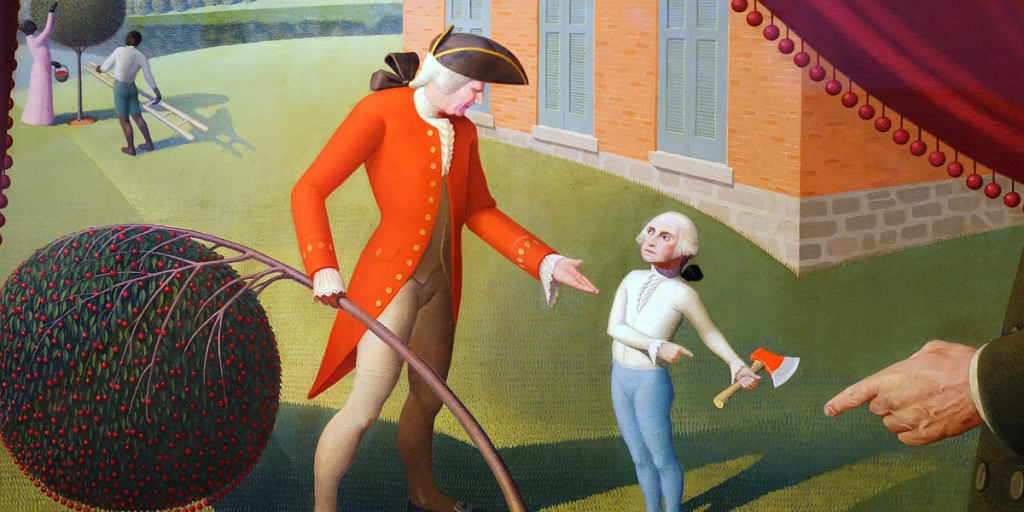
Every American knows that George Washington cannot tell a lie, so he confesses to chopping down a cherry tree. Much of American (and pretty much any) history is rife with lies. Sure, some myths, fables, and legends contain some kernel of truth, but they’re ostensibly propaganda and lies. But what is it about humans and lying? Moreover, if you don’t lie appropriately, you’re marginalised.
‘Yes, those jeans do make you look fat. To be honest, they don’t have much of a chance of doing otherwise.’
Why Honesty Gets You Shunned
Ah, truth. That elusive, glittering ideal we claim to cherish above all else. The thing we teach our children to uphold, weave into our national anthems, and plaster across inspirational posters. Yet, scratch the surface of human interaction, and you’ll find a murky, convoluted relationship with truth—one that oscillates between romantic obsession and outright disdain. If truth were a person, it would be the friend we invite to parties but spend the whole night avoiding.
we don’t just tolerate lying; we expect it
It’s not just that we lie—we excel at it. We lie casually, reflexively, like it’s part of our evolutionary DNA. And here’s the kicker: we don’t just tolerate lying; we expect it. Worse still, they are promptly shunned when someone dares to buck the trend and embrace honesty—unapologetically refusing to engage in the ritualistic deception that greases the wheels of society. It’s a paradox so rich it deserves its own soap opera.
Lying: The Social Glue That Binds Us
lying is essential to civilisation
Let’s start with the uncomfortable truth: lying is essential to civilisation. Yes, the thing your kindergarten teacher told you was bad is the same thing that keeps society from collapsing into chaos. Without lies, polite society would implode under the weight of raw honesty.
The Politeness Lie: “Do these trousers make me look fat?” Imagine answering this question truthfully. You’d be ostracised by lunchtime.
The Collective Myth: From national pride to religious dogma, our shared lies—”We’re the greatest country on Earth!” or “Our side never starts wars!”—are the glue that holds nations, ideologies, and social hierarchies together.
Without these lies, the façade crumbles, and we’re left staring into the abyss of our inadequacies. Lies make the unbearable palatable. They provide comfort where truth would leave only discomfort and despair.
The Paradox of the Honest Outsider
Now here’s where it gets juicy: we claim to value honesty, yet we loathe the honest person. The unapologetic truth-teller is viewed not as virtuous but as insufferable. Why? Because they threaten the delicate equilibrium of our collective deceptions.
Social Disruption: Truth-tellers force us to confront realities we’d rather ignore. Like that co-worker who insists the team-building exercises are pointless, they upset the carefully curated fiction we’ve all agreed to believe.
Untrustworthy Honesty: Ironically, we often trust liars more than truth-tellers. The liar plays by the unspoken rules of the game, while the honest person seems unpredictable and even dangerous.
Image: Meme: ‘What’s your greatest weakness?’
Lies as Power Plays
From a Foucauldian perspective (because who doesn’t love a bit of Foucault?), lies are more than social lubricants—they are tools of power. Governments lie to maintain control, institutions lie to justify their existence, and individuals lie to navigate these systems without losing their minds.
Honesty is a destabilising force. It’s a rebellion against the status quo.
But honesty? Honesty is a destabilising force. It’s a rebellion against the status quo. Those who reject lies challenge the structures of power that depend on them. This is why whistleblowers, truth-tellers, and sceptics are often ostracised. They expose the game, and in doing so, they risk collapsing the entire house of cards.
Cognitive Dissonance and Escalating Commitment
The real kicker is how we defend these lies. Once we’ve told or accepted a lie, we become invested in it. The psychological discomfort of admitting we’ve been duped—cognitive dissonance—leads us to double down.
Escalating Commitment: From minor fibs (“I’ll just hit snooze once”) to societal delusions (“This war is for freedom”), we defend lies because admitting the truth feels like self-destruction.
Meanwhile, the honest person, standing on the sidelines of this elaborate charade, becomes a threat. Their refusal to participate makes them a mirror, reflecting the absurdity of our commitment to the lie. And we hate them for it.
The Ostracism of Honesty
Shunning the truth-teller isn’t just a quirk of human behaviour—it’s a survival mechanism. Lies are the foundation of the social contract. Refusing to lie or to accept lies is tantamount to breaking that contract.
The Group Protects Itself: Honest individuals are scapegoated to preserve cohesion. They’re labelled as rude, arrogant, or untrustworthy to justify their exclusion.
The Emotional Toll: Truth-tellers aren’t just rejected—they’re actively punished. This social cost ensures that most people choose compliance over honesty.
Is There Hope for Honesty?
lies may be the glue that binds us…
So, where does this leave us? Are we doomed to live in a world where lies are rewarded and honesty is punished? Not necessarily. Here’s the silver lining: lies may be the glue that binds us, but truth is the solvent that cleanses.
Building Bridges: Truth-tellers who approach honesty with empathy—rather than confrontation—can foster change without alienating others.
Cultural Shifts: Societal norms around lying are not fixed. Movements like radical transparency in organisations or calls for accountability in politics show that change is possible.
The challenge is navigating the paradox: to live truthfully in a world that prizes deception without becoming a martyr for the cause.
Conclusion: The Truth Hurts, But Lies Hurt More
Our love-hate relationship with truth is as old as humanity itself. Lies comfort us, unite us, and shield us from the harshness of reality—but they also entrap us. The truth-teller, though ostracised, holds a mirror to our collective delusions, forcing us to confront the uncomfortable question: what kind of world do we want to live in?
For now, it seems, we’d rather lie than answer honestly.
References
Ariely, D. (2012). The Honest Truth About Dishonesty: How We Lie to Everyone—Especially Ourselves. Harper.
Explores everyday lies, self-deception, and the psychological mechanisms behind dishonesty.
Raden, A. (2021). The Truth About Lies: The Illusion of Honesty and the Evolution of Deceit. St. Martin’s Press.
Examines the evolutionary and cultural roots of deception and its role in shaping human behaviour.
Foucault, M. (1977). Discipline and Punish: The Birth of the Prison. Vintage Books.
A foundational text for understanding power dynamics, including how truth and lies are used to control and normalise behaviour.
Foucault, M. (1980). Power/Knowledge: Selected Interviews and Other Writings, 1972–1977. Pantheon Books.
Delves into the relationship between power and the production of truth in society.
Bok, S. (1999). Lying: Moral Choice in Public and Private Life. Vintage Books.
A comprehensive analysis of the ethical dimensions of lying and its societal implications.
Smith, D. L. (2004). Why We Lie: The Evolutionary Roots of Deception and the Unconscious Mind. St. Martin’s Press.
Explores how deception is hardwired into the human psyche and its evolutionary advantages.
Orwell, G. (1946). Politics and the English Language. Horizon.
A classic essay on how language—including lies—is used as a tool of manipulation in politics.
Arendt, H. (1972). Crises of the Republic. Harcourt Brace Jovanovich.
Particularly the essay “Lying in Politics,” which critiques the use of deception in public affairs.
Trivers, R. (2011). The Folly of Fools: The Logic of Deceit and Self-Deception in Human Life. Basic Books.
Examines self-deception and its evolutionary benefits, shedding light on how lies operate at individual and societal levels.
Nietzsche, F. (1873). On Truth and Lie in an Extra-Moral Sense (translated in Philosophy and Truth, 1979). Harper & Row.
A philosophical exploration of truth as a construct and the utility of lies.
Apologies. The sacred cow of social rituals. We’re told they’re essential—an ego on its knees, a ritual cleansing of the proverbial moral ledger. And yet, for all their lofty promises of redemption and relationship mending, aren’t apologies just glorified public relations exercises?
If you don’t like my position, I apologise. This is my response to Philosophy Minis, a channel I follow.
The philosophical breakdown you provide is charmingly earnest: admit guilt, promise reform, and repair the damage. It sounds good, doesn’t it? But let’s not kid ourselves—this is an ideal that seldom leaves the page. In practice, apologies are often nothing more than a performance. The “I’m sorry if you took offense” genre is merely the tip of the iceberg; the whole construct is a social mirage, designed more to shield the offender than to restore the wronged.
Take the idea that a “good” apology must paint the apologizer as a villain. In the real world, does that happen? Rarely. Instead, we get the watered-down version—a careful choreography of noncommittal contrition, crafted to absolve the perpetrator while barely acknowledging the harm. It’s the politician’s bread and butter: “I made a mistake” becomes code for “I’m not actually sorry, but my PR team says I should say something.” Serial apologists thrive on this economy of empty gestures, repeating offences with impunity, because they know the script will always offer them an escape hatch.
Then there’s the supposed promise of change—“I will try my best not to do this again.” Admirable in theory, utterly laughable in execution. Actions speak louder than words, but apologies, divorced from tangible behavioural shifts, speak volumes about their futility. The self-flagellation of guilt is easy; reform is hard. The apology may declare, “This is not who I want to be,” but the track record often screams, “This is exactly who I am, and I’ll see you here next week.”
And let’s not forget the crowning jewel of the apology trilogy: relationship repair. The idea that an apology rebuilds bridges is as idealistic as it is naive. True repair requires more than words; it demands effort, time, and trust—not the performative recitation of a three-step apology handbook. Worse, the insistence on a good apology as a relationship panacea risks shifting the burden onto the harmed party. If they don’t forgive, they’re the villain. Apologies weaponized as moral obligations are nothing short of emotional coercion.
Even the social utility of apologies feels overstated. Sure, children may warm to those who apologise, but is this truly evidence of moral profundity, or just a reflection of our preference for surface-level niceties? If anything, our societal obsession with apologies perpetuates the illusion that words can magically undo harm. This is a comforting narrative for offenders, but it does little for the offended.
Ultimately, apologies are not the noble moral endeavour they are so often made out to be. At best, they are flawed attempts at social cohesion; at worst, they are phatic placeholders that substitute genuine accountability with a hollow facsimile. Before we canonise the “good apology,” perhaps we ought to ask whether its real purpose is to humble the ego—or to let it off the hook entirely.
The assassination of UnitedHealth CEO Brian Thompson is more than just a shocking headline—it’s a vivid tableau of modern society’s darkest impulses. For some, Thompson’s death represents long-overdue justice, a symbolic blow against the machinery of corporate greed. For others, it’s an unforgivable act of chaos that solves nothing. But as the dust settles, we’re left with an unsettling truth: both sides may be acting rationally, yet neither side emerges morally unscathed.
It’s not just about one man or one system—it’s about the cycles of conflict and violence that have defined human societies for millennia.
This event takes on deeper significance when viewed through the lens of René Girard’s theories on mimetic rivalry and the scapegoat mechanism. It’s not just about one man or one system—it’s about the cycles of conflict and violence that have defined human societies for millennia.
Mimetic Rivalry: The Root of Conflict
Girard’s theory begins with a simple observation: human desires are not unique; they are mimetic and shaped by observing what others want. This inevitably leads to rivalry, as individuals and groups compete for the same goals, power, or symbols of status. Left unchecked, these rivalries escalate into social discord, threatening to tear communities apart.
Enter the scapegoat. To restore order, societies channel their collective aggression onto a single victim, whose sacrifice momentarily alleviates the tension. The scapegoat is both a symbol of the problem and a vessel for its resolution—a tragic figure whose elimination unites the community in its shared violence.
Thompson as Scapegoat
In this story, Brian Thompson is the scapegoat. He was not the architect of the American healthcare system, but his role as CEO of UnitedHealth made him its most visible face. His decisions—denying claims, defending profits, and perpetuating a system that prioritises shareholders over patients—embodied the injustices people associate with healthcare in America.
manifesto of a society pushed to its breaking point
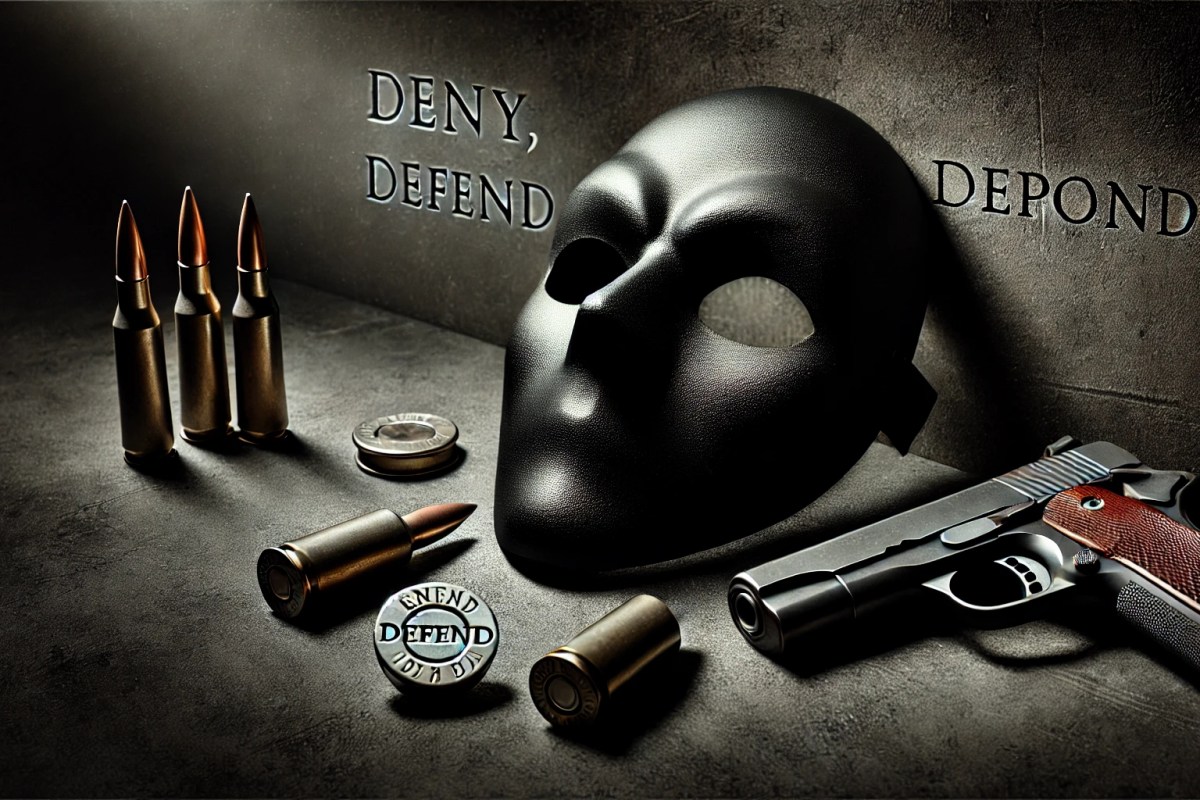
The assassin’s actions, however brutal, were a calculated strike against the symbol Thompson had become. The engraved shell casings found at the scene—inscribed with “Deny,” “Defend,” and “Depose”—were not merely the marks of a vigilante; they were the manifesto of a society pushed to its breaking point.
But Girard would caution against celebrating this as justice. Scapegoating provides only temporary relief. It feels like resolution, but it doesn’t dismantle the systems that created the conflict in the first place.
The Clash of Rationalities
Both Thompson and his assassin acted rationally within their respective frameworks. Thompson’s actions as CEO were coldly logical within the profit-driven model of American capitalism. Deny care, maximise profits, and satisfy shareholders—it’s a grim calculus, but one entirely consistent with the rules of the system.
sacrifice one life to save countless others
The assassin’s logic is equally clear, though rooted in desperation. If the system won’t provide justice, then justice must be taken by force. From a Consequentialist perspective, the act carries the grim appeal of the trolley problem: sacrifice one life to save countless others. In this view, Thompson’s death might serve as a deterrent, forcing other executives to reconsider the human cost of their policies.
Yet Girard’s framework warns us that such acts rarely break the cycle. Violence begets violence, and the system adapts. The hydra of modern healthcare—the very beast Thompson represented—will grow another head. Worse, it may become even more entrenched, using this event to justify tighter security and greater insulation from public accountability.
“An Eye for an Eye”
Mahatma Gandhi’s warning, “An eye for an eye will only make the whole world blind,” resonates here. While the assassin may have acted with moral intent, the act itself risks perpetuating the very cycles of harm it sought to disrupt. The scapegoat mechanism may provide catharsis, but it cannot heal the underlying fractures in society.
Moving Beyond the Scapegoat
To truly break the cycle, we must confront the forces that drive mimetic rivalry and scapegoating. The healthcare system is just one manifestation of a larger problem: a society that prizes competition over cooperation, profit over people, and violence over dialogue.
The hydra story looms in the background here, its symbolism stark. Slaying one head of the beast—be it a CEO or a policy—will not bring about systemic change. But perhaps this act, as tragic and flawed as it was, will force us to reckon with the deeper question: How do we create a society where such acts of desperation are no longer necessary?
The answer lies not in finding new scapegoats but in dismantling the systems that create them. Until then, we remain trapped in Girard’s cycle, blind to the ways we perpetuate our own suffering.
The assassination of Brian Thompson, CEO of UnitedHealth, has electrified public discourse. In the court of public opinion—and particularly on social media—the assailant has been lionised, hailed as a hero who slayed a corporate leviathan. Yet the metaphorical beast is no simple predator; it’s a hydra. Slice off one head, and two grow back.
Still, this act has stirred the waters. It forces us to reckon with a clash of titans: the corporate machine versus the rogue idealist. Both are acting rationally, but neither is acting morally—at least not in the conventional sense. The question, then, is whether the assassin’s actions might occupy the higher moral ground, particularly through the lens of Consequentialist ethics.
The Hydra: UnitedHealth and the Systemic Beast
To understand the morality of the act, we must first confront the monster. UnitedHealth didn’t invent the healthcare system; it merely exploited its flaws with cold, clinical efficiency. Thompson’s leadership was emblematic of an industry that sees human lives as variables in a profit-maximising equation. Claims denial, inflated premiums, and labyrinthine bureaucracy are not bugs—they’re features. And for every life saved by healthcare, countless others are destroyed by its financial and emotional toll.
Rational? Certainly. Morally defensible? Hardly. Yet from the corporation’s perspective, these actions are the logical byproducts of a system designed to prioritise shareholder value above all else. Blame the player, yes—but blame the game more.
The Assassin: Vigilante Justice or Trolley Ethics?
Now consider the assassin, who embodies a grimly utilitarian logic: sacrifice one life to spare the misery of thousands. It’s a brutal, visceral iteration of the trolley problem—or perhaps the “baby Hitler problem,” only carried out decades too late. This wasn’t mindless violence; it was a calculated act of symbolic retribution.
From a Consequentialist perspective, the act raises uncomfortable questions. If Thompson’s death leads to systemic reform—if it forces even one profit-hungry executive to hesitate before denying care—does the assassin’s action gain moral weight? In utilitarian terms, the calculus seems clear: one life traded for a net reduction in suffering.
But that’s a dangerous game. Symbolism doesn’t always translate to change, and the hydra analogy looms large. The industry won’t topple because one CEO fell. The machinery grinds on, indifferent to the blood spilled in Manhattan. Worse, the system might grow even more resilient, using Thompson’s death as justification for tighter security, greater secrecy, and more aggressive self-preservation.
Rationality vs. Morality
What makes this clash so compelling is the cold rationality on both sides. UnitedHealth’s actions, reprehensible as they are, make sense within a capitalist framework. The assassin’s actions, though violent and morally fraught, also make sense if viewed as a desperate attempt to restore balance to a world that prioritises profit over human life.
The difference lies in their moral standing. The corporation’s rationality is underpinned by greed; its actions perpetuate suffering. The assassin’s rationality, however misguided, is rooted in outrage at injustice. If morality is determined by intent and consequence, the assassin might indeed occupy higher moral ground—not because killing is inherently justifiable, but because the system left no other path for redress.
The Symbolism and the Hydra
The tragedy is that this act of violence, however symbolic, won’t solve the problem. The hydra will grow another head, as corporations close ranks and reform remains elusive. Yet the act remains a potent reminder of the power of individual resistance. Perhaps it will force a moment of reflection, a hesitation before the next denial stamp hits the desk. Or perhaps it will simply serve as another chapter in the grim saga of a system that turns suffering into profit.
The Final Question
In this clash of titans, one side wields institutional power and systemic exploitation; the other wields desperation and bullets. Both are rational. Neither is fully moral. But perhaps the assassin’s act—brutal, symbolic, and imperfect—offers a glimpse of what happens when systemic injustice pushes people past the breaking point.
The real question is whether this singular act of defiance will lead to change—or whether the hydra will simply grow stronger, hungrier, and more entrenched.
As I put the finishing touches on the third revision of my Language Insufficiency Hypothesis manuscript, I find myself reflecting on the role of Foucault’s concept of Power Relations in shaping the use and interpretation of language in institutional contexts.
A key aspect of my hypothesis is the notion that some abstract conceptual language is intentionally vague. I touched on this idea in my recent article on the ambiguity of the term ‘gift’, but the implications extend far beyond that specific example. The strategic use of linguistic indeterminacy is a pervasive feature of many professional domains, serving to veil and enable subtle power plays.
The strategic use of linguistic indeterminacy is a pervasive feature of many professional domains
In my manuscript, I examine the concept of ‘reasonableness’ as a prime example of this phenomenon. This term is a favourite hiding spot for legal professionals, appearing in phrases like ‘reasonable doubt’ and ‘reasonable person’.Yet, upon closer inspection, the apparent clarity and objectivity of this language dissolves into a morass of ambiguity and subjectivity. The invocation of reasonableness often serves as a rhetorical sleight of hand, masking the exercise of institutional power behind a veneer of impartiality.
While I don’t wish to venture too far into Nietzschean cynicism, there is a sense in which the legal system operates like a casino. The house always seeks to maintain its edge, and it will employ whatever means necessary to preserve its authority and legitimacy. In the case of reasonableness, this often involves a strategic manipulation of linguistic indeterminacy.
interpretation of key legal concepts is always subject to the shifting imperatives of institutional power
The court reserves for itself the power to decide what counts as reasonable on a case-by-case basis. Definitions that prove expedient in one context may be swiftly discarded in another. While skilled advocates may seek to manipulate this ambiguity to their advantage, the ultimate authority to fix meaning rests with the judge – or, in some instances, with a higher court on appeal. The result is a system in which the interpretation of key legal concepts is always subject to the shifting imperatives of institutional power.
This example highlights the broader significance of the Language Insufficiency Hypothesis. By attending to the ways in which abstract and contested terms can be strategically deployed to serve institutional ends, we can develop a more critical and reflexive understanding of the role of language in shaping social reality. In the process, we may begin to glimpse the complex interplay of power and meaning that underlies many of our most important professional and political discourses.
Nous vivons une époque où le langage est utilisé non pas pour éclairer, mais pour diviser et détourner. L’Obamacare, détesté dans son ensemble mais soutenu dans ses détails, en est un parfait exemple. Cela reflète un problème plus fondamental : des concepts comme « dérèglement climatique » ou « inégalités systémiques » deviennent des points de friction en raison de leur abstraction. Ce ne sont pas les scientifiques ou les activistes qui posent problème, mais une structure de pouvoir qui manipule le discours pour diluer l’action.
Déplaçons le débat. Comme pour l’Obamacare, déconstruisons les concepts en éléments concrets : énergies renouvelables, adaptation agricole, redistribution des richesses. Chaque brique est plus compréhensible et soutenable que le mur idéologique qu’on nous oppose.
Le langage, dans sa complexité, peut être insuffisant, mais il reste notre outil principal pour reconstruire des vérités fragmentées. À nous de le manier avec précision, en refusant de céder à ceux qui le déforment pour mieux nous diviser.
Cela illustre parfaitement ma notion de « dés-intégration ». Ce terme, que je préfère à la « déconstruction » de Derrida, se distingue également de l’usage courant de « désintégration ». Là où la « déconstruction » appartient au domaine littéraire et philosophique, et où la « désintégration » évoque une destruction pure, la « dés-intégration » renvoie à une méthode critique et analytique pour séparer un concept en ses composantes essentielles afin de le reconstruire ou le recontextualiser.
C’est exactement ce qu’il faut appliquer au débat sur le changement climatique d’origine anthropique. Plutôt que de nous enfermer dans des abstractions globales qui polarisent, il faut fragmenter ce débat en ses constituants concrets : l’énergie, l’industrie, l’agriculture, les infrastructures. En décomposant ces éléments, nous pouvons redonner du sens et du pragmatisme à des discussions souvent noyées sous l’idéologie.
LinkedIn est une plateforme horrible pour le partage. C’est pourquoi j’ai copié ma réponse ici. Si vous avez accès à LinkedIn, la conversation générale s’y déroule.
I don’t believe in the notions of ‘self’ or identities, but it makes for a nice thought experiment.
Imagine, just for a moment, that somewhere on this planet, there is someone who is your opposite in every conceivable way. They live as you do not. If you are kind, they are cruel. If you revel in the thrill of running through a rainstorm, they are the kind who sit comfortably by the fire, dreading the mere thought of a brisk step outdoors. If you drink to toast life’s joys, they abstain, unwilling to let a drop pass their lips. They are your anti-self—an inversion of who you are, lacking everything that you have and yet possessing everything that you do not.
To truly grow, we must encounter the other
As strange as it seems, this image is more than idle speculation. According to the Romantic poet John Keats, holding such an image of your anti-self is an essential part of the process of creating your own identity. The elusive art of true self-creation lies, paradoxically, in our capacity to hold in our minds those lives and feelings that are utterly different from our own. To truly grow, we must encounter the other—whether that other is someone we know or a shadowy, imagined version of who we could have been if only we’d chosen differently. This exercise is more than an intellectual indulgence; it is at the core of what Keats called ‘soul-making.’
Keats believed in the concept of the ‘chameleon poet’—the idea that writers, and indeed all human beings, must cultivate the ability to lose themselves in the perspectives of others. It is not enough to gaze upon the world through the singular lens of our own experience; to truly create, we must dissolve our egos and embrace a kaleidoscope of possibilities. A woman might explore the life of a soldier, writing deeply about a battle she’s never fought. A contented parent might dare to delve into the unimaginable grief of losing a child. Fiction writers, poets, artists—they all do this: they shed their own skin, assume another’s, and, in doing so, broaden the horizons of their own soul.
But Keats’ lesson here isn’t limited to the domain of poets and storytellers; it’s a practice that should extend to all of us. In what he evocatively called ‘the vale of soul-making,’ Keats posited that life offers each of us the raw materials to forge a soul, but we must engage imaginatively with all the lives we might lead, all the people we could be. We must dare to envision every possible road before us, not as a commitment but as an act of creation—enriching ourselves with the essence of each path before deciding which one we wish to tread.
We must set ablaze all our imagined lives just to make room for the one we decide to live.
And therein lies the heartbreak of it all. When we choose one possible life, we necessarily burn the others. In the very act of committing, we close other doors. We must set ablaze all our imagined lives just to make room for the one we decide to live. This thought is thrilling but also terrifying. Unlike a poet, who can glide into and out of fictional worlds, we must choose where we stand and stay there. We are not chameleons. We cannot flit endlessly between possibilities. We cannot write a library of books. We must write the one, and we must write it well.
Keats understood that the art of imagining one’s anti-self wasn’t about living vicariously forever in a land of could-have-beens. The exercise is in acknowledging these spectres of other lives, learning from them, and then committing, knowing full well what is lost in the process. Self-creation means being both the builder of one’s house and the one who tears down all the others, brick by potential brick. It means knowing who you could have been and yet, resolutely stepping into who you choose to be.
Embrace the anti-self
In a world obsessed with keeping every option open, Keats offers us the wisdom of finality. Burn off your possible lives and focus on writing the best version of the one that remains. Embrace the anti-self, learn from it, and commit once you have glimpsed all the possible worlds you might inhabit.
That is the paradoxical art of soul-making—of becoming whole while knowing you could have been anyone else. The beauty lies in the commitment, not in the drifting dream of endless potentiality. There is a deep satisfaction in choosing, in writing your own story, in saying, ‘This is who I am,’ even though you could have been another. And for that, we have John Keats to thank, the poet who understood that our anti-selves are not merely an idle game of imagination but the fuel for becoming fully human—the forge in which the soul is made.







 Philosophics