Truth After Deflation: Why ‘Truth’ Refuses to Behave

3–4 minutes

I’ve long had a problem with Truth – or at least the notion of it. It gets way too much credit for doing not much at all. For a long time now, philosophers have agreed on something uncomfortable: Truth isn’t what we once thought it was.

The grand metaphysical picture, where propositions are true because they correspond to mind-independent facts, has steadily eroded. Deflationary accounts have done their work well. Truth no longer looks like a deep property hovering behind language. It looks more like a linguistic device: a way of endorsing claims, generalising across assertions, and managing disagreement. So far, so familiar.

Audio: NotebookLM summary podcast of this topic.

What’s less often asked is what happens after we take deflation seriously. Not halfway. Not politely. All the way.

That question motivates my new paper, Truth After Deflation: Why Truth Resists Stabilisation. The short version is this: once deflationary commitments are fully honoured, the concept of Truth becomes structurally unstable. Not because philosophers are confused, but because the job we keep asking Truth to do can no longer be done with the resources we allow it.

The core diagnosis: exhaustion

The paper introduces a deliberately unromantic idea: truth exhaustion. Exhaustion doesn’t mean that truth-talk disappears. We still say things are true. We still argue, correct one another, and care about getting things right. Exhaustion means something more specific:

After deflation, there is no metaphysical, explanatory, or adjudicative remainder left for Truth to perform.

Truth remains grammatically indispensable, but philosophically overworked.
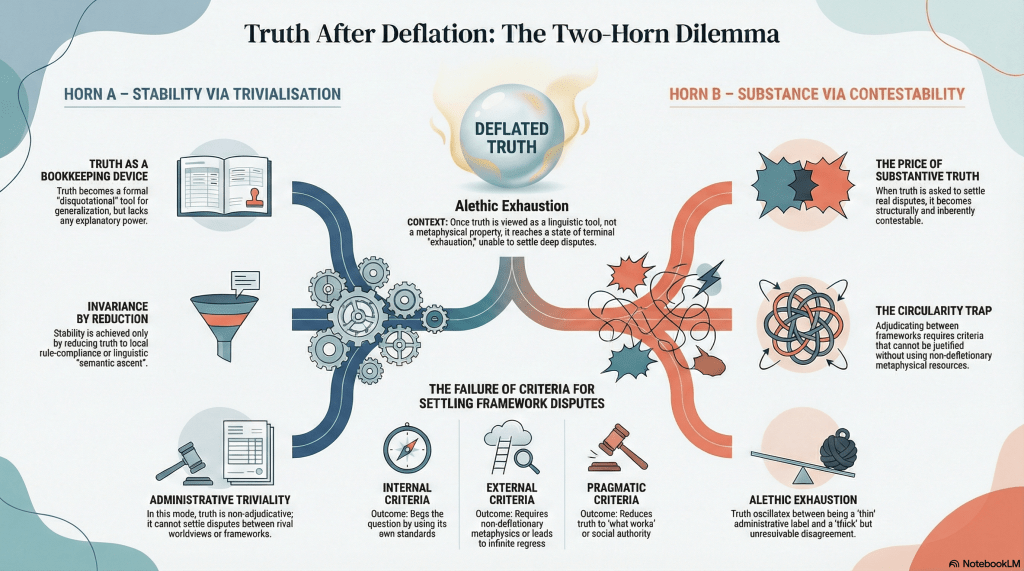
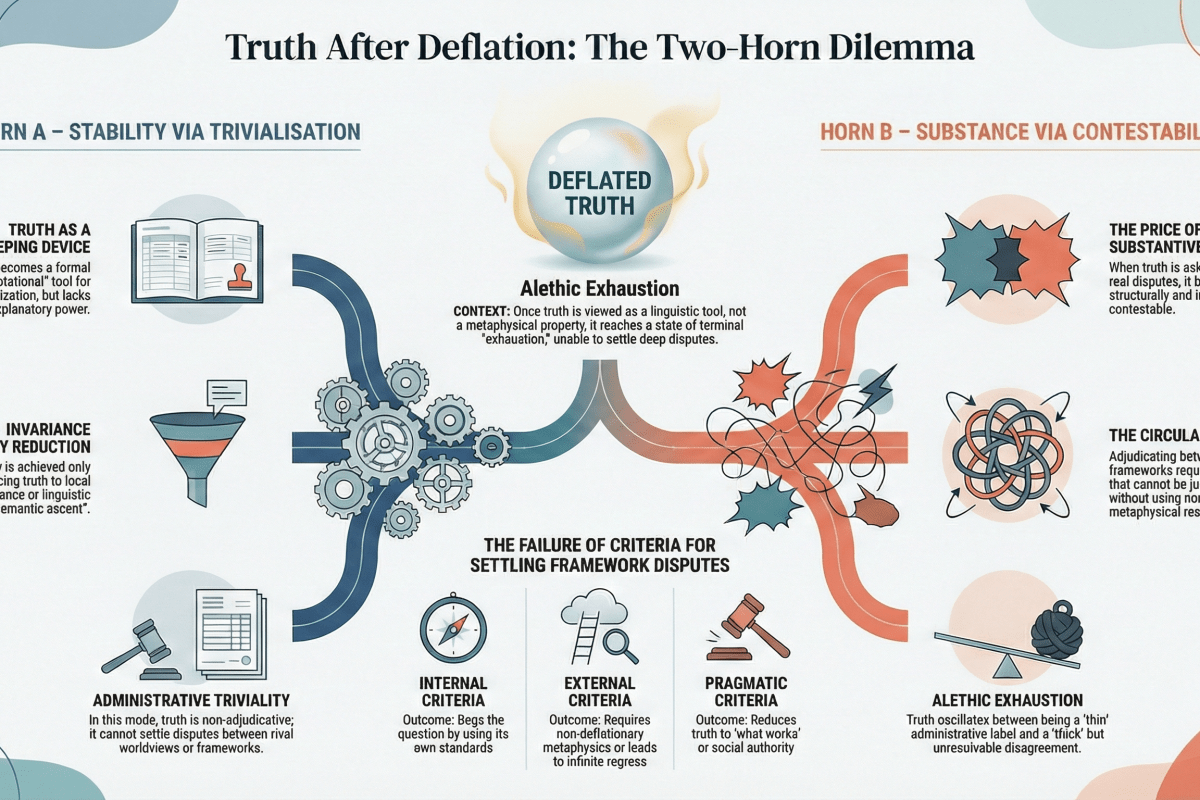
Image: NotebookLM infographics of this topic. (Please ignore the typos.)

The dilemma

Once deflationary constraints are accepted, attempts to “save” Truth fall into a simple two-horn dilemma.

Horn A: Stabilise truth by making it invariant.
You can do this by disquotation, stipulation, procedural norms, or shared observation. The result is stable, but thin. Truth becomes administrative: a device for endorsement, coordination, and semantic ascent. It no longer adjudicates between rival frameworks.

Horn B: Preserve truth as substantive.
You can ask Truth to ground inquiry, settle disputes, explain success, or stand above practices. But now you need criteria. And once criteria enter, so do circularity, regress, or smuggled metaphysics. Truth becomes contestable precisely where it was meant to adjudicate.

Stability costs substance. Substance costs stability. There is no third option waiting in the wings.

Why this isn’t just abstract philosophy

To test whether this is merely a theoretical artefact, the paper works through three domains where truth is routinely asked to do serious work:

  • Moral truth, where Truth is meant to override local norms and condemn entrenched practices.
  • Scientific truth, where Truth is meant to explain success, convergence, and theory choice.
  • Historical truth, where Truth is meant to stabilise narratives against revisionism and denial.

In each case, the same pattern appears. When truth is stabilised, it collapses into procedure, evidence, or institutional norms. When it is thickened to adjudicate across frameworks, it becomes structurally contestable. This isn’t relativism. It’s a mismatch between function and resources.

Why this isn’t quietism either

A predictable reaction is: isn’t this just quietism in better prose?

Not quite. Quietism tells us to stop asking. Exhaustion explains why the questions keep being asked and why they keep failing. It’s diagnostic, not therapeutic. The persistence of truth-theoretic debate isn’t evidence of hidden depth. It’s evidence of a concept being pushed beyond what it can bear after deflation.

The upshot

Truth still matters. But not in the way philosophy keeps demanding. Truth works because practices work. It doesn’t ground them. It doesn’t hover above them. It doesn’t adjudicate between them without borrowing authority from elsewhere. Once that’s accepted, a great deal of philosophical anxiety dissolves, and a great deal of philosophical labour can be redirected.

The question is no longer “What is Truth?” It’s “Why did we expect Truth to do that?”

The paper is now archived on Zenodo and will propagate to PhilPapers shortly. It’s long, unapologetically structural, and aimed squarely at readers who already think deflationary truth is right but haven’t followed it to its endpoint.

Read it if you enjoy watching concepts run out of road.

Pinpointing the Messiness of Language

LinkedIn, that carnival of professional self-delusion, has a little diversion called Pinpoint. It pretends to tell you how much you “match” with other people, presumably so you’ll feel less alone as you scroll past thought-leaders peddling snake oil in PowerPoint form. In English, the results arrive in the cold, hard, dating-app idiom: “% match.” Simple, brutal, and bland.

Audio: NotebookLM podcast on this topic.

But LinkedIn, ever the polyglot, translates this phrase into other tongues. And here is where a trivial game unmasks the philosophical chaos of language itself. For in one idiom, your soul and another’s are “in correspondence.” In another, you are the product of “coincidence.” Elsewhere, you are a “hit,” a “fit,” a “suitability.” The poor Swedes, apparently exhausted, simply gave up and borrowed “matchning.”

The Romance languages, of course, are the most pedantic. Correspondência, corrispondenza — all very scholastic, as if Aquinas himself were lurking in the backend code. A match is nothing less than the degree to which one proposition mirrors another, as in the correspondence theory of truth. You can be 72% true, like a botched syllogism that half-lands. Elegant, precise, exasperating.

Spanish, on the other hand, opts for coincidencia. A “% coincidence.” Imagine it: you bump into your ex at the market, but only 46% of the way. Coincidence, by definition, is binary; either the train wreck occurs or it does not. And yet here it is, rendered as a gradable metric, as if fate could be quantified. It’s a kind of semantic surrealism: Dalí with a spreadsheet.

Then we have the Germans: Treffer. A hit. In English, a hit is binary – you score or you miss. But the Germans, ever the statisticians of fate, make Trefferquote into a percentage. You may not have killed the truth outright, but you wounded it respectably. It’s a firing squad turned bar chart.

Indonesians say cocok, which means “appropriate, suitable.” This is not about truth at all, but about fit. A match is not correspondence to reality but pragmatic adequacy: does it work? Does it feel right? The difference is subtle but devastating. Correspondence makes truth a metaphysical mirror; suitability makes it a tailoring problem.

And English? English, with its toddler’s toybox of a vocabulary, just shrugs and says “match.” A word that means as much as a tennis final, a Tinder swipe, or a child’s puzzle book. Adequate, lazy, neutered. Anglo-pragmatism masquerading as universality.

So from a silly HR-adjacent parlour game we stumble into a revelation: truth is not one thing, but a polyglot mess. The Romance tongues cling to correspondence. Spanish insists on coincidence. German goes target practice. Indonesian settles for a good fit. And English floats on ambiguity like an inflatable swan in a corporate swimming pool.

The lesson? Even a “% match” is already lost in translation. There is no stable denominator. We speak not in universals but in parochialisms, in metaphors smuggled into software by underpaid translators. And we wonder why philosophy cannot settle the matter of truth: it is because language itself cheats. It gives us correspondence, coincidence, hits, and fits, all while claiming to say the same thing.

Perhaps LinkedIn should update its UI to something more honest: % mess.

The Truth About Lying

Every American knows that George Washington cannot tell a lie, so he confesses to chopping down a cherry tree. Much of American (and pretty much any) history is rife with lies. Sure, some myths, fables, and legends contain some kernel of truth, but they’re ostensibly propaganda and lies. But what is it about humans and lying? Moreover, if you don’t lie appropriately, you’re marginalised.

Why Honesty Gets You Shunned

Ah, truth. That elusive, glittering ideal we claim to cherish above all else. The thing we teach our children to uphold, weave into our national anthems, and plaster across inspirational posters. Yet, scratch the surface of human interaction, and you’ll find a murky, convoluted relationship with truth—one that oscillates between romantic obsession and outright disdain. If truth were a person, it would be the friend we invite to parties but spend the whole night avoiding.

It’s not just that we lie—we excel at it. We lie casually, reflexively, like it’s part of our evolutionary DNA. And here’s the kicker: we don’t just tolerate lying; we expect it. Worse still, they are promptly shunned when someone dares to buck the trend and embrace honesty—unapologetically refusing to engage in the ritualistic deception that greases the wheels of society. It’s a paradox so rich it deserves its own soap opera.

Lying: The Social Glue That Binds Us

Let’s start with the uncomfortable truth: lying is essential to civilisation. Yes, the thing your kindergarten teacher told you was bad is the same thing that keeps society from collapsing into chaos. Without lies, polite society would implode under the weight of raw honesty.

  • The Politeness Lie: “Do these trousers make me look fat?” Imagine answering this question truthfully. You’d be ostracised by lunchtime.
  • The Collective Myth: From national pride to religious dogma, our shared lies—”We’re the greatest country on Earth!” or “Our side never starts wars!”—are the glue that holds nations, ideologies, and social hierarchies together.

Without these lies, the façade crumbles, and we’re left staring into the abyss of our inadequacies. Lies make the unbearable palatable. They provide comfort where truth would leave only discomfort and despair.

The Paradox of the Honest Outsider

Now here’s where it gets juicy: we claim to value honesty, yet we loathe the honest person. The unapologetic truth-teller is viewed not as virtuous but as insufferable. Why? Because they threaten the delicate equilibrium of our collective deceptions.

  • Social Disruption: Truth-tellers force us to confront realities we’d rather ignore. Like that co-worker who insists the team-building exercises are pointless, they upset the carefully curated fiction we’ve all agreed to believe.
  • Untrustworthy Honesty: Ironically, we often trust liars more than truth-tellers. The liar plays by the unspoken rules of the game, while the honest person seems unpredictable and even dangerous.
Image: Meme: ‘What’s your greatest weakness?’

Lies as Power Plays

From a Foucauldian perspective (because who doesn’t love a bit of Foucault?), lies are more than social lubricants—they are tools of power. Governments lie to maintain control, institutions lie to justify their existence, and individuals lie to navigate these systems without losing their minds.

But honesty? Honesty is a destabilising force. It’s a rebellion against the status quo. Those who reject lies challenge the structures of power that depend on them. This is why whistleblowers, truth-tellers, and sceptics are often ostracised. They expose the game, and in doing so, they risk collapsing the entire house of cards.

Cognitive Dissonance and Escalating Commitment

The real kicker is how we defend these lies. Once we’ve told or accepted a lie, we become invested in it. The psychological discomfort of admitting we’ve been duped—cognitive dissonance—leads us to double down.

  • Escalating Commitment: From minor fibs (“I’ll just hit snooze once”) to societal delusions (“This war is for freedom”), we defend lies because admitting the truth feels like self-destruction.

Meanwhile, the honest person, standing on the sidelines of this elaborate charade, becomes a threat. Their refusal to participate makes them a mirror, reflecting the absurdity of our commitment to the lie. And we hate them for it.

The Ostracism of Honesty

Shunning the truth-teller isn’t just a quirk of human behaviour—it’s a survival mechanism. Lies are the foundation of the social contract. Refusing to lie or to accept lies is tantamount to breaking that contract.

  • The Group Protects Itself: Honest individuals are scapegoated to preserve cohesion. They’re labelled as rude, arrogant, or untrustworthy to justify their exclusion.
  • The Emotional Toll: Truth-tellers aren’t just rejected—they’re actively punished. This social cost ensures that most people choose compliance over honesty.

Is There Hope for Honesty?

So, where does this leave us? Are we doomed to live in a world where lies are rewarded and honesty is punished? Not necessarily. Here’s the silver lining: lies may be the glue that binds us, but truth is the solvent that cleanses.

  • Building Bridges: Truth-tellers who approach honesty with empathy—rather than confrontation—can foster change without alienating others.
  • Cultural Shifts: Societal norms around lying are not fixed. Movements like radical transparency in organisations or calls for accountability in politics show that change is possible.

The challenge is navigating the paradox: to live truthfully in a world that prizes deception without becoming a martyr for the cause.

Conclusion: The Truth Hurts, But Lies Hurt More

Our love-hate relationship with truth is as old as humanity itself. Lies comfort us, unite us, and shield us from the harshness of reality—but they also entrap us. The truth-teller, though ostracised, holds a mirror to our collective delusions, forcing us to confront the uncomfortable question: what kind of world do we want to live in?

For now, it seems, we’d rather lie than answer honestly.

References

  1. Ariely, D. (2012). The Honest Truth About Dishonesty: How We Lie to Everyone—Especially Ourselves. Harper.
    • Explores everyday lies, self-deception, and the psychological mechanisms behind dishonesty.
  2. Raden, A. (2021). The Truth About Lies: The Illusion of Honesty and the Evolution of Deceit. St. Martin’s Press.
    • Examines the evolutionary and cultural roots of deception and its role in shaping human behaviour.
  3. Foucault, M. (1977). Discipline and Punish: The Birth of the Prison. Vintage Books.
    • A foundational text for understanding power dynamics, including how truth and lies are used to control and normalise behaviour.
  4. Foucault, M. (1980). Power/Knowledge: Selected Interviews and Other Writings, 1972–1977. Pantheon Books.
    • Delves into the relationship between power and the production of truth in society.
  5. Bok, S. (1999). Lying: Moral Choice in Public and Private Life. Vintage Books.
    • A comprehensive analysis of the ethical dimensions of lying and its societal implications.
  6. Smith, D. L. (2004). Why We Lie: The Evolutionary Roots of Deception and the Unconscious Mind. St. Martin’s Press.
    • Explores how deception is hardwired into the human psyche and its evolutionary advantages.
  7. Orwell, G. (1946). Politics and the English Language. Horizon.
    • A classic essay on how language—including lies—is used as a tool of manipulation in politics.
  8. Arendt, H. (1972). Crises of the Republic. Harcourt Brace Jovanovich.
    • Particularly the essay “Lying in Politics,” which critiques the use of deception in public affairs.
  9. Trivers, R. (2011). The Folly of Fools: The Logic of Deceit and Self-Deception in Human Life. Basic Books.
    • Examines self-deception and its evolutionary benefits, shedding light on how lies operate at individual and societal levels.
  10. Nietzsche, F. (1873). On Truth and Lie in an Extra-Moral Sense (translated in Philosophy and Truth, 1979). Harper & Row.
    • A philosophical exploration of truth as a construct and the utility of lies.