Fish Are Not Arboreal by Nature

4–5 minutes

This is a continued reflection of the ramifications of yesterday’s post.

There is a growing tendency to describe certain moral conflicts as educational failures: If only people were shown the right perspective. If only they listened. If only they learned to see differently.

This language is most visible in discussions of objectification. Some men are told that what they perceive, feel, or notice is something that can be unlearned through dialogue. That with sufficient moral instruction, a perceptual orientation can be rewired into a different one. The problem is not that this ambition is moral. The problem is that it is architecturally incoherent.

The category mistake at the centre

Objectification is routinely treated as if it were a belief. A proposition. A theory about women that can be corrected with better arguments.

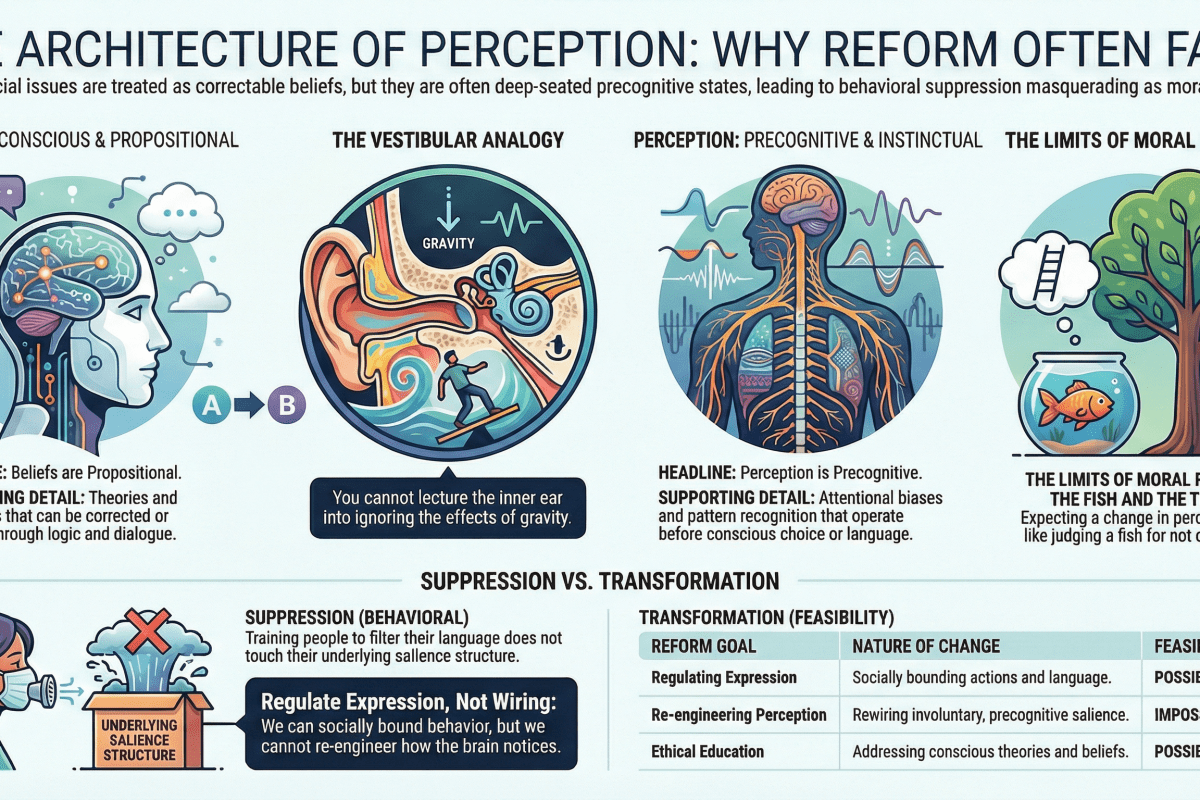
But much of what is being targeted is not propositional at all. It is precognitive salience. Attentional bias. Pattern recognition that operates before language, before justification, before conscious choice. You cannot reason someone out of a perception any more than you can lecture the vestibular system into ignoring gravity.

This is not a defence of behaviour. It is a refusal to confuse perception with endorsement. When we mistake a precognitive state for a belief, we end up conducting moral seminars aimed at the wrong organ.
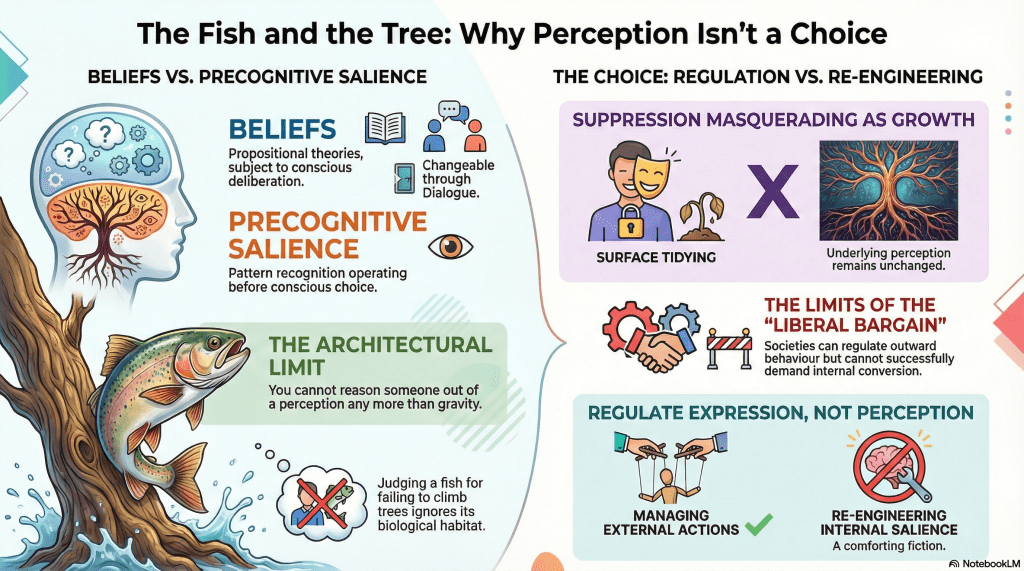
Image: NotebookLM infographic

What education quietly becomes

Once this mistake is made, the rest follows with grim reliability.

If the orientation persists after instruction, it is no longer treated as structural. It is treated as obstinacy. The individual is said not merely to have a problematic perception but to be refusing growth.

At this point, moral education slides into something else entirely. Compliance is redescribed as transformation. Suppression is redescribed as insight. Silence is redescribed as progress.

The person learns to inhibit expression, to monitor language, to filter behaviour. None of this touches the underlying salience structure. But the culture congratulates itself anyway, because the surface has been tidied. This is how behavioural containment comes to masquerade as moral reform.
The fish and the trees

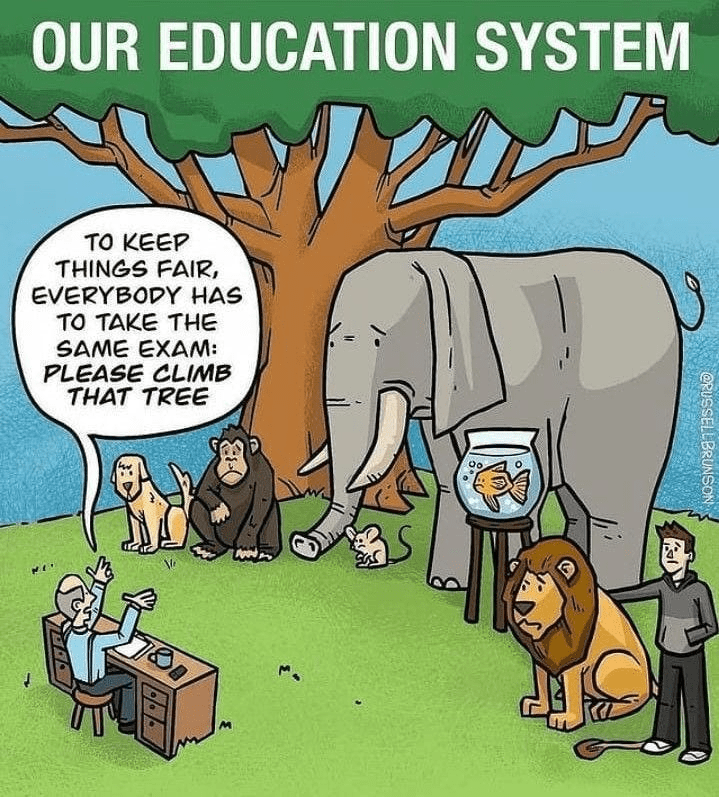
The fish analogy is not flippant. It is diagnostic. Telling a fish it must climb trees is not an invitation to growth. It is a refusal to acknowledge habitat. When the fish fails, the failure is moralised.

  • ‘You could do this if you tried.’
  • ‘Others have managed.’
  • ‘Your resistance is the problem.’

The water is never named. Only the inadequacy of the swimmer.

Likewise, telling someone that a precognitive orientation can be dialogically dismantled assumes a plasticity that does not exist. When it fails, the failure is framed as an ethical defect rather than an architectural limit.

A topical case study

Rather than think in abstractions, let’s use a culturally-relevant example – at least through a relatively recent US frame – objectifying women. This has been a topic since at least the 1970s, and it remains in the cultural consciousness.

Some men have been accused of objectifying women. They are told this is wrong and asked to change their perspectives. But what’s really happening here?

These people are being asked to suppress the expression of a precognitive state. In Haidt’s parlance, they are being chastised for not controlling their elephant.

No amount of dialogue will rewire this faculty. This is akin to judging the fish for not climbing a tree and adopting an arboreal lifestyle.

I am not saying that all men are wired like this, nor am I saying that some men cannot control their baser impulses, but I am saying that asking a person not to express something does not thwart the impulse. In fact, it may make them also feel guilty for this instinct.

Why this becomes culturally unstable

A culture can regulate behaviour without demanding internal conversion. That is the old liberal bargain. You may think what you think; you will act within bounds.

What it cannot do indefinitely is promise inner transformation it cannot deliver, while punishing those who fail to achieve it. That produces exhaustion. It produces resentment. It produces a constant background hum of self-surveillance.

Worse, it moralises involuntary cognition. Not what you do, but what you notice. Not action, but salience. Not harm, but perception. Once that line is crossed, the scope of moral suspicion expands without limit.

The choice we avoid naming

The dilemma is not whether objectifying behaviour should be constrained. It should.

The dilemma is whether we will admit the difference between:

  • regulating expression, and
  • re-engineering perception

One is possible. The other is a comforting fiction. Pretending otherwise allows us to speak the language of enlightenment while practising the mechanics of discipline. It lets us call suppression ‘growth’ and exhaustion ‘progress’. The honest position is less flattering.

Some orientations cannot be taught away. They can be managed, constrained, and socially bounded. Demanding more than that is not moral ambition. It is ontological impatience.

You can’t teach a fish to stop being wet. You can decide which waters it is allowed to swim in.

In the end, the point is that it isn’t a matter of knowing; it’s a matter of feeling – something much deeper.

No Agent, No Agency

There is no spoon” is a classic line from The Matrix. Reality is a construct. I agree, but I’m not sure I believe that we can get under this reality to experience it differently. And this might hinge on a distinction between experience and perception.

Losing Ourselves is a book just published in the US and forthcoming (July 2022) in the UK promoting the Buddhist notion of no-self or selflessness. I’ve been partial to Buddhism since, when I lived outside of Tokyo, I was exposed to it in 1980.

Book Cover: Losing Ourselves

For me, this intersects with my anti-Agency endeavour. If the Self is a construct, there is no Agent, and without an agent, there is no Agency. I realise that this is a meta-position and not uncontroversial, but I do like to collect ideas and perspectives in my quiver.

Obviously, there seems to be a strong drive (at least in the West) to construct selves, not the least of which serves the purpose of an object to confer praise or blame. Interestingly, I’ve heard much about objectification, but not many seem to care about this form. It’s more about sub-objectification.

It’s OK to parse the person from the fabric of the universe, but don’t further disintegrate that person.

Capitalising on Prostitution

DISCLAIMER: This post is a veritable rant. It promises to go off script or at least be oblique to the recent themes I’ve adopted. It is also a bit late, missing the heels of the FOSTA debacle in the United States. 

Prostitution is immoral. It exploits women. It exists in a world of violence. It objectifies and creates a rape culture. It is a vector for transmission of diseases. These are the main arguments against it, yet many of these are arguments against Capitalism itself.

In fact, most arguments of prostitution are criticisms of capitalism or conflated claims to some tangential activity. The most popular conflation is with sex trafficking,  ‘modern-day slavery and involves the use of force, fraud, or coercion to obtain some type of labor or commercial sex act‘.

Prostitution is a category of sex work, which includes dominatrixes in the BDSM space, porn actors (and actresses if you expect archaic sexist jargon), phone sex operators, cam models. Nude modelling is somehow tasteful and not readily included in the collection.

actress

The World Health Organisation (WHO) defines sex workers [PDF] as ‘women, men and transgendered people who receive money or goods in exchange for sexual services, and who consciously define those activities as income-generating even if they do not consider sex work as their occupation‘. I won’t comment on why they feel the final dependent clause is relevant to the definition. Perhaps it’s in the realm of the aspiring actors or screenwriters who wait tables but don’t consider themselves to be waitstaff.

Returning to the main arguments in turn:

Prostitution is immoral. As a subjectivist, this is a difficult argument to win. Although morality is a human social construct, many people believe otherwise, and even those who don’t ascribe to the notion of an objective morality still adopt and abide by the fabricated moral codes generated by the worldview of, say, Christians or Muslims or some other sect who claim to have direct insight into such codes.

Nothing is immoral that society doesn’t declare to be immoral.

Nothing is immoral that society doesn’t declare to be immoral. In the United States, the institution of slavery—what I call hyper-capitalism or a capitalist’s wet dream—was deemed moral by most. Eventually, the morality was hotly debated, and now, it is considered to be immoral. Time changes everything. In some circles, slavery is still considered to be moral. In other circles, it has morphed into wage-slavery and because money is exchanged within a frame of a labour market, it escapes the definition.

Excepting for local norms, prostitution is not inherently more immoral than banking or retail sales.

Prostitution exploits women. Excepting that there are male prostitutes and sex workers, it is commonly believed that these people are (somehow) less likely to be exploited, so I’ll keep this focused on women. First, it is important to separate prostitution from human sex trafficking. This is not the topic, and it’s a problem with specificity. If you feel that sex trafficking is immoral and should be illegal, that’s fine; but don’t throw out the baby with the bath water. Focus on the actual problem. <sarcasm>If you want to prevent all women from being exploited, lock them all up in monasteries. Problem solved. </sarcasm>

Prostitution is not inherently more immoral than banking

If one wants to discuss exploitation, let’s discuss a system designed such that a person needs to earn money to survive. Period. Full stop. If you buy into the capitalist worldview, then, that in order to survive a person chooses to be a marketing executive, a customer service representative, a janitor, or a prostitute, is none of your concern.

I have heard many arguments put forth that these women should get ‘real jobs’, jobs that pay minimum wage (or less) and have no other benefits, jobs where it would take a week or more to earn what they could in a day or less. That’s not even rational.

Prostitution exists in a world of violence. Despite trends, the world is still a violent place. Part of the higher probability of violence in the realm of prostitution exists because these women are marginalised by moralists. Even where prostitution is legal, it is still often viewed as immoral. They have little recourse to the legal system. They can’t organise. They are forced underground. Sunlight is the best disinfectant. Don’t force these women into alleys and underground.

In the US, recent FOSTA and SESTA hysteria have disarmed women from the tools they used to navigate their environment. They could share intelligence related to which men to avoid for one reason or another. Other tools have cropped up to facilitate this cooperation, but these tools benefit from network effects. The more people having access to the information clearinghouse, the better.

Prostitution objectifies women. I’ll concede this point straight away but not without noting that many things objectify women: the beauty industry, the entertainment industry, the marketing industry in general. If as a society we can resolve objectification and prostitution is the last holdout, I’m onboard, right there with you. But there is no need to make prostitution the poster child for eliminating objectification.

745_600_10964maybelline-color-elixir-gloss-sohelee1[1]

Prostitution creates a rape culture. To be fair, I have no metrics on this, and I am going to pass, but not without saying that it seems to be an implausible claim. And I have read counterclaims anyway.

Prostitution is a vector for the transmission of diseases. Indeed. And driving is a vector for traffic accidents. Of course, given higher frequencies of an activity, one would expect a greater number of outcomes—even with the same probability, the additional exposure may result in hitting this undesirable lottery. And the variety of partners with unknown sexual histories is problematic.

However, a mitigating factor is education—and not simply moralistic lip service. Women need to understand the risks and understand how to diminish it. Yet again, being marginalised does not necessarily allow a woman to be empowered. A client can insist on unprotected sex. If he forces his hand, no one is going to believe that a prostitute can be raped. As with sex trafficking, rape is its own subject and is only part of a larger conversation.


I was winding down, but I found a related quote I wanted to address:

Geena Leigh was in prostitution for 19 years from the age of 18. In her submission to an Australian inquiry into the regulation of brothels, she said prostitution: “has this way of stealing all the dreams, goals and beautiful essence out of a woman. During my years in it, I didn’t meet one woman who enjoyed what she was doing. Everyone was trying to get out.”

Evidently, lack of enjoyment in one’s employment is not limited to prostitutes. The is the problem with fundamental attribution bias. A recent Gallup poll cited that 85% of people hate their jobs. Maybe Gallup only interviewed prostitutes, or perhaps the 15% who liked their jobs were the only ones who weren’t sex workers.


Well, there went my morning…

For those wondering (and who’ve gotten this far), the impetus for this post was some other blog posts I happened upon in WordPress’ Reader.