Against the Intelligence Industrial Complex

Why IQ is Not Enough – and Never Was

I’m not a fan of IQ as a general metric. Let us be done with the cult of the clever. Let us drag the IQ score from its pedestal, strip it of its statistical robes, and parade it through the streets of history where it belongs—next to phrenology, eugenics, and other well-meaning pseudosciences once weaponised by men in waistcoats.

The so-called Intelligence Industrial Complex—an infernal alliance of psychologists, bureaucrats, and HR departments—has for too long dictated the terms of thought. It has pretended to measure the immeasurable. It has sold us a fiction in numerical drag: that human intelligence can be distilled, packaged, and ranked.

Audio: NotebookLM podcast on this topic.

What it measures, it defines. What it defines, it controls.

IQ is not intelligence. It is cognitive GDP: a snapshot of what your brain can do under fluorescent lights with a timer running. It rewards abstraction, not understanding; speed, not depth; pattern recognition, not wisdom. It’s a test of how well you’ve been conditioned to think like the test-makers.

This is not to say IQ has no value. Of course it does—within its own ecosystem of schools, bureaucracies, and technocracies. But let us not mistake the ruler for the terrain. Let us not map the entire landscape of human potential using a single colonial compass.

True intelligence is not a number. It is a spectrum of situated knowings, a polyphony of minds tuned to different frequencies. The Inuit hunter tracking a seal through silence. The griot remembering centuries of lineage. The autistic coder intuiting an algorithm in dreamtime. The grandmother sensing a lie with her bones. IQ cannot touch these.

To speak of intelligence as if it belonged to a single theory is to mistake a monoculture for a forest. Let us burn the monoculture. Let us plant a thousand new seeds.

A Comparative Vivisection of Intelligence Theories

Theory / ModelCore PremiseStrengthsBlind Spots / CritiquesCultural Framing
IQ (Psychometric g)Intelligence is a single, general cognitive ability measurable via testingPredicts academic & job performance; standardisedSkewed toward Western logic, ignores context, devalues non-abstract intelligencesWestern, industrial, meritocratic
Multiple Intelligences (Gardner)Intelligence is plural: linguistic, spatial, musical, bodily, etc.Recognises diversity; challenges IQ monopolyStill individualistic; categories often vague; Western in formulationLiberal Western pluralism
Triarchic Theory (Sternberg)Intelligence = analytical + creative + practicalIncludes adaptability, real-world successStill performance-focused; weak empirical groundingWestern managerial
Emotional Intelligence (Goleman)Intelligence includes emotion regulation and interpersonal skillUseful in leadership & education contextsCommodified into corporate toolkits; leans self-helpWestern therapeutic
Socio-Cultural (Vygotsky)Intelligence develops through social interaction and cultural mediationRecognises developmental context and cultureLess attention to adult or cross-cultural intelligenceSoviet / constructivist
Distributed Cognition / Extended MindIntelligence is distributed across people, tools, systemsBreaks skull-bound model; real-world cognitionHard to measure; difficult to institutionalisePost-cognitive, systems-based
Indigenous EpistemologiesIntelligence is relational, ecological, spiritual, embodied, ancestralHolistic; grounded in lived experienceMarginalised by academia; often untranslatable into standard metricsGlobal South / decolonial

Conclusion: Beyond the Monoculture of Mind

If we want a more encompassing theory of intelligence, we must stop looking for a single theory. We must accept plurality—not as a nod to diversity, but as an ontological truth.

Intelligence is not a fixed entity to be bottled and graded. It is a living, breathing phenomenon: relational, situated, contextual, historical, ecological, and cultural.

And no test devised in a Princeton psych lab will ever tell you how to walk through a forest without being seen, how to tell when rain is coming by smell alone, or how to speak across generations through story.

It’s time we told the Intelligence Industrial Complex: your number’s up.
Multiple Intelligences

I engaged in a nice debate recently. Someone suggested that because some executives are smart, they can figure things out. Specifically, she posited that a CTO, Chief Technology Officer, should understand communication and diplomatic skills when interacting with a corporate board because they have the technical skills to get into their current C-level position. I disagreed based on the multiple intelligence theory.

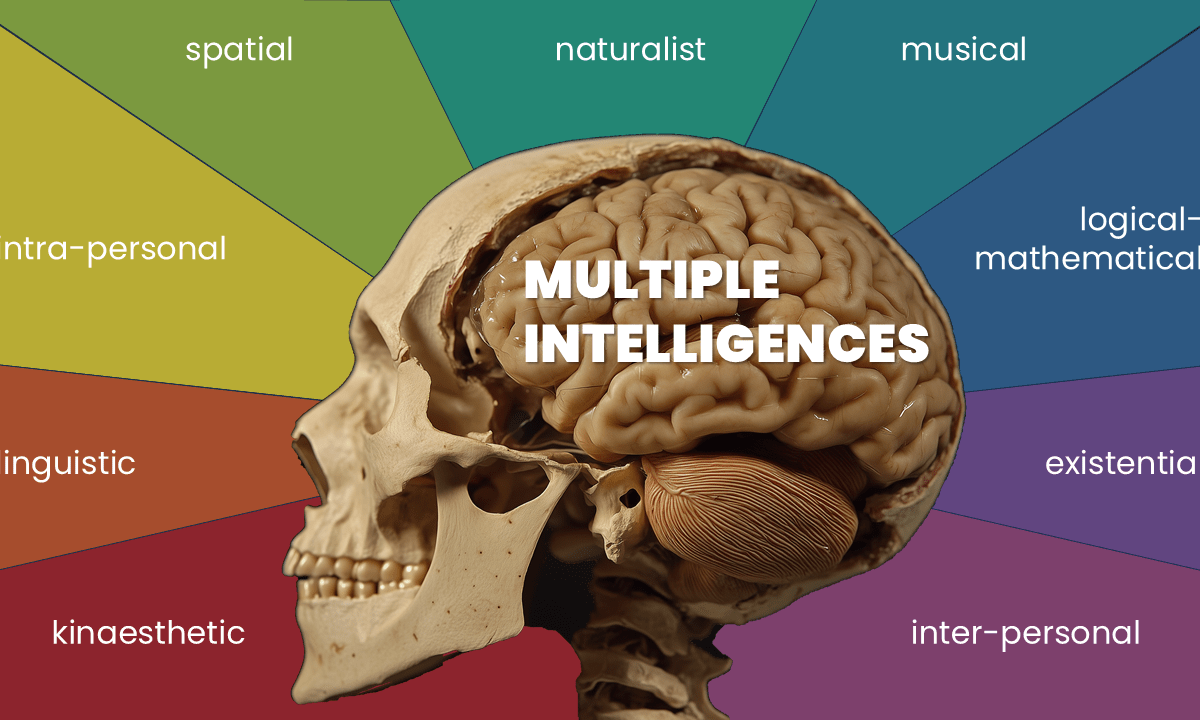
Howard Gardner’s Multiple Intelligences theory posits that intelligence isn’t a monolith, but rather a nine-dimensional construct:

1. Existential (philosophical pondering; questioning the questions of why we live and why we die)

2. Inter-personal (reading people; sensing people’s feelings and motives)

3. Intra-personal (self-awareness; understanding yourself, what you feel, and what you want)

4. Kinaesthetic (mind-body coordination; coordinating your mind with your body)

5. Linguistic (wordsmithing; finding the right word(s) to express what you mean)

6. Logical-Mathematical (quantifying and proving; quantifying things, making hypotheses, and proving them)

7. Musical (discerning sounds; their pitch, tone, rhythm, and timbre)

8. Naturalist (understanding nature; understanding living things and reading nature)

9. Spatial (3D/4D visualisation)

For a deep dive, check out Gardner’s Frames of Mind: The Theory of Multiple Intelligences.

Here’s the rub: a CTO with off-the-charts technical skills might be rubbish at diplomacy (interpersonal) or communication (linguistic). It’s like expecting every pro athlete to be a concert pianist – it’s not on.

Assuming every “intelligent” person can max out all intelligence dimensions is bollocks. It’s as likely as training every smart CTO to be the next Shakespeare or Machiavelli. Language and diplomacy are distinct skills, mate.

While we all love a Renaissance man (or woman), peaking in all these dimensions in one lifetime is a pipe dream. It’s not inherently bad, though. When building teams – be it a corporate board or an exploration party – ensure you’ve got a good mix of skills. I’m not saying you need a bard, a philosopher, and LeBron James on every team, but make sure you’ve covered the bases necessary for success.

If you think you don’t need a particular dimension, ask yourself: is it because you’re weak in that area and can’t see its importance? Don’t let your blind spots become your downfall.

In the end, it’s about recognising and respecting diverse intelligences. So, next time you’re tempted to think your brilliant CTO should just “learn to be diplomatic”, remember: they might be better off focusing on their strengths and leaving the smooth talking to someone else on the team.

Defining Intelligence

Using AutoCrit, I continue to share the review progress of my work in progress, Democracy: The Grand Illusion—perhaps Grand Delusion might be more fitting. In this chapter, I establish a foundation for intelligence and cognitive function.

Synopsis

The text begins by discussing the concept of intelligence, specifically focusing on IQ as a measure of cognitive abilities relative to others. It explains the origins and standardisation of IQ tests, highlighting their limitations in capturing the full spectrum of human intelligence. The discussion then shifts towards Emotional Intelligence (EQ), outlining its components and emphasising its importance in interpersonal relationships and leadership roles.

The narrative further delves into Howard Gardner’s Theory of Multiple Intelligences, which challenges the idea that intelligence is a singular ability measured solely by traditional IQ tests. The text elaborates on various types of intelligences proposed by Gardner, such as linguistic, musical, spatial, naturalistic, and intrapersonal intelligence.

Moreover, cognitive biases are explored in detail within democratic processes through real-world examples like confirmation bias or groupthink. Strategies to mitigate these biases are suggested for improving decision-making within democracies.

The text concludes with a call for embracing diverse forms of intelligence within democratic systems while acknowledging and addressing cognitive biases to enhance governance effectiveness.

Audience

The target audience for this text appears to be individuals interested in psychology, education theory, and political science, or those exploring the intersection between human cognition and democratic governance. Readers seeking an in-depth analysis of different forms of intelligence alongside discussions on democracy would find this text engaging.

Those less inclined towards academic or theoretical discourse may not be the primary target audience. To make it more relevant to a broader readership base outside academia or specialized fields:

  • Simplifying complex terminology
  • Providing relatable examples
  • Incorporating practical applications

Structure and Organisation

The structure follows a logical order starting with defining traditional measures of intelligence leading up to discussions on multiple intelligences and cognitive biases impacting democracy. Each section flows cohesively into the next without abrupt transitions or disjointed topics. No significant issues with organisation are evident; each subsection builds upon previous concepts effectively.

Clarity

Overall clarity is maintained throughout most sections; however:

  • Complex sentence structures could potentially hinder comprehension for some readers.
  • Jargon related to psychological theories might require additional clarification for lay audiences.
    Providing simplified explanations where needed can enhance reader understanding without sacrificing depth.

Argument and Persuasion

Opinions presented focus more on informing than persuading; strengths lie in presenting well-supported arguments backed by historical context (e.g., case studies). Logical construction aids credibility but lacks explicit attempts at persuasion beyond informative purposes.

Tone

The tone remains informative yet engaging throughout without veering towards overly formal or casual language usage which suits an academic discourse effectively.

Interest and Engagement

The text manages to maintain interest through its exploration of diverse aspects related to human intelligence; however certain sections discussing specific types like “Naturalistic Intelligence” might require additional engagement strategies such as case studies showcasing individuals excelling in that particular domain.

Final Thoughts & Conclusions

The conclusions drawn at the end tie together various points introduced earlier effectively providing clear insights into how embracing diverse forms of intelligence can enhance democratic decision-making processes – offering strong closure that resonates with preceding discussions.

The text concludes by emphasising the importance of understanding intelligence in a multifaceted manner, encompassing both IQ and EQ as well as Howard Gardner’s theory of multiple intelligences. It highlights the limitations of relying solely on IQ tests for measuring intelligence, pointing out cultural biases and the narrow scope of such assessments. The discussion on emotional intelligence (EQ) adds depth to the exploration, underscoring its significance in interpersonal relationships, leadership, and mental health. By integrating multiple intelligences into the context of democracy, the text suggests a more inclusive approach to decision-making that values diverse forms of intelligence beyond traditional analytical skills. Overall, the conclusion effectively ties together key points introduced throughout the text, providing a comprehensive perspective on human intelligence and its implications for democratic systems.


Bonus

References and Citations

Democracy and Political Systems

  • Bogdanor, V. (1997). The monarchy and the constitution. Clarendon Press.
  • Brams, S. J., & Fishburn, P. C. (2007). Approval voting. Springer.
  • Dahl, R. A. (1989). Democracy and its critics. Yale University Press.
  • Dahl, R. A. (2006). On political equality. Yale University Press.
  • Diamond, L. (1999). Developing democracy: Toward consolidation. Johns Hopkins University Press.
  • Edwards, G. C. (2011). Why the Electoral College is bad for America. Yale University Press.
  • Farrell, D. M. (2011). Electoral systems: A comparative introduction. Palgrave Macmillan.
  • Kriesi, H. (2005). Direct democratic choice: The Swiss experience. Lexington Books.
  • Lijphart, A. (1999). Patterns of democracy: Government forms and performance in thirty-six countries. Yale University Press.
  • Ober, J. (2008). Democracy and knowledge: Innovation and learning in classical Athens. Princeton University Press.
  • Putnam, R. D. (2000). Bowling alone: The collapse and revival of American community. Simon & Schuster.
  • Reynolds, A., Reilly, B., & Ellis, A. (2005). Electoral system design: The new international IDEA handbook. International IDEA.
  • Sen, A. (1999). Development as freedom. Oxford University Press.
  • Shugart, M. S., & Wattenberg, M. P. (2001). Mixed-member electoral systems: The best of both worlds?. Oxford University Press.
  • Sunstein, C. R. (2009). Republic.com 2.0. Princeton University Press.
  • Tocqueville, A. de. (1835). Democracy in America. (H. Reeve, Trans.). Vintage Books.

Intelligence and Cognitive Psychology

  • Binet, A., & Simon, T. (1916). The development of intelligence in children. (E. S. Kite, Trans.). Williams & Wilkins.
  • Flynn, J. R. (1987). Massive IQ gains in 14 nations: What IQ tests really measure. Psychological Bulletin, 101(2), 171-191.
  • Gardner, H. (1983). Frames of mind: The theory of multiple intelligences. Basic Books.
  • Goleman, D. (1995). Emotional intelligence: Why it can matter more than IQ. Bantam Books.
  • Herrnstein, R. J., & Murray, C. (1994). The bell curve: Intelligence and class structure in American life. Free Press.
  • Kaufman, A. S. (2009). IQ testing 101. Springer Publishing Company.
  • Mayer, J. D., & Salovey, P. (1997). What is emotional intelligence? In P. Salovey & D. J. Sluyter (Eds.), Emotional development and emotional intelligence: Educational implications (pp. 3-31). Basic Books.
  • Sternberg, R. J. (1985). Beyond IQ: A triarchic theory of human intelligence. Cambridge University Press.
  • Sternberg, R. J., & Kaufman, S. B. (Eds.). (2011). The Cambridge handbook of intelligence. Cambridge University Press.
  • Terman, L. M. (1916). The measurement of intelligence. Houghton Mifflin.
  • Wechsler, D. (1949). Wechsler intelligence scale for children (WISC). Psychological Corporation.

Classical Works and Philosophy

  • Plato. (c. 380 BCE). The republic. (G. M. A. Grube, Trans.; C. D. C. Reeve, Rev.). Hackett Publishing Company.

AutoCrit is an AI-based editorial application. I am a member of their affiliate programme, so I gain minor financial benefits at no cost to you if you purchase through a link on this page.