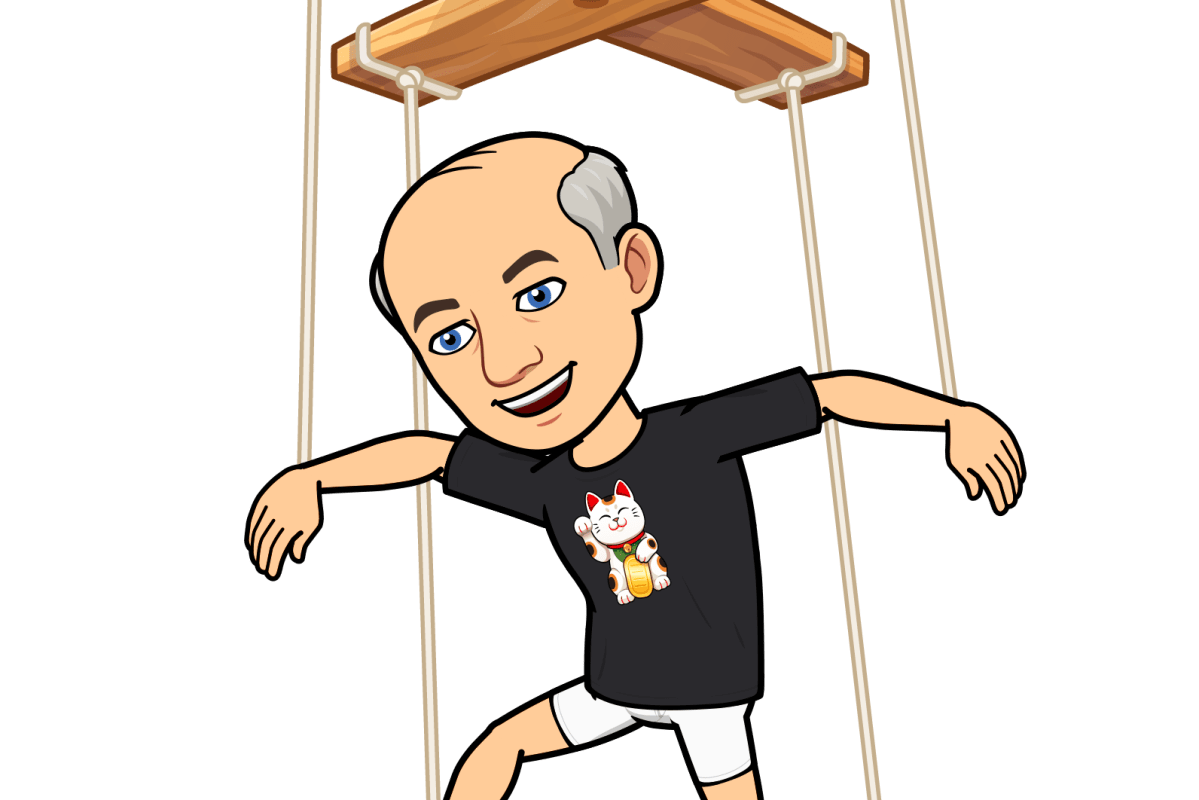
Free Will Scepticism: Determinism, Indeterminism, and Luck

Making video content for even the simplest of concepts is time-consuming, but I wanted to create some visual content. Even though this material is hardly controversial, I feel it is important to set the stage for more advanced conversations.

Video: Free Will Scepticism: Determinism, Indeterminism, and Luck

I am getting better at understanding how the video editor works, so subsequent videos should be of higher quality. As I use free repurposed video content, I am forced to accept what’s available. In plenty of cases, more apt content is available from Adobe or iStock, but I can’t justify purchasing content at this timeโ€”especially given that the channel isn’t even monetised. Patience.

Follows is the transcript I used as a guide.

Free Will Scepticism. Determinism, Indeterminism & Luck

[REDACTED]

In this segment of free will scepticism, I talk about what free will is, why itโ€™s important, and why it creates challenges that lead to a debate thatโ€™s lasted millennia.

Once weโ€™ve established a foundation, weโ€™ll look at the nemesis of free will that is determinism and its attendant nuancesโ€”indeterminism and luck.

As we unravel this problem, weโ€™ll evaluate the relationship between these and whether these competing concepts can coexist.

In future segments, I intend to dig deeper into the question of free will as it relates to human agency and moral responsibility.

Defining Free Will

A good starting point is to define our terms. As weโ€™ll discover, a fundamental challenge in the free will debate is that there is no common, agreed-upon definition, so letโ€™s at least put some on the table.

A quick Google search yields these two definitions.

  1. the apparent human ability to freely and consciously make choices that are not externally determined
  2. the doctrine that such human freedom of choice is not illusory
    Letโ€™s break down the first one by touching on the terms. This is an ability. No controversy here. Choices are the focus of this ability, and this ability is limited to humans. Not everyone limits the notion of free will to humans. In general, the reason free will gets so much attention is in relation to moral choice. As we donโ€™t generally impose morality on non-human animals, we can live with this for now.

Note that this definition concedes that this is just an apparent human ability. This is because some people believe that if free will exists at all, it is just an illusion.

This ability. Iโ€™ll drop the โ€˜apparentโ€™ qualifier so I donโ€™t come across like an attorney and their โ€˜allegedโ€™ perpetrator. This ability needs to be made freely and consciously. Free means without restriction, and consciously means with conscious intent. The definition further qualifies the free and conscious choice-making by stating that these choices are not externally determined. A person cannot be under a spell, hypnotised, or driven by unconscious intents. Weโ€™ll eventually see that disagreement centres around each of these terms, freely, conscious, and externally determined.

Stanford Encyclopaedia of Philosophy, an excellent online resource, defines free will as โ€˜a philosophical term of art for a particular sort of capacity of rational agents to choose a course of action from among various alternativesโ€™. The ability to freely make choices is a common thread for all of these.

Another way to think about free will is to ask if you could have chosen otherwise. This is a thought experiment, and weโ€™ll spend more time on this later. If you could turn back the clock and rerun the scenario, could you have chosen otherwise.
As Jerry Coyne put it, โ€˜if you could rerun the tape of your life up to the moment you make a choice, with every aspect of the universe configured identically, free will means that your choice could have been differentโ€™.
Letโ€™s work through a simple scenario with no moral implications. All of the events of your life have led up to this moment. A server asks, tea or coffee. You choose tea. Black or lemonโ€”or cream? Letโ€™s not get ahead of ourselves.
Letโ€™s re-run the scenario. Everything leading up to this server asking for your order is the sameโ€”the same seat at the same table, in the same restaurant, the same server. Even the same jelly stain on the curtain and the same blue Buick parked outside your window. And the same parent trying to quiet her unruly child. You get the idea. Everything until now has played out the same. Last time you ordered tea. Do you possess the free will to order coffee this time around?
We donโ€™t need to answer this question quite yet. Keep whatever idea you have and we can compare it against the competing perspectives.

You might be thinking, so what? Who cares? Why is free will so important?

Free will is not just some abstract philosophical concept. Philosophy gets accused of pondering topics with no application in the real world. What is the sound of one hand clapping sort of fare.

Free will is at the centre of human agency and autonomy. The only reason it makes sense to praise or blame someone is because they could have done otherwise. We might praise a robot that was programmed to rescue people from fires. Even if we marvelled at the achievement of the robot, weโ€™d more likely praise the programmer or the operator over the robot.

Likely more important than praise is blame. Humansโ€™ propensity for blame could be its own series, so letโ€™s just consider the notion idiomatically. If a person is remotely controlling a robot and steers it into your table, spilling your tea, you may be miffed at the robot, but your blame will be aimed at the one whoโ€™s holding the remote controller.

After blame comes punishment, or reward in the case of praise. This is another subdiscipline in its own right, so letโ€™s continue.

Many people just presume that free will exists, so where are the challenges?
First, the definition of free will is unstable, and it has drifted over time. Sometimes this has been innocent enough whilst at other times the definition has been amended to suit an argument. Sort of moving the goal posts. So, thereโ€™s no standard definition. This means that I can accept the notion under one definition and reject it under another. This hardly makes for fruitful debate.

Related to these first two is that for some people, the concept is reduced to something so narrow, so laser-focused, that it doesnโ€™t seem to matter in the real world. Daniel Dennett has said that heโ€™d be willing to concede that one doesnโ€™t have free will except in matters of decisions in the order of โ€˜one cube of sugar or two in your teaโ€™ or โ€˜taking the lavender blouse over the lilac oneโ€™. If you contend that this is the limiting boundary for free will, sure. Youโ€™ve got free will, for what itโ€™s worth.

Still others say that free will is nothing more than an illusion. That a person perceives having free will is akin to perceiving that the sun rises in the East. We know this not to be true, and yet it appears to be true. We even commit this faulty observation to language, and itโ€™s difficult not to envisage it differently.

The strongest position against free will comes from the Impossibilists, who hold unsurprisingly, the belief that free will is impossible given what we know about physical laws and the universe. Galen Strawson is likely the most notable of these people.

Determinism

Contrary to free will is Determinism. Defined, Determinism is the doctrine that all events, including human action, are ultimately determined by causes external to the will.

Ostensibly, this is a strong belief in cause and effect. That every event is caused by a prior event. The implication is that if one were to turn back time to the Big Bang and let history run again, everything down to the smallest atomic movement would run the same course of events. Absolutely nothing would change. This includes any thoughts and decisions. Unchanged.

Given this worldview, some philosophers have taken determinism to imply that individual human beings have no free will and cannot be held morally responsible for their actions.

Without going too deep, Determinism can be a view adopted from a sectarian or secular perspective. The sectarian narrative is that God created the natural laws and set the universe in motion. The secular vantage is that there are physical laws, and the big bang set the universe in motion. These days, not many people hold this view. Indeterminism is the reason.

Indeterminism

Indeterminism is another idea cursed with multiple definitions. The name originated as a counterargument to Determinism, hence the ‘in‘ prefix in the name. Not determinism.
Indeterminism says that deliberate choice and actions are not determined by or predictable from antecedent causes, or that although there may be deterministic behaviours in the universe,
not every event has a cause.

Iโ€™d like to qualify โ€˜not every event has a causeโ€™ to โ€˜not every event has a known causeโ€™ or some events have probabilistic causes, hence indeterminate. There is a bit of overlap here with the notion of luck, and weโ€™ll get to that presently.

Our knowledge of physics and the advent of quantum mechanics has put hard determinism out of favour. As we saw, under strict determinism, if we turned back time, the future would always unfold identically. Think of this as a film strip or a video. No matter how many times you replay it the events manifest the same way. You can warn the camper not to go down into the cellar alone, but every time, she will. You can almost think of this as a sort of fate, although one must be careful to note that rewinding and replaying to the parts weโ€™ve already seen does not mean that we can predict what we havenโ€™t.

Quantum physics notes that there are many events that are stochastic or probabilistic. So even if you rewound and played it again, it would be like the girl flipping a coin before opening the cellar doorโ€”or I suppose the director. Heads, she goes down. Tails, she remains up, or she gets a friend.

The less strict version of Indeterminism doesnโ€™t say that nothing is determined. Rather, that there are enough probabilistic events that we canโ€™t claim to know whatโ€™s going to happen next.

Luck

Then thereโ€™s luck. Luck is also indeterministic, but it tries to clarify some cases. By definition, luck is success or failure apparently brought by chance rather than through one’s own actions. If you flip a fair coin or throw a fair die or pull the handle on a slot machine, you may win or lose, but this outcome had nothing to do with you except that you were there at that moment. But there is more to it than this because a strict Determinist might claim that the outcome was determined by the state of molecules in history, that if you reran history, it would unfold the same way.

Apart from the luck that we tend to think of in gamblingโ€”good luck and badโ€”, there is the notion of moral luck, that is treating people as objects of moral judgement even when what they do depends on factors out of their control.

Not all luck is created equal, so letโ€™s look at the various flavours of luck. Most of these were articulated by Thomas Nagel.

Resultant Luck

Resultant luck is the way things turn out. This notion evaluates luck in reverse. It involves what is known as survivorship bias.

Iโ€™ll share a true story. An acquaintance of mine got married and took a honeymoon in Jamaica. On holiday, the couple ate some seafood. His wife became sick and was hospitalised. There she died.
One can imagine a story with a happier ending, where the couple took holiday and won a large cash prize in a casino, again a situation that could not have happened unless they had happened to be there.
In the first case, one might say she had bad luck. In the second case, her luck was good.

Circumstantial Luck

Circumstantial luck is the circumstance one finds oneself in. You had no control over how you got to a certain place, but because you got there, you are faced with a choice. The gist of this is that the choice would not have been given, so you would never have made it.

Perhaps, expecting you to be out, a burglar enters your home one evening and you confront him and he shoots you (or you shoot him; it doesnโ€™t matter). Maybe you were driving to someplace and another vehicle crashes into yours, totalling it. This is circumstantial. You had no intention of getting into an accident. Had you not been driving, this could not have happened. Perhaps, because of the accident, you won a lawsuit that yielded you a lot of money; perhaps, your back was irreparably damaged. Circumstantial luck.

Constitutive Luck

Constitutive luck relates to who one is or their traits and dispositions. Think of this as character. Some people are โ€˜bornโ€™ with a persuasive disposition. Some are born to excel at football or maths. Some are The Rain Man. This is the genetic lottery. Perhaps you want to be a famous singer. Only you canโ€™t sing. And maybe you can sing, but you lack charisma.

Billionaire Warren Buffett readily concedes that he would not likely be a billionaire if he happened to be born in India rather than the United States. This is constitutive luck.

Present Luck

Present luck is about luck at or around the moment of a putatively free action or decision point. This is a term used by Levy, borrowed from Mele. At any point in time, you are who you are and where you are as a matter of luck. You were born in a place at a time in history into a family. Heidegger called this โ€˜thrownnessโ€™. A person is thrown into this world and has to survive or not on their own terms. In any case, this family moulded you and schooled you with whatever constraints that they may have had: money, class, access, location. All the usual suspects. You interacted with the kids who were available. You got whatever teachers you got, and on and on. I think you get it. None of this is within your control.
Examples I think of are musical acts, bands like The Beatles, Korn, U2, and so many others that are comprised entirely or largely of friends. They just happened to be born in the same general time and vicinity. I imagine if either of these were different, they wouldnโ€™t have manifested the same way. Imagine Mozart being born in the 21st century. Perhaps heโ€™d be a YouTube star. Who knows?

Causal Luck

Causal luck is how one is determined by antecedent circumstances. This is the type of luck most closely aligned with free will and determinism. Simply put, it says that everything that preceded you is outside of your control as is everything leading up to what you have become. Causal luck is about the directional relationship between cause and effect.

For the record, some view causal luck as redundant to the combination of constitutive and circumstantial luck. I think thatโ€™s a fair charge, but letโ€™s continue and see how these concepts play together.

At the highest level, there are two competing perspectives. Free will and determinism are either incompatible or compatible. Letโ€™s begin with incompatibilism.

Incompatibilism

As it would seem, this view holds that free will and determinism are mutually exclusive. This holds for indeterminism as well. One cannot simultaneously hold the view that everything is determined, and that one can still manage to have free will in this determined universe.

A puppet is free as long as he loves his strings

SAM HARRIS

Sam Harris famously wrote, โ€˜a puppet is free as long as he loves his stringsโ€™. Harris is a neuroscientist and free will sceptic, who believes that free will is an illusion. And I was determined to not let this image go to waste.

Compatibilism

Finally, we have compatibilism, where the belief is that free will and determinism can coexistโ€”and do. There are two basic reasons this might be possible: metaphysics or emergence.

Metaphysics

Iโ€™ll let you know that I find the metaphysical argument to be weak tea. The argument is that maybe there is a god or something not bound by the constraints of our universe, who can put ideas into your brain, thus manipulating your decision. You were going to order tea, but this intervention led you to order coffee. I think that this perspective falls on its face right out of the gate. If some force is controlling you, the resulting actions may not have been predictably determined, but neither are they caused by you. In this scenario, this force might as well be the person controlling the robot to spill your tea.

Emergence

Then thereโ€™s emergence. Quickly, emergence is the notion that one can combine two or more elements with the outcome being a substance with different โ€˜emergentโ€™ properties. An example most people are familiar with is the combining of hydrogen and oxygen to produce water. Two Hs plus an O creates H20. Hydrogen and Oxygen are both gasses, but water is a liquid with a further emergent property of being wet.

The argument is that this free will occurs independently of all the inputs and processes. If this were true, then free will and determinism could coexist. There is no evidence of this, and Iโ€™ll just leave it here.
I intend to add to this by reviewing articles for and against free will and the compatibilist position.

Do you believe you have free will? If so, why. Are you a determinist or an indeterminist? Are you a compatibilist or an incompatibilist?

Let me know in the comments below.

[REDACTED]

Moral Responsibility

Can we be held morally responsible for our actions? Yes, says Daniel Dennett. No, says Gregg Caruso. Reader, you decide

Aeon Article, 4 October 2018

Caruso: [Dan,] you have famously argued that freedom evolves and that humans, alone among the animals, have evolved minds that give us free will and moral responsibility. I, on the other hand, have argued that what we do and the way we are is ultimately the result of factors beyond our control, and that because of this we are never morally responsible for our actions, in a particular but pervasive sense โ€“ the sense that would make us truly deserving of blame and praise, punishment and reward. While these two views appear to be at odds with each other, one of the things I would like to explore in this conversation is how far apart we actually are. I suspect that we may have more in common than some think โ€“ but I could be wrong. To begin, can you explain what you mean by โ€˜free willโ€™ and why you think humans alone have it?

Gregg Caruso

Dennett: A key word in understanding our differences is โ€˜controlโ€™. [Gregg,] you say โ€˜the way we are is ultimately the result of factors beyond our controlโ€™ and that is true of only those unfortunates who have not been able to become autonomous agents during their childhood upbringing. There really are people, with mental disabilities, who are not able to control themselves, but normal people can manage under all but the most extreme circumstances, and this difference is both morally important and obvious, once you divorce the idea of control from the idea of causation. Your past does not control you; for it to control you, it would have to be able to monitor feedback about your behaviour and adjust its interventions โ€“ which is nonsense.

In fact, if your past is roughly normal, it contains the causal chains that turned you into an autonomous, self-controlling agent. Lucky you. You werenโ€™t responsible for becoming an autonomous agent, but since you are one, it is entirely appropriate for the rest of us to hold you responsible for your deeds under all but the most dire circumstances. 

Daniel Dennett

if your past is roughly normal, it contains the causal chains that turned you into an autonomous, self-controlling agent

Dan Dennett

So commences this debate. The argument unfolds largely on semantic grounds. Even here, one can see the debate over the distinction between control and causation. I understand what Dennett is attempting to parse here, but I object on the grounds of causa sui.

I recommend reading the Aeon article as there is much more than this distinction, but it does remain a semantic issue. I started a post on backwards- and forward-looking perspectives, that better articulate Caruso’s perspective, but I am also working on other things. This was quicker to post and I wanted to keep a bookmark anyway, so it’s a win-win.

Determinism and Indeterminism

Without worrying about free will, here’s a quick look at determinism and indeterminism.

Determinism

Determinism effectively says that whatever happens in a causal chain results from what has happened before. If we could turn back time, the events would unfold identically.

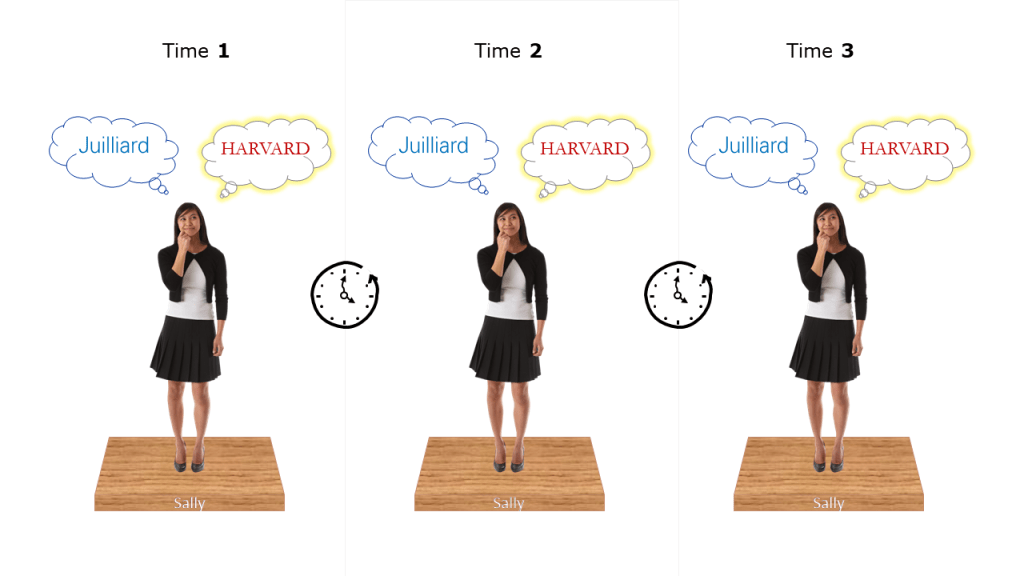
In a deterministic universe, borrowing from Peter van Inwagen’s example, if Sally has to choose between Julliard and Harvard, if she ‘chooses’ Harvard, the first time, and subsequent instance would see her making the same choice.

Indeterminism

Indeterminism effectively says, that whatever happens in a causal chain results from what has happened before. However, random events could alter the outcome. If we could turn back time, although events could unfold identically, they don’t have to.

In an indeterministic universe, borrowing again from Peter van Inwagen’s example, if Sally has to choose between Julliard and Harvard, if she ‘chooses’ Harvard, the first time, a subsequent instance might see her choosing Harvard again, but she might also choose Julliard. Since we have not entered free will into the arena, her choice was indeterminate but based on something entirely outside of her control. At some point, RNG entered the picture and tossed a 1 instead of a 0 thereby sealing her fate, as it were.

Again, absent the notion of free will, perhaps Sally was particularly inspired by a music teacher or a musician. Perhaps she just watched the Johnny Depp and Amber Heard trial and was compelled to fight for justice. Perhaps she was hungry or full. Perhaps she was stuck in traffic. Perhaps she was deciding during shark week.

Groundhog Day and Butterfly Effect

Another popular trope is that if we could rewind time, we could either effect change in the rerun through learning or just altering the past. We’ve seen this played out in movies like Groundhog Day, Butterfly Effect, the Back to the Future series, and so on. Time travel stories present several thought experiments that clearly play on the concept that we do have power over our environment. We’ll save this narrative for another day.

Life Debt

Abortion rights and a woman’s right to choose are on quick repeat in the latest news cycles as the SCOTUS has signalled that it wished to remove a woman’s right to choose. For most of us, it’s plainly obvious that this is codifying religious moral doctrine into lawโ€”Judeo-Christian beliefs to be more precise. This Christian belief is predicated on the notion that life is sacred.

In the West or at least in the United States citizens are inundated with this religious tripe, literally from infancy. It’s presented as sacrosanct, but this is not a universal belief.

One of my favourite stories in David Graeber’s Debt: The First 5,000 Years was the recounting of French philosopher Lucien Levy-Bruhl’s anecdotal observation that a man saved from drowning proceeded to ask his rescuer for remuneration for having saved his life.

As Graeber puts it, a man saved from drowning who proceeded to ask his rescuer to give him some nice clothes to wear, or another who, on being nursed back to health after having been savaged by a tiger, demanded a knife. One French missionary working in Central Africa insisted that such things happened to him on a regular basis:

You save a personโ€™s life, and you must expect to receive a visit from him before long; you are now under an obligation to him, and you will not get rid of him except by giving him presents.

In the early decades of the twentieth century, the French philosopher Lucien Levy-Bruhl, in an attempt to prove that โ€œnativesโ€ operated with an entirely different form of logic, compiled a list of similar stories: for instance, of a man saved from drowning who proceeded to ask his rescuer to give him some nice clothes to wear, or another who, on being nursed back to health after having been savaged by a tiger, demanded a knife. 

The interesting thing for me is the way this flips the sanctity of life narrative on its head. As Westerners, it is not only beat into our headsโ€”whether secular or sectarianโ€”, and this sanctity becomes the crux of the pro-life [sic] anti-abortion argument. But this sanctity is just another human construct. Part of the ‘be fruitful, go forth and multiply’ logic. This is arguably just more human hubris.

Of course, this is a slippery slope. Start undermining this narrative, and you start to see eugenic apologists coming out of the woodwork. In fact, we aren’t really that far removed from this notion. Whenever we encounter common enemies, one of the first tactics is to vilify and dehumanise them, so as to soothe the psyche, making it justify killing these subhuman species. In the end, the human mind is very facile.

Flavours of Free Will and Compatibilism

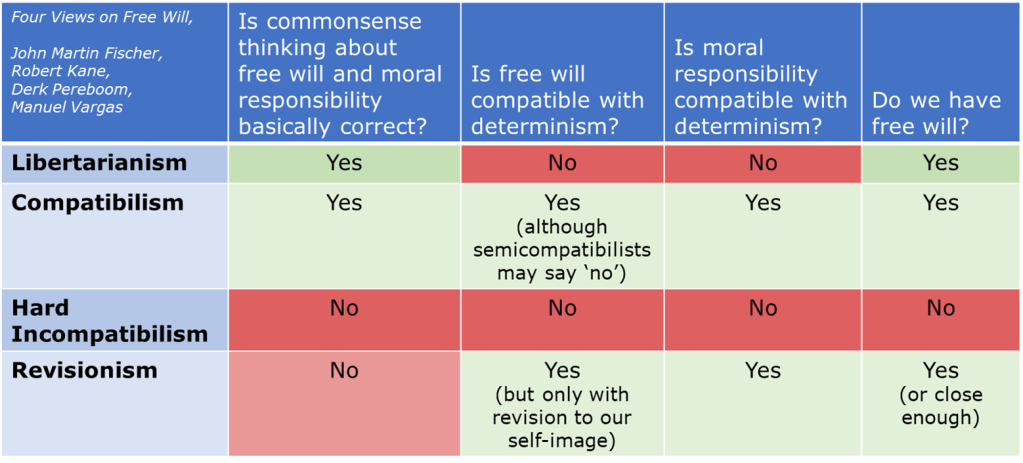
Reading Four Views on Free Will. In the introduction are some guiding definitions as well as this chart to help one to understand various views (row-wise) based on some questions (column-wise).

According to this chart, I’m a hard incompatibilist, As it reads,

  1. I don’t subscribe to notions of free will or moral responsibility.
  2. Free will and determinism cannot coexist in the same domain. (And the domain is the universe.)
  3. Moral responsibility cannot be assigned in a deterministic environment.
  4. Humans have no free will. (And neither can anything else.)

I’ve only read Robert Kane’s chapter so far. He’s a defender of Libertarianism.

John Martin Fischer is next. He’s known as a semi-compatibilist. We’ll find out what that means.

This is the end of a very short post, but I felt that the chart would be helpful for some.

Identity and Responsibility

Self and identity are cognitive heuristic constructions that allow us to make sense of the world and provide continuity in the same way we create constellations from the situation of stars, imagining Ursa Major, the little dipper, or something else. The self and identity are essentially expressions of apophenia.

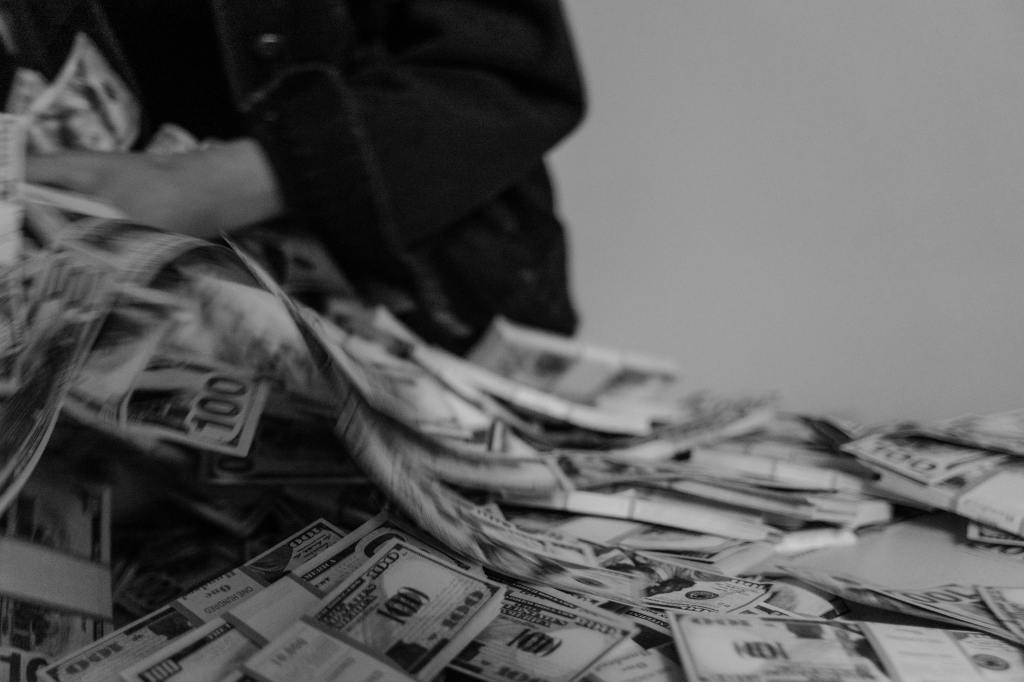
Consider this thought experiment about responsibility. Rob decides to rob a bank. He spends weeks casing the target location. He makes elaborate plans, drawing maps. and noting routines and schedules. He gets a gun, and one day he follows through on his plans, and he successfully robs the bank, escaping with a large sum of money in a box with the name of the bank printed on it. Rob is not a seasoned criminal, and so he leaves much incriminating evidence at the scene. To make it even more obvious, he drops his wallet at the scene of the crime containing his driverโ€™s licence with fingerprints and DNA on the licence and other contents of his wallet. He leaves prints and DNA on the counter where he waited for the money. This wallet even contains a handwritten checklist of steps to take to rob this bankโ€”the address of the bank, the time and date. All of this left no doubt about who robbed the bank.

The self and identity are essentially expressions of apophenia.

Using this evidence, the police show up at Robโ€™s apartment to arrest him. They knock on the door and identify themselves as law enforcement officers. Rob opens the door and invites them in. All of the purloined money is still in the box with the name of the bank printed on it. Itโ€™s on a table in plain sight next to the gun he used. All of his maps, plans and, surveillance notes are in the room, too. They read him his rights and arrest him. Things arenโ€™t looking good for Rob.

Before I continue this narrative, ask yourself is Rob responsible for robbing the bank? Letโ€™s ignore the question of whether Rob has agency. For this example, I am willing to ignore my contention that no one has or can have agency. Besides, the court will continue to presume agency long after itโ€™s been determined that it is impossible because agency is a necessary ingredient to law and jurisprudence.

Is Rob responsible? Should he be convicted of armed robbery and sentenced to incarceration? Letโ€™s make it even easier. This isnโ€™t Robโ€™s first offence. In fact, heโ€™s been in prison before for some other crimes he committed. Heโ€™s no first-time offender. Why do you think that heโ€™s responsible? More importantly, why should he be convicted and sentenced? What should his sentence be?

Consider that the money has been recovered, no one was injured, and Rob didnโ€™t resist arrest. At first glance, we might consider both restorative and retributive justice. Iโ€™ve purposely made it easy to ignore restorative justice as all the money was recovered. This leaves us with retributive justice. What should happen to Rob? What would you do if you were the judge? Why? Hold that thought.

Letโ€™s continue the narrative. All of the above happened, but I left out some details. Because of course I did. After the heist, Rob returned home and he lost his balance and hit his head rendering him an amnesiacโ€”diagnosed with permanent retrograde and dissociative amnesia. Because of the retrograde amnesia, Rob canโ€™t remember anything prior to hitting his head. Because of the dissociation, Rob has no recollection of anything about himself, not even his name. In fact, he now only responds to the name Ash. (This is where I debate whether to have Rob experience a gender-identity swap, but I convince myself to slow my roll and focus on one thought experiment at a time.)

Because of the retrograde amnesia, Rob canโ€™t remember anything prior to hitting his head. Because of the dissociation, Rob has no recollection of anything about himself

To make this as obvious as I can consider, Ash has no recollection of Rob, robbing the bank, or anything about Rob. Ash doesnโ€™t know Robโ€™s friends or family. Ostensibly Ash is a different person inhabiting former-Robโ€™s body. To make it even easier, Ash is not feigning this condition. So, letโ€™s not try to use that as an out when I ask you to reconsider responsibility.

If my experience serves as a guide, if I asked you about your response to whether Rob was responsible and what his sentence should be, you would be committed to your same response and for the same reasons, so I wonโ€™t ask again.

What I ask now is if Ash is responsible and what his sentence should be. Keep in mind that we should be able to ignore the restorative element and focus on the retributive aspect. What should happen to Ash? What would you do if you were the judge? Whether your response has changed or remained the same, why would you judge Ash this way?

Here are some considerations:

  • Retributive justice might serve as a lesson to other would-be offenders.
  • The public may not believe the amnesia excuseโ€”even though you, as judge, are convinced thoroughly.
  • Ash does not believe he committed the crime and does not comprehend the charges.
  • Ash was surprised to discover the money and gun and was pondering how it got there and what to do with it when the police arrived at his apartment.
  • If released, Ash would not commit a crime in the future. (My thought experiment, my rules; the point being that Ash was no threat to society.)
  • From my perspective, Ash is a different person. Sentencing Ash is ostensibly the same as sentencing any person arbitrarily.

The purpose of this experiment is to exaggerate the concept of multiple selves. Some have argued that there is no self; there is just a constructed narrative stitching discrete selves together to create a continuous flow of self-ness.

Is Ash responsible for Robโ€™s action?

Iโ€™m interested in hearing what you think. Is Ash responsible for Robโ€™s action, and why or why not? Let me know.

Human Agency is an Illusion

I just published a video on YouTubeโ€”just over 7 minutes long. I’ll be publishing the audio as a podcast and will share the script here as well.

Human Agency is an illusion. This is the end of the story. If you listen for a while, youโ€™ll hear as I rewind and pull back the curtains.

[Redacted]

Letโ€™s get started.

Human Agency is an illusion.

Think of life as a motion picture thatโ€™s already been filmed. The ending is already known. The script has been written and performed by actors already chosen and hired.

I like this visual, but itโ€™s not quite right. The end is not known in the same sense as that of the movie. Itโ€™s just as inevitable, just unknown.

Some might prefer to use the metaphor of cascading dominos. And this might even play better into the illusion. Some unforeseen force might intervene and stop the otherwise inevitable. But even this is beyond our control. Like an action-adventure story, weโ€™re strapped into a runaway train and just along for the ride. This train might someday stop, but weโ€™ll have had nothing to do with it. Enough of metaphors. What am I saying? Why am I saying it? And what does it mean?

Allow me to set up the scene. From there, Iโ€™ll elaborate.

For millennia, thereโ€™s been a debate over free will and determinism. These terms have been defined in different ways in an attempt to sway the argument for or against, one way or another. It turns out that for the human agency illusion, it doesnโ€™t much matter, but it might still help to set the stage, so letโ€™s establish some foundation. I like to consider free will and determinism as bookends.

free will is the ability to make a choice
and have had the ability to have chosen otherwise

Commonly, free will is the ability to make a choice and have had the ability to have chosen otherwise. That one can make this choice of their own accord or volition, is typically added for good measure. On the other hand, determinism says that everything that happens is determined by everything that has happened prior in a chain of cause and effect. Like dominoes falling one after another, so some event has caused another event since the dawn of time. Perhaps before time.

Some have argued that random events occur in our universe. Quantum theory suggests this. But that these events happen, doesnโ€™t mean that we as humans have any say in the matter. This is what is known as indeterminism. Causes and effects are not so cut and dry. Some stochastic event serving as an exogenous factor manifesting as a pigeon, can swoop down and break the causal domino chain, but that doesnโ€™t afford us human agency. A little more background. Some hold that free will and these alternatives are either mutually exclusive, or theyโ€™re compatible with each other. Not surprisingly, those who believe that these can coexist are called compatibilists, whilst the others are incompatibilists.

What I am saying is that if we allow that this wide shot might have validity, we can zoom in for a tight shot on the agent and notice that it doesnโ€™t really matter. Some have said that the freewill versus alternatives challenge is a pseudo-problem. I am going to agree for the time being, if only for expedience.
Before getting to the illusion of agency, letโ€™s see why this situation creates problems.

Without getting too deep, humans seem to be wired to view their reality in a manner of cause and effect. Moreover, they seem wired to attribute blame based on this presumed causal relationship. Oksana hit a homerun. We should praise her. Raj robbed a store. We should blame him. Western society is constructed with this worldview, so we create rules and laws. We may even choose to codify how to rehabilitate or punish him. Or to reward her.

Without agency, there is no cause to praise or blame

Without agency, there is no cause to praise or blame. Whilst I consider it a pathology, for better or for worse, given the human propensity to blame concomitant with the agency illusion, I donโ€™t see this changing any time soon.

There are arguments around quarantining bad actors independent of their agency or lack thereof on the grounds of public safety. Even this logic has serious holes, but weโ€™ll save that for another time.
And now the big reveal. With a reminder that my intent is to not go deep, how can I say that human agency is an illusion? Letโ€™s start with the science.

As a lifeform, humans are a product of heredity, genetics, and epigenetics. Essentially, DNA passes information from generation to generation. Besides determining our physical attributesโ€”head, shoulders, knees, and toes, potential height and weight, pigmentation, sex, and so on, it also establishes our temperamentโ€”our base attitude and way we perceive and interpret the world. This doesnโ€™t make us clones or robots or automatons, but it does comprise some percentage of what we are. Identity politics aside, we donโ€™t have much control of our sex, finger count, or eye colour. Clearly, we arenโ€™t talking about trans-humans and cyborgs here.

Genetics and so on arenโ€™t the only factor. Behaviourists will remind us that the environment and circumstances mould us, too. Each of us is taught mores and moral codes; how to behave and act. We are raised in a structure comprised of family, school, church, peers, larger society, authority figures, and whatever elseโ€”ostensibly like a sausage being stuffed into a skin.

Beyond the genetics that we have no control over,
we are products of our environment

Beyond the genetics that we have no control over, we are products of our environment. These things interact, but there is nothing of us that we are responsible for creating. Despite the motivational tripe, we cannot create ourselves. This, too, is an illusionโ€”delusion if I am being less charitable.

Iโ€™ll reserve elaboration for future content. In a nutshell, youโ€™ve got no agency. Every choice you make is based on prior events. Even something as simple as choosing to order a chocolate or vanilla ice cream in a cup or a cone, sugar cone or waffle cone is predicated on some prior events, and you had nothing to do with them. You were a passive vessel.

Iโ€™ll leave with two relevant quotes.

A man can do what he wants, but not want what he wants.

Arthur Schopenhauer

And as Galen Strawson puts it,

  1. You do what you do, in any given situation, because of the way you are.
  2. So in order to be ultimately responsible for what you do, you have to be ultimately responsible for the way you areโ€”at least in certain crucial mental respects.
  3. But you cannot be ultimately responsible for the way you are in any respect at all.
  4. So you cannot be ultimately responsible for what you do.

So there you have it. I hope you found this cursory treatment interesting and informative if not provocative.

[Redacted]

Iโ€™m interested in hearing what you think. Do you think you have agency? Do we have free will, or is everything determined at the start? I didnโ€™t even mention religion. Does that throw a spanner in the works? Let me know.

Evolution of Free Will

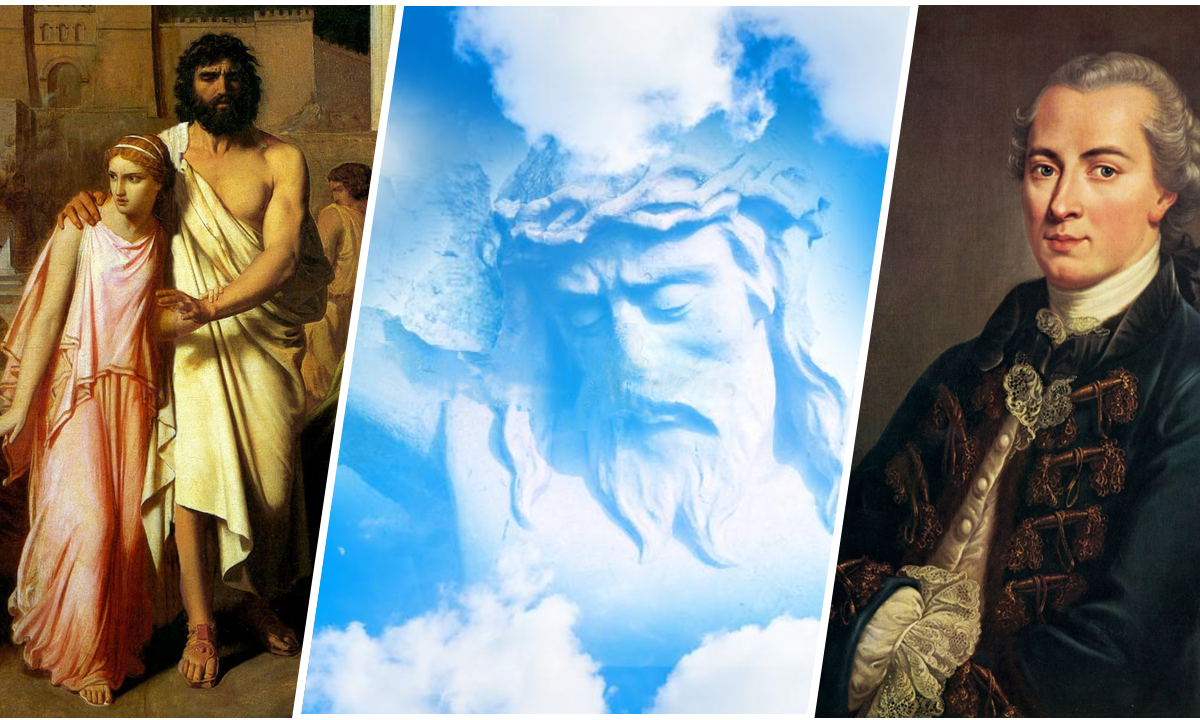
The more I read about free will the more I feel that it is a modern invention. I don’t mean to claim that this is cut and dry, but as the image accompanying this post suggests, Sophocles’ story of ล’dipus Rex is precisely about a man attempting to escape his fate. Without getting mired in a discussion about the distinction between fate and determinism, we understand that the plight of ล’dipus is set in stone.

As I said, I am simplifying as I know there are authors debating free will before this, but it is also known that many people simply believed that their lives were governed. I suspect that in certain slave societies this might be a source of comfort. If Buddhist thought that life is suffering holds true, what better consolation than it was just meant to be, I might as well just make the best of it.

Enter Christianity and Aquinus. Their god may have set things up, but there can be no notion of growth or responsibility without free will, so we’d better create a narrative around this. How an omniscient creator can not know every possible plotline and twist remains a question, though rationale akin to retrograde motion has been suggested to accommodate it. Now, it seems that we’ve got a little less determined and a little freer if I think of it as a zero-sum game.

Si Dieu nโ€™existait pas, il faudrait lโ€™inventer

Voltaire, ร‰pรฎtre ร  l’Auteur du Livre des Trois Imposteurs (1769)

By the time Kant enters the picture, he rather spills the beans on the whole narrative. Perhaps riffing on Voltaire’s quip, ‘If God did not exist, it would be necessary to invent Him‘. Kant tells us that if we need to blame people and presume responsibility, then we need to assume free will. And so we did.

In this day and age, most people have been marinated in this worldview, so it’s difficult to see outside of this frame. The rhetoric of free will has been particularly effective. Though we have evidence of free will not being dominant in some cultural conversations, we have little idea in preliterate societies. I’d be interested to gain additional perspective from historians or anthropologists. Some may have already been published. I’ve already been so overwhelmed with the deluge of information and opinions to date. I’ve learned much and have been introduced to many new scholars. As I wrote the other day, this is somewhat daunting. I wish I were a grad student and could justify spending so much time trying to justify my position.

The Appointment in Samarra*

There was a merchant in Bagdad who sent his servant to market to buy provisions and in a little while the servant came back, white and trembling, and said, Master, just now when I was in the marketplace I was jostled by a woman in the crowd and when I turned I saw it was Death that jostled me. She looked at me and made a threatening gesture, now, lend me your horse, and I will ride away from this city and avoid my fate. I will go to Samarra and there Death will not find me. The merchant lent him his horse, and the servant mounted it, and he dug his spurs in its flanks and as fast as the horse could gallop he went. Then the merchant went down to the marketplace and he saw me standing in the crowd and he came to me and said, why did you make a threatening gesture to my servant when you saw him this morning? That was not a threatening gesture, I said, it was only a start of surprise. I was astonished to see him in Bagdad, for I had an appointment with him tonight in Samarra.

I was astonished to see him in Bagdad,
for I had an appointment with him tonight in Samarra.

Death

I love this story of fatalism. Originally from the Babylonian Talmud, Sukkah 53a, it’s a story about one attempting to alter their determined fate. An interesting side-comment on the original version. The last line attributes fate to the servant’s feet.

A man’s feet are responsible for him; they lead him to the place where he is wanted

Babylonian Talmud, Sukkah 53a

This interpretation would allow for the feet to be determined but in conflict with the intellect and reason of the head, much as is said about the conflict between the head and the heart. It could be argued that the only fate this accounts for is that of death, but that’s well beyond my scope of inquiry.

Final Note

Some people seem to not quite grasp the distinction between constructed and unreal. Many things are human social constructs, from money to states and countries, to nations, to governments, to ethnicities, and to gender. Even sex. All of my favourite weasel words are constructs.

But there’s a difference between money and unicorns. No amount of money can buy you a unicorn. This is the difference between fiction and figment. We can say that money is ‘real’ insomuch as it affects our everyday lives. We transact. We buy things. We sell things. It’s an agreed-upon medium of exchange. Without going into details, long before cryptocurrency, most money is in the form of computer bits and bytesโ€”rather it has no form. The currency and coins we can touch are a small fraction of the money that exists. The money behind your credit card or debit card is not banknotesโ€”and it’s not gold. When a central bank wants to create money, it simply has to type a number in a computer register and press enter, and it exists.

So whilst each of these is pretend, some things are manifest in our ‘real’ world and have real-world implications. Not so much for unicorns and fairies.


* The Appointment in Samarra as retold by W Somerset Maugham (1933)

Raising Kane

Robert Kane’s chapter in Four Views on Free Will is titled Libertarianism, and I’ve just finished it. I’ve been writing in the margins, and I’ll summarise my thoughts here.

TL;DR

As I wrote in my last post, I don’t find the Libertarian position on free will and agency compelling. Kane made some interesting points, but none persuaded me to buy what he was selling. The biggest challenge I had was to maintain focus because I think he was chasing red herringsโ€”at least given my focus on agency. He spent a lot of time tearing down determinism and indeterminism instead of building up his own position. I feel the debate centres around agency. I waited for him to explain how this agency operated, but he just assumes agencyโ€”or at least a self to possess agencyโ€”from the start. I am not convinced. If you are interested, my more detailed commentary follows.

The Rest of the Story

My intent at the start is to approach this chronologically as I retrace my marginalia, hoping to recall whatever prompted my notes in the first place. I’ll be quoting or paraphrasing Kane’s positions to serve as a reference in the event you don’t have access to the book.

1, Determinism and the Garden of Forking Paths

Kane starts off by mentioning that determinism implies that ‘given the past and the laws of nature at any given time, there is only one possible future‘. Within this unvarying environment, he writes, ‘We believe we have free will when we view ourselves as agents‘. I don’t disagree with either of these points, and, as agents, we are ‘capable of influencing the world in various ways‘.

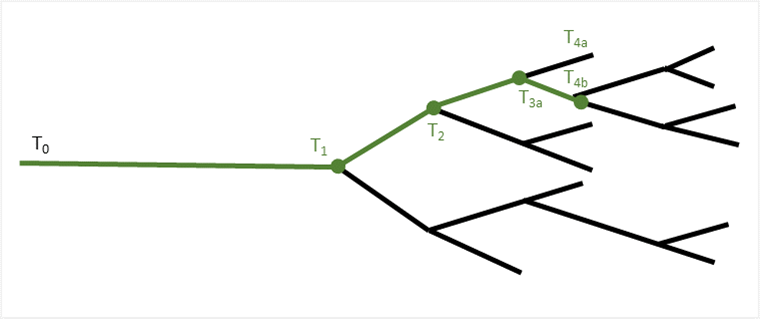
Kane introduces a garden of forking paths illustration, which I’ve recreated here.

Garden of Forking Paths

He uses this as a visual decision tree, where an actor traverses the branches and makes decisions at the various vertices. To breathe life into this tree, he gives us one of several forthcoming examples. He introduces us to Jane.

In his scenario, Jane is faced with a decision with one of two possible outcomes, and ‘she believes there is more than one possible path into the future available to her and it is โ€œup to herโ€ which of these paths will be taken‘. He continues, ‘This picture of different possible paths into the future is also essential, I believe, to what it means to be a person and to live a human life‘.

And herein lies the rub. Jane is not making these decisions in a vacuum. She is a puppet to forces beyond her control. I shouldn’t be so hard on psychology and Freud, but as Luke 23:34 of the Christian Bible relates, ‘Forgive them, for they know not what they do’.

Then Kane reinforces that if determinism were true that Jane would not have free will before bringing up the idea of responsibility, that ‘free will is โ€ฆ intimately related to notions of accountability, blameworthiness, and praiseworthiness for actions‘. I agree with Kane here.

Next, he invokes an emotional appeal-to-nature argument, asking us to imagine a ‘young man [who] is on trial for an assault and robbery in which his victim was beaten to death.’ He suggests that our tendency to blame this man is natural, but that we might search for mitigating circumstances that might account for his actions. He leaves us with a question, Did these influences entirely determine his actions, or did they โ€œleave anything overโ€ for him to be responsible for?

I have this question, too, but as I said, this is an appeal to emotion in the way Westerners have been conditioned to believe. There is little reason to accept this as some sort of universal law or principle.

2. Modern Challenges to Libertarian Free Will

He starts this section as follows, ‘I will be defending the libertarian view of free will in this volume. We libertarians typically believe that a free will that is incompatible with determinism is required for us to be truly morally responsible for our actions, so that genuine moral responsibility, as well as free will, is incompatible with determinism.’

He continues his setup, ‘A goal of this essay is therefore to consider this modern attack on the traditional libertarian view of free will and to ask how, and whether, it can be answered. Much is at stake, it seems to me, in knowing whether we do or do not have a freedom of the will of the ultimate kind that libertarians defend. The modern attack on it has two parts‘.

Part 1: The first prong of the modern attack on libertarian free will comes from compatibilists, who argue that, despite appearances to the contrary, determinism does not really conflict with free will at all.

[A]ccording to compatibilists, esoteric questions about whether determinism is true or not โ€“ in the physical or psychological sciences โ€“ are irrelevant to the freedoms we really care about in everyday life. All the varieties of free will โ€œworth wantingโ€ (as a modern compatibilist, Daniel Dennett, has put it) do not require the falsity of determinism for us to possess them, as the traditional libertarian view of free will suggests.

He informs the reader, ‘Influential philosophers of the modern era, such as Thomas Hobbes, John Locke, David Hume and John Stuart Mill, were all compatibilists‘.

Kane ends part 1 with, ‘If compatibilists are right, we can have both free will and determinism; and we need not worry that increasing scientific knowledge about nature and human beings will somehow undermine our ordinary convictions that we are free and responsible agents.’

I agree with this statement. It’s also why I consider agency to be the pivotal target, not determinism.

In part 2, he writes ‘The second prong goes further, arguing that libertarian free will itself is impossible or unintelligible and has no place in the modern scientific picture of the world.

He conveys that ‘modern defenders of libertarianism, such as Immanuel Kant, have argued that we need to believe in libertarian free will to make sense of morality and genuine responsibility, but we can never completely understand such a free will in theoretical and scientific terms.’

This is a good point, and Kant is correct. As a moral non-cognitivist, I feel that morality is a non-sensical human social construct. Inventing free will to make sense of another invention doesn’t get much sympathy from me. Kant finishes with an appeal to noumenism, yet another concept I’ve got no time for.

Next, Kane introduces us to another foe of free will, indeterminism. ‘Events that are undetermined, such as quantum jumps in atoms, happen merely by chance. So if free actions were undetermined, as libertarians claim, it seems that they too would happen by chance.’

He ends this section with two issues a libertarian must address:

  • The Compatibility Problem: free will really is incompatible with determinism
  • The Intelligibility Problem: indeterminism can be made intelligible and how, if at all, such a free will can be reconciled with modern scientific views

3. Is Free Will Incompatible with Determinism?: The Consequence Argument

Kane opens with a plea, ‘[L]ibertarians who believe free will is incompatible with determinism can no longer merely rely on intuitions about โ€œforking pathsโ€ into the future to support their view that determinism conflicts with free will. These intuitions must be backed up with arguments that show why free will must be incompatible with determinism.

If determinism is true, then our acts are the consequences of the laws of nature and events in the remote past. But it is not up to us what went on before we were born; and neither is it up to us what the laws of nature are. Therefore the consequences of these things (including our own acts) are not up to us.

Peter van Inwagen, An Essay on Free Will, Oxford: Clarendon Press, 1983, p. 16

Then he sets up The Consequence Argument:

  1. There is nothing we can now do to change the past.
  2. There is nothing we can now do to change the laws of nature.
  3. There is nothing we can now do to change the past and the laws of nature.
  4. If determinism is true, our present actions are necessary consequences of the past and the laws of nature.
  5. Therefore, there is nothing we can now do to change the fact that our present actions occur.

In other words, we cannot now do otherwise than we actually do.

Indeed, I agree in principle with the logic, but I’ll reiterate that I feel that the entire determinism angle is a red herring. Next, Kane goes into a discussion about the Transfer of Powerlessness Principle.

In essence, TP ‘says in effect that if you are powerless to change something X, and something else Y is necessarily going to occur if X does, then you are also powerless to change Y.

As I don’t think it’s’ important to my ends and I agree with Kane’s critique of this tailing logic, if you are powerless to change something X, and something else Y is necessarily going to occur if X does, then you are also powerless to change Y.

Finally, he argues that there is a likely insurmountable semantic challenge that accepting one meaning of ‘can’ and ‘power’ (and some other terms) will determine [pun intended] if one is a compatibilist or not.

4. Ultimate Responsibility

Carrying over from the previous section, Kane reminds us that ‘as a result of this impasse, philosophical debates have multiplied about just what โ€œcanโ€ and โ€œpowerโ€ (and related expressions, such as โ€œcould have done otherwiseโ€) really mean‘. But he also concedes that ‘The problem is that focusing on โ€œalternative possibilitiesโ€ (or โ€œforking pathsโ€ into the future) or the โ€œpower to do otherwiseโ€ alone, as the Consequence Argument does, is too thin a basis on which to rest the case for the incompatibility of free will and determinism.’

He sets up his position.

  1. Free will seems to require that open alternatives or alternative possibilities [AP] lie before us โ€“ a garden of forking paths โ€“ and it is โ€œup to usโ€ which of these alternatives we choose.
  2. Free will also seems to require that the sources or origins of our actions lie โ€œin usโ€ rather than in something else.

This second point he terms ultimate responsibility [UR].

The basic idea of UR is this: To be ultimately responsible for an action, an agent must be responsible for anything that is a sufficient cause or motive for the actionโ€™s occurring.

To be ultimately responsible for the choice, the agent must be at least in part responsible by virtue of choices or actions voluntarily performed in the past for having the character and motives he or she now has.

This is what I am waiting for him to resolve. A red flag that has me on alert is the term character. This is on my list of weasel words. He also cites Aristotle as a referenceโ€”also relative to characterโ€”, so that’s a double red flag in my book.

He returns to his post that free will ‘does require that we could have done otherwise with respect to some acts in our past life histories by which we formed our present characters. I call these earlier acts by which we formed our present characters โ€œself-forming actions,โ€ or SFAs‘.

My causa sui post already illustrates that Kane doesn’t actually answer the question of how the self forms the so-called self-forming actions. He just invents the term, appeals to idiomatic notions of self and declares victory. I recent post discussed the challenges with self.

In the sense that the enemy of my enemy is my friend, he name-drops Daniel Dennett and a story Dennett had cited involving Martin Luther initiation of the Protestant Reformation. Luther said, โ€œHere I stand, I can do no other.โ€

Kane then argues that Dennett’s deterministic interpretation is incorrect, but given that Dennett is a compatibilist, he doesn’t care if Luther was free or determined in a deterministic universe.

So the ability to do otherwise (โ€œcould have done otherwiseโ€) or AP, says Dennett, is not required for moral responsibility or free will.

In the end, we are back into a language gameโ€”a semantic pissing match.

Continuing with Luther, Kane concedes, ‘We can grant that Luther could have been responsible for this act, even though he could not have done otherwise then and there and even if his act was determined. But this would be so, if UR is required, only to the extent that Luther was responsible for his present motives and character by virtue of some earlier struggles and self-forming actions.

I’m still left wondering how and when Kane is going to prove this argument.

Kane provides more context by telling us that an agent requires sufficient cause of motive, but he never does define sufficient. He is also aware that a causal chain can lead us back to the dawn of time, so he’s devised an angle:

‘The only way to stop this regress is to suppose that some acts in our life histories must lack sufficient causes altogether.’

Perfect. Let’s see how this works.

Now he’s bringing in his SFAs and character. No thank you, please.

‘UR makes explicit something that is often hidden in free will debates, namely that free will โ€“ as opposed to mere freedom of action โ€“ is about the forming and shaping of character and motives which are the sources or origins of praiseworthy or blameworthy, virtuous or vicious, actions.’

This is where the psychobabble word salad comes in full force. It feels that Kane is employing circular reasoning and claiming that free will is necessary to shape the character necessary to have free will. Perhaps I am missing something.

‘If persons are responsible for the wicked (or noble, shameful, heroic, generous, treacherous, kind or cruel) acts that flow from their wills (characters and motives), they must at some point be responsible for forming the wills from which these acts flow

This ‘forming’ argument feels like a non-sequitur. Let’s keep going.

5. Ultimate Responsibility and Alternative Possibilities

‘When one argues about the incompatibility of free will and determinism from alternative possibilities or AP (as in the Consequence Argument), the focus is on notions of โ€œnecessity,โ€ โ€œpossibility,โ€ โ€œpower,โ€ โ€œability,โ€ โ€œcan,โ€ and โ€œcould have done otherwise.โ€ By contrast, the argument from UR focuses on a different set of concerns about the โ€œsources,โ€ โ€œgrounds,โ€ โ€œreasons,โ€ and โ€œexplanationsโ€ of our wills, characters, and purposes. Where did our motives and purposes come from, who produced them, who is responsible for them?’

These are my questions as well. He provides his answers to his own question:

‘To understand the connection between AP and UR, alternative possibilities and ultimate responsibility, we must first note that having alternative possibilities for oneโ€™s action โ€“ though it may be necessary for free will โ€“ is not sufficient for free will, even if the alternative possibilities should also be un-determined. This can be shown by noting that there are examples in which agents may have alternative possibilities and their actions are undetermined, and yet the agents lack free will.’

I can’t wait.

Next, he witters on about God and determinism and leaves us with the conclusion that ‘persons in such a world lack free will‘. Whew! Good thing.

I haven’t really addressed the issue here, but the very concept of will doesn’t sit right with me. It feels a bit magical, but let’s just leave that here.

This assertion relies on volition, cause, and motiveโ€”volition and motive feeling pretty weaselly.

Around here, he conveys a story about an assassin that I feel totally misses the mark. Pun intended because in this story, the assassin intent on shooting the Prime Minister gets an involuntary twitch and kills the aide instead.

‘UR captures this additional requirement of being the ultimate source of oneโ€™s will that is lacking in this imagined world. For UR says that we must be responsible by virtue of our voluntary actions for anything that is a sufficient cause or a sufficient motive (or reason) for our acting as we do.’

Kane says that the will of the assassin is sufficient motive and reason. I disagree. I’ll circle back to this in a moment with a robot assassin analogy. Kane goes on to say ‘Anything else he might do (miss the prime minister, kill the aide) would be done only by accident or mistake, unintentionally or unwillingly‘.

This second part is particularly interesting to me. If his intent was to kill the Prime Minister and failed but killed the aide without intention, does this mean he’s not culpable?

Kane tells us that ‘we are interested in whether they could have acted in more than one way voluntarily, intentionally, and rationally, rather than only in one way voluntarily, intentionally, and rationally and in other ways merely by accident or mistake, unintentionally or irrationally.

Kane revisits UR: If (i) free will requires (ii) ultimate responsibility for our wills as well as for our actions, then it requires (iii) will-setting actions at some points in our lives; and will-setting actions require (iv) the plurality conditions, the ability to act in more than one way voluntarily, intentionally and rationally.

I’m feeling strongly that a person agreeing with this line of argumentation has to already agree with the underlying conditions. In fact, one cannot will oneself to believe in free will if one doesn’t and vice versa. I’m not inclined to agree.

Kane injects pangs of conscience into the equation. I’ll ignore it, as conscience in this context is wholly constructed. I understand that Kane wants to say that conscience is an impetus for free. I’ll disagree and level it at that.

If we are to be ultimately responsible for our own wills, some of our actions must be such that we could have done otherwise, because some of them must have been such that we could have done otherwise voluntarily, intentionally, and rationally.

We are still in agreement. Now what?

He closes with a dual regress of free will. We need to be ultimate sources of our actions and ultimate sources of our actions wills.

6. The Intelligibility Problem: Is Libertarian Free Will Possible?

Can we make sense of a free will that requires Ultimate Responsibility of the kind described in the previous section? Can we really be the ultimate designers of our own ends and purposes? There are many skeptics about free will who think not. They argue that being the ultimate source of oneโ€™s will and actions is an incoherent and impossible idealโ€ฆ

Please. Are we there yet?

The โ€œIntelligibility Problemโ€ says that incompatibilist free will requires that ultimate responsibility is intelligible or possible and can be reconciled with modern scientific views of human beings.

Kane articulates how indeterminism and probability might affect free will and how, given the ‘exactly same past’, can possibly arrive at different outcomes on our forking paths. He provides an example. I’ll relate it, but mostly to critique his narrative.

Recalling the forking paths we have two scenarios. The premise is that, in the first scenario, John has to decide whether to travel to Hawaii or Colorado. Based on the state of his person, he chose Hawaii.

This can be illustrated about be following the green line from point T0 to T4b. At decision point T3a, John had to choose between Hawaii and Colorado. T4a represents his Hawaii preference.

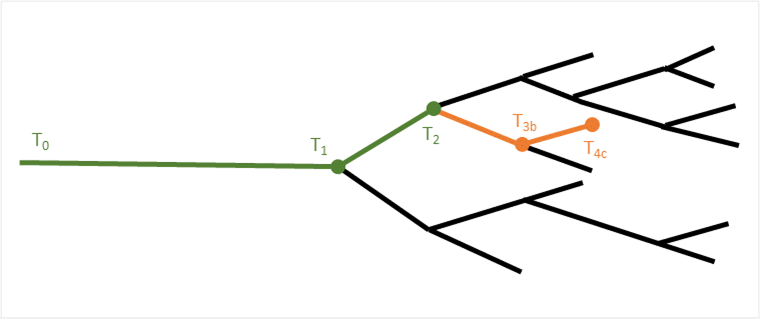
Still looking at the same chart (above), under the second scenario, something ever so slightly changed and John could have chosen the top branch rather than the lower branch, thus choosing Colorado instead.

‘โ€œIf the past had been just a tiny bit different, then John might have sensibly and rationally chosen differently (chosen Colorado instead).โ€ Determinists and compatibilists can say this.’

The problem (referring to the chart below) is that a different choice at T2, no matter how small or seemingly insignificant, would have put him on a different path, choosing T3b on the lower branch over T3a on the upper branch. Therefore, the T4b option stemming from the upper T3a branch is not the same T4c option on the lower branch. Instead of a choice of travelling to Hawaii or Colorado, the choice may have between chicken or steak for dinner.

Whilst it is conceivable that the Colorado versus Hawaii decision might still occur, the person at T3 is not the same person.

Kane reintroduces Kant’s noumenal self by name, but he quickly discounts it on the grounds of obscurantism or mystery or โ€œpanicky metaphysicsโ€. He’s right in doing so.

As Kane also admits creating the external actors tend to render supporters of these notions as nutters. Besides, if the external actor is the agent, it’s no different than a god doing it.

Before we move to the next section, I want to return to the assassin. My argument is that anyone, including the assassin, is a product of their environment. Full stop. Therefore, one cannot be responsible for anything. To illustrate this, let’s replace the human assassin with a robot assassin. We want to be sure the robot doesn’t twitch and miss.

The robot gets into place and does the assassination task as designed without a hitch (or a twitch). Is the robot in any way responsible for its actions? Not many would argue that it was. It was a victim of its own circumstances. Here, one might argue that the robot has no conscience, and so has no ability to do otherwise. The robot has been programmed. Even if this robot could acquire new information, it could only interpret it relative to the information and processes it already had. The human is no different. The human cannot transcend itself to invoke a different outcome. And any new input would. by definition, be an external influence.

7. Indeterminism and Responsibility

Kane wants to set the stage, so he conveys that ‘The first step in this rethinking about the Intelligibility Problem is to note that indeterminism does not have to be involved in all acts done โ€œof our own free willsโ€ for which we are ultimately responsible โ€ฆ only those acts by which we made ourselves into the kinds of persons we are, namely the โ€œwill-settingโ€ or โ€œself-forming actionsโ€ (SFAs) that are required for ultimate responsibility.’

Kane believes that ‘believe these undetermined self-forming actions or SFAs occur at those difficult times of life when we are torn between competing visions of what we should do or become.’ Thus, he reintroduces character.

Next, he makes an assertion that I disagree with: ‘The uncertainty and inner tension we feel at such soul-searching moments of self-formation is thus reflected in the indeterminacy of our neural processes themselves.’ It should be obvious that I object to the notion of soul-searching from the start.

Kane advances another assertion: ‘Just as indeterminism need not undermine rationality and voluntariness of choices, so indeterminism in and of itself need not undermine control and responsibility.’ I suppose it may ‘need not’, but let’s see if it does.

Then he introduces an example from communications theory, suggesting that a person can willfully concentrate on the signal to overcome noise: ‘Whether you are going to succeed in solving the problem is uncertain and undetermined because of the distracting neural noise. Yet, if you concentrate and solve the problem nonetheless, we have reason to say you did it and are responsible for it, even though it was undetermined whether you would succeed. The indeterministic noise would have been an obstacle that you overcame by your effort’. My margin note reads ‘silly’. I’ll just leave it at that.

8. Parallel Processing

I’ll admit at the start, that this section was just an annoyance, adding little to Kane’s position. My commentary will be brief.

Kane brings in his SFAs and suggests that if we are at a decision point with two (or multiple) options, each option is processed on its own thread. Reflecting on a woman faced with a decision, he tells us that ‘the choice the woman might make either way will not be โ€œinadvertent,โ€ โ€œaccidental,โ€ โ€œcapricious,โ€ or โ€œmerely randomโ€ (as critics of indeterminism say) because the choice will be willed by the woman either way when it is made, and it will be done for reasons either way โ€“ reasons that she then and there endorses.

NB: Underlined words in the paragraph above represent Kane’s italicised words in the chapter text.

Here, Kane continues down a rabbit hole wintering on about SFAs. I’m not convinced. It’s getting late. I’m getting cranky. I’ll will myself to continue. [Yes, that’s a joke.]

9. Responsibility, Luck, and Chance

Kane now wants to remind us that although one might ‘still find it hard to shake the intuition that if choices are undetermined, they must happen merely by chance โ€“ and so must be โ€œrandom,โ€ โ€œcapricious,โ€ โ€œuncontrolled,โ€ โ€œirrational,โ€ and all the other things usually charged‘, and that ‘such intuitions are deeply ingrained‘.

Fair enough. Also interesting is how ingrained the sense of self and soul is, but never mind that for now.

Kane continues to unwind the bias he notes. His punchline is this:

‘(Imagine the assassinโ€™s lawyer arguing in the courtroom that his client is not guilty because his killing the prime minister was undetermined and might therefore have failed by chance. Would such a defense succeed?)’

The ‘law’ is not seeking this truth. it is seeking blame and will go to great lengths to do so. Law is about closure. This feels like a strawman on a non-sequitur. Nothing to see here. Let’s keep on.

Kane’s final blow is that if ‘they endorsed the outcomes as something they were trying and wanting to do all along, knowingly and purposefully, not by mistake or accident‘, then they are responsible.

This reminds me of something that may or may not have been uttered by the Dalai Lama explaining the mechanics or scoring system that karma operates by. There are effectively three dimensions of karma:

  • Intent
  • Action
  • Reaction

Intent is the desire to do something, whether to give a gift or assassinate a Prime Minister.

Action is the activity itself: giving a gift or killing a Prime Minister.

Reaction is your emotional response: giving a gift or killing a Prime Minister.

Exploring this, say a person gains or loses a karmic point for each good or bad thing and receives no point where an event did not happen.

Let’s start with the assassin.

If your intent is to kill someone, you lose a karma point. Sort of a thought crime, I guess. [-1]

If you do kill the Prime Minister, you’ve lost another point. [-1]

Now, if you feel good about your success in this case, you lose yet another point [-1], netting you with minus 3 [-3] all tolled. However, if you feel remorse, you gain a point [+1], netting you with a minus 2 [-2].

Let’s say you have no intent to kill the Prime Minister, yet you lose control of your vehicle and smash into them. S/he dies instantly.

You get no intent pointโ€”positive or negative. [0]

You lose a point for the action. Sorry, Charlie. [-1]

Now, if you feel remorse about this event, you gain another point [+1], netting you with zero [0] all tolled. However, if you didn’t really like the Prime Minister and start singingโ€”even in your headโ€”Ding, Dong, the witch is dead, you lose another point [-1], netting you with a minus 2 [-2].

Let’s try gift-giving.

If you want to give a gift, you gain a karma point. [+1]

If you don’t follow through, you lose a karma point [-1], leaving you with zero [0]. There is no cause for reaction, so you remain at zero.

Let’s up the game a bit and instead of just wanting to buy a gift, you promise to buy one.

If you promise to give a gift, you gain a karma point. [+1]

If you don’t follow through, you lose a point [-1], leaving you with zero [0].

If you feel good about the ensuing disappointment, you lose another point. [-1]

If you feel bad about it, you regain a karma point [+1], so you are ahead of the game. And this, boys and girls, is how you game karma. But karma is ahead of your sorry ass, and it takes back the point. And then it takes away a penalty point if you don’t feel sorry about being a jerk.

But I digress. What were we talking about? Oh yeah, I do not endorse Kane’s endorsement idea.

10. Choice, Agency, Efforts, and Causes: Further Objections Considered

If indeterminism is involved in a process (such as the womanโ€™s deliberation) so that its outcome is undetermined, one might argue that the outcome must merely happen and therefore cannot be somebodyโ€™s choice. But there is no reason to assume such a claim is true‘, Kane relates. More subterfuge.

Self-forming choices are undetermined, but not uncaused‘, Kane says. Tell me more.

They are caused by the agentโ€™s efforts.’ Them’s fighting words.

He continues, ‘Perhaps indeterminism does not undermine the idea that something is a choice simply, but rather that it is the agentโ€™s choice. This objection raises important questions about agency. What makes the womanโ€™s choice her own on the above account is that it results from her efforts and deliberation, which in turn are causally influenced by her reasons and her intentions (for example, her intention to resolve indecision in one way or another). And what makes these efforts, deliberation, reasons, and intentions hers is that they are embedded in a larger motivational system realized in her brainโ€ฆ

A choice is the agentโ€™s when it is produced intentionally by efforts, by deliberation and by reasons that are part of this self-defining motivational system and when, in addition, the agent endorses the new intention or purpose created by the choice into that motivational system as a further purpose to guide future practical reasoning and action.’

My reaction is that this so-called agent is just an invention.

Since those causally relevant features of the agent, which can be counted among the causes of the womanโ€™s choice, are her reasons or motives, her conscious awareness and her deliberative efforts, we can also say that she is the cause of the choice by virtue of making the efforts for the reasons and succeeding.’

Just no.

Next, Kane conveys a situation where a guy smashes a glass table and blames it on chance events, ending with this argument.

We tend to reason that if an outcome (breaking a table or making a choice) depends on whether certain neurons fire or not (in the arm or in the brain), then the agent must be able to make those neurons fire or not, if the agent is to be responsible for the outcome.’

Let’s see if he comes up from this rabbit hole in the next section.

11. Responsibility and Control: Three Assassins

Watch out. Kane is doubling downโ€”nay, tripling downโ€”on the assassins. His primary argument appeals to emotion and indoctrinationโ€”the social programming of the reader.

‘Is the assassin less guilty of killing the prime minister, if he did not have complete control over whether he would succeed because of the indeterminism in his neural processes?’

Robert Kane, Four views on Free Will

Kane recalls the dilemma that I discussed in my Citizen Kane post of a woman to continue to the office or to help someone being mugged, and asserts (without evidence) that this is volitional and ‘is coming from her own will‘.

There must be hindrances and obstacles to our choices and resistance in our own wills to be overcome, if we are to be capable of genuine self-formation and free will. Compare Evodiusโ€™s question to St Augustine (in Augustineโ€™s classic work On the Free Choice of the Will).

This seems like plausible logic, I suppose. But it doesn’t follow from this definition that self-formationโ€”genuine or otherwiseโ€”or free will exists.

I tuned out at the God talk.

12 Conclusion: Complexity and โ€œBeing an Author of Oneโ€™s Own Storyโ€

Finally. The last section of this chapter before I turn to John Martin Fischer’s chapter on Compatibilism.

Kane introduces the complexity of chaotic systems next.

Agents, according to this modern conception with ancient roots, are to be conceived as information-responsive complex dynamical systems. Complex dynamical systems are the subject of โ€œdynamical systems theoryโ€ and also of what is sometimes popularly called โ€œcomplexity theory.โ€ They are systems (which are now known to be ubiquitous in nature) in which new emergent capacities arise as a result of greater complexity or as the result of movement away from thermodynamic equilibrium toward the edge of chaos.’

Only when creatures attain the kind of inner complexity capable of giving rise to conflicts in their wills, or motivational systems, between incommensurable values does the capacity for self-formation characteristic of free will arise.’

Supposing a reaction by critics, he asks himself, ‘Even if one granted that persons, such as the businesswoman, could make genuine self-forming choices that were undetermined, isnโ€™t there something to the charge that such choices would be arbitrary?

His response is that we can’t really answer this question and tries to redirect the reader’s attention to the semantics of the word arbitrary. In the end, his final position is that this is the right approach because he can feel it in his bones.

I’m not buying what he’s selling.

I’m not buying what he’s selling.

Ambiguous Normalcy

I’ve never really liked the concept of normal being applied to behaviour, whether individually or societally. At a micro level, it might be fine, and one can assess a deviation from a norm, but at a macro level, we have averages of averages, so how many dimensions need to be out of calibration and for how long to be considered abnormal.

Moreover, statistically speaking, where we have a normal (Gaussian) distribution, we might consider a mean and a certain variance or standard deviation from that mean to be normal, but the reaction to deviance is asymmetrical.

An example that comes to mind is that of cheating. It is well documented that humans are predictably cheaters (and liars). Nonetheless, there are two measures of normalcy. There is a fundamental attribution bias in play.

We view ourselves as basically honest and justify occasions when we act the same way. Regarding the chart below, we like to believe that cheating is uncommon. In fact, we chastise or otherwise punish cheaters.

Descriptive versus Prescriptive Normalcy

Full disclosure this is not to scale nor representative of actual data. It’s merely an illustrative tool for conversation.

Prescriptive Normalcy

The bottom range in green represents the accepted and prescribed normal range of cheating. In this example, it might be anticipated that an average person might cheat on things like their taxes, their diets, not returning extra change at a vendor, and so on, about a third of the time, give or take. Anything more would be considered abnormal and unacceptable. Anything less and the person might be considered to be uptight or a goody-two-shoes, perhaps like Ned Flanders of the Simpsons franchise.

Ned Flanders – Hokily Dokily

Descriptive Normalcy

In practice, people operate well outside of this range. As illustrated by the top red range, people tend to cheat closer to two-thirds of the time. If a person is caught cheating, they are treated as being well outside of the prescribed range, society will look upon them harshly despite this actually being normal behaviour for those judging, those who know that they are guilty of the same activity.

One reason for the overreaction may be to signal that they are among the righteous. Here, it’s good to remember Jung’s quip: The brighter the light, the darker the shadow.

The brighter the light, the darker the shadow

Carl Jung

Intelligence Quotient

If I use IQ* for a reference, normal is the mean plus or minus a standard deviation (or sigma [ฯƒ]) of 16 points, so between 84 and 116. In the early to mid-20th century, clinical psychology nomenclature grouped IQs by bands:

ClassificationIQ Range
Idiot0 – 24
Imbecile25 – 49
Moron50 – 69
Dull or Borderline70 – 79
Below Average90 – 89
Average90 – 109
Above Average100 – 119
Superior120 – 129
Very Superior130 – 139
Genius140+
Willam Stern Intelligence Quotient Nomenclature

Later moron was replaced by moderate mental retardation or moderate mental subnormality with an IQ of between 35 and 49. As with many things, and in the case of IQ, an observation above the norm is associated as better with an observation below the norm being considered as worse.


* IQ has many problems. At first, an IQ of 100 is supposed to represent the average (mean) of a population, yet the average IQ of the world population is just over 82, a number outside and below the 1ฯƒ threshold. In the United States, the average IQ is an unremarkable 97% (ranking 26 among 199 countries). Japan and Taiwan top the list at over 106. In fact, Asian countries comprise the top 6 slots. Canada, Australia, and the United Kingdom are almost an even 100, falling ever so short. at 99 and change. Guatemala, Liberia, Sierra Leone, and Nepal fall at the bottom of the ranking, each with average IQs under 50.