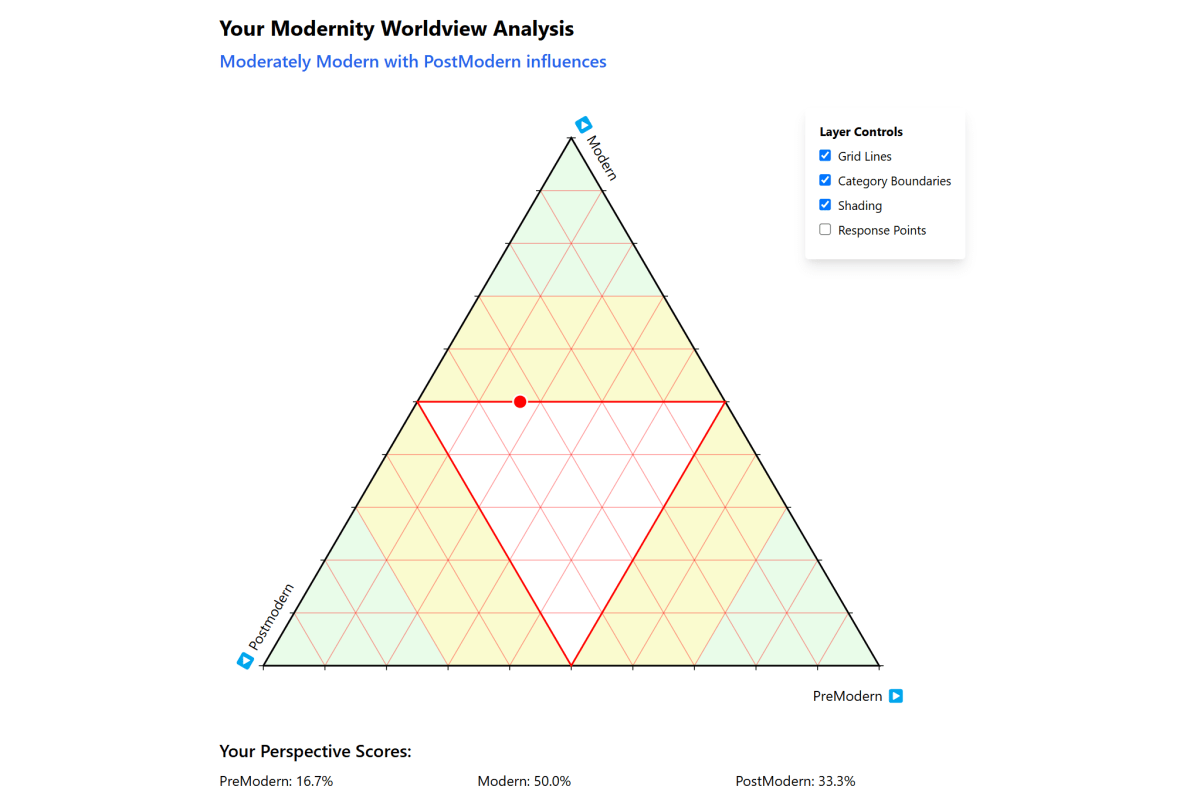
Surveying Modernity

A Brief, Brutal Experiment in Categorising Your Worldview

This month, I’ve been tinkering with a little project—an elegant, six-question survey designed to assess where you land in the great intellectual mess that is modernity.

Audio: Podcast discussion about this post.

This isn’t some spur-of-the-moment quiz cooked up in a caffeine-fueled haze. No, this project has been simmering for years, and after much consideration (and occasional disdain), I’ve crafted a set of questions and response options that, I believe, encapsulate the prevailing worldviews of our time.

It all began with Metamodernism, a term that, at first, seemed promising—a bold synthesis of Modernism and Postmodernism, a grand dialectic of the ages. But as I mapped it out, it collapsed under scrutiny. A footnote in the margins of intellectual history, at best. I’ll expand on that in due course.

The Setup: A Simple, Slightly Sadistic Ternary Plot

For the visually inclined (or the masochistically curious), I initially imagined a timeline, then a branching decision tree, then a Cartesian plane before landing on a ternary plot—a three-way visual that captures ideological leanings in a way a boring old bar chart never could.

The survey itself is brief: six questions, each with five possible answers. Submit your responses, and voilà—you get a tidy little ternary chart plotting your intellectual essence, along with a breakdown of what your answers signify.

Methodology: Half-Rigorous, Half-Reckless

I am, after all, a (recovering) statistician, so I’ve tried to uphold proper methodology while also fast-tracking certain safeguards for the sake of efficiency. If there’s enough interest, I may expand the survey, adding more questions or increasing response flexibility (tick boxes instead of radio buttons—revolutionary, I know).

Privacy Concerns? Relax. I’m not harvesting your data for some nefarious scheme. No personally identifiable information is collected—just a timestamp, session ID, and your browser’s language setting. I did consider tracking IP addresses to analyze regional trends but ultimately scrapped that idea.

In the future, I may add an optional email feature for those who wish to save and track their responses over time (assuming anyone is unhinged enough to take this more than once).

The Rest of the Story: Your Feedback, My Amusement

Since this is a personal project crafted in splendid isolation, I’d love to hear your thoughts. Are the questions reasonable? Do the response options make sense? Does the summary feel accurate? Is the ternary chart decipherable, or have I constructed a glorified inkblot test?

As an academic, economist, and statistician, I had never encountered a ternary chart before embarking on this, and now I rather enjoy it. That said, I also find Nietzsche “intuitive,” so take that as you will.

If this gains traction, expect follow-up content—perhaps videos, podcasts, or further written explorations.

Your Move

Take the survey. It’s painless, requiring mere minutes of your life (which is, let’s be honest, already wasted online). And because I’m feeling generous, you can even generate a PDF to stick on your fridge, next to your collection of expired coupons and disappointing takeout menus.

Click here to take the survey.

Let’s see where you stand in the grand, chaotic landscape of modernity. Or at least, let’s have a laugh trying to make sense of it.

DISCLAIMER: The Modernity Worldview Survey is not scientific. It is designed as an experiment to provide directional insights. It is hosted on Google Cloud and subject to its availability and performance limitations.

Jung and Catholic Ritual

I was chatting with some Catholics on Social Media, responding to a post about the need to grow their base. I sympathised that it must be difficult because the product of organised religion was not exactly tailor-fit. Protestants have provision for roll-your-own, but not Catholics. This led me to a discussion about what Jung wrote about rituals – that it doesn’t matter if the underlying rationale was remembered because some people like ritual for its own sake – candles, incense, wafers, whatever.

(I studied Jung intensely in the mid-’90s, and while I still find him useful as metaphor, I don’t take his broader metaphysics seriously anymore – too mystical for my tastes. But this particular insight about ritual sticks.)

Follows are the unedited results.

Yes, and Jung was being quietly subversive about it. He was pointing to something most modern institutions would rather not hear.

For Carl Jung, ritual doesn’t need to be true in the propositional sense to be effective in the psychological one. Its power doesn’t reside in correct belief, historical accuracy, or even conscious assent. It resides in repetition, form, symbol, and the way those elements bypass the rational gatekeeper and go straight for the nervous system.

Which is precisely why ritual unnerves modernity.

Once you accept Jung’s claim, you’re forced to concede that meaning is not the primary engine of human orientation. Function is. A ritual can continue to stabilise, contain, and organise psychic life long after its original metaphysics has decayed, been forgotten, or become frankly unbelievable. The candles still work even if God has quietly slipped out the back.

This is deeply inconvenient for Enlightenment-descended sensibilities, which insist that symbols must justify themselves, that practices require reasons, and that belief precedes action. Jung flips that on its head. We act first. We kneel first. We chant first. Understanding, if it arrives at all, comes later as a kind of aftercare.

Which helps explain your mate’s conversion without invoking any sudden metaphysical awakening.

Catholic ritual functions even when belief wobbles. Protestantism, having stripped ritual back to avoid superstition, leaves belief carrying all the weight. Once belief falters, there’s nothing left to hold the structure together. No choreography. No inherited muscle memory. No symbolic surplus. Just a sermon competing with the rest of the week’s content.

Jung saw this coming. He understood that modern people would continue to need ritual even as they lost faith in the stories that once justified it. His worry wasn’t that people would abandon religion. It was that they would abandon ritual competence and then wonder why anxiety, fragmentation, and compensatory myth-making flooded in through the cracks.

From that angle, Catholicism’s current crisis looks different again.

The conservatives think ritual must be defended because it encodes truth.
The progressives think ritual can be loosened because truth can be updated.
Jung would have said both are missing the point.

Ritual persists because it does work that language cannot do. It orders time. It disciplines the body. It makes the invisible feel locally real. Strip away the incense, the repetition, the inherited forms, and you don’t get a purer faith. You get an exposed psyche scrambling for substitutes.

So when someone says, “I’m drawn to Catholicism because of the candles and incense,” they’re not being shallow. They’re being honest in a way theologians and sociologists often aren’t. They’re admitting that humans are not primarily convinced creatures.

They are conditioned ones.

Jung didn’t romanticise that fact. He warned about it. But he understood it well enough to say the thing modern institutions still resist admitting:
you can drain a ritual of meaning and it will still shape lives long after the doctrine has stopped persuading anyone.

Fiction Nation: Living in a World of Fictions


Section 5: Living in a World of Fictions

The Ubiquity of Fictions

In examining nations, economies, money, and legal systems, it becomes evident that much of what structures our daily lives is founded on fictions—collective agreements and constructs that shape our reality. Recognizing this opens a new perspective on how we understand and interact with the world. These fictions, while not inherently negative, demonstrate the power of human imagination and the social nature of our existence.

From the moment we wake up, we engage with these fictions. The money we use, the laws we abide by, and the national identities we hold are all part of a complex web of social constructs that provide order and meaning to our lives. These fictions create a shared reality that allows for coordination, cooperation, and coexistence on a large scale.

The Power and Potential of Fictions

Fictions are powerful because they shape our perceptions and behaviors. They provide frameworks for understanding our place in the world and guide our interactions with others. For instance, the belief in the value of money enables complex economic transactions, while national identities foster a sense of belonging and community.

However, the power of these fictions also means they can be manipulated. Political narratives, economic policies, and legal decisions can be crafted to serve particular interests, often at the expense of others. This underscores the importance of critically examining the fictions we live by and questioning whose interests they serve.

The potential of fictions lies in their flexibility. Because they are constructed, they can be deconstructed and reconstructed. This offers opportunities for innovation and change. By reimagining our social constructs, we can address contemporary challenges such as inequality, climate change, and global conflicts. For example, the emergence of new economic models, such as the sharing economy or digital currencies, illustrates how rethinking foundational fictions can lead to transformative change.

Sports as Fiction

Sports provide a compelling example of another pervasive fiction in human society. Like money and legal systems, sports are constructed through a set of agreed-upon rules, rituals, and narratives. The games we play, the leagues we follow, and the teams we support are all part of a shared fiction that brings people together, creates communities, and evokes strong emotions.

The rules of sports are arbitrary yet accepted by all participants and fans, creating a framework within which competition and achievement are celebrated. These rules can be changed, and often are, to adapt to new circumstances or to improve the game. This flexibility highlights the constructed nature of sports, similar to other social systems.

Moreover, sports narratives—stories of underdogs triumphing, legendary performances, and historic rivalries—are powerful fictions that shape our collective memory and identity. They provide a sense of continuity and shared experience, connecting individuals across different backgrounds and generations.

Challenges of Living with Fictions

Living in a world of fictions comes with challenges. One significant challenge is the tension between reality and fiction. When the fictions we live by are mistaken for immutable truths, it can lead to rigidity and resistance to change. This can be seen in the reluctance to reform outdated legal systems, economic models, or national identities that no longer serve the common good.

Another challenge is the potential for disillusionment. Recognizing that much of what we consider to be real is, in fact, a construct can lead to a sense of instability and uncertainty. This awareness requires a balance between skepticism and pragmatism—understanding that while fictions are not inherently true, they are necessary for social cohesion and functioning.

The Role of Critical Awareness

Critical awareness is crucial in navigating a world of fictions. This involves questioning the assumptions and narratives that underpin our social constructs and being open to alternative perspectives. Education, media literacy, and public discourse play vital roles in fostering this critical awareness.

By understanding the constructed nature of our realities, we can become more active participants in shaping them. This empowers individuals and communities to advocate for changes that reflect their values and address their needs. It also encourages a more inclusive and equitable approach to social organization, recognizing the diverse ways in which people experience and contribute to society.

Imagining New Fictions

The future will undoubtedly bring new fictions that will shape our lives in unforeseen ways. As technology advances, new forms of social organization, identity, and interaction will emerge. For example, the rise of virtual reality and artificial intelligence will create new spaces and entities that challenge our current understanding of reality.

Imagining new fictions involves creativity and collaboration. It requires us to envision possibilities beyond our current constructs and to work together to bring those visions to life. This imaginative process is fundamental to human progress and the continual evolution of our societies.

Conclusion

Living in a world of fictions is both a profound and practical reality. By recognizing and understanding the fictions that structure our lives, we gain the power to question, reform, and innovate. This critical awareness allows us to navigate the complexities of our social world with greater insight and intentionality, fostering a more just and dynamic society.

⬅ Fiction Nation: Legal and Jurisprudence Sytems (section 4)

➡ Fiction Nation: Can This Be True (section 6)

References

  1. Graeber, David. Debt: The First 5,000 Years (2011).
  2. Anderson, Benedict. Imagined Communities: Reflections on the Origin and Spread of Nationalism (1983).
  3. Giddens, Anthony. The Consequences of Modernity (1990).
  4. Beck, Ulrich. Cosmopolitan Vision (2006).
  5. Cover, Robert. “Nomos and Narrative” (1983).

Fiction Nation: Economies and Money

Section 3: Economies and Money as Fictions

The Concept of Money

Money is one of the most pervasive fictions in human society. Traditionally, it is thought that money evolved from barter systems, where goods and services were directly exchanged. However, anthropologist David Graeber, in his book “Debt: The First 5,000 Years” (2011), argues that this narrative is largely a myth. According to Graeber, there is little historical evidence to support the idea that societies primarily relied on barter before the advent of money. Instead, he suggests that credit systems were more prevalent, where people kept track of debts and credits in the absence of physical currency.

Graeber’s perspective challenges the conventional economic narrative by emphasizing the role of social relationships and trust in early economic transactions. Rather than evolving from barter to commodity money (like gold and silver coins) and then to fiat money, economies often operated on the basis of mutual obligations and social bonds long before the invention of physical currency. This underscores the idea that money, in all its forms, is a social construct—a fiction agreed upon by the members of a society.

Fiat money, which is currency that a government has declared to be legal tender but is not backed by a physical commodity, relies entirely on trust and belief in its value rather than any intrinsic worth. Its value comes from the collective agreement that money can be used for transactions, illustrating how deeply embedded fictions can shape our economic reality.

Economies as Constructs

Economies, much like money, are constructed systems designed to organize and facilitate the production, distribution, and consumption of goods and services. The idea of a market economy, where supply and demand determine prices and allocation of resources, is a theoretical construct that has been widely adopted and adapted across the globe. Economic theories and models, while rooted in empirical observations, are also shaped by human assumptions and values.

For example, capitalism, the dominant economic system in much of the world, is built on the principles of private property, free markets, and competition. These principles are human-made constructs that have been institutionalized through laws, regulations, and cultural norms. The notion of “economic growth” itself is a concept that has been prioritized and pursued, shaping policies and societal goals.

Implications of Economic Fictions

Understanding economies and money as fictions highlights their dependence on collective belief and participation. This perspective allows us to critically examine the assumptions underlying economic systems and consider alternative models. For instance, the rise of digital currencies like Bitcoin challenges traditional notions of money by introducing decentralized and peer-to-peer forms of exchange.

Moreover, recognizing the fictional nature of economies can lead to more flexible and adaptive economic policies. It encourages innovation and experimentation with new economic frameworks that may better address contemporary challenges such as inequality, environmental sustainability, and technological disruption.

By exploring the fictions of economies and money, we gain insight into the powerful influence of human-made constructs on our daily lives. This awareness can inspire us to question and potentially reshape these constructs to create more equitable and resilient economic systems for the future.

References

  1. Graeber, David. Debt: The First 5,000 Years (2011).
  2. Giddens, Anthony. The Consequences of Modernity (1990).
  3. Beck, Ulrich. Cosmopolitan Vision (2006).
  4. Anderson, Benedict. Imagined Communities: Reflections on the Origin and Spread of Nationalism (1983).

⬅ Fiction Nation: Nations as Fictions (part 2)

➡ Fiction Nation: Legal and Jurisprudence Systems (part 4)

Path to the Fall

By fall, I don’t mean autumn except perhaps metaphorically speaking. The accompanying image illustrates a progression from the pre-Enlightenment reformation and the factors leading to the Modern Condition and increases in schizophrenia in people, societies, and enterprises.

Podcast: Audio rendition of this page content.

This image is essentially composited from a later chapter in Iain McGilchrist’s The Master and His Emissary. In it, he outlines a path that commences at the Reformation that led to Lutheranism and Protestantism and further to Calvinism (not separately depicted). Max Weber argued that Capitalism is inextricably linked to Calvinism and the workmanship ideal tradition.

McGilchrists argument is founded on the notion that Catholocism is a communally oriented belief system whilst Protestantism is focused on the individual and salvation through personal work. The essence of capitalism is the same.

Of course, history isn’t strictly linear. In fact, there are more elements than one could realistically account for, so we rely on a reduction. In concert with the Reformation but on a slight delay is the so-called Age of Enlightenment, the Age of Reason, which led not only to faith in science but then to the pathology of Scientism.

This Protestant-Scientismic nexus brought us to Capitalism and into the Industrial Revolution, where humans were devivified or devitalised, trading their souls to be pawns to earn a few shekels to survive. Capitalism and the Industrial Revolution led to Marxism, through Marx’s critique of Capitalism, but Marxism has the same fatal flaw as Capitalism inasmuch as it doesn’t view people as humans. It does afford them a slightly higher function as workers, but this still leaves humanity as a second-tier aspect and even historicity is elevated above as a sort of meta-trend or undercurrent.

From there, we transition to Modernity, which yields the modern condition and schizophrenics in one fell swoop. This is no coincidence.

Although I end this journey at Modernism, McGilchrist is also leery of the effects of post-modernism as well as philosophy itself as overly reductionist in its attempts to categorise and systematise, valuing signs and symbols over lived experience. His main complaint with postmodernism is that it moves from the objective perspective of Modernity to the subjective perspective, and so there remains no base foundation, which is the shared experience. I’m not sure I agree with his critique, but I’m not going to contemplate it here and now.

In the end, this journey and illustration are gross simplifications, but I still feel it provides valuable perspective. The challenge is that one can’t readily put the genie back into the bottle, and the question is where do we go from here, if not Modernism or Postmodernism. I shouldn’t even mention Metamodernism because that seems like an unlikely synthesis, as well-intentioned as it might be. McGilchrist gives examples of reversals in the trend toward left-hemisphere bias, notably the Romantic period, but that too was reversed, recommencing the current trajectory. My feeling is that if we continue down this dark path, we’ll reach a point of no return.

It seems to be that it’s growing at an increasing rate, like a snowball careening down a slope. It not only drives the left-dominant types further left because an analytical person would reinforce the belief that if only s/he and the world were more analytical things would be so much better—even in a world where net happiness is trending downward—, but it also forces this worldview on other cultures, effectively destroying them and assimilating them into the dark side, if I can borrow a Star Wars reference.

Epilogue

I wasn’t planning to share this story—at least not now. In another forum, I responded to a statement, and I was admonished by Professor Stephen Hicks, author of the book of dubious scholarship, Explaining Postmodernism.

I responded to this query:

If you’re a single mother and have a son I’d suggest putting him in a sport or martial arts to add some masculine energy to his life. It’s not a replacement for the actual father but it can help instil structure and discipline into the core of his being.

— Julian Arsenio

“Perhaps this world needs less discipline and structure, not more,” was my response, to which Hicks replied.

The quotation is not about “the world.” It is about boys without fathers. Evaluate the quotation in its context.

— Stephen Hicks

“Disciplined boys create a disciplined world. Not a world I’d prefer to create or live in. We need more right-hemisphere people. Instead, we are being overwhelmed by left hemisphere types, leading to Capitalism and the denouement of humanity as it encroaches like cancer, devouring or corrupting all it touches.

“In the end, it is about the world, which from a left hemisphere perspective is a sum of its parts. Right-hemisphere thinkers know otherwise,” was my reply. He responded,

You seem to have difficulty focusing. From a quotation about fatherless boys you free associate to [sic] weird psychology and global apocalptic [sic] pessimism. Pointless.

— Stephen Hicks

“I’ll suggest that the opposite is true, and perhaps you need to focus less and appreciate the Gestalt. This was not free association. Rather, it is a logical connexion between the disposition of the people in the world and lived reality.

“Clearly, you are a left-hemisphere structured thinker. The world is literally littered with this cohort.

“I suggest broadening your worldview so as not to lose the woods for the trees. I recommend Dr Iain McGilchrist as an apt guide. Perhaps reading The Master and His Emissary and/or The Matter with Things would give you another perspective. #JustSaying”

His final repartee is,

And still, rather than addressing the issue of fatherless boys, you go off on tangents, this time psychologizing about people you’ve zero first-hand knowledge of.

— Stephen Hicks

Feel free to interpret this as you will. For me, his attempt to limit discussion to some notion he had in his head and his failure to see the woods for the trees, as I write, suggests that he is a left-brain thinker. Having watched some of his videos, whether lectures or interviews, this was already evident to me. This exchange is just another proof point.

I considered offering the perspective of Bruno Bettleheim’s importance of unstructured play, but as is evidenced above, he is not open to dialogue. His preference appears to be a monologue. This is the left hemisphere in action. This is an example of how insidious this convergent thinking is, and it makes me worry about what’s ahead in a world of people demanding more structure and discipline. Foucault’s Discipline and Surveillance comes to the forefront.

The Matter with Things: Chapter Nine Summary: Schizophreia &c.

Index and table of contents

Podcast audio version to follow.

Intro

Creativity is chapter nine of Iain McGilchrist’s The Matter with Things. It also marks the end of part one of three in this two-volume set.

The main thrust is to provide a lot of cases of schizophrenia to elaborate on how the deficits impact perception—and of course, attention and judgment.

Content

This chapter starts off by noting that mental illnesses are not a matter of the brain being broken like a machine. McGilchrist doesn’t much like the analogies to machines or computers, to begin with. Instead, they affect how their world is experienced. They attend to different things, which creates a different perception because we perceive what we attend to.

It is effectively a left-hemisphere challenge, but he is careful to say that we don’t have enough evidence to call it a right-hemisphere deficit. His rationale is that it could be one of these three leading scenarios:

  1. The right hemisphere has deficits.
  2. The left hemisphere is not performing its function to work with the right hemisphere, which is otherwise intact.
  3. The frontal lobe which is supposed to moderate the hemispheres is not performing its function.

Schizophrenia and autism are distinct conditions, but there are some overlaps. He clarifies that schizophrenia and autism are too broad of categories (a situation made worse in the case of autism by the creation of the autism spectrum). There are types of schizophrenias and autisms that would otherwise be unrelated except for psychology’s kitchen junk drawer approach to categorisation, I suppose, following the lead of syndromes in the medical profession. I digress.

These conditions exemplify what it’s like to experience the world with an overreliance on the left hemisphere. A point he wants to make is that he feels society at large is shifting in this direction to the detriment of all concerned, that the world of business, science, politics, and bureaucracy more generally is migrating to a hyper-rational position at the expense of experiential reality.

He praises Louis Sass’s 1992 book Madness and Modernism as “one of the most fascinating, and compelling, books I have ever read”, primarily because it notes the relationship between schizophrenia and Modernism and a modern world that is experiencing an increase in the phenomena of schizophrenia.

they miss the forest for the woods

McGilchrist goes into detail about how right hemisphere deficits affect perception in schizophrenic patients. I won’t share that level of detail here. Effectively, they miss the forest for the woods and make contextual miscues, lacking in empathy and intuition. Missing this context, they jump to conclusions—invalid conclusions. He goes on to explain this from the perspective of brain construction and physiology whilst extending the conversation to include the autism spectrum, noting a general overlap between these diagnoses.

He invokes the work of Eugène Minkowski—reflecting on the foundational work of Henri Bergson—, which resonated with me, wherein Minkowski tries to simplify and characterise the hemisphere as the left representing intellect and the right being intuition. This feels about right. He shares a list of terms generally representing qualities in schizophrenics that detail what is atrophied in the intuition of the right hemisphere and what is hypertrophied (or exaggerated) in the left hemisphere. I’ll not share this list here, but I like it. He promises to elaborate on this in chapter 22.

Essentially what’s missing is a sense of coherence with experience leading to a detachment from reality as we normally experience it—and a loss of vitality and a sense of self. These people live as outsiders looking in rather than simply feeling a part of the whole. Man becomes a machine built of parts and separate to nature. Everything becomes literal. There is no room for connotation in a denotative world. But this world is disconnected from the presented reality, instead relying on a re-presented version. The world loses depth and becomes a two-dimensional caricature.

Perspective

My summary of this chapter left many details unsaid, probably more so than the preceding chapters, so a lot of context and nuance is missing. My biggest takeaway is really the scary connexion between schizophrenia and Modernity. It is far from comforting. Add to this the positive feedback loop otherwise known as a vicious cycle as societies more and more adopt a left hemisphere perspective, that of a schizophrenic, and it becomes scarier still. To make matters worse, this is not metaphorical. It’s analogical. I’m not sure how to reverse this tide.

connexion between schizophrenia and Modernity

This wraps up the chapter on schizophrenia, autism and the rest. As I mentioned at the start, this also marks the end of part one of the book. The next chapter is “What is Truth?” This will allow the reader to delve more deeply into various aspects of truth, from science to reason to intuition and imagination. This second part of the books takes us to the end of the first volume, traversing us through chapters ten to nineteen.

What are your thoughts on mental illnesses like schizophrenia and autism, especially around how they may shed light on neurotypical persons and the relationship between these and modern society?

Leave comments below or on the blog.