Chapter 5: Harari’s Defence of Democracy

A Pollyanna Perspective

Chapter 5 of Yuval Noah Harari’s Nexus feels almost unlistenable, like polemic propaganda, painting cherry-picked anecdotes with a broad brush for maximal effect. If I hadn’t agreed to read this in advance, I’d have shelved the book long ago. It is as though Harari has never set foot on Earth and is instead relying on the optimistic narratives of textbooks and travel guides. His comparisons between democracy, dictatorship, and totalitarianism are so heavily spun and biased that they verge on risible. Harari comes across as an unabashed apologist for democracy, almost like he’s part of its affiliate programme. He praises Montesquieu’s separation of powers without noting how mistaken the idea as evidenced by modern-day United States of America. Not a fan. If you’re a politically Conservative™ American or a Torrey in the UK, you’ll feel right at home.

A Trivial Freedom – At What Cost?

Harari ardently defends the “trivial freedoms” offered by democracies whilst conveniently ignoring the shackles they impose. It’s unclear whether his Pollyanna, rose-coloured perspective reflects his genuine worldview or if he’s attempting to convince either himself or his audience of democracy’s inherent virtues. This uncritical glorification feels particularly out of touch with reality.

The Truth and Order Obsession

Once again, Harari returns to his recurring theme: the tradeoff between truth and order. His obsession with this dynamic overshadows more nuanced critiques. Listening to him defend the so-called democratic process that led to the illegal and immoral US invasion of Iraq in 2002 is nothing short of cringeworthy. Even more egregious is his failure to acknowledge the profound erosion of freedoms enacted by the PATRIOT Act, the compromised integrity of the offices of POTUS and SCOTUS, and the performative partisanship of Congress.

The Role of Media and Peer Review

Harari cites media and peer review as essential mechanisms for error correction, seemingly oblivious to the fallibility of these systems. His perception of their efficacy betrays a glaring lack of self-awareness. He overlooks the systemic biases, self-interest, and propaganda that permeate these supposed safeguards of democracy.

A Flimsy Narrative

Whilst many Modernists might uncritically embrace Harari’s perspective, his argument’s veneer is barely a nanometre thick and riddled with holes. It’s not merely a question of critiquing metanarratives; the narrative itself is fundamentally flawed. By failing to engage with the complexities and contradictions inherent in democratic systems, Harari’s defence feels more like a sales pitch than a rigorous examination.

Final Thoughts

Harari’s Chapter 5 is a glaring example of uncritical optimism, where the faults of democracy are brushed aside in favour of a curated narrative of its virtues. This chapter does little to inspire confidence in his analysis and leaves much to be desired for those seeking a balanced perspective.

Death by Tiger, Death by Document: Reflections on Nexus Chapter 3

As I continue to react to Harari’s Nexus, I can’t help but feel like a curmudgeon. Our worldviews diverge so starkly that my critique begins to feel like a petty grudge—as though I am inconsolable. Be that as it may, I’ll persist. Please excuse any revelatory ad hominems that may ensue.

Audio: Podcast of the page contents

Harari is an unabashed Zionist and unapologetic nationalist. Unfortunately, his stories, centred on Israel and India, don’t resonate with me. This is fine—I’m sure many people outside the US are equally weary of hearing everything framed from an American perspective. Still, these narratives do little for me.

Patriotism and property are clearly important to Harari. As a Modernist, he subscribes to all the trappings of Modernist thought that I rail against. He appears aligned with the World Economic Forum, portraying it as a noble and beneficial bureaucracy, while viewing AI as an existential threat to its control. Harari’s worldview suggests there are objectively good and bad systems, and someone must oversee them. Naturally, he presents himself as possessing the discernment to judge which systems are beneficial or detrimental.

In this chapter, Harari recounts the cholera outbreak in London, crediting it with fostering a positive bureaucracy to ensure clean water sources. However, he conflates the tireless efforts of a single physician with the broader bureaucratic structure. He uses this example, alongside Modi’s Clean India initiative, to champion bureaucracy, even as he shares a personal anecdote highlighting its flaws. His rhetorical strategy seems aimed at cherry-picking positive aspects of bureaucracy, establishing a strawman to diminish its negatives, and then linking these with artificial intelligence. As an institutionalist, Harari even goes so far as to defend the “deep state.”

Earlier, Harari explained how communication evolved from Human → Human to Human → Stories. Now, he introduces Human → Document systems, connecting these to authority, the growing power of administrators, and the necessity of archives. He argues that our old stories have not adapted to address the complexities of the modern world. Here, he sets up religion as another bogeyman. As a fellow atheist, I don’t entirely disagree with him, but it’s clear he’s using religion as a metaphor to draw parallels with AI and intractable doctrines.

Harari juxtaposes “death by tiger” with “death by document,” suggesting the latter—the impersonal demise caused by bureaucracy—is harder to grapple with. This predates Luigi Mangione’s infamous response to UnitedHealthcare’s CEO Brian Thompson, highlighting the devastating impact of administrative systems. Harari also briefly references obligate siblicide and sibling rivalry, which seem to segue into evolution and concepts of purity versus impurity.

Echoing Jonathan Haidt, Harari explores the dynamics of curiosity and disgust while reinforcing an “us versus them” narrative. He touches on the enduring challenges of India’s caste system, presenting yet another layer of complexity. Harari’s inclination towards elitism shines through, though he occasionally acknowledges the helplessness people face when confronting bureaucracy. He seems particularly perturbed by revolts in which the public destroys documents and debts—revealing what feels like a document fetish and an obsession with traceability.

While he lauds AI’s ability to locate documents and weave stories by connecting disparate content, Harari concludes the chapter with a segue into the next: a discussion of errors and holy books. Once again, he appears poised to draw parallels that serve to undermine AI. Despite my critiques, I’m ready to dive into the next chapter.

Metamodernism: A Retrograde Synthesis Disguised as Progress

I’ve written about this topic before. Metamodernism has been heralded as the great reconciler of Modernism and Postmodernism, a dialectical triumph that purports to synthesise these two oppositional paradigms. On the one hand, Modernism clings to its belief in objective truths, rationality, and universal principles. On the other, Postmodernism dismantles those certainties, exposing them as fragile constructs, rooted as much in ideology as in reason. The promise of metamodernism is to bridge this divide, to create a space where the objectivity of Modernism and the relativism of Postmodernism can coexist. But can it?

Audio: NotebookLM Podcast about this topic.

Spoiler alert: it cannot. In fact, metamodernism doesn’t even attempt to fulfil its stated goal. Instead, what it really does—intentionally or not—is meld Modernism’s objective framework with Pre-Enlightenment mysticism, offering a regressive concoction that romanticises the past while pretending to chart a bold new future. This isn’t synthesis; it’s nostalgia masquerading as innovation.

The Unbridgeable Divide: Objective vs. Relative

To understand why metamodernism’s claimed synthesis is untenable, we need to examine the fundamental incompatibility of its supposed components. Modernism rests on the firm foundation of objectivity: truth is universal, reason is supreme, and progress is inevitable. Postmodernism, however, thrives in the cracks of that foundation, pointing out that these so-called universal truths are culturally and historically contingent, and that “progress” often serves as a euphemism for domination or erasure.

Reconciling these two positions is like trying to mix oil and water. Modernism’s faith in absolutes cannot coexist with Postmodernism’s celebration of ambiguity and multiplicity without reducing one to a mere aesthetic flourish for the other. The result is not a synthesis but a superficial oscillation, an endless back-and-forth that achieves neither clarity nor coherence.

The Real Agenda: A Fusion of Objectivities

What metamodernism actually achieves is something quite different. Instead of bridging the gap between Modernism and Postmodernism, it fuses Modernism’s objective certainties with the equally objective but pre-rational framework of Pre-Enlightenment mysticism. In doing so, it abandons the critical lens of Postmodernism altogether, retreating to a worldview that is comfortingly familiar but intellectually regressive.

Consider the resurgence of myth, spirituality, and transcendence in metamodernist discourse. These elements hark back to a time when objective truths were dictated by divine authority or cosmological narratives rather than scientific inquiry. By incorporating these pre-modern ideas into its framework, metamodernism sidesteps the hard questions posed by Postmodernism, offering a fusion that is plausible only because both Modernism and Pre-Enlightenment mysticism share a common belief in absolute truths.

Plausible but Retrograde

This melding of Modernist and Pre-Enlightenment frameworks might seem plausible because, in truth, many Moderns never fully abandoned their mystical roots. The Enlightenment’s project of replacing religious dogma with reason was always incomplete; its foundational assumptions about universality and objectivity often carried an unspoken theological residue. Metamodernism taps into this latent nostalgia, offering a vision of the world that feels grounded and comforting, but at the cost of intellectual progress.

The problem is that this vision is fundamentally retrograde. By retreating to the certainties of the past, metamodernism ignores the most valuable insight of Postmodernism: that all frameworks, whether Modern or mystical, are ultimately constructed and contingent. To move forward, we need to grapple with this contingency, not escape from it.

Conclusion: Nostalgia in Disguise

Far from being a dialectical synthesis, metamodernism is a retreat. It cloaks itself in the language of progress while recycling old patterns of thought. Its attempt to reconcile Modernism and Postmodernism collapses into a fusion of Modernist objectivity and Pre-Enlightenment mysticism, leaving the critical insights of Postmodernism by the wayside.

If we are to truly progress, we must resist the siren song of metamodernism’s nostalgia. Instead, we should embrace the challenge of living without absolutes, grappling with the ambiguity and multiplicity that define our postmodern condition. Anything less is not synthesis but surrender.

Postmodernism is Bollox

A short podcast on the reason Postmodernism is rubbish.

Video: YouTube (added 2/9/2022)

Postmodernism is rubbish. It makes no sense, and here’s why.

The term ‘modern’ is analogous to the term ‘now’. It is a time reference that privileges the moment. With time, we have a structure of yesterday, today, and tomorrow. Now fits into a structure of before, now, and later.

Conversely, where ‘modern’ means now, postmodern would mean ‘later’, it makes no sense to label an ongoing pursuit postmodern, anymore than tomorrow can run contemporaneously with today.

Just labelling something as modern is pretentious enough. It’s similar to labels such as New Wave or New Age. It’s just trying to privilege a movement by branding it new.

So, if Modern was the new kid on the block, how might postmodern operate.

Another problem with the term postmodern is that most people considered postmodern, did not consider themselves to be postmodern. In fact, many vehemently disagreed.

A reason for this disagreement, is that the term is not owned by the purported Postmoderns. Rather, it’s a disparaging slur by so-called and improperly named Moderns.

Apart from the nomenclature challenge, postmodern is a reaction to the promise of modernity, but the reactions differ by discipline. Postmodern art and architecture are different to postmodern literature, which is different to postmodern philosophy.

And since postmodernism is rather a disparaging catchall, those with ideas not conformant to mainstream doctrine get tossed into the bin. This means that any number of feminists and post-colonialists are thrown onto the postmodernist pyre.

Here’s some food for thought. I argue that postmodernism cannot have a privileged perspective, because it claims that there is no such perspective available. If a feminist or a post-colonialist is saying anything, they are pointing out, that one needs to look through their lens too. By and large, they are not claiming that it is the lens of lenses.

In essence, if the modern lens is red, they might recommend viewing the same events through a blue lens or from a different angle. Walk a mile in another’s shoes. This shift in perspective can make all the difference.

The difference between a modern and the bolloxed-up postmodern is that the Modern thinks either that they have the only lens, or in any case, they have the right one. Moderns tend to be absolutists and universalists, so subjectivists and relativists rather rub them the wrong way.

The final thing I’d like to say about postmodernism is the notion of Deconstruction as made famous by one Jacques Derrida and misunderstood and misapplied by millions since. I’ll spare you the instruction, but I like to capture the sentiment of the way it is misunderstood by suggesting my own term, Disintegration. Perhaps, I’ll share more on Disintegrationism™ in future. Meantime, it’s just the process of breaking systems down to their core elements to inspect the working parts. Disintegrationism notes that these pieces can be re-integrated into new systems, but it makes no claim that one is better than another because that can only be determined by purpose. Another thing Moderns tend to ‘know’, is what the purpose is. Conditionally, if I know what the purpose is, I can claim to know, by extension, what the best system is.

Abraham Maslow gave us the law of the instrument, popularly conveyed as the aphorism, if you’re a hammer, everything looks like a nail. Moderns are hammers and insist that every solution can be solved as if it were a nail. Only, everything is not a nail. The postmodern reminds us that hammers don’t make the best knives or screwdrivers or spanners.

What are your thoughts on postmoderns and postmodernism? What about moderns? Is there a term you feel might better capture the essence of these two schools?

Lions and Tigers and—a Jackass?

The donkey told the tiger, “The grass is blue.”

The tiger replied, “No, the grass is green .”

The discussion became heated, and the two decided to submit the issue to arbitration, so they approached the lion.

As they approached the lion on his throne, the donkey started screaming: ′′Your Highness, isn’t it true that the grass is blue?”

The lion replied: “If you believe it is true, the grass is blue.”

The donkey rushed forward and continued: ′′The tiger disagrees with me, contradicts me and annoys me. Please punish him.”

The king then declared: ′′The tiger will be punished with 3 days of silence.”

The donkey jumped with joy and went on his way, content and repeating ′′The grass is blue, the grass is blue…”

The tiger asked the lion, “Your Majesty, why have you punished me, after all, the grass is green?”

The lion replied, ′′You’ve known and seen the grass is green.”

The tiger asked, ′′So why do you punish me?”

The lion replied, “That has nothing to do with the question of whether the grass is blue or green. The punishment is because it is degrading for a brave, intelligent creature like you to waste time arguing with an ass, and on top of that, you came and bothered me with that question just to validate something you already knew was true!”

Moral of the Story: The biggest waste of time is arguing with the fool and fanatic who doesn’t care about truth or reality, but only the victory of his beliefs and illusions. Never waste time on discussions that make no sense. There are people who, for all the evidence presented to them, do not have the ability to understand. Others are blinded by ego, hatred and resentment, and the only thing that they want is to be right even if they aren’t.

When emotions run high, intellect goes low.

This story is circulating on LinkedIn and has made the social media circuits. As you can judge from the attendant ‘moral of the story’ that this has been interpreted by an absolutist. This is a telltale sign of a Modern versus a so-called Postmodern who will allow for a different translation.

Post-Postmodernism

I happened upon an article that notes that the postmodern label is now 50-odd-years old, so what’s next? Just a short response, the label never made sense for several reasons.

First, the prefix post suggests a new era or paradigm. In and of itself, this is not a problem. The challenge is the root: modern.

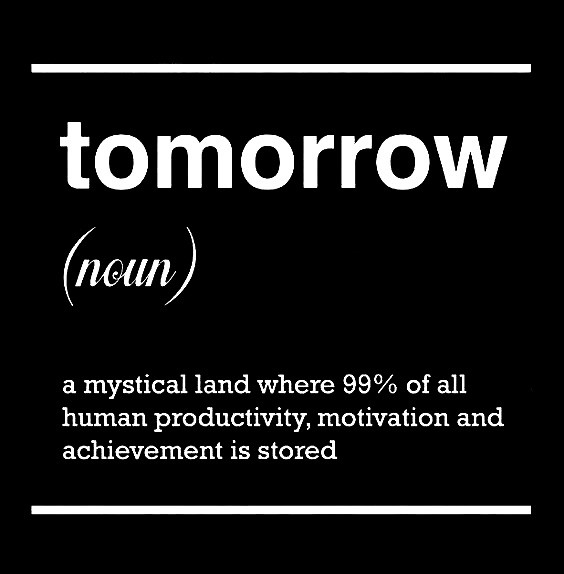
Effectively, modern means now, the current era, in the same manner as today sits between yesterday and tomorrow. The problem is that we are employing the term postmodern as if it’s tomorrow but today. Of course, except in jest, tomorrow is never simultaneously today. The notion reminds me of the sentiment captured in the quip when asked ‘When will you do this task?’ ‘I’ll do it tomorrow’. When queried the next day, ‘Why have you not yet done this task?’ and the response is ‘I’ll do it tomorrow’, ad infinitum.

I’ll caption this tomorrow

Modern derives from the Latin meaning ‘just now‘. People have been labelling themselves as modern since at least 1585 when it meant ‘of or pertaining to present or recent times‘. As early as 1500, it meant ‘now existing‘, so more toward ‘extant‘.

My point is that one might be able to retroactively reference post-X in relationship to X, but to name something duratively as post-X simply makes no sense. Add to this the complication that Latour mentions that we’ve never been modern or the further connotation that privileges the term adopter over others. Namely, whilst the West are modern at time-zero, being the height of modernity, some other contemporaneous other does not qualify. The United States are modern—just not Appalacia and certainly not Bangladesh. In a temporal sense, premodern takes on a similar meaning, e.g. Aztec or Mayan civilisations.

Besides the unfortunate naming, ‘postmodern‘ attempts to envelop many thoughts. As I’ve mentioned before, it is most typically pejoratively.

Whist I attempt to align myself with certain so-called postmodern figures, and I use the term myself because it still has some referential value, I do so with reservations and the understanding that it’s a nonsensical notion from the start. Perhaps, I’ll suggest a new solution tomorrow.

Still a Slave

“Wage slavery is not the same as slavery, and this diminishes the experience of plantation slaves in the antebellum Southern US states” is a sentiment I’ve heard repeated over the years.

I’ll argue that it is the same. Saying wage slavery is like when the then-president of the United States, Bill Clinton, denied that oral sex was sex despite it being an obvious part of the name. When one says wage slavery is still slavery, s/he is making a commentary on the lack of agency, a lack of personal control. That the worker has a choice over which master to slave under is hardly a consolation. That a plantation slave has a choice of picking cotton or tobacco is of no consequence.

To disqualify wage slavery as slavery is to disqualify a 3-month pregnant woman as being not as pregnant as a 6-month pregnant woman. One might be closer to term, but they are equally pregnant.

That a plantation slave may have had less freedom and run the risk of physical beatings, torture, or even death is a sad commentary. That they may have separated from their families and have no autonomy is a matter of degree.

The slavery connexion occurs where the human needs to comply. Sure, a wage slave can opt out and live as a transient—ostensibly homeless; perhaps s/he can home-surf. Perhaps s/he can beg or live off the land.

Wage slavery is not the same as slavery

To me, the common missing element is to be able to operate as a functioning society, that as communities, we might contribute however we see fit. Of course, that narrative will quickly provoke an appeal to Tragedy of the Commons. People are selfish and act only in their own self-interests. And this is accepted uncritically as fact rather than evaluating whether this worldview is a consequence of Modernity or Capitalism, whichever nomenclature one has opted to adopt.

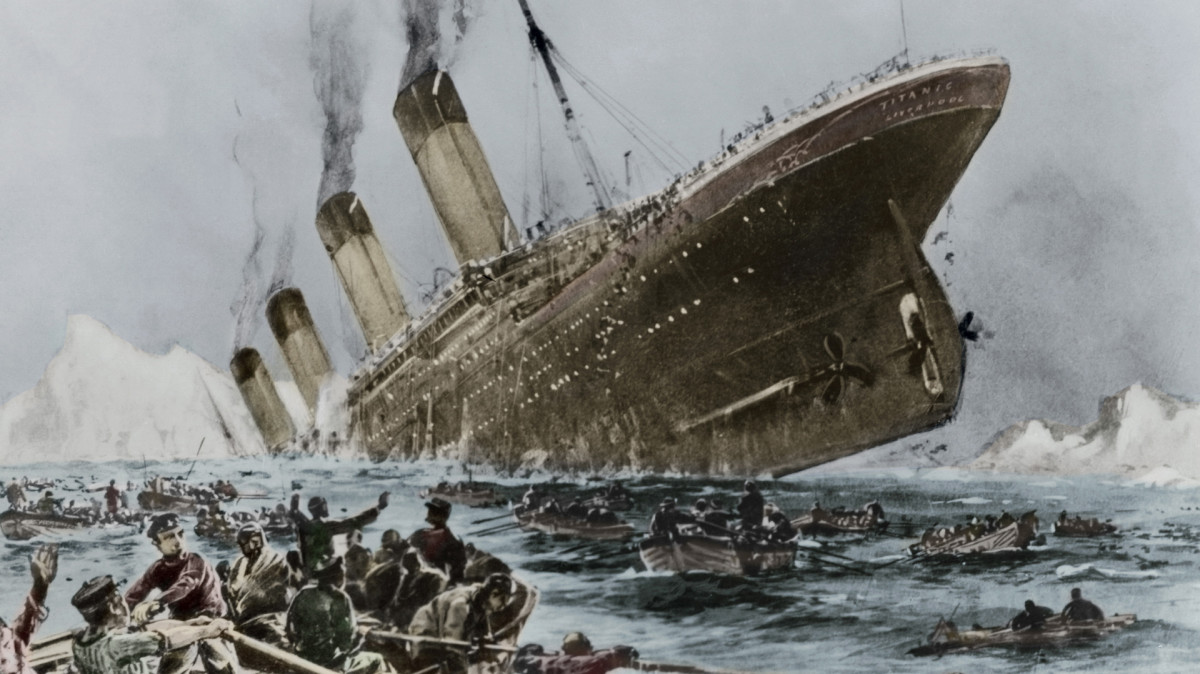
Wage slavery is slavery. Depending on the information source bout 50 per cent of Americans are a paycheque away from needing to deplete savings to survive; some have assessed a single paycheque from homelessness without intervention. One paycheque from poverty. Over two-thirds of Americans have been living paycheque-to-paycheque since the Covid-19 pandemic hit. If this describes you, it likely provides little solace that you are not alone. Who on the Titanic was relieved to know that other people shared their plight? Is there a silver lining for those who are paid fortnightly or monthly? And God forbid the ones whose paycheque arrive daily—perhaps in cash from the till.

Research from the Federal Reserve found that 4 in 10 Americans couldn’t afford a $400 emergency, and 22 per cent say they expect to forgo payments on some of their bills. It’s not much better in the UK, where the runway appears to end at 2.5 months rather than 1, although about two-thirds of renters would expect to make it more than a month.

Slavery, like turtles, all the way down. Just be thankful the worst that can happen is that one starves to death or pursues the life of Valjean. Dissociating wage slavery from plantation slavery is like separating the abbatoire from the butcher’s shop. When you’re the chattel it makes little difference.

Modern Spectrum: 1 Dimension

I’ve been pondering how to effectively dimensionalise the spectrum that illustrates the relationship among premodern, modern, and postmodern—and potentially, metamodern. I was researching and happened upon a YouTube video from a few years back by Rick Durst, a Conservative Evangelical professor. He was diagramming the chronological path from pre to post.

I think at this point it’s important to distinguish between Modern and Modernity and PostModern and PostModernity1. I feel that the noun form, Modernity, can be used to describe the chronology whilst the adjective form, Modern, describes the philosophy. I’m not sure that this is a standard distinction. If I adhere to this difference, then Rick is discussing Modernity rather than Modern. Perhaps I’m being pedantic.

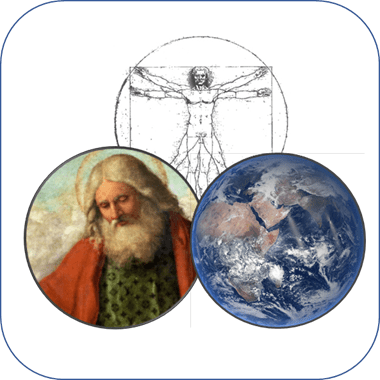
I’ve taken liberties to rerender Rick’s model.

In his view, the stages are from God to Man to Earth. I don’t fully agree with the transition from Man to Earth, but the God to Man or Humanism doesn’t feel very controversial. Although Rick is describing modernity against a temporal backdrop, this doesn’t invalidate the God-Man-Earth aspect—leaving open the possibility that it may be invalid for other reasons.

Following the chronology, Rick points out that the overlapping periods between PreModern and Modern and Modern and PostModern are not clean breaks. As I’ve suggested before, in illustration B, some people today retain PreModern beliefs and others hold PostModern beliefs. On balance, I feel that the Western world today remains substantially Modern, philosophically speaking. I am not sure that I am qualified to assess this relative to contemporary Eastern cultures.

Again, without otherwise critically evaluating Rick’s model, belief and God and in particular, Catholocism was the hallmark of the PreModern, PreEnlightenment world—the supernatural and superstition ruled the day.

Many consider Modernity to have commenced with the Renaissance, roughly from the 14th to the 17th century—describing it as early modern. Given the prevalence of superstitious beliefs, I’d be more comfortable with something more along the lines of proto-modern rather than modern. Scientific discoveries were evident, but this was reserved for the elite.

Given the Protestant Reformation that occupied the 15th century, it’s clear that a declaration of Modern should be considered to be premature. One might even argue that even with the advent of the Age of Enlightenment, which spanned the 17th and 18th centuries, Secular Humanism become the theme for the empowered elites, but the masses never relinquished their PreModern belief systems. If we are to start the Modern clock at all, this seems to be as good a place as any.

Although Modernism is marked by Humanism, in the United States, federal and state government is still predicated on PreModern principles, so it is not unfair, twisting Lyotard’s phrase, to question, Have We Ever Been Modern? It is somewhat interesting how—at least anecdotally—how many people do not find it inconsistent to have faith in humanity to solve the ills of the world through technology whilst simultaneously believing in gods, angels, tarot, and homoeopathic and other anachronistic healing modalities.

Chronologically, Rick demarcates Modern and PostModern with the ecological crises of the 1970s, which turned the focus from Man to the Earth. Seeds of postmodernism were sewn post-WWII and even post-WWI with the devastation and realisation of the limits of human capacity.

For the purpose of the ternary plot, it seems easy enough to assess where a person might feel relative to gods versus humans. And whilst I could argue that the belief in gods and the supernatural is a discrete binary state rather than on a continuous scale, I could argue as well that someone could feel that their gods are in control but they retain some degree of what’s known as free will. As a matter of degree, one could be a Deist—believing in some Prime Mover—but feel that now humans are on their own. God is like a crocodile slithering into the darkness having enabled the next generations. On a 1 to 10 spectrum, they might get 90% Modern and 10% PreModern. A believer in astrology, tarot, and the like, might also have faith in Man, yet they may reside more on the 60%-40% in favour of Modernity—or vice versa.

The question is how to get past Man to Earth. I am not sure how to frame this. Perhaps this wasn’t the right avenue to pursue.


  1. For the record, I chose to render the terms PreModern and PostModern in camel case for no particular reason, save to think that it seems to make the prefix more readily distinguishable.

Metamodernism on the Ternary Plot

I don’t have a strong grasp of Metamodernism, but at first glance, it doesn’t seem to be a place I wish to reside, and I don’t have the motivation to look deeper. Instead, I’ll rely on proponants and advocates to fill that void. They are already ahead of me on that curve and far more qualified to lead that charge. Moreover, I believe there are at least two paths to follow.

Metamodernism attempts to synthesise Modernism and Postmodernism, but from my perspective, it’s a Modern belief that simply preferences Premodern mysticism over Postmodernism. From what I understand about Metamodernism, all of it’s dimensions can be measured on the planar ternary plot I am architecting. From what I read by Metamodernists is that it is either operates to sublate or is a paradigm shift that transcends these worldviews.

If my characterisation is correct, Metamodernism is captured by the model and simply shifts the dot to the left. If one of the other persectives is correct, it either changes the shape of the plane itself, alters the pathing of the movement of the dot, or creates a need for a Z-axis to capture this Z-dimentional movement. To assess this, I’ll need more information. For now, I will adopt my perspective and see where I end up.

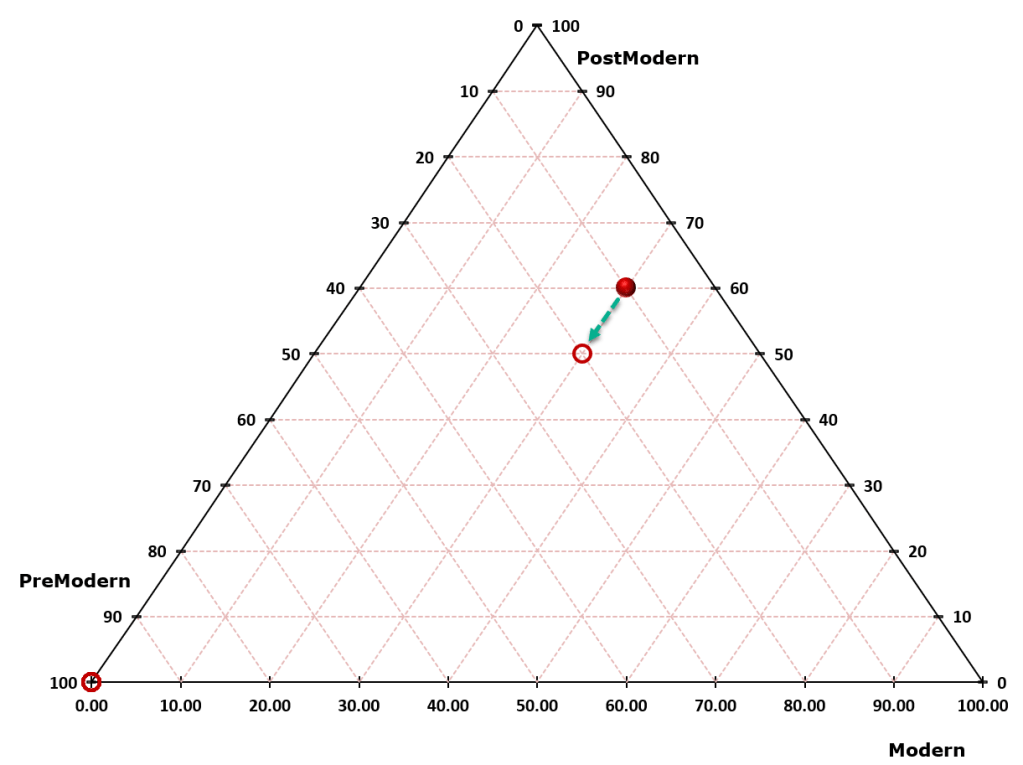
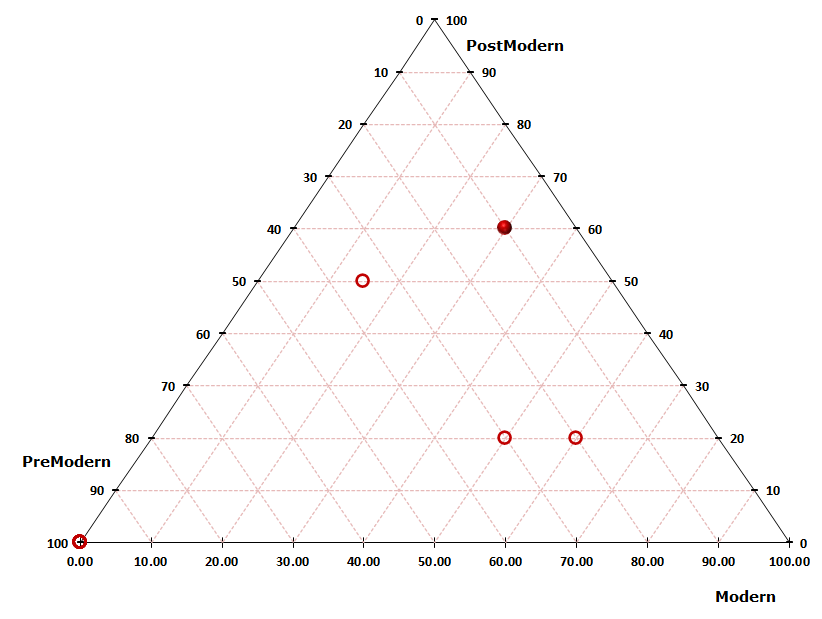
Usign this ternary chart as a reference, if I am the solid red dot at time-1, and adopt some Metamodern world views, my place at time-2 moves in the direction of PreModern, which is to say down and to the left.

To be clear, the direction of this shift is not inevitable. It depends on the initial orientation and the dimension under consideration. If I were lower on the chart (more Modern than PostModern), then the movement would more likely be from right to left horizontally and not angular as depicted. Moreover, even from the starting position shown, the movement might simply go left. What it won’t do is go up or to the right, the area shaded in red on the chart below.

My next step is still to dimentionalise this. Altought I have some canditates already in mind, I suspect this will be an emergant process. Feel free to come along for the ride.

Ternary Chart

I am working toward fleshing out my Modernity Triangle. Since I want to illustrate placement graphically, I’ve settled on using a ternary plot—at least for now. I’ve borrowed an existing Excel template, which already contained the simple maths and charting. This is really just the tip of the iceberg as creating appropriate dimensions, measures, and weights is the heavy lifting.

I may work on the aesthetics, but this is the underlying framework. I’ve already commenced a scoping conversation in a previous post. In a nutshell, there are three primative movements—the spectra are Premodern to Modern, Modern to Postmodern, and Postmodern to Premodern.

This chart is meant to be discriptive. As the adage goes, there is no correct placement. If you identify as a Modern, you may wish the dots to bias in that direction, but the same is true if you occupy one of the other corners. For those who prefer moderation as a stance—the Middle Path—, you may be tempted to find comfort in a dot occupying the centre. That’s fine. I’m not judging your worldview.

Taking a moment to mention prescription, the best I can offer at this point is that if you feel you should or want to occupy a particular place. Feel free to create a vector from where you are to where you aspire to be. My only caveat at this point is that sometimes it is hard to reverse tack once the genie’s been let out of the bottle. An example might be agriculture. Humans progressed from Hunter-Gatherers to Aggrarians. Some have ‘progressed’ to Industrial and Postindustrial worldviews. However, not all humans have taken these paths. But due to encroachment of Premodern humans by Moderns, the habitat of Premoderns has made hunting and gethering an untenable lifestyle, so in the contemporary world, only Hunter-Horticulturalist remain.

In the accompanying ternary chart, I clumsily place myself where I self-identify, though I could be way off base. As a matter of example, this dot could represent a single dimension as well as some aggregation of dimensions. At the most abstract level, the view should interpret as a person espousing a tendency toward Postmodernism over Modernism fairly far removed from Premodernism. The lower leftmost dot on the Premodern corner could represent a typical pre-Enlightenment peasant as well as a member of some contemporary indigenous tribe such as the Sentinelese.

In the contemporary Western world, I’d image that they might be represented by the 2 dots on the second horizontal, fairly Modern, a smidgeon of PostModern, and more PreModern than they’d likely be comfortable to admit.

Political Compass

I was inspired by the Political Compass conceived by Libertarians attempting to differentiate themselves from a strict Left-Right political frame. My intent is to create something similar. I don’t feel that I have four points to work with, so I settled for three. I discuss how Metamodernism fits into this model elsewhere. Here is how the Political Compass situated the UK parties in the 2019 general election.