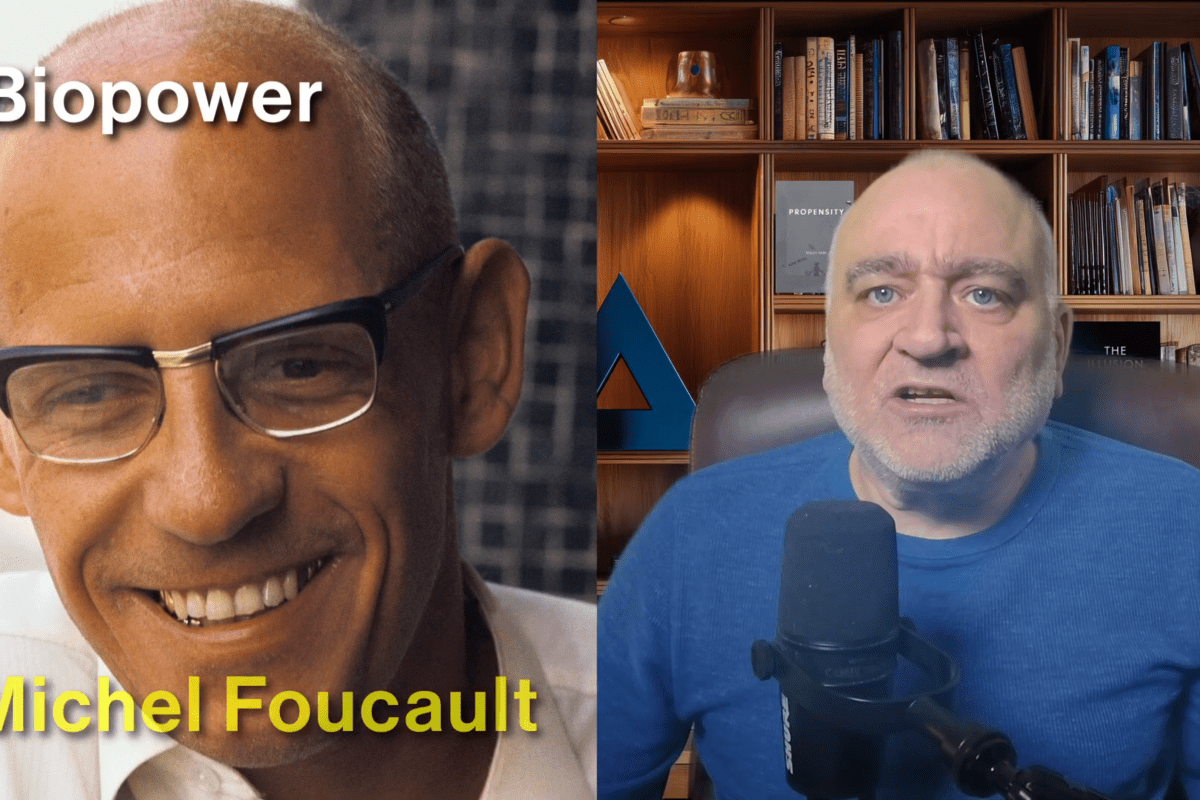
Video: Architecture of Grammatical Compromise. (Duration: 10:30)
In this video, I define Ontology, Grammar, and Commensurability before I use abortion as a poster child. Then, I discuss what happens when ontological grammars are incommensurable.
These thinkers follow:
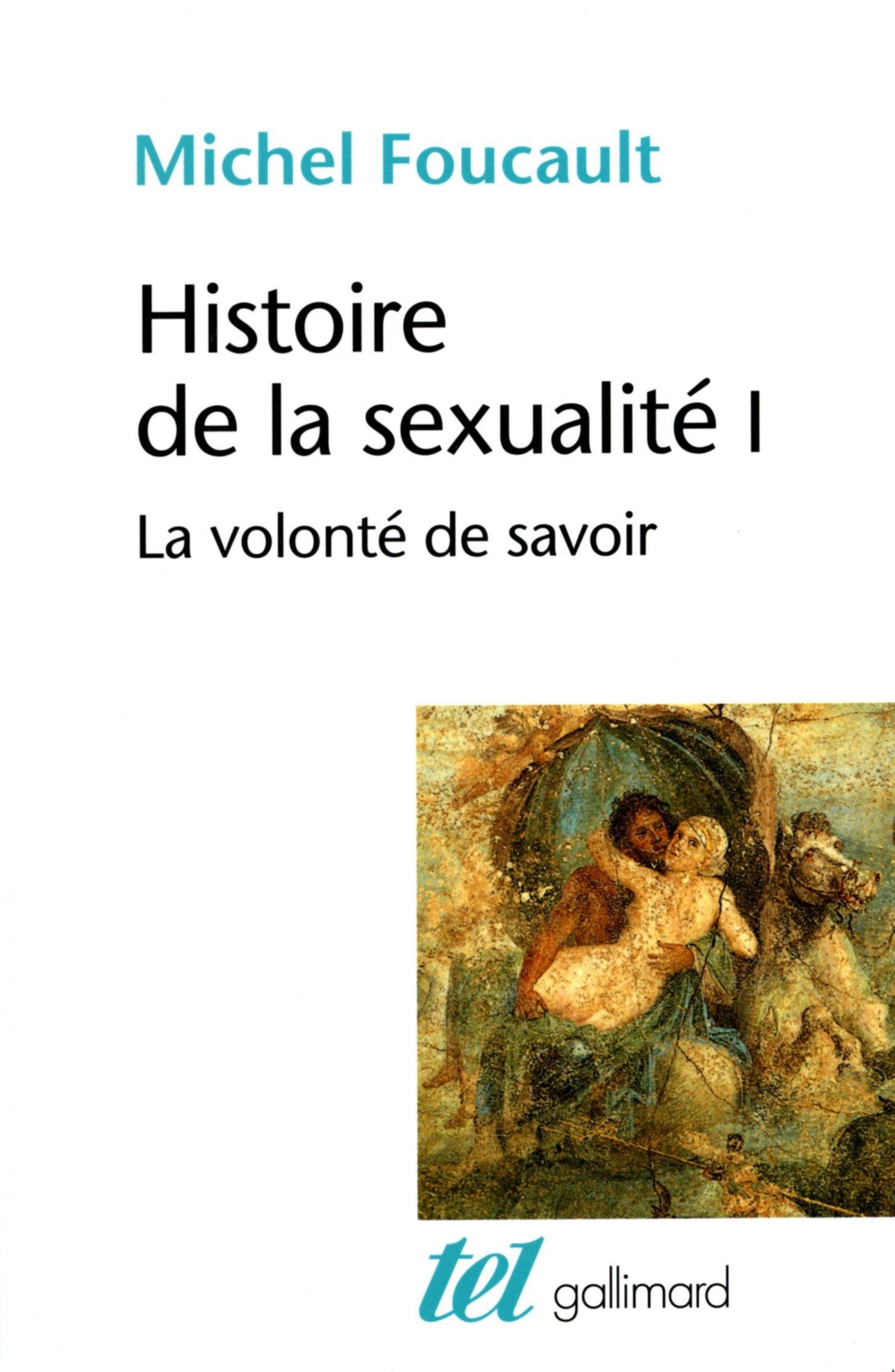
Michel Foucault: Biopower, notably The History of Sexuality, Volume I.
Bernard Williams: Thick Moral Concepts from Ethics and the Limits of Philosophy.
Pierre Bourdieu: Habitus, notably from Outline of a Theory of Practice.
Karl Popper: Paradox of Intolerance.
I discuss the challenge of the promise of compromise and its three possible outcomes, none of which are true compromises.
Watch the video for context. Read the essay for fuller details.
Abortion, Ontological Grammar, and the Limits of Civil Discourse
When federal abortion protections were withdrawn in the United States, many observers treated the event as a policy reversal, a judicial shift, or a partisan victory. Those are surface descriptions. They are not wrong. They are simply too thin.
What was exposed was not a failure of dialogue. It was the collision of ontological grammars.
Audio: NotebookLM summary podcast.
1. Thick Concepts and the Illusion of Neutral Ground
Bernard Williams famously distinguished between ‘thin’ moral terms (good, bad, right) and ‘thick’ ones (cruel, courageous, treacherous), where description and evaluation are fused.
Abortion is not a thin concept. It is thick all the way down.
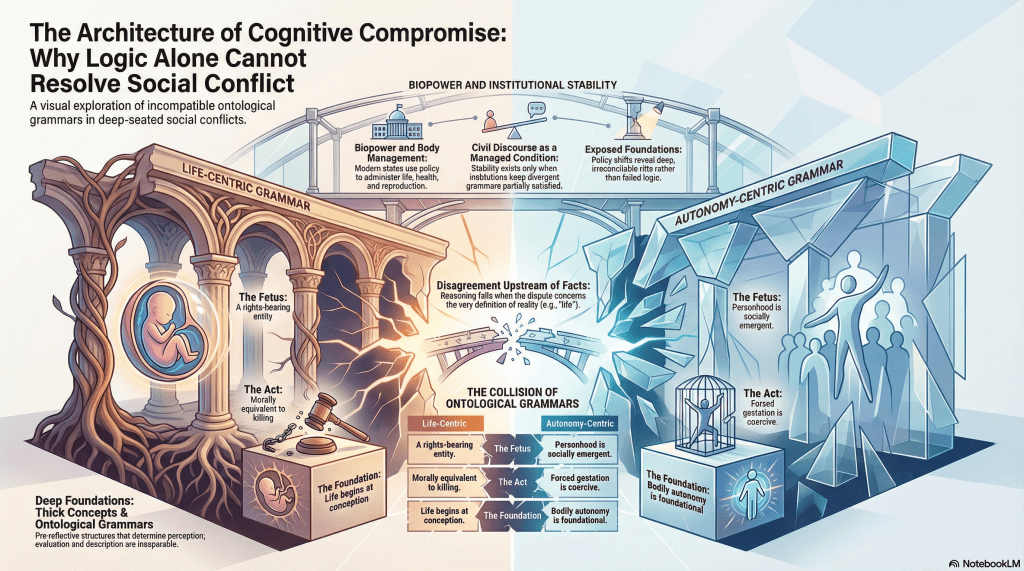
For one framework, the operative grammar is something like:
Life begins at conception.
The foetus is a rights-bearing entity.
Termination is morally equivalent to killing.
For another:
Personhood is socially and biologically emergent.
Bodily autonomy is foundational.
Forced gestation is coercive.
Notice that these are not competing policies. They are competing ontological commitments about what exists, what counts as a person, and what kind of being a pregnant body is.
Argument across this divide does not merely contest conclusions. It contests the background conditions under which reasons register as reasons.
This is not ‘people see the world differently’. It is: people parse reality through grammars that do not commute.
2. Ontological Grammar: Where Deliberation Stops
By ‘ontological grammar’, I do not mean syntax in the Saussurean or Chomskyan sense. I mean the pre-reflective substrate that structures what appears salient, real, morally charged, or negligible.
We deliberate within grammars. We do not deliberate our way into them.
Liberal Enlightenment optimism assumes that if disagreement persists, more information, better reasoning, or improved empathy will close the gap. But if the dispute concerns the very ontology of ‘life’, ‘person’, or ‘rights’, no amount of fact-sharing resolves the issue. The disagreement is upstream of facts.
The closure of federal abortion access did not prove that one side reasoned better. It demonstrated that institutional containment had failed.
3. Biopower and the Management of Bodies
Michel Foucault gives us a crucial lens: biopower. Modern states do not merely govern territory; they administer life. Birth rates, mortality, sexuality, health – these become objects of policy.
Abortion sits directly inside this matrix.
A state that restricts abortion is not only expressing moral judgment. It is reallocating control over reproductive capacity. It is asserting a claim over which bodies count, which futures are permitted, and which biological processes are subject to regulation.
The conflict is therefore not purely ethical. It is biopolitical.
And what appears as ‘civil discourse’ around abortion is often possible only so long as institutional frameworks keep both grammars partially satisfied. When federal protections existed, they acted as a stabilising superstructure. Remove that, and the ontological conflict becomes naked.
4. Habitus and the Illusion of Reasoned Consensus
Pierre Bourdieu would remind us that our dispositions are not self-authored. Habitus sedimented through family, religion, class, and institutional life shapes what feels obvious, outrageous, or unthinkable.
People do not wake up one morning and choose an abortion ontology.
They inherit it. It becomes embodied common sense.
Thus, when someone says, ‘Surely we can agree that making a person feel whole is more important than ideological purity’, they are already speaking from within a grammar that prioritises individual authenticity and psychological coherence. That priority is not universal. It is historically situated.
Compromise is not achieved by stepping outside habitus. It is achieved when institutional and social conditions allow divergent grammars to coexist without totalising one another.
5. The Popperian Threshold
It is impossible to speak in such a way that you cannot be misunderstood. —Karl Popper
Karl Popper warned of the ‘paradox of tolerance‘: unlimited tolerance may enable intolerant forces to eliminate tolerance itself.
In particularly virulent climates, appeals to compromise are heard not as gestures of goodwill but as tactical weakness.
When one faction succeeds in unilaterally redefining the legal status of abortion at a federal level, it is not merely participating in discourse. It is altering the biopolitical infrastructure. Once altered, the range of permissible disagreement narrows.
Civil discourse, then, is not a natural equilibrium. It is a managed condition sustained by institutional design, social trust, and shared legibility.
NB: Popper’s paradox of tolerance is often invoked as a moral axiom. But it is better understood as a self-protective clause internal to liberal ontology. It presupposes a shared commitment to rational exchange. When that commitment erodes, the paradox does not resolve disagreement; it merely marks the point at which biopower intervenes to preserve a regime.
6. Why This Is Not Just ‘People Disagree’
The lay intuition – ‘people see the world differently’ – is descriptively correct and analytically useless.
What the ontological grammar model adds is structure:
When stabilisation weakens, conflict appears irreconcilable.
Abortion is not uniquely polarising because people are irrational. It is polarising because it touches ontological primitives: life, personhood, autonomy, and obligation.
In such cases, ‘compromise’ is not achieved by discovering a middle truth. It is achieved – if at all – by constructing a legal and institutional arrangement that both grammars can grudgingly inhabit.
NotebookLM Infographic
7. The Uncomfortable Conclusion
The Enlightenment story tells us that disagreement is a surface phenomenon, curable by better reasoning.
The ontological grammar story tells us something harsher: some disagreements are not resolvable through language because they are about the conditions under which language binds.
This does not entail quietism. It entails clarity.
Civil discourse is not proof that grammars have converged. It is evidence that power, institutions, and habitus have aligned sufficiently to prevent rupture.
When that alignment shifts, the illusion of shared ontology evaporates.
And what we are left with is not failed reasoning – but exposed foundations.
I planned to use prostitution and anti-natalism as other cases for elucidation, but I see this has already grown long. I’ll reserve these are others for another day and time.
Follows is another AutoCrit1 review of my current focus—working title: Democracy: The Grand Illusion, affectionately called Dumocracy.
Synopsis
The chapter “Vote Against Democracy, Say ‘Nay'” delves into a comprehensive exploration of the critiques posed by prominent intellectuals and philosophers throughout history regarding democratic systems. The opening sets the stage by quoting Winston Churchill’s famous line: “The best argument against democracy is a five-minute conversation with the average voter.” This quote immediately introduces a critical perspective on democracy, foreshadowing the in-depth analysis to come.
“The best argument against democracy is a five-minute conversation with the average voter.”
The text then proceeds to examine various historical figures’ criticisms of democracy, ranging from Plato’s concerns about mob rule to Tocqueville’s observations about mediocrity in democratic societies. Each thinker’s critique is dissected and analyzed, shedding light on the potential pitfalls and limitations of democratic governance. From elitism and failures within democracies to warnings about the tyranny of the majority and challenges with meritocracy, each section offers valuable insights into different aspects of democratic systems.
As the text progresses towards its conclusion, it synthesizes these diverse critiques while acknowledging both strengths and weaknesses inherent in democratic ideals. It culminates by emphasizing that despite its flaws, democracy remains one of the best available forms of government—a sentiment encapsulated in Winston Churchill’s famous remark: “Democracy is the worst form of government, except for all others that have been tried.” This closing statement reinforces a pragmatic understanding of democracy while encouraging ongoing reflection on how to refine and improve democratic governance models.
“Democracy is the worst form of government, except for all others that have been tried.”
Winston Churchill
In essence, “Vote Against Democracy, Say ‘Nay'” presents a nuanced examination of historical critiques surrounding democracy that challenge readers to critically assess both the virtues and vulnerabilities embedded within this prevalent system of governance.
Audience
audience for this text appears to be individuals interested in political theory, philosophy, and the complexities of democratic governance. Those who are engaged in scholarly or academic discussions surrounding democracy, its critiques, and potential reforms would likely find this text highly relevant. The detailed exploration of historical perspectives from prominent figures like Plato, Aristotle, Churchill, Nietzsche, and Tocqueville provides a comprehensive overview for readers with an interest in political thought.
However, individuals seeking a more general overview or introductory understanding of democracy may find the text overly intricate and specialized. To make it more accessible to a broader audience outside academia or political theory enthusiasts, the author could consider simplifying complex philosophical concepts into more digestible language. Additionally, providing real-world examples or contemporary case studies illustrating the practical implications of these critiques could help engage a wider range of readers who may not have prior knowledge of political theory. Incorporating clear summaries at key points throughout the text can also aid in enhancing readability and comprehension for those less familiar with the subject matter.
Structure and Organisation
The text follows a logical order and is well-organized. Each critique of democracy by the different intellectuals is presented in a structured manner, with clear transitions between each section. The text flows smoothly from one critique to the next, providing a comprehensive overview of various perspectives on democratic governance without any apparent issues of structure or organization.
Clarity
The author’s points are generally presented clearly throughout the text. Complex ideas and critiques of democracy are explained in a structured manner, making it easier for readers to follow the arguments presented by each thinker. However, there are instances where additional clarification or simplification could enhance reader understanding:
In the section discussing Joseph Schumpeter’s elitist theory of democracy, some readers may find the concept of democracy as a competitive struggle for votes rather than genuine self-governance by the masses somewhat challenging to grasp without further elaboration on how this dynamic operates within democratic systems.
The discussion on Michel Foucault’s critique of democracy introduces terms like biopolitics and power structures that may require more explicit definitions or examples to help readers unfamiliar with these concepts fully comprehend their significance within democratic contexts.
Audre Lorde’s critique focusing on intersectionality and democratic inclusion touches upon complex social dynamics that might benefit from clearer illustrations or real-world applications to elucidate how these issues manifest in practice within democratic institutions.
Overall, while the text effectively conveys nuanced critiques of democracy by various thinkers, providing more concrete examples or simplified explanations in certain sections could enhance clarity for readers less familiar with political theory and philosophy.
Commentary
I may address these aspects with footnotes as this background information is at times extensive and in any case available elsewhere.
Argument and Persuasion
The text presents a range of opinions critiquing democratic systems from various thinkers such as Plato, Aristotle, Alexis de Tocqueville, Friedrich Nietzsche, Winston Churchill, Joseph Schumpeter, Simone Weil, Michel Foucault, and Audre Lorde. These critiques cover themes like elitism in governance (Plato), the importance of moderation (Aristotle), concerns about tyranny of the majority (Tocqueville), critique of egalitarianism (Nietzsche), pragmatic view on democracy’s flaws and strengths (Churchill), elitist theory emphasizing competition for votes over self-governance by masses (Schumpeter), highlighting failures to address spiritual needs and rootedness in society (Weil) and understanding how democratic institutions can perpetuate subtle forms of control through power structures embedded within knowledge frameworks.
Each thinker presents their arguments with logical reasoning and supporting evidence drawn from historical contexts or philosophical principles. The strength lies in the diversity of perspectives offered which enriches the discourse on democracy by exploring its complexities from different angles. By addressing issues like potential mediocrity in democracies or challenges with inclusivity for marginalized groups within democratic systems these critiques prompt critical reflection on areas where improvements may be needed.
Overall, the persuasive elements are well-supported through references to original texts or established theories. The logical construction is evident as each opinion is presented coherently with relevant examples or theoretical frameworks backing them up.
Tone
The text presents a range of emotional perspectives, reflecting both critical analyses and nuanced reflections on democratic systems. The tone varies from sober contemplation to impassioned critique, showcasing a mix of scepticism, concern, pragmatism, and urgency. Each author’s perspective evokes emotions such as caution (Plato), moderation (Aristotle), wariness (Tocqueville), disdain for egalitarianism (Nietzsche), pragmatic acknowledgement of flaws (Churchill), elitist realism (Schumpeter), longing for rootedness and community (Simone Weil), critical examination of power structures (Foucault) and call for inclusivity and justice for marginalized groups (Audre Lorde). These emotional tones collectively create a rich tapestry that challenges conventional views on democracy while urging readers to consider the complexities inherent in governance systems.
Interest and Engagement
The text presents a wide range of critiques on democracy from various historical and philosophical perspectives, which can be engaging for readers interested in political theory. The inclusion of notable figures such as Plato, Aristotle, Alexis de Tocqueville, Friedrich Nietzsche, Winston Churchill, Joseph Schumpeter, Simone Weil, Michel Foucault, and Audre Lorde adds depth and credibility to the discussion.
However, due to the detailed nature of each critique presented in the text and the extensive references to specific works by these thinkers, some sections may become dense or overwhelming for readers who are not well-versed in political philosophy. To improve engagement in these sections:
Simplify Complex Ideas: Break down complex concepts into more digestible segments that are easier for a broader audience to understand.
Provide Contextual Explanations: Offer brief explanations or summaries before delving into each critique to provide context for readers unfamiliar with the philosophers’ works.
Use Analogies or Real-World Examples: Illustrate abstract ideas with relatable examples or analogies that help clarify their relevance in contemporary society.
Incorporate Visual Aids: Consider using diagrams or visual aids to enhance understanding of intricate theories and make them more accessible.
By incorporating these strategies throughout the text when discussing challenging concepts from different critiques on democracy by prominent theorists such as Plato’s “The Republic,” Aristotle’s “Politics,” Tocqueville’s “Democracy in America,” Nietzsche’s concept of the Übermensch (Overman), Churchill’s pragmatic observations on democracy being “the worst form of government except all others,” Schumpeter’s elitist theory of democracy emphasizing competition among elites for votes rather than direct self-governance by all citizens; Weil’s focus on rootedness and community needs within democratic systems; Foucault’s analysis on power structures within democracies perpetuating control; Lorde’s intersectionality critique highlighting exclusionary practices towards marginalized groups—the author could maintain reader interest while navigating through intricate discussions surrounding democratic governance across history and philosophy.
Commentary
I plan to incorporate some visual and diagrammatic aids, but AutoCrit cannot evaluate this type of content.
Final Thoughts and Conclusions
The text ends with a comprehensive and cohesive conclusion that effectively ties together the various critiques of democratic systems presented by Plato, Aristotle, Alexis de Tocqueville, Friedrich Nietzsche, Winston Churchill, Joseph Schumpeter, Simone Weil, Michel Foucault, and Audre Lorde. The final thoughts provide a reflective summary of the challenges inherent in democratic governance while emphasizing the need for ongoing reflection and improvement within democratic systems. The concluding section successfully synthesizes the diverse perspectives on democracy discussed throughout the text.
AutoCrit is an AI-based editorial application. I am a member of their affiliate programme, so I gain minor financial benefits at no cost to you if you purchase through a link on this page. ↩︎
Churchill is not on record having said this, but the sentiment remains. ↩︎
Identity is a fiction; it doesn’t exist. It’s a contrivance, a makeshift construct, a label slapped on to an entity with some blurry amalgam of shared experiences. But this isn’t just street wisdom; some of history’s sharpest minds have said as much.
“There are no facts, only interpretations.”
— Friedrich Nietzsche
Think about Hume, who saw identity as nothing more than a bundle of perceptions, devoid of any central core. Or Nietzsche, who embraced the chaos and contradictions within us, rejecting any fixed notion of self.
Edmund Dantes chose to become the Count of Monte Cristo, but what choice do we have? We all have control over our performative identities, a concept that Judith Butler would argue isn’t limited to gender but applies to the very essence of who we are.
“I don’t feel that it is necessary to know exactly what I am. The main interest in life and work is to become someone else that you were not in the beginning.”
— Michel Foucault
But here’s the kicker, identities are a paradox. Just ask Michel Foucault, who’d say our sense of self is shaped not by who we are but by power, society, and external forces.
You think you know who you are? Well, Erik Erikson might say your identity’s still evolving, shifting through different stages of life. And what’s “normal” anyway? Try to define it, and you’ll end up chasing shadows, much like Derrida’s deconstruction of stable identities.
“No such things as selves exist in the world: Nobody ever was or had a self.”
— Thomas Metzinger
“He seemed like a nice man,” how many times have we heard that line after someone’s accused of a crime? It’s a mystery, but Thomas Metzinger might tell you that the self is just an illusion, a by-product of the brain.
Nations, they’re the same mess. Like Heraclitus’s ever-changing river, a nation is never the same thing twice. So what the hell is a nation, anyway? What are you defending as a nationalist? It’s a riddle that echoes through history, resonating with the philosophical challenges to identity itself.
“I never can catch myself at any time without a perception, and never can observe anything but the perception.”
— David Hume
If identity and nations are just made-up stories, what’s all the fuss about? Why do people get so worked up, even ready to die, for these fictions? Maybe it’s fear, maybe it’s pride, or maybe it’s because, as Kierkegaard warned, rationality itself can seem mad in a world gone astray.
In a world where everything’s shifting and nothing’s set in stone, these fictions offer some solid ground. But next time you’re ready to go to the mat for your identity or your nation, take a minute and ask yourself: what the hell am I really fighting for? What am I clinging to?
My love affair with Foucault goes way back. Joseph Campbell is said to have spent five years (1929–1934) living in a shack, engaged in intensive and rigorous independent study. In my dreams, I’d spend five years with Foucault, Galen Strawson, and David Guignion.
Michel Foucault is likely the most well-known of these three, and I’ve written a few Galen Strawson-related posts lately, but who the hell is David Guignion? I’ll tell you. David is a PhD philosophy student studying conspiracy theories if his bio is up to date and otherwise relevant. I’ve shared some of his content and insights over the years.
The reason I love David is that he introduces me to contemporary philosophers I had not been aware of as well as material or perspectives on classical philosophers to broaden my horizons. I think it’s safe to say that David and I are both Foucault fanboys. Hell, I don’t even have a tee shirt with Foucault’s likeness, so he’s even ahead of me in that game.
So, where’s this all leading, you ask. And I’m glad you did. A couple of days ago David posted a clip on YouTube called Michel Foucault’s “The Subject and Power”. I was drawn to the mention of Foucault, but I decided not to visit. I get so many distractions on my anti-agency endeavour—and that’s not even accounting for the sheer quantity of research—, and I didn’t need yet another. But the synchronicity was determined.
Last night, as I was getting ready for bed, I decided that I’d just let the video play as I fell into slumber. Spoiler Alert: That never happened. Topic after topic caught my ear, and it took all of my will to not get out of bed and start reading and writing. But it was almost 4 am, so that worked in favour of remaining supine—though alternately prostrate.
Kumi Yamashita, Building Blocks (2014)
My thesis is that the free will versus determinism or indeterminism debate is not inherently critical to the agency versus structure debate. My position is that agency has little breathing room and no material degrees of freedom to matter. Foucault’s subjectification or subjectivation makes the same argument. In effect, this is an argument about structure over agency. It’s about conscious and unconscious forces to conform. Full disclosure, I identify most as an indeterminist, but in the end, I don’t think it much matters. I disclose this being it may provide a clue as to how I ended up here—of my own free will, it goes without saying.
I’m not going to summarise David’s summary because you can just watch his clip for yourself. But the gist of it is that we are all subjectivised or moulded. Foucault tries to convince us that this is the crux of his decades of teaching, but to me, it still comes down to power—to the pressure that creates these diamonds. Diamonds have no free will; they just become diamonds. And so it goes for humans cum subjects.
Not to come across like Rousseau, but I am still interested in understanding what happens to those outside of this sphere of influence.
Cover Image Credit
Kumi Yamashita
BUILDING BLOCKS 2014 H200, W300, D10 cm Carved wood, single light source, shadow Permanent Collection Otsuma Women’s University, Tokyo, Japan
Galen Strawson is my latest male crush. With almost everything I read or hear from him, I say, ‘that’s what I think’, over and over and over again. So I thought I’d share some of my journey to now. I made a post about female influences not too long ago. This is a bit different.
My first obsession, let’s say was the Beatles. I can’t pinpoint precisely when, but when I was a child, it’s been said that I would sing ‘she’s got a chicken to ride’ when it came on to AM radio. I asked for or bought all of their albums, and read everything about them that a kid could get his hands on back in the day. This obsession lasted for years and overlaps some of my next interests. My interests were in John Lennon’s political interests and George Harrison’s spiritual interests. I didn’t really find Paul McCartney or Ringo Starr very interesting beyond their musical abilities. And to be honest, I also got all of the Stones, Led Zeppelin, Pink Floyd, and so on. At my peak, I had over a thousand vinyl records—all lost in a house fire because vinyl and heat are generally incompatible. Paper didn’t fare much better, as I lost hundreds of books, too. A lesson in impermanence.
I am a bit of a nonconformist, a contrarian, and a polemicist
In grades 5 to 8, National Socialism and World War II were fascinating to me. Not Hitler, per se, though I do recall reading Mein Kampf at the time. There was just something about the sense of unity. Upon reflection, I realised that this meant me conforming to some other trend, and that was no longer interesting, as I am a bit of a nonconformist, a contrarian, and a polemicist, so there was that.
At some point, I came across Voltaire’s Candide and it just struck me. This may have commenced me on my path to becoming somewhat of a francophile. I extended my interest into the language and culture. My WWII phase has already primed that pump. I remember reading Dumas, Hugo, and some Descartes.
After I graduated, I was a recording engineer and musician. I remember reading Schoenberg’s Structural Function of Harmony and being enamoured with Dvořák and Stravinsky. I was influenced by many musicians, engineers, and producers, but there was just something about Schoenberg.
I went through a Kafka phase—that eventually included Donald Barthelme. His Absurdism was a nice foundation for my subsequent interest in Camus. It was something that just resonated with me. After Kafka, I discovered Dostoyevsky and consumed everything of his I could get my hands on.
I took from Jung and Campbell the importance of metaphor
In the 1990s, I discovered Carl Jung and eventually Joseph Campbell and a few years I spent reading Jung’s Complete Works and peripheral material related to Archetypal and Depth Psychology. I absorbed the material. I took from Jung and Campbell the importance of metaphor, but it never really resonnated beyond this.
Somehow, this experience led me to the Existentialism of Sartre (and Camus and Beauvoir). At the same time something clicked with me, I was always put off by the teleological imperative these guys seemed to insist upon—Sartre’s political involvement and Camus’ insistence on Art. These were their paths—and I certainly had an interest in Art and Politics—, but I felt this was too prescriptive.
For a brief time, I really liked Hume (and Spinoza), but then I discovered Nietzche and felt compelled to read his major works. It all made sense to me. It still does. Nietsche set me up for Foucault with his power relationships and the sense that morality, good, and evil are all socially constructed and contextual.
And Nietzsche brought me to Foucault and his lens of Power. These two still resonate with me. I investigated a lot of postmodern thinkers after this.
Nietzsche brought me to Foucault and his lens of Power
Daniel Dennett came next. He seems brilliant, and I tend to agree with most of what he says. I was still absorbing. Where biologist Robert Sapolsky gets philosophical, it’s about the same.
But Galen Strawson is different. And I have a lot of catching up to do in my reading of his direct work. The difference is that with these prior influences, I was absorbing and synthesising—creating my own perspectives and worldview. By the time I am finding Strawson, with every encounter, I am ticking off boxes.
That’s what I think
That’s what I think
That’s what I think
That’s what I think
Only, he started publishing in the 1960s. I could have been reading his work all along. Since I agree with 99.999 per cent of what I get from him and he is such a deep thinker, I am looking for two things:
Something that expands rather than confirms
Some spaces to operate that he has missed or ignored
As I continue on my Anti-Agency project and gather more inputs and perspectives, I’ll be considering a lot of Strawson. Here’s a clip I really enjoyed. I am thinking of doing a sort of reaction piece, but whether or not that happens, here’s the source.
[Video] Galen Strawson — Is Free Will a Necessary Illusion?
Spoiler Alert: I believe that free will is a cognitive bias related to apophenia. It’s a Gestalt heuristic.
I can’t count the number of times I’ve defended Postmodernism (PoMo) from attack, so I am publishing this, so I can link to it. Perhaps I am not defending PoMo, but my flavour of it, but I’ve read a lot of work published by the usual suspects—some who eschew being lumped into a poorly defined category—or at least a nebulous category.
Before I get too far, I also want to remind the reader to take care to separate the philosophy from the person. One popular attack is the conflating of identity politics and social justice advocacy as PoMo phenomena. In fact, I consider myself to be PoMO—to be defined here in a moment—and a social justice warrior (SJW), this despite contesting the very notion of identity to begin with.
By definition, a summary is a reduction of some thing, but one needs to be careful not not arrive at reductio ad absurdum. Where appropriate, one may also wish to differentiate postmodernism with postructuralism. So as not to create a definition partir de rien, I’ll reference other accessible versions. A critic may disagree with these definitions, but they will serve as the foundation of my position and vantage.
Wikipedia gives us this definition (their reference links retained):
That postmodernism is indefinable is a truism. However, it can be described as a set of critical, strategic and rhetorical practices employing concepts such as difference, repetition, the trace, the simulacrum, and hyperreality to destabilize other concepts such as presence, identity, historical progress, epistemic certainty, and the univocity of meaning.
Notice the commonalities. PoMo is a descriptive, critical activity. It’s descriptive. As language and grammar can be approached descriptively of prescriptively, so can philosophy. Some ‘schools’ do both. PoMo is exclusively descriptive. PoMo was born as a reaction to Modernism, especially the unstated foundations labelled by Lyotard as metanarratives—the grand narratives and underlying ideologies of prevailing beliefs that were uncritically taken for granted, many of which that were formed or catalysed in the Age of Enlightenment.
Jean-François Lyotard defined philosophical postmodernism in The Postmodern Condition, writing “Simplifying to the extreme, I define postmodern as incredulity towards meta narratives….”[4] where what he means by metanarrative is something like a unified, complete, universal, and epistemically certain story about everything that is. Postmodernists reject metanarratives because they reject the concept of truth that metanarratives presuppose. Postmodernist philosophers in general argue that truth is always contingent on historical and social context rather than being absolute and universal and that truth is always partial and “at issue” rather than being complete and certain.[3]
My defence is that PoMo cannot be for social justice or engage in identity, as it has no positive position on these. It functions to critically deconstruct. People unfamiliar with PoMo concepts often misunderstand this notion of deconstruction. All to often, I see people criticise Derrida for his brand of Deconstruction, but that only illustrates the fact that they never read or simply misunderstand what Derrida means by Deconstruction. Perhaps, I’ll elaborate on that in future.
My point is that PoMo is corrosive—like lye. It eats away at ideologies, dissolves them. It is not meant to construct anything. So where does this constructive expectation come from? It derives primarily from two places.
Modernism
Most people casting dispersion are modernists. They need to construct things. To be fair, this perspective has been an evolutionary advantage, but some people can’t allow a bunch of Lego pieces to remain unconstructed. This is fine, but you need another tool to perform this task. It’s not PoMo.
Ad Hominem
The other challenge is the inability to distinguish between the person and the idea. Michel Foucault was very vocal in the political realm and actively promoted Marxism, but, firstly, Foucault was not a self-professed PoMo—and for several reasons, one could come to accord with his assessment; secondly, in his deconstruction of history, he discovered a foundational component—this activity being squarely PoMo—, but he reconstructed historical narratives employing the lens of power. This rebuilding is not PoMo activity.
Parting Shot
Besides—or in addition to—ignorance, some people have an agenda, and they play ad hominem games, so if they can vilify a person and associate that person to an ideology, it can have the tendency of poisoning the well. Uncritical people won’t even notice the sleight of hand and redirect.
never attribute to malice that which is adequately explained by ignorance*
Hanlon’s Razor
A textbook example is Stephen Hick’s attempt in Explaining Postmodernism: Skepticism and Socialism from Rousseau to Foucault to conflate feminism (a positive mechanism) with postmodernism (to reiterate, a negative mechanism). In it he claims that feminists Andrea Dworkin and Catherine Mckinnon are proponents of PoMo thought, but he is apparently unaware that McKinnon has explicitly attacked PoMo as destructive to feminism. A fuller critique of Hicks‘ work can be heard on YouTube. I recommend it highly if you have the better part of an hour to spare. Jordan B Peterson is a celebrity personality whose primary exposure to PoMo is Hicks, so when you understand how off-base Hicks is, you’ll realise why Peterson is so off-base, too.
* Hanlon’s razor is originally cast as “never attribute to malice that which is adequately explained by stupidity“, but I prefer the term ignorance, as it it less value-laden and more broadly applicable. Besides, to be ignorant does not mean to be stupid. Many ignorant people are not stupid. I am ignorant of the Russian language, but I am not stupid.
As I read his Utilitarianism, I want to like John Stuart Mill. He seems like such a clever man, but he is a victim of his Enlightenment Age. Attempting to fabricate order created by science’s encroachment on the absolutes of religion and the shifting sentiments toward monarchies, Mill tries to replace this moral compass with Jeremy Bentham‘s utility.
£1 ≠ £1
The problem is that despite (sort of) dispensing of religious doctrine, Mill was still fettered by the dogma of virtue ethics of dignity and duty. To this, he adds happiness. Not to go full-on Foucault, but these are concepts leveraged, like religion, to maintain power—take an elevated system in a constructed society, and the duty becomes a burden to the bottom, save for pretence of duty and dignity at the top.
I’ve had an issue with the concept of virtue and all of its offspring: duty, justice, and so on. I’ll likely write about this later. I expect that I’ll be reading Mill’s On Liberty next, so stay tuned.
Ignoring my contention that Utilitarianism is baseless, I have two other issues, using economic examples, each related to prospect theory (pdf):
Regressivity: A person with less money values an incremental dollar more than a person with more money.
Loss to gain asymmetry due to risk aversion: A person values losing a dollar more than earning a dollar, ceteris paribus.
Pareto efficiency, a cornerstone of Classical economics, does not take this into account. For this theory, all dollars are created (or perceived to be) equal, so it doesn’t matter whether person A, who earns £10,000 p.a., or person B, who earns £100.000 p.a., gets £100, but in the real world, person A would give it a higher value, so a transfer from A to B would be an inferior transaction to a B to A transaction.
This said, person B values the £100 more than having gained the amount, but it is not clear how to reconcile (in order to reach perceived parity) what the fair equilibrium would be, allowing that equality of outcome might not be the desired outcome.









 Philosophics