Not explicitly about Kübler-Ross. In the 1990s, I enjoyed listening to the stories of a cantadora—keeper of the stories—, Clarissa Pinkola Estes and her Theatre of the Imagination. Many inspirational stories. That I deem psychology as a pseudoscience does not mean that it serves no purpose. It runs aground where they interpret metaphor for the actual—the symbol for the object. There is a lot to glean from symbols as representations, and one can even apply them to their lives, but never conflate the map for the terrain.
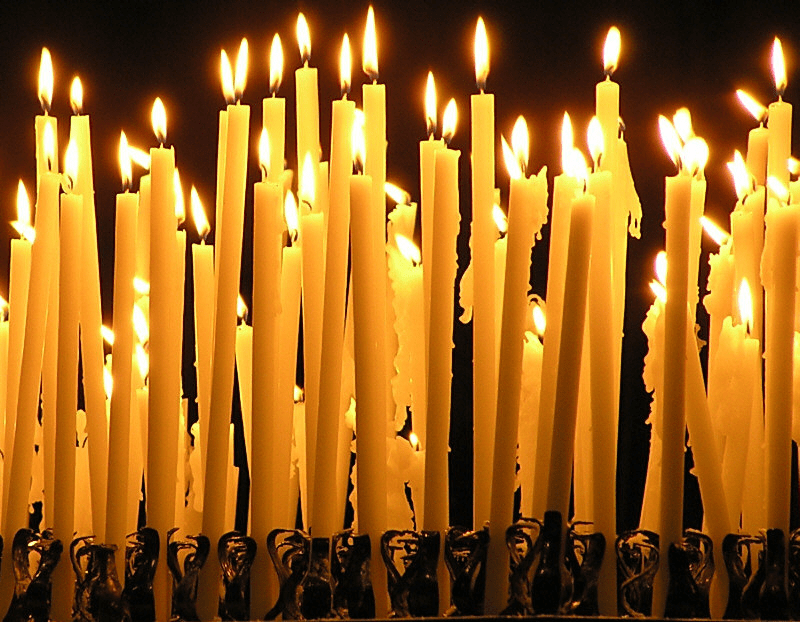
I loved Baba Yaga, but the one I am reminded of today regards candles as measures of life remaining. In this story, a person on a deathbed pleads with Death.
Death explains that the candles represent peoples’ lives and their life force.
Some are tall and burning brightly whilst others are on the verge of being snuffed out
The Dying assumes that all the tall and bright candles must represent young children and that the ones with almost no wax and wick to burn are the elderly.
Death explains:
Some children have very short candles.
And some of the very tall and very bright ones are very old people.
‘Look, here is yours’, Death tells him.
The Dying is directed to one of the dimmest, most pathetic, struggling-for-its-last-few-moments-of-burning-candle in all the land.
I just published a video on YouTube—just over 7 minutes long. I’ll be publishing the audio as a podcast and will share the script here as well.
Human Agency is an illusion. This is the end of the story. If you listen for a while, you’ll hear as I rewind and pull back the curtains.
[Redacted]
Let’s get started.
Human Agency is an illusion.
Think of life as a motion picture that’s already been filmed. The ending is already known. The script has been written and performed by actors already chosen and hired.
I like this visual, but it’s not quite right. The end is not known in the same sense as that of the movie. It’s just as inevitable, just unknown.
Some might prefer to use the metaphor of cascading dominos. And this might even play better into the illusion. Some unforeseen force might intervene and stop the otherwise inevitable. But even this is beyond our control. Like an action-adventure story, we’re strapped into a runaway train and just along for the ride. This train might someday stop, but we’ll have had nothing to do with it. Enough of metaphors. What am I saying? Why am I saying it? And what does it mean?
Allow me to set up the scene. From there, I’ll elaborate.
For millennia, there’s been a debate over free will and determinism. These terms have been defined in different ways in an attempt to sway the argument for or against, one way or another. It turns out that for the human agency illusion, it doesn’t much matter, but it might still help to set the stage, so let’s establish some foundation. I like to consider free will and determinism as bookends.
free will is the ability to make a choice and have had the ability to have chosen otherwise
Commonly, free will is the ability to make a choice and have had the ability to have chosen otherwise. That one can make this choice of their own accord or volition, is typically added for good measure. On the other hand, determinism says that everything that happens is determined by everything that has happened prior in a chain of cause and effect. Like dominoes falling one after another, so some event has caused another event since the dawn of time. Perhaps before time.
Some have argued that random events occur in our universe. Quantum theory suggests this. But that these events happen, doesn’t mean that we as humans have any say in the matter. This is what is known as indeterminism. Causes and effects are not so cut and dry. Some stochastic event serving as an exogenous factor manifesting as a pigeon, can swoop down and break the causal domino chain, but that doesn’t afford us human agency. A little more background. Some hold that free will and these alternatives are either mutually exclusive, or they’re compatible with each other. Not surprisingly, those who believe that these can coexist are called compatibilists, whilst the others are incompatibilists.
What I am saying is that if we allow that this wide shot might have validity, we can zoom in for a tight shot on the agent and notice that it doesn’t really matter. Some have said that the freewill versus alternatives challenge is a pseudo-problem. I am going to agree for the time being, if only for expedience. Before getting to the illusion of agency, let’s see why this situation creates problems.
Without getting too deep, humans seem to be wired to view their reality in a manner of cause and effect. Moreover, they seem wired to attribute blame based on this presumed causal relationship. Oksana hit a homerun. We should praise her. Raj robbed a store. We should blame him. Western society is constructed with this worldview, so we create rules and laws. We may even choose to codify how to rehabilitate or punish him. Or to reward her.
Without agency, there is no cause to praise or blame
Without agency, there is no cause to praise or blame. Whilst I consider it a pathology, for better or for worse, given the human propensity to blame concomitant with the agency illusion, I don’t see this changing any time soon.
There are arguments around quarantining bad actors independent of their agency or lack thereof on the grounds of public safety. Even this logic has serious holes, but we’ll save that for another time. And now the big reveal. With a reminder that my intent is to not go deep, how can I say that human agency is an illusion? Let’s start with the science.
As a lifeform, humans are a product of heredity, genetics, and epigenetics. Essentially, DNA passes information from generation to generation. Besides determining our physical attributes—head, shoulders, knees, and toes, potential height and weight, pigmentation, sex, and so on, it also establishes our temperament—our base attitude and way we perceive and interpret the world. This doesn’t make us clones or robots or automatons, but it does comprise some percentage of what we are. Identity politics aside, we don’t have much control of our sex, finger count, or eye colour. Clearly, we aren’t talking about trans-humans and cyborgs here.
Genetics and so on aren’t the only factor. Behaviourists will remind us that the environment and circumstances mould us, too. Each of us is taught mores and moral codes; how to behave and act. We are raised in a structure comprised of family, school, church, peers, larger society, authority figures, and whatever else—ostensibly like a sausage being stuffed into a skin.
Beyond the genetics that we have no control over, we are products of our environment
Beyond the genetics that we have no control over, we are products of our environment. These things interact, but there is nothing of us that we are responsible for creating. Despite the motivational tripe, we cannot create ourselves. This, too, is an illusion—delusion if I am being less charitable.
I’ll reserve elaboration for future content. In a nutshell, you’ve got no agency. Every choice you make is based on prior events. Even something as simple as choosing to order a chocolate or vanilla ice cream in a cup or a cone, sugar cone or waffle cone is predicated on some prior events, and you had nothing to do with them. You were a passive vessel.
I’ll leave with two relevant quotes.
A man can do what he wants, but not want what he wants.
Arthur Schopenhauer
And as Galen Strawson puts it,
You do what you do, in any given situation, because of the way you are.
So in order to be ultimately responsible for what you do, you have to be ultimately responsible for the way you are—at least in certain crucial mental respects.
But you cannot be ultimately responsible for the way you are in any respect at all.
So you cannot be ultimately responsible for what you do.
So there you have it. I hope you found this cursory treatment interesting and informative if not provocative.
[Redacted]
I’m interested in hearing what you think. Do you think you have agency? Do we have free will, or is everything determined at the start? I didn’t even mention religion. Does that throw a spanner in the works? Let me know.
The lamb spends all its time worrying about the wolf and ends up being eaten by the shepherd.
— Unknown
I think one could look at this from several perspectives or through different lenses.
We worry about the wrong things.
At some level, this is about trust.
We trust the wrong people. Those whom we most entrust do us in. But I feel this is contextual.
One might feel this shepherd is Capitalism or the State or organised religion. Perhaps it’s culture or identity cohorts. Or all or these or none of these.
On another level, it recalls the inevitability of death. This shepherd reaper is always waiting in the wings whether or not one worries.
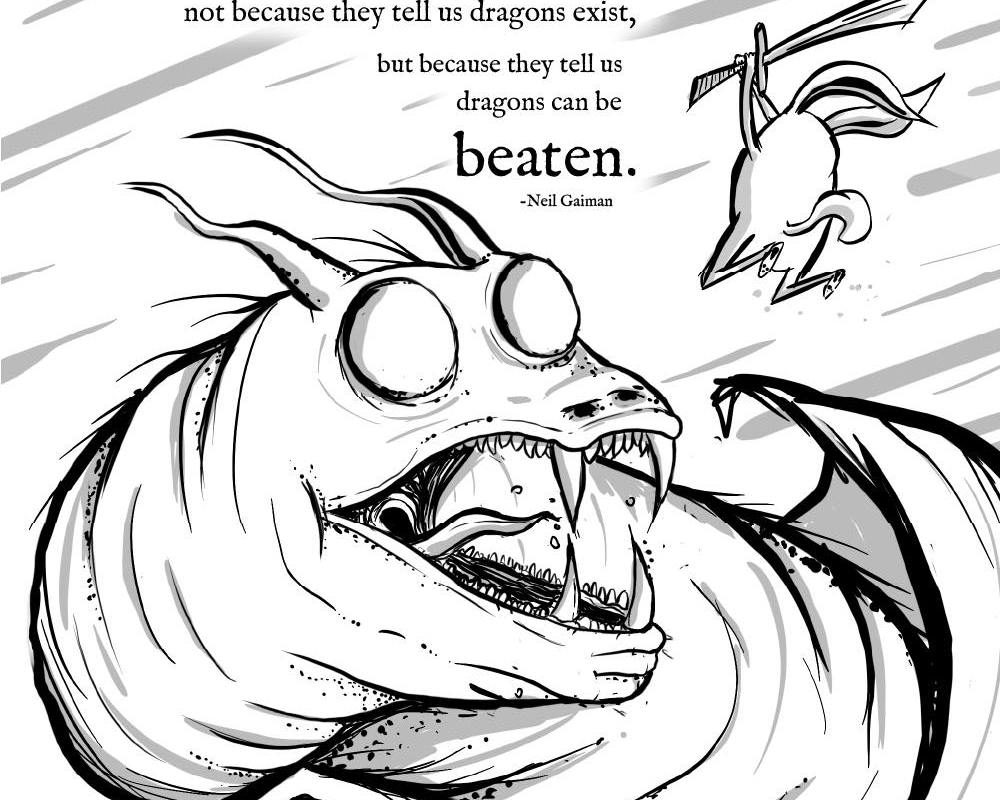
Neil Gaiman, an articulate, imaginatory writer. He makes a claim:
Fairy tales are more than true — not because they tell us dragons exist, but because they tell us that dragons can be beaten.
Neil Gaiman
To me, this is a problem with correlating imagination with truth. Moreover, many a war was lost on the story that it could be won.
Of course, we can still play the metaphor game. I’ve been a fan of metaphor since Joseph Campbell. Metaphor is strength. There was a time when I read Jung and had a stronger interest in Depth and Archetypal Psychology. And fairy tales per Marie-Louise von Franz or her more contemporary cantadora, Clarissa Pinkola Estes. Archetypes are metaphor, but this doesn’t render them real. Still, we can operate as if they are. The trick is to remember that they are not.