I maintain this blog for two primary reasons: as an archive, and as a forum for engagement.
Philosophy isn’t a mass-market pursuit. Most people are content simply to make it through the day without undue turbulence, and I can hardly blame them. Thinking deeply is not an act of leisure; it’s a luxury product, one that Capitalism would rather you didn’t afford. Even when I’ve been employed, I’ve noticed how wage labour chokes the capacity for art and thought. Warhol may have monetised the tension, but most of us merely survive it.
Video: Sprouting seed. (No audio)
That’s why I value engagement – not the digital pantomime of ‘likes’ or ‘shares’, but genuine dialogue. The majority will scroll past without seeing. A few will skim. Fewer still will respond. Those who do – whether to agree, dissent, or reframe – remind me why this space exists at all.
To Jason, Julien, Jim, Lance, Nick, and especially Homo Hortus, who has been conversing beneath the recent Freedom post: your engagement matters. You help me think differently, sometimes introducing writers or ideas I hadn’t encountered. We may share only fragments of perspective, but difference is the point. It widens the aperture of thought – provided I can avoid tumbling into the Dunning-Kruger pit.
And now, a note of quiet satisfaction. A Romanian scholar recently cited my earlier essay, the Metanarrative Problem, in a piece titled Despre cum metanarațiunile construiesc paradigma și influențează răspunsurile emoționale – translation: On How Grand Narratives Shape Paradigms and Condition Our Emotional Responses. That someone, somewhere, found my reflections useful enough to reference tells me this exercise in public thinking is doing what it should: planting seeds in unpredictable soil.
It’s remarkable what surfaces when one lingers deliberately in a given space. In this case, Kazimierz Dąbrowski’s Theory of Positive Disintegration has drifted into view.
As often happens, we find agreement in the opening movement and parts of the second, but part company in Act III. That’s where Dis-Integration begins. Like many before and after him, Dąbrowski tries to reconstruct atop a compromised foundation. This can only fail. The scaffolding may hold for a time, but reality has a way of reminding us it was never load-bearing. Eventually, the quake comes, and the structure folds in on itself.
Japan, of course, knows this. Earthquakes are not hypothetical there; they are assumed. Traditional builders worked with the instability, designing dwellings that could flex, even collapse, without killing their inhabitants. James Clavell’s Shōgun is not scripture, but it captures the principle: impermanence as an architectural ethic.
Image: Shirakawa-go by Colette English
Then there’s kintsugi – the gold-laced repair of broken pottery. The break is not erased but acknowledged, even exalted. The resulting vessel bears the evidence of its fracture, made stronger not by restoration to an imagined wholeness but by visible accommodation of its failure.
Image: 金継ぎ, [kʲint͡sɯɡʲi], lit. ’golden joinery‘
If Dąbrowski had stopped there – if his ‘positive disintegration’ had remained a celebration of fracture rather than a prelude to rebuilding – we might have been entirely aligned.
Freedom is just another weasel word undergirding many post-Enlightenment constitutions. In this metanarrative, Man needs freedom. It’s another inalienable right.
Man is born free and everywhere he is in chains.
Jean-Jacques Rousseau, The Social Contract
Jacques Cousteau
Religion is the opitate of the masses
Karl Marx, A Contribution to the Critique of Hegel’s Philosophy of Right
Karl Marx wrote something along the lines that ‘religion is the opiate of the masses’, Die Religion … ist das Opium des Volkes. He was correct, but the masses have more than one drug of choice. Freedom, independence, identity, sovereignty, and a plethora of others.
What is a plethora? Three Amigos (video clip)
Freedom is mind candy for the feeble-minded, a silly remnant of anachronistic Age of Enlightenment. To believe in freedom is to believe in Santa Claus, gods, and unicorns. I’ve got a bridge for sale in Brooklyn.
One primary function of language is to convey stories. As Yuval Noah Harari notes in his Sapiens, one reason humans have evolved to be seemingly above other species is the ability to construct narratives—particularly narratives about some vision of the future as well as metanarratives about the past and how we got here. His other two factors were money and religion; rather, these are merely special instances of story-telling, and so it’s all about stories.
The human brain responds to narratives, but it does not seem
so concerned with the truth element. We are often deceived. In fact, there are
notions like cognitive dissonance and escalating commitment where we fabricate
rationale around some implausible story or we entrench our thinking when
counter-knowledge might otherwise alter our perspective.
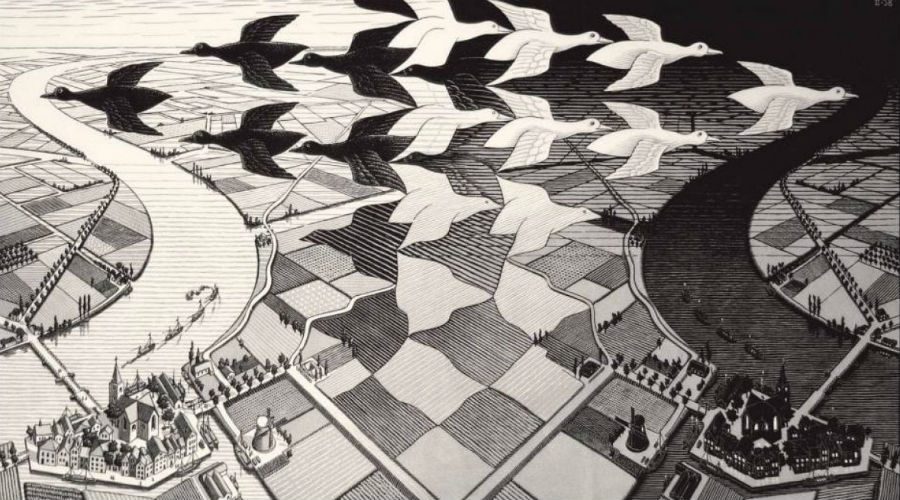
MC Escher
In fact, truth is merely another narrative we’ve been fed—rhetorical legerdemain. But it’s just a story: cognitive dissonance envelopes the notion and we build some heuristic defences around it; escalating commitment kicks in when someone attacks the notion.
The concept of Truth underlies entire societies, governments,
and legal systems. Idiomatically, we employ small-t truth to represent a sort
of relative proximity to match our senses to some observation. If I am asked if
a book is on a table when a book is on a table—ignoring semantics of what
constitutes a book, a table, or the concept of on—, and I say that it is, this is
considered to be a true statement. Of course, this statement is concerned with
the correspondence of observation and some shared reality. But this is
tautological or analytical. In the end, it’s petty.
Capital-T Truth is more universal (or multiversal), is so
much as it would be inviolable. Besides, the Truth of Truth, there are the
notions of Trust of Justice or Truth of Duty or Truth of Integrity. Truth of
any archetypes, really. Yet these are unobtainable—because there are imaginary
concepts.
Classically, archetypes are forms from which physical
objects sort of spawn. A table to an instantiation of some archetypal table.
Archetypes follow from Ancient Greek pathological notions of perfections—perfect
forms, shapes, harmonies, relationships, virtues, gods, and on and on. The
notion of perfect itself is an archetype in this sense.
But the causal relationship has been inverted. Empirical observations taken to imaginary extremes generate a notion of the archetype. Mother is an archetype—the perfect mother—, but it’s not that mothers are formed by some archetypical mould; it’s that the aggregation of mothers and how a perfect mother might be is the definitive. In Jungian psychology, all mothers are compared by their children against this archetypal form. In the Greek tradition, the virtuous mother would attempt to live up to this expectation.
Christian religion plays this up, too. Jesus and God are archetypes. Humans are fallible, but the virtuous strive to be like them; WWJD. Buddhists have their own archetypes of Buddha and Enlightenment, the realization of perfection in nirvana. Again, this is just a story.
Language itself is a human construct, and so anything within it is also constructed. It doesn’t matter whether language acquisition comes a priori or a posteriori. The language itself remains a fabrication.
Post Truth has been a popular topic recently. But what is post is the belief by many in the concept of truth. Although couched this way by detractors, no one is claiming that all truths are equally valid. The claim is rather that many truths are. To claim that women are equal to men and women are inferior to men cannot be evaluated because it would require a complete set of dimensions. Besides, even with this complete set of dimensions, a couple of dimensions are place and time, both of which are subject to change. Beauvoir pointed this out in Second Sex, where she noted that in hunter-gatherer societies physical size and strength may have made males ‘superior’ in matters of protection (a specific context), but that industrialization and automation have rendered this factor insignificant.
So why is any of this important? Well, it’s not. As I’ve
said, evidently truth was not necessary to become evolved to this point. And
since it’s a figment, there is little reason to believe that it will ever
become necessary. My point is merely to
point out that the emperor of truth is wearing no clothes.






 Philosophics