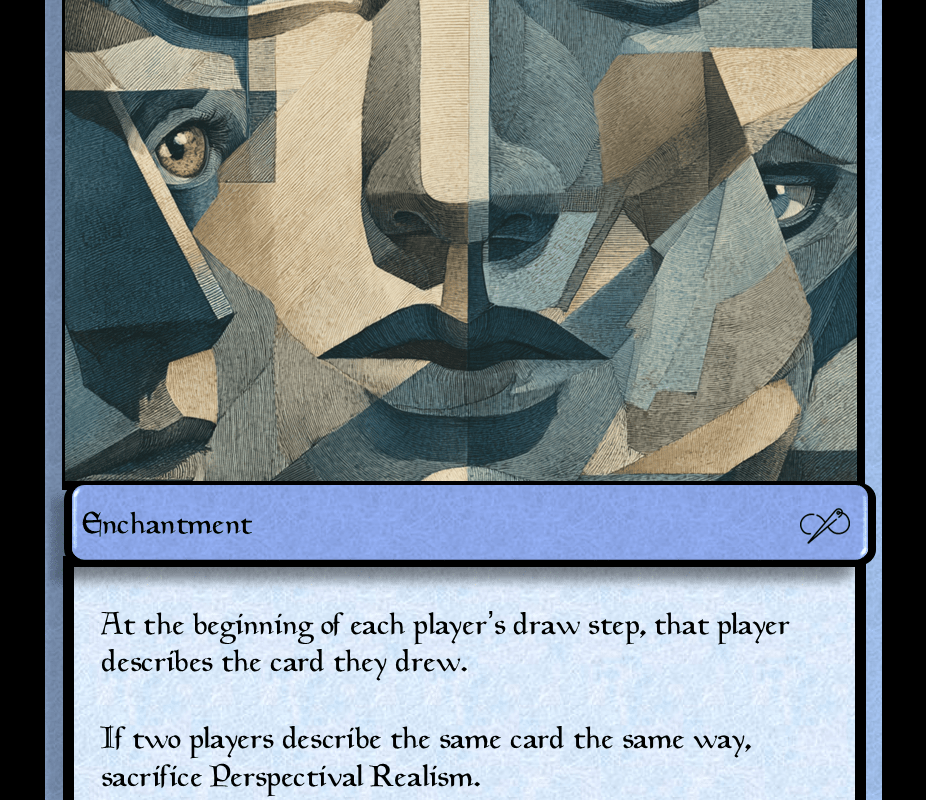
This Magic: The Gathering parody trading card was the first in my Critical Theory series.
It’s an important card for me. As with sex and gender, creating a taxonomic or ontological dichotomy poses categorical challenges. Despite the insufficiency of language, it’s still all I have to attempt to classify the world. In the case of articulating the perception of reality, we can choose between idealism and realism. The problem is that it’s not either; it’s both. Reality cannot be realised without both.
Reality, we’re told, exists. That confident noun has carried a great deal of human arrogance. It has underwritten empires, sciences, and sermons. Yet somewhere between Plato’s cave and the latest TED Talk, we forgot to ask a simpler question: for whom does reality exist, and from where is it seen?
The parody trading card Perspectival Realism was born from that unease. Its mechanic is simple but cruel: at the beginning of each player’s draw step, they must describe the card they drew. The enchantment persists until two players describe a card in the same way—at which point the spell collapses. In other words, consensus kills magic.
Reality is always viewed from somewhere.
—Johannes Jaeger
That rule is the metaphysics of the thing.
When a player ‘describes’ a card, they are not transmitting information; they are constructing the object in linguistic space. The moment the description leaves their mouth, the card ceases to be a piece of paper and becomes a conceptual artefact.
This mirrors the insight of Kant, Nietzsche, and every post-structuralist who ever smoked too much Gauloises: perception isn’t passive. We don’t see reality; we compose it. Language isn’t a mirror but a paintbrush. The thing we call truth is not correspondence but coherence – a temporary truce among competing metaphors.
So the card’s enchantment dramatises this process. So long as multiple descriptions circulate, reality remains vibrant, contested, alive. Once everyone agrees, it dies the death of certainty.
Philosophers have spent centuries arguing whether the world is fundamentally real (existing independent of mind) or ideal (a projection of mind). Both sides are equally tiresome.
Realism, the old bulldog of metaphysics, insists that perception is transparent: language merely reports what’s already there. Idealism, its mirror adversary, claims the opposite – that what’s “there” is mind-stuff all along. Both mistakes are symmetrical. Realism forgets the perceiver; Idealism forgets the world.
Perspectival realism refuses the divorce. It begins from the premise that world and mind are inseparable aspects of a single event: knowing. Reality is not a photograph waiting to be developed, nor a hallucination spun from neurons – it’s a relation, a constant negotiation between perceiver and perceived.
For years, I called myself a Realist™ with an asterisk. That asterisk meant I understood the observer problem: that every ‘fact’ is perspective-laden. Then I became an Idealist™ with an asterisk, meaning I recognised that mind requires matter to dream upon.
The asterisk is everything. It’s the epistemic scar left by perspectival humility – the tacit admission that every claim about the world carries a hidden coordinate: said from here. It is not relativism, but situatedness. It is the philosophical equivalent of depth perception: without the offset, there’s no vision at all.
The card’s rule – sacrifice Perspectival Realism when two players describe a card identically – captures the tragedy of modernity. The Enlightenment taught us to chase consensus, to flatten multiplicity into “objective truth.” We became addicted to sameness, mistaking agreement for understanding.
But agreement is anaesthetic. When all perspectives converge, the world ceases to shimmer; it becomes measurable, predictable, dead. The card’s enchantment disappears the moment reality is stabilised, precisely as our cultural enchantment did under the fluorescent light of ‘reason’.
To live under perspectival realism is to acknowledge that reality is not what is drawn but what is described. And the description is never neutral. It is always written from somewhere – by someone, with a vocabulary inherited from history and stained by desire.
As long as multiple descriptions coexist, the game remains alive. The moment they fuse into one, the spell is broken, and the world returns to grey.
Bernardo Kastrup’s analytic idealism reminded me that consciousness might be primary, but perspectival realism refuses to pledge allegiance. It keeps both flags tattered but flying. The world exists, yes, but only ever for someone.
The enchantment, then, is not belief but perspective itself. So long as difference endures, the game continues.


 Philosophics