He doesn‘t, but he accidentally demonstrates the problem.
There is a certain kind of person who loathes Nietzsche for the same reason they loathe earthquakes. Not because he causes damage, but because he refuses to pretend the ground was ever stable.
In a recent address, Mark Carney says something that would have been unutterable in polite company a decade ago. He admits that the ‘rules-based international order’ was always a partial fiction. Not false enough to abandon, not true enough to believe in without effort. A story everyone knew was cracked, but which continued to function so long as enough people kept repeating the lines.
“We knew that the story about the rules-based order was partially false… We knew that international law applied with varying rigour depending on the identity of the accused and the victim. This fiction was useful [because of the goods provided by American hegemony]… So we placed the sign in the window. We participated in the rituals. And we largely avoided calling out the gaps between rhetoric and reality. This bargain no longer works. Let me be direct. We are in the midst of a rupture, not a transition… You cannot live within the lie of mutual benefit through integration when integration becomes the source of your subordination.“
Audio: NotebookLM podcast of this topic.
International law, he concedes, applied unevenly. Power decided enforcement. Friends received nuance. Enemies received principle. This was not ignorance. It was a bargain. The illusion delivered goods, stability, growth, a sense of moral hygiene. So the sign stayed in the window. The rituals continued. The gaps between rhetoric and reality were politely ignored. That bargain, Carney says, no longer works.
This is framed as geopolitical realism, but it is really an ontological admission. The mask slipped, and everyone is suddenly offended by the face underneath.
Image: NotebookLM infographic of this content.
This is why people hate Friedrich Nietzsche. Not because he celebrates cruelty or chaos, but because he insists that order is something we perform, not something we discover. He refuses the comfort of believing that the rules were ever neutral, universal, or self-enforcing. He points at the scaffolding and says: this is what is holding things up, not the sky.
When enough people play along, the game feels like reality. When someone refuses to play, panic sets in.
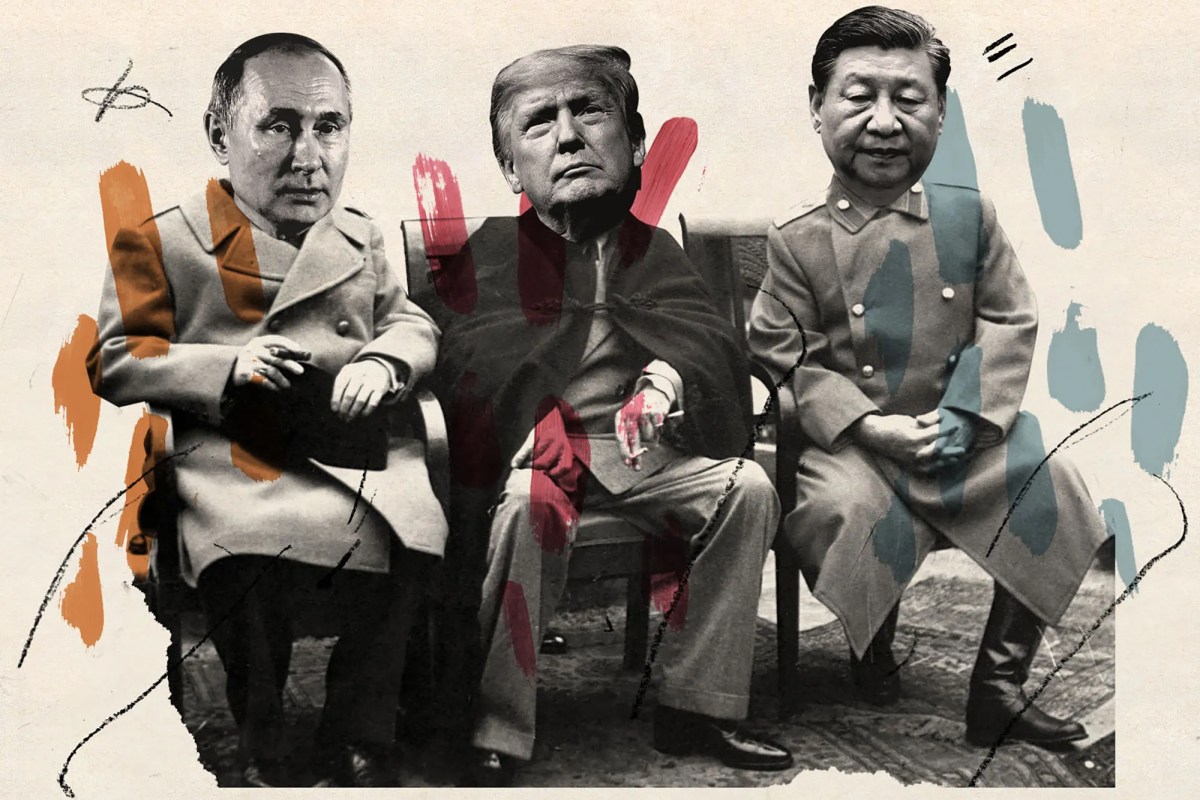
Enter Donald Trump. Trump did not invent the asymmetries of power. He refused to speak them politely. This created a moral crisis for institutions built on the assumption that everyone would continue to pretend. When a designated enemy like Vladimir Putin does this, it is filed under Evil. When an ally does it, the response bifurcates: either frantic appeasement, or embarrassed silence disguised as strategy.
Image: Foreignsentiment
Carney tries to walk a middle path. He neither genuflects nor detonates the stage. He acknowledges the fiction without fully abandoning it. This makes him interesting, but also symptomatic. He wants the audience to notice the set wobbling without asking them to leave the theatre.
When he says the old rules-based order is not coming back, what he really means is that the illusion has been interrupted. Whether permanently or only until someone builds a more convincing façade is left diplomatically unresolved. This is where Nietzsche becomes unavoidable.
People often lump Nietzsche together with vague talk of “power,” as though this were a crude obsession shared with Michel Foucault. But Nietzsche’s contribution is sharper and more unsettling. He is not merely describing power as something exercised. He is describing power as something that manufactures meaning, legitimacy, and moral vocabulary after the fact. Power does not break the rules. It writes them retroactively and calls them eternal.
This is the kind of power later adopted by Adolf Hitler, by Putin, and now by Trump. Not brute force alone, but the refusal to treat inherited norms as sacred simply because they are inherited. This is precisely what terrifies people who mistake procedural continuity for moral truth.
The United States borrowed Montesquieu’s separation of powers as though it were a lock rather than a suggestion. Anyone paying attention could see how easily it could be gamed. That this came as a shock says less about constitutional brilliance than about selective vision. The system functioned not because it was impregnable, but because its participants agreed, tacitly, to behave as though it were.
Nietzsche would call this decadence. Not decline as catastrophe, but decline as denial. The refusal to look directly at the conditions that make order possible, preferring instead to moralise their breakdown.
Carney’s speech is not radical. It is late. It says aloud what everyone already knew but preferred not to articulate: that the world was never neat, the order never neutral, and the rules never binding on those strong enough to ignore them.
What comes next is the uncomfortable part. Once the illusion is acknowledged, it cannot simply be re-believed. You can rebuild institutions. You can repaint the signage. But you cannot unknow that the coffee was always bitter.
Nietzsche does not tell us what replaces the façade. He only insists that pretending it was ever a window onto truth is the most dangerous fiction of all.
What Carney inadvertently demonstrates is not a failure of leadership but a failure of language. ‘Rules-based order’ was never a description of the world; it was a map we mistook for the terrain because it worked often enough to feel true. Nietzsche’s crime was pointing at the legend and saying it was doing the real work. Once that admission is made, you do not get to return to innocence. You can draw a new map, call it reform, integration, or renewal, but you will know it is a diagram pinned to power, not a window onto justice. The unease people feel now is not about chaos. It is about recognition. The lie no longer holds because too many have noticed the pins.
This is awkward. I’d been preparing some posts on the age of consent, and I decided to write a formal essay on ageism. Since the age of consent is a moral hot-button topic for some, I decided to frame the situation in a political framework instead. The setup isn’t much different, but it keeps people’s heads out of the gutter and removes the trigger that many people seem to pull. It’s awkward because none of these posts has yet been posted. Spoiler alert, I guess. I could delay this announcement, but I won’t. Here it is.
Democracy is often defended in lofty terms. We are told that citizens are rational agents, capable of judgment, autonomy, and reasoned participation in collective decision-making. Voting, on this story, is not just a procedure. It is the expression of agency by competent participants. That all sounds reassuring.
Audio: NotebookLM summary podcast of this essay and concept.
What’s curious is that no democratic system actually checks whether any of this is true.
There are no assessments of political understanding. No evaluation of judgment. No test of civic competence. You become a fully empowered political agent overnight, not because you demonstrate anything, but because the calendar flips. Turn eighteen. You’re in. This isn’t a minor oversight. It’s the central puzzle my recent preprint explores.
The Proxy Nobody Questions
Modern democracies assign political standing using proxies: simple categorical markers that stand in for more complex qualities. Age is the most obvious. It is treated as a substitute for maturity, judgment, autonomy, and responsibility. But here’s the key point: age doesn’t approximate competence. It replaces it.
If age were a rough indicator, we might expect flexibility at the margins. Exceptions. Supplementary criteria. Some attempt to track the thing it supposedly represents. Instead, we get a hard boundary. Below it, total exclusion. Above it, permanent inclusion. Capacity doesn’t matter on either side. The proxy isn’t helping institutions identify competence. It is doing something else entirely.
Competence Talk Without Competence
Despite this, democratic theory remains saturated with competence language. We are told that participation is grounded in rational agency. That citizens possess the capacities needed for self-government. That legitimacy flows from meaningful participation by autonomous agents. None of this is operationalised.
Competence is never specified, measured, or verified. It functions purely as justificatory rhetoric. A moral vocabulary that explains why inclusion is legitimate, without ever guiding how inclusion actually happens. This isn’t confusion; it’s design.
Why the Gap Doesn’t Collapse
At this point, a reasonable person might expect trouble. After all, if the justification doesn’t match the mechanism, shouldn’t the system wobble? It doesn’t. And the reason matters.
Political participation generates very weak feedback. Outcomes are mediated through institutions. Causal responsibility is diffuse. Success criteria are contested. When things go badly, it’s rarely clear why, or what a better alternative would have been.
Under these conditions, dissatisfaction becomes affective rather than analytic. People sense that things aren’t working, but lack the tools to diagnose how or where the system failed. Crucially, they also lack any way to recalibrate the link between competence and political standing, because that link was never operational in the first place. The system doesn’t aim for optimisation. It aims for stability.
Boundary Drawing Without Saying So
This structure becomes clearest when we look at boundary cases. Why eighteen rather than sixteen? Or twelve? Or twenty-one? There is no competence-based answer. Developmental research consistently shows wide overlap between adolescents and adults, and massive variation within age groups. If competence were taken seriously, age thresholds would be indefensible.
Historically, when competence was operationalised such as through literacy tests, the result was transparent hierarchy and eventual delegitimation. Modern democracies avoid that by keeping competence abstract and proxies neutral-looking. The boundary remains. The justification changes.
What This Does and Does Not Argue
This analysis does not propose reforms. It does not advocate competence testing. It does not suggest lowering or raising the voting age. It does not claim voters are stupid, irrational, or defective. It describes a structural feature of democratic legitimacy:
Democracy works by saying one thing and doing another, and that gap is not accidental. Competence language stabilises legitimacy precisely because it is never put to work. You may think that’s fine. You may think it’s unavoidable. You may think it’s a problem. The paper doesn’t tell you which to choose. It simply insists that if we’re going to talk seriously about democratic legitimacy, we should notice what role competence actually plays. And what it doesn’t.




 Philosophics