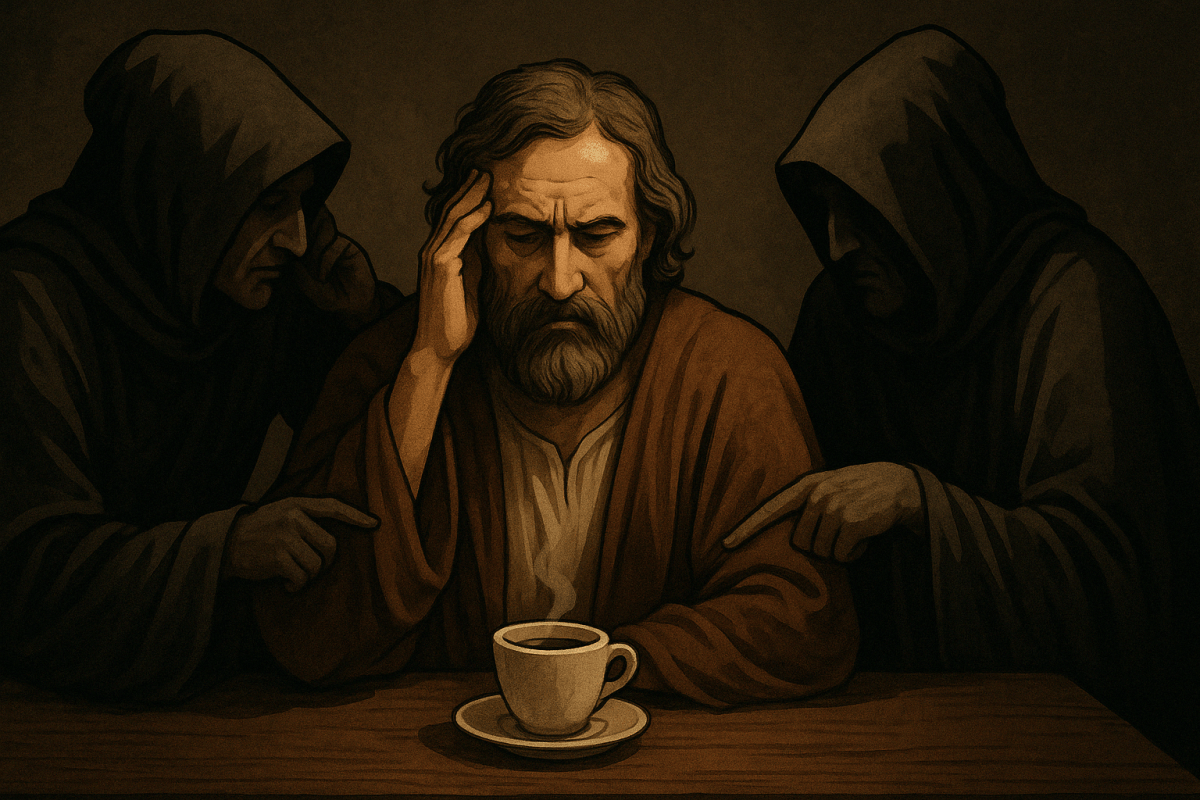
The Illusion of Clarity in a World of Cognitive Fog
Apologies in advance for this Logic 101 posting. Reason—our once-proud torch in the darkness, now more like a flickering lighter in a hurricane of hot takes and LinkedIn thought-leadership. The modern mind, bloated on TED Talks and half-digested Wikipedia articles, tosses around terms like “inductive” and “deductive” as if they’re interchangeable IKEA tools. So let us pause, sober up, and properly inspect these three venerable pillars of human inference: deduction, induction, and abduction—each noble, each flawed, each liable to betray you like a Greco-Roman tragedy.
Deduction: The Tyrant of Certainty
Deduction is the purest of the lot, the high priest of logic. It begins with a general premise and guarantees a specific conclusion, as long as you don’t cock up the syllogism. Think Euclid in a toga, laying down axioms like gospel.
Example:
- All humans are mortal.
- Socrates is human.
- Therefore, Socrates is mortal.
Perfect. Crisp. Unassailable. Unless, of course, your premise is bollocks. Deduction doesn’t check its ingredients—it just cooks with whatever it’s given. Garbage in, garbage out.
Strength: Valid conclusions from valid premises.
Weakness: Blind to empirical falsity. You can deduce nonsense from nonsense and still be logically sound.
Induction: The Gambler’s Gospel
Induction is the philosopher’s lottery ticket: generalising from particulars. Every swan I’ve seen is white, ergo all swans must be white. Until, of course, Australia coughs up a black one and wrecks your little Enlightenment fantasy.
Example:
- The sun rose today.
- It rose yesterday.
- It has risen every day I’ve been alive.
- Therefore, the sun will rise tomorrow.
Touching, isn’t it? Unfortunately, induction doesn’t prove anything—it suggests probability. David Hume had an existential breakdown over this. Entire centuries of Western philosophy spiralled into metaphysical despair. And yet, we still rely on it to predict weather, markets, and whether that dodgy lasagna will give us food poisoning.
Strength: Empirically rich and adaptive.
Weakness: One exception detonates the generalisation. Induction is only ever as good as the sample size and your luck.
Abduction: Sherlock Holmes’ Drug of Choice
Abduction is the inference to the best explanation. The intellectual equivalent of guessing what made the dog bark at midnight while half-drunk and barefoot in the garden.
Example:
- The lawn is wet.
- It probably rained.
It could be a garden sprinkler. Or a hose. Or divine intervention. But we bet on rain because it’s the simplest, most plausible explanation. Pragmatic, yes. But not immune to deception.
Strength: Useful in messy, real-world contexts.
Weakness: Often rests on a subjective idea of “best,” which tends to mean “most convenient to my prejudices.”
The Modern Reasoning Crisis: Why We’re All Probably Wrong
Our contemporary landscape has added new layers of complexity to these already dubious tools. Social media algorithms function as induction machines on steroids, drawing connections between your click on a pasta recipe and your supposed interest in Italian real estate. Meanwhile, partisan echo chambers have perfected the art of deductive reasoning from absolutely bonkers premises.
Consider how we navigate information today:
- We encounter a headline that confirms our worldview
- We accept it without scrutiny (deductive failure)
- We see similar headlines repeatedly (inductive trap)
- We conclude our worldview is objectively correct (abductive collapse)
And thus, the modern reasoning loop is complete—a perfect system for being confidently incorrect while feeling intellectually superior.
Weakness by Analogy: The Reasoning Café
Imagine a café.
- Deduction is the customer who checks the menu and confidently orders “Soup of the Day,” because the chalkboard says “Today’s Soup is Tomato,” and she trusts chalkboards.
- Induction is the one who has had tomato soup every Wednesday for months and assumes it’ll be tomato today again—until it isn’t, and now he’s wearing bisque.
- Abduction sees the waiter carrying bowls of red liquid to every table and infers it’s probably tomato soup, orders it, and gets… gazpacho. Ice-cold disappointment.
All three are trying to reason. Only one might get lunch.
The Meta-Problem: Reasoning About Reasoning
The true joke is this: we’re using these flawed reasoning tools to evaluate our reasoning tools. It’s like asking a drunk person to judge their own sobriety test. The very mechanisms we use to detect faulty reasoning are themselves subject to the same faults.
This explains why debates about critical thinking skills typically devolve into demonstrations of their absence. We’re all standing on intellectual quicksand while insisting we’ve found solid ground.
Conclusion: Reason Is Not a Guarantee, It’s a Wager
None of these modalities offer omniscience. Deduction only shines when your axioms aren’t ridiculous. Induction is forever haunted by Hume’s skepticism and the next black swan. Abduction is basically educated guessing dressed up in tweed.
Yet we must reason. We must argue. We must infer—despite the metaphysical vertigo.
The tragedy isn’t that these methods fail. The tragedy is when people believe they don’t.
Perhaps the wisest reasoners are those who understand the limitations of their cognitive tools, who approach conclusions with both confidence and humility. Who recognize that even our most cherished beliefs are, at best, sophisticated approximations of a reality we can never fully grasp.
So reason on, fellow thinkers. Just don’t be too smug about it.
 Philosophics