I Don’t Buy It

1–2 minutes

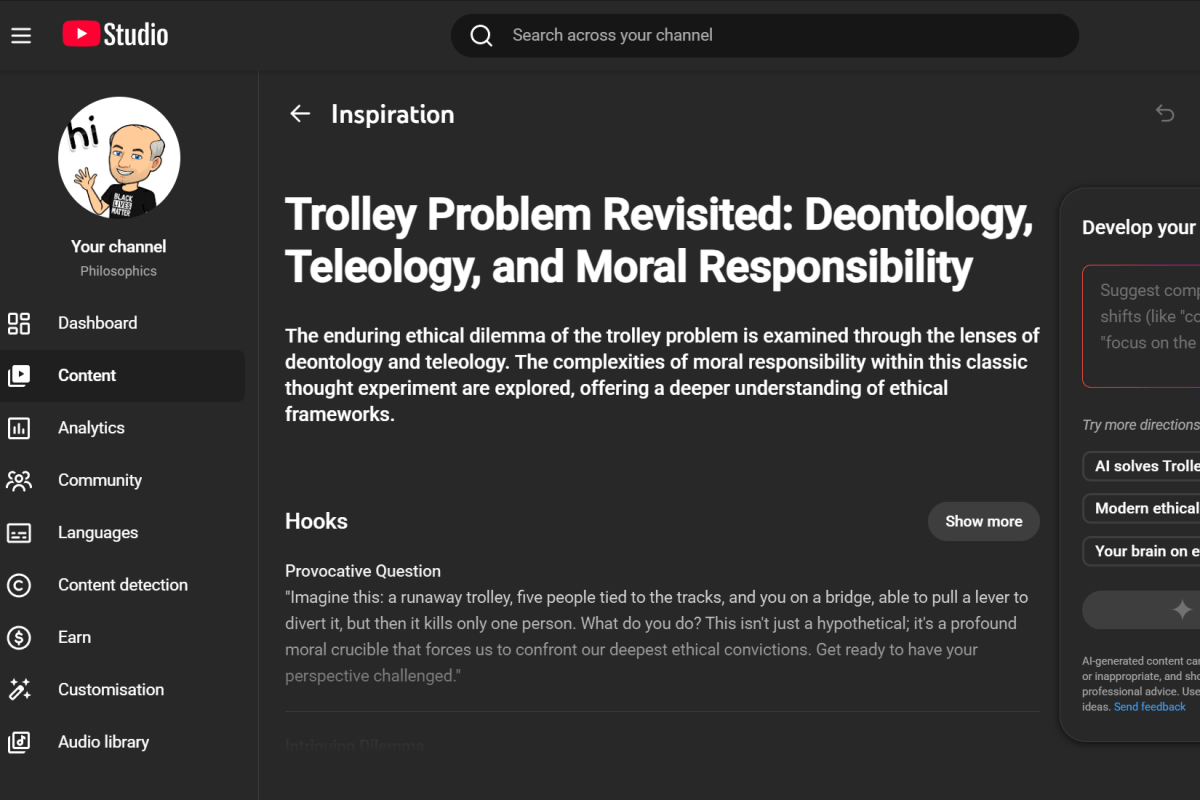
I posted a video on YouTube that I shared here. They’ve added some AI to the studio channel interface.

Image: YouTube Studio’s Inspiration Page. Thanks, but no thanks.

On the previous page, the prompt window (top right) asked if I wanted to know how my video was performing versus the baseline. I affirmed, and it spit out results. Brilliant.

I noticed a handful of ‘inspiration items’. None looked particularly interesting, but I have a nostalgia for Trolley Problems™. A few years ago, I would have jumped on the idea. Nowadays, I’ve seen hundreds of variations, and I’ve lost interest. However, being on familiar ground, I clicked on it to see what would happen. The result is the screenshot above.

Not only is the response templated with thumbnails, but AI is also ready to write the script. At this rate, why doesn’t YouTube just create ideas and generate them itself – like Spotify or Suno? It may just be a matter of time.

I am a heavy user of AI, but I lead the conversation. I am an author, and a reason I don’t join writers groups – I’ve attended some – is that I don’t need help with topics. I don’t get writer’s block. I just need the time and focus to get it out. I suppose that one day the creative well could run dry, but I don’t do this for commercial gain. Sure, that happens, but it’s not my goal. My goal is to write to share and exchange ideas.

I have many colleagues who are commercial writers and artists. I don’t know how they can do it. I understand that people have different interests and temperaments, but this is not one of mine. It would literally take all of the joy out of it. Not all people are artists™. Some people are more acquisitive than I am; I’m not judging, but it’s not me.

When I look at YouTube’s shiny AI muse and think, thanks, but no; I’d rather derail the trolley myself.

Dumocracy

I’m working on a new book—if by new I mean reengaging a book I started in 2022. I’m picking up where I left off with fresh eyes. As I’ve not had time to contribute much to this blog, I thought I’d share the preface as a work in progress. I may share additional subsections over time. Feel free to share any feedback in the comments section.

Preface

“The first step to recovery is to admit there’s a problem.” – Anonymous

Introduction

Imagine a world where the foundation of our governance, the system we hold as the pinnacle of fairness and equality, is fundamentally flawed. What if the mechanisms we trust to represent our voices are inherently incapable of delivering the justice and prosperity we seek? This book embarks on a provocative journey to challenge the sanctity of democracy, not with the intent to undermine its value but to question its effectiveness and expose the inherent limitations that have been overlooked for centuries.

This book is meant to be inclusive, though not necessarily comprehensive. Although focused heavily on a Western experience, particularly the United States, the insights and critiques apply globally.

Democracy feels like an anachronism awaiting a paradigm shift. As a product of the Enlightenment Age, democracy has been sacrosanct in the Western world for centuries. However, a quick glance at current results reveals dissonance. Not all is well. Despite typical defences such as entrenched political parties, low-information voters, rural-urban divides, gerrymandering, and illegal voting, this book sets out to show that democracy is fundamentally flawed. It doesn’t even work well on paper, almost inevitably yielding suboptimal results. When people are added to the equation, it just gets worse.

In this book, we’ll discuss inherent challenges to democracy. The main premises are:

  • In theory, democracy is not mathematically tenable. It always leads to suboptimal solutions with mediocre results. [1]
  • In practice, human nature and cognitive limitations exacerbate the execution of democracy from the perspective of voters and representatives. [2]

We’ll explore democracy from its beginnings and various forms across time, history, scale, and scope. We’ll investigate the impacts of imperfect information, human rationalities, emotional triggers, and cognitive limitations and biases of the general populace. We’ll survey the continents and look at ancient Mesopotamia, India, the Polynesian islands, and beyond.

This book aims to spark critical thinking and dialogue about the efficacy of democracy, encouraging readers to question widely held assumptions and consider the need for potential reforms or alternative governance models. Through this examination, the book hopes to inspire new ideas and solutions that can address the complexities and challenges inherent in democratic systems.


[1] Arrow, 1951; Sen, 1970

[2] Kahneman, 2011; Tversky & Kahneman, 1974