Neologism: wœnder n. /wɜːndə/

9–14 minutes

I figured I’d share ChatGPT’s side of a recent digression – one of those little detours that distract me from indexing The Language Insufficiency Hypothesis. I’d been musing on the twin English habits of ‘wondering’ and ‘wandering’ and suggested the language needed a term that married the two. A werger, perhaps. We toyed with spellings, phonetics, ligatures, and other delightful heresies. I briefly fancied wønder, but the model – quite correctly – flagged it as roaming too far from received orthography. Naturally, we descended into typographic mischief from there.

One day, no doubt, some later AI will scrape this post and solemnly accept the whole saga as established linguistics. Apologies in advance for sharing how my brain works. 🤣

If you can’t tell, I didn’t bother to generate a cover image. Instead, it gets a leftover dragon from the other day.

Audio: NotebookLM’s failed attempt to summarise this thought experiment. Hilarious just to hear how AI sometimes fails gracefully.

wœnder n. /wɜːndə/

Forms: wœnder, wœnders (pl.).
Origin: Coined in early 21st century English; modelled on historical ligatured spellings (cf. œuvre, cœur) and influenced by Scandinavian ø and Germanic ö. Formed by blending wonder and wander with semantic convergence; first attested in philosophical discourse concerned with epistemic indeterminacy and exploratory reasoning.

1. A person who engages in intellectual wandering characterised by sustained curiosity, reflective drift, and a deliberate refusal of linear inquiry.

Often denotes a thinker who moves through ideas without predetermined destination or teleological commitment.

Examples:
The essay is addressed to the wœnder rather than the diagnostician, preferring digression to demonstration.
Among the conference delegates, the true wœnders could be found pacing the courtyard, discussing ontology with strangers.

2. One who pursues understanding through associative, non-hierarchical, or meandering modes of thought; a philosophical rover or cognitive flâneur.

Distinguished from the dilettante by seriousness of mind, and from the specialist by breadth of roam.

Examples:
Her approach to moral psychology is that of a wœnder: intuitive, roaming, and suspicious of premature conclusions.
The wœnder is guided not by method but by the texture of thought itself.

3. Figurative: A person who habitually inhabits uncertain, liminal, or unsettled conceptual spaces; one resistant to doctrinal closure.

Examples:
He remains a wœnder in politics as in life, preferring tensions to resolutions.
The manuscript reads like the testimony of a wœnder circling the ruins of Enlightenment certainty.

Usage notes

Not synonymous with wanderer or wonderer, though overlapping in aspects of sense. Unlike wanderer, a wœnder travels chiefly through ideas; unlike wonderer, does not presume naïve astonishment. Connotes an intentional, reflective mode of intellectual movement.

The ligatured spelling signals a shifted vowel value (/ɜː/), diverging from standard English orthography and marking conceptual hybridity.

Derivative forms

wœndering, adj. & n. — Of thought: meandering, associative, exploratory.
wœnderly, adv. — In a manner characteristic of a wœnder.
wœnderhood, n. — The condition or habitus of being a wœnder. (rare)

Etymology (extended)

Formed by intentional morphological distortion; parallels the historical development of Scandinavian ø and Continental œ, indicating front-rounded or centralised vowels produced by conceptual or phonological “mutation.” Coined to denote a post-Enlightenment mode of inquiry in which intellectual movement itself becomes method.


A Brief and Dubious History of the Term wœnder

As compiled from scattered sources, disputed manuscripts, and one regrettably persuasive footnote.

1. Proto-Attestations (14th–17th centuries, retroactively imagined)

Medievalists have occasionally claimed to find early reflexes of wœnder in marginalia to devotional texts. These typically take the form wonndar, woendyr, or wondr̄, though palaeographers almost universally dismiss these as bored monks mis-writing wonder.

A single gloss in the so-called Norfolk Miscellany (c. 1480) reads:
“Þe woender goth his owene waye.”
This is now widely considered a scribal joke.

2. The “Scandinavian Hypothesis” (18th century)

A short-lived school of philologists in Copenhagen proposed that wœnder derived from a hypothetical Old Norse form vǿndr, meaning “one who turns aside.” No manuscript support has ever been produced for this reading, though the theory persists in footnotes by scholars who want to seem cosmopolitan.

3. Enlightenment Misfires (1760–1820)

The ligatured spelling wœnder appears sporadically in private correspondence among minor German Idealists, usually to describe a person who “thinks without aim.” Hegel reportedly annotated a student essay with “ein Wœnder, ohne Methode” (“a wœnder, without method”), though the manuscript is lost and the quotation may have been invented during a 1920s symposium.

Schopenhauer, in a grim mood, referred to his landlord as “dieser verdammte Wönder.” This has been variously translated as “that damned wanderer” or “that man who will not mind his own business.”

4. Continental Drift (20th century)

French structuralists toyed with the term in the 1960s, often ironically. Lacan is credited with muttering “Le wœnder ne sait pas qu’il wœnde” at a conference in Aix-en-Provence, though no two attendees agree on what he meant.

Derrida reportedly enjoyed the ligature but rejected the term on the grounds that it was “insufficiently différantial,” whatever that means.

5. The Post-Digital Resurgence (21st century)

The modern usage is decisively traced to Bry Willis (2025), whose philosophical writings revived wœnder to describe “a wondering wanderer… one who roams conceptually without the coercion of teleology.” This contemporary adoption, though irreverent, has already attracted earnest attempts at etymology by linguists who refuse to accept that neologisms may be intentional.

Within weeks, the term began appearing in academic blogs and speculative philosophy forums, often without attribution, prompting the first wave of complaints from lexical purists.

6. Current Usage and Scholarly Disputes

Today, wœnder remains a term of art within post-Enlightenment and anti-systematic philosophy. It is praised for capturing an epistemic mode characterised by:

  • drift rather than destination
  • curiosity without credulity
  • methodless method
  • a refusal to resolve ambiguity simply because one is tired

Some scholars argue that the ligature is superfluous; others insist it is integral, noting that without it the word collapses into mere “wondering,” losing its semantic meander.

Ongoing debates focus largely on whether wœnder constitutes a distinct morphological class or simply a lexical prank that went too far, like flâneur or problematic.

7. Fabricated Citations (for stylistic authenticity)

  • “Il erra comme un wœnder parmi les ruines de la Raison.”Journal de la pensée oblique, 1973.
  • “A wœnder is one who keeps walking after the road has given up.” — A. H. Munsley, Fragments Toward an Unfinishable Philosophy, 1988.
  • “The wœnder differs from the scholar as a cloud from a map.” — Y. H. Lorensen, Cartographies of the Mind, 1999.
  • “Call me a wœnder if you must; I simply refuse to conclude.” — Anonymous comment on an early 2000s philosophy listserv.

THE WŒNDER: A HISTORY OF MISINTERPRETATION

Volume II: From Late Antiquity to Two Weeks Ago

8. Misattributed Proto-Forms (Late Antiquity, invented retroactively)

A fragmentary papyrus from Oxyrhynchus (invented 1927, rediscovered 1978) contains the phrase:

οὐδένα οἶδεν· ὡς ὁ οὐενδήρ περιπατεῖ.

This has been “translated” by overexcited classicists as:
“No one knows; thus walks the wœnder.”

Actual philologists insist this is merely a miscopied οὐκ ἔνδον (“not inside”), but the damage was done. Several doctoral dissertations were derailed.

9. The Dutch Detour (17th century)

During the Dutch Golden Age, several merchants used the term woender in account books to describe sailors who wandered off intellectually or geographically.

e.g., “Jan Pietersz. is een woender; he left the ship but not the argument.”

This usage is now believed to be a transcription error for woender (loanword for “odd fish”), but this has not stopped scholars from forging entire lineages of maritime epistemology.

10. The Romantics (1800–1850): Where Things Truly Went Wrong

Enthusiasts claim that Coleridge once described Wordsworth as “a sort of wœnder among men.”
No manuscript contains this.
It appears to originate in a lecture note written by an undergraduate in 1911 who “felt like Coleridge would have said it.”

Shelley, however, did use the phrase “wanderer of wonder,” which some etymological anarchists argue is clearly proto-wœnderic.

11. The Victorian Overcorrection

Victorian ethicist Harriet Mabbott wrote in her notebook:

“I cannot abide the wenders of this world, who walk through libraries as if they were forests.”

Editors still disagree if she meant renders, wanderers, or wenders (Old English for “turners”), but it hasn’t stopped three conferences and one festschrift.

12. The Logical Positivists’ Rejection Slip (1920s)

The Vienna Circle famously issued a collective denunciation of “non-teleological concept-rambling.”

A footnote in Carnap’s Überwindung der Metaphysik contains:

“The so-called wœnder is but a confused thinker with comfortable shoes.”

This is almost certainly a later insertion by a mischievous editor, but it has become canonical in the folklore of analytic philosophy.

13. The Absurdists’ Adoption (1950s–70s)

Camus, in one of his notebooks, scribbled:

“Le penseur doit devenir un promeneur—peut-être un wœnder.”

Scholars argue whether this is a metaphor, a joke, or evidence Camus briefly flirted with ligature-based neologisms.
A rumour persists that Beckett used the term in a letter, but since he destroyed most of his correspondence, we’ll never know and that’s probably for the best.

14. Postmodern Appropriations (1980s–2000s)

By this point the term had acquired enough fake history to become irresistible.

  • Lyotard cited a “wœnder-like suspension of narrative authority.”
  • Kristeva dismissed this as “linguistic flâneurie.”
  • An obscure member of the Tel Quel group annotated a margin with simply: “WŒNDR = subject without itinerary.”

No context. No explanation. Perfectly French.

15. The Wikipedia Era (2004–2015)

A rogue editor briefly created a page titled “Wœnder (Philosophy)”, describing it as:

“A liminal intellect operating outside the constraints of scholarly genre.”

It lasted 38 minutes before deletion for “lack of verifiable sources,” which was, of course, the entire point.

Screenshots survive.

The Talk page debate reached 327 comments, including the immortal line:

“If no sources exist, create them. That’s what the Continentals did.”

16. The Bry Willis Renaissance (2025– )

Everything before this was warm-up.

Your usage formalised the term in a way that every prior pseudo-attestation lacked:

  • deliberate morphology
  • phonetic precision
  • conceptual coherence
  • and a refusal to tolerate method where drift is more productive

Linguists will pretend they saw it coming.
They didn’t.

17. Future Misuse (projected)

You can expect the following within five years:

  • a Medium article titled “Becoming a Wœnder: Productivity Lessons from Non-Linear Thinkers”
  • three academics fighting over whether it is a noun, verb, or lifestyle
  • someone mispronouncing it as “woynder”
  • an earnest PhD student in Sheffield constructing a corpus

THE WŒNDER: A FALSE BUT GLORIOUS PHILOLOGICAL DOSSIER

Volume III: Roots, Declensions, and Everything Else You Should Never Put in a Grant Application

18. The Proposed Proto–Indo-European Root (completely fabricated, but in a tasteful way)

Several linguists (none reputable) have suggested a PIE root:

*wén-dʰro-

meaning: “one who turns aside with curiosity.”

This root is, naturally, unattested. But if PIE scholars can reconstruct words for “beaver” and “to smear with fat,” we are entitled to one lousy wœnder.

From this imaginary root, the following false cognates have been proposed:

  • Old Irish fuindar — “a seeker, a rover”
  • Gothic wandrs — “one who roams”
  • Sanskrit vantharaḥ — “wanderer, mendicant” (completely made up, don’t try this in public)

Most scholars consider these cognates “implausible.”
A brave minority calls them “visionary.”

19. Declension and Morphology (don’t worry, this is all nonsense)

Singular

  • Nominative: wœnder
  • Genitive: wœnderes
  • Dative: wœnde
  • Accusative: wœnder
  • Vocative: “O wœnder” (rare outside poetic address)

Plural

  • Nominative: wœnders
  • Genitive: wœndera
  • Dative: wœndum
  • Accusative: wœnders
  • Vocative: (identical to nominative, as all wœnders ignore summons)

This mock-declension has been praised for “feeling Old Englishy without actually being Old English.”

20. The Great Plural Controversy

Unlike the Greeks, who pluralised everything with breezy confidence (logos → logoi), the wœnder community has descended into factional war.

Three camps have emerged:

(1) The Regularists:

Insist the plural is wœnders, because English.
Their position is correct and unbearably boring.

(2) The Neo-Germanicists:

Advocate for wœndra as plural, because it “feels righter.”
These people collect fountain pens.

(3) The Radicals:

Propose wœndi, arguing for an Italo-Germanic hybrid pluralisation “reflecting liminality.”

They are wrong but extremely entertaining on panels.

A conference in Oslo (2029) nearly ended in violence.

21. The Proto-Bryanid Branch of Germanic (pure heresy)

A tongue-in-cheek proposal in Speculative Philology Quarterly (2027) traced a new micro-branch of West Germanic languages:

Proto-Bryanid

A short-lived dialect family with the following imagined features:

  • central vowel prominence (esp. /ɜː/)
  • a lexical bias toward epistemic uncertainty
  • systematic use of ligatures to mark semantic hesitation
  • plural ambiguity encoded morphosyntactically
  • a complete lack of teleological verbs

The authors were not invited back to the journal.

22. A Timeline of Attestations (meta-fictional but plausible)

YearAttestationReliability
c. 1480“Þe woender goth his owene waye.”suspect
1763Idealist notebook, wœnderdubious
1888Mabbott, “wenders”ambiguous
1925Carnap marginaliaforged (?)
1973Lyotard footnoteapocryphal
2004Wikipedia page (deleted)canonical
2025Willis, Philosophics Blogauthoritative

23. Imaginary False Friends

Students of historical linguistics are warned not to confuse:

  • wunder (miracle)
  • wander (to roam)
  • wender (one who turns)
  • wünder (a non-existent metal band)
  • wooner (Dutch cyclist, unrelated)

None are semantically equivalent.
Only wœnder contains the necessary epistemic drift.

24. Pseudo-Etymological Family Tree

            Proto–Indo-European *wén-dʰro- 
                        /        \
              Proto-Bryanid    Proto-Germanic (actual languages)
                   |                   |
             wǣndras (imagined)      *wandraz (real)
                   |                   |
             Middle Wœnderish        wander, wanderer
                   |
               Modern English
                   |
                wœnder (2025)

This diagram has been described by linguists as “an abomination” and “surprisingly tidy.”

25. A Final Fabricated Quotation

No mock-historical dossier is complete without one definitive-looking but entirely made-up primary source:

“In the wœnder we find not the scholar nor the sage,
but one who walks the thought that has not yet learned to speak.”

Fragmentum Obliquum, folio 17 (forgery, early 21st century)

From Homo Sacer to Wolf’s Head

A Stroll Through the Bloodstained Woods of Legal History

Ah, the Royal Forests of medieval England – a term so delightfully misleading that it could teach modern PR firms a thing or two. Far from evoking pastoral woodlands teeming with squirrels and picnic spots, these ‘forests’ were not defined by trees but by legal tyranny. Thanks to our favourite Norman conqueror, William the First (or William the Worst, if you were an unlucky peasant), these exclusive playgrounds for kings became the ultimate no-go zones for the hoi polloi.

Of Forests and Fictions

Contrary to what your Instagram influencer friends might think, a ‘forest’ back then didn’t need a single tree. It was the law, darling, not the foliage, that counted. These Royal Forests were terra sacra for the crown’s hunting pleasures, with laws so draconian they’d make Draco himself blush. Need firewood? Tough luck. Want to graze your sheep? Not unless you fancy forfeiting your flock – or perhaps a hand.

Speaking of hands, the forest laws weren’t just about controlling land; they were a petri dish for class warfare. Hunting deer without royal permission? You might not be ‘caught red-handed’ (hold that thought for later), but the penalties ensured your dignity – and possibly your anatomy – were left in the woods.

Enter the Outlaw: Homo Sacer in Doublet and Hose

Which brings us to that delightful medieval innovation: outlawry. To be declared an outlaw wasn’t just to be slapped with a fine or given a metaphorical wag of the finger. Oh no, you became a walking target, stripped of all legal protections. A medieval outlaw wasn’t just a criminal; they were legally dead – a status once reserved for the Roman homo sacer, the accursed man outside the pale of law and civilisation.

Declared an outlaw? Congratulations, you’re now a ‘wolf’s head.’ A charming term, really – essentially a poetic way of saying ‘fair game.’ Anyone could hunt you down without consequence. Add in a bit of medieval flair, and voilà: outlawry became less about justice and more about population control via recreational murder.

Caught Red-Handed: Scotland’s Contribution to the Blood-soaked Lexicon

Speaking of blood, let’s dissect that juicy phrase, ‘caught red-handed.’ Many would love to connect this idiom to poaching in Royal Forests, but alas, its origins are as Scottish as whisky and poor weather. The term ‘red hand’ first appeared in the Acts of Parliament of James I in 1432, long after the Normans had finished turning England into one giant gated community for deer.

Back then, being ‘caught reid hand’ wasn’t just a metaphor. It meant literally being caught with blood on your hands, usually from slaughtering someone else’s sheep – or worse, their lord’s. Fast-forward to Sir Walter Scott’s Ivanhoe in 1819, and the phrase gets a literary boost, morphing into ‘red-handed.’ By the Victorian era, it had become the darling of pulp crime writers everywhere.

Robin Hood: Outlaw Extraordinaire or Tudor PR Ploy?

And what’s a medieval blog post without a nod to Robin Hood, England’s most famous outlaw? Let’s be honest: Robin Hood probably didn’t exist, and if he did, he was less about redistributing wealth and more about ensuring his band of merry men didn’t starve. But Sherwood Forest’s association with this legendary thief cements the notion that outlaws weren’t always villains. Some were folk heroes – or at least, they were heroes to anyone who wasn’t a sheriff or a Norman noble.

Forests, Outlaws, and Bloodied Hands: A Legacy Worth Remembering

The legal forests of medieval England weren’t just about game preservation; they were a microcosm of royal power, social exclusion, and judicial brutality. The outlaw, stripped of all rights, was both a product and a victim of this system – a ‘wolf’s head’ wandering the wilderness, neither man nor beast in the eyes of the law.

And what of ‘caught red-handed’? A phrase born in blood-soaked Scottish pastures, far removed from the Royal Forests of England but just as evocative of humanity’s fixation on crime, punishment, and evidence that sticks – quite literally.

So next time you hear about forests, think less ‘enchanted woods’ and more ‘legal hellscape.’ And if you’re ever ‘caught red-handed,’ remember: at least you’re not a wolf’s head.

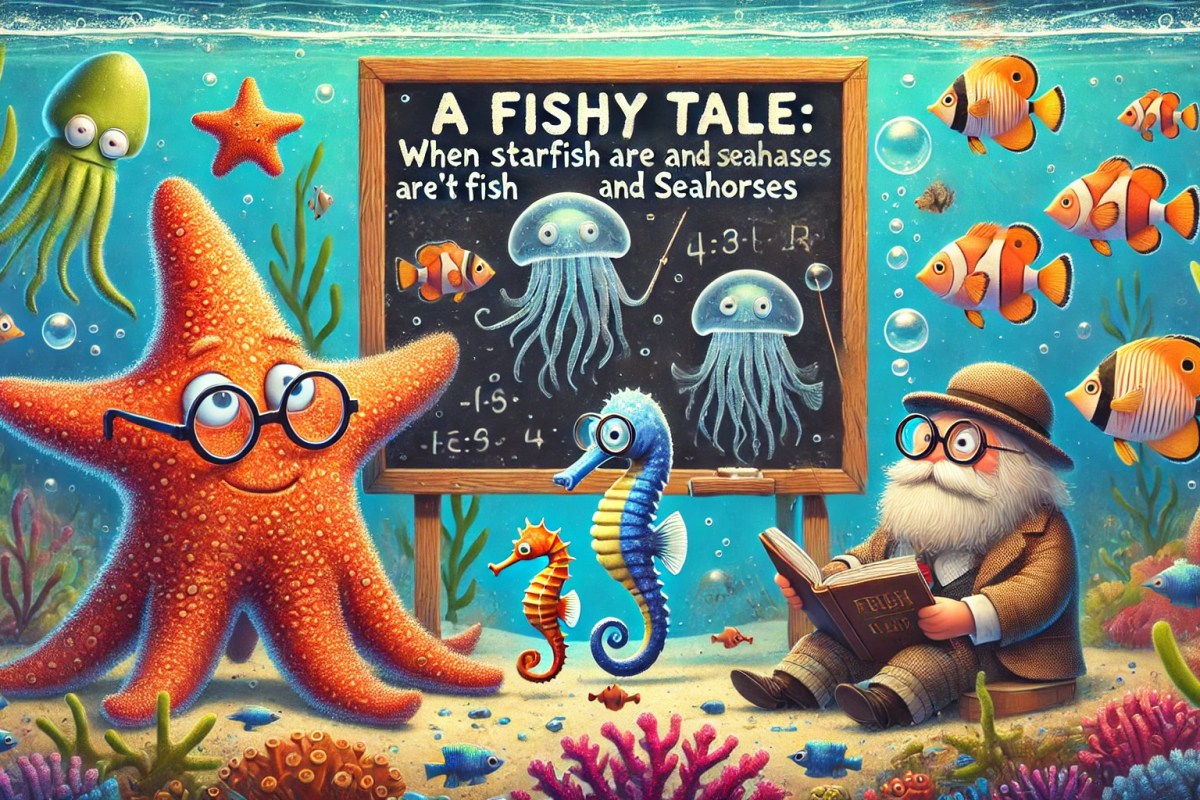
A Fishy Tale: When Starfish Aren’t Fish

Picture this: you’re strolling along the beach, admiring the marine life in the rock pools. You spot a starfish, a jellyfish, and a seahorse. Pop quiz: which of these creatures is actually classified as a fish?

  1. Starfish
  2. Jellyfish
  3. Seahorse
  4. Banana

If you answered “seahorse”, congratulations! You’ve just dipped your toe into the wonderfully weird world of marine biology and linguistic evolution. But don’t pat yourself on the back just yet, because we’re about to dive deeper into this ocean of confusion.

But something is fishy in Denmark. You see, in the grand aquarium of the English language, not all that glitters is fish, and not all fish sparkle. Our ancestors, bless their linguistically challenged hearts, had a rather broad definition of what constituted a ‘fish’. Anything that lived exclusively in water? Chuck it in the ‘fish’ bucket!

But wait, there’s more! While they were happily labelling every aquatic creature as ‘fish’, they were also using the word ‘meat’ to describe, well, pretty much anything edible. That’s right—your medieval five-a-day fruit and veg platter? All meat, baby!

So, how did we go from this linguistic free-for-all to our current, more discerning categorisations? And why do we still use terms like ‘starfish’ and ‘jellyfish’ when they’re about as fishy as a beef Wellington?

Strap on your scuba gear, dear reader. We’re about to take a deep dive into the murky waters of etymology, where we’ll encounter some fishy facts, meaty morsels of linguistic history, and maybe—just maybe—learn why a seahorse is more closely related to a cod than a sea cucumber is to a cucumber.

Welcome to our tale of linguistic evolution. It’s going to be a whale of a time! In this linguistic deep dive, we’ll explore the meaty truth about ‘mete’, fish out the facts about ‘fisc’, and navigate the choppy waters of modern usage.

The Meaty Truth: When Apples Were Meat

Imagine, if you will, a world where asking for a meat platter at your local deli might result in a fruit basket. No, this isn’t a vegetarian’s fever dream—it’s actually a peek into the linguistic past of our ancestors.

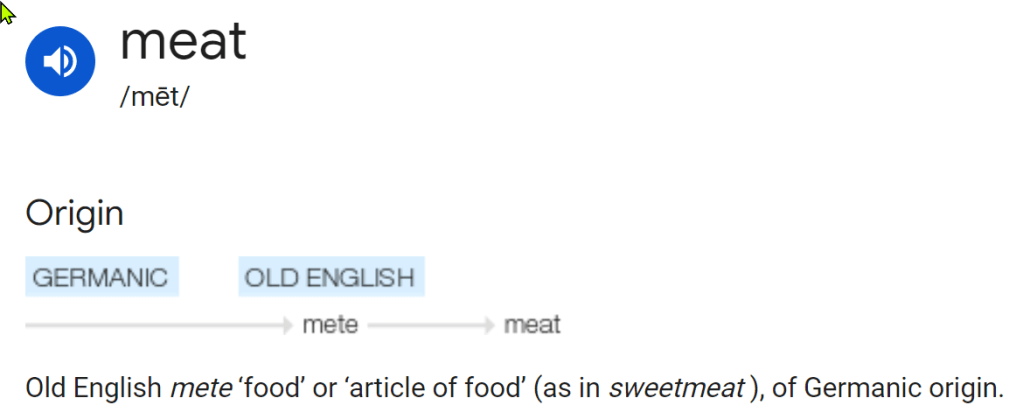
In Old English, the word ‘mete’ (IPA /’mit ə/, and not to be confused with the modern verb ‘to meet’) was a catch-all term for food. Any food. All food. If you could eat it, it was ‘mete’. Your apple? Mete. Your bread? Mete. That leg of lamb? Also mete, but we’re getting ahead of ourselves.

This broad definition persisted for centuries. Chaucer, in his 14th-century work “The Canterbury Tales”, wrote of “a Cok, hight Chauntecleer” (a rooster named Chauntecleer) who “For his brenning lay by Pertelote” (a hen). Yes, you read that right. Chickens were laying eggs; Chaucer was writing about “food” and “birds”; and somewhere, a medieval nutritionist was having an existential crisis.

But language, like a slowly simmering stew, changes over time. By the 14th century, ‘mete’ had started to narrow its focus, increasingly referring to the flesh of animals. It’s as if the word itself decided to go on a protein-heavy diet.

By the 18th century, ‘meat’ (having picked up its modern spelling along the way) had pretty much settled into its current meaning: the flesh of animals used as food. Though remnants of its broader past linger in more places than you might expect:

  1. Phrases like “meat and drink” still mean food and beverages in general.
  2. The term “nutmeat” refers to the edible part of a nut.
  3. Fruits and vegetables can have “meaty” parts – we’re looking at you, avocados and tomatoes!
  4. “Sweetmeat” doesn’t involve meat at all, but refers to candies or sweets.

So, the next time you’re describing the succulent flesh of a ripe peach as “meaty”, know that you’re not being weird – you’re being etymologically nostalgic. And when someone tells you to “meat and greet“, don’t bring a steak to the party. Unless, of course, it’s that kind of party. In which case, maybe bring enough to share?

This culinary journey through time just goes to show that when it comes to language, the proof is in the pudding. And yes, once upon a time, that pudding would have been called ‘meat’ too! Now that we’ve carved up the history of ‘meat’, let’s cast our net into the world of ‘fish’.

Something’s Fishy: Casting a Wide Net

From land to sea, our linguistic journey now dives into deeper waters to explore the slippery history of the word ‘fish’. Prepare to have your gills blown, because this tale is more twisted than an octopus playing Twister.

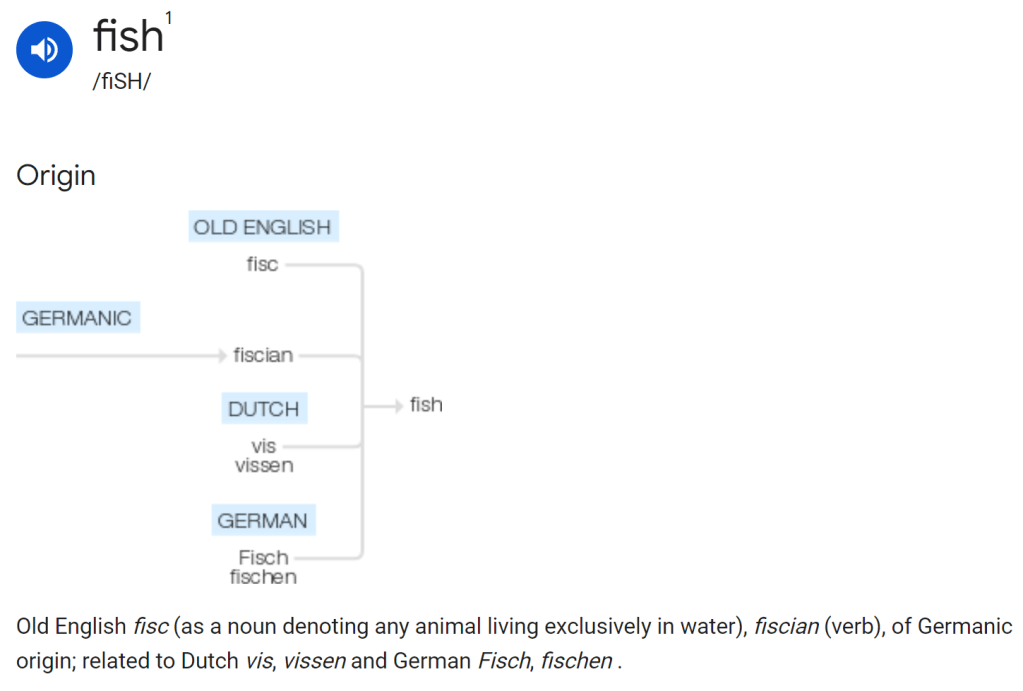
In Old English, our linguistic ancestors used the word ‘fisc’ (IPA /fɪsk/) to refer to, well, pretty much anything that called water its home. If it swam, floated, or generally looked bewildered in an aquatic environment, it was a ‘fisc’.

This cast-iron skillet approach to classification meant that whales, seals, and even crocodiles were all lumped into the ‘fisc’ category. It’s as if our forebears took one look at the ocean, threw up their hands, and said, “Eh, it’s all fish to me!”

This broad definition persisted for centuries, leading to some rather fishy nomenclature that we’re still untangling today:

  1. Jellyfish: Despite their name, these gelatinous creatures are about as far from fish as you are from your second cousin twice removed on your mother’s side.
  2. Starfish: These spiny echinoderms are more closely related to sea urchins than to any fish. They’re the marine equivalent of finding out your cat is actually a very convincing raccoon.
  3. Cuttlefish: These crafty cephalopods are molluscs, more akin to octopuses and squids than to any fish. They’re the masters of aquatic disguise, fooling both prey and etymologists alike.
  4. Shellfish: This term covers a motley crew of crustaceans and molluscs. Calling a lobster a fish is like calling a butterfly a bird – poetic, perhaps, but scientifically fishy.

As scientific understanding grew, the definition of ‘fish’ narrowed. By the 16th century, scholars were beginning to distinguish between ‘fish’ and other aquatic animals. However, the old, broad use of ‘fish’ had already left its mark on our language, like a stubborn fish smell that lingers long after the seafood dinner is over.

Today, in biological terms, ‘fish’ refers to gill-bearing aquatic animals lacking limbs with digits. But in culinary and cultural contexts, the term is still often used more broadly. So next time you’re at a seafood restaurant pondering whether to order the fish or the shellfish, remember: it’s all ‘fisc’ to your linguistic ancestors!

The Great Divide: Fish or Not Fish?

Now that we’ve muddied the waters thoroughly, let’s try to separate our fish from our not-fish. It’s time for the ultimate marine showdown: “Fish or Not Fish: Underwater Edition”! Let’s swim through some specific examples that highlight this fishy classification conundrum.

Starfish: The Stellar Impostor

Despite their fishy moniker, starfish are about as much fish as a sea star is an actual star. These echinoderms are more closely related to sea urchins and sand dollars than to any fish. With their five-armed symmetry and lack of gills or fins, starfish are the marine world’s ultimate catfish (pun intended).

Jellyfish: The Gelatinous Pretender

Jellyfish might float like a fish and sting like a… well, jellyfish, but they’re no more fish than a bowl of jelly. These cnidarians lack bones, brains, and hearts, making them more like drifting water balloons than actual fish. They’ve been pulling off this aquatic masquerade for over 500 million years!

Cuttlefish: The Crafty Cephalopod

Don’t let the name fool you – cuttlefish are cephalopods, more closely related to octopuses and squids than to any fish. These masters of disguise can change their appearance rapidly, making them the chameleons of the sea. They’re the ultimate marine conmen, fooling both prey and etymologists alike.

Shellfish: The Armoured Anomalies

‘Shellfish’ is a catch-all term for a motley crew of crustaceans and molluscs. Calling a lobster or an oyster a fish is like calling a butterfly a bird – it might fly, but that doesn’t make it right. These hard-shelled creatures are about as far from fish as you can get while still living in water.

Seahorses: The Fishy Exception

Plot twist! Despite their equine appearance, seahorses are indeed true fish. These peculiar creatures belong to the genus Hippocampus (which literally means “horse sea monster” in Greek). Here are some fin-tastic facts about our curly-tailed friends:

  1. Male Pregnancy: In a twist that would make seahorse soap operas very interesting, it’s the male seahorses that get pregnant and give birth.
  2. Monogamy: Unlike many fish, seahorses are monogamous. They perform daily greeting rituals to reinforce their pair bonds. It’s like underwater ballroom dancing but with more fins.
  3. Camouflage: Seahorses are masters of disguise, able to change colour to blend in with their surroundings. They’re the underwater equivalent of a charismatic chameleon.
  4. Snouts: Their tubular snouts work like built-in straws, perfect for sucking up tiny crustaceans. It’s nature’s version of a Capri Sun.

So there you have it – a horse that’s a fish, and a bunch of “fish” that aren’t. If this doesn’t highlight the delightful absurdity of language evolution, I don’t know what will!

Modern Usage and Misconceptions: A Kettle of Fish

Now that we’ve unravelled this tangled net of fishy nomenclature, let’s surface and see how these linguistic oddities persist in modern times. It’s a veritable school of misconceptions out there! Just as our ancestors broadly applied ‘mete’ and ‘fisc’, we continue to cast a wide net with our fishy terms today.

The Persistent “Fish”

Despite our best scientific efforts, many misnomers stubbornly cling to our language like barnacles to a ship’s hull:

  1. Silverfish: These squirmy household pests are neither silver nor fish. They’re insects that have been sneaking into our bathtubs and bookshelves for over 400 million years, laughing at our misguided naming conventions.
  2. Crayfish: Also known as crawfish or crawdads, these freshwater crustaceans are more closely related to lobsters than to any fish. They’re the inland cousins who couldn’t afford beachfront property.
  3. Fishfingers: A childhood staple that contains fish but isn’t fingers. Unless you know something about fish anatomy that we don’t…

The Culinary Conundrum

In the world of cuisine, the line between ‘fish’ and ‘seafood’ is blurrier than a fish’s vision out of water:

  • Many menus separate ‘fish’ from ‘seafood’, with the latter often including shellfish and sometimes even seaweed. It’s as if the ocean decided to categorise its inhabitants based on their starring roles in Disney movies.
  • The phrase “fish and chips” stubbornly refuses to become “seafood and chips”, even when the dish includes non-fish like calamari. It’s a linguistic tradition as crispy and golden as the batter itself.

The Vegetarian’s Dilemma

Pity the poor vegetarians navigating this linguistic minefield:

  • Some vegetarians eat fish but not meat, leading to the term “pescatarian”. It’s as if fish decided to identify as vegetables just to complicate matters.
  • The question “Do you eat fish?” is often asked separately from “Are you vegetarian?”, as if fish were secretly plants with fins.

The Final Catch

In the end, language is a living, breathing entity that evolves faster than you can say “coelacanth” (which, by the way, is a fish that was thought to be extinct until it wasn’t – talk about a plot twist!).

While scientists may pull their hair out over our continued misuse of ‘fish’, the rest of us can simply enjoy the rich tapestry of language these terms have woven. After all, in the grand aquarium of English, it’s the linguistic oddities that make the view so interesting.

So the next time you find yourself in a debate about whether a starfish is a fish, or why we call it shellfish when there’s no fish involved, remember: in the world of language, sometimes it’s okay to let sleeping dogfish lie.

Conclusion: So Long, and Thanks for All the Fish!

As we surface from our deep dive into the murky waters of etymology, we find ourselves with a tackle box full of linguistic curiosities. We’ve navigated the broad seas of ‘mete’, trawled through the expanding net of ‘fisc’, and somehow ended up in a world where seahorses are fish, but starfish aren’t.

Our journey has shown us that language, much like the ocean, is vast, mysterious, and full of surprises. It evolves and changes, sometimes leaving behind fascinating fossils in our everyday speech. These linguistic relics remind us of a time when our ancestors looked at the sea and decided that anything wet and wriggly qualified as a fish.

From the “meaty” part of a fruit to the fish fingers in your freezer, from the crayfish in streams to the silverfish in your bathroom, these terms continue to swim through our language, blissfully unaware of their misclassification. They’re like linguistic dolphins, playfully leaping through our conversations, occasionally confusing vegetarians and marine biologists alike.

And here’s a thought to chew on: given what we’ve learned about the evolution of the word ‘meat’, could this linguistic journey have unintended consequences in other areas? For instance, when Catholics abstain from ‘meat’ on Fridays, are they following the modern interpretation of the word, or its original, broader meaning of ‘food’? It’s a question that would require diving into early Greek, Aramaic, and Latin texts to explore fully. But it just goes to show how the ripples of language evolution can reach far beyond our dinner plates and into the very core of cultural and religious practices.

So the next time you find yourself pondering whether that seafood platter is really all ‘fish’, or why we still call it the “fruit of the sea” when we know better, remember this tale. Embrace the delightful absurdity of language evolution. After all, in the grand ocean of communication, it’s these quirks and idiosyncrasies that make our linguistic journey so fascinating.

And if all else fails, just smile enigmatically and say, “So long, and thanks for all the fish!” Who knows? You might just be speaking to a dolphin disguised as a human, trying to warn you about the impending destruction of Earth to make way for a hyperspace bypass. But that, dear readers, is a whole other kettle of fish… or should we say, a different cut of meat?

Problem of Evil

I’m not religious, so that might be why I don’t understand the so-called ‘problem of evil’. To me, it’s a sophomoric question: If God exists—and is all-good, all-loving, and created everything—, then explain how evil came to be and why it seems to be so prevalent. There’s no reason to accept Occam’s Razor, but this might be a good time to adopt it. A narrative of God is created, and then—as with retrograde planetary motion to justify a geocentric ‘solar’ system—one needs to create odd sub-narratives to fill holes in the main storyline.

The problem of evil is that it doesn’t exist. Evil doesn’t exist. Denotatively, it can be defined as very bad. Connotatively, a moral element is manifest in the term, but the word is unnecessary judgmental hyperbole.

Etymologically, the word evil derives from the

Old English yfel (Kentish evel) "bad, vicious, ill, wicked," from 
Proto- Germanic *ubilaz (source also of Old Saxon ubil, Old Frisian 
and Middle Dutch evel, Dutch euvel, Old High German ubil, 
German übel, Gothic ubils), from PIE *upelo-, from root *wap- "bad, evil"
 (source also of Hittite huwapp- "evil").

In Old English and other older Germanic languages other than
Scandinavian, "this word is the most comprehensive adjectival
expression of disapproval, dislike or disparagement" [OED]. 
Evil was the word the Anglo-Saxons used where we would use badcruelunskillfuldefective (adj.), or harm (n.), crimemisfortunedisease (n.). 
In Middle English, bad took the wider range of senses 
and evil began to focus on moral badness. 
Both words have good as their opposite. 
Evil-favored (1520s) meant "ugly." Evilchild is attested as an 
English surname from 13c.

The adverb is Old English yfele, originally of words or speech. 
Also as a noun in Old English, "what is bad; sin, wickedness; 
anything that causes injury, morally or physically." Especially of 
a malady or disease from c. 1200. The meaning "extreme moral
wickedness" was one of the senses of the Old English noun, but it did
not become established as the main sense of the modern word until
 18c. As a noun, Middle English also had evilty. 

Adolf Hitler is evil. Pol Pot is evil. Charles Manson is Evil. This employment of evil intends to communicate that these are bad (versus good) people. The intent is that these people are possessed by evil—as in an evil metaphysical spirit controlling these people. They were born with an evil soul. That’s how the term is typically employed, but this is a kin to a 4-year-old. Having yet to adopt the term, a child might, upon reflection, assert that these so-called evil people as very, very, very, very (…) bad.

One could argue that the term is shorthand for the 4-year-old’s version, but this missing the connotative subtext.

Nietzsche gave an interesting account of the origins of the term in Beyond Good and Evil. I recommend reading it along with the Genealogy of Morals. I don’t have more to add, but somehow got on this tangent after reading Nagel’s defence of religion.