Curved Histories: Irreversibility and Inertia After Empire

1–2 minutes

NB: This is an idea I had kicking around, but it’s not really in my ballpark. Given my backlog, I don’t think I’ll pursue this. If anyone in the post-colonial space finds it interesting or adaptable, please pick it up as a kernel and run with it.

Thesis

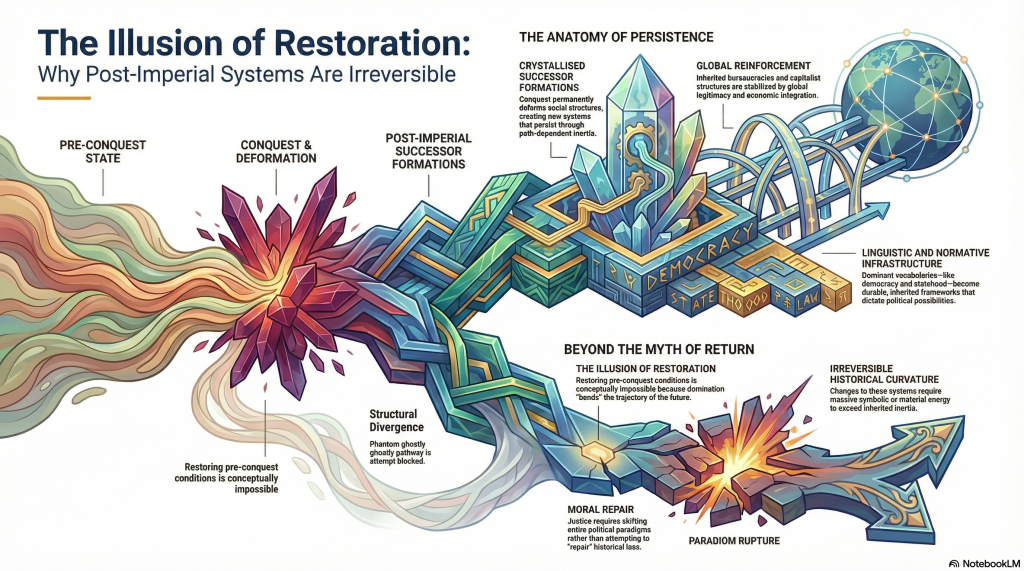
Post-imperial political orders do not restore pre-conquest social ontology but instead crystallise into historically irreversible successor formations whose institutional, linguistic, and normative structures persist through path-dependent inertia reinforced by global systems of legitimacy. Consequently, projects of restitution or decolonial restoration misrecognise the temporal dynamics of domination and must be reconceived as ethical and political negotiation within curved historical trajectories that can be altered only through paradigm-level rupture rather than moral repair.

Audio: NotebookLM summary podcast on this topic.

Abstract

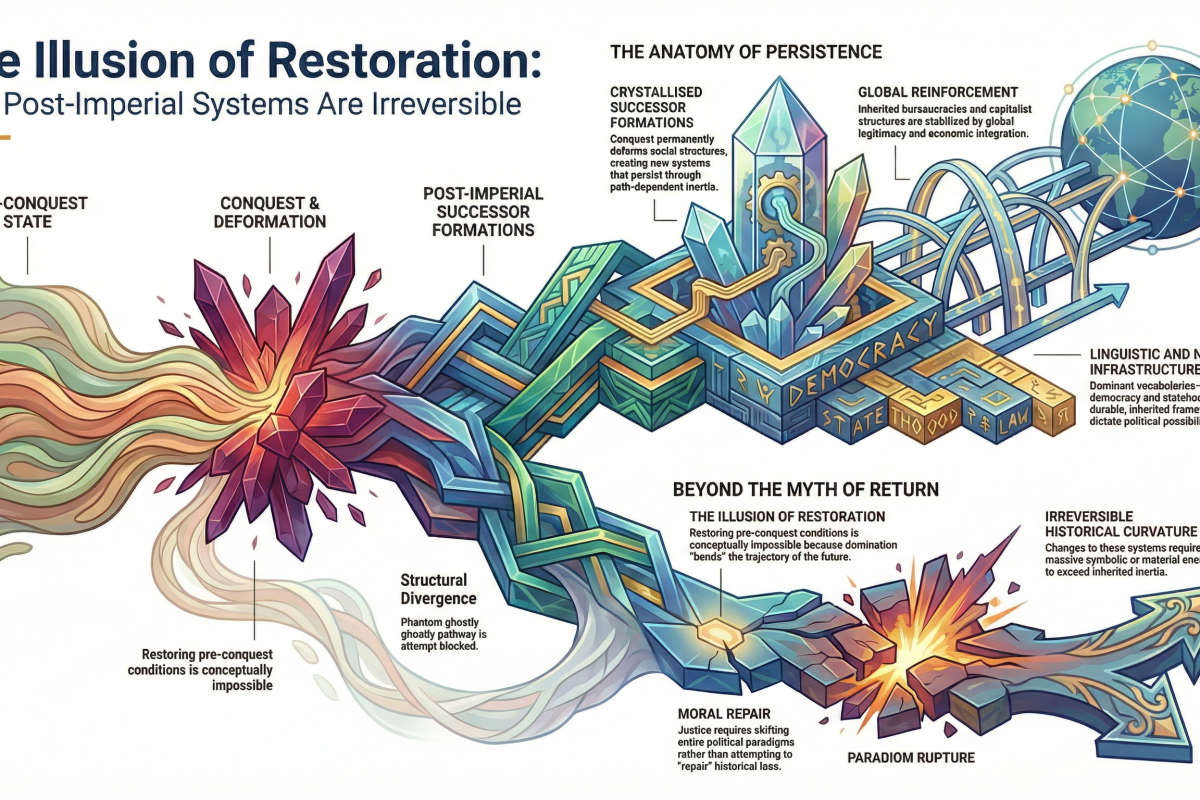
This argues that post-imperial political transformation cannot be understood through narratives of restoration, restitution, or completed decolonisation. Conquest generates not only territorial dispossession but durable deformation of social ontology, producing successor formations structured by inherited administrative forms, linguistic infrastructures, and normative vocabularies – most prominently democracy, capitalism, and bureaucratic statehood – that persist through path-dependent institutional inertia. These structures endure not as static remnants but as dynamically stabilised systems reinforced by global regimes of legitimacy, economic integration, and mnemonic continuity.

Against both liberal accounts of reconciliation and radical imaginaries of full decolonial return, the analysis develops a framework of historical curvature and rupture. Domination bends the trajectory of possible futures, rendering restoration of a pre-conquest condition conceptually incoherent while leaving open the possibility of paradigm-level transformation when sufficient political, material, or symbolic energy accumulates to exceed inherited inertia. Justice after empire must therefore be reconceived not as repair of historical loss but as ethical and political negotiation within irreversibly transformed temporal horizons. This reframing clarifies persistent tensions surrounding sovereignty, restitution, and legitimacy in post-imperial orders and provides a diagnostic account of why decolonisation remains structurally incomplete despite formal independence.
Infographic

The Melian Dialogue, Trump, and the Persistent Fantasy of Fair Play

3–4 minutes

We like to believe the world is governed by rules. By fairness. By international law, norms, institutions, treaties, and laminated charters written in earnest fonts. This belief survives not because it is true, but because it is psychologically necessary. Without it, we would have to admit something deeply unfashionable: power still runs the table.

Two and a half millennia ago, Thucydides recorded what remains the most honest conversation in political theory: the Melian Dialogue. No soaring ideals, no speeches about freedom. Just an empire explaining itself without makeup.

Audio: NotebookLM summary podcast of this topic.

Athens, the regional superpower of the ancient world, demanded that the small island of Melos surrender and pay tribute. Melos appealed to justice, neutrality, and divine favour. Athens replied with a line so indecently clear that political philosophy has been trying to forget it ever since: ‘The strong do what they can and the weak suffer what they must’.

That sentence is not an ethical claim. It is a descriptive one. It does not say what ought to happen. It says what does. The Athenians even went further, dismantling the very idea that justice could apply asymmetrically: ‘Justice, as the world goes, is only in question between equals in power’.

This is the part liberal internationalism prefers to skip, usually by changing the subject to institutions, norms, or aspirations. But the Athenians were being brutally honest. Appeals to fairness only work when neither side can impose its will outright. When there is a power imbalance, morality becomes theatre.

The Melians refused to submit. They chose honour, principle, and the hope that the gods would intervene. Athens killed every Melian man of fighting age and enslaved the women and children. End of dialogue. End of illusions. Fast-forward to now.

In early 2026, under Donald Trump, the United States launched a military operation against Venezuela, striking targets in Caracas and forcibly detaining Nicolás Maduro, who was transported to the United States to face federal charges. The justification was framed in familiar moral language: narco-terrorism, stability, regional security, democratic transition. The accompanying signals were less coy: temporary U.S. administration, resource access, and ‘order’. Cue outrage. Cue talk of illegality. Cue appeals to sovereignty, international law, and norms violated. All of which would have been very moving… to the Athenians.

Strip away the rhetoric and the structure is ancient. A dominant power identifies a weaker one. Moral language is deployed, not as constraint, but as narrative cover. When resistance appears, force answers. This is not a deviation from realism. It is realism functioning exactly as advertised.

Modern audiences often confuse realism with cynicism, as if acknowledging power dynamics somehow endorses them. It does not. It merely refuses to lie. The Melian Dialogue is not an argument for empire. It is an autopsy of how empire speaks when it stops pretending. And this is where the discomfort really lies.

We continue to educate citizens as if the world operates primarily on ‘shoulds’ and ‘oughts’, whilst structuring global power as if only ‘can’ and ‘must’ matter. We teach international law as though it binds the strong, then act shocked when it doesn’t. We pretend norms restrain power, when in reality power tolerates norms until they become inconvenient.

The Athenians did not deny justice. They reclassified it as a luxury good. Trump’s Venezuela operation does not abolish international law. It demonstrates its conditional application. That is the real continuity across 2,500 years. Not cruelty, not ambition, but the quiet consensus among the powerful that morality is optional when enforcement is absent.

The lesson of the Melian Dialogue is not despair. It is clarity. If we want a world governed by rules rather than force, we must stop pretending we already live in one. Appeals to fairness are not strategies. They are prayers. And history, as ever, is not listening.