
The winding down seems to take longer than the winding up. I’m trying to finish my Language Insufficiency Hypothesis manuscript, and I’m hung up on word choices. I’ve shared this chart before. My conundrum is the name of the Y-axis.
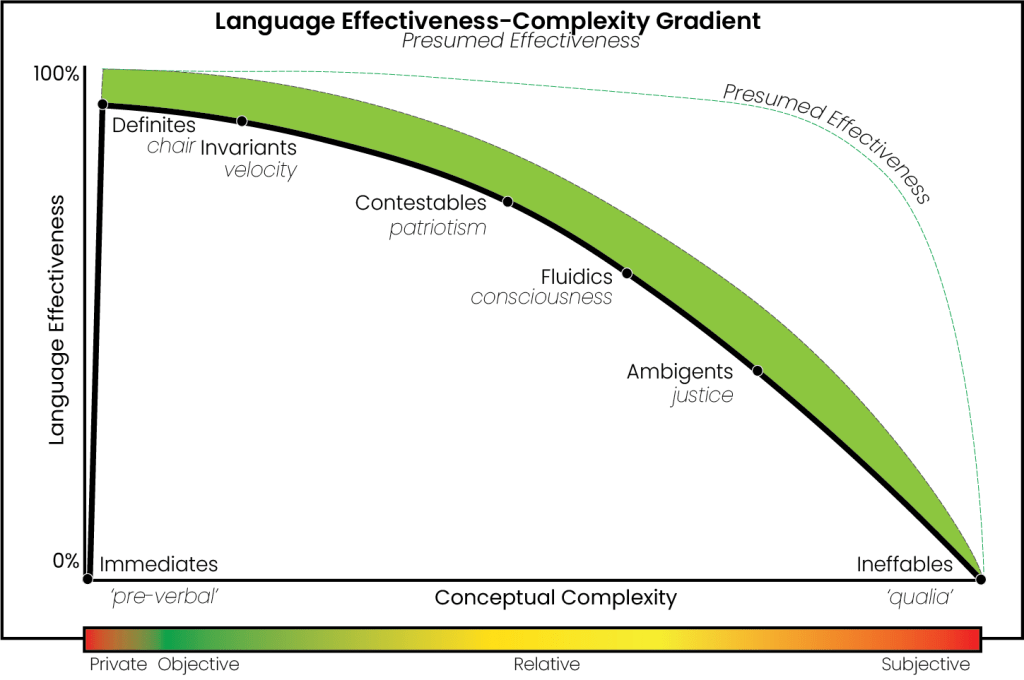
I’ve been calling it Language Effectiveness, but I’ve been losing sleep. Rather than effectiveness, should it rather be efficiency or efficacy? These are all near-synonyms, but they have nuanced differences, so I turned to ChatGPT.
The terms efficiency, efficacy, and effectiveness are often used interchangeably but have distinct meanings, especially in professional, scientific, and practical contexts. Here is a breakdown of their differences:
Efficiency
- Definition: The ability to achieve a desired result with minimal waste of resources (time, money, energy, materials).
- Focus: Resource utilisation.
- Key Question: How well are resources being used to achieve the goal?
- Example: A fuel-efficient car travels further on less petrol, minimising waste.
In short, efficiency measures how economically resources are used to accomplish a task.
Efficacy
- Definition: The capacity to produce the desired result under ideal conditions.
- Focus: Capability and potential.
- Key Question: Does it work as intended when tested in controlled settings?
- Example: A new medication shows high efficacy in clinical trials, curing 95% of patients in controlled environments.
In short, efficacy refers to the theoretical or tested success of an intervention under optimal conditions.
Effectiveness
- Definition: The degree to which something produces the desired result in real-world conditions.
- Focus: Practical success.
- Key Question: Does it work in everyday use or the real world?
- Example: A medication might be effective in treating 80% of patients in a hospital, accounting for factors like adherence and side effects.
In short, effectiveness measures how well something performs when applied practically, outside idealised settings.
Comparison
- Efficiency concerns how something is done (minimal resource use).
- Efficacy assesses if it can be done successfully (ideal conditions).
- Effectiveness evaluates how well it works in real situations (practical application).
Think of a machine:
- Its efficacy is its ability to perform a task perfectly when running in optimal conditions.
- Its efficiency is how little energy or resources it uses while running.
- Its effectiveness is how well it performs the task in a chaotic, real-world factory.
Interestingly, this was a helpful inquiry. Notice that the chart has three curves. My first choice seems to capture the entire framework, but the other two better capture the curves themselves.
The lower curve reflects efficiency — though effectiveness given the real-world circumstances. The middle curve represents efficacy. This is because conditions are ideal if the speaker and listener are on the same page and the speaker is a skilled communicator. The chart illustrates that even in this perfect situation, language communication cannot reach one hundred per cent for abstract concepts. The top curve illustrates the cognitive phenomenon that makes some people believe they communicate at a higher level than they do. This is akin to the illusory superiority cognitive bias, where people tend to believe they are above average.
I’m leaning towards naming the bottom curve language effectiveness and the middle curve the language efficacy horizon. Please stand by.
NB: If the cover image makes no sense, it’s because I entered ‘efficiency effectiveness efficacy’ into Midjourney, and this was one of the images it spat out.

 Philosophics