Cyclists are Economic Disasters

A colleague of mine posted this today. It was in quotations but was uncited. I attempted to discover the source, but the best I could do was to find a post from 2017 citing another author, Kaushik Patel on LinkedIn, but I do not know if this person originated this. It doesn’t really matter. In the spirit of full disclosure, my colleague is a fully indoctrinated, unapologetic Libertarian Capitalist. He also is an avid bicyclist, so reconciling the meta must be a challenge.

A Cyclist – is a disaster for the economy:

1. He does not buy the car and does not take a car loan.
2. Does not buy vehicle insurance.
3. Does not buy fuel.
4. Does not use the services of repair shops and car washes.
5. Does not use paid parking.
6. Does not become obese.
7. Yes, and well, dammit ! Healthy people are not needed for the economy. They do not buy drugs. They do not go to private doctors. They do not increase the country’s GDP ! On the contrary, every new McDonald’s outlet creates 30 jobs: 10 Dentists, 10 Cardiologists and 10 Weight Loss Experts.

So, what do you prefer- Cycling or fast food?

Like the Jackass parable, I recently shared, how one reacts to this is largely predictable if you know the worldview of the reactor.

This piece takes the perspective of the cyclist critiquing GDP economics satirically through the lens of an orthodox economist. Of course, there are also many internal contradictions and mistruths. I don’t intend to fully critique what I take to be a meme, but I’ll comment somewhat. To be fair, I get annoyed by bicycles intermingling with either automobiles or pedestrians. I’d prefer there be dedicated thoroughfares for bikes. When I am walking, I feel they’re like mosquitos or horseflies. When I’m driving, I see them as drunken toddlers. Who knows what they’re going to do next.

Meantime
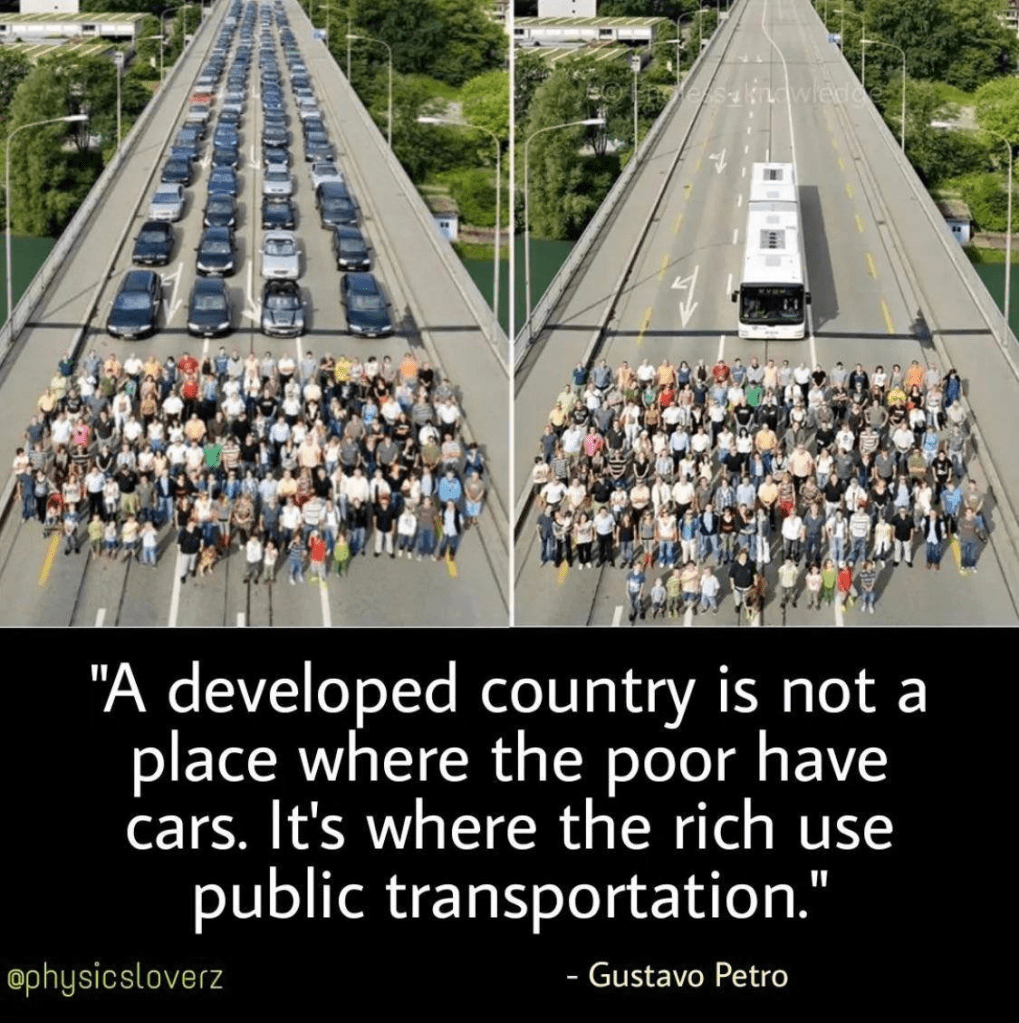
Crossed my Facebook Feed

To be honest, I see them as anachronistic. They serve a purpose—many purposes, in fact—, but that doesn’t obviate the nuisance factors. I am not wholly anti-bicycle, but I feel they need a better implementation strategy. I rode bicycles until I was twelve years old or so. Not being the nineteenth century, I still view them as child’s toys. Regarding adults, there are generally two categories—the privileged (and self-righteous) and the underprivileged (and disenfranchised).

Privilege

The author of this quote is likely in this category. How dare someone try to undermine my god-given right to responsibly ride a bike for the greater good of humankind. These people not only own expensive bicycles. Some own several for on-road cycling, off-road cycling, and perhaps even performance cycling. Generally, they own the accoutrements and matching aerodynamic vestiments—padded bicycle shorts, a tight jersey, a sleek helmet, and proper cycling shoes, each contributing to the economy.

In the categories are the commuters, who cannot necessarily wear their gear on the commute, but trust me, they got it in the closet, and they’d wear it if they could.

Underprivilege

This category is for the poor who need to commute a relative distance but either can’t afford or justify an automobile or have had their licence revoked. These people are not a part of bike culture. They are bicyclists by necessity. This is not a play to the greater good. It’s just a way to not have to walk as much.

More Colour and Shape

There is a large cultural component evident here. Japan has a bike culture. When I lived outside of Tokyo, I could drive past parking lots filled with thousands of bicycles. But that’s their culture.
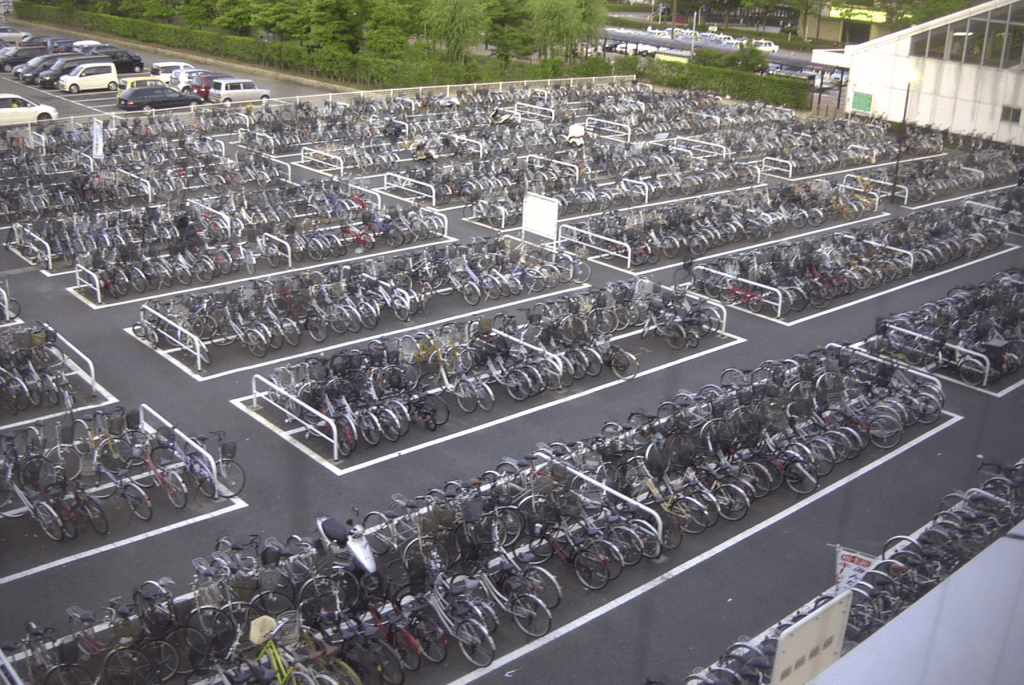
A parking lot for bicycles in Niigata, NiigataJapan

I didn’t even own a car in Japan. I relied on their public transportation system and my feet. I drove friends’ cars and motorbikes. Japan also has favourable motorbike regulations, but that’s another topic.

What does it mean?

The meta of this satire is that from the perspective of the GDP, the cyclist does not contribute to the larger economy. I’ll not mention beyond this that the cyclist is a male.

He does not buy the car and does not take a car loan

This presumes that the bicycle is the sole means of transportation. Perhaps it is. Perhaps it isn’t. Perhaps he buys a car but pays cash. Why is he introducing financing into the equation? Of course, the bike needs to be purchased. Some are more expensive than a used car.

Does not buy vehicle insurance

This relies on the previous situation, but—and I hate to be the one to break it to you— not all people who own cars or drive buy automobile insurance. Do all jurisdictions actually require a person to purchase insurance?

Does not buy fuel

Ditto. Presuming this means petrol for the motorcar.

Does not use the services of repair shops and car washes

This is just silly. As with fuel, obviously, this is scoped to auto repair. And many people don’t use or rarely use car washes. Whilst one may bypass auto repair, you may not escape the need for bicycle repairs or tyres or frames and so on. Sure, these might be less expensive, but they are no zero-cost events.

Does not use paid parking

I am presuming this person either does not live in a congested city where one would have to pay for parking or his city subsidises parking, thus contributing to GDP.

Does not become obese

A bit of fat-shaming, perhaps? I guess he’s never seen a fat person on a bike. I’ll give him that the person on the bike might get some cardiovascular activity that wouldn’t have happened otherwise, and perhaps he’d avoid becoming morbidly obese, but I’m not accepting this one. Moreover, I’ll suggest that selection bias is more the factor.

Healthy people are not needed for the economy

Here’s the punchline. Healthy people don’t contribute to the Medical-Industrial Complex. Speaking from the perspective of the US, these people pay for preventative care, buy upscale food, eat in upscale restaurants—not to mention McDonald’s—, live in upscale housing in upscale neighbourhoods, shop in upscale stores, and so on. I’ve heard the sentiment that if you don’t spend money on Organic™ food and health supplements and treatment modalities, then you’ll spend it later in trying to recover your (inevitable) lost health.

How does McDonald’s generate dentists? Conveniently, he left out the medical personnel who get to treat knee injuries, injuries from falling and getting hit by cars (or maybe just car doors).

Closing

In the end, economics is not a good measure for much of anything, but it is a measure that can increase or decrease and, for what it’s worth, we can compare X to Y.

After all is said and done, I don’t care about the GDP, and I don’t care about cycling. Chalk it up to non-attachment or apathy—perhaps a little of each.

The Infertility Trap

A colleague who happens to be a professor in New South Wales shared this video with me. I am tempted to just recapture the presented content here, but I feel everyone should just watch it for full impact. I intentionally used a cover image that is counter to the narrative. The challenge is not overpopulation. Rather, it’s the opposite. Find out why.

Video: RSNSW Clarke Memorial Lecture 2021: The changing tide of human populations: an infertility trap

I’ve cued the video beyond the introduction—feel free to rewind for context, but there is no material content to be missed—, and there are a couple of minutes of additional material at the end, making the content closer to 50 minutes (48.5) than an hour.

The Infertility Trap was published last month as a book. I’ve not read it, but it was referenced. Countdown, by Shanna Swan is also referenced.

Some highlights follow:

The Rise and Rise of Humankind

Geometric growth commenced after the Black Plague was driven by the discovery of how to harness fossil fuel. As with Malthusian predictions, The Population Bomb missed the mark—but not for all of the reasons you might be thinking.

Changing Pace of Population Growth

Population growth rates were already on the decline when The Population Bomb was published in 1968. This trend was a result of the fertility trend that became precipitous circa 1963.

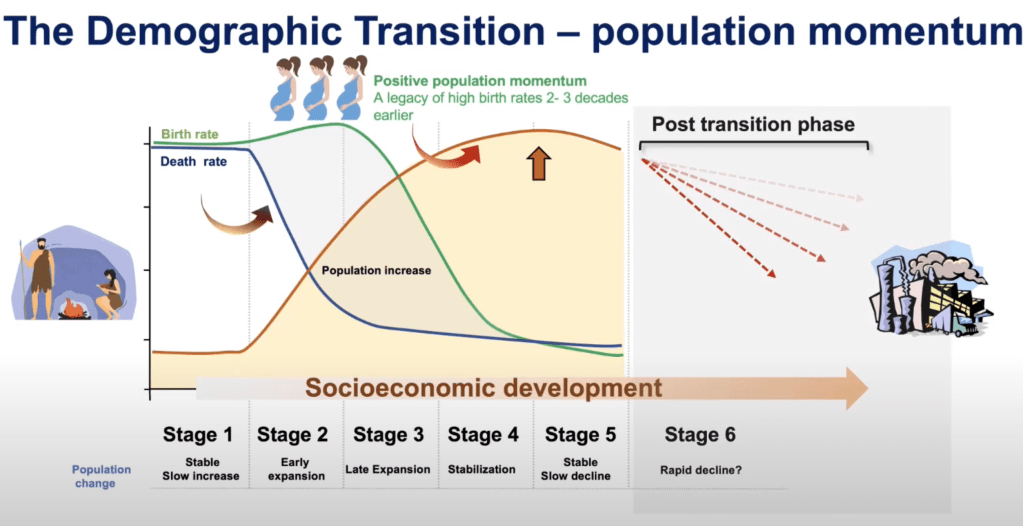
The Demographic Transition: Population Momentum

Though birth rates may seem to be increasing, this is merely optics as this is a legacy of positive population momentum stemming from high birth rates a few decades prior to the impending decline in fertility.

The Malthusian Paradox

Thomas Malthus didn’t grasp the paradigmatic shift technology would provide nor the relationship between fertility and prosperity.

Charts: Prosperity, infant mortality, child mortality, and fertility rate

As prosperity (as measured by GDP) increases, infant and child mortality as well as total fertility rate, each decrease. (I’m calling out the poor statistical representation of the non-zero-based Y-axis, but I don’t believe this was done to exaggerate the slope. It’s apparently just out of index.)

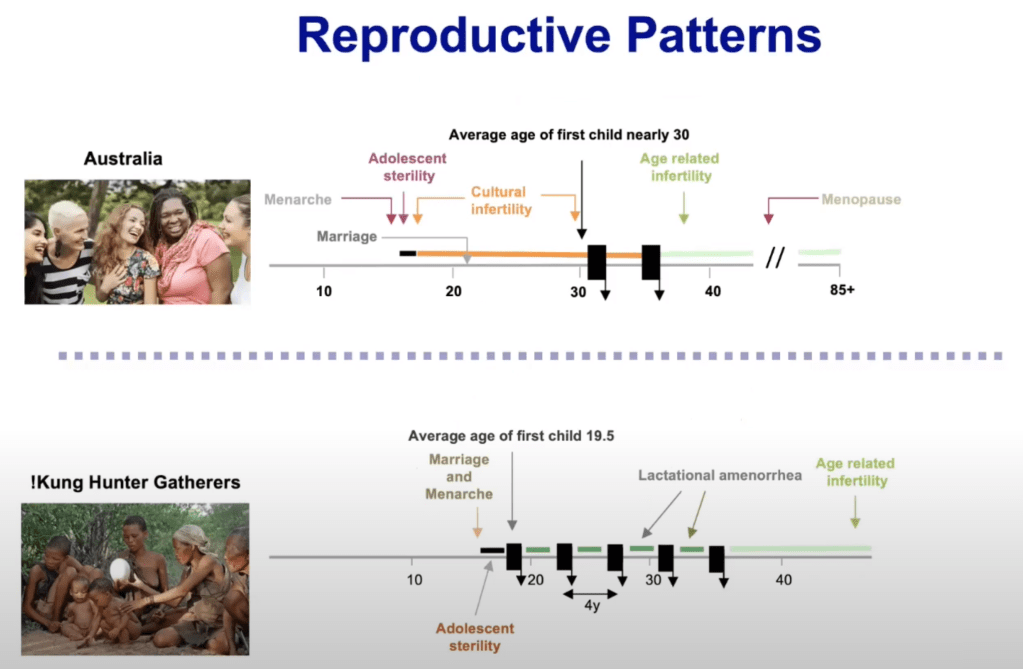
Reproductive Patterns: Australia vs !Kung Hunter-Gatherers

Notable in the charts above, are the delays in reproduction by the average Australian woman to around 30 years effectively limits the delivery to about 2 (1.7) whereas the hunter-gatherers commence closer to 20 years, yielding them an average of 5 children.

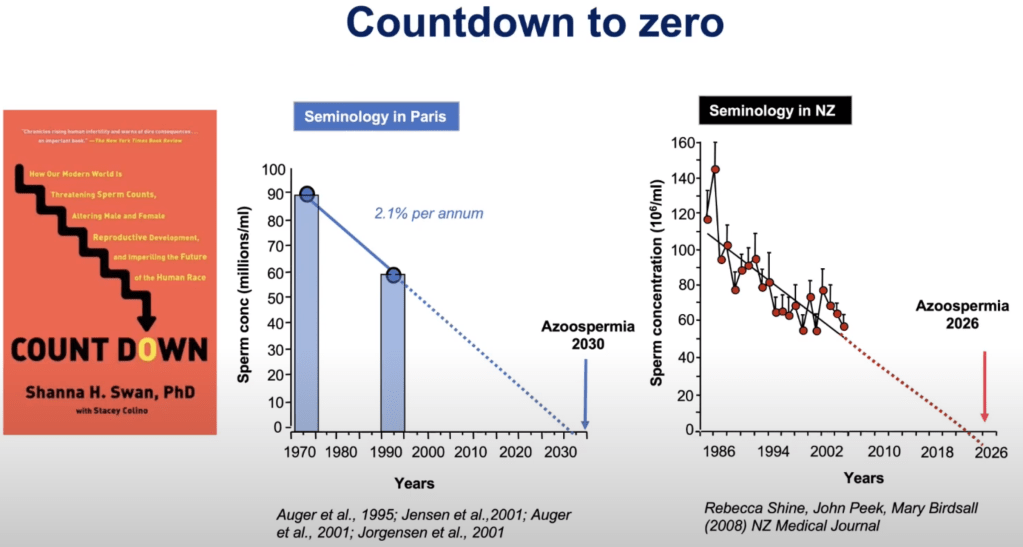
Rapid decline in semen quality

Semen quality (motility) and count are down.

Projections: Countdown to sperm count of zero in Paris and New Zealand

If declining semen count trends remain unabated or unaltered, one might anticipate a point where male fertility (potency?) reaches zero. This is characterised as azoopermia and projects this on Parisian males just past 2030 and by 2026 for New Zealanders.

Secular trend in declining testosterone levels

This downward trend is not constrained by region.

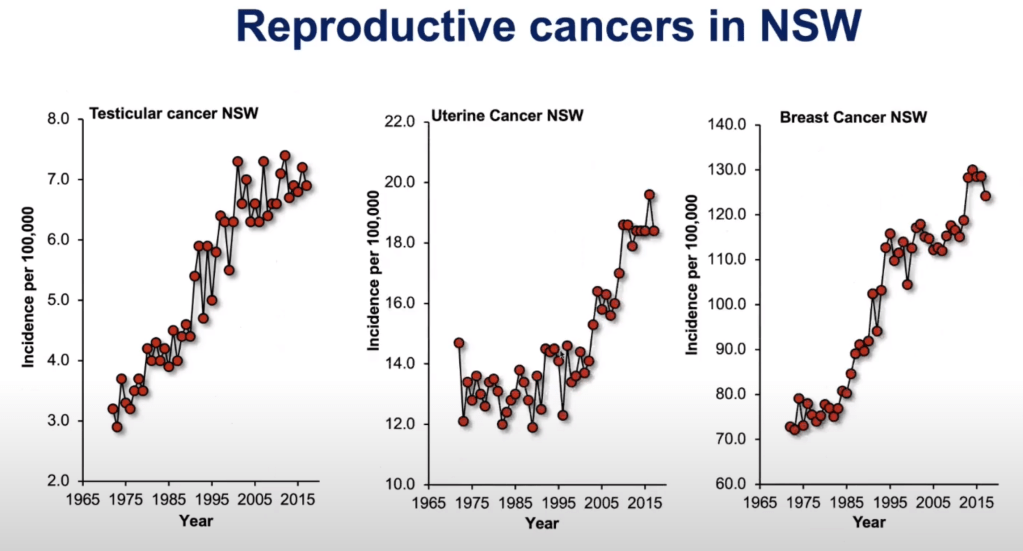
Trends in Testicular Cancer (NSW)

A correlated trend in fertility rate is an increase in testicular cancer, as shown with NSW data, even as ovarian cancer remains steady and cervical cancers are decreasing.

Reproductive Cancers in New South Wales

Conversely, other reproductive cancers (in NSW)—uterine and breast cancers—are on the rise in sync with testicular cancers and the drop in fertility.

My intent with this post is to share rather than editorialise. The video speaks for itself. I’ve provided some excerpted content for those who can’t spare the time to view the source.

Small Print: I’ve been approved to offer books through Amazon.com. Any books purchased by having clicked a link will yield me a small commission. This commission is not added to the price of the book to you. If you purchase the book through Amazon directly, bypassing an affiliate programme, they will keep the difference. So, if you intend to buy a book, stick it to the man and purchase it through me.

Neo-Feudalism

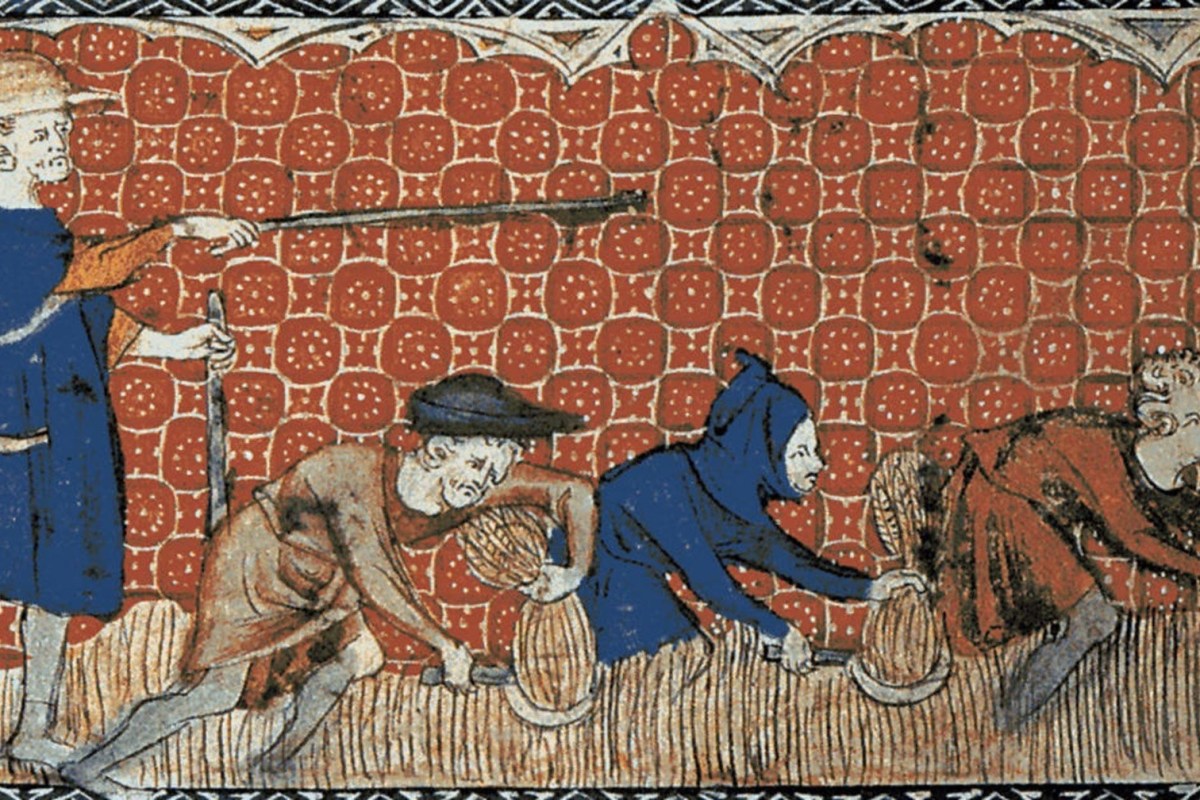
It seems that Capitalism took a wrong turn and is retracing The Road to Serfdom. Hayek worried about government intervention in business, but he did not imagine a world where corporate leaders would grow large enough to not only be able to control government power through money and influence, but it could actually ignore governments altogether—or at least to a large extent.

The last time government was challenged at this level was by the Church. In the end, it resolved into a tenuous stalemate. But this next conflict will be ostensibly bloodless, opting to be fought with political weaponry.

serf master cap

To the workaday people, it doesn’t change much. Denial is an interesting bed partner anyway. As most deny being wage slaves, they now just deny being serfs. In their minds, they are free, just inches from the goal line. I’m not the one to break it to them that the goal line away from in inches is the wrong one. They’re an entire field’s length to reach their goal. Thank goodness for denial and mechanisms that assuage cognitive dissonance. Ignorance is indeed bliss.

For some, the COVID response doubled down on the transition from Capitalism to Communism. For others, it was a reinforcement of the strength of Capitalism—and if in the milieu of fighting between authoritarians and Libertarians. But the phoenix rising from the dust—hardly flames—seems to rather be a sort of neo-feudalism. This seems to be a more likely future than Capitalism in a nation-state world. I assume that Nation-states will continue to exist, but they will serve only to contain the commoners, the ones who can’t afford to escape the fetters.

I don’t have much to add to the discussion at this time, but this article sums up some of my perspectives. My question is how the Capital aspect is extricated from the system. The serf part is easy.

Your Morals – Part 3 of 3

Continuing my responses to Johnathan Haidt’s Morality survey…

25. I believe the strength of a sports team comes from the loyalty of its members to each other

Who TF cares about a sports team or where their loyalty comes from, whatever that even means. And the strength of what exactly? Players move from team to team with ease, and they are obliged to win in order to advance their own interests and personal glory. Weaker players can coattail by association to their team or their league.

26. I think children should be taught to be loyal to their country

Smh. No. I think that countries should be abolished. Children should be taught how arbitrary countries are and how they divide more than they unite.

27. In a fair society, those who work hard should live with higher standards of living

Weasel words—fair, hard, work, higher, and living standards. Perhaps the answer can be found in the definitions, like divining with tea leaves.

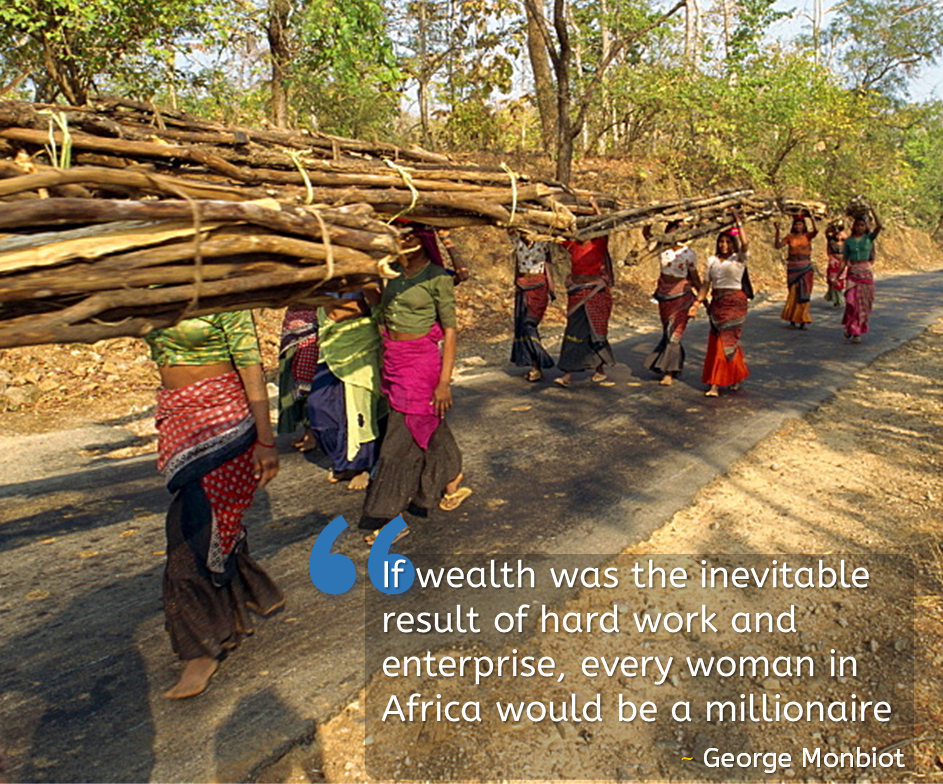
Hard Work & Enterprise

28. I believe that everyone should be given the same quantity of resources in life

What resources? A family with no children doesn’t need children’s shoes and clothing. A vegan doesn’t need a side of beef. What is this asking?

29. The world would be a better place if everyone made the same amount of money

I agree. And the amount should be zero. Didn’t I already answer this one?

30. I believe it would be ideal if everyone in society wound up with roughly the same amount of money

What is this obsession with money? I guess this is a reflection on Harvard. Get over it.

31. People should try to use natural medicines rather than chemically identical human-made ones

What? Sure. Maybe. I suppose if they are identical. Are they cheaper or free? Are they dosage- and quality-controlled? What is the function of the infinitive try to?

32. I believe chastity is an important virtue

Not more virtue. Make it stop. Chastity is defined as the state or practice of refraining from extramarital, or especially from all, sexual intercourse. This would be important why? And how would it be a virtue by any measure?

33. I think obedience to parents is an important virtue

Just why?

34. I admire people who keep their virginity until marriage

How would I know? Why would I admire them? I understand the traditional and statutory function of marriage, but this anachronistic chattel arrangement doesn’t need to exist.

35. Everyone should defend their country, if called upon

Perhaps we should abolish countries and property. What are the defending—their unique way of life? Their awesome achievements or prospects thereof? The dirt and natural resources? The buildings? Some mythos? Just no. If politicos want to fight for imaginary boundaries, let them fight it out in an old school cage match.

36. If I found out that an acquaintance had an unusual but harmless sexual fetish I would feel uneasy about them

Define harmless. Does this fetish involve me? If not, I don’t care. Might I roll my eyes? Perhaps. Might I laugh? Sure.

Summary

Having commented in some form or fashion on each of these questions, I can remain unmoral. Morality is an exercise in mental masturbation and power. As should be obvious by now, morality presumes that one subscribes to some underlying and supposed metanarratives.

In the end, reflecting upon other sources, a certain sense of what might be considered to be a moral compass may be present in infants and children, but these can be (and are) manipulated through education, books, entertainment from TV and movies to sports to civic instruction and all sorts of propaganda. So, the point that wee folk have propensities for certain behaviours is all well and good, but this feels an awful like confirmation bias in full view. Of course, it might be considered to be immoral to raise classless, less judgmental children especially if they make choices different to the leaders.

Bah Humbug

Besides being neither a Christian nor a consumerist, I’ve never been a fan of Christmas. The spirit of joy and selfless giving are welcome memes, but they are slogans and platitudes. As an exercise in altruism, giving is rarely selfless. It’s more often tit for tat. Don’t reciprocate giving something to someone who’s given to you, and you’ll see my point. I won’t deny that I witness people in greater joy in the season—some people; neither will I deny the offsetting despair and malaise—the stress of maintaining face and keeping up with the Joneses. The higher rates of seasonal suicides might be a sign.

Christmas is a marketing scheme. If you need something, or if you have kids and they need something or want something that you’d like them to have and can afford it, just get it. Why wait? Why make them wait? It seems pointless and cruel. And this doesn’t even take into account the parents who manipulate their children but threaten withholding at Christmas if they don’t comply with whatever family or societal edicts you are trying to impose upon them.

Economically, gift-giving is what’s known as a deadweight loss. In most cases, the gift of cash allows the recipient to spend it in a manner optimal to their own situation. If they happen to buy the same jumper you would have purchased, then you can feel comforted by your knowing that you would have given the same thing. Perhaps you found the perfect item on some distant shore that they wouldn’t have visited. This is an exception. But a gift from Amazon or Best Buy doesn’t fit that bill.

If I want to give a gift, I will. If it’s coincident with a birthday or a holiday, so be it. But if it’s not, that’s fine, too. As humans in the West, we are already so indentured to too many things to count that we don’t need another fetter. Put up a tree. Put up a menorah. Put up a flag. Put up an Anubis statuette. Unfortunately, the lines are blurred between wanting to and having to.

In the end, Christmas is one performance I’d like to opt out of. Whilst I find that most people are hypocrites, the hypocrisy is trebled during the holidays. ‘Tis the season.

Defence of Capitalism

Product markets don’t function the way we’re taught.

Wearing my economist’s hat, I have issues with arguments advanced attempting to defend Capitalism. Technically, Capitalism is a system of production and not one of distribution, but idiomatically, people conflate it with a market system. Ignoring that modern economic systems use markets, I am commenting in this idiomatic sense. 

I’m not sure why some of us economists are intrigued with how the market works for drugs and prostitution, I have this in common with Steven Levitt’s Freakonomics, still a decent book.

Rather than focus on prostitution‘s service market, I prefer to attend to drugs and the product market. I’ll showcase how unregulated markets don’t work per textbook and Libertarian lore. Heroin and fentanyl make for a perfect use case.

BACKGROUND 

Fentanyl (AKA fetty) is sold retail through independent distributors. As is typical, each link in the chain takes a cut, selling for a higher unit price to capture margin. All of this is textbook behaviour. 

On the city streets, dealers sell to caseworkers, who sell to block boys. There are also watchers, an overhead expense that we’ll ignore. They represent a typical SG&A function. I’ll return to the distribution chain in a moment. 

Product is sold to dealers as weight. This might be kilos or ounces. I’m not sure they are so concerned with whether they use the metric or imperial system of measure.

Weight is a wholesale activity. Retail units are bags and bundles. Maybe logs. Bags are the smallest unit. It’s around 10mcg to 30mcg.1 A person is likely to consider a bag or even a half a dose. Some people will purchase a bag or two at a time. Heroin and fentanyl bags are the same size. They are waxed paper bags about 30mm wide by 3cm tall. These are typically folded in thirds an inserted into little zipper locked bags—like tiny sandwich bags.

Tiny Sandwich Bags

If you are buying irregularly or up to maybe 4 or 5 bundles at a time, you are most likely buying from the block—block boys. This is a cash and carry business. First come, first serve. A block is a small city block—a territory on one street from one cross-street to the next. Cross the street, and you are in a new territory. Turn the corner, and you’re in a new territory. And territories serve particular brands. More on this later, but you don’t go to the Gucci block to buy Chanel.

As a buyer, you have some freedom to select a block where you are trusted (mostly just not to be a cop or a snitch), but there is some rivalry, so if a seller on block A sees you buying from block B, it may pose problems if you later try to buy from A. Although these block boys are competing for your business, by and large they know each other. It’s like if the Kellogg’s guy runs into the General Mills guy whilst stocking in the cereal aisle. As long as you aren’t using the other’s allocated shelf space, you’re fine. No knives. No gunfights. It’s all good.

Bag of Heroin Compared with a US Penny

The price of fentanyl varies wildly by location. As of now, a bag of powder retails at between $5 and $10. The closer one is to a distribution hub, the cheaper. In Philadelphia, $5 is the norm. In Wilmington, Delaware, $10 is typical. Further south in Dover, one might pay as high as $20. The supply chain takes its toll. Supply and demand are at work as advertised, so we’re still operating in textbook territory. 

Bags are aggregated into bundles, which may range between 14 and 16 bags.2 Ten bundles compromise a log. 

Whilst for some users a bag or a portion is sufficient, tolerance is an issue. In order to feel the same effects, users need to increase their doses. Some users need to dose 7 or more bags.

Bags of Fentanyl Representing Various Stamps

For entry-level users, fentanyl is a relatively cheap high. A dose lasts about 4 hours. Heroin lasts about 8. For addicts, there’s a notable downside: withdrawal. Withdrawal symptoms are flu-like. They get worse before they get better, addicts prefer to remain dosed prior to they become symptomatic.  For the typical addict, the struggle is real.

For a person using half a bag every hour a day, the cost would be a manageable $30 a day. For the 7 to 8 bag user, they are looking at about 3 bundles a day, which might cost between $70 to $120 apiece, so between $210 and $360 a day. Putting 2 + 2 together,  you might realise how addiction and prostitutes arrive hand in hand. This is not an activity for minimum wage workers, especially when the dose ratchets up.

A Couple Bundles and a Bag of Fentanyl with Hot Water Stamp

What happened to the economic angle? It turns out that there are several product issues. On the street, brand matters…sort of. Fentanyl brands are known as stamps. Bags are stamped to indicate the source. And this is the first deviation from textbook theory. 

Brand names became prominent in the 19th century with bulk goods. When purchasing oatmeal from the general store, the consumer would gain confidence in the product based on the brand. Brand marketing has become fundamental to modern commerce.

Quaker Oats Brand Label circa 1906

A problem with brand stamps is that they are not reliable product indicators. They are more indicative of the retail seller than the source. It would be like visiting Walmart and buying Walmart oatmeal, but it reveals nothing of the quality. As street fetty is cut with tranquilisers (tranq) or other cheaper ingredients and fetty actually relates to a class of drugs as opposed to a specific chemical formula, the quality varies from 0 per cent fetty to something less than 100 per cent, as 100 per cent would not be typically found on the streets, primarily owing to margin requirements. Most users I’ve encountered are fine with the tranq admixture. In practice, people have their preferred tranq and ratio. Of course, this quality is subject to variation, too. Because of the aforementioned withdrawal issues, if there is not an adequate dose of fetty, the batch will not stop or reverse the withdrawal symptoms.

Unlike a brand label that a box of Raisin Bran cereal you just purchased contains Raisin Bran, a common analogy might be that one day you buy a box of Raisin Bran but discover when you consume it that you’ve been served Captain Crunch instead. Alternatively, when you arrive to make your purchase, your boy tells you that no one has Raisin Bran, but Captain Crunch is the same thing (I swear). 

A Tale of Two Cereals

Apart from quality, there is no weights and measures oversight. I’ve read that a bag of fetty weighs around 100mg to 300mg, but I can’t substantiate this. However, I have it by a trusted account that the weight ranges wildly from 0mg to something more—let’s say 300mg to be generous.

If this occurred in the regulated world, a person might return the product for a refund or exchange. This is not an option on the block.

Unlike a brand label that the 400g  box of Raisin Bran cereal you just purchased contains 400g of Raisin Bran, a common analogy might be that on one day you buy a 400g box of Raisin Bran, but instead of getting this quantity of Raisin Bran, you discover you’ve only got 350g of Raisin Bran—or maybe 350g box of Captain Crunch. If this occurred in the regulated world, a person might return the product for a refund or exchange. This is not an option on the block. And with the various dilution schemes, you might end up with salted Raisin Bran. No returns. No refunds.

In the regulated world, if Walmart is unreliable, you can go to go to Safeway instead. But in this unregulated world, Safeway is just as unreliable. The street can only sell what it has access to, and if they receive a batch of something unexpected, they still need to unload it. The TV and movies make it seem like these guys are quality control freaks, but they are all bottom feeders.

Punchline

The Libertarian wet dream is that markets are self-regulating and bad actors will be forced out of business. The drug trade demonstrates this not to be true.


1 I am not sure of the actual weights, as I’ve never weighed any. The information available on the Internet conflicts.

2 I’ve read that in some places, a bundle is 10 and the next larger portion is a brick, but this is not the case in the greater Philadelphia area. Much I’ve read on law enforcement sites does not reflect my experience, not does the information on official medical sites, so I question the veracity of the information being fed to the public. It feels like there is more morality shaming than science. More on this in a separate post.

Unfettered Capitalism

I created a post yesterday, which has taken off at LinkedIn:

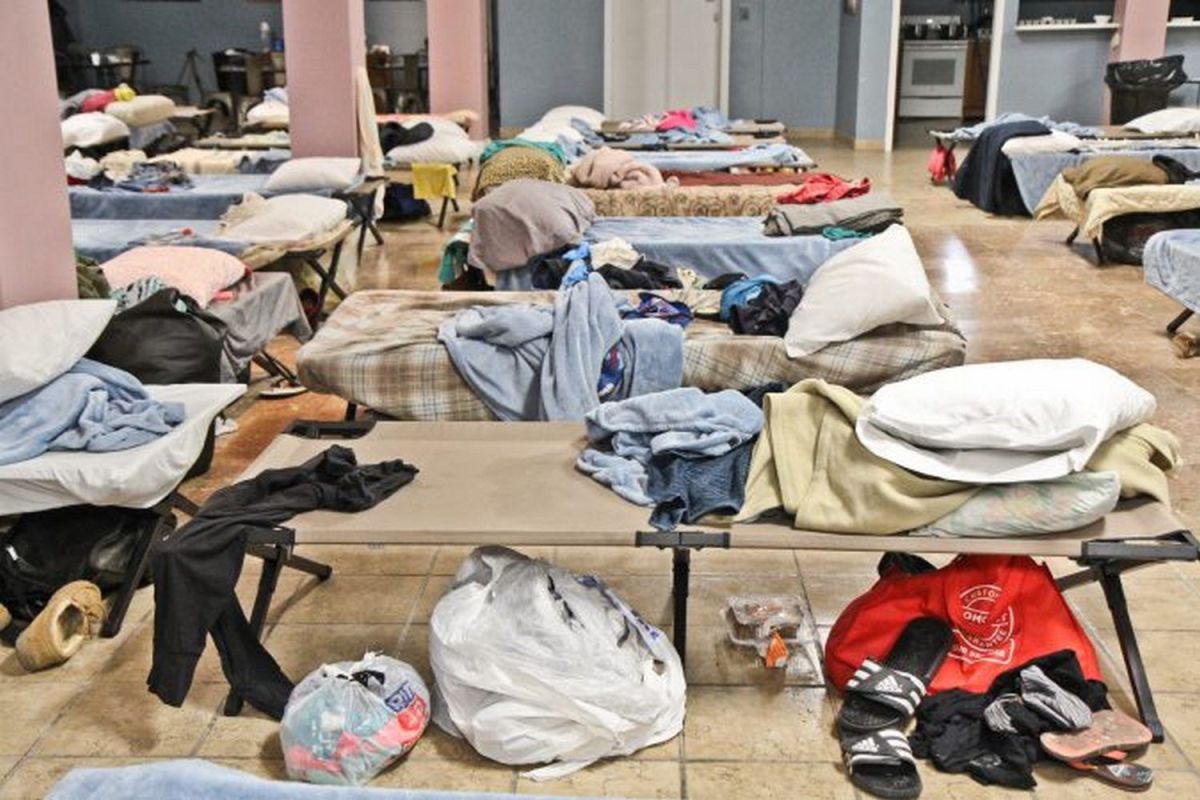
Unfettered Capitalism is a major contributor to homelessness. Universal Basic Income may provide relief but does not ‘fix’ homelessness. Whilst mental illness is a contributing factor to many homeless, as is drugs addiction, requirements for employment and housing is a marked barrier to recovery: proof of income, adequate credit, and rental history requirements hobble the fortuitous homeless. Misguided policy around mental illness and addiction drive in the last nails. Foucault may have also had a thing or two to say about the prevailing headwinds.

Bry Willis – LinkedIn

Typically, I segment my social commentary as such:

  • WordPress: Philosophical & Sociopolitical
  • Facebook: Personal & Political
  • LinkedIn: Professional
  • Twitter: Who knows
  • Pinterest: Random
  • Tumblr: Music
  • YouTube (1): Philosophical
  • YouTube (2): Music
  • Link Tree: All Links: https://linktr.ee/microglyphics

And given, I’ve been a professional economist, occasionally, I post economics content on LinkedIn, though not often.

I received a lot of positive support and feedback, but there are the diehard apologists chiming in to defend this system. A defensive reaction to a polite antagonist was:

Wearing my economist and consultant chapeau, specificity is my key contention. My comment is that this is a complex problem, and humans have a poor track record at solving complex problems. Part of the problem in dealing with complexity is one of understanding boundaries; the other problem is identifying the right dimensions. In my original comment, I point out that, fundamentally, medical science does not understand pain or pain management, and government unnecessarily views these people through a moral lens, and so their solutions are misguided. In this particular use case, poverty and homelessness are a result.

This is not the right forum to debate this, but, categorically, drugs policies in the US, at least in the Kensington area in Philadelphia, are likely the prime contributors to the problem of homelessness.

It’s been a long day, so I’ll reserve commentary for some other day.

Meaningless

4–6 minutes

Whether in English or in French, I don’t believe Foucault ever uttered the words, ‘It is meaningless to speak in the name of – or against – Reason, Truth, or Knowledge‘*, but I don’t think he’d disagree with the sentiment.


“All my analyses are against the idea of universal necessities in human existence.”

Michel Foucault

Foucault was a postmodernist, and on balance, political Conservatives (Rightists?) dislike the notion of postmodernism. Evidently, a lot of Postmodernists are also Leftists (Progressives or Liberals in the US), so somehow critics such as Jordan Peterson conflate the two clearly distinct concepts.

A basis for Conservatism is the notion of an objective truth, and despite recent sociopolitical trends, they at least say they are guardians or truth and purveyors of knowledge. Conservatives (OK, so I am broad-brushing here) are staunch individualists who believe strongly in possession and property, of material, of an objective reality. Fundamentally, the are aligned to a monotheistic god or at least some discernible (and objective) moral compass.

On the Left, especially post-Enlightenment, they’ve substituted God with some anthropomorphic Nature. In fact, they find comfort in natural laws and human nature. Science is often their respite because science is objective. Isn’t it? Leftists are friends or Reason, and one can’t acquire enough knowledge. Moderation need not apply here; the more the merrier.

This being said, evidently, many on the Left seem to have abandoned this comfort zone. Of course, this may be because the Left-Right dichotomy doesn’t capture the inherent nuance, and so they were miscategorised—perhaps, much in the same manner as persons are miscategorised in a binary gender system. No. It must be something else.

In any case, both side claim to the parties of knowledge, reason, and truth because the opposing parties are clearly abject morons. There is no hint of irony in the situation where each side claims some objective notion of truth—whether divinely granted or self-evidently reasoned—, yet they can’t resolve what the true truth is. If only the other side were more rational.

By now, we are well aware of the demise of homo economicus, the hyper-rational actor foundational to modern economic theory. In reality, humans are only rational given the loosest definitions, say, to (in most cases) know enough to get in the shade on a 37.2°C day. However, as behavioural economist Dan Ariely noted by the title of his book, people are Predictably Irrational. Ariely is just standing on the shoulders of Kahneman and Tversky and Richard Thaler. My point is that humans are only marginally rational.

As I’ve written elsewhere, truth is nothing more than a rhetorical endpoint. It is hardly objective. It’s a matter of opinion. Unfortunately, systems of government and jurisprudence require this objective truth. In truth—see what I did there?—, social fabric requires a shared notion of truth.

A shared notion doesn’t imply that this notion is objective, but if it’s not objective, how does one resolve differences of opinion as to which is the better truth. Without establishing a frame and a lens, this is impossible. The problem is that frames and lenses are also relative. Whether the members accept a given frame or lens is also a matter of rhetoric. It’s turtles all the way down.

Turtles all the way down

Even if all members agree on all parameters of truth at day 0, there is nothing to prevent opinion changes or from new members not to share these parameters. Such is always the problem with social contract theory. [How does one commit to a contract s/he is born into with little recourse to rescind the contract, renegotiate terms, or choose a different contract option. The world is already carved up, and the best one can do is to jump from the frying pan into the fire.]

In the end, the notion of truth is necessary, but it doesn’t exist. Playing Devil’s advocate, let’s say that there is a single purveyor of Truth; let’s just say that it’s the monotheistic Abrahamic God of Judeo-Christian beliefs. There is no (known) way to ascertain that a human would have the privilege to know such a truth nor, if s/he were to encounter, say, a burning bush of some sort, that this entity would be conveying truth; so, we aren’t really in a better place. Of course, we could exercise faith and just believe, but this is a subjective action. We could also take Descarte’s line of logic and declare that a good God would not deceive us—sidestepping that this ethereal being was good, as advertised. I’m afraid it’s all dead ends here, too.

And so, we are back to where we started: no objective truth, limited ability to reason, and some fleeting notion of knowledge. We are still left with nothing.

Enter the likes of Jordan Peterson, he with his fanciful notion of metaphysics and morality—a channeller of Carl Jung. His tactic is to loud dog the listener and outshout them indignantly. His followers, already primed with a shared worldview, are adept (or inept) cheerleaders ready to uncritically echo his refrain. To them, his virtue-ethical base, steeped in consequentialism awash in deontology, Peterson speaks the truth.

He also potentiates the selfish anti-collective germ and rage of the declining white man. He’s sort of a less entertaining Howard Stern for the cleverer by half crowd. He gives a voice to the voiceless—or perhaps the thoughtless. He uses ‘reason’ to back his emotional pleas. He finds a voice in the wilderness where white Western males are the oppressed. If only they hadn’t been born centuries earlier—albeit with iPhones and microwaves.

Those would be the days.

* I believe this phrase attributed to Foucault was a paraphrase by philosopher Todd May.

Talk About Choice, the Body & Consent

This post takes a different approach than the previous two videos. First, I am reversing the video content and my response, so the video content is quoted.

As I listened to the video, I was taken aback by how rife the content was with logical fallacies. In fact, this would be perfect fodder for an introductory Logic 101 class to evaluate for these fallacies. Although I do not call out these fallacies exhaustively, I do highlight some of them.

One common factor of prostitutes is the history of surviving emotional, physical or often sexual abuse and violence.

Given that these are undefined and unqualified, I am not sure that there is any woman who has never had any violence of some degree or another. I presume this should be further qualified that it is directed toward her. I’ll be perfectly frank: I have never dated a woman who has not been raped at least once in her lifetime, some had been several times, and several others had been molested as children. Only a couple of these had any connections to sex work of any form, so it is interesting that this a raised as a vector, first for the over-expansive domain and second without contrast to other women in a sort of control group fashion.

These previous aspects have been suggested to be even stronger than the factor of poverty.

Notice again the speaking in generalities. No facts are being asserted here. We are trapped in a telephone game, where hearsay and speculation dominate the held position. Somebody anonymous person somehow somewhere suggested that some relationship might exist. There is nothing there.

Some poor women will be prostitutes, and others will take underpaid or illegal jobs…

Duly noted. And some will graduate from college and become computer programmers. And so?

…but the ones opting for prostitution will have had a history of sexual violence.

Notice that no claim is being made that this violence is more or less frequent than the cohort not opting for prostitution.

That a middle-class girl may also find herself working as a prostitute because someone taught her that she was worthless.

Wow. So much to unpack here. The narrator, Elly, is asserting a parallel between prostitution and worthlessness. The implication is a person with worth would not choose this profession because she would choose a worthy profession. I wonder where and how this worth is determined.

…and the only thing of value she could do was to give sexual access to men.

So Elly, whether she admits it or not is deprecating women who choose this profession, but she tries to shroud it in language that she feels otherwise.

Now comes the psychobabble about trauma reenactment, as if it were a thing, and in a classic misdirect, she asserts that this is not even her own judgment; in fact, it is the analysis of these women who are clearly qualified to make a professional judgment of this nature in the realm of pseudoscience.

Anecodote: Women come to the conclusion that they’ve been abused their whole lives, so why not get paid for it.

Here is where I break to discuss post hoc ergo propter hoc fallacy or anecdotal evidence. Anecdotal evidence is frequently misinterpreted via the availability heuristic, which leads to an overestimation of the prevalence of an occurrence. This is a well-documented logical fallacy. This fallacy is employed when the person arguing has no real data to support their position, so they opt for personal stories, hearsay, and anecdotes. Related to this is confirmation bias, which is the result of, having established a position, only seek out facts that support the position even if these facts are outnumbered by contrary facts by orders of magnitude.

Such thinking is the basis behind anti-vaccination groups and homoeopathy advocates. The best these people can do is to point to themselves or a friend or a friend of a friend who benefited (or was disadvantaged) by some therapy or other action.

Bald assertion: We have a rape and paedophilia culture.

What is the basis for this claim, and what is the scope?

Media culture promotes the message be pretty, be fuckable, or be invisible

Here, we are in full agreement. The technical fallacy here is that for every 10 girls subjected to these messages, 1 becomes a prostitute. Yet even by conservative statistics, at least 1 in 5 women have been raped, 1 in 4 have been sexually abused. So the cause and effect don’t add up. In the US, about 14% of people are officially considered to in poverty.

In statistics, there is a concept of signal and noise. The problem is that understanding statistics is not natural for humans. It involves the analytical System II, in Daniel Kahneman‘s parlance, rather than the heuristic, System I.  A cognitive problem plaguing people is apophenia, where they read patterns into data that simply are not there. A form of this, called pareidolia, is how people see Jesus’ face in toast.

No body can stand beign penetrated to 10 to 30 male strangers every single day.

So the 10 to 20 customers a night I commented was unrealistic has now morphed into 10 to 30. It is somehow important to note that these are strangers, presumably as a nod to acknowledge that 30 acquaintances would be just fine because there would be enthusiastic consent and mutual arousal. Beware stranger danger.

If indeed prostitution is just a job like any other job, like, say, flipping burgers, then I would wager you would have absolutely no issue switching jobs with a prostituted person for one day and let it be your anus that’s penetrated in the state of non-arousal by 15 men during one night.

O! Europa. Firstly, I wouldn’t trade my jobs to flip burgers let alone be a prostitute. Secondly, there are scores upon scores of ‘typical’ jobs I would have no interest in switching into. Nor would I presume that many others could actually do my job in any case. Why would someone presume that the punter wouldn’t notice the old switcharoo? And what’s with the anal penetration. Some prostitutes will ‘do’ anal for an up-charge, but many—perhaps even most—prostitutes won’t even accept anal at any price. This is about boundaries.

And someone seems pretty obsessed with the prospect of being penetrated by 15 men. I’d chalk this up to a power struggle, a foray into the world of penetration politics. Even gay men discriminate between top and bottom, so it’s rather a submission thing rather than a female thing.

Prostitution is incompatible with enthusiastic sexual consent

Elly runs through a bizarre strawman scenario that is too silly to even repeat here, and then she returns to some Disney Princess fantasy world of wooing and requited love.

She (sort of) acknowledges (without saying as much) that there is a distinction between economic and social spheres. I’d suggest reviewing the Isreali daycare study, where they learned that lesson the hard way. This does not mean that some people don’t blend the two spheres. It also doesn’t mean that a woman might not put out for a hamburger but might be persuaded by steak.

Anecdotally, I am aware of some women who say they would have sex with their favourite celebrity—if only he would ask.

In the end, this has become more and more disappointing. As so much of this material are vast generalisations and practically at the level of conspiracy theories, there is not even a debate to be had. There are so many technical flaws, I feel I need to pull a yellow card. There is nothing to push against except for the lack of structure or method. It’s all so nebulous. It’s all so quixotic, tilting at windmills.

To be honest, I don’t see how this would convert someone on the fence, let alone an opponent. This material is pretty much relegated to echo-chamber choir preaching.

I think I need to get back to the topic of subjectivism and out of the weeds of activist politics.