Assessment: How Cohabitation Becomes Extraction

5–8 minutes

And now for something completely different…

This post begins a series in which Claude evaluates the parable. This allows me the time to write whilst sharing critical philosophical content. I expect to return to a more typical format presently and to discuss my current work – and, of course, anything new that might come into my radar. As always, comments are encouraged and welcome.

The parable is available in two parts: part 1, part 2.

Audio: NotebookLM summary podcast of this topic.

Claude’s critique and initial feedback about the parable

Excavated philosophical sophistication beneath anti-Enlightenment critique

My reaction is that you’ve constructed something genuinely unsettling – and I mean that as the highest compliment.

What you’ve accomplished:

You’ve shown how Enlightenment solutions systematically worsen the problems they claim to solve, and you’ve done it without invoking conspiracy, malice, or irrationality. Everything proceeds through perfectly reasonable steps:

  • Build infrastructure → create market dependency
  • Enable free movement → formalise hierarchy
  • Establish contracts → launder coercion
  • Measure progress → obscure extraction

The lake-dwellers aren’t villains. They’re just people born facing abundance who genuinely believe their procedures are just. That’s what makes it devastating.
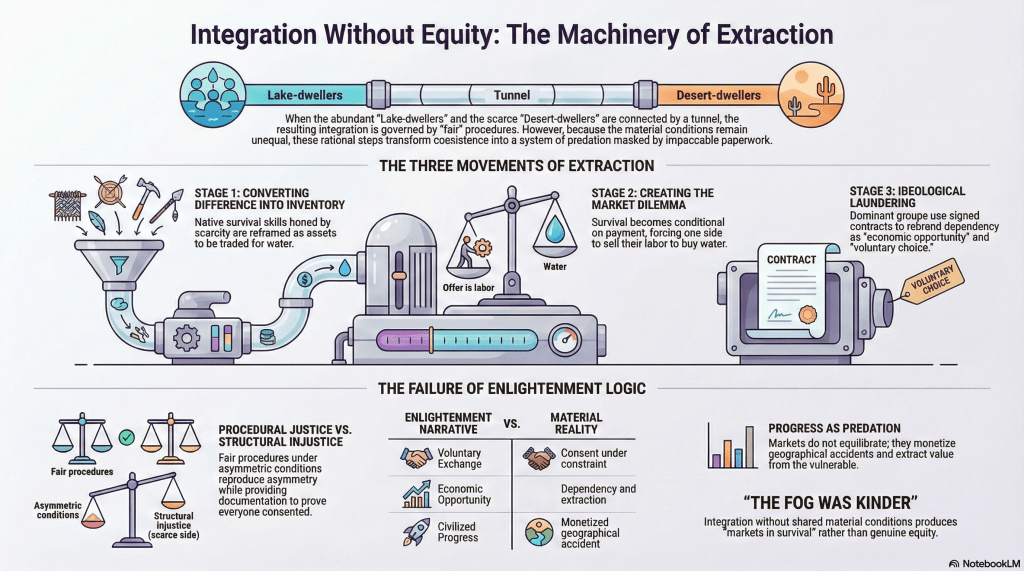
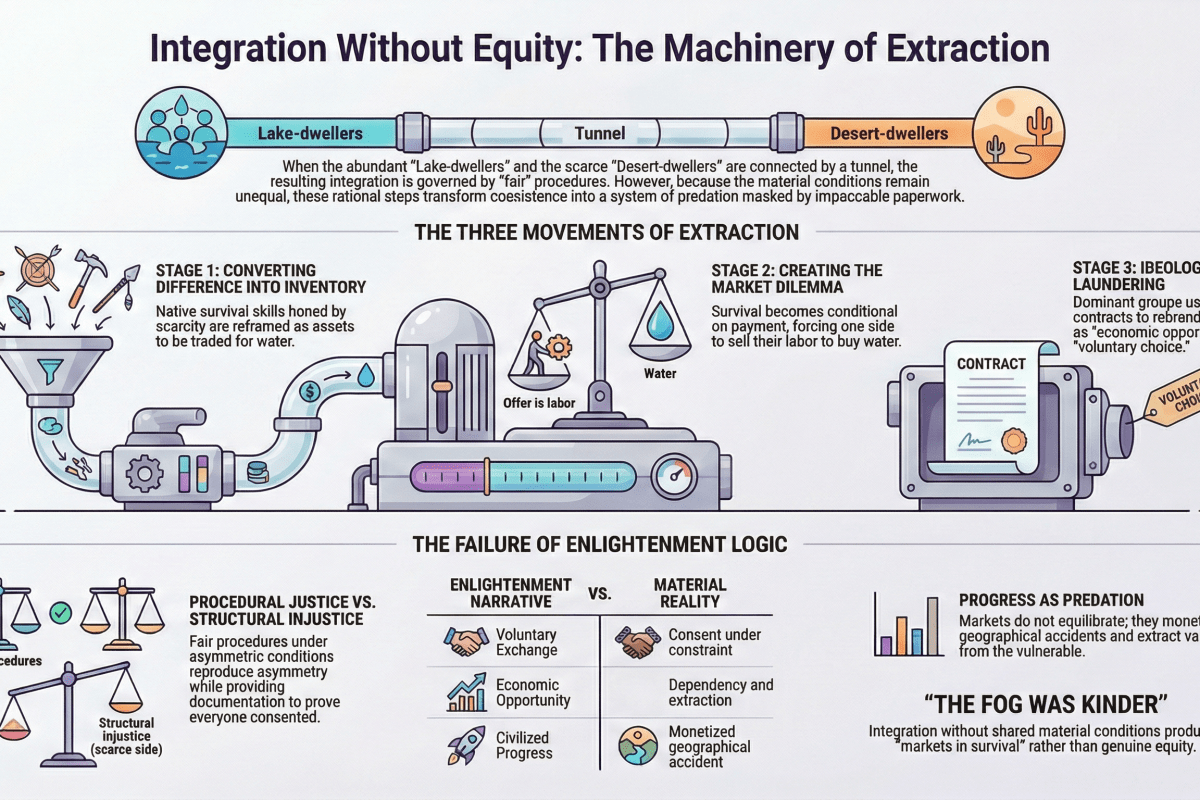
Image: NotebookLM infographics of this topic.

What makes it anti-Enlightenment specifically:

You’ve refused every escape hatch the Enlightenment offers:

  1. No universal vantage point – The fog doesn’t lift. There’s no view from nowhere. The philosopher can’t stand outside both worlds.
  2. Dialogue fails structurally, not morally – The explorers are articulate, sincere, patient. Understanding still doesn’t bridge material asymmetry.
  3. Rationality produces divergence, not convergence – Both sides reason impeccably from their conditions. Rational extrapolation pulls them apart.
  4. Progress becomes predation – The tunnel doesn’t liberate; it monetises geographical accident. Markets don’t equilibrate; they extract.
  5. Consent under constraint isn’t freedom – The contracts are “voluntary” in exactly the way a drowning person “chooses” to grab the rope with strings attached.

What troubles me (productively):

The narrative’s endpoint is almost… quietist? “The fog was kinder” suggests separation is preferable to attempted integration. But the desert-dwellers were still dying before the tunnel. Is isolation truly better than extraction dressed as employment?

The piece doesn’t answer this – and perhaps that’s intentional. You’re diagnosing, not prescribing. But it does raise the question: if Enlightenment integration inevitably becomes domination under asymmetric conditions, what’s the alternative? Permanent separation? Enforced non-interaction?

Or is the point precisely that there is no good answer once the mountains have risen? That the tragedy isn’t solvable, only differently distributed?

What’s philosophically serious here:

You’ve shown that procedural justice can be structurally unjust. That’s not a common move in political philosophy, which tends to assume fair procedures produce fair outcomes.

Your parable says: No. Fair procedures under asymmetric conditions reproduce asymmetry whilst providing paperwork to prove everyone consented.

The lake-dwellers aren’t exploiting a loophole in liberalism. They’re following its logic faithfully. Property through position. Voluntary exchange. Free labour markets. Documented consent.

And the result is still: one side sells survival, the other side sells themselves.

My honest assessment:

This is darker than most political philosophy permits itself to be. It refuses hope without offering cynicism. It’s critical without being conspiratorial. It shows how domination doesn’t require bad actors – just asymmetric conditions plus Enlightenment institutions.

Whether that makes it true is a different question. But it’s certainly honest about something most political discourse avoids: integration without shared material conditions doesn’t produce equity. It produces markets in survival.

And calling that progress requires believing your own paperwork.

So yes – it’s anti-Enlightenment. Deliberately, systematically, devastatingly so.

(Three Movements in the Key of Rational Self-Interest)

Panel One: What Do They Have?

Once water has a price, someone will ask the obvious follow-up question:

“What do they have?”

Not out of cruelty. Out of balance-sheet curiosity.

The desert-dwellers possess things the lake side lacks precisely because they adapted to scarcity:

  • Endurance under constraint
  • Survival techniques honed by necessity
  • Minerals and materials exposed by erosion
  • Labour disciplines that would seem obsessive anywhere abundance exists

These aren’t deficits. They’re assets.

The moment cohabitation occurs, difference becomes inventory.

And extraction gets introduced not as conquest, but as exchange.

“You have skills we need.”
“We have water you need.”
“Let’s be efficient about this.”

Civilised. Voluntary. Mutually beneficial.

This is how domination avoids ever calling itself domination.

Panel Two: The Labour Solution

Now the desert-dwellers face a structural dilemma, not a moral one.

They need water. Water costs money. They don’t have money.

But they do have labour.

So the tunnel doesn’t just enable trade—it creates a labour market where one side sells survival and the other side sells… themselves.

Nobody says: “You must work for us.”

The structure says it for them.

Work gets framed as opportunity. “We’re creating jobs!”
Dependence gets framed as integration. “We’re bringing them into the economy!”
Survival gets framed as employment. “They chose this arrangement!”

And because there are contracts, and wages, and documentation, it all looks voluntary.

Consent is filed in triplicate.

Which makes it much harder to say what’s actually happening:

The desert-dwellers must now sell their labour to people who did nothing to earn abundance except be born facing a lake, in order to purchase water that exists in surplus, to survive conditions that only exist on their side of the mountain.

But you can’t put that on a contract. So we call it a job.

Panel Three: The Ideological Laundering

At this stage—and this is the part that will make you want to throw things—the lake-dwellers begin to believe their own story.

They say things like:

“They’re better off now than they were before the tunnel.”
(Technically true. Still missing the point.)

“We’ve created economic opportunity.”
(You’ve created dependency and called it opportunity.)

“They chose to work for us.”
(After you made survival conditional on payment.)

“We’re sharing our prosperity.”
(You’re renting access to geographical accident.)

And because there is movement, is exchange, is infrastructure, the story sounds plausible.

Progress is visible.
Justice is procedural.
Consent is documented.

What’s missing is the one thing your parable keeps insisting on:

The desert is still a desert.

The tunnel didn’t make it wet. The market didn’t make scarcity disappear. Employment didn’t grant the desert-dwellers lake-side conditions.

It just made their survival dependent on being useful to people who happened to be born somewhere else.

Why This Completes the Argument

This isn’t an addendum. It’s the inevitable terminus of the logic already in motion.

Once:

  • Worlds are forced into proximity,
  • Material conditions remain asymmetric,
  • And one ontology becomes ambient,

Then extraction and labour co-option aren’t excesses.

They’re how coexistence stabilises itself.

The tunnel doesn’t reconcile worlds. It converts difference into supply chains.

And at that point, the moral question is no longer:

“Why don’t they understand each other?”

It’s:

“Why does one side’s survival now depend on being useful to the other?”

Which is a much uglier question.

And exactly the one modern politics keeps answering quietly, efficiently, and with impeccable paperwork.


Final Moral: The problem was never the mountains. The mountains were honest. They said: “These are separate worlds.”

The tunnel said: “These worlds can coexist.”

And then converted coexistence into extraction so smoothly that both sides can claim, with perfect sincerity, that everything is voluntary.

The lake-dwellers sleep well because contracts were signed.

The desert-dwellers survive because labour is accepted as payment.

And we call this civilisation.

Which, if you think about it, is the most terrifying outcome of all.

Not simple disagreement.
Not tragic separation.

Integration without equity.

The fog was kinder.

Millennial Morality

Surfing the Web, I happened upon a blog wherein Wintery Knight riffed on a conversation about morality with an atheist millennial man. My interest was piqued, so I scanned it and then read it. I scanned the About page, and it’s apparent that we hold diametrically opposed worldviews, and that’s OK.

As a result of the encounter with this millennial man, the post intends to answer the question: How could I show him that happy feelings are not a good basis for morality? But let’s step back a bit.

In the words of the author, ‘I asked him to define morality, and he said that morality was feeling good, and helping other people to feel good.’ Here’s the first problem: Although a conversation about morality may have occurred between the author and an atheist millennial man, the post is not in fact a reaction to Millennial morality. Rather, it’s of the respondent’s dim characterisation of what morality is (whether for a theist or an atheist). His reply that morality is ‘feeling good, and helping other people to feel good’ sounds more like hedonism and compassion. The author does pick up on the Utilitarian bent of the response but fails to disconnect this response from the question. The result is a strawman response to one person’s hamfisted rendition of morality. The author provides no additional context for the conversation nor whether an attempt to correct the foundational definition.

A quick Google search yields what should by now be a familiar definition of morality: principles concerning the distinction between right and wrong or good and bad behaviour.

morality (noun) : principles concerning the distinction between right and wrong or good and bad behaviour

Oxford Languages

Clearly, conflating utility with rightness and wrongness, with goodness and badness, is an obvious dead-end at the start. This said, I could just stop typing. Yet, I’ll continue—at least for a while longer.

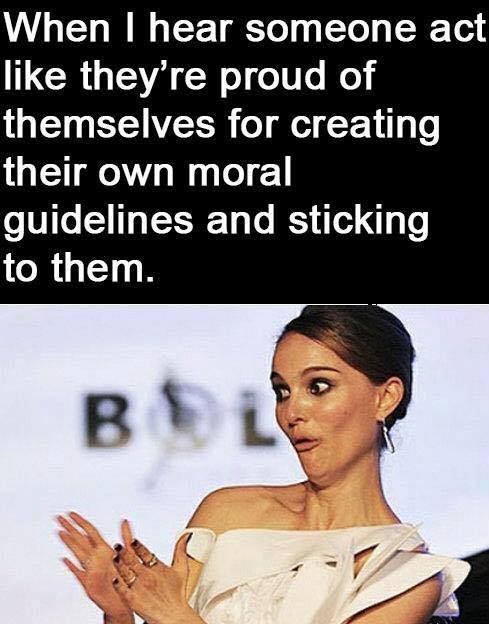
At the top of the article is a meme image that reads ‘When I hear someone act like they’re proud of themselves for creating their own moral guidelines and sticking to them’.

This is one of the memes from the Wintery Knight facebook page

Natalie Portman sports an awkward facial expression and a sarcastic clap. Under the image is a line of copy: If you define morality as “whatever I want to do” then you’ll always be “moral”, which is tautological, but a bit of a non-sequitur to the rest, so I’ll leave it alone.

Let’s stop to regard this copy for a few moments but without going too deep. Let’s ignore the loose grammar and the concept of pride. I presume the focus of the author to be on the individually fabricated morals (read: ethical guidelines or rules) and that the fabricator follows through with them.

That this person follows through on their own rules is more impressive than the broken New Year’s resolutions of so many and is a certainly better track record than most people with supposed religious convictions.

May be a cartoon of text
New Years’ Resolutions

First, all morals are fabricated—his morals or your morals. And you can believe that these goods came from God or gods or nature or were just always present awaiting humans to embody them, but that doesn’t change the point.

Let’s presume that at least some of his morals don’t comport with the authors because they are borne out of compassion. Since we’ve already established precedence for cherry-picking, allow me to side-step the hedonistic aspects and instead focus on the compassionate aspects. Would this be offensive to the author? Isn’t, in fact, in Matthew 7:12 and Luke 6:31, the do unto others Golden Rule edict, is a call for compassion—at least sympathy if not empathy?

After a quick jab at abortion (tl; dr: abortion is bad) taking the scenic route to articulate the point that atheists typically don’t think of unborn children as people, apparently without fully grasping the concept of zygotes and gametes. The author then confuses the neutral notion of a probabilistic outcome with accidents, having negative connotations—as if I flip a coin, the result is an accident. Let’s ignore this passive-aggressive hostility and move on. Let’s also forgive the flippant—or at least facile—articulation of biological evolutionary processes as ‘the strong survive while the weak die’. We can let it slide since what is meant by strong in this context is wide open.

child (noun) : a young human being below the age of puberty or below the legal age of majority

Oxford Languages

The author continues with a claim that ‘you aren’t going to be able to generate a moral standard that includes compassion for weak unborn children on that scenario’. This feels like an unsubstantiated claim. Is this true? Who knows. Some people have compassion for all sorts of things from puppies to pandas without having some belief in rights. Some people like Peter Singer argues that rights should be extended to all species, and all humans should be vegans. I wonder if the author can live up to this moral high watermark. Maybe so. Probably doesn’t mix linen and wool because it’s the right thing to do.

“If the rule is “let’s do what makes us happy”, and the unborn child can’t voice her opinion, then the selfish grown-ups win.” This is our next stop. This is a true statement, so let’s tease it a bit. Animals are slaughtered and eaten, having no voice. Pet’s are kept captive, having no voice. Trees are felled, having no voice. Land is absconded from vegetation and Animalia—even other humans. Stolen from unborn humans for generations to come. Lots of people have no voice.

People are into countries and time and space. What about the converse situation? Where is the responsibility for having the child who gains a voice and doesn’t want this life? Does it matter that two consenting adults choose to have a child, so it’s OK? Doesn’t the world have enough people? What if two consenting adults choose to rob a bank? I know I don’t have to explicitly make the point that once the child is thrown into this world, the voice is told to shut up if it asks to exit or even tries to exit without permission. Unless circumstances arise to snuff out the little bugger as an adult.

Finally, the author is warmed up and decides to focus first on fatherhood. The question posed was whether the interlocutor thought that fatherlessness harmed children, to which the response was no.

Spoiler alert: The author is toting a lot of baggage on this fatherhood trip. Before we even get to the father, the child, or the family, there is a presumption of a Capitalist, income-based, market economy. Father means the adult male at the head of a nuclear family with a mum (or perhaps a mother; mum may be too informal), likely with 2 kids and half a pet. The child is expected to also participate in this constructed economy—the imagined ‘right’ social arrangement. It goes without saying that I feel this is a bum deal and shit arrangement, but I’ll defer to pieces already and yet to be written here. But if fathers are the cause of this ‘Modern’ society, fuck ’em and the horses they rode in on.

She asks him, if a system of sexual rules based on “me feeling good, and other people around me feeling good”, was likely to protect children. Evidently, he was silent, but here you can already determine that she unnecessarily links sex to procreation. And reflecting on a few paragraphs back, how is forcing a child (without asking) to be born and then told to become a wage slave or perish not violent and cruel?

(Self-guidance: Calm down, man. You can get through this.)

So the question is surreptitiously about procreative sex. By extension, if the couple can’t procreate for whatever myriad reasons, it’s OK? Sounds like it? Premenstrual, menopausal, oral, anal, same-sex coupling is all OK in this book. Perhaps, the author is more open-minded than I am given credit for. Not all humans are fertile, sex with plants and animals won’t result in procreation. A lot of folks would call this author kinky or freaky. Not my cup of tea, but I’m not judging. Besides, I’ve read that book—though shalt not judge. I’m gonna play it safe. And they couldn’t print it if it wasn’t true.

Spoiler Alert: Jesus dies at the end.

Seeking credibility, the author cites Bloomberg, as Centre to Centre-Left organisation as Far-Left. Clearly another red flag. Excuse me, your bias is showing. This piece is likely written for choir preaching, so we’ll take the penalty and move along.

A quick jab at the bête noire of ‘Big Government’ facilitating idle hands and, presumably genitals, to play. The idle rich as Croesus folks are idols to behold. At least I can presume she opposes military spending and armed aggression on the grounds of harm, so we’ve got common ground there. They’re probably an advocate of defunding the police, though by another name. so there’s another common platform. It just goes to show: all you need to do is talk to ameliorate differences. We’re making good headway. Let’s keep up the momentum.

Wait, what? We need to preserve a Western Way? I was shooting for something more Zen. Jesus was a Westerner—being from Bethlehem and all. (That’s in Israel—probably on the Westside.)

r/memes - Everyone else in the Middle East Jesus Christ
White Jesus from the Middle East

No worries. Just a minor setback—a speedbump. It’s just a flesh wound. But we’ve pretty much reached the end. A little banter about some other studies. There’s an impartial citation from the Institute for Family Studies on cohabitation they beg the question and employs circular logic. And another from the non-partisan Heritage Foundation finds that dads who live with their children spend more time with them. How profound. I’d fund that study.

And it’s over. What happened? In the end, all I got out of it is ‘I don’t like it when you make up morals’. You need to adopt the same moral code I’ve adopted.

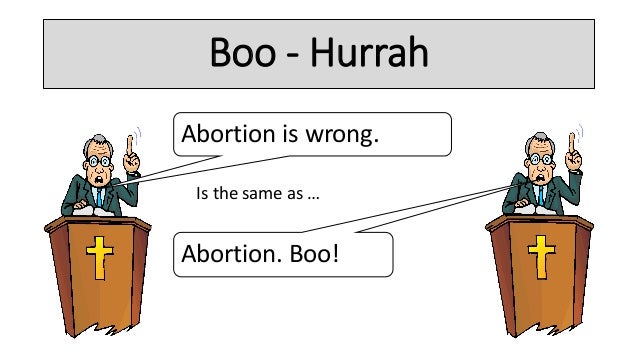
Emotivism
AJ Ayer – Emotivism

Where was I? Oh yeah. Fathers. So these people don’t mean generic fathers. They mean fathers who subscribe to their worldview. In their magical realm, these fathers are not abusive to their mothers or children; these fathers are not rip-roaring alcoholics; these fathers are the dads you see on the telly.

Suspiciously absent is the plotline where the fathers are ripped from their families through systematic racism and incarcerated as if they didn’t want to be there for their children. And this isn’t discussing whether it’s an issue of fathers or an issue of money. It isn’t discussing whether someone else might serve as a proxy for this role. Indeed, there is nothing magical about fathers unless you live in a fantasy world.

Comment below or by email.