In the spirit of full disclosure and to set the stage, I’m an atheist and can’t remember being otherwise. I’ve discussed this here before at length. Iain McGilchrist is not.
Religion is the topic of chapter nine of The Master and His Emissary. I understand what the author is saying, and I think a question I have about a fundamental issue is coming to head. Although I’ve spoken at greater length before, I’ll recapitulate here.
An assertion of McGilchrist’s is that we should judge the hemispheres by how well each corresponds to the truth of reality. He goes on to tell us that the left hemisphere is the controller of words, so we shouldn’t get hung up on the word truth and the definition that pales relative to the intuition of truth. I have an issue with this, but I’ll return to it in a moment.
As I’ve stated countless times by now, the left cerebral hemisphere is convergent and closing whilst the right is divergent and expansive. The left is intellect whilst the right is intuition. The left is categorisation, naming, and re-presentation whilst the right is Gestalt and presentation. The left is literal whereas the right is metaphorical. I’ll return to this presently.
Before touching on religion, I’ll articulate my challenge. He makes an unsubstantiated assertion that we can’t build a whole from a sum of parts. Instead, we need to accept the whole as presented as is, and realise that we may not be able to fully account for all of the parts. Just trust our intuition of the experience.
My contention here is that neither is quite right. Whilst the left hemisphere has the possibility of leaving things out, the right hemisphere has the possibility of adding irrelevant or otherwise injected content. In the case of religion, this would be along the lines of inserting a god of the gaps. I’ll come back to this.
All religions are not created equal. McGilchrist argues that Catholicism is a right-hemisphere religion whilst Protestantism, in particular Lutherans, operates from the left hemisphere. He even cites Max Weber’s writings noting the connexion between Protestantism and Capitalism. Despite being raised in an area with seventy-odd per cent Roman Catholics, I don’t know enough about Catholicism to critique that part of his assertion, but I agree with his statement on Protestants. As for my intuition, I’d say that all of the rote ritualism is a left-hemisphere function, but I’m not sure.
As he continues his argumentation he makes a case that religion needs to be taken metaphorically and cannot be deconstructed. This is to lose the proverbial woods for the trees. Of course, this is not only precisely what the left hemisphere does it’s also what the Protestant reformation did and Protestantism continues to do today. Like Capitalism, the focus is on the individual. For Catholics, it’s communal. Although he doesn’t cite Calvanlism and the ideal of work, the result is the same. Hard work yields a preternatural payoff.
I have no problem with metaphor, whether in speech, writing, art, or music. I’ve been a musician and dabbled in art. Much of my favourite fiction is metaphorical, and I don’t need to dissect it any of these to enjoy the experience.
religion can be experienced metaphorically
I am even willing to grant that religion can be experienced metaphorically. I have no quarrel here. Where his argument tends to lose ground is when it becomes prescriptive and systematised. Again, I am no expert on Catholicism, but I have attended Catholic church ceremonies. I even got ejected from CCD classes I had attended with a mate when I was eight or nine years old—not a great way to win hearts and minds.
When I lived in West Los Angeles—Palms to be exact—, my apartment was across the street from an Anglican church. Down the road, there was a Hare Krishna ashram—very diverse. I poked my nose into each. In fact, the Anglican church was my designated voting location, so I visited there on that occasion periodically. The spectacle of the smoke of frankincense and myrrh billowing out and wafting up is still a pleasant recollection. Frankly, I hadn’t thought of it in years, but writing about it returned the memories. Of course, the ashram had its own incense; only it was nag champa.
Some self-professed ‘spiritual’ people I have encountered, love the spectacle of a Catholic ceremony. There are candles, rituals, chanting, kneeling, chorals, and incantations. I can see how these can be taken metaphorically, but it’s also rote. But that’s not where my difficulty lay.
My problem is not that religion can’t be interpreted metaphorically. In fact, I can’t agree more. My problem is that this metaphor further aligns to God or to gods. But wait. I know what you’re thinking. Those are just metaphors, too. And I agree. The problem isn’t that I don’t grant or understand that. It’s that the parishioners don’t. They think there is an old bearded man in the clouds issuing commandments and listening for their prayers. And if you don’t toe the line and play nice, your eternal life prospects don’t look good.
He does argue that this fire and brimstone are artefacts of the Protestants, but this is what I see depicted in films and books. Obviously, the Southen Baptist preacher at the pulpit shrieking sermons is Protestant fare. On the other hand, Catholics have demons to exorcise and rosary beads and confession. I can see that these are metaphorical. Perhaps he’s right. I don’t know if Catholics have the equivalent of eternal hell. They do have—or did have—a purgatory. Do they have a decalogue. As far as I know, they do. Perhaps he was just speaking in relative terms—that Catholic tradition is just more right-hemisphere-oriented than Protestantism.
If this is the extent of his claim, we agree, but he goes further and invokes the divine. Yet again, I can accept this as a metaphor, but I feel he means it to be taken more literally. In any case, the followers seem to tend to.
With meditation … the idea is to let go and forego attachment
This brings me back to God of the gaps. Metaphors are concepts or notions. I say this because, metaphors don’t, for example, answer prayers. The act of praying may be metaphorical—perhaps I could equate it to singing or meditation—, but no physical action is expected in return. With singing, the effect may be a connexion or an emotion. The music is aiming to lift spirits or make one reflective or sad—perhaps add tension in a suspense movie. With meditation—guided meditation notwithstanding—, the idea is to let go and forego attachment. What do your suspect we are letting go of? What are we detaching from? The fetters of the left hemisphere—the bastion of judgment.
Prayer is different. On one hand, there is the metaphorical aspect of compassion and sharing, But it doesn’t end there. Susie has surgery and we pray for her recovery. Metaphorically, a believer may feel consoled by compassion. Even Susie may feel better, which will lead to a more positive disposition that may lead to faster recovery and healing, even if by placebo effects. On the other hand, perhaps not. And then there’s distance healing where the recipient isn’t even aware of the prayers, but they are either brokered by God or simply permeate the fabric of the universe or Jung’s collective unconsciousness. This is where it goes off the rails.
So, when I am asked to accept religion metaphorically but am also asked to accept magical thinking as part of that equation, I’m just not on board. Sorry. It makes no sense and doesn’t even feel intuitively right.
religion is about power
Call me a cynic, but for me, religion is about power. Perhaps at one time, the religious experience was a feeling, but all evidence points to this being almost immediately exploited by the priest classes and then by Government and other nefarious actors. Some countries are worse than others, but that’s no consolation.
In the end, I get the religion-metaphor connexion, and I trust that Iain is not so naive to see the Foucauldian power-control angle. Besides, if culture is shifting to the left hemisphere and can’t interpret metaphors very well—something experience demonstrates—, so I’m not sure the defence holds as much water as he wants it to.
Most people have heard the term schizophrenia. It’s a mental health pathology wherein people interpret reality abnormally. To oversimplify to make a point, in a ‘normal’ brain, the left and right hemispheres operate together to regulate bodily functions and to interpret the world we live in. In brief, schizophrenia is a condition where the left cerebral hemisphere overly dominates the right. Some might be led to believe that schizophrenics interpret reality irrationally, but the opposite is true. Schizophrenics are hyperrational to a fault.
Schizophrenia has been on the rise this past half century or so, but this might just be a symptom of Modernity, as cultures are also experiencing a leftward shift—a shift toward hyperrationality. Cultures have swung like a pendulum from left-hemisphere-dominance to right dominance and back through the ages, but we may be seeing an uncorrected swing further and further to the left, led by science, followed by commerce and politics, dangerously close to the territory of schizophrenia, if not already occupying this territory. Allow me to briefly summarise how the hemisphere function to help the reader understand what it means to be too far left or right.
Cerebral Bilateral Hemispheres
Most people experience the world—what some otherwise known as reality—with both cerebral hemispheres, and each hemisphere has a function. In a nutshell, the right hemisphere experiences reality holistically, which is to say that it views the world through a Gestalt lens. The right hemisphere is open and divergent. It is creative—generative. It knows no categories or subdivisions. All is one and connected. I like to refer to this as Zen. Many people can relate to this Zen notion. The right hemisphere is a creative and empathetic centre that only knows the world as it is presented—without words or naming. Intuition lives here. It distinguishes differences in the world in a manner similar to that of a preverbal child who can tell mum from a bowl of porridge without knowing the word for either. Children are right hemisphere creatures. As we mature toward adulthood, the function of the left hemisphere increases to offset the dominance of the right.
The left hemisphere is the sphere of intellect. Its function is to categorise, to create symbols—words, names, labels, icons, and so on. It doesn’t know how to create, intuit, or empathise. In fact, it doesn’t even experience the world as presented; it relies on re-presentation. To borrow from a computer analogy, when it experiences something in the world, it caches a symbol. Where the right hemisphere experiences a tree and just appreciates its ‘treeness’, and it doesn’t know that it’s a tree by name. It’s just another thing in the world. The left hemisphere, on the other hand, notices these things with ‘treeness’ and categorises them as trees—or des arbres, árboles, Bäume, 木, درختان , पेड़, or whatever. And it reduces the tree to an icon, so it can file it away for later retrieval to compare with other tree-like inputs.
The left hemisphere is where difference, the sense of self, and ego come from
The left hemisphere is where difference, the sense of self, and ego come from. Where the right hemisphere is open and divergent, the left hemisphere is closed and convergent. It is particularly egotistical, stubborn, and always thinks it’s right if I can anthropomorphise analogically. The left hemisphere knows no nuance, and it doesn’t recognise connotation, metaphor, allegory, or allusion. Everything is literal.
The left hemisphere can use similes and understand that a man is like a tiger, but it takes the right hemisphere to know that a man is a tiger, has metaphorically embodied the tiger and assumed its form, say in the manner of indigenous Americans. Poetically, there is a difference between being a tiger and being like a tiger. The left will have none of this. The response to hearing ‘he was a tiger’ would either result in ‘no he isn’t, he’s a human’ or ‘someone must be talking about a male tiger’. The nuance would be lost.
At the risk of further digression, this is why a poem can’t be dissected for meaning—this despite so many valiant attempts by high school teachers and undergraduate professors. Dissecting a living poem is like dissecting a living animal. You might learn something, but at the risk of devitalisation—you’ve killed the subject. It’s like having to explain a joke. If you have to explain it, it didn’t work. You can’t explain a work of art or a piece of music. The best you can do is to describe it. Although we’re likely familiar with the adage, “A picture is worth a thousand words”, a thousand words is not enough to do more than summarise a picture. This sentiment is captured by Oscar Wilde when he wrote, “Education is an admirable thing, but it is well to remember from time to time that nothing that is worth knowing can be taught.” Education is a left-brain function, that can be stuffed like a sausage, but no amount of education can make someone feel a work of art, music, or poetry. This can only be experienced and is apart from language.
A Tree is not a Tree
As already noted, schizophrenics are hyperrational. They are devoid of the empathy and intuition afforded by the right hemisphere. So, they fail to connect the parts to a constructed whole. They presume that a whole is constructed of parts. This is the mistake of Dr Frankenstein, that he could construct a man from parts, but all he could manage is to construct a monster.
In the experienced world, there are only whole objects as experienced by the right hemisphere. As humans, we break them down for easier storage and retrieval, but this is like lossy compression if I can risk losing some in technical lingo.
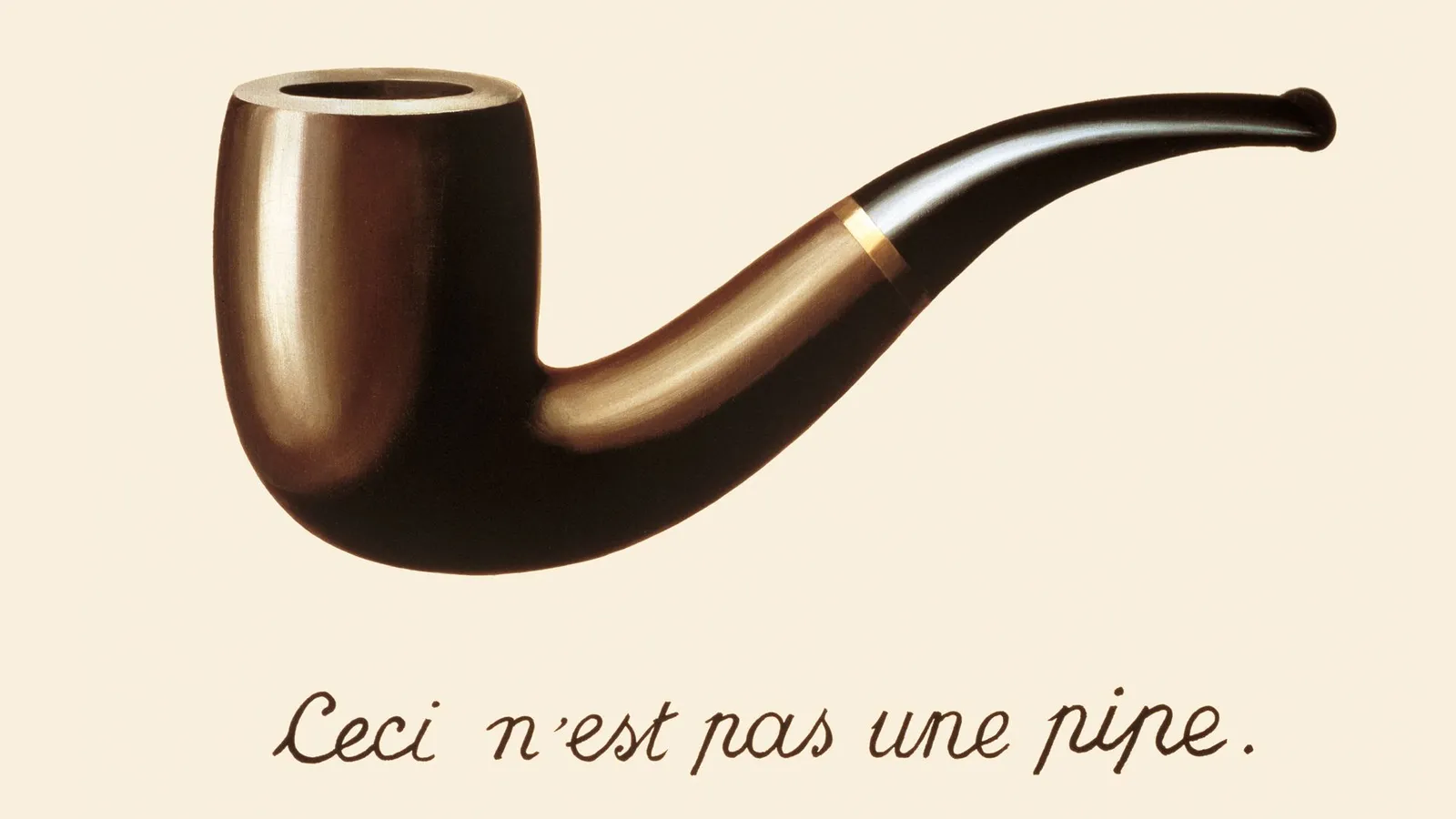
But a tree is not built from parts. It’s just a tree. We can articulate that a tree has a trunk and roots and branches and leaves and seeds and blooms, but it’s just a tree. The rest we impose on it with artificially constructed symbol language. This is what post-modern painter Rene Magritte was communicating with the “Ceci n’est pas une pipe” inscription in his work The Treachery of Images—This is not a pipe. He was not being cute or edgy or trying to be clever. He was making the point that the symbol is not the object.
In the manner that the image is not the pipe, it’s been said that to document a system is to make an inferior copy. The documented system is less optimal. This may feel counterintuitive. In fact, you may even argue that a documented system allows subsequent process participants to plug into the system to allow it to continue to operate into perpetuity. Whilst this is true, it comes at a cost. I’ll leave this here for you to ponder. The right hemisphere understands the difference. The document is not the process.
Getting Down to Business
If you’ve been following along, you may have already noticed that the left hemisphere looks and sounds a lot like the business world. Everything is systematised, structured, and ordered. We have all sorts of symbols and jargon, processes, and procedures. Everything is literal. There is no room for metaphor. There is no room for empathy. HR instructs that there be empathy, but they might as well instruct everyone to speak Basque or Hopi. In fact, it’s worse because at least Basque and Hopi can be learnt.
Sadly, this leftward shift isn’t limited to the world of commerce. It’s affected science, politics, and entire cultures. It’s caused these entities to abandon all that isn’t rational as irrational. But empathy and intuition are irrational. Science says if you can’t measure it and reproduce it, it’s not worth noting, but science is not the arbiter of the non-scientific realm. Business takes a similar position.
Politics of the Left (Hemisphere)
And politics creates categories: left and right, red and blue, black and white, men and women, gay and straight, and this and that. All of this is all left-hemisphere debate.
Categories and names are exclusive provinces of the left hemisphere. If you are hung up on an ideology, whether Democracy, Republicanism, Marxism, or Anarchism, you’re stuck in your left hemisphere. If you defend your positions with logic and words, you’re stuck in your left hemisphere. If you can’t imagine an alternative, you are really stuck in the left. I’ll stop here.
Science and Scientism
How did we get here and come to this? Science was receptive to right hemisphere influence up until about the 1970s. That’s where Scientism began to take hold. Scientism is when faith in science becomes a religion. I feel that many scientists today are less likely to hold a belief in Scientism as a religious belief. Paradoxically, I think this is more apt to be a faith held by non-scientists. Unfortunately, this faith is exploited by politics as exemplified by the recent trust in science campaign perpetrated by politicians, which is to say non-scientists with their own agenda, whether they practised Scientism or not.
The problem is that the left hemisphere has an outsized ego. It thinks it’s always right. In practice, it’s right about half the time. Because of its reliance on stored data and a ‘belief’ that it doesn’t need to fresh its data until it’s effectively overwhelmed and acquiesced. It fails to give enough weight to the experienced world, so that it shifts belief further and further left, which is to say further from reality as it is.
It trusts the symbol of the tree more than the tree itself. We may all be familiar with stories of cars driving down train tracks and off cliffs because the SAT-NAV user put more faith in their device than the world outside. This is the risk companies face as well, choosing to believe that the documented process is superior to the system in and of itself.
Getting on About?
You may be wondering what inspired me to write this and where I get my information. My realisation started in chapter 9 of The Matter with Things and was reinforced by this video interview by its author, Iain McGilchrist.
Actually, it started even before this with The Corporation, a Canadian documentary and companion book released in 2003. One of the points of The Corporation is to articulate the parallels between corporate behaviour relative to the definition of psychopathy as presented in The Diagnostic and Statistical Manual of Mental Disorders, henceforth DSM. Per Wikipedia, the DSM ‘is a publication by the American Psychiatric Association for the classification of mental disorders using a common language and standard criteria and is the main book for the diagnosis and treatment of mental disorders in the United States and is considered one of the “Bibles” of psychiatry’. Essentially, corporations ticked all the boxes.
Methodologically, this assertion is a bit weak, but it is at least sometimes entirely valid despite provoking an emotional trigger reaction. Nonetheless, this established corporations as pathological entities. But that is not my focus here. It simply tilled the soil for me to be more receptive to this topic. This topic is less about the legal fiction that is a corporation and more about the people embodied in it. From the height of the C-suite to the workaday staff, floor workers, warehouse workers, and the mailroom. Do they still have mailrooms? I digress.
I can’t claim to know what it is to be schizophrenic or schizoaffective, but I’ve known enough people who have these diagnoses. My brother was one of those. Although I use these and other labels, I am not a fan of labels, generally, especially psychological labels, specifically this label. Autism is another nonsensical label. Both fall into the realm of medical syndromes, which for the uninitiated is the equivalent of your kitchen junk drawer. It’s equivalent to the other choice when all others fail. I don’t want to go off on a tangent from the start, so I’ll leave it that these categories are overly broad and reflect intellectual laziness. There is no single schizophrenia or autism. There are many, but the distinction is lost in the category. The push to create an autism spectrum for DSM obscures the problem, but it helps for insurance purposes. As the saying goes, follow the money and you can gain clues to the driving force behind why this happened. I suppose you can also label me a conspiracy theorist. If I learned one thing in my undergrad Sociology classes, it’s to eschew labels.
Almost finished
Given the length of this segment, I am not going to summarise it here, save to say that this leftward shift in business and culture doesn’t have a good outlook. We are not only being replaced by machines, but we are also forced into becoming machines, and we aren’t even questioning it. All we need to do is to become more analytic, right?
What I suggest is to watch the six-minute video of Dr Iain McGilchrist discussing this topic, and if you really want a deep dive, read The Matter with Things, an almost three-thousand-page tome, to fill in the details.
Postscript
Here’s a music analogy to help to express why the whole is more important than the sum of the parts. If I want to learn to play a new piece, I will listen to the piece first. Depending on the length and genre, I may have to listen many times. In some cases, once or twice is enough, but let’s say this is at least somewhat complex and not some repetitive three-chord pop song. I’ll probably break the song into pieces or movements—verse, chorus, bridge, and whatever—, and then, I’ll learn each note and each pattern of notes, perhaps as musical phrases. Once I figure out the verse, I might either learn how the next verse differs or move on to the chorus and defer that verse-to-verse step. I’ll rinse and repeat until I’ve got through each of the sections. If I’ve had the luxury of hearing the piece, I’m at an advantage as far as tone, timbre, and dynamics are concerned; otherwise, I’d better hope these are all documented and that I interpret them in the manner they were intended. If the audience is familiar with a tune, they’ll notice the difference.
When I am practising, I need to get the mechanics down pat. All of what I’ve described thus far is left-hemisphere fare. It’s translating the symbolic representation of notes—like letters and words in writing—into an utterance. In this case, it’s a musical utterance. But once I am ready to perform the piece, it needs to be performed through the right hemisphere or it will feel mechanical and stilted.
I used to earn my living as an audio recording engineer and producer. Most of the time I was working with unknown artists recording demo records and trying to get a record deal. For the uninitiated, that usually translated into not having a large recording budget. Occasionally, we want, say string parts—violins, viola, cello, or whatever—but we couldn’t afford union players. We’d hire music students from USC or UCLA. These players would be more than willing to play for cheap in exchange for something to add to their portfolios or experience chops.
Somebody would transcribe the musical notation, and we’d give it to the string player. Of course, it could be a keyboard or wind or reed part, but I’ll stick to strings. Part of music is the vibe. This is something that can’t be captured in symbols. Revisiting Scientism and the left-hemisphere analogy, vibes can’t be real because they can’t be notated.
Almost invariably, if we got someone with Classical training, they could not get the vibe. The music was right in front of them. We’d play it for them on piano, maybe on a synthesiser, but they couldn’t get it—even if they were playing along to a reference track just trying to double the synth part. They would hit every note for the specified duration and dynamic, but it might have as well been the equivalence of a player piano or music box. We could have played it on a synthesiser, but we might be seeking the nuance a real instrument would bring.
We never had the luxury of auditioning players or recording several players and grabbing the best parts. That’s for the bigger-budget artists who go through a half-dozen or more performers to get just the right one. When we got lucky, it was usually because we got someone from the jazz program. These cats seem to have a natural feel for vibe inaccessible to the classical performers.
In business, the classical performer is good enough, but for art, it wasn’t. Business might appreciate the difference if it happens to get it, but it won’t seek it, and it won’t pay for it. A pet peeve of mine is a quip in business I heard often—don’t let perfection be the enemy of the good. This is obviously a left-hemisphere sentiment based on Voltaire’s statement. Besides, even from a left hemisphere perspective, reciting, “Don’t let perfection be the enemy of the good” doesn’t mean you shouldn’t at least strive for good enough because I noticed that mark was missed often enough, too.
Creativity is chapter nine of Iain McGilchrist’s The Matter with Things. It also marks the end of part one of three in this two-volume set.
The main thrust is to provide a lot of cases of schizophrenia to elaborate on how the deficits impact perception—and of course, attention and judgment.
Content
This chapter starts off by noting that mental illnesses are not a matter of the brain being broken like a machine. McGilchrist doesn’t much like the analogies to machines or computers, to begin with. Instead, they affect how their world is experienced. They attend to different things, which creates a different perception because we perceive what we attend to.
It is effectively a left-hemisphere challenge, but he is careful to say that we don’t have enough evidence to call it a right-hemisphere deficit. His rationale is that it could be one of these three leading scenarios:
The right hemisphere has deficits.
The left hemisphere is not performing its function to work with the right hemisphere, which is otherwise intact.
The frontal lobe which is supposed to moderate the hemispheres is not performing its function.
Schizophrenia and autism are distinct conditions, but there are some overlaps. He clarifies that schizophrenia and autism are too broad of categories (a situation made worse in the case of autism by the creation of the autism spectrum). There are types of schizophrenias and autisms that would otherwise be unrelated except for psychology’s kitchen junk drawer approach to categorisation, I suppose, following the lead of syndromes in the medical profession. I digress.
These conditions exemplify what it’s like to experience the world with an overreliance on the left hemisphere. A point he wants to make is that he feels society at large is shifting in this direction to the detriment of all concerned, that the world of business, science, politics, and bureaucracy more generally is migrating to a hyper-rational position at the expense of experiential reality.
He praises Louis Sass’s 1992 book Madness and Modernism as “one of the most fascinating, and compelling, books I have ever read”, primarily because it notes the relationship between schizophrenia and Modernism and a modern world that is experiencing an increase in the phenomena of schizophrenia.
they miss the forest for the woods
McGilchrist goes into detail about how right hemisphere deficits affect perception in schizophrenic patients. I won’t share that level of detail here. Effectively, they miss the forest for the woods and make contextual miscues, lacking in empathy and intuition. Missing this context, they jump to conclusions—invalid conclusions. He goes on to explain this from the perspective of brain construction and physiology whilst extending the conversation to include the autism spectrum, noting a general overlap between these diagnoses.
He invokes the work of Eugène Minkowski—reflecting on the foundational work of Henri Bergson—, which resonated with me, wherein Minkowski tries to simplify and characterise the hemisphere as the left representing intellect and the right being intuition. This feels about right. He shares a list of terms generally representing qualities in schizophrenics that detail what is atrophied in the intuition of the right hemisphere and what is hypertrophied (or exaggerated) in the left hemisphere. I’ll not share this list here, but I like it. He promises to elaborate on this in chapter 22.
Essentially what’s missing is a sense of coherence with experience leading to a detachment from reality as we normally experience it—and a loss of vitality and a sense of self. These people live as outsiders looking in rather than simply feeling a part of the whole. Man becomes a machine built of parts and separate to nature. Everything becomes literal. There is no room for connotation in a denotative world. But this world is disconnected from the presented reality, instead relying on a re-presented version. The world loses depth and becomes a two-dimensional caricature.
Perspective
My summary of this chapter left many details unsaid, probably more so than the preceding chapters, so a lot of context and nuance is missing. My biggest takeaway is really the scary connexion between schizophrenia and Modernity. It is far from comforting. Add to this the positive feedback loop otherwise known as a vicious cycle as societies more and more adopt a left hemisphere perspective, that of a schizophrenic, and it becomes scarier still. To make matters worse, this is not metaphorical. It’s analogical. I’m not sure how to reverse this tide.
connexion between schizophrenia and Modernity
This wraps up the chapter on schizophrenia, autism and the rest. As I mentioned at the start, this also marks the end of part one of the book. The next chapter is “What is Truth?” This will allow the reader to delve more deeply into various aspects of truth, from science to reason to intuition and imagination. This second part of the books takes us to the end of the first volume, traversing us through chapters ten to nineteen.
What are your thoughts on mental illnesses like schizophrenia and autism, especially around how they may shed light on neurotypical persons and the relationship between these and modern society?
Not really, but I’ve had visitors from these countries visit here in the past 7 days. Whilst I either try to be culturally inclusive or admit where I am obviously off, I live in the United States at the time and it just colours my perspective in the same manner it would be coloured if I was spending a lot of time steeped in some other cultural setting.
I am aware that people visit blogs for different reasons. Some are searching for confirming views or to broaden a perspective; others are scratching their heads and asking if people actually think like this or that. In all cases, you are welcome. You are also welcome to share your agreements or disagreements.
What I find most interesting are my subscribers (or whatever WordPress names them). from what I can tell, at least three-quarters of subscribers to Philosophics would appear to have views counter to my own. Of course, they are welcome, but it seems that a have a lot of, let’s say, ‘spiritual’ subscribers, where I hold antithetical if not diametrically opposed views. I’ll presume this is to keep a pulse on a different perspective, which I admire.
Nothing more to say at the moment. Just taking a quick break to give a special shoutout to anyone who has visited from one of these countries. If ‘Unknown Region‘ is some interdimensional visitor, you are still welcome. Thanks for stopping by.
I’ve never really liked the concept of normal being applied to behaviour, whether individually or societally. At a micro level, it might be fine, and one can assess a deviation from a norm, but at a macro level, we have averages of averages, so how many dimensions need to be out of calibration and for how long to be considered abnormal.
Moreover, statistically speaking, where we have a normal (Gaussian) distribution, we might consider a mean and a certain variance or standard deviation from that mean to be normal, but the reaction to deviance is asymmetrical.
An example that comes to mind is that of cheating. It is well documented that humans are predictably cheaters (and liars). Nonetheless, there are two measures of normalcy. There is a fundamental attribution bias in play.
We view ourselves as basically honest and justify occasions when we act the same way. Regarding the chart below, we like to believe that cheating is uncommon. In fact, we chastise or otherwise punish cheaters.
Descriptive versus Prescriptive Normalcy
Full disclosure this is not to scale nor representative of actual data. It’s merely an illustrative tool for conversation.
Prescriptive Normalcy
The bottom range in green represents the accepted and prescribed normal range of cheating. In this example, it might be anticipated that an average person might cheat on things like their taxes, their diets, not returning extra change at a vendor, and so on, about a third of the time, give or take. Anything more would be considered abnormal and unacceptable. Anything less and the person might be considered to be uptight or a goody-two-shoes, perhaps like Ned Flanders of the Simpsons franchise.
Ned Flanders – Hokily Dokily
Descriptive Normalcy
In practice, people operate well outside of this range. As illustrated by the top red range, people tend to cheat closer to two-thirds of the time. If a person is caught cheating, they are treated as being well outside of the prescribed range, society will look upon them harshly despite this actually being normal behaviour for those judging, those who know that they are guilty of the same activity.
One reason for the overreaction may be to signal that they are among the righteous. Here, it’s good to remember Jung’s quip: The brighter the light, the darker the shadow.
The brighter the light, the darker the shadow
Carl Jung
Intelligence Quotient
If I use IQ* for a reference, normal is the mean plus or minus a standard deviation (or sigma [σ]) of 16 points, so between 84 and 116. In the early to mid-20th century, clinical psychology nomenclature grouped IQs by bands:
Later moron was replaced by moderate mental retardation or moderate mental subnormality with an IQ of between 35 and 49. As with many things, and in the case of IQ, an observation above the norm is associated as better with an observation below the norm being considered as worse.
* IQ has many problems. At first, an IQ of 100 is supposed to represent the average (mean) of a population, yet the average IQ of the world population is just over 82, a number outside and below the 1σ threshold. In the United States, the average IQ is an unremarkable 97% (ranking 26 among 199 countries). Japan and Taiwan top the list at over 106. In fact, Asian countries comprise the top 6 slots. Canada, Australia, and the United Kingdom are almost an even 100, falling ever so short. at 99 and change. Guatemala, Liberia, Sierra Leone, and Nepal fall at the bottom of the ranking, each with average IQs under 50.
That culture is a social construct is by now a meme. Those who disagree with the notion believe there is some objective measure—who disagree with the notion of cultural relativism—, almost invariable to their own belief systems. My goal is not to convince them otherwise. I’m sure their teacups are full. However, I’ve recently become aware of some data I find interesting. These data consider dimensional pairs of data. For example, do parents of certain cultures foster the message of imagination or hard work.
The caveat here is that no culture is monolithic. In practice, no two people are precisely redundant. People are effectively snowflakes—not the pejorative sort. Just insomuch that even identical twins are not, in fact, identical. What we are examining are generalised stereotypes. For example, the United States finds hard work over-indexing imagination. This comes as no surprise to anyone who takes even a cursory view will note that both political persuasions buy into and propagate this mythos. On the Right, imagination is something that can be explored. In fact, it needs to be propagated if only to buy into supported narratives. Imagination is over-indexed in Left-leaning countries. On the Left, a little more latitude is afforded, but in the end, someone needs to pay for the Volvos and Teslas. Given that the Left basically doesn’t exist in the professional politics of the US, imagination is more lip service than manifest.
Imagination need not apply. Britain, Australia, and Canada are more balanced, but they still favour hard work over imagination. Interesting to me is that the Nordic / Scandanavian countries push imagination more than their peers. I’ve never ‘imagined’ them to be imaginative. Perhaps it’s more an absence of Calvinism. Perhaps I’m judging. The piece suggests that Anime is evidence of Japan’s imagination. Firstly, this feels like a stretch. Secondly, this doesn’t resonate with my experience living in Japan. Perhaps I’m just conflating cultural obsequiousness.
Independence vs Obedience
Another pairing is independence versus obedience. Whilst I focus on the UK, US, and Canada, you may find represented your own country or culture of interest. Across these dimensions, the US, Great Britain, Australia and New Zealand all favour independence over obedience, though I find this a strange dichotomy. Fundamental attribution bias is evident in full force and effect.
I just came across a meme that lauded the Japanese for fostering independence, but cultural obedience is a given. Honour, shame, and shunning are ubiquitous in Japanese, so I’m not sure how this manifests. Cognitive dissonance is strong here. I’m having a difficult time reconciling. Perhaps I need to evaluate the semantics.
Independence versus Obedience
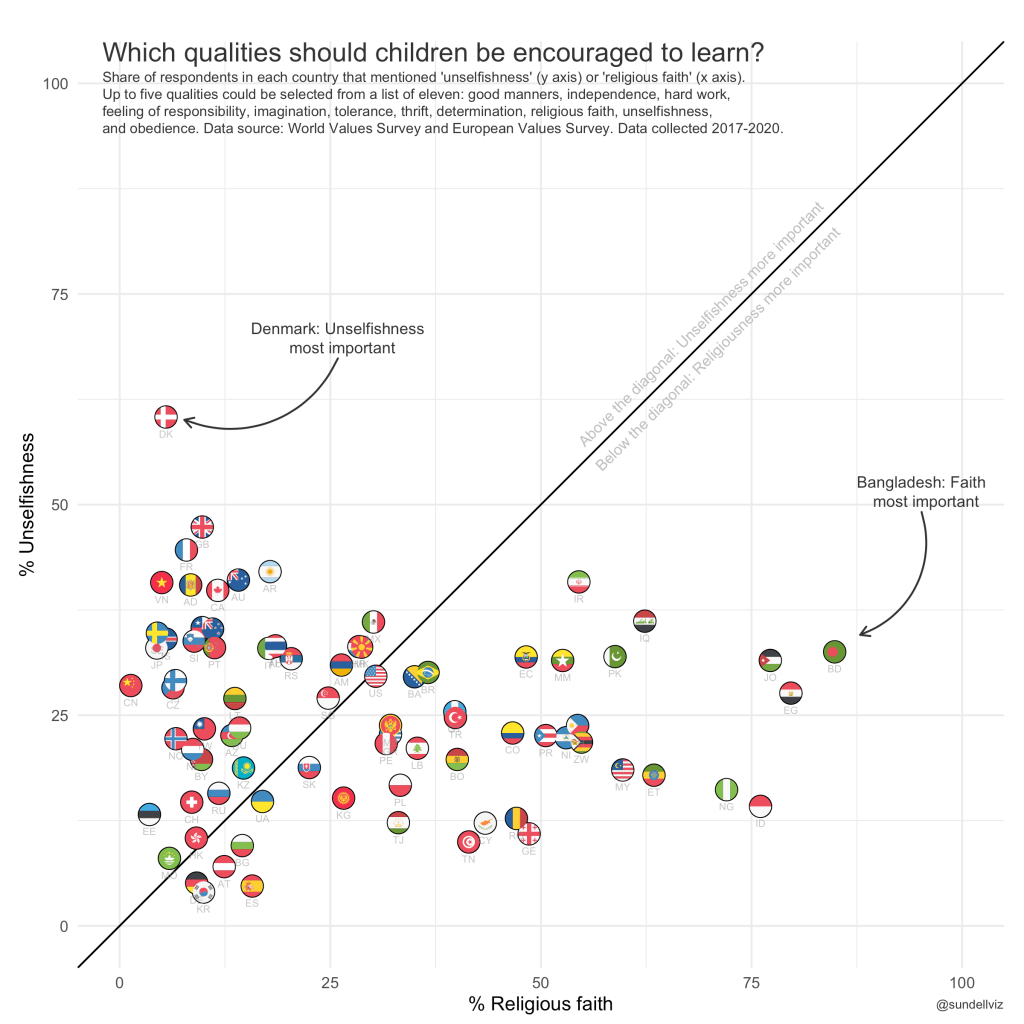
Unselfishness vs Religious Faith
I debated including this dimensional paring. First, it’s an odd dichotomy. Are we trying to claim that the religious are selfish or that unselfish people are areligious? No matter. Let’s keep going.
Unselfishness versus Religious Faith
I suppose this just shows that one can compare anything on a graph and someone can read something into it—like a Rorschach test or tea leaves. Here the US rides the fence. Great Britain and France self-assess as promoting selflessness, and Bangladesh is off the charts with its need for faith. Well, clearly not off the charts because it’s literally on the chart, but it’s trying.
Anyhoo, I feel I need to investigate the raw data and evaluate more parings. For now, I think it’s safe to say that cultural preferences are all over the map. And, even though these preferences have no objective centre, I can admit to having preferences of my own. On these dimensions, I favour imaginative, selfless independence, but that’s just me. Where do you stand?
Foucault should be a reminder that the culture wars are not new and post-truth can’t exist because there was never a truth at the start. This is similar to Latour’s question asking if we’ve ever been modern. And the answer remains ‘no’. There is no post-truth as there is no post-modern as each of these is predicated on a fantastical claim. Many humans defend the notion of truth, but they are fighting windmills.
“We are therefore at war with one another; a battlefront runs through the whole of society, continuously and permanently, and it is this battlefront that puts us all on one side or the other. There is no such thing as a neutral subject. We are all inevitably someone’s adversary.”
In these culture wars, each side is fighting for its version of the truth. The truth of rights and freedoms and the correct construct of societies. But there is not one culture war. There are myriad culture wars, and there are few opportunities to be allied across all of these dimensions with another person. For the congruent dimensions, one needs to operate in the mode of the enemy of my enemy is my friend whilst deciding how to ally on other disagreed dimensions later.
But never forget that the wars are intentional. They are a feature of the system of normalisation, not a bug. More importantly, don’t think for a moment that your truth is the truth. The same goes for your adversary.
There was a recent insurrection at the United States Capitol building in Washington, DC. I won’t take any more time discussing whether this is hyperbole or real. In the end, it doesn’t matter. It’s not relevant to the solution.
From the perspective of propaganda, it’s been an effective message. It’s gotten Trump haters and supporters to view Trump as a common enemy—some of them anyway. Some people and entities can’t performatively distance themselves fast enough or scapegoat him loudly enough.
Whilst I do feel that much of the hullabaloo is performative, I’m not going to focus on the performative aspect. This serves to amplify, but it’s not the central message. Instead, I’d like to frame this through the lens of René Girard’s mimetic theory of conflict and resolution.
Adopting Girard’s vantage, we can see each of mimetic desire, scapegoating, mimetic crisis, ritual, sacrifice, and culture.
Mimetic Desire
In a social context, mimetic theory is about creating in-groups and out-groups—and intentionally so. Groups have rules, by which membership is governed. Symbols are employed to amplify belonging and compliance. At it’s core, mimetic desire employs mimesis—imitation. Monkey see, monkey do.
Here, society is the prevalent in-group. From their perspective, this is the us of the in-group versus the them of the out-group. Girard noted that us versus them is evident in many contexts—whether in the wild or otherwise—, and it can be exploited. It’s about creating a flag to rally around—in this case literally, figuratively speaking.
The mechanism of mimetic desire is to coalesce the focus on some object. From the positive dimension, the desire is to belong, but mimetic desire doesn’t have to be positive. As in this case, it can be negative. The masses have assembled for a common cause of vilifying one Donald J Trump.
Mimetic Crisis
The insurrection is the mimetic crisis. It broke the rules. It’s unclear how all of the many rules that were broken in the four preceding years were able to fly under the radar. To some extent, the US government is constructed of two nearly equal in-groups. They each belong to the institution of institutionalised government and so-called Republican ideal as an expression of modern Democracy. They share some common beliefs, but this sharing diverges dimensionally and methodologically. The telos are multi faceted, and each group prefers different facets—and the facets desired by the public are different still.
At first—to borrow from Kübler-Ross—, there was denial by the Trump-aligned party of sycophants. These Trump-aligned Republicans (read: Neoconservatives; UK: Tories) were also aligned with the outgroup, leaving them vulnerable to ostracism. Meanwhile, the Democrats (read: Liberal/Neoliberal; UK: Labour) secured the moral high-ground and control of the larger in-group. They painted themselves as the adults wearing big boy trousers (over their Pull-Ups).
Scapegoating
Scapegoating is instrumental in mimetic theory. It’s a mechanism to build solidarity and cohesion through exclusion. Narratively, it operates to distinguish acceptable behaviour versus unacceptable. In almost all instances, scapegoating is an object to project blame.1 The remaining members have received the signal.
Here, we have two entities to scapegoat2: the insurrectionists and the Instigator in Chief, soon to be ex-president, Donald Trump.
Ritual
Ritualistically, scapegoats need to be bear the brunt of the anger of the in-group and associated friends and family. There are procedures to follow. These rituals play out in the House in the form of impeachment, and in the Senate in the form of conviction. For the uninvited guests, the traditional court system ritual
Part of the outrage is performative ritual. Certain entities are checking the boxes suggested by their PR teams. These same entities had nothing to say for the past four years as they’ve enriched themselves at the expense of the American public and world, but this was the last straw. They vowed to cut off support and funding —until they don’t, but by then no one will be any the wiser. People have both short attentions spans and memories.
There is no requirement whatsoever that rituals produce anything. As hard work is its own reward, ritual for the sake of ritual is all that’s necessary. Rituals needn’t be authentic or heartfelt. Simply mime the parts, and you’re all set. Plus, you get full credit—participation points just for playing.
Sacrifice
One ritual is to sacrifice the goats, but we need only exile the offending members. In Christian lore 3, there are actually two goats—a sacrificial goat and an emissary goat—the scapegoat. The sacrificial goat is, obviously, sacrificed—burnt offerings—, but the emissary goat was released into the wilderness, taking with it all sins and impurities. This is the excommunicated, the shunned.
Culture
Where performatism really comes in, is cultural signalling. People and other entities work overtime to signal they are on the winning side. This includes everything from Oscar-winning performances to cringeworthy Razzie-candidates. Those in the public eye tend to go overboard. It’s good to remember that an empty vessel makes the most noise.
The notable exception to this scapegoat-blame relationship is the Christian Christ myth, where Jesus acted as a scapegoat but was without blame.
Trump and the Scapegoat Effect, The American Conservative, David Gornoski, September 1, 2016. An interesting article discusses the Trump-scapegoating phenomenon that also mentions René Girard’s work.
Humans seem to be hard-wired to prefer in-groups over out-groups, family and tribe over outsiders. In the business world, we hear about corporate culture. But these days, diversity is all the rage. Companies strive to convince the world that that have diverse and inclusive cultures, but what does this mean? Is there such an animal as a diverse culture? And how does one balance the familiarity of in-group homogeneity versus out-group heteronormativity?
you can’t spell culture without ‘cult’
In corporate-speak, there is the concept of cultural fitness. Afterall, we want efficient and productive humans and processes? People who don’t fit this mould are disruptive, right? So, we are justified in excluding people from the group, right? Remember, you can’t spell culture without ‘cult’.
Although the United States brand themselves as a cultural melting pot, this is only partially correct, and mostly in more populous areas, and even this occurs in pockets.
Diversity—in hiring and otherwise—is only accepted if it is along approved superficial dimensions—skin colour, national origin, sex, religious orientation, maybe gender, perhaps some latitude around lifestyle choices. But more substantial diversity need not apply. They are interested in hiring conforming normies. The gay guy is OK, so long as he toes the rest of the line. That woman: ditto. That Muslim: same. That black person: so long as s/he acts white in public.
everything needs to distil down to the white male ethic
Performatively, they’ll accept the diversity proponent as a PR prop. This person is proof that they hire [target group]. This person broadcasts how s/he can wear their cultural garb, bring cultural dishes to potlucks, put up posters and advertise about support groups outside of work. But in the end, everything needs to distil down to the white male ethic.
Talk about work-life balance is fine, so long as work gets the upper hand. You need to be able to talk about charity, but you need to be motivated by money and status. There are exceptions to this motivation, say, public health and healthcare, education, and so on, but the boundaries in these professions are narrow, too. Not acting ‘professional’ is a key criticism. So, if your diversity counters some perceived professionalism, your diversity is not welcome.
not acting ‘professional’ is a key criticism
If the company hires people who routinely put in 60 hours for 40 hours of salary, they are not interested in the person with boundaries, insisting on 40 hours of work for 40 hours of salary. They aren’t interested in people who might question the ethics of the company’s business practices. Companies aren’t generally interested in rebels.
You need to be Sartre’s waiter. You’ve got a role to perform. In fact, you are evaluated specifically how well you perform that role. So, whilst you may be a singing waiter or a dancing waitress, your boundaries aren’t much broader than this. It’s easy for an observer to dismiss the call for diversity. S/he’s a waiter, right? Why should I expect anything different to that? And this is what locks in a lack of diversity.
DISCLAIMER: This ended up more of a meandering rant, but I’m distracted and out of time. And so it goes…
Fiction in the form of film, television, and books has an insidious propaganda effect. This effect is not necessarily conscious or intentional. In practice, it may simply be a meme as a result of prior programming.
I don’t tend to engage with much fiction, though I have in the past. I hadn’t really considered the indoctrination effects at the time. Lately, on account of my significant other, I’ve been consuming fiction via Netflix, Amazon Prime, HBO, Starz, and the like. It’s mostly drivel, in my opinion, but I like to spend time with her, and we can connect discussing plot lines and such over a shared experience.
I find the repetition of facile but culturally prevailing themes such as right and wrong, good and evil, heroes and villains, the power of community and the detriment of the individual, except for the rugged individual, who prevails against all odd.
These shows propagate pop-psychology beliefs and over-simplify complexity to create a digestible narrative, but which is the equivalent of eating refined white bread instead of whole grains.
My point is not that the writers are seeking to influence the masses, it’s just to point out that this is the case. People view this, and use it to calibrate their own believe systems, but it’s a recursive, self-referential model—an echo chamber. I haven’t done any investigation or research into whether people have already made this connection. I will if I get the time.
One might argue that a counter model would not be well-received, and a goal of most fiction is to gain an audience and earn some money, so give the people what they are asking for and don’t make them think about their worldview. Besides, a single film or series is likely to challenge ones prevailing filters anyway. Even if someone were to create an anti-theme, cognitive dissonance may just rationalise it as a statement, so satire rather than objective criticism.
We do have Absurdist authors, like Franz Kafka, Donald Barthelme, or even Kurt Vonnegut, who rather point out absurd situations in life and some possible speculative fictions, but these Post-Modern writers are accepted, though arguably not widely consumed, save for intellectuals and their quasi-counterparts.
If I had more time, I’d document a few examples, but these shows are typically difficult to sit through once casually let alone carefully dissect. Perhaps, I’ll do this for the sake of science.















 Philosophics