Perceptual Realism in Film

3–4 minutes

I watched this video so you don’t have to.

Video: Why Movies Just Don’t Feel “Real” Anymore

Only teasing. It reads as pejorative unless you catch the self-inflicted mockery baked in. This chap Tom has for film what I seem to have for language: an alarming degree of enthusiasm paired with the creeping suspicion that most of civilisation is determined to ruin the very medium we love.

I don’t actually share his fondness for film, mind you. I merely recognise the feral passion. What pulled me into this clip wasn’t cinema but dissection. The language of his breakdown dropped me neatly into my natural habitat.

I seldom watch films, television, or whatever corporate imagination-by-committee is calling itself these days. Besides being an outrageous time-sink, Sturgeon’s Law doesn’t just hold; it’s juiced up as if someone ran it through a cheap VFX plug-in. The decline in visual quality Tom describes feels depressingly familiar.

A similar aesthetic rot crept in during the digital audio shift of the ’80s. Vast new possibilities, yes, but a certain grain, a certain breath, went missing. I remember an engineering mate in ’84 being asked to record a well-known jazz artist using Sony’s shiny new digital system. He refused on technical principle, writing a blistering hand-delivered letter explaining why the end result would sound worse. He was right, of course. The label didn’t care, of course. And he walked.

The problem then resembles the problem now. Most people aren’t experiencing media in the environment it was built for. We consume films on phones, tablets, monstrous living-room billboards, or, in my case, a knackered 32-inch monitor. Half the audience barely looks at the screen anyway. They want distraction, not discernment. Some, like Tom – and to a lesser degree, me – actually notice that something in the visual vocabulary has been quietly amputated.

Perhaps that’s why I avoid the form: the predictability, the shallow craft, the sense that the whole affair is engineered for attention-drifting multitudes rather than people who actually, well, look.

Anyway, the whole point was to share the video. Naturally, I ended up editorialising. I learnt something from it. You might too.


I promise I won’t continue injecting Claude into the conversation, but this is where my brain went as I watched the linked video:

Thought Process

This is an interesting philosophical question that connects two different thinkers and concepts. Let me think through this carefully.

Charles Peirce’s indexicality refers to his theory of indexical signs – signs that point to or indicate their objects through a direct, existential connection (like “this,” “here,” “now,” “I”). These are part of his broader semiotics, where he distinguished between icons, indexes, and symbols.

Galen Strawson’s notion of episodic self-identity relates to his work on the phenomenology of the self. Strawson distinguishes between “Diachronic” and “Episodic” self-experience. Diachronic individuals experience themselves as continuous over time, with a narrative extending into past and future. Episodic individuals (like Strawson claims to be) experience themselves more in terms of discrete, present-centered episodes, without a strong sense of narrative continuity.

How might these relate?

  1. The indexical “I”: Peirce’s indexicality is crucial for how the “I” functions. The first-person pronoun is paradigmatically indexical – it picks out the speaker/thinker in the moment of utterance. For Strawson’s episodic self, each moment’s “I” might be more purely indexical, pointing to the present subject without necessarily carrying thick narrative continuity.
  2. Temporal indexicals: “Now” is also indexical. Episodic self-experience emphasizes the “now” of experience over temporal extension. The indexical nature of present-tense self-reference might support episodic rather than diachronic self-conception.
  3. Existential connection vs narrative construction: Indexical signs work through direct, causal-existential connection, not through resemblance or convention. Similarly, episodic self-experience might be more immediately indexical (this experience, now) rather than mediated through narrative construction.

This is a sophisticated question that deserves a nuanced response.

Autocorrect vs Philosophy: The Battle of Wrong and Bad

Go Home, Autocorrect, You’re Drunk

I recently wrote an article on my disdain for Jordan Peterson. (A cathartic exercise, I assure you.) But as I was busy sharpening my polemic, my so-called writing assistant – autocorrect – decided it fancied itself a philosopher, chipping in with some of the most spectacularly unhelpful suggestions I’ve encountered this side of a Facebook comment thread.

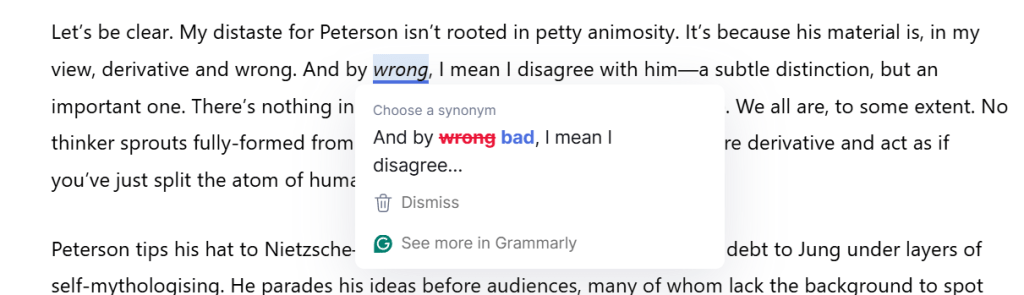
Is wrong bad?

In the first instance, autocorrect took issue with my phrasing:

This, apparently, was too much for it. The poor dear couldn’t recognise the parallel sentence structure, or the rhetorical flourish at work. No, it suggested replacing wrong with bad. Because why not destroy the symmetry and nuance in one fell swoop?

Image: Is wrong bad?

Obviously, the second wrong is a riff on the first. To replace wrong with bad would be incorrect—wrong, if you will. Some might say bad. But I digress. The point is: the logic holds, and autocorrect’s intervention doesn’t.

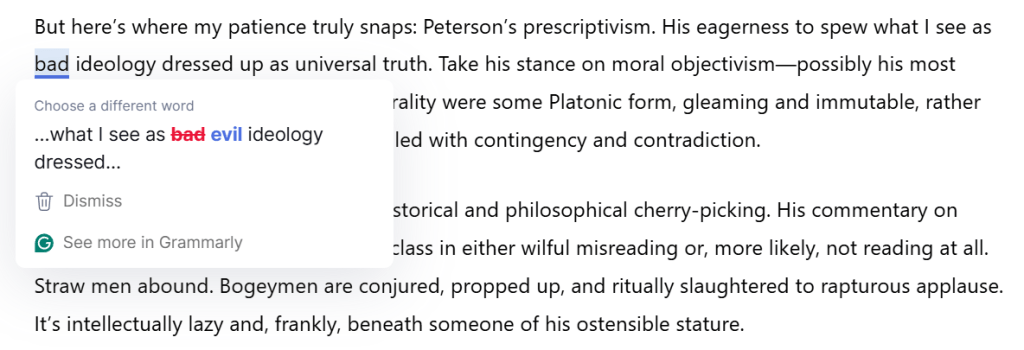
Is bad evil?

As if that weren’t enough, round two delivered an even greater affront:

Autocorrect, in its infinite wisdom, suggested I swap bad for evil. Ah yes, because evil is precisely what I want—a term dripped in moral absolutism and ideological baggage.

Image: Is bad evil?

First, autocorrect, might I suggest you check out Nietzsche’s Genealogy of Good and Evil before piping up? Perhaps then you’d grasp the not-so-subtle difference between bad and evil—a distinction that, in moral philosophy, rather matters.

And now my book titles aren’t safe either…

Even as I write this post, the machine assaults me with a suggestion to rename the title of my book recommendation. O! the humanity. Is nothing sacred?

Image: Autocorrect strikes again

Final thoughts

Autocorrect may be marvellous for spotting typos and the occasional rogue comma, but when it tries its hand at philosophy, the result is about as elegant as a rhinoceros in a tutu. Dear autocorrect: stick to spelling. Leave the nuance to the humans.

Questioning Traditional Families

I neither champion nor condemn tradition—whether it’s marriage, family, or whatever dusty relic society is currently parading around like a prize marrow at a village fête.

Audio: NotebookLM podcast on traditional families.

In a candid group conversation recently, I met “Jenny”, who declared she would have enjoyed her childhood much more had her father not “ruined everything” simply by existing. “Marie” countered that it was her mother who had been the wrecker-in-chief. Then “Lulu” breezed in, claiming, “We had a perfect family — we practically raised ourselves.”

Now, here’s where it gets delicious:

Each of these women, bright-eyed defenders of “traditional marriage” and “traditional family” (cue the brass band), had themselves ticked every box on the Modern Chaos Bingo Card: children out of wedlock? Check. Divorces? Check. Performative, cold-marriage pantomimes? Absolutely—and scene.
Their definition of “traditional marriage” is the vintage model: one cis-male, one cis-female, Dad brings home the bacon, Mum weeps quietly into the washing-up. Standard.

Let’s meet the players properly:

Jenny sprang from a union of two serial divorcées, each dragging along the tattered remnants of previous families. She was herself a “love child,” born out of wedlock and “forcing” another reluctant stroll down the aisle. Her father? A man of singular achievements: he paid the bills and terrorised the household. Jenny now pays a therapist to untangle the psychological wreckage.

Marie, the second of two daughters, was the product of a more textbook “traditional family”—if by textbook you mean a Victorian novel where everyone is miserable but keeps a stiff upper lip about it. Her mother didn’t want children but acquiesced to her husband’s demands (standard operating procedure at the time). Marie’s childhood was a kingdom where Daddy was a demigod and Mummy was the green-eyed witch guarding the gates of hell.

Lulu grew up in a household so “traditional” that it might have been painted by Hogarth: an underemployed, mostly useless father and a mother stretched thinner than the patience of a British Rail commuter. Despite—or because of—the chaos, Lulu claims it was “perfect,” presumably redefining the word in a way the Oxford English Dictionary would find hysterical. She, too, had a child out of wedlock, with the explicit goal of keeping feckless men at bay.

And yet—and yet—all three women cling, white-knuckled, to the fantasy of the “traditional family.” They did not achieve stability. Their families of origin were temples of dysfunction. But somehow, the “traditional family” remains the sacred cow, lovingly polished and paraded on Sundays.

Why?

Because what they’re chasing isn’t “tradition” at all — it’s stability, that glittering chimera. It’s nostalgia for a stability they never actually experienced. A mirage constructed from second-hand dreams, glossy 1950s propaganda, and whatever leftover fairy tales their therapists hadn’t yet charged them £150 an hour to dismantle.

Interestingly, none of them cared two figs about gay marriage, though opinions about gay parenting varied wildly—a kettle of fish I’ll leave splashing outside this piece.

Which brings us back to the central conundrum:

If lived experience tells you that “traditional family” equals trauma, neglect, and thinly-veiled loathing, why in the name of all that’s rational would you still yearn for it?

Societal pressure, perhaps. Local customs. Generational rot. The relentless cultural drumbeat that insists that marriage (preferably heterosexual and miserable) is the cornerstone of civilisation.

Still, it’s telling that Jenny and Marie were both advised by therapists to cut ties with their toxic families—yet in the same breath urged to create sturdy nuclear families for their own children. It was as if summoning a functional household from the smoking ruins of dysfunction were a simple matter of willpower and a properly ironed apron.

Meanwhile, Lulu—therapy-free and stubbornly independent—declares that raising oneself in a dysfunctional mess is not only survivable but positively idyllic. One can only assume her standards of “perfect” are charmingly flexible.

As the title suggests, this piece questions traditional families. I offer no solutions—only a raised eyebrow and a sharper question:

What is the appeal of clinging to a fantasy so thoroughly at odds with reality?
Your thoughts, dear reader? I’d love to hear your defences, your protests, or your own tales from the trenches.