Descriptive Postmodernism

I can’t count the number of times I’ve defended Postmodernism (PoMo) from attack, so I am publishing this, so I can link to it. Perhaps I am not defending PoMo, but my flavour of it, but I’ve read a lot of work published by the usual suspects—some who eschew being lumped into a poorly defined category—or at least a nebulous category.

Before I get too far, I also want to remind the reader to take care to separate the philosophy from the person. One popular attack is the conflating of identity politics and social justice advocacy as PoMo phenomena. In fact, I consider myself to be PoMO—to be defined here in a moment—and a social justice warrior (SJW), this despite contesting the very notion of identity to begin with.

By definition, a summary is a reduction of some thing, but one needs to be careful not not arrive at reductio ad absurdum. Where appropriate, one may also wish to differentiate postmodernism with postructuralism. So as not to create a definition partir de rien, I’ll reference other accessible versions. A critic may disagree with these definitions, but they will serve as the foundation of my position and vantage.

Wikipedia gives us this definition (their reference links retained):

Postmodernism is generally defined by an attitude of scepticismirony, or rejection toward what it describes as the grand narratives and ideologies associated with modernism, often criticizing Enlightenment rationality and focusing on the role of ideology in maintaining political or economic power. 

https://en.wikipedia.org/wiki/Postmodernism

The Stanford Encyclopedia of Philosophy gives us this

That postmodernism is indefinable is a truism. However, it can be described as a set of critical, strategic and rhetorical practices employing concepts such as difference, repetition, the trace, the simulacrum, and hyperreality to destabilize other concepts such as presence, identity, historical progress, epistemic certainty, and the univocity of meaning.

https://plato.stanford.edu/entries/postmodernism/

Notice the commonalities. PoMo is a descriptive, critical activity. It’s descriptive. As language and grammar can be approached descriptively of prescriptively, so can philosophy. Some ‘schools’ do both. PoMo is exclusively descriptive. PoMo was born as a reaction to Modernism, especially the unstated foundations labelled by Lyotard as metanarratives—the grand narratives and underlying ideologies of prevailing beliefs that were uncritically taken for granted, many of which that were formed or catalysed in the Age of Enlightenment.

Jean-François Lyotard defined philosophical postmodernism in The Postmodern Condition, writing “Simplifying to the extreme, I define postmodern as incredulity towards meta narratives….”[4] where what he means by metanarrative is something like a unified, complete, universal, and epistemically certain story about everything that is. Postmodernists reject metanarratives because they reject the concept of truth that metanarratives presuppose. Postmodernist philosophers in general argue that truth is always contingent on historical and social context rather than being absolute and universal and that truth is always partial and “at issue” rather than being complete and certain.[3]

https://en.wikipedia.org/wiki/Postmodern_philosophy

My defence is that PoMo cannot be for social justice or engage in identity, as it has no positive position on these. It functions to critically deconstruct. People unfamiliar with PoMo concepts often misunderstand this notion of deconstruction. All to often, I see people criticise Derrida for his brand of Deconstruction, but that only illustrates the fact that they never read or simply misunderstand what Derrida means by Deconstruction. Perhaps, I’ll elaborate on that in future.

My point is that PoMo is corrosive—like lye. It eats away at ideologies, dissolves them. It is not meant to construct anything. So where does this constructive expectation come from? It derives primarily from two places.

Modernism

Most people casting dispersion are modernists. They need to construct things. To be fair, this perspective has been an evolutionary advantage, but some people can’t allow a bunch of Lego pieces to remain unconstructed. This is fine, but you need another tool to perform this task. It’s not PoMo.

Ad Hominem

The other challenge is the inability to distinguish between the person and the idea. Michel Foucault was very vocal in the political realm and actively promoted Marxism, but, firstly, Foucault was not a self-professed PoMo—and for several reasons, one could come to accord with his assessment; secondly, in his deconstruction of history, he discovered a foundational component—this activity being squarely PoMo—, but he reconstructed historical narratives employing the lens of power. This rebuilding is not PoMo activity.

Parting Shot

Besides—or in addition to—ignorance, some people have an agenda, and they play ad hominem games, so if they can vilify a person and associate that person to an ideology, it can have the tendency of poisoning the well. Uncritical people won’t even notice the sleight of hand and redirect.

never attribute to malice that which is adequately explained by ignorance*

Hanlon’s Razor

A textbook example is Stephen Hick’s attempt in Explaining Postmodernism: Skepticism and Socialism from Rousseau to Foucault to conflate feminism (a positive mechanism) with postmodernism (to reiterate, a negative mechanism). In it he claims that feminists Andrea Dworkin and Catherine Mckinnon are proponents of PoMo thought, but he is apparently unaware that McKinnon has explicitly attacked PoMo as destructive to feminism. A fuller critique of Hicks‘ work can be heard on YouTube. I recommend it highly if you have the better part of an hour to spare. Jordan B Peterson is a celebrity personality whose primary exposure to PoMo is Hicks, so when you understand how off-base Hicks is, you’ll realise why Peterson is so off-base, too.


* Hanlon’s razor is originally cast as “never attribute to malice that which is adequately explained by stupidity“, but I prefer the term ignorance, as it it less value-laden and more broadly applicable. Besides, to be ignorant does not mean to be stupid. Many ignorant people are not stupid. I am ignorant of the Russian language, but I am not stupid.

Can Metamodernism Sublate Modernism and Postmodernism?

I’ve been hearing that metamodernism is the next stage in the march of history toward progress. Metamodernism will synthesise modernism and postmodernism into something better that before. It’s what’s for breakfast.

Audio: Podcast conversation around this topic.

I’ve heard about metamodernism in the past, and every time I review some material, I discount it and move on. This time, I’ll react to it. My colleagues in some other online fora have suggested metamodernism (Freinacht) or post-liberalism (Pabst), who see their solution located in the middle between conventional polarities. The attempt here is to adopt Hegel’s dialectic approach, so we’ve got a starting point, an objective, a lens, and a framework. Sounds good. Let’s go. But what are we trying to reconcile?

Ideas attributed to Modernism are

  1. Faith in science
  2. Development and progress
  3. Democracy
  4. The individual
  5. A meritocratic social order
  6. Humanity can recreate nature by virtue of its reason

Ideas attributed to Postmodernism are

  1. Critical questioning of all knowledge and science
  2. Suspicion towards all grand narratives about “progress”
  3. Emphasis on symbols and contexts
  4. Ironic distance
  5. Cultures have been oppressed and ruined by modern society
  6. Reveals injustice in “democratic” societies
  7. Relations create the individual
  8. A multicultural order where the weak are included
  9. Humanity has destroyed the biosphere

Metamodern Ideas

  1. How can we reap the best parts of the other two?
  2. Can we create better processes for personal development?
  3. Can we recreate the processes by which society is governed, locally and globally?
  4. Can the inner dimensions of life gain a more central role in society?
  5. How can modern, postmodern and premodern people live together productively?
  6. How can politics be adjusted to an increasingly complex world?
  7. What is the unique role of humanity in the ecosystems of nature?

Reviewing the Modern List

I want to be careful not to construct a strawman or create a false dichotomy, so perhaps I do have to backtrack to touch on the Modern list.

Faith in science is exactly that—faith—and is not warranted without recognised and articulated assumptions.

The notions of development and progress rely on underlying teleological goals and values that are not universally agreed upon and don’t benefit participants in the same manner and to the same degrees. There are winners and losers.

Democracy is a specious notion that I’ve railed against time and again. This is simply one form of political organisation among many. There is no reason to elevate this form over many others.

Moderns do have an rather fixed notion of what defines the individual. A Postmodern is not very likely to accept this notion except as a snapshot that can only be interpreted within a narrowly defined context.

A meritocratic social order is a Modern concept ripe with metanarrative support.

That humanity can recreate nature by virtue of her reason—notwithstanding the odd use of ‘her, evidently a nod to Mother Nature—, there is a elevated notion that reason is a superior mechanism. I’d extend this to include the notion that many people—not just the elite—are capable of ‘reason’. Yet again, all of this is questionable.

Critiquing the Postmodern List

At the start, I’ll suggest that Metamodernism is an attempt by Moderns to re-established ground lost to Postmoderns under the auspices of reconciliation. This does not appear to come from a disinterested mediator. The constituents of the Modern list look orthodox enough for my purposes, and I wish to spend some time parsing the Postmodern list. These lists don’t appear to be equivalent, as there is more editorialising in the PoMo list. I’ll skip the the first 4, taking them as given.

That cultures have been oppressed and ruined by modern society is quite value-laden. I’d be more inclined toward cultural constructs rely on unspoken metanarratives that leads to unbalance and disrupt the playing field. Employing the term ruin is a hint that the author is a Modern out of their element. To ruin would presume a notion of something to ruin with some teleological metanarrative in play.

That PoMo reveals injustice in “democratic” societies is interesting. First, the quotes around democratic suggests that the author finds claims of democracy to be specious or finds the term is at least at times misapplied. I can’t be certain. In the end, it’s not important because it seems to be acting as an unnecessary filler anyway. I better rendering might be the phrase ‘reveals injustice in societies‘. Full stop.

Relations create the individual feel legitimate. Identity is unnecessary in a vacuum. Although Identity is a dynamic and ambiguous concept. I don’t think this will affect my assessment.

A multicultural order where the weak are included is prescriptive. This, again, is a misinterpretation by a modern. That a Postmodern makes a claim that a culture has inequalities and inequities, it does not follow that s/he is promoting some particular solution—include the weak. Emotionally, this may indeed be the reaction by a Postmodern—perhaps myself included—, but this is not part of the philosophy that points out the discrepancy. It’s an annex.

Attributing the claim that humanity has destroyed the biosphere to Postmoderns is a huge stretch. I don’t believe this is an idea initiated by Postmoderns, and I don’t think this perspective is disproportionality held by Postmoderns over some other cohort.

Perusing the Metamodern List

Now to react to the metamodern list. Having already inspected the list, I’ll point out that every one of these questions has a Modern perspective—the need to construct and resolve over a need to deconstruct and explore.

How can we reap the best parts of the other two?

Ok. The concept of best here is a bit disconcerting since best is value-laden and relies on context, which further relies on some set of narratives.

Can we create better processes for personal development?

Again, what is this person we are developing? What is the telos? Why this telos and not another?

Can we recreate the processes by which society is governed, locally and globally?

This is a binary question, so I’ll assume the author meant more. We already know this answer. It’s yes.

The question this implies is ‘what might it be?’ We already know this answer, too. There are any number of organisations and processes of government, none particularly better than the next.

Can the inner dimensions of life gain a more central role in society?

Where is the inner dimensions idea even come from? Why would anyone even accept the notion, and why give it any preference let alone credence? Not to be a dick, but why give anyone a role? The apparent metanarrative here appears to be democracy or at least participation, but there is not reason to accept this as better or worse than alternatives.

How can modern, postmodern and premodern people live together productively?

Why ‘productively’? This is another Modern notion foisted on the solution. Aside from the productivity red herring, this is a somewhat valid question, though it does elevate the notion of an inclusive society, and there is not reason to accept this as a preference, again, without some underlying metanarrative treatment.

How can politics be adjusted to an increasingly complex world?

This feels a bit emptier that the other list entries. Again, the answer depends on the goals and expectations, so it requires this context.

What is the unique role of humanity in the ecosystems of nature?

Really? Humans need to have a unique role? This is obviously a Modernist-Humanist notion that elevate humans. I could see an argument where humans can be unique but not elevated. Again, what world would that be in? With notions of progress and productivity, it should be obvious that we’re again operating with some underlying metanarratives in place.

So What?

Reviewing metamodernism again, I can see why I forget about it shortly after I encounter it. Perhaps this will serve as a reminder that I’ve trodden this ground before. In summary, it’s painfully apparent to me that so-called Metamodernism is simply an attempt by Moderns to repackage and re-gift Modernism through the same old lens, but I’m not buying it.

Along my quick review of information on Metamodernism, there is a large metaphysical/spiritual element that is quite unlikely to resolve to either rationality or Postmodernism.

I may investigate other flavours of this concept, whether post-post modernism, post-liberalism, but from what I can tell, these are backwards looking toward Classical Virtue metaethical models. Besides having nostalgic value, I’m not a fan.

Critique of ‘Some Problems with the Intellectual Left’

This post is a commentary on this post, which I happened upon through this other post on via this blog that I follow but that I haven’t yet read because I was distracted by the source. As the title suggests, the source post is about the author’s perspective on ‘some problems with the intellectual left‘. I am not sure who he includes in this group, so I am not defending anyone in particular.

I’ll disclose at the start that although I am sympathetic to the author, I feel he has a worldview I don’t share. He is obviously very frustrated and does not feel his voice is heard. It’s evident that he wants to persuade, yet he hasn’t mastered the art of rhetoric. Not having read his other posts and the concept of political Left and Right being somewhat nebulous, I’ll presume him to identify with the Right rather than the Centre. He seeks and finds solidarity among his brethren on the Right, people it seems who share his perspective, and yet feel alienated from the Left and from society as they envisage it.

I can’t speak for the rest of the world, but in the United States, there is very little conservatism or liberalism in politics. These have been coöpted by the brand politics of Republicans and Democrats. My Conservative and Liberal colleagues are all pretty much fed up with the lack of an ideological anchor in the US. Each claim that neither of the dominant political parties represent them or their ideologies. That might be a topic for another day. What this means is that I will be commenting by referencing the political party brand names, which in the UK translate to Tories and Labour parties.

What I can critique is this polemic. I am neither Conservative or Liberal, though a Conservative may deem me to be a Progressive.

First, it’s nice to see you begin with an admission that you are reacting from a place of emotion. I’ll try to comment on each paragraph in sequence and as necessary.

« A general issue that tends to recur is the arrogance of assumed or presumed access to truth and reality. »

This is an interesting claim. Two things:

(1) Most rational people presume whatever opinion they hold to be true at the time they express it. This is a known cognitive phenonenon for all humans. I am not sure how this is only attributable to Left intellectuals.

(2) Let’s estabish some working definitions. When I read ‘Right’, I presume Conservatism, a fundamental element of which is about traditionalism. ‘Left’, I presume to equate either to Liberalism (non-Classical, so from a US-biased perspective) or Progressivism, which views much of the past as flawed and wishes to remdeiate it.

If we accept as a simple attribute of Conservatism that there is a desire to take what has seemed to work in the past and continue to rely on it now and going forward, then it would seem to me this past would be the single truth upon which to operate. For the Progressive, there are many possible solutions, though, admitedly, a person might choose one as being more apt to be the best past forward, which I sup0pose could be characterised as the truth.

I disagree that the person on the Left would assume this to be the only path forward, so the claim of truth intransigence seems a bit overblown.

« They will take a complicated issue with many ambiguities to it, and present dogmatically one party line as fact. »

I have not experienced this. In practise, I see that the Right is able to signal simplistic slogans and sound bites, where the Left is required to be mired in nuance to explain, thereby losing the attention span of its constituents. Again, I am speaking from the perspective of the US. It may be different elsewhere.

« Not only this, they will try to ridicule and humiliate anyone who disagrees with them. This kind of shaming approach so common on the left to force a sham public consensus, extends as a tactic also and especially to intellectuals on the left. »

As there is no discernable Left or Right in American politics, there is only us and them relative to the two dominant competing brands, each clumps of mud and spercial interests, but neither with a recognisable underlying poltical ideology.

I am going to fast-forward because the tendency to single out one party when both parties are equally guilty continues.

« For all that they may try to condescendingly diagnose people who oppose them as suffering from one from of irreality or another… »

This is not limited to one side or another.

« At no point is there respect for some reality they could be missing »

Neither is this limited to one side or another.

« This is a ludicrous state of affairs. Can you imagine anyone on the right, or just independently minded, being willing or even able to engage in a reasonable dialogue with a group of people who have such strong attachment to their values… »

Notice how we distinguish Left from Right, but we also attempt to associate Right with ‘independantly minded’. I can imagine a so-called indepenant to be able to engage in ‘reasonable dialogue’. I can’t as much image the same for a person on the Right.

« And don’t think this is not the case, because it clearly is a fact… »

This is ironic given the previous claim that the Left is steadfast in owning the truth, yet the claim here is the writer owns the truth. Anything counter to his beliefs is opinion.

« The problem I think is that there is this general tendency among more intelligent people … have been insulated from reality more… »

I’m guess I need to get clarity on how intelligent people are shielded from reality. Is the claim that these people somehow live apart from reality? Apparently intelligent people are some monolithic group.

« …they prefer to hide in theoretical realms and not face the judgement of the practical world. »

What is this hiding mechanism? Does this hiding allow one to avoid reality as we know it? Is the practical world different to the real world?

« As a result, they try to hide their assertions behind claims of neutral fact, camouflaging opinionated things in this way, and by sneaky tactics of exploiting the human desire to fit in, in order to shame people into line with these opinions. »

I am not sure I am able to parse this sentence, but somehow there are sureptitious claims that shame people into compliance. I was under the impression that people of the Left were the free sex hippies of bygone days and Conservatives were ostensibly The Man. Moving on…

« They are not sure enough of themselves and their values… »

I thought the Left were the ones with ‘presumed access to truth and reality’. How would you be unsure if this were the case?

« so they must resort to all this underhand stuff, and once it spreads worldwide we get the kind of climate we are now in today. A climate where a tautological assertion such as climate change, becomes a calling card for worldwide shame and conformity. »

If I am interpreting this correctly, the Left is bludgeoning the general populace into conformity with shame. Again, the Left is not not monolithic entity, so I am not sure what conformity is being forged.

Also, there is a claim that ‘climate change’ is a tautological assertion, yet this missing the point that the assertion is an ‘anthropogenic climate change’ rather than a generalised claim that the climate is changing, an important distinction and not nuance.

« Another issue I have with intellectuals on the left is their disingenuous cherry picking of reality. »

Some examples would be nice.

« They think by obsessing on one “truth” in a much larger debate… »

Again, I believe that the concept of a single truth is one adopted by Conservatives, and I feel this is why more Conservatives believe in the notion of a monotheistic existence because it allows them to believe in a single source of Truth.

« …somehow saves them from criticism and gives them free reign to criticise and ridicule anyone else who questions that “truth”. »

Ditto

« Of course a person questioning it may only be making a point of nuance to distinguish an aspect of truth to it, and an aspect that is not true. »

There are a few possibilities here:

(1) That a thing can be simultaneously true and untrue, such as in a quantum place as exemplified by Schrodengers cat.

(2) That the definition of the thing being discussed is not common, so we are talking about a different reference.

(3) The definition is ambiguous, as captured by the old Groucho Marx joke, ‘I once shot an elephant in my pyjamas; how he got in my pyjamas, I’ll never know.’

(4) The topic being discussed can be further broken down or clarified, as portrayed by the African story of the man walking down the street wearing a hat coloured red on one side and blue on the other. Asked to recount, the people on one side declared his hat to be red, and the other that it was blue. In fact, they only had access to a partial truth based upon their own limited vantage.

(5) Neither side has access to the truth, as exemplified by the stoey of the blind men and the elephant, one who envisions the tail as a rope and another who envisions the ears as a carpet.

« But once you try to go into that debate, they have achieved their aim which was solely to get you on the defensive… »

Pretty sure this is a fundamental Debating 101 tactic we learn in high school

« …so now they can just belabour their same dumb point over and over and look like they know what they are talking about. »

Perception is reality, as the adage goes.

« All these kinds of underhand tactics… »

This author sounds bitter and has a difficult time communicating his position or gaining traction on his ideas. A person coming from this position will likely be defensive and put others on the defensive from the start. I’ll presume that these ideas are ones associated to the Right. I haven’t read any of his other writings, so I don’t have a broader or deeper perspective.

« Individuals must rebel against this encroaching totalitarianism… »

Again, the author is tilting windmills or strawmen as the case might be. I’m not sure I can parse this final paragraph, so I’ll just end here.

Unfettered Capitalism

I created a post yesterday, which has taken off at LinkedIn:

Unfettered Capitalism is a major contributor to homelessness. Universal Basic Income may provide relief but does not ‘fix’ homelessness. Whilst mental illness is a contributing factor to many homeless, as is drugs addiction, requirements for employment and housing is a marked barrier to recovery: proof of income, adequate credit, and rental history requirements hobble the fortuitous homeless. Misguided policy around mental illness and addiction drive in the last nails. Foucault may have also had a thing or two to say about the prevailing headwinds.

Bry Willis – LinkedIn

Typically, I segment my social commentary as such:

  • WordPress: Philosophical & Sociopolitical
  • Facebook: Personal & Political
  • LinkedIn: Professional
  • Twitter: Who knows
  • Pinterest: Random
  • Tumblr: Music
  • YouTube (1): Philosophical
  • YouTube (2): Music
  • Link Tree: All Links: https://linktr.ee/microglyphics

And given, I’ve been a professional economist, occasionally, I post economics content on LinkedIn, though not often.

I received a lot of positive support and feedback, but there are the diehard apologists chiming in to defend this system. A defensive reaction to a polite antagonist was:

Wearing my economist and consultant chapeau, specificity is my key contention. My comment is that this is a complex problem, and humans have a poor track record at solving complex problems. Part of the problem in dealing with complexity is one of understanding boundaries; the other problem is identifying the right dimensions. In my original comment, I point out that, fundamentally, medical science does not understand pain or pain management, and government unnecessarily views these people through a moral lens, and so their solutions are misguided. In this particular use case, poverty and homelessness are a result.

This is not the right forum to debate this, but, categorically, drugs policies in the US, at least in the Kensington area in Philadelphia, are likely the prime contributors to the problem of homelessness.

It’s been a long day, so I’ll reserve commentary for some other day.

Ye Olde Wordes

1–2 minutes

Hear ye! Hear ye! Should I rather have titled this Every Rose Has its Thorn?

Am I alone in this? Are there others who also cringe when they hear period-piece reenacters pronounce the word ye as ‘yee’, or is it just me? Be honest now.

Those as pedantic as I, know that ye was a solution to a technological limitation of early European printing. Prior to the printing press, Old English had a þ character pronounced thorn. Phonetically, it sounded like the modern English voiced dental fricative expression of the th digraph— IPA: /ð/.

Given this, ye would have been spelt þe and should be pronounced the (IPA: /ði/—not necessarily /ðə/) and not yee (IPA: /ji/). I am not sure if a hand-printed (or painted) sign of the day would have conformed to the pre-press spelling or the post-press variant. I wonder how long it took for thorn to pass by the wayside.

I am aware that language is a human construct and even that language is like a living organism. But in this case—as with Latin—, thorn is dead. It seems we should not revise the pronunciation of a fossil of a word. It seems to me it should be frozen in the amber of time.

Bonus Round 1

Back in the day, not only was the abbreviated as ye in printing, but this was abbreviated as ys and that was shortened to yt, as in the Mayflower Compact. Don’t ask why someone felt that it was important to abridge 3- and 4-letter words to 2 characters.

Herbert Manuscripts (excerpt)

Bonus Round 2

It’s may be important to note that the ye of Ye Olde Shoppe fame, which is simply a shortened form of the, is not the same ye of biblical fame, ‘Judge not, that ye be not judged‘, which was the plural form of thou, which is now rendered as you—the plural form.

And now you know…

As for the pronunciation of the ye of hear ye (hear ye), I am not sure which concept is being captured. If you know, then let me know.

Will the Real Jordan Peterson Please Stand Up?

On the topic of social constructivism and cultural relativism, Jordan Peterson is both a vehement counter voice and a hypocritical adherent. This post calls out Peterson’s hypocrisy. To Peterson, the notion that people create their own reality and especially their own identity is heresy. Worse, he will not abide where someone wishes to be identified by some non-gender-performative pronoun.

In his world, it’s obvious that there are two each of singular, gendered subject pronouns and their correspondent object pronouns: he, she, him, and her. Betwixt the two shan’t ever meet. For people like Jordan Peterson, this arbitrary taxonomical classification is written in stone in a manner reflective of Moses encounter with God on the mount.

Peterson 23:13-15

There shalt be two and only two genders, male and female;

and all humans shall conform to these classifications;

and all humans shall dress and behave in compliance with these classifications

commandments-inline1[1]

For people who view the world like Peterson, there is no distinction between sex and gender, so there is no CIS-this or CIS-that. They will accept for the minority of exceptions for hermaphrodites, but these people are freaks of nature and need to pick a path.

If you have were born with certain primary sexual traits, you must comply with gender stereotypes:

  • Male = Penis
  • Female = Vagina

And these are not cultural stereotypes, by the way; it’s obvious that this is Natural Law handed down from on high because identity is not an individual’s construct. If anything, you must accept with grace the identity society bestows upon you. If they perceive you as X, you had better conform to X or all hell will break loose, and your parents and friends will corral you into the X-mould, if you’ll only listen and comply. It’s for your own good.

Society knows best. If you can’t see it, that’s your problem. It our world, it’s majority rule, and if the masses perceive you as gender X, you had better comply. And don’t be a sissy about it. Purses are for women. Makeup is for women. Dresses are for women. Skirts are for women.

9-_TfKGzN5RMaeAoFS7-SMlaQ2d5d1ZFBwRHnnkZtmw94pkdSsIUTFFT3WGHhpjGaUSjR30Ajjg2XAkPqhTaIEp2vnIv8I9nNhsZcANmL15h14s0XNBJCdsXXEzNWXOQU1[1]
Image: Men wearing kilts
As action figures are not dolls, kilts are not skirts; even so, don’t wear a kilt unless you are either Scottish or playing dress-up, but don’t play dress-up, and you’d better be toting a bagpipe or we’ll question your motives.

266257282_640[1]

Where was I going with all of this?

At the same time, Peterson and his ilk defend universalism, they leave open the ability to envision their own deities as realities as they choose in a ‘it’s my personal god’ sort of way. They want to have their cake and eat it, too.

It’s fine to take a position of objectivism versus subjectivism. I mean you’d be wrong, but you don’t really get to cherry-pick from each where it is convenient. Actually, you do, but you’d be a hypocrite, so there’s that. Perhaps just logically inconsistent or disingenuous.

Happy Endings

If everything is just “rhetoric” or “power” or “language,” there is no real way to judge anything. 

Somehow, I happened across a blog post, Postmodernisms: What does *that* mean? Of course, this is right up my street, I skimmed a couple other posts on the site and followed some links to establish some contextual frame.

My by-now standard (read: autonomic) reaction to this line of questioning is that this is a correct assessment of the conditional statement.

If everything is just X, Y, or Z, there is no real way to judge anything.

Before evaluating the entirety of the content, let’s look at the lexical choices, in particular:

  • everything: Realising that this is hyperbole. I am going to assume that the author did not mean that everything is X, Y, or Z. I believe he means everything within some imagined yet undefined domain. I’ll guess that this domain relates to some moral or social sphere. Anything employs the same hyperbole, so I’ll ignore it.
  • just: This rhetorically modifies X, Y, and Z, in order to diminish them for the reader, to make them appear petty.
  • real: I believe the term he was looking for is objective or perhaps ontological. Otherwise, we’ll need to discern what he considers to be real versus not real.

Also, notice the use of or as a conjunction. This seems odd, as the listed items do not have equal weight or effect. Rhetoric does not exist without language, and power really feels out of place, Michel Foucault’s law of the instrument complicity notwithstanding. To him, power was his litmus.

Constructionism

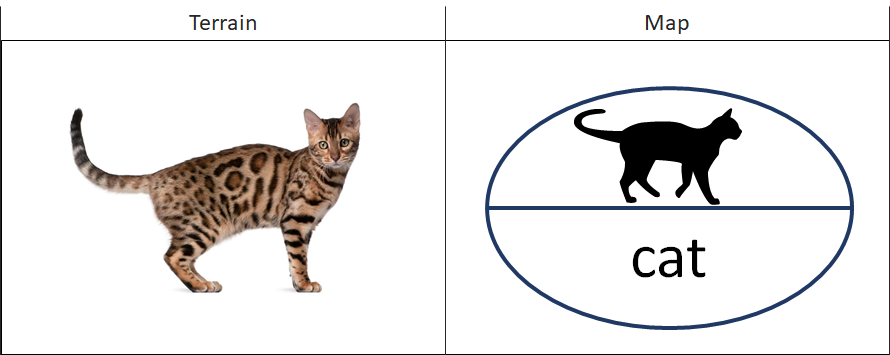
Firstly, all social perception is the result of the construct of human language. Of course, there is the physical world that exists independently of humans and perception—perhaps this is the real world where real judgments occur. Let’s label this real world the terrain. The earth and the larger universe would exist absent of humans. In fact, it had for aeons and will persist for many aeons beyond the last semblance of humanity. Humans are also real, if ephemeral, on a grander scale.

If this independent, objective, real world is the terrain, language is the map. We use language to communicate and make sense of the terrain, but it is only a representation based on our imperfect sense faculties.

cat saussure labels
Image: Symbolic language mapping of terrain

So when one makes a claim that everything [sic] is, say, language, they are making a claim similar to that of Saussure. Saussure was a structuralist. In fact, post-structuralism (or its expanded form labelled post-modernism) was a reaction against structuralists. Within the context of this post, Saussure believed that if one could fully qualify the structure of language, one could achieve a one-to-one fidelity relationship of the map to the terrain.

Post-structuralists pointed out all of the reasons why this was a fool’s errand. Like a geographical map, it is only a representation of the underlying terrain. Language serves the purpose of communication including expression and phatic aspects. One form of communication is rhetoric, which is a form employed for the purpose of persuasion. One possibility of this persuasion is to gain and retain power—or to at least win the upper hand in your argument. I suppose this is where the original statement starts to coalesce: rhetoric, power, and language.

quote-all-models-are-wrong-but-some-are-useful-george-e-p-box-53-42-27[1]
All models are wrong, but some are useful.
My point, then, is that our language map is always disconnected from the terrain. Moreover, it can be a pretty low fidelity map indeed. So when one says that everything is language, they are making a claim that we can not acquire this real knowledge. We can make sensory observations and construct narratives about it.

If you’ve ever taken a basic communications class, you’ve probably experienced the telephone game. Perception works in a similar manner. There are many things of which we have little or no experience save for conveyance through language. But as with the telephone game, fidelity can be lost. This is less likely to be a problem when interfacing with the so-called real world of rock and trees and of lions and tigers and bears.

terrain saussure
Image: Symbolic language mapping of nebulous concept

It is more likely to become a problem when dealing with non-ontic concepts, these ‘things’ that would not exist without humans or, more critically, without language. These artificial (in contrast to real) concepts are things like goodness, justice, democracy, liberty, sovereignty, nations, and on and on, ad nauseum. Humans have constructed narratives about all of these, but if the last human were to die tomorrow, these concepts would die, too. Whether some new lifeform would eventually evolve to develop language and further develop these concepts is debatable.

Judging

All of this aside, let’s look at the perceived intent of this statement, which is the same sentiment behind Nietzsche’s ‘God is dead’ quip.

As has been discussed, the Enlightenment replaced God with Nature and Nietzsche realised that if this worldview were universally adopted, the tyrannic role that God and gods had played could not be leveraged to maintain control or power, much in the same way that the divine rights or kings had withered and died. God played a vital role in this narrative. Nature, particularly human nature, was a weak substitute. This said, moral and natural realists, quickly (and relatively successfully) filled the void with cognitive filler, a perfect pairing for budding Enlightenment thinkers.

Given that even if there were some objective morality (terrain), there is no reason to believe that a human could gain access to it. Previously, priests and pharaohs claimed to possess this ability, but this vector was no longer extant or accessible. Even if a person did have this power through some miracle of some sort or another (or another or another), what reason (other than convincing rhetoric) would one have to believe him (or her—but let’s be honest; it’s pretty much all hims).

Without access to this objective morality, we are left with creating some subjective morality. I fully admit that trying to gain consensus and compliance to a known-to-be constructed moral code would be akin to herding cats. It is no doubt that society would operate more efficiently if all constituents follow the same code.

If wouldn’t matter if this society adopted, say, monogamy over polygamy, so long as everyone accepted this as the rules of engagement. Cultural subjectivism would provide a moral framework for this situation, We have many examples of social arrangements where this is the mode of operation.

Sports are an example. There are rules. Players agree on the rules, protocols, and procedures, and they operate within this socially constructed framework. There is no objective sportsball deity on high that conveyed the commandments, and yet it works.

John+Locke+-+Jean+Jacques+Rousseau[1]

Locke and Rousseau each wrote about social contracts. Granted, they believed in a supernatural Nature with a capital N, but they still felt that people could operate as a society based on some sort compact or accord.

This missing element would be power because those in power could not use some higher power to justify their actions especially in regard to retributive justice and so on.

Commentary

What I still don’t understand after all these years is how this logic works. It is eerily similar to Pascale’s Wager.

If not SOME CONDITION,
then not DESIRED OUTCOME
therefore FABRICATE SOME CONDITION

If not [belief in God],
then not [eternity of bliss in Heaven; instead eternal suffering in Hell, so double down]
therefore [convince yourself of or feign belief in God]

If not [objective means of judgment],
then not [real judgment]
therefore [delude yourself into the belief that an objective means of judgment exists]

And they all lived happily ever after

jessica-brooke-real-lesbian-wedding-orlando-florida-alternative-life-photography-design-first-kiss[1]

happily ever after

Insufficiency Theory of Language

I’m not an ethical subjectivist. The truth* is that I am a non-cognitivist. I gravitate more toward Ayer‘s Emotivism. Stevenson‘s Expressivism and Hare‘s Prescriptivism add the element of intention. This may seem like hair-splitting, but the distinction lies in the taxonomy of meta-ethics.

Emotivism and the rest are categorised under the non-cognitivist branch whilst ethical subjectivism falls into the cognitivist bucket. Intuitively, humans appear to have an innate bias toward accepting cognitivism, much in the same way as they seem to be wired to believe in supernatural concepts and see images of Jesus in toast. Whether these are vestiges of some successful evolutionary strategy is beside the point, but the problem it creates is that, in contrast, non-cognitivism is perceived as counterintuitive.

In its essence, cognitivism can be distilled down to the belief that moral statements are truth-apt, which is to say that they can be evaluated as true or false. Because of the current created by intuitionists, I lead with my fallback position, which is one of ethical subjectivism or more likely error theory.

Heads I win; Tails you lose

Although for reasons I’ll articulate later, entering a conversation assuming truth-aptness, the conversation can at least focus on the compositionality and universality components because whether I believe that moral statements cannot be evaluated as true or false, the default cognitive position of the general population is that they can be. This is not to say that I identify as a quasi-realist, which is to believe that there is no truth-aptness but to behave (pretend) that they do.

coin-flip - Captioned
Image: Deciding the truth-aptness of a moral claim

God Is Dead

In his critique of Enlightenment beliefs, Nietzsche declared that ‘God is dead’ as he understood the implications of a society absent a justification for not only believing that morality claims are truth-apt but that they are true, divinated from some metaphysical, supernatural, and universal power. In practice, the Enlightenment replaced God with a rather animated and interactive concept of Nature, hence were born all sorts of natural rights. You may get a sense of some déjà vu, as humans, not being particularly creative, just reappropriated and rebranded the same tropes Theists use prior to that. They just performed a search-and-replace of God with Nature in a manner similar to the Christian appropriation of pagan holidays.

Goddead
Image: God is dead

Non-cognitivism has generally fallen out of favour primarily because it was sort of painted into a corner by the Frege-Geach (embedding) problem, but this issue is only intractable if you accept the given frame.

I should probably just link out to a different source to explain the Frege-Geach problem because I feel it’s a red herring, which only presents a problem if you accept the frame established by the Structuralist

The problem here is that language is a complex, socially constructed communication system. Even if we accept Chomsky’s theory of the innate ability to parse language, the syntax, lexicon, and grammar are still arbitrary human constructs. I can’t likely repeat this point often enough: humans have a poor track record of creating and comprehending complex systems, examples of which are the various half-cocked socio-political, economic, jurisprudent, and philosophical systems. Hubris is evidently a successful evolutionary selection factor, as it persists everywhere and certainly in people of power.

The logical positivists ran into a similar problem when they proposed the verification principle that asserted that a statement is only truth-apt if it is either an ANALYTICAL statement or a SYNTHETIC statement, and yet this assertion with neither analytical nor synthetic, so it itself does not meet the verification principle. It’s simply a normative prescription.

Fundamentally, this quandary underscores the deficiencies of the constructed language system more than anything else, what I am developing with a working title of Insufficiency Theory. A tangent to this theory is my concept that the only moral truth (and many social truths) are simply rhetorical victories—situations where one agent employing rhetorical devices has convinced others as the truth of some condition.

Intermission

intermission

A problem with writing an unstructured stream of consciousness is that you look up and realise your post is getting pretty lengthy, and there is a lot more depth than you expected. Due to this, I am going to unpack this over several posts over several days.

Disclaimer

DISCLAIMER: I am not a professionally-trained philosopher, linguist, psychologist, or gynaecologist for that matter. I had considered studying Linguistics at uni as well as Philosophy, but I opted instead to study Economics and Finance, as these appeared to be more pragmatic. As relates to philosophy and language, I am an autodidact. This said, this particular area is new to me, so I am certain that I am missing key elements and may have large gaps in my understanding. In some cases, I’ve read more excerpts and others’ perspective on these people and their work than their actual work product. I am trying to catch up, but that leads me to a place fraught with selection and affirmation bias—though I do try to comprehend counter arguments as well. Moreover, I am painfully well aware of the Dunning-Kruger effect, and I am trying to allow for enough time to elapse to move further along this curve.

dunning-kruger-graph[1]
Chart: Dunning-Kruger Effect

Article head  image cropped from here: http://existentialcomics.com/comic/80


* Truth: (n) an opinion or held belief

Talk About Choice, the Body & Consent

This post takes a different approach than the previous two videos. First, I am reversing the video content and my response, so the video content is quoted.

As I listened to the video, I was taken aback by how rife the content was with logical fallacies. In fact, this would be perfect fodder for an introductory Logic 101 class to evaluate for these fallacies. Although I do not call out these fallacies exhaustively, I do highlight some of them.

One common factor of prostitutes is the history of surviving emotional, physical or often sexual abuse and violence.

Given that these are undefined and unqualified, I am not sure that there is any woman who has never had any violence of some degree or another. I presume this should be further qualified that it is directed toward her. I’ll be perfectly frank: I have never dated a woman who has not been raped at least once in her lifetime, some had been several times, and several others had been molested as children. Only a couple of these had any connections to sex work of any form, so it is interesting that this a raised as a vector, first for the over-expansive domain and second without contrast to other women in a sort of control group fashion.

These previous aspects have been suggested to be even stronger than the factor of poverty.

Notice again the speaking in generalities. No facts are being asserted here. We are trapped in a telephone game, where hearsay and speculation dominate the held position. Somebody anonymous person somehow somewhere suggested that some relationship might exist. There is nothing there.

Some poor women will be prostitutes, and others will take underpaid or illegal jobs…

Duly noted. And some will graduate from college and become computer programmers. And so?

…but the ones opting for prostitution will have had a history of sexual violence.

Notice that no claim is being made that this violence is more or less frequent than the cohort not opting for prostitution.

That a middle-class girl may also find herself working as a prostitute because someone taught her that she was worthless.

Wow. So much to unpack here. The narrator, Elly, is asserting a parallel between prostitution and worthlessness. The implication is a person with worth would not choose this profession because she would choose a worthy profession. I wonder where and how this worth is determined.

…and the only thing of value she could do was to give sexual access to men.

So Elly, whether she admits it or not is deprecating women who choose this profession, but she tries to shroud it in language that she feels otherwise.

Now comes the psychobabble about trauma reenactment, as if it were a thing, and in a classic misdirect, she asserts that this is not even her own judgment; in fact, it is the analysis of these women who are clearly qualified to make a professional judgment of this nature in the realm of pseudoscience.

Anecodote: Women come to the conclusion that they’ve been abused their whole lives, so why not get paid for it.

Here is where I break to discuss post hoc ergo propter hoc fallacy or anecdotal evidence. Anecdotal evidence is frequently misinterpreted via the availability heuristic, which leads to an overestimation of the prevalence of an occurrence. This is a well-documented logical fallacy. This fallacy is employed when the person arguing has no real data to support their position, so they opt for personal stories, hearsay, and anecdotes. Related to this is confirmation bias, which is the result of, having established a position, only seek out facts that support the position even if these facts are outnumbered by contrary facts by orders of magnitude.

Such thinking is the basis behind anti-vaccination groups and homoeopathy advocates. The best these people can do is to point to themselves or a friend or a friend of a friend who benefited (or was disadvantaged) by some therapy or other action.

Bald assertion: We have a rape and paedophilia culture.

What is the basis for this claim, and what is the scope?

Media culture promotes the message be pretty, be fuckable, or be invisible

Here, we are in full agreement. The technical fallacy here is that for every 10 girls subjected to these messages, 1 becomes a prostitute. Yet even by conservative statistics, at least 1 in 5 women have been raped, 1 in 4 have been sexually abused. So the cause and effect don’t add up. In the US, about 14% of people are officially considered to in poverty.

In statistics, there is a concept of signal and noise. The problem is that understanding statistics is not natural for humans. It involves the analytical System II, in Daniel Kahneman‘s parlance, rather than the heuristic, System I.  A cognitive problem plaguing people is apophenia, where they read patterns into data that simply are not there. A form of this, called pareidolia, is how people see Jesus’ face in toast.

No body can stand beign penetrated to 10 to 30 male strangers every single day.

So the 10 to 20 customers a night I commented was unrealistic has now morphed into 10 to 30. It is somehow important to note that these are strangers, presumably as a nod to acknowledge that 30 acquaintances would be just fine because there would be enthusiastic consent and mutual arousal. Beware stranger danger.

If indeed prostitution is just a job like any other job, like, say, flipping burgers, then I would wager you would have absolutely no issue switching jobs with a prostituted person for one day and let it be your anus that’s penetrated in the state of non-arousal by 15 men during one night.

O! Europa. Firstly, I wouldn’t trade my jobs to flip burgers let alone be a prostitute. Secondly, there are scores upon scores of ‘typical’ jobs I would have no interest in switching into. Nor would I presume that many others could actually do my job in any case. Why would someone presume that the punter wouldn’t notice the old switcharoo? And what’s with the anal penetration. Some prostitutes will ‘do’ anal for an up-charge, but many—perhaps even most—prostitutes won’t even accept anal at any price. This is about boundaries.

And someone seems pretty obsessed with the prospect of being penetrated by 15 men. I’d chalk this up to a power struggle, a foray into the world of penetration politics. Even gay men discriminate between top and bottom, so it’s rather a submission thing rather than a female thing.

Prostitution is incompatible with enthusiastic sexual consent

Elly runs through a bizarre strawman scenario that is too silly to even repeat here, and then she returns to some Disney Princess fantasy world of wooing and requited love.

She (sort of) acknowledges (without saying as much) that there is a distinction between economic and social spheres. I’d suggest reviewing the Isreali daycare study, where they learned that lesson the hard way. This does not mean that some people don’t blend the two spheres. It also doesn’t mean that a woman might not put out for a hamburger but might be persuaded by steak.

Anecdotally, I am aware of some women who say they would have sex with their favourite celebrity—if only he would ask.

In the end, this has become more and more disappointing. As so much of this material are vast generalisations and practically at the level of conspiracy theories, there is not even a debate to be had. There are so many technical flaws, I feel I need to pull a yellow card. There is nothing to push against except for the lack of structure or method. It’s all so nebulous. It’s all so quixotic, tilting at windmills.

To be honest, I don’t see how this would convert someone on the fence, let alone an opponent. This material is pretty much relegated to echo-chamber choir preaching.

I think I need to get back to the topic of subjectivism and out of the weeds of activist politics.


Arguing for the Abolition of Prostitution: Talk About The Men

Apparently, there was a part 0 and a part 2. I didn’t realise that, so I skipped video 1. My bad, as this is one I was particularly interested in.

In this video, Elly’s premise is to focus on the right to buy sex instead of the right to sell it. Pausing for a moment, I’d like to point out that sex is neither bought nor sold; rather access is rented or leased, in a manner similar to renting a streamed movie on Amazon or Netflix. You retain no rights to ownership or future access. You don’t get to keep it when your time is up. Rather than adopt new nomenclature, I’ll continue with the convention in place.

Rather than asking is there a right to sell sex, ask is there a right to buy it, AND ask is there a right to profit off of selling someone else for sex.

Ignoring whether a right can even exist ontologically, I’ll go along and pretend that a right can exist. We’ve been down this street before, but I am commenting in real time, and I am not yet even a minute in. Essentially, she suggests asking two questions:

  1. Is there a right to buy sex?

  2. Is there a right to profit off of selling someone else for sex?

Clearly, these two questions are related. The right to buy sex begs the question from whom, so even though the focus is redirected from the seller to the buyer, there cannot be a buyer without a seller. In practice, the seller is a critical piece of the equation. For example, I may have a right to buy an automobile, but you only have the right to sell it if it is your property; you can’t rightfully sell me your neighbour’s car.

Separately, is there a right to profit from selling sex [as a first party transaction] in the first place, and for selling someone else for sex [as a second party transaction] in the second place?

[SPOILER ALERT] » This video does not yield the anwers to these questions.  

The next order of business is to use these talking points…

  1. Discuss what motivates men to by prostituted women.

  2. Discuss how they view and treat them rather than discuss statistics.

…followed by this assertion.

“There is plenty of evidence that men are motivated to buy prostituted women because prostitution at its core means the availability of sexual access with little to no boundaries to young, attractive women anywhere at any time for affordable prices.”

This is where I go off the rails and critique poor methodology and poor rhetorical form. Let’s unpack this:

  • There is plenty of evidence that…
    • First, plenty is a weasel word. It carries no rhetorical weight unless it is followed with, well, plenty of evidence. How much is plenty? Is there plenty of counter-evidence? Is the evidence more prevalent than the counter evidence or vice versa.
    • Second, what is the source of this unspecified, uncited, and unattributed evidence. Elly references links; perhaps they are the evidence she is references. What is the quality of this evidence?
    • Not to offend, but this wouldn’t even pass as a Wikipedia comment.
  • …men are motivated to buy prostituted women because…
    • Apart from the inability to actually know someone’s motivation, I am interested in seeing where this leads.
    • Elly uses the noun phrase prostituted women. As she employs the adjective form prostituted, I am led to wonder what the motivation was for this word choice.
      • My initial thought is that she is modifying the noun women because wants to differntiate buying women from buying prostituted woman, but I don’t think this is quite right.
      • My next thought is that her motivation to convey that these women have no agency or volition; they are passive objects who are prostituted against their will.
      • My third, or perhaps it was my first, thought is why not emply the plural noun prostitutes. She has already established context that her focus is women, so I am left feeling there is a deeper subtext. Perhaps I am reading too much in.
  • …prostitution at its core means the availability of sexual access with little to no boundaries to young, attractive women anywhere at any time for affordable prices.
    • This is some definition. I’ll need to unpack this one slowly:
      • This definition get to the heart of the matter from the perspective of the  punter.
      • Prostitution is the availability of sexual access…  Yup. Nailed it.
      • with little to no boundaries… Wait, what? Where did this come from? Is there some subclass of prostitutes to which this applies? Surely does not define all prostitutes? Does this define most prostitute? As I understand it—at least the escorts of Backpage of days gone by, a victim of FOSTA—, escorts to have boundaries. Moreover, some boundaries can be expanded by an up-charge. Even reading the negative reviews on the Invisible Men Project, it is apparent that many of the complaints were that the woman refused one service or another, which is to say to enforce a boundary. This appears to be counterevidentiary.
      • to young… I wonder how we are defining young. I wonder what the average age of a prostitute is. A quick Google search of ‘prostitution’ yeilds a recent arrest of 7 women. I am not saying this is a valid random sample or size, but their ages range from 27 to 55 with an average age of just under 40-years old. I suppose to a 70-year-old, these are young. Let’s move on…
      • attractive women… Attractiveness is relative, but let’s just say there’s no accounting for taste. Without comment, I’ll leave it to you to decide the attraction level of these same arrested women.
      • anywhere… This is a bold assertion.
      • at any time… This is an another bold assertion. I am certain there is support for this claim somewhere.
      • at affordable prices. Finally, the end of this parsing party. Affordabilty is another relative term. Who’s the punter and what’s the cost? I’m noticing that first guy perportedly spent £340 for 45 minutes. That’s about $450 US for the peeps reading on this side of the pond, and I am just going to go out on a limb and suggest that is beyond the affordability range of most Americans by several hundred dollars.

At the end of the day, I am left with the impression that the purpose of this definition is to incite and inflame not to objectively define anything. In the court system, this is what one would call leading the witness. As such it would be inadmissible. I concur.

Her next course of action is to determine ‘If your opponents are aware of widespread social stigma in society against prostituted people, which causes risks or disadvantages during interactions with law enforcement or social services, ask them if Johns are somehow magically exempt from this’.

Resulting from my previous search, it seems buyers not exempt. In fact, 6 of the 8 people arrested were men ‘charged with patronizing a prostitute’.

Again, an unsubstantiated claim was countered in less than a minute. It feels to me that the tactic is to throw so much word salad at the opponent that they simply can process the mis- and dis-information, and without recourse to Google, they may be overwhelmed and convert having never researched any of the false claims. Donald Trump relies heavily on this technique.

If they are unable to see the misogyny in the words and actions of punters, introduce them to punter forums…where prostitutes are rated like products.

The claim of misogyny is one of intent. It is not a claim that the words are offensive. It is a claim that the intent behind the words is fueled by some inherent hatred of women. I’m sorry but this is unadulterated psychobabble.

I did read the negative reviews on the punter forums, and to be honest at the expense of being accused of mansplaining, these don’t read much differently to bad service reviews on on Yelp or Google. And, yes, the woman are rated—albeit like services not like products: like my stylist butchered my hair; my gardner killed my dog; whatever. Linguistically, this is akin to code switching. They are employing the vernacular of the forum.

Do some of these men hate women? Sure. Who knows? Do they hate all women? Do all men who frequent prostitutes hate women? Do they hate all women or just prostitutes? Do they hate their mothers? Is their hatred of prostitutes simply a hidden hatred of their mother manifest in hatred of women? Do they hate other categories of people? Do they kick cats and beat dogs? Of course they do, and then they go home and beat their wives and children and speak poorly about their aunts and mothers.

Of course, this line of reasoning is just as inane as the line that inspired it.

She mentions men who freely admit to abusing and raping women.

Wait, what? I didn’t see that. I must have been distracted by the snuff films.

I can tell this is just turning into a rant. If there is one thing I can’t stand—and there is more than one thing I can’t stand—is sloppy academics. The rules of engagement for defending a position with integrity are simple. If the goal is to win at any expense, then, as the saying goes, all is fair in love and war. But I am not sure what the prize is here. I am not one to have much faith in the intellectual capacity of most humans, but even I am pretty sure that the majority of people can see right through this subterfuge.

Shake it off, Bry. Just shake it off. Push through it. No pain no gain.

Presumed motivators for men to pay for prostitutes are because…

A. Men want to have sex with no responsibilities with maximum control and no required effort of actually impressing and winning over the other person, and because other men are willing to provide it by pimping out others for their own lucrative profit.

Wow. Another unfounded, ungrounded assertion. Just some claim pulled from thin air. Also, I am pretty sure I heard her say A, as if to enummerate some list, but I never heard any subsequent letters.

  • Men want to have sex
    • So far, so good…
  • with no responsibilities
    • I’ll presume she means with no additional strings attached. I am not sure what other responsibilities we could be talking about.
  • with maximum control
    • I am pretty sure we’ve already trodden this teritory. Perhaps he feels he has (or even has) more control over a prostitute than over some alternative woman. Perhaps he wife or partner won’t allow him to do something or another, but I have a feeling that this maximum control claim is a bit more hyperbole than reality justifies.
  • and no required effort of actually impressing and winning over the other person
    • I am fast-forwarding a bit because this feels like reading it will be like watching paint dry or grass grow. By what Romantic construct is this a thing? Someone’s watched too many Disney films. And this is a game, and the person who pays to avoid effort is a cheater? He jumped the queue. Hmmm. When I say it like that, it does seem awfully juvenile.
  • and because other men are willing to provide it by pimping out others for their own lucrative profit.
    • Let’s just tag some barely relevent rationale on because we can.
    • And let’s pepper our speech with superlatives so the hyperbole doesn’t feel lonely.

Prostitution exists because of the demand not because of a subset of women who are nymphomaniacs.

I have to admit that I loved this last line.

Also [prostitution does] not [exist] because of poverty. Poverty is a supporting factor.

Rachel wins the strawman argument contest of the year. Who is asserting that poverty is the sole arbiter of prostitution? Apparently, some unnamed source in Parliament.


Prostitution exists for one reason: male demand —Rachel Moran


This logic exhibits a fundamental lack of understanding of the basic rules of transactional economics and equilibrium in context with supply and demand.

Not to be a dick about it, but I can demand a Ferrari until the cows come home, but this will not conjure a Ferrari. Believe me, I’ve been waiting for those cows to come home for ages. Also, the supply of Ferraris does me no good either because the transction price is too high; therefore, I cannot afford a Ferrari.

Rachel however is correct—In your face Jean Baptiste Say!—when she recognises that supply does not create its own demand. Sorry believers in Conservative economics dogma. But I digress.

Even if this nymphomaniac offered her services for free, there could be no transaction without demand, so the monetary exchange is a secondary factor.

Don’t sugarcoat the violence that punters and pimps commit.

Also, don’t differentiate violence that happens on the job, such as a dope dealer or a loan shark that would have occurred, perhaps even sooner, whether or not she was a prostitute. Let’s just pretend that these are related to her line of work because it helps to inflate number to make our position more sellable.


occupation definition


When a prostituted woman is raped or killed, the most likely rapist and/or killer is a pimp or a John. That makes prostitution the only so-called occupation which [sic] changes the most likely perpetrator of severe bodily harm from a partner or relative to your customer or employer.

And this is relavent how? Perhaps we should make associating with partners and relatives illegal. It seems that they are the biggest concern.

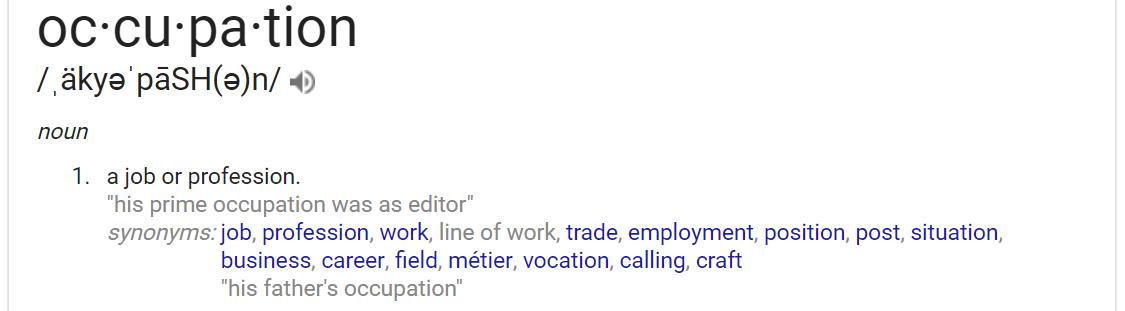
Why is this a so-called occupation? Is this not a job or line of work?

Lastly, make it very clear that this dynamic and this level of violence does not magically change under legalised prostitution.

OK.

The set of men buying and selling women doesn’t really change.

I disagree. Where prostitution is illegal, the good men are going to exit the system, and only bad men will remain. Of course, if you define all men who frequent prostitutes as misogynists, then I suppose you’ve created a situation where all men are bad, and so I stand corrected.

Let’s see how that renders as a categorical syllogism:

  • – All men who frequent prostitutes are bad.
  • – Joe is a man who frequents prostitutes.
  • Joe is bad.

I see how it works. I stand corrected. All punters are evil. Burn them.

Under legalisation, too, men retain their disgust for the prostituted and their disrespect for their boundaries.

Here we go again with the broadbrushing.

Ample evidence are the punter forums of Germany, the Netherlands, and New Zealand. This contempt and the sever mistreatment does not change unless there is effective widespread social intervention that teaches children for elementary school onwards that prostituted women and men are just as human and deserving of respect as anyone else and that all sexual interaction requires enthusiastic consent, which means that it cannot be bought.

Prostituted women and men are just as human and deserving of respect as anyone else…which is why we should deprive them of their livelihoods. Nothing says “I respect you” more than kicking the chair out from under you.  That’s my creed.

Not merely consent but enthusiastic consent. Not only do I have to work, I have to do so enthusiastically.

Abolitionists have an issue not with the prostitutes but in the system they are caught in and the men who operate and benefit from it.

I think I am approaching the end of this clip.

The systems they are caught up in is Capitalism and a market economy, a system that presumes to be able to put a price on anything.


A cynic is…a man who knows the price of everything, and the value of nothing. — Oscar Wilde

Hatred of a system does not equate to hatred of a person in that system.

I agree, and so…

Humans have a piss poor track record in understanding complex systems, whether weather, poitical, sociological, economic, or otherwise. The issue here is that you can hate the system and love the person, but if you disrupt the system intentionally or otherwise, the wide ranging effect may prove disaterous.

Punters love the system but hate the women. Abolistionists care about the women.

Where is all this categorical hatred coming from?

Lastly, Elly mentions that she is working on a video piece to summarise the important stats and info on who punters are, what they do, and why they do it.

And here is where I will challenge your integrity. Who here would believe—especially insomuch as by her own admission that she recommends hiding inconvenietly opposing facts—any reporting would contain an accounting of unbiased and unabridged data, metrics, or summaries or that proper methodological rigour would be applied for the study.

On the topic of studies, in the description of the video on the page, there are links, which I’ve copied here for comment.

  • Rachel Moran at Femifest in London
    • This is a PDF of speaking notes or a transcript of Rachel’s presentation in London, based on her experience as a sex-trade survivor. Rachel’s is a sad story, but it is her story.
  • The Invisible Men project on Tumblr
    • Yet again, a list of cherry-picked perhaps 180 quotes from some Canadian forum. This is contemptuous. I only read about a dozen and a half of them. In order to be even somewhat useful (instead of being polemic) would be to see all of the reviews, and to see what percentage of people wrote these reviews. You can’t convince me that there are no doting reviews. These are exempted because they dilute the disingenuous shock value of only negative reviews. Even a simple word cloud would be more useful than this hatchet job. (I feel like finding one of these forums and cherry-picking the rest of the story just out of spite.)
  • Prostitution Research & EducationAbolish Prostitution And Provide Real Alternatives
    • This is a full forum of resources. I have not done anything more than scan the initial page where I landed. I may return for more context. If you seek additional information, visit. I think it goes without saying that the information here is slanted, much like watching Fox News in an attempt to understand American Liberal politics.
  • How Porn Creates the John: Porn, Trafficking and the Social Construction of Masculinity (Youtube video from a lecture given in December 2012)
    • Being on the topic of social constructivism, this one should be right up my street. I haven’t watched even a moment of this video, so am probably commenting prematurely, but it is interesting to me how some people accept the concept of social constructivism when it relates to a different perspective, but rarely do they accept their own perspectives as social constructions. This is a cognitive bias.

I am not so sure I have the interest in commenting on the rest of the series. To be honest, Elly has other series as well. I’d like to take a look, but I’m afraid I’ll have a similar reaction that the position and content haven’t been well thought out. Perhaps a strong editor would help, a disinterested party who would maintain (or otherwise elevate) the integrity of the content and who would provide needed rigour.

In the end, Elly’s message would be stronger and more cogent, and she could shed the chaff whilst retaining the substance.