
The Seduction of the Spreadsheet

1–2 minutes

Whilst researching “The Will to Be Ruled: Totalitarianism and the Fantasy of Freedom”, I stumbled across Mattias Desmet’s The Psychology of Totalitarianism. The title alone was bait enough. I expected the usual reheated liberal anxiety about dictators; instead, I found a critique of data worship and mechanistic reason that hits the nerve of our statistical age.

Besmet, a Belgian psychologist with a background in statistics, begins not with tyranny but with epistemology – with how the Enlightenment’s dream of objectivity curdled into the managerial nightmare we now inhabit. The first half of the book reads like a slow unmasking of Scientism: how numbers became our gods, and graphs, our catechisms.

Written before COVID-19 but finished during it, his argument turns pandemic data into theatre – a performance of certainty masking deep confusion. The daily tally became ritual sacrifice to the idol of ‘evidence-based’ policy. His point, and mine, is that totalitarianism no longer needs gulags; it thrives in dashboards and KPIs.

Desmet’s frame intersects beautifully with my own thesis: that obedience today is internalised as reasonableness. Freedom has been recast as compliance with ‘the data’. We surrender willingly, provided the orders come in statistical form.

This is why even Agile™ management and its fetish of ‘velocity’ reek of the same mechanistic faith. Every sprint promises deliverance through quantification; every retrospective is a bureaucratic confession of inefficiency. The cult of metrics is not merely a managerial fad – it is the metaphysics of our time. The problem is at once ontological and epistemological: we mistake the measure for the thing itself, and in doing so, become measurable.

It’s a rare pleasure to encounter a fellow dissident of the numerical faith – a man who sees that the spreadsheet has replaced the sceptre.

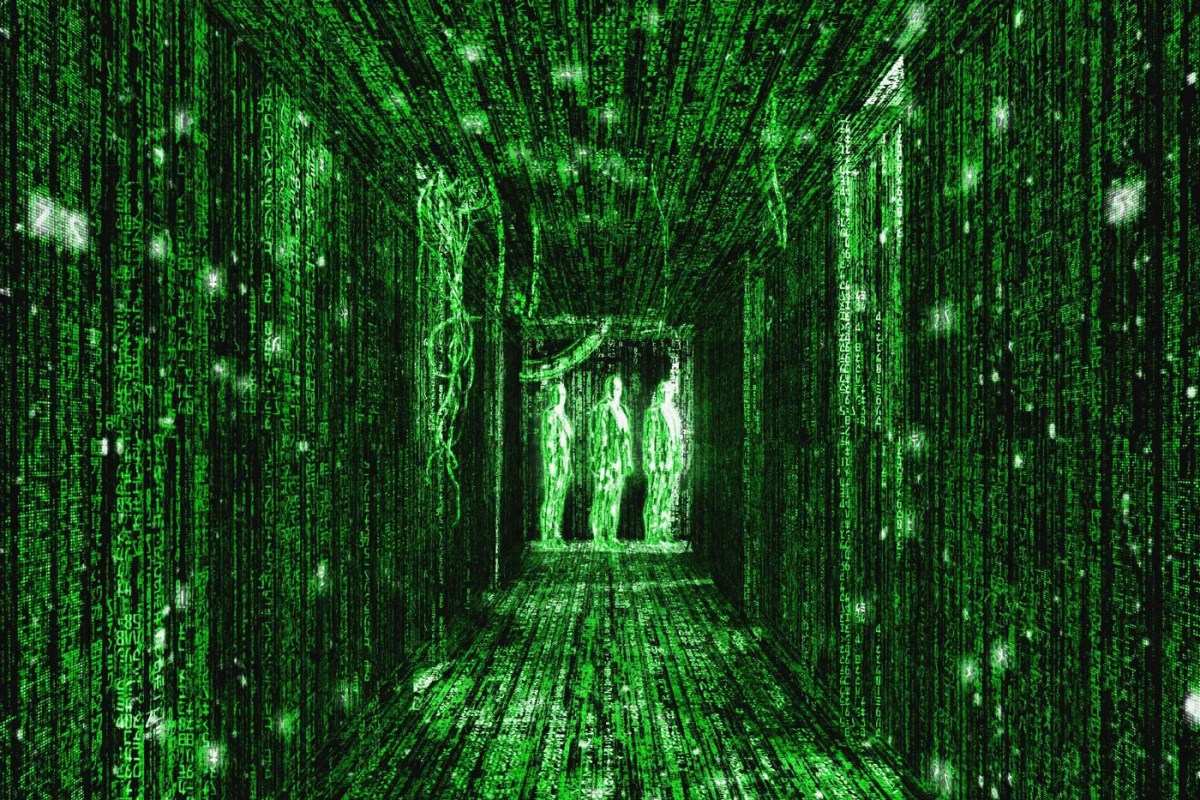
Baudrillard in Latex: Why The Matrix Was Right About Everything Except Freedom

2–3 minutes

In the late 1990s, the Wachowskis gave us The Matrix – Keanu Reeves as Neo, the Chosen One™, a man so bland he could be anyone, which was the point. Once he realised he was living inside a simulation, he learned to bend its laws, to dodge bullets in slow motion and see the code behind the curtain. Enlightenment, Hollywood-style.

Audio: NotebookLM podcast on this topic.

But here’s the twist, the film itself couldn’t stomach: realising the simulation doesn’t free you from it.

Knowing that race and gender are social constructs doesn’t erase their architecture. Knowing that our economies, legal systems, and so-called democracies are fictions doesn’t get us out of paying taxes or playing our assigned roles. “The social contract” is a collective hallucination we agreed to before birth. That and a dollar still won’t buy you a cup of coffee.

Baudrillard, whose Simulacra and Simulation the film name-dropped like a trophy, argued that simulation doesn’t hide reality – it replaces it. When representation becomes indistinguishable from the thing it represents, truth evaporates, leaving only consensus. We don’t live in a system of power; we live in its performance.

The Matrix got the metaphor half right. It imagined the bars of our cage as a digital dream – glossy, computable, escapable. But our chains are older and subtler. Rousseau called them “social”, Foucault diagnosed them as “biopolitical”, and the rest of us just call them “normal”. Power doesn’t need to plug wires into your skull; it only needs to convince you that the socket is already there.

You can know it’s all a fiction. You can quote Derrida over your morning espresso and tweet about the collapse of epistemic certainty. It won’t change the fact that you still have rent to pay, laws to obey, and identities to perform. Awareness isn’t liberation; it’s just higher-resolution despair with better UX.

Neo woke up to a ruined Earth and thought he’d escaped. He hadn’t. He’d only levelled up to the next simulation – the one called “reality”. The rest of us are still here, dutifully maintaining the system, typing in our passwords, and calling it freedom.

NB: Don’t get me wrong. I loved The Matrix when it came out. I still have fond memories. It redefined action films at the time. I loved the Zen messaging, but better mental acuity doesn’t grant you a pass out of the system.

Moral Responsibility

Can we be held morally responsible for our actions? Yes, says Daniel Dennett. No, says Gregg Caruso. Reader, you decide

Aeon Article, 4 October 2018

Caruso: [Dan,] you have famously argued that freedom evolves and that humans, alone among the animals, have evolved minds that give us free will and moral responsibility. I, on the other hand, have argued that what we do and the way we are is ultimately the result of factors beyond our control, and that because of this we are never morally responsible for our actions, in a particular but pervasive sense – the sense that would make us truly deserving of blame and praise, punishment and reward. While these two views appear to be at odds with each other, one of the things I would like to explore in this conversation is how far apart we actually are. I suspect that we may have more in common than some think – but I could be wrong. To begin, can you explain what you mean by ‘free will’ and why you think humans alone have it?

Gregg Caruso

Dennett: A key word in understanding our differences is ‘control’. [Gregg,] you say ‘the way we are is ultimately the result of factors beyond our control’ and that is true of only those unfortunates who have not been able to become autonomous agents during their childhood upbringing. There really are people, with mental disabilities, who are not able to control themselves, but normal people can manage under all but the most extreme circumstances, and this difference is both morally important and obvious, once you divorce the idea of control from the idea of causation. Your past does not control you; for it to control you, it would have to be able to monitor feedback about your behaviour and adjust its interventions – which is nonsense.

In fact, if your past is roughly normal, it contains the causal chains that turned you into an autonomous, self-controlling agent. Lucky you. You weren’t responsible for becoming an autonomous agent, but since you are one, it is entirely appropriate for the rest of us to hold you responsible for your deeds under all but the most dire circumstances. 

Daniel Dennett

if your past is roughly normal, it contains the causal chains that turned you into an autonomous, self-controlling agent

Dan Dennett

So commences this debate. The argument unfolds largely on semantic grounds. Even here, one can see the debate over the distinction between control and causation. I understand what Dennett is attempting to parse here, but I object on the grounds of causa sui.

I recommend reading the Aeon article as there is much more than this distinction, but it does remain a semantic issue. I started a post on backwards- and forward-looking perspectives, that better articulate Caruso’s perspective, but I am also working on other things. This was quicker to post and I wanted to keep a bookmark anyway, so it’s a win-win.