When Language Fails – Abstract

3–4 minutes

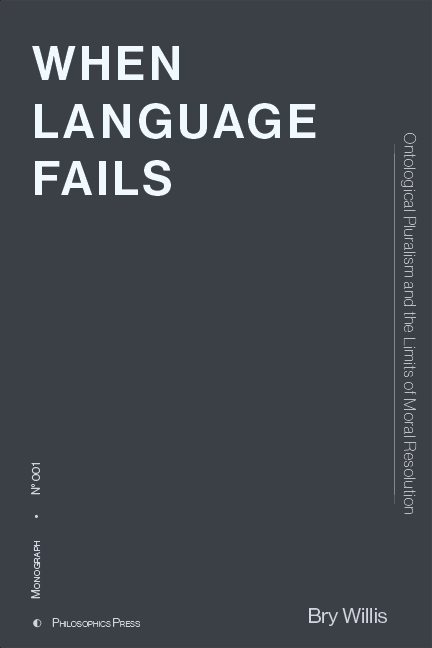
I set aside some time to design the front cover of my next book. I’m excited to share this – but that’s always the case. It’s substantially complete. In fact, it sidelined another book, also substantially complete, but the content in this might force me to change the other one. It should be ready for February. I share the current state of the Abstract

This book is meant to be an academic monograph, whilst the other, working title: The Competency Paradox, is more of a polemic.
As I mentioned in another post, it builds upon and reorients the works of George Lakoff, Jonathan Haidt, Kurt Gray, and Joshua Greene. I’ve already revised and extended Gallie’s essentially contested concepts in A Language Insufficiency Hypothesis in the form of Contestables, but I lean on them again here.

Abstract

Contemporary moral and political discourse is marked by a peculiar frustration: disputes persist even after factual clarification, legal process, and good-faith argumentation have been exhausted. Competing parties frequently agree on what happened, acknowledge that harm occurred, and yet remain irreconcilably divided over whether justice has been served. This persistence is routinely attributed to misinformation, bad faith, or affective polarisation. Such diagnoses are comforting. They are also often wrong.

This paper advances a different claim. Certain conflicts are not primarily epistemic or semantic in nature, but ontological. They arise from incompatible orientations that structure how agents register salience, threat, authority, autonomy, and legitimacy. These orientations are genealogically shaped through enculturation, institutions, and languaged traditions, yet operationally they function prior to linguistic articulation: salience fires before reasons are narrated. Moral vocabulary enters downstream, tasked with reconciling commitments that were never shared.

From this perspective, the instability of concepts such as justice is not the primary problem but a symptom. Justice belongs to a class of Contestables (in Gallie’s sense, PDF): action-authorising terms that appear determinate while remaining untethered from shared reference under ontological plurality. Appeals to clearer definitions, better process, or shared values therefore misfire. They presume a common ontological ground that does not, in fact, exist.

When institutions are nevertheless required to act, they cannot adjudicate between ontologies. They can only select. Courts, juries, regulatory bodies, and enforcement agencies collapse plural interpretations into a single outcome. That outcome is necessarily experienced as legitimate by those whose orientation it instantiates, and as injustice by those whose orientation it negates. No procedural refinement can eliminate this asymmetry. At best, procedure dampens variance, distributes loss, and increases tolerability.
Crucially, the selection itself is constrained but underdetermined. Even within formal structures, human judgment, discretion, mood, confidence, fear, and narrative framing play a decisive role. Following Keynes, this irreducible contingency may be described as animal spirits. In formal terms, institutional outcomes are sampled from a constrained space of possibilities, but the reaction topology remains structurally predictable regardless of which branch is taken.

The consequence is stark but clarifying: outrage is not evidence that a system has failed to deliver justice; it is evidence that plural ontological orientations have been forced through a single decision point. Where semantic reconciliation is structurally unavailable, exogenous power is the dominant near-term mediator. Power does not resolve the conflict; it pauses it and stabilises meaning sufficiently for coordination to continue.

This analysis does not deny the reality of harm, the importance of law, or the necessity of institutions. Nor does it lapse into nihilism or indifference. Rather, it reframes the problem. In ontologically plural environments, the task is not moral convergence but maintenance: containing collision, resisting premature coherence, and designing institutions that minimise catastrophic failure rather than promising final resolution.

The argument developed here predates any particular event. Its value lies precisely in its predictive capacity. Given plural ontologies, untethered contestables, and institutions that must act, the pattern of reaction is invariant. The surface details change; the structure does not.
What follows is not a proposal for reconciliation. It is a diagnosis of why reconciliation is so often a category error, and why pretending otherwise is making things worse.


A Language Insufficiency Announcement

1–2 minutes

A Language Insufficiency Hypothesis is now available, and I am commencing a series of video content to support it.

Video: Language Insufficiency Hypothesis – Part 1 – The Basic Concepts (Duration: 6:44)

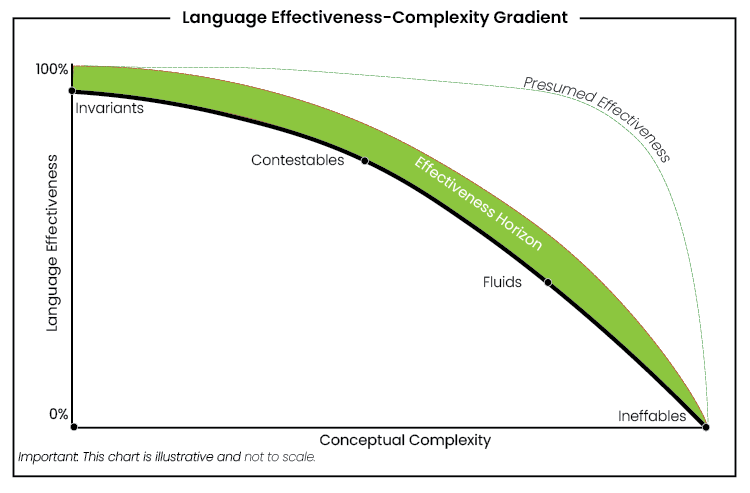
In this primer, I introduce the Language Effectiveness–Complexity Gradient and the nomenclature of the hypothesis: Invariants, Contestables, Fluids, and Ineffables.

In the next segment, I’ll discuss the Effectiveness and Presumed Effectiveness Horizons.

If you would like to support my work, consider purchasing one of my books. Leaving ratings and reviews helps more than you know to appease the algorithm gods.

The book is available at Amazon, Barnes and Noble, and traditional booksellers.

ISBN (Hard Cover): 978-0-9710869-0-6
ISBN (Paperback): 978-0-9710869-4-4

US Library of Congress ID: LCCN: 2025927066

What the LIH Is Not About (And Why This Still Needs Saying)

3–5 minutes

As the publication date of A Language Insufficiency Hypothesis (LIH) draws nearer, I feel it’s a good time to promote it (obviously) and to introduce some of the problems it uncovers – including common misperceptions I’ve already heard. Through this feedback, I now understand some of the underlying structural limitations that I hadn’t considered, but this only strengthens my position. As I state at the start of the book, the LIH isn’t a cast-in-stone artefact. Other discoveries will inevitably be made. For now, consider it a way to think about the deficiencies of language, around which remediation strategies can be developed.

Audio: NotebookLM summary podcast of this content.

Let’s clear the undergrowth first. The Language Insufficiency Hypothesis is not concerned with everyday ambiguity, garden-variety polysemy, or the sort of misunderstandings that vanish the moment someone bothers to supply five seconds of context. That terrain is already well-mapped, thoroughly fenced, and frankly dull.

Take the classic sort of example wheeled out whenever someone wants to sound clever without doing much work:

Video: a woman making a large basket

If you’re a basketweaver, you picture an absurdly large basket and quietly question the maker’s life choices. If you’re watching basketball, you hear ‘score’. If you’re anywhere near the context in which the sentence was uttered, the meaning is obvious. If it isn’t, the repair cost is trivial. Add context, move on, live your life.

Language did not fail here. It merely waited for its coat. This is not the sort of thing the LIH loses sleep over.

The Groucho Marx Defence, or: Syntax Is Not the Problem

Logicians and armchair philosophers love to reach for jokes like Groucho Marx’s immortal line:

Video: A man and elephant in pyjamas (no sound)

Yes, very funny. Yes, the sentence allows for a syntactic misreading. No, nobody actually believes the elephant was lounging about in striped silk. The humour works precisely because the “wrong” parse is momentarily entertained and instantly rejected.

Again, language is not insufficient here. It’s mischievous. There’s a difference.

If the LIH were worried about this sort of thing, its ambitions would be indistinguishable from an undergraduate logic textbook with better branding.

Banks, Rivers, and the Myth of Constant Confusion

Likewise, when someone in a city says, ‘I went to the bank’, no sane listener imagines them strolling along a riverbank, unless they are already knee-deep in pastoral fantasy or French tourism brochures. Context does the heavy lifting. It almost always does.

Video: Rare footage of me trying to withdraw funds at my bank (no sound)

This is not a crisis of meaning. This is language functioning exactly as advertised.

Where the Trouble Actually Starts: Contestables

The LIH begins where these tidy examples stop being helpful. It concerns itself with Contestables: terms like truth, freedom, justice, fairness, harm, equality. Words that look stable, behave politely in sentences, and then detonate the moment you ask two people what they actually mean by them. These are not ambiguous in the casual sense. They are structurally contested.

In political, moral, and cultural contexts, different groups use the same word to gesture at fundamentally incompatible conceptual frameworks, all while assuming a shared understanding that does not exist. The conversation proceeds as if there were common ground, when in fact there is only overlap in spelling.

That’s why attempts to ‘define’ these terms so often collapse into accusation:

That’s not what freedom means.
That’s not real justice.
You’re redefining truth.

No, the definitions were never shared in the first place. The disagreement was smuggled in with the noun.

‘Just Ignore the Word’ Is Not a Rescue

A common response at this point is to suggest that we simply bypass the troublesome term and discuss the concrete features each party associates with it. Fine. Sensible. Often productive. But notice what this manoeuvre concedes. It does not save the term. It abandons it.

If meaningful discussion can only proceed once the word is set aside and replaced with a list of clarifications, constraints, examples, and exclusions, then the word has already failed at its primary job: conveying shared meaning. This is precisely the point the LIH is making.

The insufficiency is not that language is vague, or flexible, or context-sensitive. It’s that beyond a certain level of conceptual complexity, language becomes a confidence trick. It gives us the feeling of agreement without the substance, the appearance of communication without the transaction.

At that point, words don’t merely underperform. They mislead.