“Your Triggers Aren’t My Problem!”

…except, sometimes they are.

This came across my feed, the laminated wisdom of our times: Your triggers are your responsibility. It isn’t the world’s obligation to tiptoe around you. A phrase so crisp, so confident, it practically struts. You can imagine it on a mug, alongside slogans like Live, Laugh, Gaslight. These are the language games I love to hate.
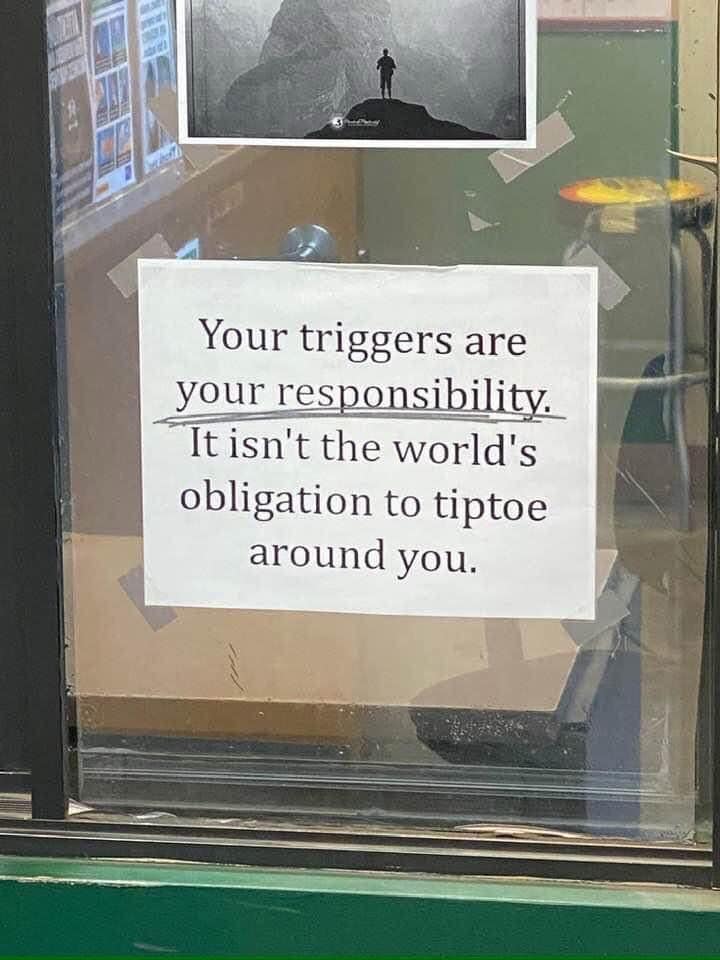
Now, there’s a certain truth here. Life is hard, and people aren’t psychic. We can’t reasonably expect the world to read our mental weather reports—50% chance of anxiety, rising storms of existential dread. In an adult society, we are responsible for understanding our own emotional terrain, building the bridges and detours that allow us to navigate it. That’s called resilience, and it’s a good thing.

Audio: NotebookLM Podcast on this topic.

But (and it’s a big but) this maxim becomes far less admirable when you scratch at its glossy surface. What does triggers even mean here? Because trigger is a shape-shifter, what I term Shrödinger’s Weasels. For someone with PTSD, a trigger is not a metaphor; it’s a live wire. It’s a flashback to trauma, a visceral hijacking of the nervous system. That’s not just “feeling sensitive” or “taking offence”—it’s a different universe entirely.

Yet, the word has been kidnapped by the cultural peanut gallery, drained of precision and applied to everything from discomfort to mild irritation. Didn’t like that movie? Triggered. Uncomfortable hearing about your privilege? Triggered. This semantic dilution lets people dodge accountability. Now, when someone names harm—racism, misogyny, homophobia, you name it—the accused can throw up their hands and say, Well, that’s your problem, not mine.

And there’s the rub. The neat simplicity of Your triggers are your responsibility allows individuals to dress their cruelty as stoic rationality. It’s not their job, you see, to worry about your “feelings.” They’re just being honest. Real.

Except, honesty without compassion isn’t noble; it’s lazy. Cruelty without self-reflection isn’t courage; it’s cowardice. And rejecting someone’s very real pain because you’re too inconvenienced to care? Well, that’s not toughness—it’s emotional illiteracy.

Let’s be clear: the world shouldn’t have to tiptoe. But that doesn’t mean we’re free to stomp. If someone’s discomfort stems from bigotry, prejudice, or harm, then dismissing them as “too sensitive” is gaslighting, plain and simple. The right to swing your fist, as the old adage goes, ends at someone else’s nose. Likewise, the right to be “brutally honest” ends when your honesty is just brutality.

The truth is messy, as most truths are. Some triggers are absolutely our responsibility—old wounds, minor slights, bruised egos—and expecting the world to cushion us is neither reasonable nor fair. But if someone names harm that points to a broader problem? That’s not a trigger. That’s a mirror.

So yes, let’s all take responsibility for ourselves—our pain, our growth, our reactions. But let’s also remember that real strength is found in the space where resilience meets accountability. Life isn’t about tiptoeing or stomping; it’s about walking together, with enough care to watch where we step.

A Buddhist Critique of Modern Livelihoods

It’s interesting to me that as an atheist and non-cognitivist, I can take the moral high ground relative to health insurance concerns in the United States. So, I write about it.

Blood Money and Broken Principles

In the aftermath of the tragic killing of Brian Thompson, the CEO of a health insurance conglomerate, a striking narrative has emerged. Many Americans view this act—shocking though it is—as emblematic of the anger and despair born of a system that profits by exploiting human vulnerability. Such reactions compel us to examine the ethics of industries that flourish on what can only be described as blood money. From health insurance to tobacco, alcohol, and the arms trade, these livelihoods raise profound ethical questions when viewed through the lens of the Buddhist Noble Eightfold Path, specifically Right Livelihood and Right Action.

The Moral Framework: Buddhism’s Path to Ethical Livelihood

Buddhism’s Eightfold Path provides a blueprint for ethical living, with Right Livelihood and Right Action serving as its ethical cornerstones. These principles demand that one’s work and deeds contribute to the welfare of others, avoid harm, and align with compassion and integrity. In short, they urge us to earn a living in a manner that uplifts rather than exploits. The health insurance industry’s business model—which often prioritises profits over the preservation of life—challenges these tenets in ways that are difficult to overlook.

Consider the denial of coverage for life-saving treatments, the exploitation of legal loopholes to reduce payouts, or the systemic perpetuation of healthcare inequality. These actions, while legally sanctioned, conflict sharply with the Buddhist ideal of avoiding harm and promoting well-being. Yet, this industry is not alone in its ethical failings. Many others—both legal and illegal—fall similarly short.

Industries of Exploitation: Tobacco, Alcohol, and Arms

The tobacco and alcohol industries provide stark examples of livelihoods that thrive on human suffering. Their products, despite their legality, are designed to foster dependency and harm. They exact a heavy toll on both individual lives and public health systems, a reality that makes them incompatible with Right Livelihood. The arms trade—arguably the most egregious example—profits directly from conflict and human misery. How can such industries possibly align with the Buddhist ideal of ahimsa (non-violence) or the compassionate aspiration to alleviate suffering?

In these cases, the harm caused is not incidental; it is fundamental to their business models. Whether one manufactures cigarettes, brews alcohol, or sells weapons, the destruction wrought by these activities is integral to their profitability. The contradiction is stark: the greater the harm, the greater the profit. This stands in direct opposition to the Buddhist call for livelihoods that sustain and support life.

Organised Crime: The Dark Mirror

When we turn to organised crime, the parallels become even more unsettling. Whether it’s the drug trade, human trafficking, or financial fraud, these activities epitomise unethical livelihoods. They exploit the vulnerable, foster violence, and undermine social cohesion. Yet, when viewed alongside certain legal industries, the line between “organised crime” and “corporate enterprise” begins to blur. Is the denial of life-saving healthcare less egregious than a gang’s extortion racket? Both profit by preying on human suffering. Both thrive in systems that prioritise gain over humanity.

The Buddhist Response: From Outrage to Action

Buddhism does not condone violence, no matter how symbolic or righteous it may appear. Right Action demands non-violence not only in deeds but also in thoughts and intentions. The killing of Brian Thompson, though perhaps an act of desperation or symbolism, cannot align with Buddhist ethics. Yet this tragedy should not eclipse the broader systemic critique. The true challenge is not to exact retribution but to transform the systems that perpetuate harm.

To move forward, we must ask how our societies can pivot toward livelihoods that align with compassion and justice. This entails holding exploitative industries to account and fostering economic systems that prioritise well-being over profit. The Buddhist path offers not only a critique of harmful practices but also a vision for ethical living—a vision that demands courage, compassion, and unwavering commitment to the common good.

Conclusion: Choosing a Better Path

The case of Brian Thompson’s killing is a symptom of a much larger ethical crisis. It forces us to confront uncomfortable truths about the industries that shape our world. Whether we scrutinise health insurance, tobacco, alcohol, the arms trade, or organised crime, the moral calculus remains the same: livelihoods that thrive on harm cannot be reconciled with the principles of Right Livelihood and Right Action.

As individuals and societies, we face a choice. We can continue to turn a blind eye to the suffering embedded in these industries, or we can commit to transforming them. The Buddhist path challenges us to choose the latter, to build systems and livelihoods rooted in compassion and justice. In doing so, we can begin to heal not only the wounds of individual tragedies but also the deeper fractures in our collective soul.