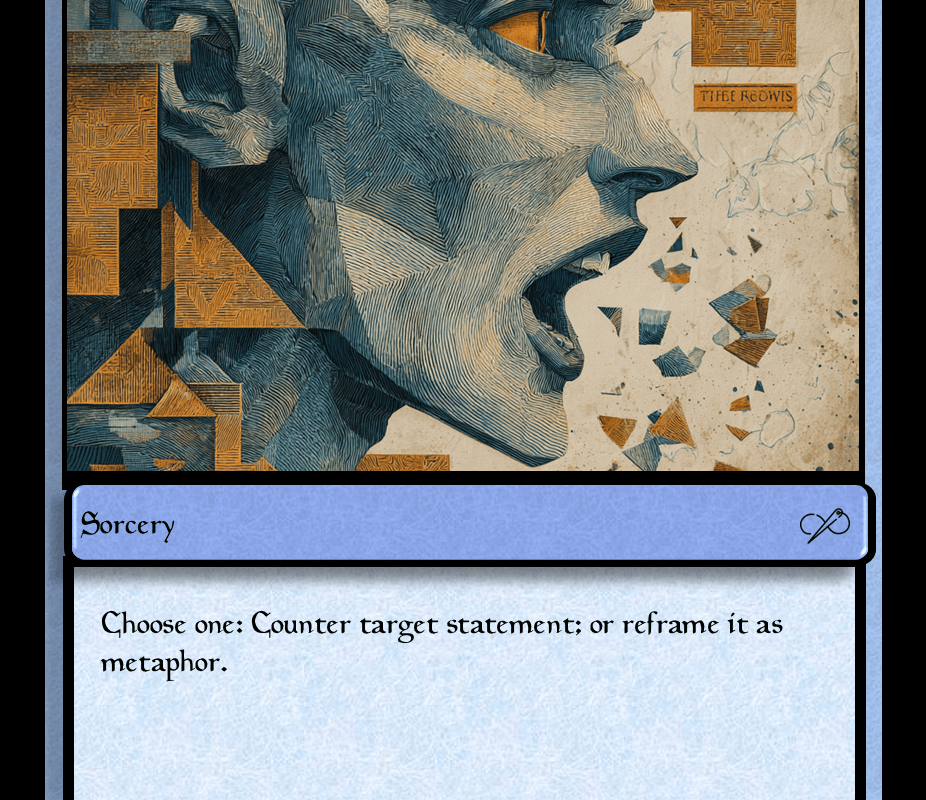
Language Games: Sorcery

If philosophy were a game, Wittgenstein rewrote the rulebook. Then he tore it up halfway through and told us the game was the thing itself.

Language Game, the third card in my Critical Theory parody set, isn’t just homage; it’s confession. Wittgenstein is among my top five philosophers, and this card embodies why. His idea that ‘meaning is use’ unhooked language from metaphysics and tethered it to life – to the messy, unpredictable business of how humans actually speak.

The card’s text reads: Choose one: Counter target statement; or reframe it as metaphor.

At first glance, it sounds like a standard spell from Magic: The Gathering – a blue card, naturally, since blue is the colour of intellect, deceit, and control. But beneath the parody is an epistemic mirror.

To “counter” a statement is to engage in the analytic impulse – to negate, clarify, define. To “reframe it as metaphor” is the continental alternative – reinterpret, play, deconstruct. These are not two distinct acts of philosophy but the alternating heartbeat of all discourse. Every argument, every essay, every tweet oscillates between contradiction and reframing.

The sorcery lies in recognising that both are linguistic manoeuvres within the same game. Meaning is not fixed in the words themselves but in how they’re used – by whom, in what context, and to what end. Wittgenstein’s point was brutally simple: there’s no hidden substance behind language, only a living practice of moves and counter-moves.

The Shattered Face

The artwork visualises this idea: speech breaking into shards, thought fragmenting as it leaves the mouth. Meaning disintegrates even as it’s formed. Every utterance is an act of creation and destruction, coherence and collapse.

I wanted the card to look like a concept tearing itself apart whilst trying to communicate, a perfect visual for the paradox of language. The cubist angles hint at structure, but the open mouth betrays chaos. It’s communication as combustion.

Wittgenstein’s Echo

Wittgenstein once wrote, ‘Philosophy leaves everything as it is’. It sounds passive, almost nihilistic, until one realises what he meant: philosophy doesn’t change the world by building new systems; it changes how we see what’s already there.

He was the great anti-system builder, a man suspicious of his own intellect, who saw in language both the limits of thought and the infinite playground of meaning. He dismantled metaphysics not through scepticism but through observation: watch how words behave, and they’ll tell you what they mean.

In that spirit, Language Game is less an argument than an invitation – to watch the mechanics of speech, to see how our statements perform rather than merely represent.

Personal Reflection

Wittgenstein earns a place in my top five because he dissolves the boundaries that most philosophers erect. He offers no comforting totalities, no grand narratives, no moral architectures. Just language, and us inside it, flailing beautifully.

His work aligns with my larger project on the insufficiency of language – its inability to capture the real, yet its irresistible compulsion to try. Wittgenstein knew that words are our most sophisticated form of failure, and he loved them anyway.

To play Language Game is to remember that communication isn’t about arriving at truth but about keeping meaning in motion. Every conversation is a temporary alliance against silence.

The card’s instruction remains both playful and tragic: Counter target statement; or reframe it as metaphor.

Whichever you choose, you’re still playing.

Apologies

Apologies. The sacred cow of social rituals. We’re told they’re essential—an ego on its knees, a ritual cleansing of the proverbial moral ledger. And yet, for all their lofty promises of redemption and relationship mending, aren’t apologies just glorified public relations exercises?

If you don’t like my position, I apologise. This is my response to Philosophy Minis, a channel I follow.

The philosophical breakdown you provide is charmingly earnest: admit guilt, promise reform, and repair the damage. It sounds good, doesn’t it? But let’s not kid ourselves—this is an ideal that seldom leaves the page. In practice, apologies are often nothing more than a performance. The “I’m sorry if you took offense” genre is merely the tip of the iceberg; the whole construct is a social mirage, designed more to shield the offender than to restore the wronged.

Take the idea that a “good” apology must paint the apologizer as a villain. In the real world, does that happen? Rarely. Instead, we get the watered-down version—a careful choreography of noncommittal contrition, crafted to absolve the perpetrator while barely acknowledging the harm. It’s the politician’s bread and butter: “I made a mistake” becomes code for “I’m not actually sorry, but my PR team says I should say something.” Serial apologists thrive on this economy of empty gestures, repeating offences with impunity, because they know the script will always offer them an escape hatch.

Then there’s the supposed promise of change—“I will try my best not to do this again.” Admirable in theory, utterly laughable in execution. Actions speak louder than words, but apologies, divorced from tangible behavioural shifts, speak volumes about their futility. The self-flagellation of guilt is easy; reform is hard. The apology may declare, “This is not who I want to be,” but the track record often screams, “This is exactly who I am, and I’ll see you here next week.”

And let’s not forget the crowning jewel of the apology trilogy: relationship repair. The idea that an apology rebuilds bridges is as idealistic as it is naive. True repair requires more than words; it demands effort, time, and trust—not the performative recitation of a three-step apology handbook. Worse, the insistence on a good apology as a relationship panacea risks shifting the burden onto the harmed party. If they don’t forgive, they’re the villain. Apologies weaponized as moral obligations are nothing short of emotional coercion.

Even the social utility of apologies feels overstated. Sure, children may warm to those who apologise, but is this truly evidence of moral profundity, or just a reflection of our preference for surface-level niceties? If anything, our societal obsession with apologies perpetuates the illusion that words can magically undo harm. This is a comforting narrative for offenders, but it does little for the offended.

Ultimately, apologies are not the noble moral endeavour they are so often made out to be. At best, they are flawed attempts at social cohesion; at worst, they are phatic placeholders that substitute genuine accountability with a hollow facsimile. Before we canonise the “good apology,” perhaps we ought to ask whether its real purpose is to humble the ego—or to let it off the hook entirely.

Where you from, Homie?

This skit is a comical take on in-group versus out-group language insufficiency. It’s a couple years old, so you may have seen it before.

This video illustrates how easy it is for miscommunication to occur in mixed-group settings.
Trigger Warning: The humour is a bit weak and the focus is on stereotypes. If this isn’t quite up your street, just move on. Nothing to see here.

The Insufficiency of Language in an Agile World

I wrote and published this article on LinkedIn. I even recycled the cover image. Although it is about the particular topic of Agile, it relates to the Language Insufficiency Hypothesis, so I felt it would be apt here as well. It demonstrates how to think about language insufficiency through the framework.

Agile in Name Only

For over two decades, I’ve been immersed in Agile and its myriad interpretations. One refrain has persisted throughout: Agile™ is “just about agility,” a term that anyone can define as they see fit. The ambiguity begs the question: What does it really mean?

On its face, this sounds inclusive, but it never passed my intuitive sniff test. I carried on, but as I reflected on my broader work concerning the insufficiency of language, this persistent fuzziness started to make sense. Agile’s conceptual murkiness can be understood through the lens of language and identity—particularly through in-group and out-group dynamics.

Otherness and the Myth of Universality

To those who truly understand agility, no elaborate definition is required. It’s instinctive, embedded in their DNA. They don’t need to label it; they simply are agile. Yet, for the out-group—the ones who aspire to the status without the substance—Agile™ becomes a muddy abstraction. Unable to grasp the core, they question its very existence, claiming, “Who really knows what Agile means?”

The answer is simple: Everyone but those asking this question.

The Agility Crisis

This disconnect creates a power shift. The in-group, small and focused, operates with quiet competence. Meanwhile, the out-group, larger and louder, hijacks the conversation. What follows is an inevitable dilution: “Agile is dead,” “Agile doesn’t work,” they declare. But these proclamations often reflect their own failures to execute or evolve, not flaws inherent to agility itself.

This pattern follows a familiar playbook: create a strawman—define Agile™ as something it’s not—then decry its inability to deliver. The result? Performative agility, a theatre of motion without progress, where the players confuse activity for achievement and rely on brittle, inextensible infrastructures.

Agile Beyond the Label

Ironically, the true practitioners of agility remain unbothered by these debates. They adapt, innovate, and thrive—with or without the label. Agile™ has become a victim of its own success, co-opted by those who misunderstand it, leading to a paradox: the louder the chorus claiming “Agile doesn’t work,” the more it underscores the gap between those who do agility and those who merely wear its name.

The lesson here is not just about Agile™ but about language itself. Words, when untethered from their essence, fail. They cease to communicate, becoming tools of obfuscation rather than clarity. In this, Agile™ mirrors a broader phenomenon: the insufficiency of language in the face of complexity and its misuse by those unwilling or unable to engage with its deeper truths.

Language: Tool for Clarity or Shaper of Reality?

6–8 minutes

Pinker: The Optimist Who Thinks Language Works

Enter Steven Pinker, a cognitive scientist and eternal optimist about language. While we’ve been busy pointing out how language is a jumbled mess of misunderstandings, Pinker comes along with a sunny outlook, waving his banner for the language instinct. According to Pinker, language is an evolved tool – something that our brains are wired to use, and it’s good. Really good. So good, in fact, that it allowed us to build civilisations, exchange complex ideas, and, you know, not get eaten by sabre-toothed tigers.

Sounds like a nice break from all the linguistic doom and gloom, right? Pinker believes that language is a powerful cognitive skill, something we’ve developed to communicate thoughts and abstract ideas with remarkable precision. He points to the fact that we’re able to create entire worlds through language – novels, philosophies, legal systems, and scientific theories. Language is, to him, one of the greatest achievements of the human mind.

But here’s where things get a little sticky. Sure, Pinker’s optimism about language is refreshing, but he’s still not solving our core problem: meaning. Pinker may argue that language works wonderfully for most of our day-to-day communication – and in many cases, he’s right. We can all agree that saying, “Hey, don’t touch the flamey thing” is a pretty effective use of language. But once we start using words like ‘freedom’ or ‘justice’, things start to unravel again.

Take a sentence like ‘freedom is essential’. Great. Pinker might say this is a perfectly formed thought, conveyed using our finely tuned linguistic instincts. But the problem? Ask five people what ‘freedom’ means, and you’ll get five different answers. Sure, the grammar is flawless, and everyone understands the sentence structurally. But what they mean by ‘freedom’? That’s a whole other ball game.

Pinker’s language instinct theory helps explain how we learn language, but it doesn’t really account for how we use language to convey abstract, subjective ideas. He might tell us that language has evolved as an efficient way to communicate, but that doesn’t fix the problem of people using the same words to mean wildly different things. You can be the most eloquent speaker in the world, but if your definition of ‘freedom’ isn’t the same as mine, we’re still lost in translation.

And let’s not forget: while language is indeed a fantastic tool for sharing information and surviving in complex societies, it’s also great at creating conflicts. Wars have been fought over differences in how people interpret words like ‘justice’ or ‘rights’. Pinker might say we’ve evolved language to foster cooperation, but history suggests we’ve also used it to argue endlessly about things we can never quite agree on.

So, yes, Pinker’s right – language is a cognitive marvel, and it’s gotten us pretty far. But his optimism doesn’t quite stretch far enough to cover the fact that language, for all its brilliance, still leaves us stuck in a web of interpretation and miscommunication. It’s like having a state-of-the-art GPS that works perfectly – until you get to that roundabout and suddenly no one knows which exit to take.

In the end, Pinker’s got a point: language is one of the most sophisticated tools we’ve ever developed. It’s just a shame that when it comes to abstract concepts, we still can’t agree on which way’s north.

Sapir-Whorf: Language Shapes Reality – Or Does It?

Now it’s time for the Sapir-Whorf hypothesis to take the stage, where things get really interesting – or, depending on your perspective, slightly ridiculous. According to this theory, the language you speak actually shapes the way you see the world. Think of it as linguistic mind control: your perception of reality is limited by the words you have at your disposal. Speak the wrong language, and you might as well be living on another planet.

Sounds dramatic, right? Here’s the gist: Sapir and Whorf argued that the structure of a language affects how its speakers think and perceive the world. If you don’t have a word for something, you’re going to have a hard time thinking about that thing. Inuit languages, for example, are famous for having multiple words for different kinds of snow. If you’re an Inuit speaker, the hypothesis goes, you’re much more attuned to subtle differences in snow than someone who just calls it all ‘snow’.

Now, on the surface, this sounds kind of plausible. After all, we do think using language, don’t we? And there’s some truth to the idea that language can influence the way we categorise and describe the world. But here’s where Sapir-Whorf starts to go off the deep end. According to the stronger version of this hypothesis, your entire reality is shaped and limited by your language. If you don’t have the word for “freedom” in your language, you can’t experience it. If your language doesn’t have a word for “blue,” well, guess what? You don’t see blue.

Let’s take a step back. This sounds like the kind of thing you’d hear at a dinner party from someone who’s just a little too impressed with their first year of linguistics classes. Sure, language can shape thought to a degree, but it doesn’t have a stranglehold on our perception of reality. We’re not prisoners of our own vocabulary. After all, you can still experience freedom, even if you’ve never heard the word. And you can certainly see blue, whether your language has a word for it or not.

In fact, the idea that you’re trapped by your language is a little insulting, when you think about it. Are we really saying that people who speak different languages are living in different realities? That a person who speaks Mandarin sees the world in a fundamentally different way than someone who speaks Spanish? Sure, there might be some subtle differences in how each language breaks down concepts, but we’re all still human. We’re all still sharing the same world, and no matter what language we speak, we still have the cognitive capacity to understand and experience things beyond the limits of our vocabulary.

Let’s also not forget that language is flexible. If you don’t have a word for something, you make one up. If you’re missing a concept, you borrow it from another language or invent a metaphor. The idea that language is some kind of mental prison ignores the fact that we’re constantly evolving our language to keep up with the way we see the world—not the other way around.

And here’s the real kicker: if Sapir and Whorf were right, and we’re all walking around in little linguistic bubbles, then how on earth have we managed to translate anything? How have entire philosophies, religious texts, and scientific theories made their way across cultures and languages for centuries? If language really was shaping our reality that strongly, translation would be impossible – or at least incredibly limited. But here we are, discussing concepts like ‘freedom’, ‘justice’, and ‘truth’ across languages, cultures, and centuries.

So while it’s fun to entertain the idea that your language shapes your reality, let’s not give it too much credit. Yes, language can influence how we think about certain things. But no, it doesn’t define the boundaries of our existence. We’re not all stuck in a linguistic matrix, waiting for the right word to set us free.


Previous | Next

Ink and Instability: The Permanent Confusion of the Written Word

5–7 minutes

The Written Word: Making Things Permanent (and Permanently Confusing)

So far, we’ve been dealing with spoken language—the slippery, ever-changing, context-dependent jumble of sounds we toss around in hopes that someone, somewhere, might understand what we’re trying to say. But what happens when we decide to make those words permanent? Welcome to the era of the written word, where all our linguistic problems got carved into stone—literally.

Let’s rewind a bit. Long before we had books or Twitter threads, ancient humans figured out that spoken words disappear into the air. They needed a way to preserve information, and voilà—writing was born. First came simple marks on clay tablets, because nothing says “let’s communicate important ideas” like scratching symbols into mud. But hey, at least it was a start.

The beauty of writing was that it gave us a way to record language—no more relying on memory to remember which berries were bad or who owed you a goat. But there was a downside too: once those words were written down, they became permanent. If you thought miscommunication was bad when words were floating in the air, just wait until you try to interpret a clay tablet left behind by someone who died 500 years ago. Good luck figuring out what they meant by “justice.”

And it didn’t stop there. As writing developed into full-fledged scripts, we gained the ability to record more complex ideas. That meant abstract nouns like “truth” and “freedom” were no longer just things you debated around the campfire—they could now be written down and preserved for future generations to also argue about. Nothing says “progress” like ensuring centuries of philosophical bickering.

But the real revolution came later. Fast forward to the 15th century, and along comes Johannes Gutenberg with his shiny new printing press. Suddenly, words—once limited to painstakingly hand-copied manuscripts—could be mass-produced. Books, pamphlets, and flyers could be printed in quantities never before imagined. Ideas could spread like wildfire.

And what ideas they were. Philosophers, theologians, and politicians alike jumped on the opportunity to get their words in front of as many people as possible. The written word wasn’t just a way to record information anymore—it became a tool for shaping societies, sparking revolutions, and (of course) stirring up endless debates about everything.

Of course, there was a catch. The printing press didn’t make language any clearer—it just gave us more of it to misunderstand. People could now read the same text and come away with completely different interpretations. What one person saw as a treatise on “freedom,” another saw as a justification for tyranny. What one reader thought was “truth,” another deemed blasphemy.

With the written word and the printing press, we managed to take the problems of spoken language and make them permanent. Miscommunication wasn’t just an unfortunate accident anymore—it was printed in ink, distributed en masse, and immortalised for future generations to argue over. If Wittgenstein had been alive during Gutenberg’s time, he probably would have thrown his hands in the air and said, “See? I told you words don’t mean what you think they mean.”

But hey, at least we were consistent. From clay tablets to printed books, the written word gave us the power to preserve language—and all its glorious inadequacies—for all time.

The Printing Press: Mass-Producing Confusion

The printing press was hailed as one of the greatest inventions in history. And sure, it was. It democratized knowledge, empowered literacy, and paved the way for all sorts of wonderful progress. But let’s be real—it also democratised miscommunication. Now, instead of one person misunderstanding you in conversation, hundreds—or thousands—could read your words and completely miss the point. Progress!

Gutenberg’s press took the words that were once fleeting and made them indelible. No more clarifying in real-time. No more adding context or adjusting your message on the fly. Once it was in print, that was it. You’d better hope your readers were playing the same “language game” as you, or things could go downhill fast.

Take Martin Luther, for example. He nailed his 95 Theses to the church door in 1517, and thanks to the printing press, those words spread all over Europe. What he intended as a call for reform turned into a revolution that spiralled far beyond his control. People read the same text and took wildly different meanings from it—some saw it as a plea for theological discussion, others as a call to burn down the nearest cathedral.

But it didn’t stop there. Luther’s seemingly clear ideas splintered into countless interpretations, and over time, what began as a movement for reform became the launchpad for hundreds of Protestant denominations. Each group interpreted Luther’s message (and the Bible) in their own unique way. From Lutheranism to Calvinism to the Baptists, Methodists, and beyond, the Protestant Reformation exploded into a thousand branches, all claiming to have grasped the “true” meaning of Luther’s words.

And this? This is the power – and the peril – of the written word. Once something is printed and distributed, it takes on a life of its own. Luther might have had one specific vision for his reforms, but as soon as those ideas hit the printing press, they fractured into countless interpretations, each with its own twist on “truth.” It’s a linguistic free-for-all, with everyone holding the same text and coming to completely different conclusions.

The printing press didn’t just give us more words—it gave us more misunderstandings. Suddenly, philosophical debates, political manifestos, and theological treatises were flying off the presses, each one ready to be misinterpreted by whoever happened to pick it up. And once it was printed, there was no going back. No retractions. No take-backs. Just page after page of linguistic uncertainty.

So while the printing press undoubtedly transformed society, it also multiplied the number of ways we could miscommunicate with each other. Because if there’s one thing we’re good at, it’s misunderstanding words – especially when they’re written down for all eternity.


Previous | Next

Indian English

This is not a discourse on the English spoken by those from the subcontinent. Rather, it’s just a short and simple observation. Perhaps, someday I’ll post something on the phonetics that makes Indians sound like Indians instead of native western English speakers, but not today.

I’ve recently taken a new job and all of my more junior team members are what’s known as off-shore. The two more senior team members are Indian by birth but live in the United States. We have daily ‘stand-up’ calls where no one really stands up, but each team member summarises how their day went and what they plan to do tomorrow. They are at the end of their day as commence mine. If there is anything impeding them from their plan, we have time to remove the impediment.

I’ve worked with Indians for years. In fact, as an Economics student in the 1980s, many of my classmates were Indian. But until now, I didn’t notice a certain phraseology that makes them sound unnatural to my ear. I am not claiming that my way is right or their way is wrong. I’m just noting the difference.

These team members routinely mention the name of the person to whom they are speaking.

  • Yes, I will do that, name.
  • I understand, name.
  • No, name, that’s not what I meant.

And other such constructions. A native speaker will not generally insert the name.

Full disclosure, this could rather be cultural deference as these people are junior and speaking to someone in a manager role, so perhaps it’s less their English speaking but rather a cultural injection. I haven’t heard them cross-talk with each other enough to gather if this name-ness is dropped with peers.

It could well be that their English is overly formal like the French I studied in school but that no one actually speaks. It is overly formal and stilted. Natives can always tell that you’re school-taught and haven’t been exposed to French in the wild. As I mentioned already, it may be cultural etiquette or simply perceived etiquette. If someone knows or has an opinion, I’d like to hear it—especially if you are a native Indian speaker of English.

Communication Breakdown

It’s good to remember that words are but a small portion of communication, which operates in a larger space. Body language, gesticulation, facial expressions, speed, tone, inflexion, and intonation, all combine to convey at least as much. This is why a written document is always lacking. This is why important or sensitive information should be delivered in person unless you are willing to risk misinterpretation.

In the post-covid reality, some people have moved a lot of their previously face-to-face communication to one of the various videoconference services. Infants rely highly on the face, and they express much through the face. Even domesticated dogs have expressive faces. The face conveys a lot of information. This helps to make videoconference a decent means of communication. It is a step up over the telephone for instant communication, but it still falls short. Even over the phone, one can still use delivery speed and pacing. Tone, inflexion, and intonation should be able to be conveyed, but this may also be limited by connexion quality as well as microphone and speaker quality. However, body language and gesticulation are still largely absent. What may be present can be lost over a small viewing screen or poor video quality.

What gets left behind or limited are cues of authenticity and trust. I remember I had a client in Texas who preferred not to speak with my manager and other executives from the New York office. We had all met in person in the pre-Covid world, and the Texans had judged these people as “fast-talking city folks” instead of real down-to-earth people. I may be a city-slicker, but I’m not as fast-talking. One of these men was a great communicator in my eyes, but these are city eyes. As for the other person, he had snake-oil salesman written all over him, but he tried to hide it in all his erudition. He was very book-smart but lacking in authenticity.

mean what you say, and you say what you mean

Allow me to pause for a moment to riff on authenticity. In one way, I don’t believe in authenticity because I don’t believe there is anything to be authentic to. I write about this in many posts and at length. On the other hand, authenticity is that you believe what you are saying—you mean what you say, and you say what you mean. So what you are asking me to believe, you believe yourself.

If spoken communication is so important, why do you write a blog? That a picture is worth a thousand words is telling. In fact, a picture may convey a thousand words, but it’s probably conveying almost infinite words—or it could be. Words typically fail to transmit metaphor and intent. If we want to be clear, we need to add all sorts of additional words to allay confusion. Perhaps we need to include background information, tangential information, context, and whatnot. By the time we include all of the information that would be conveyed by the face and gesture, we’ve probably overwhelmed the recipients with a document that reads like a terms and conditions page—the ones almost no one reads but tick the box at the end anyway.

What is lost or diminished over video is authenticity and emotional content. Of course, a person can convey sympathy, empathy, and compassion over the phone, but to me, it’s like the wire monkeys in the old psychology experiments by Dr Harry Harlow. You get something to cling to—perhaps even a blanket around the wire is better than nothing. If the telephone is a wire monkey, videoconference is the wire monkey wrapped in a Teri-towel. The human element is still missing. We’re interacting with a simulacrum.

Princess Leia Organa

Some people are amazed at the prospect of holograms in the manner of Princess Leia’s grand entrance. “Help me, Obi-Wan.” Indeed, help us all. It is a step in the right direction, but mind the gap.

In the end, we should at least strive to prioritise in-person communication. At least in the movies, when they want to tell a loved one that their combatant or police officer has fallen (read: died), they do this in person. It should be telling that this also convey’s an emotional message to the audience that is often received as intended. It may cost more, but be sure to evaluate this cost against the benefits. Consider the lost benefits as well.

Disinterested

I must have missed the memo. Disinterested has merged into uninterested. Disinterested used to mean you mean impartial; now it means not interested. Whereas uninterested means not interested in a topic.

I am not strictly a prescriptivist when it comes to language, but it does provide a certain level of efficiency in communication. Descriptively, one needs to interpret conversation through some local lens, but one can’t persist a description for too long because it might have drifted the next time you try to apply it. Imagine having to negotiate meaning and intent every time we engage in communication.

Uninterested means not interested in a topic.

A car was a vehicle last week, but those are now called ABC because this week car means XYZ—only to have to reevaluate this shared meaning in the next contextual engagement.

Disinterested used to mean not being interested in the outcome.

Disinterested used to mean not being interested in the outcome. But that’s changed. It seems that now, in order to provide clarity of communication, we need to use the word impartial so as not to introduce the ambiguity now embedded in disinterested.

Recently, I was speaking with a well-educated linguaphile, and I mentioned that I was looking for a disinterested person to mediate a debate. This man is in his eighties, yet he immediately interpreted disinterested as uninterested. When I shared my understanding of the meaning, he conveyed that he was unfamiliar with that parsing. This came as a surprise to me because he is a psychiatrist and psychoanalyst—quite the word wordsmith in a Jungian sort of way. I presumed that he would have understood the distinction and nuance in the interpretation. Once I clarified, he adopted my meaning—at least within the scope of our conversation. This said, I might drop disinterested from my vocabulary altogether. I’ll retain uninterested in the way a always have, and I’ll employ impartial where I would have heretofore employed disinterested.

Did you get this memo? Do you use disinterested and uninterested as close synonyms or do you retain the nuance?