NB: This is an idea I had kicking around, but it’s not really in my ballpark. Given my backlog, I don’t think I’ll pursue this. If anyone in the post-colonial space finds it interesting or adaptable, please pick it up as a kernel and run with it.
Thesis
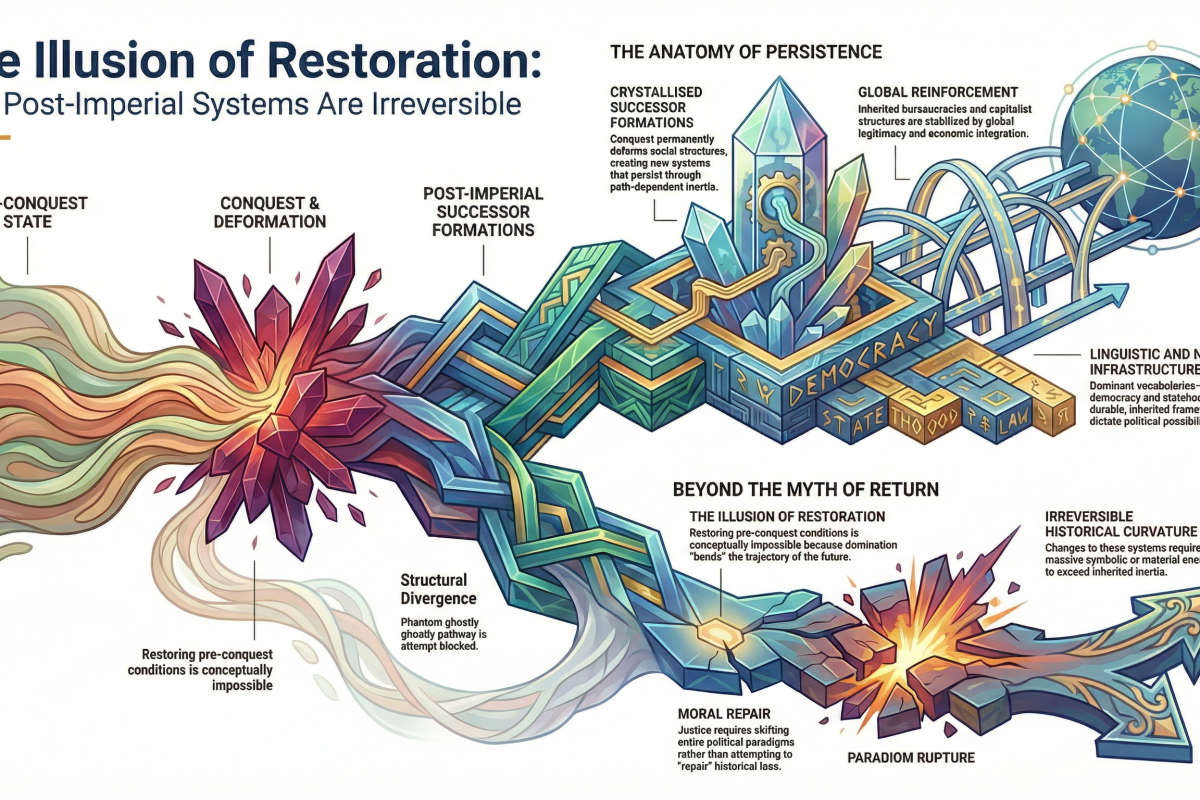
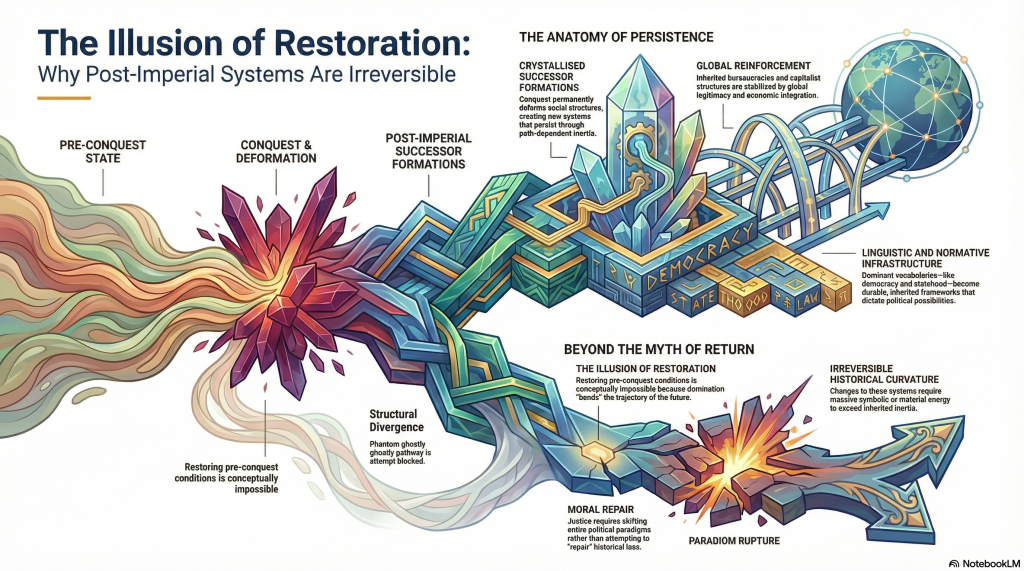
Post-imperial political orders do not restore pre-conquest social ontology but instead crystallise into historically irreversible successor formations whose institutional, linguistic, and normative structures persist through path-dependent inertia reinforced by global systems of legitimacy. Consequently, projects of restitution or decolonial restoration misrecognise the temporal dynamics of domination and must be reconceived as ethical and political negotiation within curved historical trajectories that can be altered only through paradigm-level rupture rather than moral repair.
Abstract
This argues that post-imperial political transformation cannot be understood through narratives of restoration, restitution, or completed decolonisation. Conquest generates not only territorial dispossession but durable deformation of social ontology, producing successor formations structured by inherited administrative forms, linguistic infrastructures, and normative vocabularies – most prominently democracy, capitalism, and bureaucratic statehood – that persist through path-dependent institutional inertia. These structures endure not as static remnants but as dynamically stabilised systems reinforced by global regimes of legitimacy, economic integration, and mnemonic continuity.
Against both liberal accounts of reconciliation and radical imaginaries of full decolonial return, the analysis develops a framework of historical curvature and rupture. Domination bends the trajectory of possible futures, rendering restoration of a pre-conquest condition conceptually incoherent while leaving open the possibility of paradigm-level transformation when sufficient political, material, or symbolic energy accumulates to exceed inherited inertia. Justice after empire must therefore be reconceived not as repair of historical loss but as ethical and political negotiation within irreversibly transformed temporal horizons. This reframing clarifies persistent tensions surrounding sovereignty, restitution, and legitimacy in post-imperial orders and provides a diagnostic account of why decolonisation remains structurally incomplete despite formal independence.

 Philosophics