The Illusion of the “Temporarily Embarrassed Millionaire”: How Capitalism’s Defenders Uphold Their Own Exploitation


In the contemporary world of deepening inequality and environmental degradation, capitalism continues to hold a powerful ideological grip on much of the global population. Yet the irony is that many of its staunchest defenders are not the elites or the true beneficiaries of the system, but the very workers and middle-class individuals whose lives it exploits and controls. These defenders are not capitalists themselves; they are, in fact, cogs in the machinery of a system they imagine will eventually reward their loyalty. This illusion is strikingly captured in a quote often misattributed to John Steinbeck: “Socialism never took root in America because the poor see themselves not as an exploited proletariat but as temporarily embarrassed millionaires.”[1]

This phenomenon, which we might call the temporarily embarrassed millionaire syndrome, reflects not only a profound misunderstanding of capitalism but also the effectiveness of the system in controlling its participants through hope and aspiration. Capitalism promises upward mobility, convincing even those at the bottom of the economic ladder that their current misfortunes are temporary. But as Karl Marx and Friedrich Engels observed, this is a system of exploitation that not only alienates workers but effectively destroys them.


Survivorship Bias and the Myth of the “Rising Tide”

Capitalism’s defenders frequently invoke the idea that “a rising tide lifts all boats.” The metaphor suggests that when capitalism prospers, everyone benefits. However, this vision of progress masks the reality of capitalism’s winners and losers. As economist David Harvey has pointed out, capitalism is not a neutral system of wealth creation—it is a system of accumulation by dispossession, constantly expropriating wealth from others, often through privatisation and the commodification of public goods.[2] The rising tide does lift some boats, but it simultaneously leaves others stranded, or worse, sinking.

Survivorship bias is essential to understanding how capitalism maintains its legitimacy. The success stories—the wealthy entrepreneurs, the individuals who “made it”—are lauded as proof that the system works. But the vast numbers of people left behind, those who toil in exploitative conditions or who die from poverty and neglect, are erased from the narrative. In Engels’ terms, these are victims of social murder—individuals who die prematurely not by direct violence, but through the structural forces of deprivation imposed by capitalism.[3] Their deaths are rendered invisible, falling out of the metrics of rising living standards and growth.

Engels’ critique of industrial capitalism is as relevant today as it was in the 19th century. The modern mechanisms of exploitation may be more complex, but they are no less deadly. In a late capitalist world, the poor and marginalised are still being “murdered” through the structural violence of inadequate healthcare, poor working conditions, and environmental degradation. The millions left out of the capitalist success story are not anomalies but integral to the system’s operation.


Alienation and the Tragedy of Defending the System

Marx’s theory of alienation provides another crucial lens through which to understand why capitalism’s defenders often remain blind to their own exploitation. Under capitalism, workers are alienated from the products of their labour, the process of production, their own humanity, and from each other.[4] The worker becomes a cog in a machine, detached from the value they create, and unable to control their working life. Yet, even in this state of alienation, many still defend the system, believing that their hard work will eventually lead them to wealth and freedom.

This defence of capitalism, often articulated by those whose lives it degrades, reflects Antonio Gramsci’s concept of cultural hegemony. Gramsci argued that the ruling class maintains power not just through economic domination, but by shaping the cultural and ideological landscape.[5] Capitalism’s defenders are, in part, products of this hegemony, believing in the very values—individualism, competition, the ‘American Dream’—that bind them to a system of exploitation.

This illusion of freedom under capitalism is deepened by what Herbert Marcuse calls repressive desublimation. Capitalism offers false freedoms in the form of consumer choice and superficial pleasures, giving individuals the illusion that they are exercising autonomy, even as the system remains unchallenged.[6] Workers may identify themselves in their commodities—luxury goods, tech gadgets, cars—but these objects only serve to reinforce their alienation and dependence on the capitalist system. The temporarily embarrassed millionaire clings to the dream of eventual success, all the while contributing to a system that offers only superficial rewards in return.


Social Murder and the Structural Violence of Late Capitalism

The notion of social murder offers a stark framework for understanding capitalism’s indirect, yet pervasive, violence. As Engels explained, this form of violence is not inflicted through overt means, but through the systematic neglect of basic human needs. Whether it’s the millions who die due to lack of access to healthcare or the global poor displaced by climate-induced disasters, capitalism perpetuates a form of structural violence that is invisible to those who benefit from the system’s success.[7]

The American political theorist Naomi Klein extends this analysis through her concept of disaster capitalism, where crises are exploited for profit. Whether it’s natural disasters or financial crises, capitalism uses these events as opportunities to privatise public resources, dismantle social safety nets, and deepen inequality.[8] The victims of these disasters—often the poor and vulnerable—are, in Engels’ terms, socially murdered by a system that thrives on their dispossession.


The Temporarily Embarrassed Millionaire as a Tool of Control

The illusion that one’s current position is only temporary—that any individual can rise to capitalist wealth if they work hard enough—is central to maintaining the capitalist system. This aspiration prevents individuals from seeing their exploitation for what it is. They do not identify as part of an exploited class but instead believe they are merely waiting for their turn at wealth. Zygmunt Bauman’s concept of liquid modernity—the perpetual state of instability and insecurity produced by late capitalism—helps explain this phenomenon.[9] Individuals are constantly told that their position is fluid, changeable, and that their big break is just around the corner.

But for most, this “big break” never comes. The dream of becoming a millionaire is a powerful form of social control, one that keeps individuals invested in a system that benefits only a small fraction of its participants. As Marx reminds us, “the worker becomes all the poorer the more wealth he produces, the more his production increases in power and range.”[10] Capitalism does not reward the many; it exploits the many for the benefit of the few.


Conclusion: Facing the Irony and Imagining a Post-Capitalist Future

The greatest irony of capitalism is that those who defend it most fervently are often those who will never realise its promises. These are not the capitalists of the system, but its workers, its underclass, and its exploited. They see themselves not as oppressed, but as temporarily embarrassed millionaires—an illusion that keeps them bound to a system that offers them no real future.

In this light, the true success of capitalism is not in its creation of wealth, but in its ability to mask the conditions of exploitation, alienation, and social murder that underpin it. The path forward requires a dismantling of these illusions and a recognition that the system’s failures are not accidental but integral to its design.

Only by facing these uncomfortable truths can we begin to imagine a future beyond the constraints of capitalist ideology, a world where human flourishing is no longer measured by wealth accumulation but by the collective well-being of all.


Endnotes:

[1]: Misattributed to John Steinbeck, this quote encapsulates a critical observation about American capitalism’s appeal to aspiration rather than solidarity.
[2]: David Harvey, The New Imperialism (Oxford University Press, 2005), pp. 145-147.
[3]: Friedrich Engels, The Condition of the Working Class in England (Oxford University Press, 1845), p. 112.
[4]: Karl Marx, Economic and Philosophic Manuscripts of 1844 (Progress Publishers, 1959).
[5]: Antonio Gramsci, Selections from the Prison Notebooks (International Publishers, 1971), p. 12.
[6]: Herbert Marcuse, One-Dimensional Man (Beacon Press, 1964), p. 10.
[7]: Friedrich Engels, The Condition of the Working Class in England, p. 114.
[8]: Naomi Klein, The Shock Doctrine: The Rise of Disaster Capitalism (Picador, 2007), pp. 9-10.
[9]: Zygmunt Bauman, Liquid Modernity (Polity, 2000), p. 14.
[10]: Karl Marx, Economic and Philosophic Manuscripts of 1844, p. 68.


words

Capitalism Unmasked: The New Age Slavery?

Fast forward a century. The future’s looking back, not with nostalgia but with a critical eye. Will they see our age of capitalism as we see the era of slavery – a moral misstep, a societal blight?

2023: Here we are, knee-deep in capitalism. It’s everywhere, in every transaction, every ambition. But beneath the veneer of progress and prosperity, there’s a darker narrative unfolding.


Wage Slaves in a Modern World

Wage slavery is the reality for many in a capitalist system where survival hinges on selling labour. The concept? Simple yet brutal. People are chained not by physical shackles but by economic necessity, a cycle of paycheck-to-paycheck existence. It’s freedom, but only in the loosest sense.


The Surplus of Inequality

Wage surplus – the lifeblood of capitalism. The more you squeeze out of workers, the fatter the profits. It’s a game of numbers where human cost rarely figures. The working class toil, and the upper echelons reap the rewards. Sounds familiar? It’s a throwback to the days of slavery, just dressed in modern garb.


Capitalists’ Dark Fantasy

A state of slavery – every capitalist’s secret fantasy? Perhaps not all, but for the ruthless, it’s the ultimate dream. A world where workers are mere cogs in the machine, dispensable and replaceable. No rights, no voice, just endless labour for minimal reward.


The Capitalist Paradox

Here’s the paradox – capitalism, in theory, champions freedom and innovation. But in practice, it often veers towards oppression and exploitation. The gap between the haves and have-nots widens, and social mobility becomes a myth, reserved for fairy tales.


The Future’s Judgment

In 2123, will they shake their heads at our era? Will they wonder how we allowed economic systems to morph into modern-day slavery? How we sold our souls for the illusion of prosperity?


A Glimmer of Hope?

But the tide is turning. Voices of dissent are rising, challenging the status quo. The call for a fairer, more humane economic model grows louder. There’s hope yet that we’ll steer away from the shadow of capitalism’s excesses.


Conclusion

As the world spins on, we’re at a pivotal moment. Will we continue down this path, or will we pivot towards a more equitable future? The choices we make today will echo through the annals of history.


Call to Action

What’s your stance? Is capitalism veering too close to a modern form of slavery? Drop your thoughts below. Let’s ignite a dialogue.

Path to the Fall

By fall, I don’t mean autumn except perhaps metaphorically speaking. The accompanying image illustrates a progression from the pre-Enlightenment reformation and the factors leading to the Modern Condition and increases in schizophrenia in people, societies, and enterprises.

Podcast: Audio rendition of this page content.

This image is essentially composited from a later chapter in Iain McGilchrist’s The Master and His Emissary. In it, he outlines a path that commences at the Reformation that led to Lutheranism and Protestantism and further to Calvinism (not separately depicted). Max Weber argued that Capitalism is inextricably linked to Calvinism and the workmanship ideal tradition.

McGilchrists argument is founded on the notion that Catholocism is a communally oriented belief system whilst Protestantism is focused on the individual and salvation through personal work. The essence of capitalism is the same.

Of course, history isn’t strictly linear. In fact, there are more elements than one could realistically account for, so we rely on a reduction. In concert with the Reformation but on a slight delay is the so-called Age of Enlightenment, the Age of Reason, which led not only to faith in science but then to the pathology of Scientism.

This Protestant-Scientismic nexus brought us to Capitalism and into the Industrial Revolution, where humans were devivified or devitalised, trading their souls to be pawns to earn a few shekels to survive. Capitalism and the Industrial Revolution led to Marxism, through Marx’s critique of Capitalism, but Marxism has the same fatal flaw as Capitalism inasmuch as it doesn’t view people as humans. It does afford them a slightly higher function as workers, but this still leaves humanity as a second-tier aspect and even historicity is elevated above as a sort of meta-trend or undercurrent.

From there, we transition to Modernity, which yields the modern condition and schizophrenics in one fell swoop. This is no coincidence.

Although I end this journey at Modernism, McGilchrist is also leery of the effects of post-modernism as well as philosophy itself as overly reductionist in its attempts to categorise and systematise, valuing signs and symbols over lived experience. His main complaint with postmodernism is that it moves from the objective perspective of Modernity to the subjective perspective, and so there remains no base foundation, which is the shared experience. I’m not sure I agree with his critique, but I’m not going to contemplate it here and now.

In the end, this journey and illustration are gross simplifications, but I still feel it provides valuable perspective. The challenge is that one can’t readily put the genie back into the bottle, and the question is where do we go from here, if not Modernism or Postmodernism. I shouldn’t even mention Metamodernism because that seems like an unlikely synthesis, as well-intentioned as it might be. McGilchrist gives examples of reversals in the trend toward left-hemisphere bias, notably the Romantic period, but that too was reversed, recommencing the current trajectory. My feeling is that if we continue down this dark path, we’ll reach a point of no return.

It seems to be that it’s growing at an increasing rate, like a snowball careening down a slope. It not only drives the left-dominant types further left because an analytical person would reinforce the belief that if only s/he and the world were more analytical things would be so much better—even in a world where net happiness is trending downward—, but it also forces this worldview on other cultures, effectively destroying them and assimilating them into the dark side, if I can borrow a Star Wars reference.

Epilogue

I wasn’t planning to share this story—at least not now. In another forum, I responded to a statement, and I was admonished by Professor Stephen Hicks, author of the book of dubious scholarship, Explaining Postmodernism.

I responded to this query:

If you’re a single mother and have a son I’d suggest putting him in a sport or martial arts to add some masculine energy to his life. It’s not a replacement for the actual father but it can help instil structure and discipline into the core of his being.

— Julian Arsenio

“Perhaps this world needs less discipline and structure, not more,” was my response, to which Hicks replied.

The quotation is not about “the world.” It is about boys without fathers. Evaluate the quotation in its context.

— Stephen Hicks

“Disciplined boys create a disciplined world. Not a world I’d prefer to create or live in. We need more right-hemisphere people. Instead, we are being overwhelmed by left hemisphere types, leading to Capitalism and the denouement of humanity as it encroaches like cancer, devouring or corrupting all it touches.

“In the end, it is about the world, which from a left hemisphere perspective is a sum of its parts. Right-hemisphere thinkers know otherwise,” was my reply. He responded,

You seem to have difficulty focusing. From a quotation about fatherless boys you free associate to [sic] weird psychology and global apocalptic [sic] pessimism. Pointless.

— Stephen Hicks

“I’ll suggest that the opposite is true, and perhaps you need to focus less and appreciate the Gestalt. This was not free association. Rather, it is a logical connexion between the disposition of the people in the world and lived reality.

“Clearly, you are a left-hemisphere structured thinker. The world is literally littered with this cohort.

“I suggest broadening your worldview so as not to lose the woods for the trees. I recommend Dr Iain McGilchrist as an apt guide. Perhaps reading The Master and His Emissary and/or The Matter with Things would give you another perspective. #JustSaying”

His final repartee is,

And still, rather than addressing the issue of fatherless boys, you go off on tangents, this time psychologizing about people you’ve zero first-hand knowledge of.

— Stephen Hicks

Feel free to interpret this as you will. For me, his attempt to limit discussion to some notion he had in his head and his failure to see the woods for the trees, as I write, suggests that he is a left-brain thinker. Having watched some of his videos, whether lectures or interviews, this was already evident to me. This exchange is just another proof point.

I considered offering the perspective of Bruno Bettleheim’s importance of unstructured play, but as is evidenced above, he is not open to dialogue. His preference appears to be a monologue. This is the left hemisphere in action. This is an example of how insidious this convergent thinking is, and it makes me worry about what’s ahead in a world of people demanding more structure and discipline. Foucault’s Discipline and Surveillance comes to the forefront.

Justice and Intent

When discussing the topic of justice, besides the element of the event of offence, another element is typically intent. In this case, a father inadvertently left an infant in his car. He was supposed to drop the child off at daycare but forget and instead drove directly to work. The temperatures were hot, and this contributed to the death of the child. Upon discovering this, the father suicided.

I have copied the story below in full, as these things have been known to go missing every now and again.

A Virginia father died by an apparent suicide after finding his child dead inside his hot car, authorities said.

It appears the father accidentally left the 18-month-old in the car for at least three hours on Tuesday, leading to the child’s death, Lt. Col. Christopher Hensley of the Chesterfield Police Department said at a news conference.

When the child didn’t arrive at daycare, the father apparently realized the toddler was in his car, Hensley said.

Around noon, family members called police to report that the father was talking about dying by suicide in the woods behind his house. The father was the only person home at the time, Hensley said.

Responding officers found the car in the driveway with an open door and an empty child seat, Hensley said.

Officers went into the home where they found the dead 18-month-old, he said.

As officers continued to check the perimeter, they found the father dead in the woods from an apparent gunshot wound, he said.

Hensley called it a “horrible tragedy on so many levels.”

This marks the eighth child to die from a hot car this year, according to national nonprofit KidsAndCars.org. More than 1,000 kids have died from hot cars since 1990, the organization said.

Click here for tips on how to keep children safe from hot cars this summer.

ABC News

An interest of mine is justice, hence this post. I’ll get to that, but there is also a narrative of social priorities to extract from here, too.

The first is that we live in a society where 18-month-olds almost need to be separated from their family. Of course, the privileged can defend that they have sitters or au pairs or nannies. In the past, there were extended families and Clinton’s Village. Each has its plusses and minuses. I am not a fan of the idea of women serving as baby factories, pumping out babies and serving their plight as wage slaves, but that’s not my call. I also understand that raising children is not the most mentally stimulating activity, but that’s beside the point.

In this case, the father was more focused on getting to work than the welfare of his child. And given the outcome, it’s obvious that he had feelings for the child—although perhaps it was more the fear of the repercussions of being blamed. One can’t know for sure, but I’ll opt for the charitable rendition.

Let’s return to justice. Justice is the sense that one gets one’s just desert, but what is just and what is desert? In the artificial form of justice purportedly practised by lawyers and jurists, this man would not likely be held responsible for legal reasons without even having to plumb the depths of philosophical reasons.

It’s been said that karma operates with three levers:
intent, action, and reflection.

In this case, intent appears to be absent and reflection seems to be apparent in the outcome. The action was the lost life of an infant, a human life. Equally weighted, he’d be one step back and two steps forward, so his register would not be in the black. But this is not how he judged himself.

Even given the karmic model, it’s easy to imagine the reactions. As easy as it is for me to sit back behind my keyboard and be dispassionate, I can imagine the mother not being so reserved. Humans are blame-machines. I’ve been spending the past three or four months researching this topic peripherally with a focus on human agency, but in a reductionist model, humans seem to need to blame. And if there is no object, they have no qualms about making one up. Humans are good storytellers—more so, story-receivers—, but let’s not get distracted. He knew he would be blamed. Not least of all, he blamed himself.

Although I don’t subscribe to the notion of self—or even of intent—, it seems obvious that this father did. I can’t imagine how I’d feel if this were me—and I don’t want to try. But let’s not lose sight of the complicity of society that forces humans to make a choice between family and survival.

Still a Slave

“Wage slavery is not the same as slavery, and this diminishes the experience of plantation slaves in the antebellum Southern US states” is a sentiment I’ve heard repeated over the years.

I’ll argue that it is the same. Saying wage slavery is like when the then-president of the United States, Bill Clinton, denied that oral sex was sex despite it being an obvious part of the name. When one says wage slavery is still slavery, s/he is making a commentary on the lack of agency, a lack of personal control. That the worker has a choice over which master to slave under is hardly a consolation. That a plantation slave has a choice of picking cotton or tobacco is of no consequence.

To disqualify wage slavery as slavery is to disqualify a 3-month pregnant woman as being not as pregnant as a 6-month pregnant woman. One might be closer to term, but they are equally pregnant.

That a plantation slave may have had less freedom and run the risk of physical beatings, torture, or even death is a sad commentary. That they may have separated from their families and have no autonomy is a matter of degree.

The slavery connexion occurs where the human needs to comply. Sure, a wage slave can opt out and live as a transient—ostensibly homeless; perhaps s/he can home-surf. Perhaps s/he can beg or live off the land.

Wage slavery is not the same as slavery

To me, the common missing element is to be able to operate as a functioning society, that as communities, we might contribute however we see fit. Of course, that narrative will quickly provoke an appeal to Tragedy of the Commons. People are selfish and act only in their own self-interests. And this is accepted uncritically as fact rather than evaluating whether this worldview is a consequence of Modernity or Capitalism, whichever nomenclature one has opted to adopt.

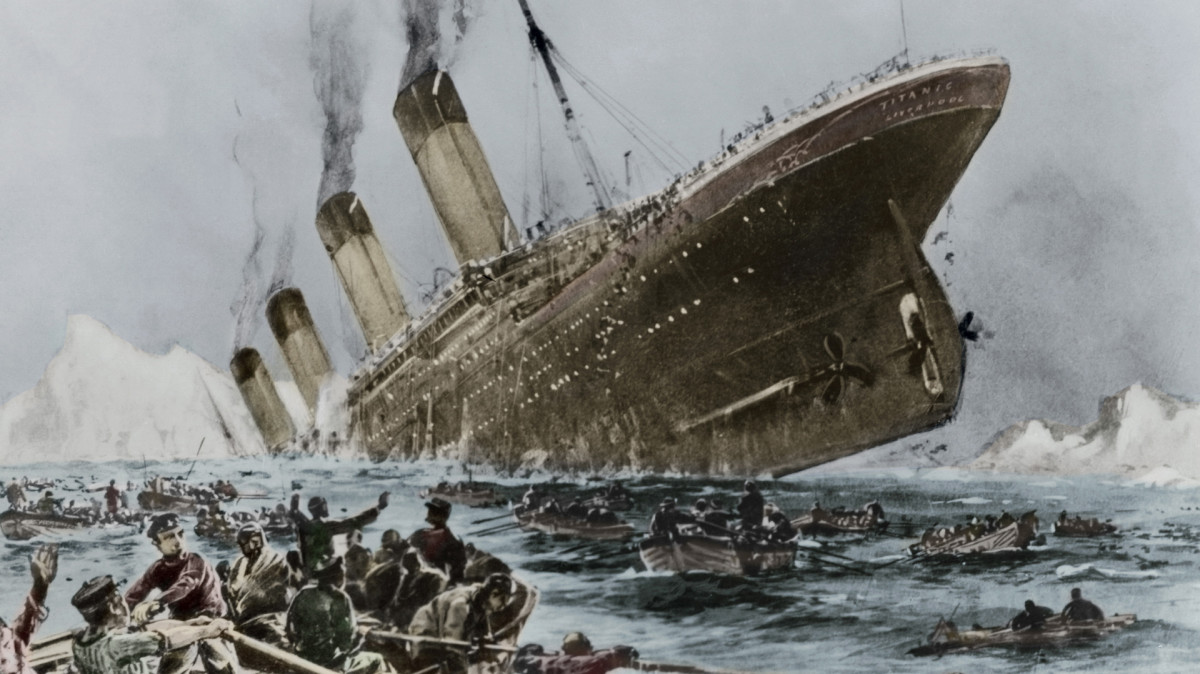
Wage slavery is slavery. Depending on the information source bout 50 per cent of Americans are a paycheque away from needing to deplete savings to survive; some have assessed a single paycheque from homelessness without intervention. One paycheque from poverty. Over two-thirds of Americans have been living paycheque-to-paycheque since the Covid-19 pandemic hit. If this describes you, it likely provides little solace that you are not alone. Who on the Titanic was relieved to know that other people shared their plight? Is there a silver lining for those who are paid fortnightly or monthly? And God forbid the ones whose paycheque arrive daily—perhaps in cash from the till.

Research from the Federal Reserve found that 4 in 10 Americans couldn’t afford a $400 emergency, and 22 per cent say they expect to forgo payments on some of their bills. It’s not much better in the UK, where the runway appears to end at 2.5 months rather than 1, although about two-thirds of renters would expect to make it more than a month.

Slavery, like turtles, all the way down. Just be thankful the worst that can happen is that one starves to death or pursues the life of Valjean. Dissociating wage slavery from plantation slavery is like separating the abbatoire from the butcher’s shop. When you’re the chattel it makes little difference.

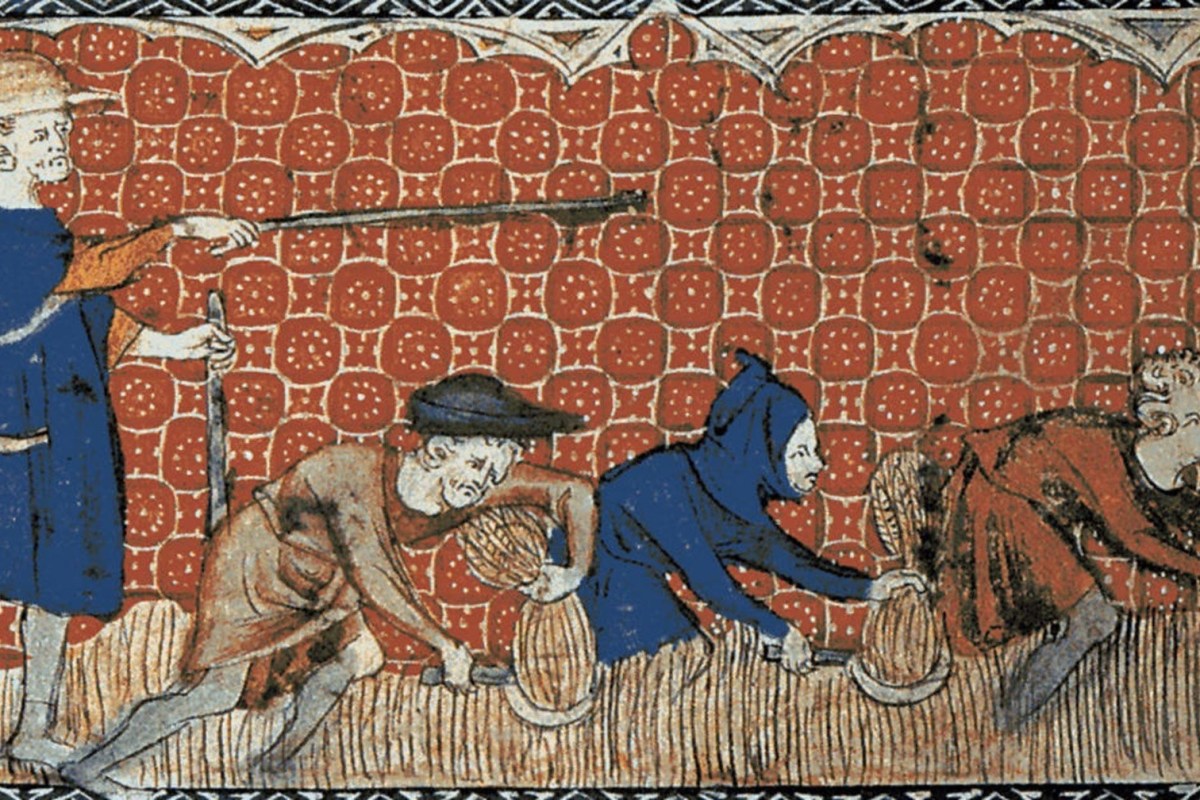
Neo-Feudalism

It seems that Capitalism took a wrong turn and is retracing The Road to Serfdom. Hayek worried about government intervention in business, but he did not imagine a world where corporate leaders would grow large enough to not only be able to control government power through money and influence, but it could actually ignore governments altogether—or at least to a large extent.

The last time government was challenged at this level was by the Church. In the end, it resolved into a tenuous stalemate. But this next conflict will be ostensibly bloodless, opting to be fought with political weaponry.

serf master cap

To the workaday people, it doesn’t change much. Denial is an interesting bed partner anyway. As most deny being wage slaves, they now just deny being serfs. In their minds, they are free, just inches from the goal line. I’m not the one to break it to them that the goal line away from in inches is the wrong one. They’re an entire field’s length to reach their goal. Thank goodness for denial and mechanisms that assuage cognitive dissonance. Ignorance is indeed bliss.

For some, the COVID response doubled down on the transition from Capitalism to Communism. For others, it was a reinforcement of the strength of Capitalism—and if in the milieu of fighting between authoritarians and Libertarians. But the phoenix rising from the dust—hardly flames—seems to rather be a sort of neo-feudalism. This seems to be a more likely future than Capitalism in a nation-state world. I assume that Nation-states will continue to exist, but they will serve only to contain the commoners, the ones who can’t afford to escape the fetters.

I don’t have much to add to the discussion at this time, but this article sums up some of my perspectives. My question is how the Capital aspect is extricated from the system. The serf part is easy.

Equality. Equity. Egality.

I can’t count how many times I’ve seen takes on this equality versus equity meme. One appeared on by LinkedIn feed this morning and I wanted to comment. I thought I’d have posted on this before and wanted to link to it. If I did, I couldn’t find it, so here’s a fresh accounting. I searched Google for the original image and cobbled together my own versions, if only for visual continuity.

 L’homme est né libre, et partout il est dans les fers.

Jean-Jacques Rousseau
Social Equality vs. Equity Meme

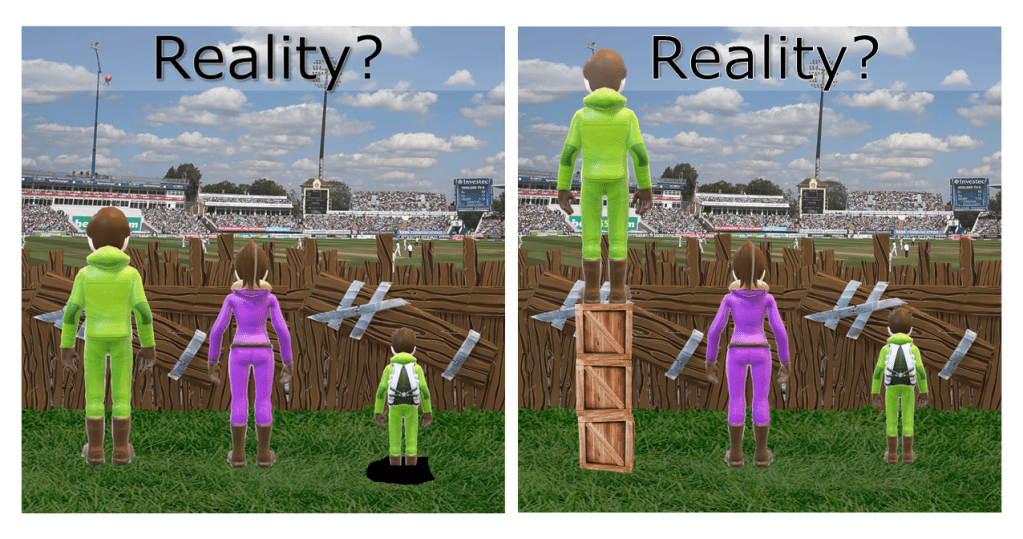
The meme renders something like this:

There are two frames being compared—equality and equity. In both, we see three people trying to view an event, but a barrier obstructs their view. The people are of different heights—tall, medium, and short—, metaphorically representing some intitial social status.

In one we see a representation of equality. In the spirit of equality, each person has one crate upon which to stand. This represents equality of condition. Each person is ensured to start the game on equal social footing. At a glance, it’s easy to discern that this intervention allows two of the people to see the event but leaves one of the three at a disadvantage and unable to view.

In the other, we see a representation of equity. In this frame, we see the same three people and a redistribution of the three crates. Equity is more in tune with equality of opportunity if not of outcomes. The taller person who had been standing on a crate had no need for it as he was tall enough to see over the barrier without it. The mid-size person, who could see the event with the crate but not without it, retained the crate. The shortest person was given the crate from the tallest person, now standing on a stack of two. The result is that each of the three people can now view the event unimpeded.

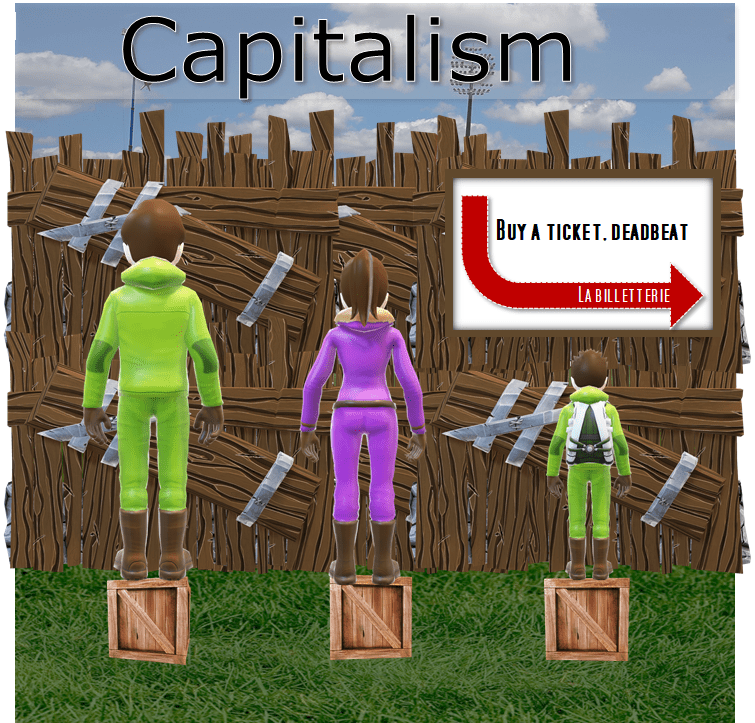
This comparison is such a nice conversation starter. It’s a hot button topic for some—and I’ll get to that presently. For me, it illustrates the concept of framing. There are several things left out of frame—at least one literally. In this meme, we are given a binary frame, but we can pull the shot back and there’s a third option: egality. This term has fallen out of favour in English, but the French retain it—égalité. In this frame, there is no need for crates, and the plank barrier is replaced by a chain-link fence.

Social Equality

Yet there’s the matter of metanarrative device. Why should there be any barrier? Why focus on these three in the foreground? Do the seated people represent the haves and those standing represent the have-nots? Might we interpret this as bourgeois versus proletariat with the focus on the struggle between the prols distracting from the broader issue? —being further distracted by the circus event? Have we lost the forest for the trees?

As it happens, people along the way have inserted their own social commentary through like-memes. I’ve similarly reconstructed these.

Societal Common Ground

In the beginning there are no crates. They are simply a device. At the start, only the tallest person can see over the barrier. At some point three crates appear ex nihilo and each person obtains one as depicted in the equality of condition frame, which leaves one of our participants better off and the other in no different of a social status, though a bit off the ground in the event of flash flooding. Small wins.

Past Burdens and Generational Wealth Transfer

Some shared the opinion that at least we all start on common ground, and yet others—likely Left- or Liberal-leaning—propose that some people start in a hole. Others might have noted that whilst some start out in a hole others start out with inherited boxes—or houses or networks—showcasing the transfer of generational wealth . Another might be able to view if there was a crate available. Given the negative starting place, the third would likely require three boxes to be on par to view, so even a redistribution of the three boxes would be insufficient.

For my first diversion, I’d like to spend a few moments defending a common response for the Right and Libertarians. Firstly, no one who supports this level-setting is suggesting that the advantaged be put into a hole like the disadvantaged. Nor is anyone asking for The Prince and the Pauper treatment where they trade places. This is a silly attempt at a strawman attack. Secondly, in a similar vein, no one is asking for the best off to relinquish everything and now be unable to see whilst the meek inherit the earth. As if that could ever happen.

Some people were overly optimistic—presumably representing the ‘if some is good, more must be better’ contingent. Why don’t we give everyone two boxes? Aside from the fact that only three are necessary for everyone to view the event, there was no mention where the original three crates came from let alone these additional three. I suppose they might have fashioned them from the fence. Who knows? But this leads us into contributions from the advocates of Capitalism.

Capitalism: Libertarian Vantage

Let’s chalk this up to the Right can’t meme syndrome. To this cohort, Capitalism is the solution. In fact, there will be more crates than one could possibly use. A rising tide rises all boats—and crates. None are left behind. In fact, this is what Capitalism is known for. Of course, this suffers from several cognitive biases: survivorship, selection and availability. But who’s really counting?

For this less fond of Capitalism, this illustrates excess and waste. We needed three crates, yet we produce over thirty. Moreover, these less-fond likely also notice a capital distribution challenge with Capitalism.

Capitalism: Democratic Vantage

The prevailing view by one cohort is that some of the excess crates ‘owned’ by the tallest person should be redistributed whilst the polar perspective holds that this person ‘earned’ those crates and is entitles to keep them. And why can’t that woman just hold her child so he can see? Don’t get me started.

Capitalism for Sale

You really do have to love Capitalists. The solution is always ‘you just have to pay for it. Duh’. Without going too far off track, many of these people—likely vastly most of them—can’t afford what they want, yet they stand by this mechanism.

Socialism Kills

Some people who despise Socialism have a rather macabre perspective on how socialism operates. To them, equality can only be acheived via some Harrison Bergeron mechanism—primarily because they choose not to distinguish between social and physical equality. And maybe they are simply sadistic and enjoy watching people suffer.

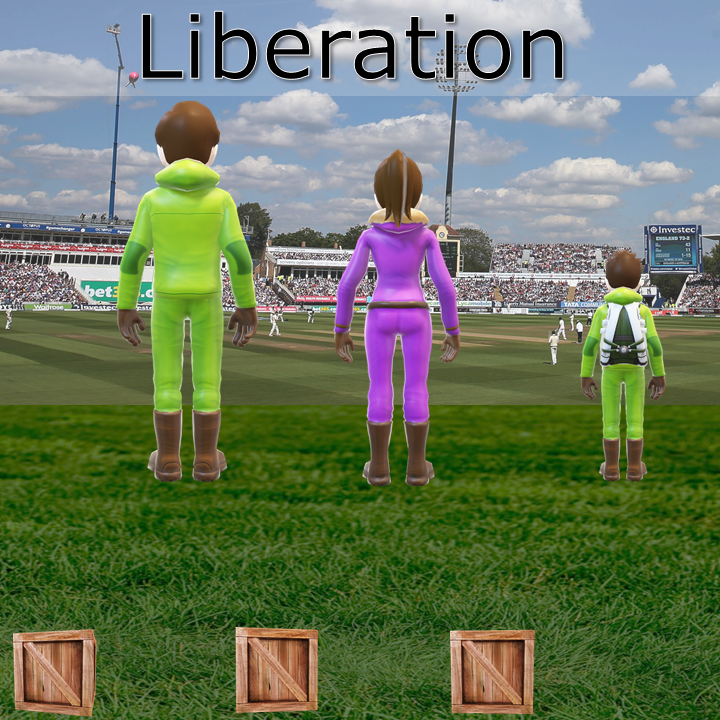
My personal favourite is the one for liberation.

Liberation is Liberating

We don’t need no fences. No barriers. No boundaries. Sit on the boxes. Fill them with food for the hungry.

But in the end, if all you are fighting for is free access to cricket matches and other circus events, you aren’t really liberated anyway. You are the slave that Rousseau wrote about, ‘Man is born free but everywhere is in chains’.


Disclaimer: For the record, I have been using the term, Capitalism idiomatically equivalent to a market economy because Americans just don’t want to separate them. I think they feel that if they can pretend they are the same, that criticising Capitalism would be tantamount to criticising market economics. This is wrong on so many levels, but, at least in North America, the terms are inextricable. The fact that Capitalism is a means of production, and the other is a distribution mechanism, people—from syndicalists and worker coöperatives to Mercantilists, tradesmen, and craft-workers—could choose to distribute goods and services through a market system without consequence. It’s not even worth expending a breath. Even English dictionaries have given up and conflated the concepts. Economic textbooks are the last bastion of academic sanity.

Corporate Religion

In bygone days, national governments asserted power and prevailed over relgion, in essence forming a ceasefire partnership that has, save in pockets, pretty much held fast in most of the Western world. Religion is still somewhat of a factor in many corners — in some circles dominant —, but the latest challenger are the acquisitive corporate defenders: multinational (wannabe supernational) entities, whose aspirations of dominance is stifled by the prevailing power structure.

As many in government are Capitialist converts, they each and collectively have an Achilles heel, as captured by the adage probably misattributed to Lenin, ‘The capitalists will sell us the rope with which to hang them’.

The capitalists will sell us the rope with which to hang them.

not Vladimir Ilich Lenin

Contemporary politics see the orgy of strange bedfellows and the slow poisoning of Democracy by lobbyists and their palliative care of the deligates of the People. Some of the polis see this and react in horror to decisions such as Citizens United in the United States, as more and more foxes are voted into the hen house — and wolves into Congress. This is not limited to the United States.

Along the way, some government officials attempt to cozy up to the predators to enriched themselves personally at the expense of their citizenry and on the way to the killing floor. They’ll have been fattened by scraps, only to be consumed in the abbatoir. In some cases — perhaps many — the leaders are themselves part of this acquisitive class, so they are not in particular need of a country.

Even if the acquisatives are aware that they’re destroying the host and the structure that invented them, these petulent progeny run roughshod anyway. But the permissive parents don’t wish to bite the hands that feed them.

So far, the acquisitive corporatists have been able to snuggle up with the ruling class, and this class perceives themselves as being part of this class. Most aren’t. They are entourage at best — pathetic sycophantic hanger-ons. Once they realise that they are not members of the club and try to wrest control, the real fight will commence, but it will likely be too little and too late. The real losers will be the people, no longer having evern the semplence of protection. Libertarians will finally see that their dream was a nightmare from the start.

And then we await the next paradigm shift.

Backstory

What prompted this post?

A colleague on Facebook posted a Scientific American article about oversimplification of sex determination in response to a transphobe, and Facebook took it down. Having had a couple similar responses myself, I have come to the conclusion that Facebook and the other social media giants need external governance. I don’t want to endure what ass hats like Donald Trump have to say any more than the next person, but this censorship needs to happen in a different way. Given my perspective on Truth, we need to assess how best to keep devisive speech in control. In some cases, these people are simply lying. They claim that I didn’t say that, wasn’t with that person, wasn’t in that place, and so on when these are all demonstrably false. This is not generally illegal behaviour.

When Trumps says, I’ll be president again in August, or I’ll be Speaker of the House, this is a prediction. It’s like saying, ‘This is the winning lottery ticket’. Language allows for this speculative hyperbole. Again, bad form and taste are not illegal. Even if some assclown riles up some portion of the populace, who’s to say whatever they’re hawking isn’t for some future greater good at the expense of some near-term disruption.

I’m rambling. The point is that the overreach of Facebook is just another instance of corporations taking power into their own hands and uncontested. It will come to a head. Perhaps not in my lifetime, but mark my words.

The Problem with Sex Work is Work

I just happened across this article from almost a year ago. It fits into my worldview that the fundamental issue with prostitution and other forms of so-called ‘sex work’ is the concept of work itself. As humans in a Capitalist (or even Socialist) system, we are conscripted into employment.

Rousseau or Locke may have called this a social contract, but I never signed it, and still I am forced to accept the terms and conditions.

I’ve been quite busy working to survive, so I don’t have time to comment, save to say that I agree with the major concepts, as I have written previously here, here, here, and here.

Arguing against Prostitution

TRIGGER WARNING: This post is about sex and prostitution and includes words and images not necessarily appropriate for the self-righteous.

If this describes you, avert your eyes.

The Holy Water, It Burns

I stumbled across another blog site advocating the Nordic (anti-prostitution) Model, which in a nutshell makes it illegal to buy but not ‘sell’ sex.

On the positive side, the advocates of this model pretty much all adhere to the same talking points. On the negative side, there are only weak strawman arguments , moralising, and anecdotes. Any studies referenced are limited in scope and with dubious rigour.

In this case, I (again) pointed out that the core of the argument was one against Capitalism, and (again) the response was that it is (somehow) more than this—because, well, things…moral things.

Interestingly, the site is named Your Social Construct Is Showing, but it seems her complaint is not about social constructs in general; rather, she doesn’t appear to like any social construct she doesn’t agree with—and without recognising the irony in claiming to understand the constructed nature of society whilst also claiming that her construction is somehow better—because, well, things…just things. She’s got some subcultural metanarrative running through her head, and, by God, it’s got to be the only valid one.

I’ve written on this before, but the primary argument is that sex work is not work—otherwise, they wouldn’t have to label it as work. It sort of employs the same logic that oral sex is not sex for the same reason—because reasons.

The next angle is to conflate prostitution with sex trafficking, just hoping no one will notice the redirection. Then they try to muddy the waters with other issues such as exploited, underage subjects as if there is some parallel between these cohorts and women who choose this line of work.

Example of an advertisement by a sex worker

So, to be fair and not fight strawmen like Cammy, I’ll comment on a Logos blog she posted in a response to me. She seemed to be impressed with it. After a rambling preamble, the post gets to its points:

Worker safety: Sex Work does not comply with OSHA rules.

Sexual Harassment: ‘unwelcome sexual conduct that is a term or condition of employment’

Civil Rights: Slavery used to be illegal, and now it isn’t. Prostitution is like slavery.

Without devoting more than a passing moment to remind the reader that workplace safety and sexual harassment rules are social constructs that vary by place and time. OSHA is relevant in the United States of America and nowhere else. Let’s address these in turn:

The Logos post cites various OSHA rules and attempts to rationalise how sex work would be non-compliant.

1

Worker Safety

Mouth pipetting/suctioning of blood or other potentially infectious materials is prohibited

The author (attributed as Lori Watson) points out that ‘this doesn’t say is permitted with protective gear. It says prohibited.’ The line of argumentation here is seemingly that semen is a potentially infectious material and so is prohibited. What she fails to note is that suctioning is not the purpose of oral sex, and with a condom, no suctioning could happen anyway.

Gloves shall be worn when it can be reasonably anticipated that the employee may have hand contact with blood, other potentially infectious materials…

If the punter is wearing a condom, it cannot be reasonably anticipated that the employee would be in contact with [semen].

Masks, Eye Protection, and Face Shields. Masks in combination with eye protection devices, such as goggles or glasses with solid side shields, or chin-length face shields, shall be worn whenever splashes, spray, spatter, or droplets of blood or other potentially infectious materials may be generated…

Again: Condoms obviate this need.

Gowns, Aprons, and Other Protective Body Clothing. Appropriate protective clothing such as, but not limited to, gowns, aprons, lab coats, clinic jackets, or similar outer garments shall be worn in occupational exposure situations. The type and characteristics will depend upon the task and degree of exposure anticipated.

Ditto: Condoms

In the event of exposure, OHSA requires: “The source individual’s blood shall be tested as soon as feasible…

OK

This part of the post closes with a comment that many [note: weasel word] punters do not prefer condoms.

2

Sexual HARASSMENT

Since the definition and expressed purpose of prostitution is ultimately an exchange of sexual services for remuneration, it seems that a person waives this protection. There is much precedence of this occurrence.

Case in point. In the United States, citizens are protected by the Constitution and its Amendments. These documents contain inalienable rights (as established by the Declaration of Independence), yet these rights are abridged (waived) in many instances—military service being the most notable, where members do not have the right to free speech, peaceable assembly, to carry a weapon (except as specifically allowed), due process, and on and on.

3

Civil Rights

The response here is a deluxe word salad, so I’ll break it down slowly.

If sexual autonomy is to mean anything, it has to mean the right to refuse sex with anyone, at any time, for any reason. 

Indeed. And the woman can refuse service and refund the fee. If I am a fast food worker, I can forego my wages and my job if I no longer wish to do it. Try to do that in the military. Indentured servitude, you ask? Why, yes. I do believe you’d be correct.

[As] a regulated commercial exchange, the “providers” are cannot be legally free to refuse clients in protected classes on grounds of their membership in the protected class.

Indeed. If I were a lawyer and refused to service a member of a protected class, I would likely be disbarred. This said, the sex worker could choose another profession. In my experience, many sex workers exclude various classes of people they do not prefer to service.

Below are some images I found whilst performing a Google search. Notice that the provider advertises her boundaries and limitations.

This one makes it clear that she does not provide unprotected services or anal sex and does not accept African-American (AA) customers under 35 years of age.

No BB – No Greek – No AA

This ad makes it clear that she only practices safe sex (No BB (bareback), including no BB oral sex) and will not provide Girl Friend Experience (GFE).

No BBBJ

Again, this provider does not service African American men of any age and does not require protection for oral sex, but she only services from her own location.

BBBJ Friendly – No AA

So at the end of all this, I stand by my original position that there is no argument to have beyond ‘boo hoo. I don’t like prostitution and neither should you. I can’t come up with a cogent argument, so I’ll shout into an echo chamber where my friends and allies will cheer me on, but critical thinking need not apply because reasons and things…lots of them.