Besmet, a Belgian psychologist with a background in statistics, begins not with tyranny but with epistemology – with how the Enlightenment’s dream of objectivity curdled into the managerial nightmare we now inhabit. The first half of the book reads like a slow unmasking of Scientism: how numbers became our gods, and graphs, our catechisms.
Written before COVID-19 but finished during it, his argument turns pandemic data into theatre – a performance of certainty masking deep confusion. The daily tally became ritual sacrifice to the idol of ‘evidence-based’ policy. His point, and mine, is that totalitarianism no longer needs gulags; it thrives in dashboards and KPIs.
Desmet’s frame intersects beautifully with my own thesis: that obedience today is internalised as reasonableness. Freedom has been recast as compliance with ‘the data’. We surrender willingly, provided the orders come in statistical form.
This is why even Agile™ management and its fetish of ‘velocity’ reek of the same mechanistic faith. Every sprint promises deliverance through quantification; every retrospective is a bureaucratic confession of inefficiency. The cult of metrics is not merely a managerial fad – it is the metaphysics of our time. The problem is at once ontological and epistemological: we mistake the measure for the thing itself, and in doing so, become measurable.
It’s a rare pleasure to encounter a fellow dissident of the numerical faith – a man who sees that the spreadsheet has replaced the sceptre.
I wrote and published this article on LinkedIn. I even recycled the cover image. Although it is about the particular topic of Agile, it relates to the Language Insufficiency Hypothesis, so I felt it would be apt here as well. It demonstrates how to think about language insufficiency through the framework.
Agile in Name Only
For over two decades, I’ve been immersed in Agile and its myriad interpretations. One refrain has persisted throughout: Agile™ is “just about agility,” a term that anyone can define as they see fit. The ambiguity begs the question: What does it really mean?
On its face, this sounds inclusive, but it never passed my intuitive sniff test. I carried on, but as I reflected on my broader work concerning the insufficiency of language, this persistent fuzziness started to make sense. Agile’s conceptual murkiness can be understood through the lens of language and identity—particularly through in-group and out-group dynamics.
Otherness and the Myth of Universality
To those who truly understand agility, no elaborate definition is required. It’s instinctive, embedded in their DNA. They don’t need to label it; they simply are agile. Yet, for the out-group—the ones who aspire to the status without the substance—Agile™ becomes a muddy abstraction. Unable to grasp the core, they question its very existence, claiming, “Who really knows what Agile means?”
The answer is simple: Everyone but those asking this question.
The Agility Crisis
This disconnect creates a power shift. The in-group, small and focused, operates with quiet competence. Meanwhile, the out-group, larger and louder, hijacks the conversation. What follows is an inevitable dilution: “Agile is dead,” “Agile doesn’t work,” they declare. But these proclamations often reflect their own failures to execute or evolve, not flaws inherent to agility itself.
This pattern follows a familiar playbook: create a strawman—define Agile™ as something it’s not—then decry its inability to deliver. The result? Performative agility, a theatre of motion without progress, where the players confuse activity for achievement and rely on brittle, inextensible infrastructures.
Agile Beyond the Label
Ironically, the true practitioners of agility remain unbothered by these debates. They adapt, innovate, and thrive—with or without the label. Agile™ has become a victim of its own success, co-opted by those who misunderstand it, leading to a paradox: the louder the chorus claiming “Agile doesn’t work,” the more it underscores the gap between those who do agility and those who merely wear its name.
The lesson here is not just about Agile™ but about language itself. Words, when untethered from their essence, fail. They cease to communicate, becoming tools of obfuscation rather than clarity. In this, Agile™ mirrors a broader phenomenon: the insufficiency of language in the face of complexity and its misuse by those unwilling or unable to engage with its deeper truths.
Children are ethically indisposed to think it’s wrong to eat animals. This article from the Journal of Environmental Psychology published a year ago looks into the schism and cognitive dissonance assuaging mechanisms in play.
This study relied on a small sample size (n=176), between the ages of 4 and 7 years living in a metropolitan area located in the southeastern region of the United States. The sample was otherwise diverse.
As this study was limited in geographic scope (see WIERD on a tangential note), it noted that eating habits vary by culture. For example, eating horse (or dog) meat is not condoned in the United States, but it is acceptable in many other places.
In summary, the childer were shown cards each with a picture of an item, whether a French fry, a horse, a cat, a fish, a tomato, and so on. At the start, they were asked to identify the item represented on the card. Next, they were asked to put the card into one of two bins, each decorated to approximate an animal or vegetation. Finally, they were asked to sort the cards into two areas, one represented by false teeth indicating edible products and a rubbish bin representing inedible items.
The subjects did a fair job of identifying the card items. They had very high image recognition of these particular animals. On the lower end of recognition were hamburger (ground beef patty), almonds, and shrimp. There was a difference between the older children and the younger children, but this may relate to the added acculturation their age would bring.
Without delving deeply into details, in this study, most 6- and 7-year-olds classified chicken, cows, and pigs as not OK to eat. The interesting cognitive trick is that these children also classified these derivative food items as non-animals thus removing the cognitive dissonance. No longer classified as an animal, their ethical framework remained internally coherent.
In discussing the results, many children were ill-informed about the source of various food products. Language games obscured the source. No one should eat a cow, but beef is fine—a hamburger is fine. Hot dogs grow on trees, don’t they?
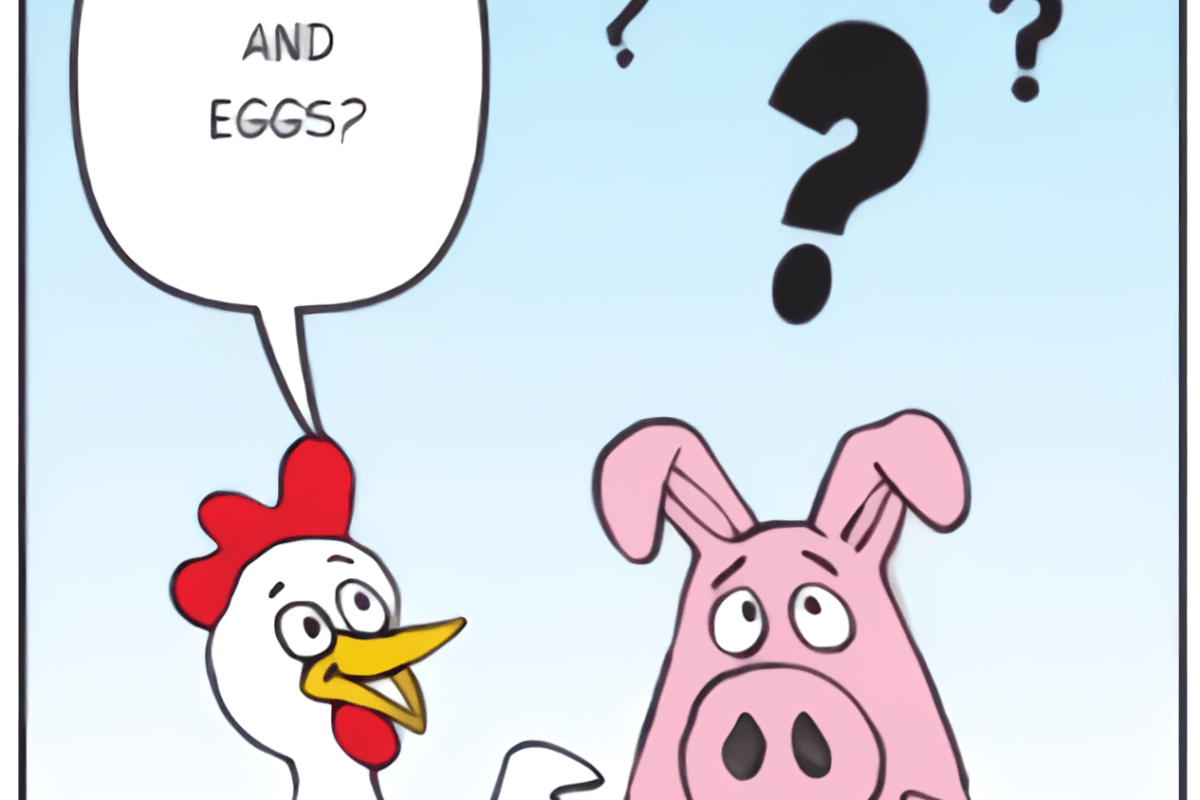
This reminds me of the story wherein a chicken and a pig are conversing, and the chicken suggests that it and the pig go into the restaurant business. The pig considers the proposition and declines by the rationale that it would be committed but the chicken would only be involved. Children may believe that hot dogs are a by-product like eggs, fur, or feathers—don’t get me started on the down used in pillows, jackets, and comforters—rather than grasping that the animals yield these products at the expense of their lives.
Some people grow up and realise the inconsistency of their ethics and actions, but they find any number of ways to reconcile their actions, noting that the activity is normal and natural.
FULL: DISCLOSURE: For the record, I eat chicken, turkey (on festive holidays in lieu of chicken), and I eat beef (that’s cows, for the uninformed). I also consume some animal byproducts, i.e., chicken eggs and cheese. I also wear leather. I was a vegetarian for about three years until I opted to become a chickenatarian. My life partners goaded me into eating beef, and so I’ve since added that. In all cases, I feel bad for eating defenceless, sentient beings. I’m not sure it serves as any consolation that I limit my consumption to these three animals—or even if it were only one. For the record, I don’t particularly like the taste of turkey or beef, but it’s not offensive like pork, coffee, or alcohol. Chicken, I like. Sorry chickens.
Video: Homer Simpson’s (not so) ethical dilemma
For the record, this is post number 500 on Philosophics. Perhaps I should write a post about it.




 Philosophics