Agency is going through the same fits as religion. When Nietzsche regarded society around him at the time, he declared that God is dead and asked now what? This is precisely the same challenge in different clothes.
Preserving “law and order” without a concept of real responsibility is a daunting task.
Dan Dennett
Without a God to use as a bully pulpit and mechanism of fear, how could we keep people in line in cohesive societies? Without the notion of human agency to allow for responsibility and blame, how can we keep people in line in cohesive societies? Only the predicate has changed, but the question remains, do we persist in lying for the so-called greater good? This is similar to the Santa Claus myth to keep young children in line.
If nobody is responsible, not really, then not only should the prisons be emptied, but no contract is valid, mortgages should be abolished, and we can never hold anybody to account for anything they do. Preserving “law and order” without a concept of real responsibility is a daunting task.
—Dan Dennett, “Reflections on Free Will” (naturalism.org)
One might like to think that lying is psychologically pathological, but it seems to be a significant part of the human condition. The fundamental question doesn’t appear to be ‘should I tell the truth’, but rather ‘Can I get away with lying?’ Despite all the talk of Truth and integrity, this seems to be the default state of humans. This renders integrity just another lie. But you knew that already, but let’s not fall into another Foucauldian rabbit hole.
We no longer have any sympathy today with the concept of ‘free will’: we know only too well what is is — the most infamous of all the arts of the theologian for making mankind ‘accountable’. . . Everywhere accountability is sought, it is usually the instinct for punishing and judging which seeks it… the doctrine of will has been invented essentially for the purpose of punishment, that is of finding guilty.
— Twilight of the Idols: ‘The Four Great Errors’, 7
I’ve spend some hours cobbling together another video that I labelled Free Will Scepticism: Would-Be Agency & Luck. I’ve embedded it here. The script is below.
Human agency does not exist. Free will is an illusion. Like the appearance that the sun rises in the east and sets and the west, we only appear to have free will.
There are some nuances and varying degrees of this belief, but if one believes in the scientific notion of cause and effect, that every effect is the result of a prior cause of causes, one inevitably ends up in this camp.
Video: Free Will Scepticism: Would-Be Agency & Luck
[REDACTED]
Without going into details because the focus of this segment is on luck, I’d still like to set the stage for the uninitiated.
Regarding the universe, we recognise a relationship between cause and effect. If we rewind to follow this logic back to the beginning of time and started again, we’d end up in exactly the same place. This is known as deterministic. What happens next is determined by what happened before.
And this is not just a scientific view. Those who believe that God caused the universe can arrive at this same place.
Owing to advancements in scientific thought, most philosophers today do not believe that the world is deterministic, per se. Given theories of quantum mechanics and probabilistic outcomes, they believe in so-called natural physical laws, but probability is also part of this model.
One may strike a billiard ball with a cue stick to cause it to strike another ball, knocking it into a pocket. In our knowledge of the universe, this is unsurprising. If one set this up mechanically, leaving no room for variation, we could run this scenario over and over again forever, and the ball would go into the pocket every time. The outcome is established by the laws of physics.
Billards Animated GIF
Actually, this is just another illusion. The laws of physics cause nothing. They are just a way of describing how things unfold in our universe. But just like saying that the sun rises in the east, we can employ idiomatic language and people know what we mean.
This was an illustration of determinism. Indeterminism accepts these same laws, but it adds an element of probability. In our mechanised billiards example, perhaps a ball is randomly rolled across the table in such a way that it might interfere with the path of the balls.
If the random ball does not interfere with the path, its presence is irrelevant. If it does interfere, there are a few different outcomes.
One, it knocks a ball off course, so the final ball does not go into the pocket.
Two, its path is such that although it collides with a ball, this event does not interfere with the final ball ending up in the pocket, so a person fixated on the pocket might not notice anything more than a slight delay in the occurrence of the event.
The second scenario depicts indeterminism.
In both scenarios, the ball expected to go into the pocket is the would-be agent. As illustrated, the ball itself has no agency. None of them does. Its fate, to borrow a term steeped in metaphysics, is entirely subject to the actions before it. And then there’s chance, so let’s continue.
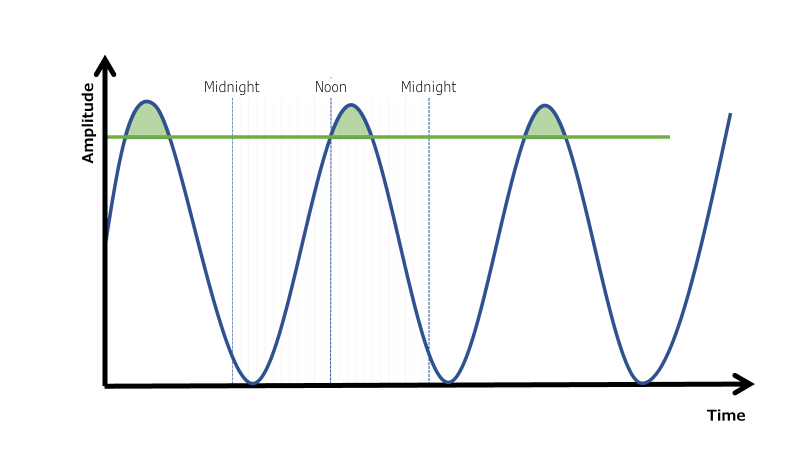
Humans are ostensibly automatons, subject to their genetic and environmental programming with no degree of free will. Let’s say that in a given context each person can be described by a certain wave function. For the sake of simplicity, let’s just pretend that it can be represented by a sine wave. As with any waveform, we can illustrate it by plotting it on a 2-dimensional plane, having amplitude on the Y-axis and time on the X-axis. Let’s consider this to be analogous to a person’s biorhythm, and let’s further consider that this represents the would-be agent’s mood or propensity to behave a certain way.
Arbitrary Disposition Cycle
Practically, there might be more functions, so let’s just say that this is the average of all of these other functions—perhaps the other functions being how much rest was had the night before, when and what the last meal was, traffic encountered on the way to work, and any number of other personal considerations.
For any stable wave, we can plot the period from peak to peak or trough to trough. Let’s use trough to trough to represent a period of a day but from 2:30 am to 2:30 am rather than from midnight to midnight. This is one complete cycle. The offset is just to more easily facilitate the scenario.
Given this frame, we’ll put noon in the centre between the midnights as expected.
For the purposes of illustration, we’ll draw a horizontal line to represent a threshold depicting a change in disposition. We’ll use this later.
Finally, let’s show time increments by hour, so we now see 24 hours in a day. And we can see that at noon the wave peak rises above the threshold and falls below the threshold again at 5 pm.
Let’s presume that this wave function represents that of a criminal trial judge. There is support for this notion as published in Daniel Kahneman’s 2021 book, Noise: A Flaw in Human Judgment, wherein he notes that trial judges are almost as predictable as a watch, that their sentences are more correlated with time of day and the aforementioned factors than anything related to law—save for the laws of time, I suppose.
Remembering that—like all people—this judge is an automaton. Let’s build some character—rather characteristics. Judge Judy believes that people are fundamentally bad and not to be trusted. She believes that they have free will and are accountable for their actions, though she does also allow for extenuating circumstances when considering sentencing, the usual suspects—bad childhood, chemical dependency, and whatnot. People who believe more strongly in free will are more likely to believe in harsher punishment. Judy is no exception.
Using this function as a guide, above the threshold represents her propensity for leniency. She tends to take lunch regularly before noon and is more lenient for a period after lunch. Data show that this effect is closer to a couple of hours after the midday meal, but we are simplifying.
Zooming in, let’s just consider a single day in the life of another would-be agent who as it happens will be interacting with our Judge Judy. I’ll take this opportunity to introduce the work of Neil Levy.
Neil is Head of Neuroethics at the Florey Neuroscience Institutes and Director of Research at the Oxford Centre for Neuroethics.
He is the author of Hard Luck, five previous books, and many articles, on a wide range of topics including applied ethics, free will and moral responsibility, philosophical psychology, and philosophy of mind.
Levy’s book promotes the concept that even if we allow for human agency, much of this supposed agency is undermined by luck. This will not only become evident in the scenario we are working through, but as a human, you may come upon a decision-point, where probability and luck come into play. You have no control over what ideas pop into your head—or don’t—and in what order. The choice you ultimately make is limited to what these ideas are and how they do or don’t manifest. Without going too far astray, perhaps you’ve constructed a false dichotomy.
Dark Alley
Perhaps you are confronted by a stranger in a dark alley. You observe that it’s a dead end. The stranger, asking for money, approaches you in a manner you interpret as menacing. As he reaches into his coat, you pull out your concealed weapon and fatally shoot him.
He was unarmed. No longer in panic, you realise that you are not in a dead-end alley.
When the police arrive, they inform you that the person you killed is known` by law enforcement and social services, who have been keeping an eye on him because he had limited cognitive capacity and resided in a group home. Not only was he not armed, but the detective on the scene noted that what he was reaching for were pens with inspirational inscriptions that he routinely sold to earn money.
Whilst you may not have been able to determine that he was otherwise harmless, it was your ‘luck’—bad luck—that you didn’t happen to see that you were never cornered in the first place.
Nevertheless, you are arrested.
In another scenario, perhaps there are two judges. Judge Judy and Justice Joe. As it happens, Justice Joe has a cycle reverse to Judy. Where Judy’s mood is better after lunch, Joe is fasting, and his mood gets worse. This means that your fate now is not only tied to the time of day but it’s also linked to the luck of which judge will hand down your sentence.
If you are a strict determinist, then the “universe” has already determined which judge will sentence you.
If you are an indeterminist, then the universe will flip a coin. And the probability of a case running long or short might determine the time of day.
In the end, as are you, the judges are slaves to their programming, and any alteration of inputs will just be processed through whatever they’ve become until that point. They have no more free will than you do. The die has already been cast.
Do you believe you have free will? If so, why. Are you a determinist or an indeterminist? Or are you a compatibilist who believes that free will and determinism can coexist in the same universe?
The title of this post is admittedly pompous, but I promise it’s relevant. I was chatting with an online colleague about the travails of my anti-agency journey. I’ll lay it out here as well.
About a month or so ago, I embarked to research on my suspicion that human agency is ostensibly hogwash*. I went down many rabbit holes to find the skeletal remains of many rabbits who have embarked on this path before me. I thought I had some unique epiphany and I would just have to articulate my position, but it turns out not to be the case. In fact, it’s a crowded space—lots of skeletal Leporidae. Moreover, many of these blokes are still alive and kicking.
As it happens, we all fit under the large umbrella of free will scepticism, but there are several flavours mostly differentiated by where one prunes the branch. Scepticism of free will is the common bond, but the differences, as one might expect, lead to different implications. Some branches still allow for responsibility—even absent agency—, others even insist on responsibility despite not having agency—and still others, like me, claim responsibility is impossible.
All of these perspectives hinge on the validity and strength of determinism or indeterminism. Soft determinism (AKA compatibilism) allows for free will and determinism to coexist, so that’s not on my radar.
As I’ve cited elsewhere, there are not many non-religious determinists these days, as the state of science and quantum theory pretty much obsoleted the idea. But by my reckoning, from the perspective of the would-be agent, it doesn’t matter because in either case, this person (or other animate objects—no need to overspecify) is affected by the causal chain and does not affect it. This lack of affectation is precisely why we can’t attribute responsibility or desert.
This is not just some philosophical mental masturbation. It turns out that entire legal frameworks are designed on the prevailing held beliefs, and the more degrees of free will a culture assumes people have, the more punitive that society is—and vice versa. More on this in a future post where I intend to write about Gregg Caruso’s perspective and where and how our positions deviate.
The CAUSA SUI is the best self-contradiction that has yet been conceived, it is a sort of logical violation and unnaturalness; but the extravagant pride of man has managed to entangle itself profoundly and frightfully with this very folly. The desire for “freedom of will” in the superlative, metaphysical sense, such as still holds sway, unfortunately, in the minds of the half-educated, the desire to bear the entire and ultimate responsibility for one’s actions oneself, and to absolve God, the world, ancestors, chance, and society therefrom, involves nothing less than to be precisely this CAUSA SUI, and, with more than Munchausen daring, to pull oneself up into existence by the hair, out of the slough of nothingness. If anyone should find out in this manner the crass stupidity of the celebrated conception of “free will” and put it out of his head altogether, I beg of him to carry his “enlightenment” a step further, and also put out of his head the contrary of this monstrous conception of “free will”: I mean “non-free will,” which is tantamount to a misuse of cause and effect. One should not wrongly MATERIALISE “cause” and “effect,” as the natural philosophers do (and whoever like them naturalise in thinking at present), according to the prevailing mechanical doltishness which makes the cause press and push until it “effects” its end; one should use “cause” and “effect” only as pure CONCEPTIONS, that is to say, as conventional fictions for the purpose of designation and mutual understanding,—NOT for explanation. In “being-in-itself” there is nothing of “casual- connection,” of “necessity,” or of “psychological non-freedom”; there the effect does NOT follow the cause, there “law” does not obtain. It is WE alone who have devised cause, sequence, reciprocity, relativity, constraint, number, law, freedom, motive, and purpose; and when we interpret and intermix this symbol-world, as “being-in-itself,” with things, we act once more as we have always acted—MYTHOLOGICALLY. The “non-free will” is mythology; in real life, it is only a question of STRONG and WEAK wills.—It is almost always a symptom of what is lacking in himself, when a thinker, in every “causal-connection” and “psychological necessity,” manifests something of compulsion, indigence, obsequiousness, oppression, and non-freedom; it is suspicious to have such feelings–the person betrays himself. And in general, if I have observed correctly, the “non-freedom of the will” is regarded as a problem from two entirely opposite standpoints, but always in a profoundly PERSONAL manner: some will not give up their “responsibility,” their belief in THEMSELVES, the personal right to THEIR merits, at any price (the vain races belong to this class); others on the contrary, do not wish to be answerable for anything, or blamed for anything, and owing to an inward self-contempt, seek to GET OUT OF THE BUSINESS, no matter how. The latter, when they write books, are in the habit at present of taking the side of criminals; a sort of socialistic sympathy is their favourite disguise. And as a matter of fact, the fatalism of the weak-willed embellishes itself surprisingly when it can pose as “la religion de la souffrance humaine“; that is ITS “good taste.”
Harvard’s Bob Doyle submits that people have free will in an indeterministic universe (read: agency) because if in the face of some random event an agent can make a choice, then s/he is responsible for that choice. I believe he is mischaracterising or misinterpreting the situation. I’ve composited an illustration to show where he and I interpret the random event differently. I’ve linked and cued the video to where he makes the statement I am reacting to.
The illustration depicts three event chains. My interpretation of Bob’s case is at the top followed by that of a Deterministic universe, followed by that of an indeterministic universe. At the bottom of the illustration is an index running from t-2 to t2, representing time, where t0 represents now, a decision point.
Determinism
Let’s set the table with the simplest narrative—Determinism. Here, every event that occurs was known since the beginning of time. Every state is the result of past events in a causal chain. Nothing can happen that isn’t caused by a prior event. This is the motion picture we just haven’t seen yet. But anyone who has already seen it can spoil the ending because it’s already known without a doubt.
Regarding the illustration, event t-2 causes t-1 that causes t0 all the way to t2 and beyond.
No Escape from Moral Responsibiliy Chart
Bob Doyle, an Interpretation
Although Bob’s case is an interpretation of Indeterminism, let’s consider his position first. Then I’ll suggest where he’s gone astray.
As with the other cases, Bob’s transition from t-2 to t-1 is Deterministic and uncontested. The difference starts where t-1 transitions to t0. In Bob’s world, a random or perhaps a probabilistic event occurs given the agent to make a choice not having been previously determined. Referring to the illustration, because of this event, the agent chooses yes and embarks on the top chosen path, even if the subsequent path is again determined. Bob argues that at t0, the agent has free will, or if we focus our language, is responsible for the decision. By definition, this means that whatever path might be embarked had our agent chosen the lower path will never be known. And that has made all the difference.
Indeterminism
Herein lies the rub. As with the prior two event chains, we arrive at t0, as with Bob’s scenario, we encounter a probabilistic (random, stochastic, aleatory, indeterministic) event. It does not follow that this event confers agential responsibility.
For example—not a moral consideration—, the random event involves the outcome of a match by their favourite sports team—or perhaps s/he’s won at Lotto—, our agent had no say in the outcome of the event. From the agent’s perspective—considering the illustration—s/he remains on a path. S/he can wish s/he rooted for the other team or had chosen a different number or ticket, but she had no choice.
To anticipate Bob’s response, perhaps she had won and now chooses to quit her job or take holiday. This should have been predictable knowing our agent’s disposition, character, and propensities. At no point did the agent actually possess even a modicum of agency.
Freedom & Creativity
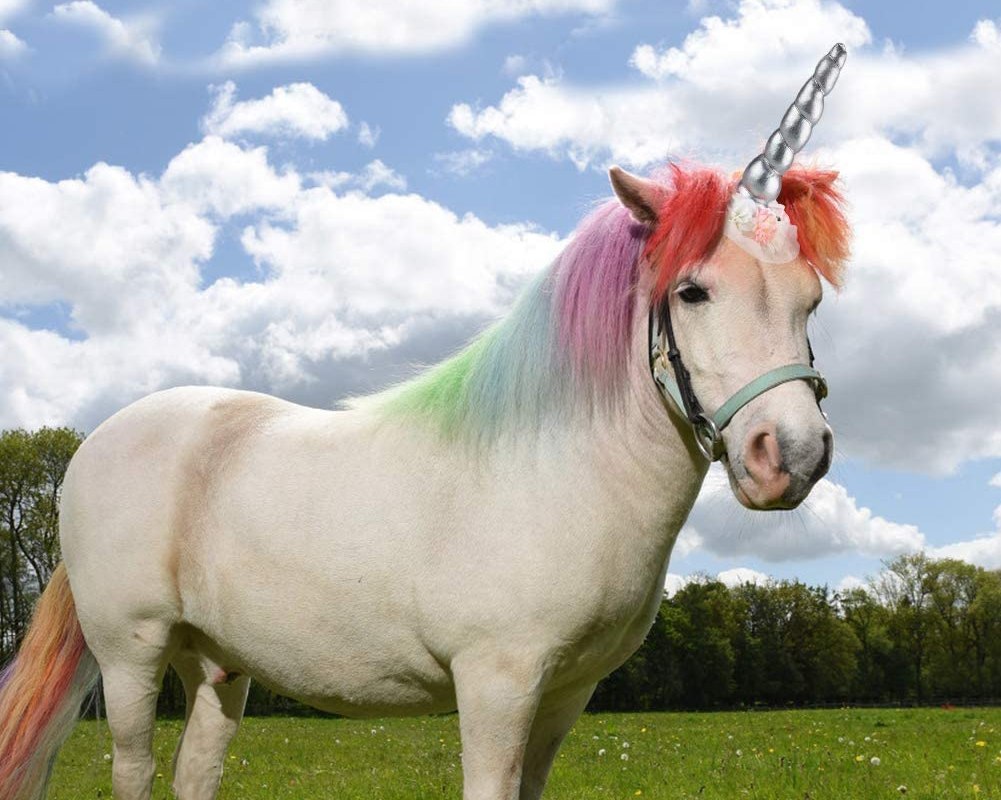
I don’t know much about Bob or his work, but earlier in the video clip he discusses freedom and creativity. My sense is that he interprets creativity as a sort of emergent property that manifests at the moment. I fundamentally disagree with this assertion. The notion reminds me of Hume’s position that unicorns are simply the mental merger of horses and horns. This is not creation so much as a remix.
Later in the video, Bob clarifies that if something randomly pops into our heads and we make a different decision because of it, this is free will. My counterargument is that he is misusing the term random. An unknown origin does not necessarily mean randomly manifest.
Stop me if you’ve heard this one before. I’ve gotten myself down a free will rabbit hole, and as I’ve said before the problem isn’t about free will. That’s a red herring. The issue ultimately distils down to agency and how one defines you or the self.
Image: There may be free will, but you can’t have it
First, the notion of you or self is a construct.
Second, the notion that this constructed self somehow has autonomous agency is a meta-construct. It’s all smoke and mirrors.
Tea or Coffee
Let’s say for the sake of argument that free will is possible in the face of determinism or indeterminism, which is to say that it is compatible with other of these options. Daniel Dennett seems to say that these things can be compatible, but where they matter are trivial. We have free will to decide if we want tea or coffee, whether to add cream or milk, and whether to add two or three spoonfuls of sugar—or was that honey or unsweetened? But so what?
My argument is that (1) there is no you to decide and (2) even if I accept the notion of you, nothing about you is of your making. Everything about you comes from external forces. The only information you can process comes exogenously from without, and any endogenous interpretive processes rely on external inputs. You are on the titanic, and the best you can do is to rearrange deck chairs.
Peter van Inwagen is a personality I’ve had on my radar, but I haven’t spent any time with him because he is a referenced influence of Robert Kane or Derk Pereboom, who hold positions I disagree with.
Video: Peter van Inwagen – Big Questions in Free Will
Still, I was interested, so I thought watching a short 13-minute video interview might introduce me to him. I’ve enjoyed other Closer to the Truth content, so I gave it a go. I feel that Peter sets up the problem perfectly. No faults whatsoever. As I see it, the same problem and solution proposal arises that Galen Strawson adopts, yet this is where I disagree with them both.
As noam chomsky has speculated maybe our minds are just put together in the wrong way to find this fault we got a certain set of cognitive modules tossed up to us in our evolutionary history maybe we got the wrong ones for thinking about this problem
— Peter van Inwagen
[TBD]
Unless I decide to unpack the rest, I’ll cut to the chase. The argument is as follows:
Humans are somehow hardwired to blame. (I do not know if this is universally true, but let’s accept this premise as being true.)
Without the notion of free will (or at least human agency), we cannot assign blame.
Therefore, in order to assign blame, free will has to be true.
I don’t disagree with this syllogism. However, in ‘free will has to be true’ , there are ostensibly two possibilities.
Free will exists as a fact in nature—a priori
Free will is a construction—a posteriori
Of course, the general consensus for proponents of free will is that it exists a priori. My contention is that this is not the case. Free will is an a posteriori construction.
Inwagen is falling into a heuristic trap: It feels like it’s true, so it’s obviously true. Borrowing from Daniel Kahneman, he and others are relying on System I and failing to trigger System II, where System II is required. Moreover, I take this position because I don’t think System II has what it needs to accurately analyse and assess the situation holistically. We can’t get outside of the system, so we make up a story that presumably serves our purposes.
I am not one who believes ‘the universe is a simulation’, but I do believe it serves as an apt metaphor. We are player characters in the game and we can’t see outside of it.
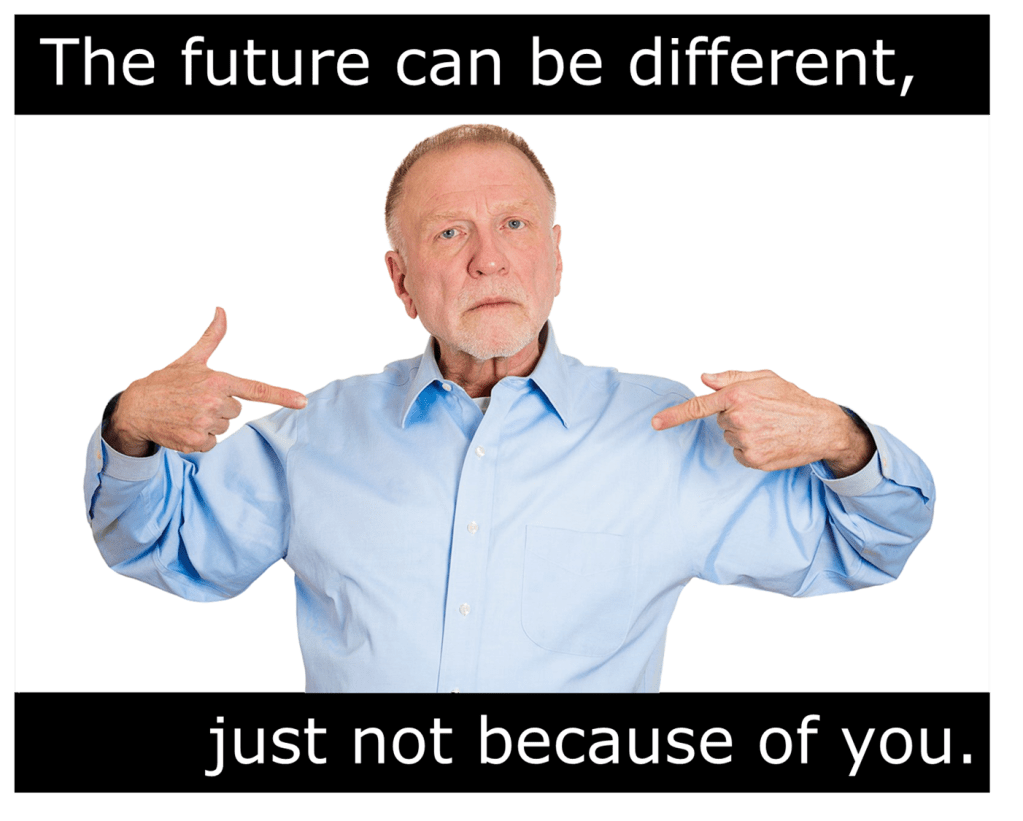
I like to sum it all up with the expression, the future can be different, just not because of you.
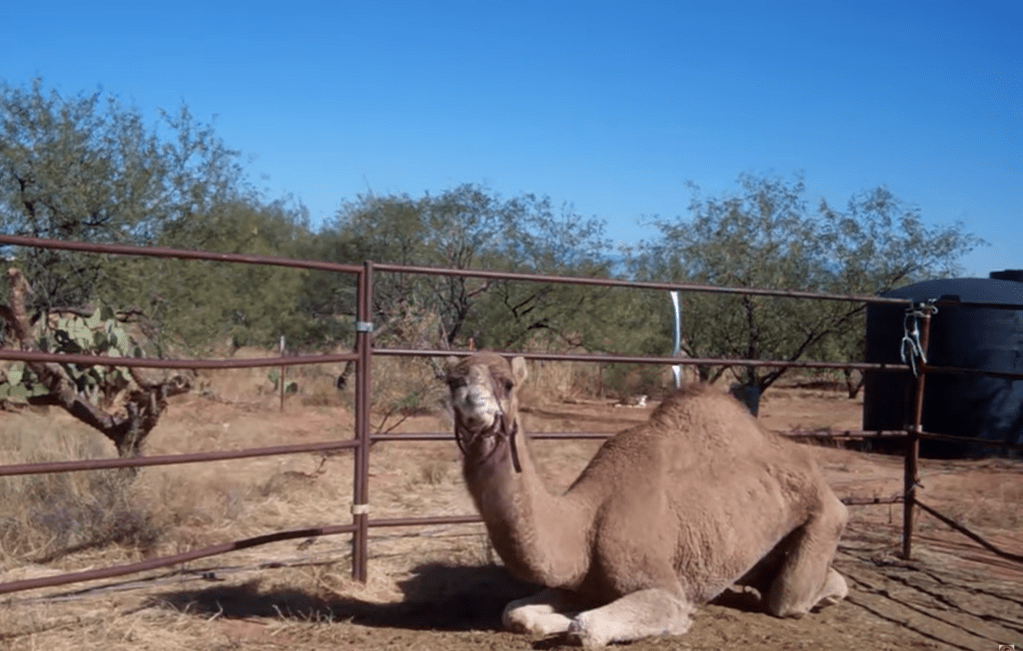
In grappling with anti-agency or non-agency, I am still trying to find apt metaphors. My latest find is the straw that broke the camel’s back. That, or death by a thousand papercuts.
My contention is that because humans have no material agency, they still have no responsibility—even if I were to agree that the world did allow for free will, is determined, semi-determined, or determined.
All of our genetics, epigenetics, and heredity along with our socio-environmental programming, any agency we might have to exert is essentially the straw that breaks the camel’s back. This story is meant to teach that the final straw cannot be seen in isolation. This straw is not responsible for breaking the camel’s back. It’s just one of a thousand papercuts, to switch metaphors for effect. We don’t get to claim that the last straw has some magical powers. If we have agency, it’s homoeopathic and hardly enough to attribute responsibility.
My point is that even if humans are effectively free to choose in the moment as people have proposed, is this sufficient to grant agency cum responsibility? I am reading John Martin Fischer’s Compatibilism chapter in Four Views on Free Will, where he gives an example of not deliberating about whether to jump to the moon because (in part at least) [he] would not successfully jump to the moon, even if [he] were to choose to jump to the moon. I feel the same goes for other non-choices.
If I have only ever watched action movies my entire life or only even drunk Coca Cola, given the choice of an action movie or a romance movie or a Coke or a Pepsi, what choice am I making? It can be said that I can ‘choose’ to watch an adventure movie and a Coke, but in fact, I am habituated to these ‘choices’.
I recall a book by Thomas Moore titled Care for the Soul. In chapter 2, he conveys the story of a man with an alcoholic father, who can either become an alcoholic like his father or abstain. Presumably, he can also moderate a middle path. My contention is that his apparent choice will be pathological. Following is the easiest narrative—monkey-see, monkey-do. If he resists, it’s a reaction, not a choice. Even if he ‘chooses’ a middle path, it’s only reactionary.
An example from my own life experience played out like this. My grandfather was an MIT engineer, but (according to the family narrative), he was a weak man controlled by his wife, who capitalised on real estate purchases during the Great Depression of the 1930s. My dad’s response was to determine that higher education was pointless. He got a high school diploma and became a successful real estate developerõall the while keeping a chip on his shoulder. Whilst my high school classmates were prepping for college with family support, I was told that I would not be supported and that I would have to pay for it myself. (I didn’t qualify for standard loans because my family had too much money. The institutions didn’t care that I had no access to my parents’ money.)
At this point, I just wanted to attend university to acquire knowledge and figure things out. I didn’t even have a major in mind. I just wanted more input because there was nothing I was interested in.
According to Sartre, we always at least have the choice to persist or perish, yet even this isn’t true.
To be honest, I feel like I have choices and have made choices, but I also know I have been fooled by magicians’ illusions. I don’t know the mechanics of these tricks either, but I know that they work because of cognitive flaws or gaps. It’s not much of a leap to accept that free will and agency can operate in the same gaps.
EDIT: As I continue to digest Fischer’s position, I am thinking he is talking about gross motor skills whilst I am trying to focus on fine motor skills, and there’s a disconnect. Free will is gross motor, but agency is fine.
Judith Thomson published an essay named ‘A Defense of Abortion‘ in 1971 where she uses a house and invaders as an analogy to defend the right to abortion. Her defence resonates with David Guignion, and David’s approach to summarising philosophy resonates with me.
Disclaimer: I listen to most of David’s work, which should be a testament to the interest I have in the material he covers as well as the accord I have for his positions—content and vehicle. In this case, he feels that Thomson employs a solid argument in defence of abortion, but I’m not sure I agree. I also freely admit that—given I feel that all morality is socially constructed—I am not likely among the intended cohort for this nuanced argument.
Firstly, I’m no misanthrope, but I don’t feel humans deserve some privileged position over other lifeforms simply because they have some limited sense of awareness.
Secondly, I’m not a strong anti-natalist, I feel this is a defensible position to adopt, so I could rely on this position to defend abortion.
Thirdly, I don’t believe that bodily autonomy is anything more than a social construct. Foreshadowing David’s line of argumentation, It’s not a matter of Liberal autonomy over dictatorial oppression. I feel that this is first a false dichotomy and second a competition between social constructs.
Whilst I do understand that Thomson’s position is intended to counter Americans who do subscribe to the myths of autonomy, sovereignty, agency, rights, and property, this is also why I feel the entire argument depends on rhetoric and emotion. Perhaps, the rest of us aren’t going to be anti-abortion in the first place, so why expend energy trying to formulate a deeper argument to convince us.
I had previously heard of the model Thomson employed that drew an analogy between an accomplished violinist and a fetus. I hadn’t read the source essay and didn’t know that Thomson had authored it. I wasn’t familiar with her extended arguments either.
I had originally planned to regard each proposed scenario separately, but I’m going to exercise the principle of least effort and just share some general observations, leaving the door open to revisit these when time and interest align. In general, I don’t feel that Thomson makes a strong logical argument. Her approach relies on emotion and rhetorical tactics.
Thomson frames a Consequentialist argument and colours it with a dash of Virtue ethics. By establishing the accomplished musician, she establishes a frame that taps into elitism. She takes a high art versus low art approach, an approach often adopted by virtue ethicists. For me, this always triggers a red flag.
Next, she triggers the home invasion reflex for people who believe in private property as an extension of bodily autonomy, so she is relying on fear as legerdemain, even if unintentionally.
In each case, the autonomous actor is given a privileged position in the story. In the first case, the tethered musician is unconscious and has no voice—like a fetus or a pet. She is generous enough to afford the musician full human status and bodily autonomy, yet without agency.
Thomson creates a false dichotomy that she expects one to adopt uncritically. Is she a reliable narrator? Are there no intermediate options available? Let’s ignore this, as she hopes one does. It’s you or the musician in a zero-sum game of life and death. In a scenario where the musician or fetus has no agency, it’s easy to take the self-righteous high road and claim decision authority.
Allow me to take a detour for a moment. Let’s say that you and the musician were both tethered without consent and that each of you came to and your inextricable plights were conveyed to you. In this case, each of you may wish to exercise autonomy and in this deathmatch, only one would prevail; the other would die. Given this elitist setup, you are the underdog—some shlub versus Paganini in his prime. Even a fetus might have this privilege. Perhaps you are carrying the proto-progeny of Einstein or a king with no heirs? Handmaid’s Tale, yes. But I digress.
The next sleight of hand is introducing an emotional self-defence trope. The setup is that given the choice of the other person being an existential threat, who wouldn’t agree that you have a right to defend yourself?—not delving into the fiction of rights.
David jumps right onto Thomson’s bandwagon, which was her intent, but it is not obvious that self-defence is some inalienable right. In practice, the right is abridged by the state often. This is true in the United States as well as Canada. I’m imagining David overloading the meter on a connected galvanic skin testing device. Pure emotion.
I fully sympathise with David’s position, but this doesn’t change the fact whether a person has autonomy or not is an arbitrary decision. Many cultures now and even Western cultures in the past had little notion of personal autonomy. Trepidation aside, there is little reason to presume this will continue to persist.
EDITORIAL NOTE: I was writing this near the end of April 2022 when I got distracted by my anti-agency interest. This was left unfinished, but I feel it’s complete enough to post. I am not sure where my mind was headed at the time.
Self and identity are cognitive heuristic constructions that allow us to make sense of the world and provide continuity in the same way we create constellations from the situation of stars, imagining Ursa Major, the little dipper, or something else. The self and identity are essentially expressions of apophenia.
Consider this thought experiment about responsibility. Rob decides to rob a bank. He spends weeks casing the target location. He makes elaborate plans, drawing maps. and noting routines and schedules. He gets a gun, and one day he follows through on his plans, and he successfully robs the bank, escaping with a large sum of money in a box with the name of the bank printed on it. Rob is not a seasoned criminal, and so he leaves much incriminating evidence at the scene. To make it even more obvious, he drops his wallet at the scene of the crime containing his driver’s licence with fingerprints and DNA on the licence and other contents of his wallet. He leaves prints and DNA on the counter where he waited for the money. This wallet even contains a handwritten checklist of steps to take to rob this bank—the address of the bank, the time and date. All of this left no doubt about who robbed the bank.
The self and identity are essentially expressions of apophenia.
Using this evidence, the police show up at Rob’s apartment to arrest him. They knock on the door and identify themselves as law enforcement officers. Rob opens the door and invites them in. All of the purloined money is still in the box with the name of the bank printed on it. It’s on a table in plain sight next to the gun he used. All of his maps, plans and, surveillance notes are in the room, too. They read him his rights and arrest him. Things aren’t looking good for Rob.
Before I continue this narrative, ask yourself is Rob responsible for robbing the bank? Let’s ignore the question of whether Rob has agency. For this example, I am willing to ignore my contention that no one has or can have agency. Besides, the court will continue to presume agency long after it’s been determined that it is impossible because agency is a necessary ingredient to law and jurisprudence.
Is Rob responsible? Should he be convicted of armed robbery and sentenced to incarceration? Let’s make it even easier. This isn’t Rob’s first offence. In fact, he’s been in prison before for some other crimes he committed. He’s no first-time offender. Why do you think that he’s responsible? More importantly, why should he be convicted and sentenced? What should his sentence be?
Consider that the money has been recovered, no one was injured, and Rob didn’t resist arrest. At first glance, we might consider both restorative and retributive justice. I’ve purposely made it easy to ignore restorative justice as all the money was recovered. This leaves us with retributive justice. What should happen to Rob? What would you do if you were the judge? Why? Hold that thought.
Let’s continue the narrative. All of the above happened, but I left out some details. Because of course I did. After the heist, Rob returned home and he lost his balance and hit his head rendering him an amnesiac—diagnosed with permanent retrograde and dissociative amnesia. Because of the retrograde amnesia, Rob can’t remember anything prior to hitting his head. Because of the dissociation, Rob has no recollection of anything about himself, not even his name. In fact, he now only responds to the name Ash. (This is where I debate whether to have Rob experience a gender-identity swap, but I convince myself to slow my roll and focus on one thought experiment at a time.)
Because of the retrograde amnesia, Rob can’t remember anything prior to hitting his head. Because of the dissociation, Rob has no recollection of anything about himself
To make this as obvious as I can consider, Ash has no recollection of Rob, robbing the bank, or anything about Rob. Ash doesn’t know Rob’s friends or family. Ostensibly Ash is a different person inhabiting former-Rob’s body. To make it even easier, Ash is not feigning this condition. So, let’s not try to use that as an out when I ask you to reconsider responsibility.
If my experience serves as a guide, if I asked you about your response to whether Rob was responsible and what his sentence should be, you would be committed to your same response and for the same reasons, so I won’t ask again.
What I ask now is if Ash is responsible and what his sentence should be. Keep in mind that we should be able to ignore the restorative element and focus on the retributive aspect. What should happen to Ash? What would you do if you were the judge? Whether your response has changed or remained the same, why would you judge Ash this way?
Here are some considerations:
Retributive justice might serve as a lesson to other would-be offenders.
The public may not believe the amnesia excuse—even though you, as judge, are convinced thoroughly.
Ash does not believe he committed the crime and does not comprehend the charges.
Ash was surprised to discover the money and gun and was pondering how it got there and what to do with it when the police arrived at his apartment.
If released, Ash would not commit a crime in the future. (My thought experiment, my rules; the point being that Ash was no threat to society.)
From my perspective, Ash is a different person. Sentencing Ash is ostensibly the same as sentencing any person arbitrarily.
The purpose of this experiment is to exaggerate the concept of multiple selves. Some have argued that there is no self; there is just a constructed narrative stitching discrete selves together to create a continuous flow of self-ness.
Is Ash responsible for Rob’s action?
I’m interested in hearing what you think. Is Ash responsible for Rob’s action, and why or why not? Let me know.















 Philosophics