Cultural Diversity

Humans seem to be hard-wired to prefer in-groups over out-groups, family and tribe over outsiders. In the business world, we hear about corporate culture. But these days, diversity is all the rage. Companies strive to convince the world that that have diverse and inclusive cultures, but what does this mean? Is there such an animal as a diverse culture? And how does one balance the familiarity of in-group homogeneity versus out-group heteronormativity?

you can’t spell culture without ‘cult’

In corporate-speak, there is the concept of cultural fitness. Afterall, we want efficient and productive humans and processes? People who don’t fit this mould are disruptive, right? So, we are justified in excluding people from the group, right? Remember, you can’t spell culture without ‘cult’.

Although the United States brand themselves as a cultural melting pot, this is only partially correct, and mostly in more populous areas, and even this occurs in pockets.

Diversity—in hiring and otherwise—is only accepted if it is along approved superficial dimensions—skin colour, national origin, sex, religious orientation, maybe gender, perhaps some latitude around lifestyle choices. But more substantial diversity need not apply. They are interested in hiring conforming normies. The gay guy is OK, so long as he toes the rest of the line. That woman: ditto. That Muslim: same. That black person: so long as s/he acts white in public.

everything needs to distil down to the white male ethic

Performatively, they’ll accept the diversity proponent as a PR prop. This person is proof that they hire [target group]. This person broadcasts how s/he can wear their cultural garb, bring cultural dishes to potlucks, put up posters and advertise about support groups outside of work. But in the end, everything needs to distil down to the white male ethic.

Talk about work-life balance is fine, so long as work gets the upper hand. You need to be able to talk about charity, but you need to be motivated by money and status. There are exceptions to this motivation, say, public health and healthcare, education, and so on, but the boundaries in these professions are narrow, too. Not acting ‘professional’ is a key criticism. So, if your diversity counters some perceived professionalism, your diversity is not welcome.

not acting ‘professional’ is a key criticism

If the company hires people who routinely put in 60 hours for 40 hours of salary, they are not interested in the person with boundaries, insisting on 40 hours of work for 40 hours of salary. They aren’t interested in people who might question the ethics of the company’s business practices. Companies aren’t generally interested in rebels.

You need to be Sartre’s waiter. You’ve got a role to perform. In fact, you are evaluated specifically how well you perform that role. So, whilst you may be a singing waiter or a dancing waitress, your boundaries aren’t much broader than this. It’s easy for an observer to dismiss the call for diversity. S/he’s a waiter, right? Why should I expect anything different to that? And this is what locks in a lack of diversity.

DISCLAIMER: This ended up more of a meandering rant, but I’m distracted and out of time. And so it goes…

Institutionalised

This LA Times Op-Ed piece, Why so many people want to believe the election was stolen, got my mind wondering

The United States have seen ‘stolen elections‘ before, but the last time this happened in a presidential election—hanging chads, and all—, Al Gore was on the losing end of a misguided Supreme Court decision that landed George W Bush into the Whitehouse. This time, we see Donald J Trump on the losing end and Joe Biden running the victory lap—except Trump was running a victory lap himself until the weight of reality stalled him.

Gore is an Institutionalist.

Many Gore supporters felt upset (and somewhat betrayed) as he conceded the election to Bush. Gore is an Institutionalist. For all of their hubris, some politicians still see the institution as a higher power greater than them. Al Gore is one of these. Despite all of their faults, most of the past presidents have been institutionalists—systemists. One of the benefits of the US system is a peaceful transfer of power. To preserve a system, proponents need to maintain the mythos of that institution.

Gore said that he fought the good fight, but by the rules of the system, he lost. Not different to a court case lost on technical grounds rather than merit, he sucked it up and demurred to the system. It may not be perfect, but it works.

Trump is not an institutionalist.

Enter Donald Trump. Trump is not an institutionalist. He is entirely self-serving—a narcissist in pop-psychology vogue. He makes no qualms about disparaging the system. He seeded the fraud argument just to be able to say, ‘I told you so’, in the event of a loss. And so he did.

— Fin —

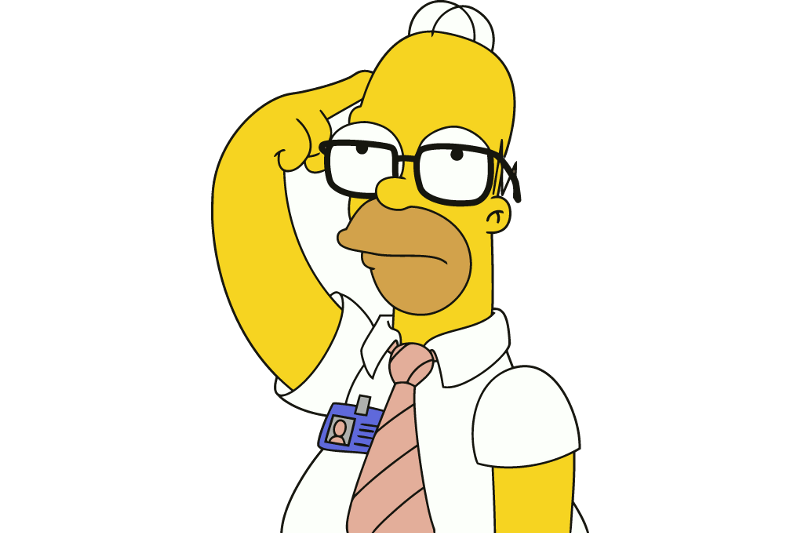
Donald J Trump, like others before him—Homer J Simpson, Barney J Rubble, Forrest J Gump?—is a simple man—a simpleton. George W Bush was another. Many of their followers are simple, too, though not all are simpletons. They just want to believe. It’s human nature.

I am not an institutionalist, but I understand the comfort zone institutions provoke. And beyond nostalgia, there can be a certain benefit to institutions. For one, it’s easier to navigate charted territory. So, whilst I don’t have a horse in the institutional race, I can see how one’s disposition towards can be a factor in how it treats it.

— Bumper Trailer —

What Reason?

Any system built on the presumption of widespread capacity for reason is bound to fail. The ability for most humans to ‘reason’ is clearly abridged and homoeopathic. And this is before one factors in cognitive deficits and biases. This is separate from sense perception limitations.

Nietzsche was right to separate the masters from the herd, but there are those in both classes with these limited capacities, though in different proportions.

People are predictably irrational

In economics, we have to define reason so narrowly just to create support the barebones argument that humans are rational actors—that given a choice, a person will take the option that leaves them relatively better off—, and even with this definition, we meet disappointment because people are predictably irrational, so they make choices that violates this Utilitarian principle. And it only gets worse when the choices require deeper knowledge or insights.

Democracy is destined to fail

This is why democracy is a destined to fail—it requires deeper knowledge or insights. The common denominator is people, most of whom are fed a steady diet of the superiority of humans over other species and lifeforms and who don’t question the self-serving hubris. They don’t even effectively evaluate their place in the system and their lack of contribution to it.

To the masters, who are aware of the limited abilities of the herd to reason, it seems like hunting fish in a barrel. If we convince the herd that they have some control over their destinies, that’s as far as it needs to go, but among the masters, there are subclasses, so people in these factions are also vying for position, so each employs rhetoric to persuade herd factions.

No one is sheltered from the limitations of reason

To the people out reading and writing blogs and such, confirmation bias notwithstanding, they may more likely to be ‘reasonable’ or able to reason, but try as they may, no one is sheltered from the limitations of reason.

More on this later…

Hopeful Rhetoric

My base belief is that what people believe is their truth, and rhetoric is a primary way to convince them. Part of the rhetorical mechanism is to introduce evidence, but this, too, is shrouded in rhetoric.

I’m not talking about the evidence that ‘standard’ water boils at 100°C at sea-level. This is tautological. Water is defined as H₂O. Literally, 100°C is the definition of where water boils under these conditions.

But things that cannot be repeated in controlled environment with the ability to alter parameters within the environment rely on rhetoric. This is why Newton’s laws seemed som compelling until a new narrative (somewhat) supplanted it. Still, this is not the point I want to make. I want to concentrate on the socio-poliotical domain.

I feel that given two equally viable explanations, the one offering more hope will prevail. Donald Trump knows this. This is why in the midst of the COVID-19 pandemic, he railed at a presser how he chastised a reporter for questioning his (false) narrative of hope. Politics relies on more than one rhetorical thread, and many already have the disposition of reviling Trump, so any messages from him are discounted at the start.* But, ceteris paribus, if a person assesses two equally probable outcomes—a typical door number 1 or door number 2 scenario—, and (for whatever exogenous reason) hope is associated to particular door.

In a survival scenario, perhaps you are one of three people lost in a cave and there are two possible paths forward. One person asserts that s/he feels that—without evidence—the left path is best way out but adds logically there is no way to tell, that you might as well flip a coin. The other person confidently conveys that s/he knows—without evidence—that the right path is the path to salvation. Being otherwise indifferent, you are likely to acquiesce to the second person, the one who offers hope over logic.

I fully admit that this is 100 per cent fabricated whole cloth from thin air, but the reason I come to this point is when you compare atheists to theists, anarchists to statists, nihilists to Existentialists, and any such analogic pair, the right side gets more traction and requires much more evidence to sway people to the left.

So when Occupy Wall Street (effectively anarchists) made demands, the status (read: the general population) asked ‘Who’s your leader?’ When the media-industrial complex broadcast this, the public was immediately sympathetic to the structured system. This is slightly different in that it’s not necessarily hope, rather a comfort zone—an endowment effect. It’s a benefit accruing to the incumbent.

My point is: hope floats. It acts to buoy otherwise rhetorically equivalent arguments. Or perhaps hope is simply an employed rhetorical device, so it’s unnecessary to call it out. Now, I’ve convinced myself to adopt this position.

* This is why ad hominem attacks can be effective, as persons swayed by the attack discount messages delivered by this person despite there not being a necessary connection between the grounds for debasement and the claim being asserted.

Not Just a Number

That perception and memory work hand in hand is mostly taken for granted, but this case reminds us that this sometimes breaks down. This is not the case of the neurotypical limitations to fallible sense organs and standard cognitive boundaries and biases. This subject can’t discern the arabic numerals from 2 through 9.

To recap the study, the man can perceive 0 and 1 as per usual, but numerals 2 through 9 are not recognisable. Not even in combination, so A4 or 442 are discernible.

In a neurotypical model, a person sees an object, a 3 or a tree, and perhaps learns its common symbolic identifier—’3′, ‘three’, or ‘tree’. The next time this person encounters the object—or in this case the symbol—, say, 3, it will be recognised as such, and the person may recite the name-label of the identifier: three.

It might look like this, focusing on the numerals:

Encounter 1: 3 = X₀ (initial)
Encounter 2: 3 = X₁ ≡ X₀ (remembered)
Encounter 3: 3 = X₂ ≡ X₀ (remembered)

In the anomalous case, the subject see something more like this:

Encounter 1: 3 = X₀ (initial)
Encounter 2: 3 = Y₀ = { } (no recollection)
Encounter 3: 3 = Z₀ = { } (no recollection)

For each observation, the impression of 3 is different.

Phenomenologically, this is different to the question of whether two subjects share the same perception of, say, the colour red. Even if you perceive red as red, and another perceives red as red, as long as this relative reference persists to the subject, you can still communicate within this space. When you see a red apple, you can remark that the apple is red—the name marker—, and the same is true for the other, who can also communicate to you that the apple is indeed red because the word ‘red’ become a common index marker.

But in the anomalous case, the name marker would have little utility because ‘red’ would be generated by some conceivably unbounded stochastic function:

Colourₓ = ƒ(x), where x is some random value at each observation

It would be impossible to communicate given this constraint.

This, as I’ve referenced, is anomalous, so most of us have a stronger coupling between perception and memory recall. Interesting to me in this instance is not how memory can be (and quite often is) corrupted, but that fundamental perception itself can be corrupted as well—and not simply through hallucination or optical illusion.

Thinking Truth

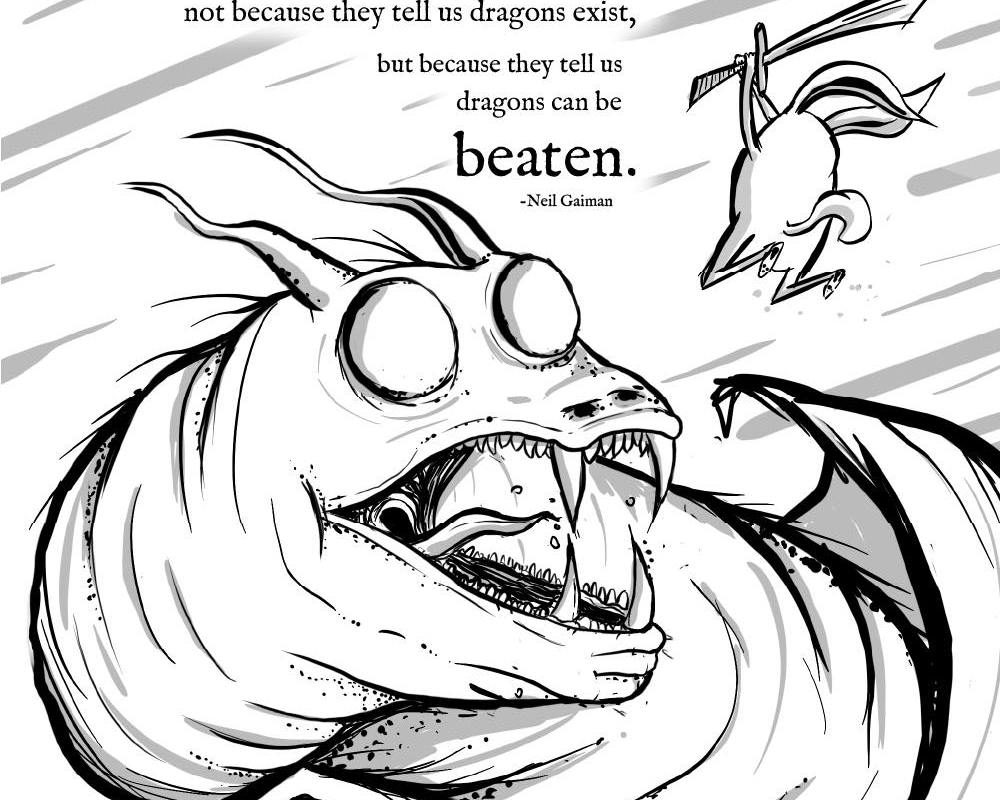
Neil Gaiman, an articulate, imaginatory writer. He makes a claim:

Fairy tales are more than true — not because they tell us dragons exist, but because they tell us that dragons can be beaten.

Neil Gaiman

To me, this is a problem with correlating imagination with truth. Moreover, many a war was lost on the story that it could be won.

Of course, we can still play the metaphor game. I’ve been a fan of metaphor since Joseph Campbell. Metaphor is strength. There was a time when I read Jung and had a stronger interest in Depth and Archetypal Psychology. And fairy tales per Marie-Louise von Franz or her more contemporary cantadora, Clarissa Pinkola Estes. Archetypes are metaphor, but this doesn’t render them real. Still, we can operate as if they are. The trick is to remember that they are not.

Mauvaise Foi

I find the notion of authenticity interesting. I believe that Heidegger was the first philosopher to promote the issue. As I have a contention with matters of identity in general, the notion of authenticity has no foundation in my eyes. As I don’t believe that the notion of identity is valid, it follows that I don’t ascribe to notions of authenticity either—the question is: authentic to what?

Essentially authenticity can be described as ‘being true to one’s own essence or true self’—whatever that might be. Heidegger presents authenticity as a response to our place in the world. An inauthentic person conforms to society and in the loses their own identity in the process to become assimilated into the society.

Carl Jung had a related concept, individuation. This is where a person strips off all of the ego and superego to get to the core of their being, to unpeel the onion, but to find a centre—and to become that true unadulterated self. This is not what Heidegger means by authentic.

To Heidegger, an authentic person remains true to themself within the constraints of society. As with Camus’ acceptance of the Absurd, Heidegger’ authenticity accepts the ‘real world’ as is it whilst retaining with awareness one’s self, even if this is more limiting than Jung’s individuation or Sartre’s freedom with no excuses.

Sartre’s vein of Existentialism contained within it the notion of authenticity. This is in common with other Continental philosophies. According to Sartre, when people hyper-constrain their identities to preclude their larger humanity, they are operating in bad faith, mauvaise foi (eidétique de la mauvaise foi). A while back, a story from an incident in 2013 was circulating on social media, where a Spanish runner, Ivan Fernandez Anaya, assisted another runner, Kenyan athlete, Abel Mutai, who errantly believed that he had already passed the finish line, so he stopped with another 10 metres to go.

The reaction was split—some praising Anaya for his humanity and other chastising him for not following the rules of the competition. These critics are guilty of mauvaise foi, of prioritising the minuscule for the larger picture. In fact, all sports do this. One might argue that all competition does this, but this is a matter of perspective. I think that Sartre’s scope was a bit narrower than this, but I believe it’s not off-point.

Evidently, I am just typing stream of consciousness, and the stream has come to an end.

And so it goes

Pragmatism and Samsara

I was engaged in a conversation in a Facebook Philosophy group for Pragmatists. I feel that these groups take me as adversarial because I question their system of belief. To the extent that I accept any categorical distinction, I consider myself to be a Postmodernist first and foremost and a Pragmatist second. In a similar fashion, I am at once an atheist first, but I operate as a Buddhist. I am a nihilist first, but I operate as an Existentialist. In any case, in explaining this, I hit upon an analogy that I hadn’t considered before.

everything just ‘is’

Pragmatism is Samsara. In Buddhism, there is the concept of Samsara, which contains the realms we reside in before we reach Enlightenment, the state of realising that everything just ‘is’, is , and is undifferentiated, at which case we either exit the system or remain as aware (woke anyone?) Bodhisattvas.

everything is a constructed illusion

The ‘just is’ is the postmodern condition. Nothing is as it seems and everything is a constructed illusion. There is no good, no bad, no right or wrong—not even black or white. This is all perception of difference, but there is no difference.

I am a Buddhist in the same way I am a Pragmatist. I know that this is all a cognitive construct—or constructs—, but I am still stuck in the middle of it, ‘thrown in’ (Geworfenheit) to echo Heidegger, and I attempt to make the best of it. None of it is real, but, as with people of the Matrix, I can’t perceive my way out of it.

The risk for Pragmatists is that they are empiricists. They trust that the past will ostensibly operate the same as the future. It’s been generally that way thus far, and we’ve misinterpreted how things operate in the past, but we’ve corrected this interpretation, and we’ll correct and refine these interpretations in future. That’s the employed logic. I’ve not got a better plan, so as shoddy or rickety as it might be, it’s my life raft replete with holes, but I’ll patch them as swiftly as I can and hope my history of having not encountered any sharks or tidal disruptions or undertows persists.

none of this exists

All the while, my core beliefs are that none of this exists—not in a solipsistic way, just not as we imagine it does. It’s the wall constructed of atoms and molecules that is more space than not, and yet we can’t pass through it. If only we could all be Neo and overcome this misperception.

Critique of ‘Some Problems with the Intellectual Left’

This post is a commentary on this post, which I happened upon through this other post on via this blog that I follow but that I haven’t yet read because I was distracted by the source. As the title suggests, the source post is about the author’s perspective on ‘some problems with the intellectual left‘. I am not sure who he includes in this group, so I am not defending anyone in particular.

I’ll disclose at the start that although I am sympathetic to the author, I feel he has a worldview I don’t share. He is obviously very frustrated and does not feel his voice is heard. It’s evident that he wants to persuade, yet he hasn’t mastered the art of rhetoric. Not having read his other posts and the concept of political Left and Right being somewhat nebulous, I’ll presume him to identify with the Right rather than the Centre. He seeks and finds solidarity among his brethren on the Right, people it seems who share his perspective, and yet feel alienated from the Left and from society as they envisage it.

I can’t speak for the rest of the world, but in the United States, there is very little conservatism or liberalism in politics. These have been coöpted by the brand politics of Republicans and Democrats. My Conservative and Liberal colleagues are all pretty much fed up with the lack of an ideological anchor in the US. Each claim that neither of the dominant political parties represent them or their ideologies. That might be a topic for another day. What this means is that I will be commenting by referencing the political party brand names, which in the UK translate to Tories and Labour parties.

What I can critique is this polemic. I am neither Conservative or Liberal, though a Conservative may deem me to be a Progressive.

First, it’s nice to see you begin with an admission that you are reacting from a place of emotion. I’ll try to comment on each paragraph in sequence and as necessary.

« A general issue that tends to recur is the arrogance of assumed or presumed access to truth and reality. »

This is an interesting claim. Two things:

(1) Most rational people presume whatever opinion they hold to be true at the time they express it. This is a known cognitive phenonenon for all humans. I am not sure how this is only attributable to Left intellectuals.

(2) Let’s estabish some working definitions. When I read ‘Right’, I presume Conservatism, a fundamental element of which is about traditionalism. ‘Left’, I presume to equate either to Liberalism (non-Classical, so from a US-biased perspective) or Progressivism, which views much of the past as flawed and wishes to remdeiate it.

If we accept as a simple attribute of Conservatism that there is a desire to take what has seemed to work in the past and continue to rely on it now and going forward, then it would seem to me this past would be the single truth upon which to operate. For the Progressive, there are many possible solutions, though, admitedly, a person might choose one as being more apt to be the best past forward, which I sup0pose could be characterised as the truth.

I disagree that the person on the Left would assume this to be the only path forward, so the claim of truth intransigence seems a bit overblown.

« They will take a complicated issue with many ambiguities to it, and present dogmatically one party line as fact. »

I have not experienced this. In practise, I see that the Right is able to signal simplistic slogans and sound bites, where the Left is required to be mired in nuance to explain, thereby losing the attention span of its constituents. Again, I am speaking from the perspective of the US. It may be different elsewhere.

« Not only this, they will try to ridicule and humiliate anyone who disagrees with them. This kind of shaming approach so common on the left to force a sham public consensus, extends as a tactic also and especially to intellectuals on the left. »

As there is no discernable Left or Right in American politics, there is only us and them relative to the two dominant competing brands, each clumps of mud and spercial interests, but neither with a recognisable underlying poltical ideology.

I am going to fast-forward because the tendency to single out one party when both parties are equally guilty continues.

« For all that they may try to condescendingly diagnose people who oppose them as suffering from one from of irreality or another… »

This is not limited to one side or another.

« At no point is there respect for some reality they could be missing »

Neither is this limited to one side or another.

« This is a ludicrous state of affairs. Can you imagine anyone on the right, or just independently minded, being willing or even able to engage in a reasonable dialogue with a group of people who have such strong attachment to their values… »

Notice how we distinguish Left from Right, but we also attempt to associate Right with ‘independantly minded’. I can imagine a so-called indepenant to be able to engage in ‘reasonable dialogue’. I can’t as much image the same for a person on the Right.

« And don’t think this is not the case, because it clearly is a fact… »

This is ironic given the previous claim that the Left is steadfast in owning the truth, yet the claim here is the writer owns the truth. Anything counter to his beliefs is opinion.

« The problem I think is that there is this general tendency among more intelligent people … have been insulated from reality more… »

I’m guess I need to get clarity on how intelligent people are shielded from reality. Is the claim that these people somehow live apart from reality? Apparently intelligent people are some monolithic group.

« …they prefer to hide in theoretical realms and not face the judgement of the practical world. »

What is this hiding mechanism? Does this hiding allow one to avoid reality as we know it? Is the practical world different to the real world?

« As a result, they try to hide their assertions behind claims of neutral fact, camouflaging opinionated things in this way, and by sneaky tactics of exploiting the human desire to fit in, in order to shame people into line with these opinions. »

I am not sure I am able to parse this sentence, but somehow there are sureptitious claims that shame people into compliance. I was under the impression that people of the Left were the free sex hippies of bygone days and Conservatives were ostensibly The Man. Moving on…

« They are not sure enough of themselves and their values… »

I thought the Left were the ones with ‘presumed access to truth and reality’. How would you be unsure if this were the case?

« so they must resort to all this underhand stuff, and once it spreads worldwide we get the kind of climate we are now in today. A climate where a tautological assertion such as climate change, becomes a calling card for worldwide shame and conformity. »

If I am interpreting this correctly, the Left is bludgeoning the general populace into conformity with shame. Again, the Left is not not monolithic entity, so I am not sure what conformity is being forged.

Also, there is a claim that ‘climate change’ is a tautological assertion, yet this missing the point that the assertion is an ‘anthropogenic climate change’ rather than a generalised claim that the climate is changing, an important distinction and not nuance.

« Another issue I have with intellectuals on the left is their disingenuous cherry picking of reality. »

Some examples would be nice.

« They think by obsessing on one “truth” in a much larger debate… »

Again, I believe that the concept of a single truth is one adopted by Conservatives, and I feel this is why more Conservatives believe in the notion of a monotheistic existence because it allows them to believe in a single source of Truth.

« …somehow saves them from criticism and gives them free reign to criticise and ridicule anyone else who questions that “truth”. »

Ditto

« Of course a person questioning it may only be making a point of nuance to distinguish an aspect of truth to it, and an aspect that is not true. »

There are a few possibilities here:

(1) That a thing can be simultaneously true and untrue, such as in a quantum place as exemplified by Schrodengers cat.

(2) That the definition of the thing being discussed is not common, so we are talking about a different reference.

(3) The definition is ambiguous, as captured by the old Groucho Marx joke, ‘I once shot an elephant in my pyjamas; how he got in my pyjamas, I’ll never know.’

(4) The topic being discussed can be further broken down or clarified, as portrayed by the African story of the man walking down the street wearing a hat coloured red on one side and blue on the other. Asked to recount, the people on one side declared his hat to be red, and the other that it was blue. In fact, they only had access to a partial truth based upon their own limited vantage.

(5) Neither side has access to the truth, as exemplified by the stoey of the blind men and the elephant, one who envisions the tail as a rope and another who envisions the ears as a carpet.

« But once you try to go into that debate, they have achieved their aim which was solely to get you on the defensive… »

Pretty sure this is a fundamental Debating 101 tactic we learn in high school

« …so now they can just belabour their same dumb point over and over and look like they know what they are talking about. »

Perception is reality, as the adage goes.

« All these kinds of underhand tactics… »

This author sounds bitter and has a difficult time communicating his position or gaining traction on his ideas. A person coming from this position will likely be defensive and put others on the defensive from the start. I’ll presume that these ideas are ones associated to the Right. I haven’t read any of his other writings, so I don’t have a broader or deeper perspective.

« Individuals must rebel against this encroaching totalitarianism… »

Again, the author is tilting windmills or strawmen as the case might be. I’m not sure I can parse this final paragraph, so I’ll just end here.

Unintentional Indoctrination

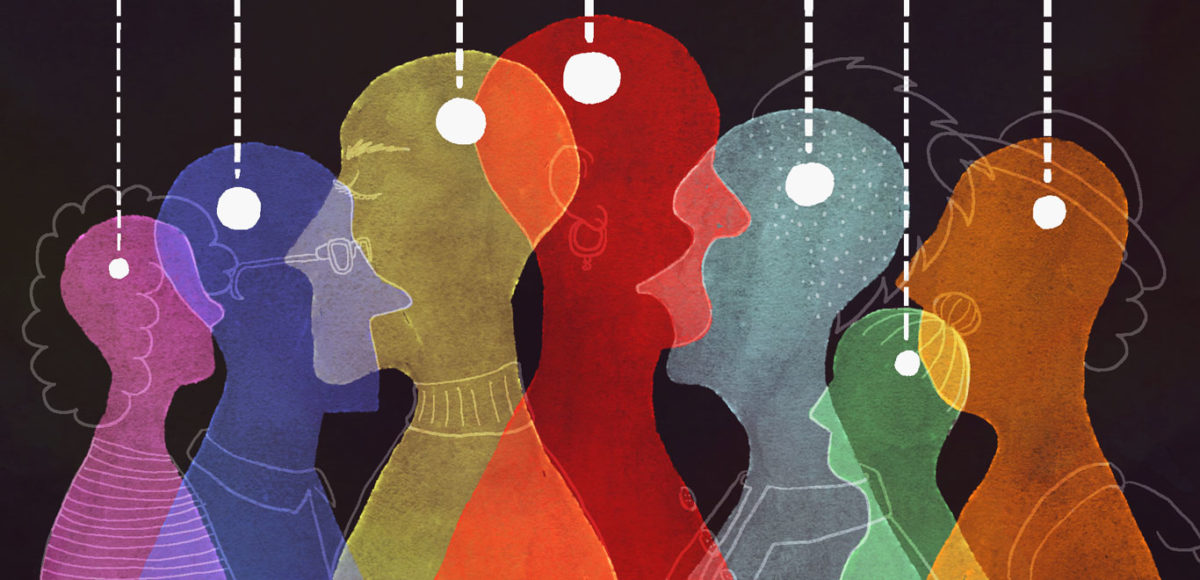
Fiction in the form of film, television, and books has an insidious propaganda effect. This effect is not necessarily conscious or intentional. In practice, it may simply be a meme as a result of prior programming.

I don’t tend to engage with much fiction, though I have in the past. I hadn’t really considered the indoctrination effects at the time. Lately, on account of my significant other, I’ve been consuming fiction via Netflix, Amazon Prime, HBO, Starz, and the like. It’s mostly drivel, in my opinion, but I like to spend time with her, and we can connect discussing plot lines and such over a shared experience.

I find the repetition of facile but culturally prevailing themes such as right and wrong, good and evil, heroes and villains, the power of community and the detriment of the individual, except for the rugged individual, who prevails against all odd.  

These shows propagate pop-psychology beliefs and over-simplify complexity to create a digestible narrative, but which is the equivalent of eating refined white bread instead of whole grains.

My point is not that the writers are seeking to influence the masses, it’s just to point out that this is the case. People view this, and use it to calibrate their own believe systems, but it’s a recursive, self-referential model—an echo chamber. I haven’t done any investigation or research into whether people have already made this connection. I will if I get the time.

One might argue that a counter model would not be well-received, and a goal of most fiction is to gain an audience and earn some money, so give the people what they are asking for and don’t make them think about their worldview. Besides, a single film or series is likely to challenge ones prevailing filters anyway. Even if someone were to create an anti-theme, cognitive dissonance may just rationalise it as a statement, so satire rather than objective criticism.

We do have Absurdist authors, like Franz Kafka, Donald Barthelme, or even Kurt Vonnegut, who rather point out absurd situations in life and some possible speculative fictions, but these Post-Modern writers are accepted, though arguably not widely consumed, save for intellectuals and their quasi-counterparts.

If I had more time, I’d document a few examples, but these shows are typically difficult to sit through once casually let alone carefully dissect. Perhaps, I’ll do this for the sake of science.