Maps and Terrain

To portray meaningful relationships for a complex, three-­dimensional world on a flat sheet of paper or a video screen, a map must distort reality … [A] single map is but one of an indefinitely large number of maps that might be produced for the same situation or from the same data …” 

Mark Monmonier, How to Lie with Maps 

The problem with perception and reality is that perception is so faulty as to be ostensibly unreliable.

Story here. No time to share.

Opiates of the Masses

No, really.

Memories are fallible. I’d thought I had written on this topic of opiates and public policy at length. And perhaps I have. Just not here. Perhaps that’s a good thing. Searching my blog for my take on opiates, I find that I cite Marx’s ‘Religion is the opiate of the masses‘, four times—make that five. But nothing more.

Carl Hart recently published a book on his heroin use—Drug Use for Grown-Ups: Chasing Liberty in the Land of Fear. By some accounts, Carl might appear to be the stereotypical heroin addict in the United States. Well, he’s black, so there’s that. But that’s where the stereotype ends.

Carl Hart is a professor of neuroscience in the psychology department of Ivy League, Columbia University—at least before he published his book. I’ve not read his book, but at my blog I’ve provided a link to the Guardian article, which prompted this post.

The gist I get from having read the Atlantic article is that the public health narrative surrounding heroin and other illicit drugs is akin to the hype of the days when Reefer Madness was all the moral outrage. And make no mistake—this outrage has everything to do with moral one-upmanship and nothing to do with health outcomes. This is pure and simple cultural performativism signalling the higher ground one occupies. As is common enough, many people have actually internalised their misinformation and disinformation to the point they truly believe there is a medical basis to their belief systems. If they are at all introspective, they would see that morals and Calvinism have nothing to do with this purported health care policy. It’s a seemingly reasonable, logical place to arrive. No emotional element is necessary.

But allow me to step back for a moment. Am I saying that there are no possible harmful effect for consuming drugs and other chemicals? No. Am I claiming that no one has ever died as a result of chemical intoxication or overdose? No, again. Am I saying that drug abuse does not incapacitate some people? Nope. I am saying none of the above. I am claiming that hyperbole abounds, the causal connection is overattributed, and cofactors are ignored in favour of an orthodox etiology.

For the record, I am a teetotaler. I do not abuse or even use chemicals referred to as drugs—illicit or otherwise. I don’t drink alcohol, don’t smoke cigarettes. I don’t even drink coffee or covfefe. I do drink Coca Cola, so my big vice in this regard is caffeine. Even rarely do I take ibuprofen or acetaminophen.

As I note in my Defence of Capitalism post, it’s difficult to get good second-hand information of illicit drugs. The medical-industrial complex and the official police state peddle fear and disinformation. Whether they believe the information they dispense is true or not is irrelevant. What is important is the low truth content. It makes one wonder what to trust and what not to when these agencies routinely propagate falsehoods and misrepresent truth.

This misrepresentation isn’t limited to opiates. I found it interesting when Michael Phelps won gold at the Olympics, only to announce that he was the consummate pothead, and smoking weed was part of his daily routine. Here’s what the official Olympics website says about him, by the time he retired at Rio 2016 at the age of 31, Michael Phelps had collected a total of 23 golds, three silvers and two bronzes at the Olympics, a record-breaking haul that looks unlikely to be bettered for many years to come. So much for the lazy stoner stereotype. As marijuana becomes more accepted by mainstream culture, we come to notice that many of the so-called mental health issues were just fabricated. The purpose was to shroud a moral argument in medical legitimacy. Whether the healthcare industry was complicit or it was the law enforcement regime gone rogue is a separate question. Yet again, it undermines the legitimacy of any claims.

In 2020, the world encountered the Coronavirus, COVID-19. And medical expertise, particularly around immunology and the spread of pathogens, came into question. In the United States and United Kingdom, their misinformation was further exacerbated by administrations hostile to science. But given the history of misinformation for political purposes, it may be premature to blame the general public for being reluctant to trust the alarms. They’ve created the classic Boy Who Cried Wolf scenario. And so the question becomes what health information can one trust? And who is the authoritative source?

Listen to this as a podcast on Spotify

Insurrection Bandwagon

There was a recent insurrection at the United States Capitol building in Washington, DC. I won’t take any more time discussing whether this is hyperbole or real. In the end, it doesn’t matter. It’s not relevant to the solution.

From the perspective of propaganda, it’s been an effective message. It’s gotten Trump haters and supporters to view Trump as a common enemy—some of them anyway. Some people and entities can’t performatively distance themselves fast enough or scapegoat him loudly enough.

Whilst I do feel that much of the hullabaloo is performative, I’m not going to focus on the performative aspect. This serves to amplify, but it’s not the central message. Instead, I’d like to frame this through the lens of René Girard’s mimetic theory of conflict and resolution.

Adopting Girard’s vantage, we can see each of mimetic desire, scapegoating, mimetic crisis, ritual, sacrifice, and culture.

Mimetic Desire

In a social context, mimetic theory is about creating in-groups and out-groups—and intentionally so. Groups have rules, by which membership is governed. Symbols are employed to amplify belonging and compliance. At it’s core, mimetic desire employs mimesis—imitation. Monkey see, monkey do.

Here, society is the prevalent in-group. From their perspective, this is the us of the in-group versus the them of the out-group. Girard noted that us versus them is evident in many contexts—whether in the wild or otherwise—, and it can be exploited. It’s about creating a flag to rally around—in this case literally, figuratively speaking.

The mechanism of mimetic desire is to coalesce the focus on some object. From the positive dimension, the desire is to belong, but mimetic desire doesn’t have to be positive. As in this case, it can be negative. The masses have assembled for a common cause of vilifying one Donald J Trump.

Mimetic Crisis

The insurrection is the mimetic crisis. It broke the rules. It’s unclear how all of the many rules that were broken in the four preceding years were able to fly under the radar. To some extent, the US government is constructed of two nearly equal in-groups. They each belong to the institution of institutionalised government and so-called Republican ideal as an expression of modern Democracy. They share some common beliefs, but this sharing diverges dimensionally and methodologically. The telos are multi faceted, and each group prefers different facets—and the facets desired by the public are different still.

At first—to borrow from Kübler-Ross—, there was denial by the Trump-aligned party of sycophants. These Trump-aligned Republicans (read: Neoconservatives; UK: Tories) were also aligned with the outgroup, leaving them vulnerable to ostracism. Meanwhile, the Democrats (read: Liberal/Neoliberal; UK: Labour) secured the moral high-ground and control of the larger in-group. They painted themselves as the adults wearing big boy trousers (over their Pull-Ups).

Scapegoating

Scapegoating is instrumental in mimetic theory. It’s a mechanism to build solidarity and cohesion through exclusion. Narratively, it operates to distinguish acceptable behaviour versus unacceptable. In almost all instances, scapegoating is an object to project blame.1 The remaining members have received the signal.

Here, we have two entities to scapegoat 2: the insurrectionists and the Instigator in Chief, soon to be ex-president, Donald Trump.

Ritual

Ritualistically, scapegoats need to be bear the brunt of the anger of the in-group and associated friends and family. There are procedures to follow. These rituals play out in the House in the form of impeachment, and in the Senate in the form of conviction. For the uninvited guests, the traditional court system ritual

Part of the outrage is performative ritual. Certain entities are checking the boxes suggested by their PR teams. These same entities had nothing to say for the past four years as they’ve enriched themselves at the expense of the American public and world, but this was the last straw. They vowed to cut off support and funding —until they don’t, but by then no one will be any the wiser. People have both short attentions spans and memories.

There is no requirement whatsoever that rituals produce anything. As hard work is its own reward, ritual for the sake of ritual is all that’s necessary. Rituals needn’t be authentic or heartfelt. Simply mime the parts, and you’re all set. Plus, you get full credit—participation points just for playing.

Sacrifice

One ritual is to sacrifice the goats, but we need only exile the offending members. In Christian lore 3, there are actually two goats—a sacrificial goat and an emissary goat—the scapegoat. The sacrificial goat is, obviously, sacrificed—burnt offerings—, but the emissary goat was released into the wilderness, taking with it all sins and impurities. This is the excommunicated, the shunned.

Culture

Where performatism really comes in, is cultural signalling. People and other entities work overtime to signal they are on the winning side. This includes everything from Oscar-winning performances to cringeworthy Razzie-candidates. Those in the public eye tend to go overboard. It’s good to remember that an empty vessel makes the most noise.


  1. The notable exception to this scapegoat-blame relationship is the Christian Christ myth, where Jesus acted as a scapegoat but was without blame.
  2. Trump and the Scapegoat Effect, The American Conservative, David Gornoski, September 1, 2016.
    An interesting article discusses the Trump-scapegoating phenomenon that also mentions René Girard’s work.
  3. Leviticus 16:21–22

The Bell Curve

Many racists, closeted and otherwise, cite The Bell Curve as proof that blacks are dumber than white people. Published in 1994, it’s controversial and bollocks. The first problem is with the notion of IQ testing itself, and then there’s the construction of the tests and relevance to aptitude. Anyone who’s read more than a handful of my posts know that I have long labelled the entire discipline of psychology a pseudoscience, so it would come as no surprise that a product of psychology is principally pseudoscience, too.

Nassim Nicholas Taleb, author of The Black Swan: The impact of the Highly Improbable and Anti-Fragile: Things that Gain from Fragility, among other publications, Nassim is working on adding to his Incerto collection. At least a portion of the work focuses on the notion that IQ is largely a pseudoscientific swindle. Reviewing the material, it’s almost effortless to draw parallels to Foucault’s Mental Illness and Psychology, or even more so, sections from Madness and Civilization: A History of Insanity in the Age of Reason.

I’ve already moving on to new topics, so my parting point is that ordinary people find interpreting statistics to be an almost insurmountable challenge. Mark Twain recognised this in his quip, lies, damn lies, and statistics.

lies, damn lies, and statistics

Mark Twain

The problem is many professionals don’t understand statistics—even those whose function requires it. I was a professional statistician decades ago, so I have a certain fondness for it. I was even working on another post on the subject of the Simpson’s Paradox, but not quite yet—though it’s been weeks in the works. I am thinking about a post related to René Girard’s conflict theory as a lens and framework to understand the ‘insurrection’ at the US Capitol. I also want to react to the notion of metamodernism as a reaction to the conflict between modernism and postmodernism.

So little time. Please stand by.

Mimetic Desire

People influence one another and, when they’re together, they have a tendency to desire the same things, primarily not because those things are rare but because, contrary to what most philosophers think, imitation also bears on desire. Humans essentially try to base their being, their profound nature and essence, on the desire of their peers.

“Mimetic Desire: Shakespeare Rather than Plato.” When These Things Begin: Conversations with Michel Treguer, by René Girard and Trevor Cribben Merrill

Although I have some reservations—or at least reserve some latitude—, I tend to agree with Girard. Desire is a social construct. Desire is separate to needs. Desires are wants. As accomodated in Economics, we don’t need what we want, but we want what we need. We desire what we need.

we don’t need what we want, but we want what we need

What Girard is essentially saying is that I want what I want because you want it. This is independent of value in an economic sense. Memetically, the value of an object increases relative to the perceiver simply because another person wants it. In my reckoning, I’d separate want from desire or at least elevate desire to a higher degree of wanting.

Girard termed this triangular relationship between subject (you), object (the thing), and the mediator (the influencer) mimetic, to mimic. I suppose some of this might be considered to be memetic, but I also suppose that memes serve to simplify rather than serve as a distinct transmission vector.

circa 2016

My question is—exacerbated during this pandemic—how does this operate in isolation? I consider myself. I am not an ascetic by most definitions, but I am somewhat of a minimalist. My only ‘vices’ are my computer and my guitars. I used to be a professional musician—though most of that was spent on the other side of the console—and I was a Gibson snob. From the perspective of emotional desire, I still am. There is a certain nostalgia, but I don’t play out anymore, and I’m not seriously recording, so I don’t need the same perceived quality of an old Gibson.

Guitarists know that different guitars give different sounds. I’ve owned as many as 10 guitars at a time, and each had its purpose. Some was feel. This guitar was for Blues, this was other for Grunge, and that was for Jazz…and that for Fusion and that for a retro sound. This one had a fast neck, and this one sustained for days. This one was tuned à la Keith Richards, sans a string, to an Open G, and the was set up for Drop C, and of course there was the Standard-tuned one for good measure

Jason & Me circa 2012

Did I need 10 guitars? No. Did I need 1? Not really—not unless I wanted to be a musician, desired to be a musician, so the degree of freedom was l, given this other desire. Having 1 guitar for a guitar player is not the same as a painter with only one colour of paint, but it almost feels like it. It’s certainly a convenience, and it allows players to express themselves artistically.

The question isn’t why I desired a guitar, but why I wanted to be a musician, and of all the instruments, why the guitar—and why did I prefer this genre over that. I’ll admit that my tastes are rather eclectic, but all that says is that I mimic eclecticism or eccentrism. My parents are not eclectic. Most of my friends are mainstream whitebread people—none I’d deem eclectic.

I’m rambling. Just because I don’t remember the source of my desire doesn’t mean there is no source. Perhaps it’s a composite source. I can’t say. Perhaps the outcome I’m naming, say eclecticism, is incorrect, so I am seeking the wrong source.

circa 2004

My point was that I don’t need a Gibson to be satisfied. First, I’ve already owed them, and I don’t have the same performative needs. But I still want to play, and I still want to exercise some artistic freedom, so I still have a few guitars.

To wrap this up, I’ll leave with an unpaid mimitec endorsement of Harley Benton guitars. The last guitar I purchased was this Harley Benton Black Paisley TE70. It’s very fit, and I picked it up for about €200, which included shipping and handling. They are German-built. When I was a kid, a guitar at this price range would have be borderline unplayable and won’t sound shite-like. These aren’t €1,000 instruments, but you’d be hard pressed to find a 5x value differential. They are build solid and have been given extra care not previously seen in down-market instruments. If I wanted to spend another €200, I could upgrade the pickups and for a bit more swap out the electronics to bigger potentiometers—but I won’t. I was planning to splurge and spend €50 on locking machine heads. Nope. Good enough. At €200 a pop, I could afford all sorts of configurations, but even that desire has waned—at least a bit, at least for a while.

circa 1984

Diversity Frame

One if the biggest foci of postmodern philosophy is the metanarrative. Employment diversity is a place that the metanarratives go unquestioned by most. The most predominant aspect is the frame. Don’t accept it.

Inside this frame, some uncritically adopted narratives are as follows:

  • Work is good
  • Work builds character (proportionately to the effort exerted)
  • Work defines your value or worth as a human
  • Work signifies your place in society
  • Work is its own reward (except for monetary payment and recognition)
  • Value is defined by monetary achievement
  • Worth is defined by your place in an enterprise

And so on…

In this HBR article*, the frame has been established as a corporation and the diversity within this context. What this say by omission is that money and power is the measure of a meaningful existence. If only women were afforded a seat at this table—proportional to their population in society—, things will be even.

Women should start their own successful companies. Women should rise to the top of existing companies. Especially if they buy into the aforementioned narratives. Many women and men buy into this story lock, stock, and barrel (whatever that means), but only is you accept this as a frame is this relevant.

It’s easy to imagine a world where money is unnecessary, where labouring is unnecessary.

It’s easy to imagine a world where money is unnecessary, where labouring is unnecessary. Some have imagined a world without work, where people could instead pursue artistic endeavours, but this is just adopting a different set of narratives—like the person who exchanges drugs or alcohol for Jesus or some such. Out of the frying pan into the fire. This is the lie.

Interestingly, the HBR article makes these points:

  1. Quantify gender equity in terms of economic gains for the company.
  2. Hold leaders accountable for change by tying DEI metrics to performance reviews.
  3. Offer development opportunities to increase gender intelligence, empathy, and self-efficacy.
  4. Pull back the curtain on misperceived social norms.
  5. Establish cross-gender professional relationships.
  6. Frame, focus, and integrate interventions into core business outcomes and mission.

Notice that each of these operates from the perspective of the company. Granted, this is HBR, where the B is for Business, but still. Here’s the low down.

  1. Gender equity will at some point increase your bottom line.
  2. Create diversity metrics (and incentives) and tie them to performance review—presumably tied to the economic performance expected in bullet 1.
  3. Offer diversity training—notwithstanding the body of evidence and long history that diversity programmes are not only ineffective but sow seeds of discontent.
  4. Educate your executives and staff to the misconceptions—so long as you don’t question the deeper metanarratives.
  5. Essentially, the ask here is to establish male-female protégé-mentor relationships. Of course, this could be expanded to break binary gender stereotypes, too.
  6. Back to business, frame the frame. But to tell the truth, I don’t even know how to interpret and summarise the provided example. It seems this is an admixture of points 1 and 2, given metrics should ladder up to stated objectives and outcomes.

asking for this equity in diversity is a short-term fix

In any case, asking for this equity in diversity is a short-term fix, but it’s unimaginative and buys into the worldview of the patriarchy. There is no reason to accept this prima facie. As with the notion of Democracy, I’d be willing to argue that the system itself is the problem and that any tinkering within the system is limited by the system itself.


* Apologies in advance if HBR has a paywall. Typically, the first 3 articles are free, but if you are like me that exhausts on day one.

Žižek’s Essentialism

So, I’ve gone down a rabbit hole. Again. This time, it’s Žižek. Again. I’ve still not read any of Žižek’s own work, but people mention him often and he is a shameless self-promoter. In this video clip, he responds to whether gender is a social construct. Unfortunately, he conflates gender with sex, and his examples cite transsexuals not transgenders.

sex is about biological sex assignment

To set the stage, sex is about biological sex assignment—the sex category you are assigned into at birth: male, female, or other for some 1.8%. This is a simplistic categorisation: penis = male; vagina = female; both or neither: rounding error. In some cases, a decision is made to surgically conform the child to either male or female and ensure through prophylactic treatment that this isn’t undone hormonally in adolescence.

gender is about identity

Gender is about identity. As such, it is entirely a social construct. All identity of this nature is a function of language and society. In this world—in the West—, females wear dresses (if they are to be worn at all) and males don’t—kilts notwithstanding. In this world, sex and gender have little room for divergence. so the male who identifies as this gender (not this sex) is ostracised.

The example I usually consider first is the comedian Eddie Izzard—a cross-dresser. He’s probably a bad example because he does identify as a male. He just doesn’t wish to be constrained by male role restrictions and wants to wear the makeup that’s been reserved for women in the West at this time.

Žižek eventually gets to an argument about essentialism—so we’re back at Sorites paradoxes and Theseus again. At the start, I could argue that the sexual distinction has few meaningful contexts. For me, unless I am trying to have sex and/or procreate, the distinction is virtually meaningless. For others, only procreation remains contextually relevant. In this technological world, as Beauvoir noted in the late 1940s, strength differentials are not so relevant. End where they are, sex is not the deciding factor—it’s strength.

Žižek’s contention seems to be that the postmoderns (or whomever) disclaim essentialism in favour of constructivism but then resolve at essentialism as a defence because ‘now I am in the body originally intended’. I’ll argue that this is the logic employed by the person, but this person is not defending some academic philosophical position. They are merely engaging in idiomatic vernacular.

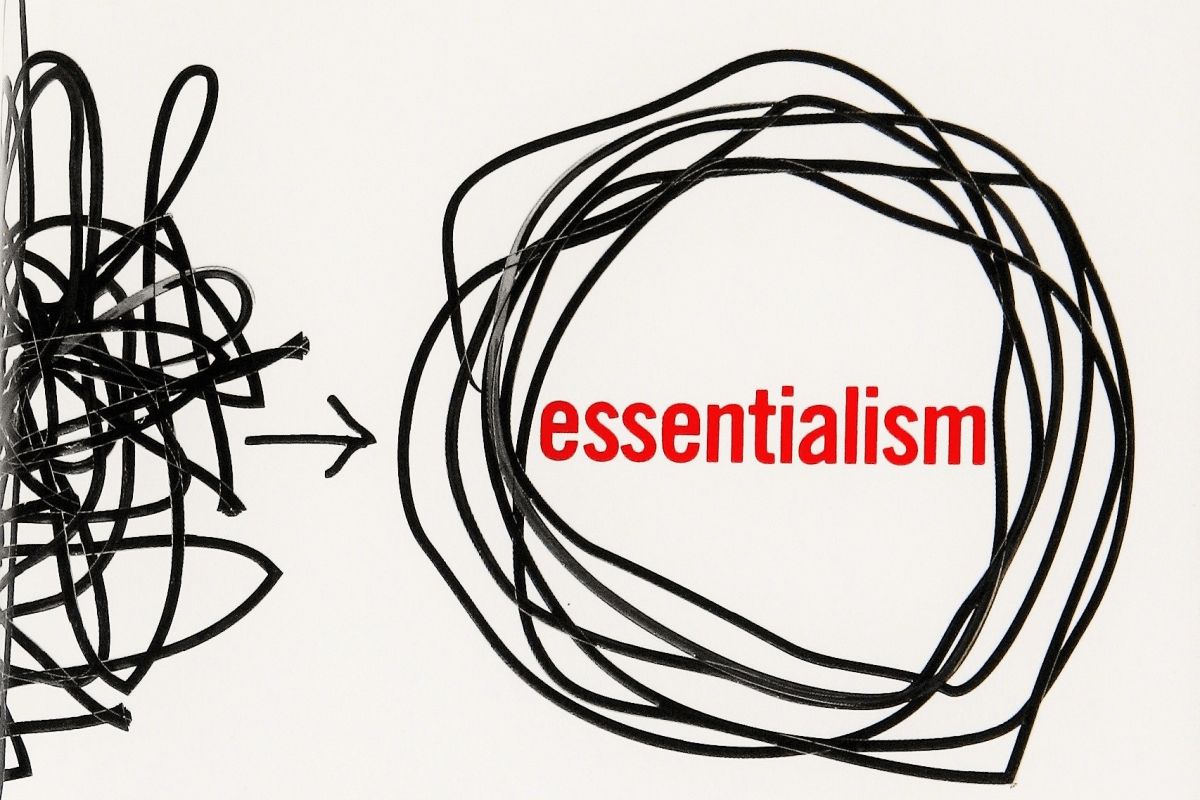
I am not deeply familiar with this space, and if the same person who is making a claim against essentialism is defending their actions with essentialism, then he’s got a leg to stand on. As for me, the notions of essentialism and constructivism are both constructed.

Perspective on Theseus

Chump in Chief* wrote a piece on dementia using analogue of the ship of Theseus. As a topic, Hobbes’** Theseus thought experiment has been well-covered, but that’s never stopped me before.

This is all about identity. Essentially, there are two perspectives. To an observer not on the ship or aware of the transformation, they would be none the wiser. For all intents and purposes, if they had ever seen the ship before, it’s the same. But what about those on the ship?

For nearly all of these observers, it’s almost unquestionably still the same ship. In a manner paralleling a person’s cells being sloughed off every 7 years, the cells in place at the start aren’t there after 7 years. Most will not doubt that you are the same person.

the average human cell is about 7 to 10 years old

As cells are continually dying and replacing themselves, for an adult the average human cell is about 7 to 10 years old, which might be interpreted as saying in the fashion of Theses’ ship that a person is anew each 7 to 10 years. Let’s ignore that this is an average, and many cells have a lifespan of only a few days whilst others—cerebral cells in particular—are here from the start and so are as old as the person.

Another perspective is to consider the replacement parts: would it matter if the colour of the parts changed in the process? What about the materials? What about the underlying architecture? What if the departing sloop arrived a schooner? Weight? What then?

My favourite extension of this thought experiment is to ask the question two-fold: Not only do we ask if this ship built with new materials is still Theseus’ ship—which to be fair is more a question of ownership than of identity—, but what if I reconstruct the original ship with the original materials. Are these both Theseus’ ships? Can we continue this exercise with new material ad infinitum?

As far as I know, we can’t repurpose cells in this fashion, but what if we could? There are many such Star Trek transporter mishap thought experiments, or the Duplicates Paradox.

In these experiments, a transporting device disintegrates the subject, and replicates the subject at a distance—but this replication presumably uses different atoms and cells, and so what if a duplicate copy is made rather than the replacement copy? Who’s identity prevails? Is it murder to eliminate one of the duplicates? Similar questions have played out in the science fiction / fantasy space.

Locke and others suggest that for people, memory and the continuity of thought are key, but your thoughts of me are not the same as my thoughts of me. This is why an amnesiac may no longer maintain some original identity, and yet to the familiar outside observer, this shell of a person remains intact. This is pretty much how it plays out with zombies and dementia patients. This sense of identity is projected upon the person rather than exuded from them.

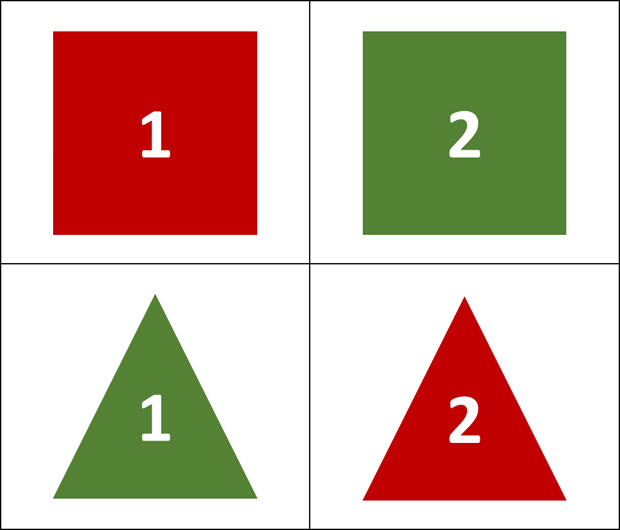
So what is my perspective? Rather than a paradox, it is more a problem of vaguity or ambiguity and how we’re defining sameness. There are many dimensions to similarity. I can present you a red square, a green square, a blue triangle, and a green triangle and play the Sesame Street ‘one of these things is not like the other game.

Is the sameness the colour, the shape, or the number? Could one be comparing area or perimeter?

So, I’ve gone off the reservation. I don’t put a lot of weight in notion of identity. It has evolutionary merit and is an effect of humans’ nature (as it were) to categorise and taxonomise.

* This Chief Chump charge may be unwarranted or even understated, as I don’t know this bloke.
** This is the same Hobbes with the ‘solitary, poor, nasty, brutish, and short’ claim to fame.

Police State

Bad police dramas on TV have gotten me in the mood to rail. First, there was the topic of lying, and then there was the Unabomber. This post is broader.

We laugh of the notions of Barney Fife, Chief Wiggum, and Paul Blart, but in my estimation these are closer to the norm than the stereotype of the bad-ass cop.

My armchair pop-psychology assessment is that people who are drawn to police work are underachievers with power and control issues and conformity and morality fetishes.

Advantage goes to the house

Law enforcement and jurisprudence systems wouldn’t work if they didn’t stack the decks in their favour. They give themselves get out of jail free cards and rely on lies and deception to create an advantage. Watching these TV shows, they have permission to lie, withhold, misrepresent, coerce, and entrap without repercussion. They make ‘deals’ in domains where they have no authority. They are even allowed to engage in criminal activity if it serves the better interests of a case. They can buy drugs and property, engage with prostitutes, and any number of otherwise illegal activities.

I won’t even spend more digital ink commenting on the lack of due process judges commit in the courtroom—personal fiefdoms.

Domestic abuse

Over 40% of active police officers have domestic abuse histories.

Over 40% of active police officers have domestic abuse histories. These people have records of abusing the wives, children, domestic partners, and pets. And these are only the ones who have been caught. Statistically, the percentage is very likely to be over 50%. This is not shining endorsement. Sadly, domestic abuse is inversely correlated with IQ, so this doesn’t fair well with the next topic.

Low IQs

The average IQ of a police officer in the United States is about 104. In and of itself, this might not seem strange. This seems to imply that these IQs are in line with average, but there’s a problem. The courts have ruled that is not discriminatory to exclude people with high IQs from being police officers because they are more likely to be independent thinkers and not conformant.

Conformity

Because cops are usually and expectedly conformant, it should come as no surprise that they feel the urge to prescribe this conformity on others. Given the opportunity, I’d argue that in many instances this conformity is superficial and performative, but that’s a topic for another day.

Industrial Society and Its Future

I was writing a post about cop and crime shows and fittingly commenting on cops and crime, when my girlfriend turned on Manhunt: Unabomber, a series about serial bomber Ted Kaczynski. I remember when the FBI finally caught Ted and publicised this story, but I don’t know how much of the series was dramatised versus the facts, so my comments will be on the series and not the underlying events.

I title this post after his published ‘manifesto’, Industrial Society and Its Future, but it otherwise has nothing to do with this topic or his manifesto. To me, Ted Kaczynski seems to be a contemporary Thoreau or Rousseau, a primitivist born into the wrong century.

From a philosophical position, the series depicted the perils of taking a deontological approach. Process prevailed over consequences, which resulted taking 18 years to identify and capture Kaczynski. Time and again, process and pushing paper were promoted over new methods.

criminal profiling is the astrology of forensics

As people familiar with me know, I find the discipline of psychology to be pseudoscience (or perhaps simply a parascience), and so-called criminal profiling is the astrology of forensics, which are already a bit sketchy from the start.

Television promotes the logical rationalism underlying forensic science, connecting the dots to a forgone conclusion, if only the right dots are found. As with most law enforcement and court dramas, the focus is on the good guys overcoming the bad guys. Sometimes, it’s the good cop rooting out the bad cops or the perils of a cop who crosses the line to the dark side. These shows want to show how procedural criminology is in order to dissuade people from taking this path.

Knowingly or otherwise, this is propaganda. The fact is that most crime goes unsolved. Most criminals don’t get caught. Many who get caught are not convicted. Some convicted didn’t commit the crime they have been charged with. From an economic perspective, the vast monetary value is taken by white collar professionals with MBAs not burglars and bank robbers.

Systems need people to have confidence in systems. It’s self-serving. The propaganda is important to shore up confidence in the system of law & order, but it’s analogous to slot machines in Vegas or Atlantic City or wherever. When a person wins, there are bells and lights to increase the excitement in the room. But this misses the losers. If the sound was for losers and not winners, the cacophony might be deafening.

Henry Ford failed at 7 business before succeeding

This propaganda overplays winners and concentrates focus. This is classic cognitive survivorship bias. But don’t ask about the losers. This framing isn’t limited to law enforcement. It is also employed in the prevailing Capitalist narrative, but it under advertises the fact that most entrepreneurs fail. Counter arguments are presented in the likes of Henry Ford failed at 7 business before succeeding. If you fail, just try again. It has to work out for you eventually—unless, of course, you aren’t working hard enough—not working as hard as the winners, not paying your dues.

Whilst watching, I found myself scoffing time and again. I am not a Romantic and not a Primative, so I didn’t exactly side with Kaczynski, but I definitely didn’t side with the system, even if that’s not what he was railing against.

Of interest to me was the forensic linguistics. Humourous to me was his choice of spelling. Like me, he wrote in international English. The series represented his spelling as accepted variants, but this is a US-centric position. In fact, most the the world that speaks English employes the British flavour, which is closer to international English than so-called American English, which is only spoken in the US and Central and northern South America. The rest of the world doesn’t use American English. I chose to use international English after high school. Occasionally I get comments and criticisms, but my grammatical footing is stronger than the vast majority of these. The biggest factor is that I don’t identify as an American. Rather, I am a citizen of the world. Perhaps Esperanto?