Agency Be Damned

I don’t believe that humans have the agency presumed they have, so I’d like to set out to prove it—at least rhetorically. In the ages-old battle between free will and determinism, I’ve tended to lean toward the determinism camp, but there is something keeping me from gaining full membership. I feel that proving hard determinism may be too hard a nut to crack, so I am aiming at just the agency aspect.

There are two major themes in my thinking.

  1. Humans have no material agency
  2. Power structures require the presumption of agency

Although this concept has been rattling around my brain cage for a while and I still have a ways to go, I feel it will be helpful to sketch out my ideas. I feel inspired by people like Robert Sapolsky and Daniel Dennett. And I feel I can draw insights into counter-arguments from people like Jonathan Haidt, Joshua Greene, and even Steven Pinker. I feel that my experience in behavioural economics may be useful for additional context—people like Daniel Kahneman, Richard Thaler, and Dan Ariely. But I feel disheartened when it appears that Galen Strawson and his father before him, Peter Strawson, people much more connected and elevated in the field have been treading the same territory for decades — over half a century — ahead of me, thankfully beating a path but not necessarily making much headway. Perhaps I can build upon that foundation if not substantially at least perceptibly. Of course, the seminal work by Isaiah Berlin’s Two Concepts of Liberty.

We may act as we will, but we cannot will as we will.

Arthur Schopenhauer

Besides the aforementioned, a correspondent has suggested other source references. He shares: Physics, including quantum mechanics, is fully Lagrangian. According to Stanford’s Leonard Susskind, Lagrange derived his formalism from the principle of ‘Least Action’. Jean Buridan’s principle of ‘Equipoise’ renders a Lagrangian model of the world perfectly deterministic. So, the physical domain is not probabilistic; and all indeterminacy is actually epistemic indeterminability. He also suggets Thomas Hobbes’ “De Corpore”.

About my second point, my corresponent agrees:

I think your “meta” is right. We feel that we are “free agents”, and we don’t know to what to attribute our feeling that we freely choose; so we imagine that we have “free will”. In my view it also doesn’t exist – we really are, as Sapolsky describes, zombie robots – we just don’t (and cannot) know it. Free will is thus a mere (but compelling) illusion on both individual and emergent scales. And yes again: all of morality, jurisprudence, etc., depends on it.

Unattributed Correspondant

My correspondent is a professional philosopher who shall remain anonymous until such time as he agrees, if ever, to make his identity known. I am quiet aware that some of my ideas are contentious and polemic. Not everyone wishes to be mired in controversy.

Humans Have No Material Agency

Humans have little to no agency. This is the point I am making in my Testudineous Agency post. From what I know until now, this likely qualifies as soft determinism, but this might shift as I acquire new nomenclature and taxonomic distinction. I’ve discovered this taxonomy of free will positions, though I am not well enough versed to comment on its accuracy or completeness. For now, it seems like a decent working model to serve as a starting point, but I am fully cognizant of possible Dunning-Kruger factors.
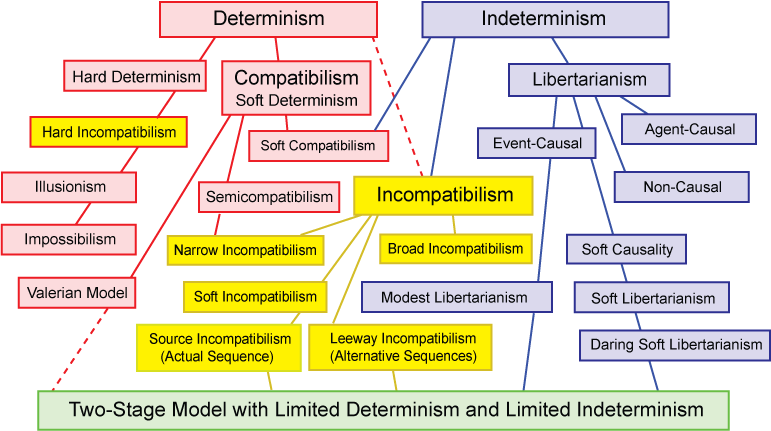
A Taxonomy of Free Will Positions

In essence, hard determinism says that the world is not probabilistic. Some event triggered the universe as we know it, and it will unfold according to the laws of physics whether or not we understand them. A weaker form, soft determinism, allows for some probability and trivial ‘agency’. I feel that Dennett supports soft determinism. I feel that because we, as ‘individuals’, are a confluence of multitudinous factors, we have little agency (interpreted as responsibility). More on this later.

Power structures require the presumption of agency

To be honest, the free will debate is only interesting to me in context. To me the context is power. The ‘meta’ of this is that society (and human ‘nature’) seem to need this accountability and culpability, but it doesn’t actually exist, so it is created as a social construct and enforced in a Foucauldian power relationship through government through jurisprudence mechanisms.

This is the part of the debate I haven’t heard much about. Sapolsky did write in Behave, chapter 20X, that criminal justice systems need to be reformed to account for diminished agency, and I’ll need to return to that to better comprehend his position and assertion.

The rest of the story

As a handy reference, these are the authors and books I’ve encountered to date and in no particular order:

Then there I those I have yet to read:

I’ve got a lot of essays and lecture notes not referenced plus general content from Reddit, Medium and other blogs sources, YouTube, podcasts, and so on. I probably should have documented some Classical philosophers, but I don’t generally find their argumentation compelling, though I might add them later.

The aim of this post is just to capture my intent—if it is indeed my intent. Oh, the questions and implications of a lack of agency. Please stand by.

Intuition and Reason

I’ve been cycling through The Righteous Mind and Moral Tribes, respectively by Jonathan Haidt and Joshua Greene. These blokes are social psychologists and moral philosophers. I started each of these books with the conception that I would neither like nor agree with the content. As for like, I suppose that’s a silly preconception better captured by whether or not I agree; that with which I don’t agree, I don’t like.

This said, I like the style of both of the authors, and I am finding the material to be less contentious than I first thought. I can already envisage myself agreeing with much of the substance but waiting to disagree with the conclusions.

Although I committed myself to document The Righteous Mind in situ, I am finding that I am listening to the audiobook whilst driving and so getting ahead of myself, so I’ll have to rewind and retread in order to do this. In fact, the reason I switched back to Greene’s Moral Tribes is so I wouldn’t progress even further in Haidt’s work.

I am writing this post to acknowledge this. I’d also like to document that I don’t believe that humans are good reasoners, a situation both Haidt and Greene cite to be generally true. Humans are post hoc rationalisers, which is to say that they make up their minds and then create a narrative to justify that position. Haidt uses an analogy of an elephant and a rider, and he asserts that humans might more accurately be described as groupish than selfish. Certainly not shellfish. Greene notes that people have been shown to concede self-interest to political party interest, which helps to explain how people continually and predictably vote against their own self-interests. This also supports my position that democracy is a horrible form of government. Of course, Haidt would argue that this proves his point that people tend to adopt facts that support their perspective and diminish or disregard those that don’t.

it doesn’t follow that intuition is (1) better, (2) significantly better, or (3) good enough for (a) long term viability or (b) grasping complexity.

Haidt suggests that reason is overvalued, but then he proposes intuition as a better alternative. I agree with him that reason is overvalued and for the same reasons (no pun intended) that he does. But it doesn’t follow that intuition is (1) better, (2) significantly better, or (3) good enough for (a) long term viability or (b) grasping complexity.

Whilst I am not immune to this any more than someone else. I recall Kahneman writing in Thinking Fast and Slow that even though he is well aware of cognitive biases and fallacies, he himself can’t escape them either. When I used to teach undergraduate economics, I’d give some sort of policy assignment. As a preamble, I’d instruct the students that without exception, all policy decisions have pros and cons. In their submissions, they’d need to gather both supporting and detracting arguments and then articulate why one should be adopted over another. Minimally, I’d expect at least three pros and cons.

The students would almost invariably complain about how difficult it was to imagine a counter-position. Even when they’d include some, they were usually weak tea fodder. Oftentimes, the students already shared the same perspective, so they couldn’t usually even get the opposing side until we debriefed after the assignments had been graded. Although I do recall instances where students would admit that they hadn’t considered this or that opposing view, I can’t recall a case where a position was flipped after hearing new evidence—not that this was my intention. People do engage in escalating commitment, doubling down on existing beliefs and generating defensive—sometimes tortuous—arguments to support their positions.

Testudineous Agency

In chapter 71, Ultimate Responsibility, in Intuition Pumps and Other Tools for Thinking, author and philosopher, Daniel Dennett presents a counterargument to the notion that an agent, a person, is not absolutely responsible for their actions. He questions some premises in the ‘the way you are’ line of argumentation, but I question some of his questions.

Here is a nice clear version of what some thinkers take to be the decisive argument. It is due in this form to the philosopher Galen Strawson (2010):
1. You do what you do, in any given situation, because of the way you are.
2. So in order to be ultimately responsible for what you do, you have to be ultimately responsible for the way you are—at least in certain crucial mental respects.
3. But you cannot be ultimately responsible for the way you are in any respect at all.
4. So you cannot be ultimately responsible for what you do.

Dennett, Daniel C.. Intuition Pumps And Other Tools for Thinking (p. 395). W. W. Norton & Company. Kindle Edition.

Dennett continues.

The first premise is undeniable: “the way you are” is meant to include your total state at the time, however you got into it. Whatever state it is, your action flows from it non-miraculously.

Dennett and I are in agreement with Strawson. There is not much to see here. It’s akin to saying the now is the result of all past events until now. This is “the way you are”.

The second premise observes that you couldn’t be “ultimately” responsible for what you do unless you were “ultimately” responsible for getting yourself into that state—at least in some regards.

This second premise asserts that one cannot be responsible for any action that one had no part in performing. Two scenarios come immediately to mind.

First, you are not responsible for being born. As Heidegger notes, we are all thrown into this world. We have no say in when or where—what country or family—or what circumstances.

Second, if one is hypnotised or otherwise incapacitated, and then involved in a crime, one is merely a cog and not an agent, so not responsible in any material sense.

But according to step (3) this is impossible.

Whilst Dennett fixates on the absolute aspect of the assertion, I’d like to be more charitable and suggest that we still end up with a sorites paradox. Dennett will return to this one, and so shall I.

So step (4), the conclusion, does seem to follow logically. Several thinkers have found this argument decisive and important. But is it really?

As Dennett invalidates step (3), he insists that the conclusion is also invalid. He asserts that the notion of absolute responsibility is a red herring, and I argue that Dennett doesn’t get us much further, perhaps redirecting us with a pink herring.

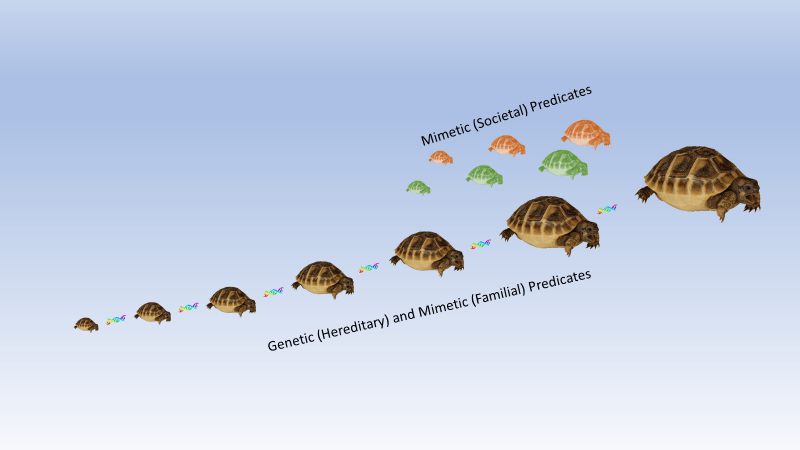
I’ve created an image with tortoises to make my point. There are actually two points I wish to make. The first point is to determine where the responsibility is inherited. This point is meant to articulate that the world can not be strictly deterministic and yet one can still not have significant agency. The second point is that culpability is asserted as a need, and acceptance of this assertion is the problem.

This image has an empty alt attribute; its file name is image-14.png
Testuditude

The image depicts an evolution of an agent, with time progressing from left to right. The tortoise on the right is a product of each of the recursive tortoises to its left. The image means to convey that each subsequent tortoise is a genetic and social and social product of each tortoise prior. Of course, this is obviously simplified, because tortoises require pairs, so feel free to imagine each precedent tortoise to represent a pair or feel free to add that level of diagrammatic complexity.

This is not meant to distinguish between nature and nurture. Instead, the claim is that one is a product of both of these. Moreover, as genetic, epigenetic, and mimetic influences are transmitted in family units, they also occur through social interaction and the environment, as represented by the orange and green tortoises.

…if one is a product of genetic and mimetic forces, how much agency remains for culpability?

The point here is that if one is a product of genetic and mimetic forces, how much agency remains for culpability? Each person is an emergent unit—autonomous, yes, and yet highly programmed.

If I programme a boobytrap to kill or maim any intruder, the boobytrap has no agency. I assert further, that the maker of that boobytrap has no more responsibility than the killing device.

The old hand grenade wired to a doorknob boobytrap trick

But who do we blame? you ask, and that’s precisely the problem. Asking questions doesn’t presume answers. This is a logical fallacy and cognitive bias. This heuristic leaves us with faulty jurisprudence systems. Humans seem hardwired, as it were, to blame. Humans need to believe in the notion of free will because they need to blame because they need to punish because vengeance is part of human nature to the extent there is human nature. There seems to be a propensity to frame everything as a causal relationship. Dennett calls this the Intentional stance. To borrow a from Dennett…

This instinctual response is the source in evolution of the invention of all the invisible elves, goblins, leprechauns, fairies, ogres, and gods that eventually evolve into God, the ultimate invisible intentional system.

Dennett, Daniel C.. Intuition Pumps And Other Tools for Thinking (p. 374). W. W. Norton & Company. Kindle Edition.
Fire Trap in Home Alone

Sins of the Fathers (and Mothers)

Let’s wrap this up with a sorites paradox. As I’ve already said, I agree with Dennett that the absolute aspect is unnecessary and undesired. The question remains how much agency™ does a person have once we account for the other factors? Is it closer to 90 per cent or 10 per cent? Apart from this, what is the threshold for culpability? Legal systems already have arbitrary (if not capricious) thresholds for this, whether mental capacity or age, which basically distils back to the realm of capacity.

I have no basis to even venture a guess, but that’s never stopped me before. I’d argue that the agency is closer to zero than to one hundred per cent of the total, and I’d propose that 70 per cent feels like a reasonable threshold.

I could have sworn I’d posted a position on this after I read Robert Sapolsky’s Behave. Perhaps it’s never made it out of drafts.

In closing, I don’t think we need to settle the question of determinism versus free will to recognise that even without strict determinism, personal agency is still severely limited, and yet as our political systems presume a level of rationality that is not apparent, so do legal systems presume a level of agency not present.

Kid Speak

A toddler lives with me. She’s been on the brink of verbal language for the past few months, and I am sharing some observations.

Listen on Spotify

Juicy Shoes

Juice (in a sippy cup) and shoe(s)

Two objects that play a large part of her verbal life are juice and shoes. As I hear her employ these words, they are virtually indistinguishable. I may actually misperceive her, and she could be uttering the same morphemes. I captioned how I perceive these images with IPA references.

In English (in IPA), juice is spelt / d͡ʒˈuːs / and shoes is / ˈʃuːz /. She simplifies ‘juice’ by not voicing the leading alveolar plosive ‘d’ and by shortening the diphthong to a monopthong vowel. For ‘shoe’, she similarly shortens the vowel sound and annunciates a voiceless rather than voiced alveolar fricative.

Awhr

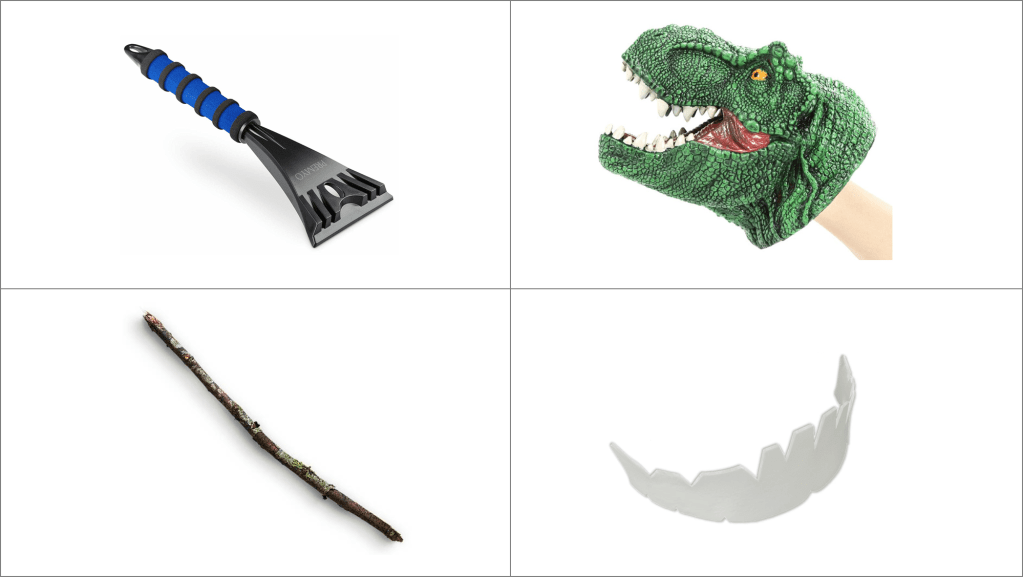
Left to Right, Top to Bottom: Windscreen Ice Scraper, Silicone Dinosaur Hand Puppet, Stick, Cap Shaper

Can you guess the common thread the above objects share?

Spoiler Alert: They are each signified by the same signifier— Awhr, which I believe may be transliterated as Rawr. Bear with me.

She loves dinosaurs. Seeing one, she reflexively roars onomatopoeically, awhr. I know. You are thinking to yourself, that’s a no brainer. Dinosaurs roar. At least in the modern-day mythos. I don’t speak dinosaur, and perhaps dinos had regional dialects or species nuances. She’s just a toddler, so ‘awhr‘ is representative of all dinos.

But, you are thinking, these other things not only don’t roar, but they’re also inanimate. Sure, you tell yourself, the dinosaur is a puppet, but you can envisage the connexion. That’s a toy dinosaur, but these other things are an ice scraper, a stick, and who knows what that last thing is? It’s a hat shaper. It was an insert to a cap—like a baseball cap or trucker cap. It was removed for the cap to be wearable, and the insert is one of her favourite toys. All of these rank high on her list of preferred toys.

As far as I can tell, she envisages the cap insert as teeth—resembling, perhaps, the teeth of a dinosaur—hence ferocity, hence a roar. I believe the roar-stick connexion has an aetiology that involves the ice scraper, so I’ll share that origin story.

Whilst shopping for an ice scraper in Winter, we were in the automotive aisle. As she was interested in the variety of air fresheners, I parked her trolley and surveyed the aisle looking for scrapers. Finding one—and for reasons unknown to me; perhaps the ‘teeth’ on the back of it—, I represented it as a claw and produced my own roar. The impression was made. It’s been months, and whenever she interacts with it, she roars as if it were a dinosaur.

By extension, I believe, the stick is a simulacrum. We’ve travelled from the signified to the first-level signifier (puppet) to a second-level signifier (scraper) to a third-level signifier (stick). Absent the causal narrative, one would be hard-pressed to suss out why a child might be representing a stick with a roar. And now you know.

But wait. There’s more. I was so busy geeking out, that I almost forgot the story that prompted this post in the first place. We were driving somewhere. She sits in a car seat that, by design restricts her movement, and sometimes her playthings go out of reach, where ‘sometimes’ means ‘almost invariably’.

As we were heading wherever, I heard the cue, awhr. A quick glance in the mirror caught the dinosaur puppet. I reached back and handed it to her. Crisis averted. She played with the puppet for a bit, and that leads to a brief diversion from the narrative. Her roars have two noted contexts. The first is playing, awhr. She finds herself amused to be a dino ventriloquist, and she bursts out laughing if you acknowledge her playing. The second is serious business, awhr. Laughter is not the expected reaction. Anything less than feigned terror will get you the look. This is no play dino. This is a dino incarnate. But I digress.

A minute or so later, awhr. This roar is neither play nor serious. She wanted something else. A quick survey of available candidates, and I sussed out the cap stretcher cum teeth. Crisis averted. But only for a minute. After satisfactorily animating the stretcher, another roar. Another glance back. No good candidates. But there was a stick. What do I have to lose?

Awhr. Yep. This is what she had in mind. She animated the stick for another few minutes. And that brings this chapter to an end.

Moar

Though her vocabulary is so far quite constrained, she does have a few more available words. More was pretty early on her list, almost invariably accompanied with a gesture—thrusting an empty juice cup or just generically declaring that she wanted more of whatever it was that she’d just had. Nice general-purpose word, for sure.

Thank You

Thank you was another early entry. She pronounces it like the German, danke, but with a cut schwa sound at the end and perhaps more: / ˈtaŋk ə /. Schwa is already a short unstressed vowel, and I don’t know how to represent it shorter. In musical notation, I might have opted for a staccato-pianississimo combo in an attempt to capture the dynamics. Alas…

Hello, Goodbye

Other phatic and still enthusiastic utterances are hi and bye with attendant waving gestures.

Enfin

She does have words for dad and mum, respectively da and ma or maman, comme en français, and she employs nods and headshakes to communicate yes and no. And she uses sulking body posture to convey disappointment. Finally, she says ow to any number of things to indicate frustration.

I’m sure she’ll be adding many more words relatively soon and quickly.

Atheism Defence

Curse YouTube and Drew—but in a good way. Drew created a video titled I took a Christian class about atheism. It was worse than I expected. Although I don’t find I need to engage with anyone to defend my atheism, I sometimes do. Perhaps, the devil made me do it. I’ve been an atheist for decades—literally for at least half a century. (Man, that’s revealing.)

Spotify Link

The magic gods of social media tossed this gem in my face, and I was fated to watch it—a 45-minute video nonetheless. Who posts long-format content on YouTube these days? Honestly, I didn’t think I was going to watch the entire thing—at least without skipping ahead.

I jotted down my thoughts—on paper no less—as I engaged the content. But before delving into that, I want to say that Greg Koukl is a formidable communicator. He knows how to engage his audience. Drew, the Genetically Modified Skeptic, is a strong communicator himself, employing cogent logic in defence of atheism—well-considered and articulated. Although I was watching the clock—cuz 45-minutes; plus I was stopping to take notes. Capturing a couple dozen bullet points, I’d comment here instead of in situ. I’ll link from there to here when I’ve published my reaction.

Drew responds so well that, generally, I avoid stepping on his responses, with which I am in agreement. Instead, I share my own observations either on topics Drew did not address or that I have a nuanced take on.

Below are the points I make with a time reference to the clip. In some cases, the link starts earlier than the point I am addressing if only to provide a reader with context.

3:25 Greg points out that he is going to focus on areas where Christianity can make sense but atheism cannot.

Response: Things do not have to make sense. This is a belief humans impose on the world. Even if one believes in a world of causes and effects, it does not follow that we have a privileged perspective into these causes. Some effects may be caused by any number of correlated and covariant factors, and to claim that A causes Z, because it’s expedient and somewhat linear over some more complex multifactor causal model, is weak tea. As humans, we want things to make sense. It’s effectively in our nature, but it doesn’t follow that the universe needs to comply with this need. Human psychology compensates knowledge and perception gaps with any number of tricks from Gestalt to apophenia. It may be comforting for some to use gods as putty to fill the cracks, though, in my mind, it’s rather Silly Putty.

3:35 Greg defines the terms theism and atheism. Drew points out the reduced, self-serving definitions Greg tries to slide by.

4:44 Greg tries to frame atheism as an assertion rather than an absence, so he can fabricate a strawman to attack.

Response: As Drew points out, this is sometimes, but not always, true. Here my thoughts (or soul, as the case might be—orthogonal, or otherwise) wandered to the Dawkins Scale, which parses atheism and agnosticism into a spectrum rather than a binary pair. Idiomatically, it’s a non-assertion. If you claim there’s a dog in my yard, it’s incumbent for you to provide evidence. If I claim, there is no dog in my yard, I am under no such obligation. Besides, my looking for evidence of a non-dog in my yard would require additional scrutiny. Perhaps it’s hidden.

Moreover, Greg attempts to make this a semantic issue. Drew points this out. For me, I reflected on the political situation where some cohorts within the US public decried Obamacare (AKA the Affordable Care Act or ACA) and yet were substantially supportive of its features. Obamacare acted as a pejorative to taint the act with negative connotations for Obama detractors. People’s cognitive faculties as deficient as they are, this was super easy—barely an inconvenience. Anarchism triggers the same sort of reaction. I attribute this to an unceasing negative propaganda/indoctrination campaign.

9:00 We have reality on our side.

Response: Translation: We have subjective experience, and we are going to pose this as some objective reality.

9:40 Greg asks: Where did everything come from? What caused the beginning of the universe.

Response: Where is thy stuff? I don’t even need to engage this question directly because the chestnut of an argument he is presenting has a recursion problem. If everything needs a beginning, then God needs a beginning. This argument just kicks the can down the kerb. And ‘He just is‘ works just as well as ‘It just is‘. Nuff said.

11:25 Greg recounts a scenario where he purportedly asks a recently converted atheist, Do things exist? to which the subject responded affirmatively.

Response: The nature of existence and reality is not resolved science. ‘“Things” are perceived‘ is about the best we can get to at this moment in time, and this doesn’t even define things very precisely.

11:30 Have things always existed? is the question posed next.

Response: I like Drew’s response here. Instead, I went to the definition of time because the notion of time is a social construct. It could be that there was a Biblical void from which the universe sprang whole cloth as depicted in the Genesis version or a Big Bang version. It could as well be that at some point time was invented. An imperfect analogy is the BCE-CE split. CE simply starts at year 1 and we’ve run with it. The universe doesn’t have an equivalent notion of BCE, but perhaps it’s similar to spinning up the universe as a virtual machine. There was a literal void of bits awaiting a cue to instantiate a VM universe. For all intents and purposes, this is the beginning of time for that virtual machine. In this example, we could extend the metaphor to a multiverse, or we could stay with a physical machine and virtual machine metaphor. Sure, the physical machine might be a god or another meta-universe—I refuse to say metaverse—, but the virtual machine has no insights earlier than its own time-zero.

The other things Greg’s approach misses are the notions of quantum mechanics and emergent properties. I won’t spend any time elaborating here.

16:50 A big bang needs a big banger!

I addressed this regressive Big Banger point earlier. Moving on.

20:00 Explanatory power of intuitions

Response: Without getting into the weeds of Kahneman and Tversky’s Systems 1 and 2, intuition and heuristics have a place, but they are very fallible for all but the most mundane of tasks. They are not very precise and are a poor foundation for any theory. I can feel it in my bones just doesn’t go very far—and that includes intuitions about reality

22:15 The problem of evil is apparently the most common objection to the existence of God.

Response: This is a sophomoric position to adopt. Greg tries to frame this as an out-there objective reality affair as opposed to an in-there subjective, emotional problem. He posits that things in the world—including people—are inherently bad or evil. Again, Drew reframes this as a uniquely Christian problem. As for me, I don’t even believe in the existence of evil. Good and bad are functional yet still social constructs. Evil is just trebled bad with a metaphysical twist. The problem with evil is more of a problem with bad narrative than anything more substantive. Somebody created a storyline and didn’t run it by strong editors or continuity reviewers.

26:15 Lawmaker Transcendence: In order for there to be laws to be broken, there have to be laws

Response: Knowing his intended audience, Greg keeps hammering on the objective reality nail. Whilst this may play well to the choir, as Drew points out, it’s not likely to score any points in a debate with atheists. Morals, as well as laws, are social constructs. And as universals, they don’t map as closely across cultures except at the most abstract of levels.

It should go without saying that even if there were a god passing out commandments, there would be no way to validate the authenticity of this exchange.

32:30 All people have souls… You are not just a piece of meat in motion

Response: Just rambling. I’m not even going to waste my time on this one except to redirect you to my previous response relative to human psychology and apophenia.

34:00 A soul is not a brain

Response: This bit is juvenile, too. Here Greg explains that the soul is not the brain, that you can’t disassemble your brain to find thought. But, he doesn’t mind ignoring that your soul is nowhere to be found either. This feels quite similar to the need for a creator, but these evidentiary needs don’t apply to their positions. Drew’s computer analogy is apt here.

39:10 Existential crisis is a problem for Greg and other Christians.

Response: Because Christians are wired the way they seem to be, any modality that severs the connection to meaning sets them off. Greg confuses hubris and ego for something more substantial, attributing meaning to it. As it happens, people also cherish their pets more than some random squirrel.

40:30 Humans feel guilty because humans are guilty.

Interestingly, there is a school of belief, psychologically speaking, that the default state of humans is one of anxiety, but given that I don’t give psychology any more credibility than religion, I’ll just leave that here. People feel guilty because they are indoctrinated to feel guilt. A hypothetical person raised on a desert island or in the woods, like Victor, the feral child of Aveyron, or in the jungle, like Tarzan or Mowgli, would not know guilt, empathy, shame, or any of a host of other social “emotional” responses.

All told, Greg raised nothing new nor offered any new support for Christian belief, let alone a broader theistic defence. Ostensibly, the approach he takes is more akin to choir preaching than any other rhetorical purpose. In the end, he’s promoting a smug superiority complex in believers. He understands that although people will accept blind faith rationale for religious belief—especially those indoctrinated from birth—that people do have a mild penchant for rationality. I don’t think most humans operate beyond a cursory level of reasoning, but it’s enough to exploit and construct social reflection mechanisms as part of personal image-building. This allows Greg to propose a homoeopathic logical, rational framework and have it uncritically adopted as being rational.

As for otherwise rational Christians, they likely see through the charlatanism, but since emotion proceeds reason, they are allowed to check out and compartmentalise this nonsense whilst otherwise simultaneously retaining the ability to process the most challenging and tortuous logical conundrum.

Checkmate Stalemate

Capitalism and apathy in the United States are leading factors in driving homelessness. Employing Capitalism and apathy is somewhat redundant as a major component of Capitalism is apathy and creating otherness—us and them; haves and have nots. People reaching retirement age—Boomers in the parlance—are finding themselves homeless—or as the sage, George Carlin reminds us, houseless.

An article titled America’s homeless ranks graying as more retire on streets was posted elsewhere with a comment, If they voted for Reagan, fuck ’em!

If they voted for Reagan, fuck ’em!

Facebook Poster

The feeling behind this sentiment is that this cohort did this to themselves. They shot themselves in the foot—or the face, as the case might be. They bought into the Darwinist mythos and envisaged themselves as coming out on top—except they didn’t and the music stopped and someone else had all the chairs. In fact, a few people had many more chairs than a person could ever need, leaving more people out of the game than strictly necessary. Illusory superiority is a cognitive fallacy that keeps things like Capitalism alive. And cognitive dissonance masquing mechanisms assuage the delta between perception and reality. And like lottery players, they convince themselves that one day their ship will come in. Yet at some point during the backside of midlife—however one defines that—, comes the foreboding that this is probably not in the cards. You’d gone all in and there was no payoff.

Whilst viscerally, I agree with the sentiment—as I sometimes feel schadenfreude for the people who vote for any major party candidates in election after election and are surprised that their candidate doesn’t move the needle because of [insert excuses here]. When the other party wins, nothing material happens because they don’t understand or don’t have it right. When their party wins and nothing material happens it’s because of entrenched opposition—perhaps, rather, controlled opposition.

Controlled Opposition

But what’s entrenched is not the other party. As I’ve noted before, there is no other party. There are no material choices. I don’t believe the image below is to scale because it makes it appear that they are less alike than they actually are. The image illustrates how the Democratic and Republican parties share the same foundation. I am fairly certain one could swap our Democrats and Republicans for Labour and Conservative, but I won’t speak out of school.

Twin Peaks

Almost nothing anyone can do in the near term can have any effect. In the long run, any real threat will be eliminated, neutralised, or assimilated. They may even allow an independent voice remain, but that is only for the sake of performance. It’s more like improv than scripted, but the impact will be negligible, in the manner of throwing a pillow at an aircraft carrier—even a firm foam pillow.

The most obvious connexion is that both parties—in practice all participating factions—are constitutionalists. Interestingly enough, my spellchecker autocorrected ‘institutionalist’ as ‘constitutionalist’, and that’s another commonality. As for foreign policy, the two are virtually indistinguishable. On domestic affairs, aside from vapid rhetorical and stylistic differences that might amount to some inconsequential veneer of a different tint, but their biggest differences above the water are hot-button items that spawn more words than action—especially from the Democrats.

In the US, there’s a notion of two Santa Clauses. Ostensibly, Republicans run roughshod and spend like drunken sailors when they are in power, but when Democrats are in power, Republican messaging accuses timid Democrats—and let’s be honest here; that’s most of them—of being free-spending liberals. Both parties are unrepentant spendaholics. The only difference is which people get the leftovers. I say ‘leftovers’, because their sponsors are first on queue to get paid.

The meter’s about to run out, so I’ll end my rant here. This is just one of two topics I wanted to get off of my chest. The other relates to racism—and otherness more generally, but that will have to wait for another day.

Tilting Bodies Politic

Does digital technology make students stupid? That’s what a 2019 BigThink article asks. I like to read Big Think, but it seems like PopScience in a negative way—like Pop Psychology. It’s not necessarily directionally wrong. It’s just oversimplified and seeks the lowest common denominator.

On this topic, Plato quipped, voicing Socrates, in his Phædrus 14 dialogue except that his quip was relative to writing and memory. Some historians and Classicists have suggested that modern readers may be missing the satire. I’m no defender of human intelligence, but this is the demise of society because of change—whether due to writing, radio, television, computers, video games, mobile devices, and whatever comes up next.

For this invention will produce forgetfulness in the minds of those who learn to use it, because they will not practice their memory. Their trust in writing, produced by external characters which are no part of themselves, will discourage the use of their own memory within them. You have invented an elixir not of memory, but of reminding; and you offer your pupils the appearance of wisdom, not true wisdom, for they will read many things without instruction and will therefore seem to know many things, when they are for the most part ignorant and hard to get along with, since they are not wise, but only appear wise.

Plato – Dialogue Phædrus 14

Whether or not this claim has merit, my claim is that computers have trebled manufactured consent, so it allows people to be passively active, to have to specious notion of participation in the body politic, and yet are virtually tilting windmills.

It seems that some people have such nostalgia for their apparent way of life that any deviation is considered to be an affront and possible disruption. Perhaps, it’s because I feel there’s possibly as much to shed than to keep in my book, so for me, it’s more good riddance than oh heavens.

If a lion could speak

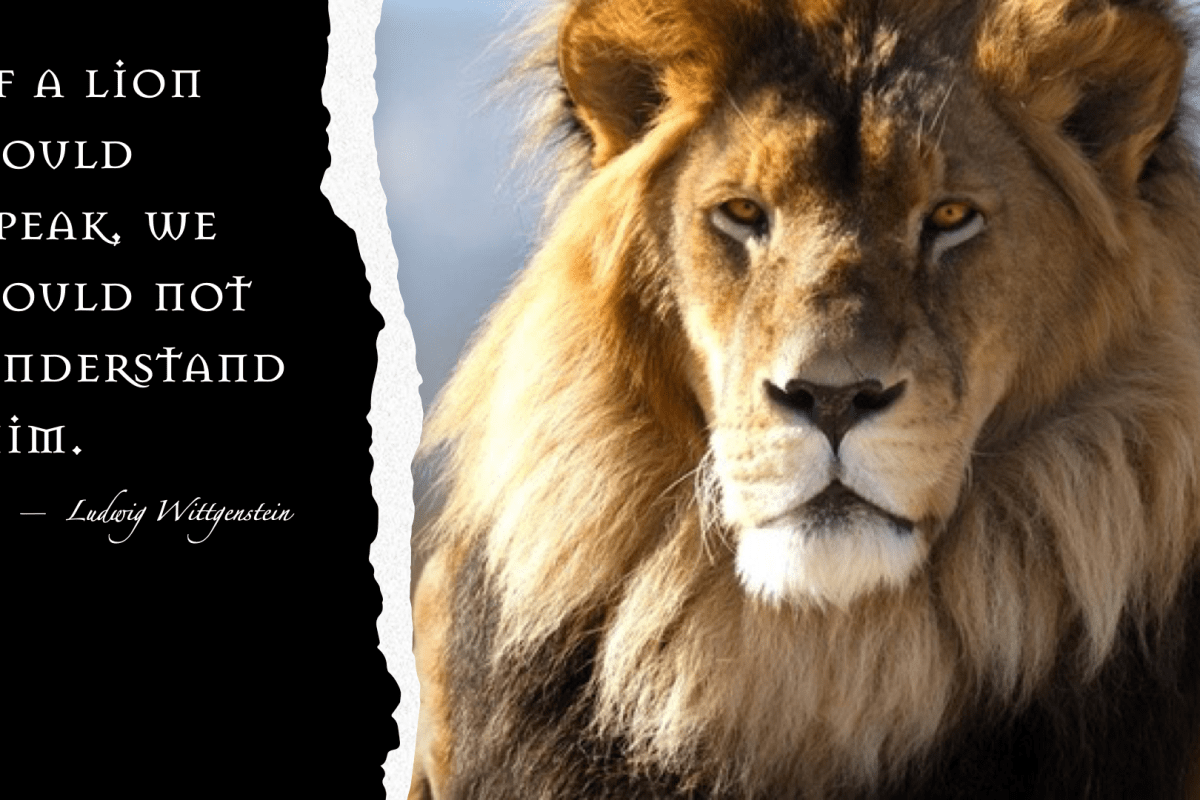
If a lion could speak, we could not understand him.

— Ludwig Wittgenstein

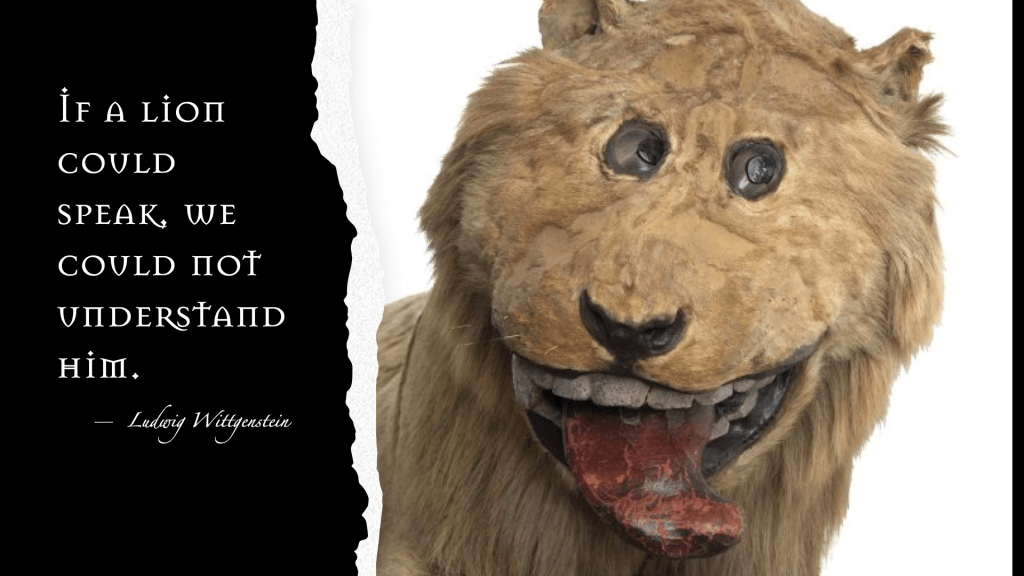
As much as I love Wittgenstein’s quote on language, I find it vastly more amusing aside the lion of Gripsholm Castle in Sweden. Because as talking lions come, this one is certainly more unintelligible than most.

If a lion could speak (Gripsholm Remix)

I also appreciate Daniel Dennett’s retort that if we could manage to communicate with this one talking lion—not, of course, this lion in particular—that it could not speak for the rest of lionity. (Just what is the equivalent of humanity for lions?)

If a lion could speak (traditional)

Ludwig Wittgenstein famously said, “If a lion could talk, we could not understand him.” ( [Philosophical Investigations] 1958, p. 223) That’s one possibility, no doubt, but it diverts our attention from another possibility: if a lion could talk, we could understand him just fine—with the usual sorts of effort required for translation between different languages—but our conversations with him would tell us next to nothing about the minds of ordinary lions, since his language-equipped mind would be so different. It might be that adding language to a lion’s “mind” would be giving him a mind for the first time! Or it might not. In either case, we should investigate the prospect and not just assume, with tradition, that the minds of nonspeaking animals are really rather like ours.

Daniel Dennet — Kinds of Minds: Toward an Understanding of Consciousness (p.18)

Consciousness Is Religion

I expect that consciousness is a human nominative concept. Like religion, it will become smaller as science encroaches. In 1994, David Chalmers presented his idea of the hard problem of consciousness in a lecture, Toward a Scientific Basis of Consciousness, but I feel this is more due to the insufficiency of language than anything else. To me, consciousness isn’t well defined. It’s like a medical syndrome. It’s just a grouping of seemingly related conditions that haven’t yet been parsed. In time, it may be determined that they weren’t even related in the first place. Apophenia and cognitive dissonance are two significant human biases that affect perception.

At core, consciousness might be functionally reduced to that of an interpreter. Some have posited that the only thing that exists is ‘information’, whatever that means, so there only needs to be an interpreter—a translater. If that interpreter is defined as consciousness, then so be it. This appears to lead us to a Cartesian place—though it doesn’t follow that the self or ego exists. This would be a second-order event.

Anyway, just rambling. As seems to be the case lately, I’ve got little time to develop my thoughts. At least I’ve captured them for now.

Dear diary…