My attention is otherwise occupied, so I won’t take time for a longer post, but I feel this illustrates my point that people just need to blame. It’s a knee-jerk response, and target accuracy is unnecessary, as this demonstrates.
tl;dr – Karen misplaced her headphones in her bag
From an evolutionary perspective, this also highlights theories supporting fitness over truth—fitness beats truth, FBT. Were that a rival stealing hard-earned food, better to apprehend or remediate than gather all the facts only to allow the culprit to escape. Of course, in cases like this, one gets false positives.
In this segment, I ponder the interplay between blame and Causa Sui. I’ll discuss the implications for moral responsibility as well as legal responsibility, which are not as in sync as one might imagine they might be.
Video: Blame & Causa Sui
To the uninitiated, Western legal systems have no pretensions about being about morality or justice. Legal systems are designed to maintain power structures and the status quo. They are deontological machines, making them prime targets for automation by the machine learning associated with artificial intelligence. This would also diminish the power of rhetoric over facts to some extent. But, I am no legal scholar, and all of this will have to wait for another segment.
I recently shared a video on causa sui and the basics of blame and blameworthiness, so I want to intersect those topics here.
Peter Strawson suggested that for humans, blame is a reactive response. It’s reflexive like having your knee jerk when tapped. Essentially, his position is that if blame didn’t naturally exist, we’d have to invent it, mirroring Voltaire’s quip, ‘If God did not exist, it would be necessary to invent Him’. Of course, this is because they serve the same power control purpose.
If God did not exist, it would be necessary to invent Him
Voltaire
To be fair, blame is closer to real than God, but the point remains. Strawson’s point is also that humans are saddled with blame and it’s not going anywhere no matter how nebulous it becomes in execution. It’s natural.
To me, this starts to sound suspiciously like a naturalistic fallacy. Humans seem to selectively cherry-pick which so-called natural tendencies they choose to defend. One might use nature to argue that female sexual availability begins at menstruation, and yet we have decided to ignore this and defer this on the grounds of civility. It’s obvious that we could consider blame to be an animal instinct we want to domesticate away, but because it serves other purposes, per Strawson’s perspective, it’s a useful tool. But what’s the causa sui challenge. Let’s quickly recapitulate.
Causa sui argues that one cannot be the cause of oneself, ex nihilo. Being full products of nature and nurture to adopt the lay parlance, any blameworthiness lies with the sources or creators. Since we are concerned with moral responsibility, we can eliminate nature forthrightly. Nature may be responsible—by many estimations approximately 40 per cent responsible—, it possesses no moral agency. And if the individual is not responsible, then we are left with the environment and society, including the social environment. Of course, the environment gets off the hook in the same manner as the genetic and hereditary factors of nature.
Before we consider society, let’s regard the individual.
Albeit the brain-as-computer is a bit facile, it’s still good enough for illustrative purposes. When you are born, your cognitive hardware is installed, as are your edge peripherals and update protocols. Any of these can become damaged through some degenerative processes, or external environmental factors, but since my interest is in optimistic rather than pessimistic scenarios, I’ll ignore these instances. Given that blameworthiness is directly related to presumed cognitive processing, factors that diminish these faculties, mitigate blameworthiness and factors than increase it, ameliorate it.
As a—quote—’normal’ child becomes an adolescent and then an adult, the probability it will become blameworthy, increases with age, ceteris paribus. A person with cognitive deficits or conditions such as aphasia or dementia decreases the probability of blame assignment. Even temporary impairment mitigates judgment—oh, she was drunk.
So, following the brain-as-computer analogy, your brain is a CPU with a self-updating cognitive operating system and instruction set. Essentially, there is also short and long-term memory. In the case of cognitive deficits, one of these components might be effectively broken. The CPU might process too slowly; it might misinterpret what it receives; there may be issues with the sense organs or the nerves that transport signals.
I’ve got a mate who, due to medical malpractice at birth, experienced nerve damage. Although his eyes and brain are normal, his optic nerve cannot carry signals very well, effectively leaving him blind. Neither can he taste nor smell. So there’s that.
But assuming that this processing and storage hardware are intact, the causa sui constraint still applies, but let’s spend some time evaluating societal interactions.
All inputs come from society—cultures and subcultures. Apart from misinterpreted processing scenarios, if a person doesn’t receive a particular moral instruction set, that person should surely be considered to be exempt from moral blame. It may be difficult to assess whether an instruction has been input. This is a reason why children are categorically exempted: they may not have received all of the expected moral codes, they may not have been stored or effectively indexed, and their processing hardware is still in development—alpha code if you will. Brain plasticity is another attribute I won’t spend much time on, but the current state of science says that the brain is still not fully developed even by age 30, so this is certainly a mitigating factor, even if we allow leeway for the causa sui argument.
I mention subculture explicitly because the predominant culture is not the only signal source. A child raised by, I don’t know, say pirates, would have an amended moral code. I am sure we can all think of different subcultures that might undermine or come at cross odds with the dominant culture, whether hippies, religious cultists, militia groups, racial purist groups, and so on.
So, a commonly held moral in the subdominant group may counter that of the prevailing one. An example that comes to mind is some religious organisations that do not agree with human medical intervention. There have been cases where parents have allowed a child to die from an otherwise curable condition. Although in the United States, there is a claim of freedom of religion—a claim that is spotty at best—, parents or guardians in situations like these have been convicted and sentenced for following their own moral codes. But as with all people, these people are as susceptible to the limitations of causa sui as the rest of us. They are not responsible for creating themselves, but moral responsibility was asserted based on the beliefs of the prevailing culture. Even besides the legal context, persons in the larger society would likely blame the parents for their neglect—though they may be praised for being resolute in their righteousness by their in-group. This just underscores that morality is a collection of socially constructed conventions rather than something more objective.
Returning to causa sui, let’s say a person commits an act that society would typically assign blame. Rather than exercise some act of retributive justice—a concept with no foundation in a causa sui universe—the course of action was remediation. In this case, the desired moral instruction would be delivered thereby seemingly making the moral offender blameworthy. But would they be?
Presumably, (for what it’s worth) psychologists would evaluate the subject for competency in maintaining the programming. In the case of the aforementioned religious parents, they may be threatened with retribution for not abiding by the superseding rules of the prevailing power structure.
Although I might personally allow some leeway even with the causa sui in full force and effect, but I can’t say that I have much faith in the ability of humans to make a correct assessment. My impression is that any assessment would be one of convenience than something sounder.
Perhaps I’ll produce a more robust segment on retributive justice, but my feeling is that retributive justice is an area that legal systems should avoid altogether. If necessary, focus on restorative justice, rehabilitation (or ‘habilitation’ as the case might be) and quarantine models to ensure any bad actors are contained away from society. Again, this puts individuals at the mercy of cultures they find themselves a part of. I am not going to delve into this any further save to remind the listener of gang initiation schemes where a person needs to kill a member of a rival gang to become a trusted member. This is their moral code—quite at odds with the mainstream.
So there you have it. Owing to causa sui constraints, a person cannot be ultimately responsible for their actions. My primary thesis is—apart from metaphorical equipment failures—that any moral responsibility falls wholly on the society or culture. Full stop. And this isn’t as foreign as one might first feel. Although for most people blame is natural, in an individualistic society, people are interested in finding the culprit. In collectivist cultures, any culprit might do. Perhaps I’ll share some stories in a future segment. Meantime, what are your thoughts on moral responsibility? Can someone be ultimately responsible? Some have said the ‘ultimate responsibility’ is a philosophical red herring and that we can still hold someone responsible, even if not in the ultimate sense, which causa sui disallows. Are you more in this camp? Is this enough to mete out so-called retributive justice? For me, retributive justice is a euphemism for vengeance, and justice is a weasel word. But that’s just me, and perhaps a topic for another segment.
Are there any topics you’d like me to cover? Leave a comment below.
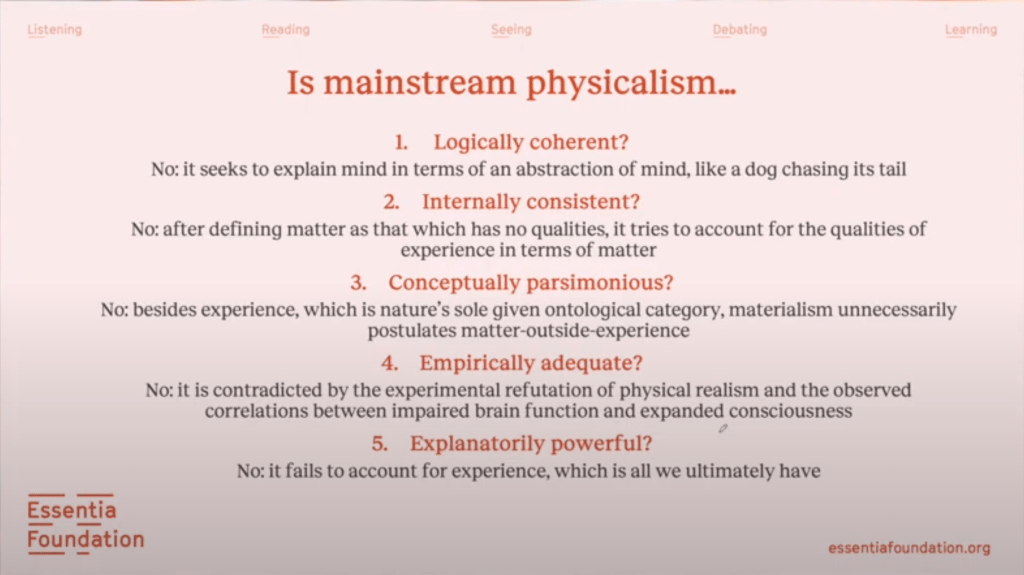
Until now, I’ve considered myself to be a physicalist or materialist, but in adopting this position, I’ve had open questions. I’d tell people, “I’m a Physicalist, but I don’t understand how X, Y, or Z works.” As it happens, Analytic Idealism fills in most of these gaps. I’ve also been leery of Constitutive Panpsychism, and this theory addressed those shortcomings.
According to standard materialistic doctrine, consciousness, like space-time before the invention of general relativity, plays a secondary, subservient role, being considered just a function of matter and a tool for the description of the truly existing material world. But let us remember that our knowledge of the world begins not with matter but with perceptions. I know for sure that my pain exists, my “green” exists, and my “sweet” exists. I do not need any proof of their existence, because these events are a part of me; everything else is a theory. Later we find out that our perceptions obey some laws, which can be most conveniently formulated if we assume that there is some underlying reality beyond our perceptions. This model of material world obeying laws of physics is so successful that soon we forget about our starting point and say that matter is the only reality, and perceptions are only helpful for its description.
Firstly, it centres everything on experience. It divides the world into ‘out there’ and ‘perception’, what Bernard Kastrup calls ‘intrinsic view’ and ‘extrinsic experience’, what Schopenhauer termed ‘noumena’ and ‘phenomena’.
So how could I abandon material so quickly? The short answer is that I didn’t. It’s just that it’s not fundamental. One of the challenges I always had with the notion of materialism is the distance between perception and material. Analytic Idealism allows there to be a concealed nature out there and a revealed nature that our senses could perceive.
Before I get ahead of myself, I’ll lay a foundation. Our brains, among other things, are experience-perceiving machines—not experience-generating. Unlike some solipsistic theories, we don’t generate our reality. There is an objective reality, as it were. out there, but our perception of it is limited by our sense organs and cognitive faculties. Anything not accessible to these is imperceptible, pretty much by definition. It could be that there is nothing out there beyond perception, but I wouldn’t count on it.
I know that this invites paranormal and spiritual injections. I don’t have a propensity to make this jump, and absence of at least circumstantial evidence, I don’t expect to expend energy pondering this space. If this is your proclivity, feel free, and I’d love to see what you come up with. As it happens, Bernard Kastrup does believe in paranormal phenomena, so you’d be in good company. I’m just not ready to make that leap.
Humans do not view reality as it is. This conforms to correspondence theories of truth. In this theory, we interface reality through a virtual dashboard. Like an aeroplane with dials and gauges, our sense organs merely give USA representations of this reality in a manner suitable to our survival—fitness over truth. Just as the altimeter and speedometer are fit for navigating a plane, they are just symbols or icons representing the ‘out there’. Similar to the Matrix, the out there is unintelligible—save for Neo who is able to transcend and decode on the fly. But this is science fiction. We cannot see beyond the dashboard, and it wouldn’t benefit us if we could.
instrument dashboard from EssentiaFoundation.org
This instrument panel or dashboard, as Kastrup calls it, is all we have. And like a computer monitor that represents files and folders as beige, blue, and white rectangles, looking behind the screen isn’t going to yield you more information. At their core, these represent binary code, millions or zeros and ones that would not be useful to see in their native state. It is more useful to see the iconic representation.
It turns out that matter is simply a representation of reality through dashboard instruments. This means that physics is ultimately a science of perception, though it only has access to the map rather than the terrain.
It’s not my intent to articulate the entire theory. Besides, I’m new to it. There is much more for me to suss out. For now, it’s the best explanation for the way I perceive perception. And although I still have questions, I have fewer than before, so here’s looking to a long and fruitful relationship.
I’ve experienced an epiphany of sorts. I am a moral non-cognitivist. Most would consider me to be a moral subjectivist or relativist. There’s a distinction, but to the public at large, it doesn’t much matter. In fact, we are all at the mercy of the cognitive deficits of the societies we find ourselves in, each culture having its own deficits. I find it difficult not to come across as an elitist in the space, especially as uninformed and otherwise misinformed most are in this space.
It’s one thing to have an academic disagreement. It’s quite another to have an academic argument with kindergartners—armchair spectators in highchairs and booster seats. Anyway, enough of the ad hominem. I’ve had my say and my fill.
All morality is constructed. Full stop. The basis is the survival and propagation of the society, though societies are dynamic organisms with different goals and purposes, so these foundations may differ. In some cases, they are strikingly similar.
All morality is constructed. Full stop.
It makes sense that most have an element of ‘thou shalt not kill’ with an exception for ‘unless they undermine the culture’. This also allows for ‘killing in order to defend the culture’, even if the people defended aren’t all in sync as to what they are defending.
So where does relative pitch come into play? you ask yourself.
Sound, hence musical tones, manifests as frequency (and amplitude, which I’ll ignore). It is common to establish an A pitch as 440 Hz (440 cycles per second), also known as A440 or A4. Whilst there have been and are other standard pitches, A440 is considered to be the standard concert tone for Western music and has been adopted in other regions. I won’t bore the listener with nuance around A332 and A442 centres, as it’s unimportant to the focus.
Whatever the centre, some people have perfect pitch and others have absolute pitch. Some people are tone deaf, and I suppose that to be a perfect metaphor for some people in society, but that’s also an analogy for another day.
A person with perfect pitch not only has the vocabulary of music stored in memory, but they can retrieve it on a whim. I’ve encountered several people with perfect pitch, and it seems inevitable to engage in parlour games. With piano at hand, it’s easy to play unseen chords and have the absolutist bark back F#min6/9 or some such. Even more amusing is the result of tossing a shoe at an object to hear what note the clang might correlate with. That stool was a B-flat.
I thought I was wrong once before, but I was mistaken.
Whilst a person with absolute pitch can pick notes out of the air, a person with relative pitch doesn’t have an anchor. In either case, a listener can tell you that the interval between an A4 and an E4 is a perfect fifth, the person with relative pitch can’t name the notes without guidance. Of course, once the listener is clued in that the first note is an A4, relative maths does the rest of the heavy lifting, so they, then be able to tell you that the note a perfect fifth above is an E4.
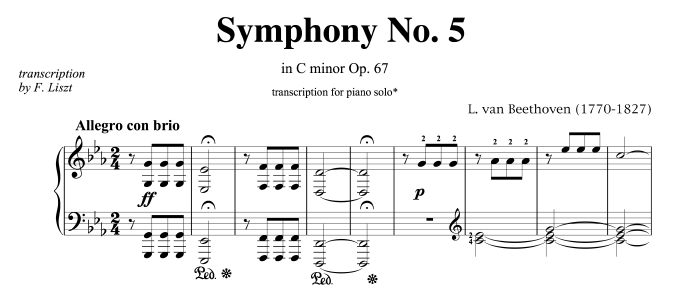
It’s important to know the vocabulary are rules as well. For example, many of us can recognise the interval at the start of Beethoven’s Fifth Symphony—da-da-da-DA…! We can hear it in our heads as we consider it. But we don’t know that the first three shorter notes are G and that the longer final note is E♭.
Thanks for the music lesson, but you’re asking, ‘How does this connect to morality?’
Unlike music, morality has nothing analogous to absolute pitch. Moreover, different cultures have different reference pitches. And some cultures with the same reference pitch are playing in different keys. The challenge is that whether or not the dominant culture has absolute pitch, it still presumes it is the tonal centre. And if it’s tuned to A432, you’d better be too; otherwise, there will be dissonance.
Referencing the Venn diagram, one can see the primary culture, C0 occupying the most space and acting as a centre of gravity. There are subcultures, some with more and less in common with the primary culture.
C1 has much in common with C0, but the majority of ideals are not shared. It remains to be seen whether these differences are material. For example, the difference may be preferences about food or clothing, perhaps which holy days to recognise to whether to recognise any at all. In practice, these cultures could very well coexist with little conflict.
Similarly, C2, may be able to coexist with either of both with little friction. Of course, the difference may be significant. Perhaps, one difference is their view on abortion or female circumcision. Clearly, these are dancing to a different tune.
Perhaps, C3 is some indigenous society. C3 has nothing in common with C0 or C2, only sharing some ideals with C1. I don’t feel this would be possible in reality because I can’t imagine a culture having opposing perspectives, even if only on the position of not killing other ‘innocent’ humans without cause. The range of causes may differ, but the core value would still be shared.
My point is that the primary culture will assume that its position is absolute, even if just from having enough mass to force the matter. And this is the difference. It doesn’t matter whether their morality is absolute. If you don’t comply—especially in matters they consider to be morally important—, you will be punished. In the case of C3, C1 may tolerate whatever the two are in common, but if C3 attempts to interact with C0, this tolerance is unlikely.
Perhaps, C3 clubs baby seals, eats dogs, or some other such hot-button activity. In their native territory, this may go unnoticed, but if they relocate to the territory of the primary culture, this will not likely go unchallenged.
If you are someone like me who feels that all morality is fabricated out of thin air—even the morality I happen to agree with in principle and in practice—, there is still friction just to suggest that their morality is a constructed social fiction. It seems that many if not most people want to believe in the notion of ‘inalienable rights’ and God-given morality or some sense of cosmic moral order. People like Jordan Peterson believe this as do his followers. This creates contention with others, like myself, who fundamentally disagree and who ask for just a modicum of evidence of their claim. You will comply or you will be chided and marginalised.
Of course, I could be wrong. I thought I was wrong once before, but I was mistaken.
I’ve bitten the bullet and have joined Patreon as a creator. I’ve been contemplating it for a while and figured, why not?
For this Philosophics endeavour, I have a few expenses that I cover, and there are things I eschew for want of a budget. Although this WordPress account is free, it costs me to host this blog on a server, and I would convert it to a paid account if I could justify it.
Content creation is something I enjoy, but it also distracts from other activities I could be doing, so a little added incentive would help. Notsomuch for this blog, but for podcast and video content.
For podcasts, I use Amazon Polly as an AI text-to-speech engine. It is free for fewer than 1MM characters per month, so I am safe on this account. I could benefit from AWS storage, but this is not necessary. It just means that I need to process paragraphs in smaller chunks to remain beneath their character count threshold. And to be completely transparent, Polly needs a little handholding along the way, so I can’t just feed it text and forget it, assuming that the result would just sound right.
For videos, I have occasionally purchased image and video content (or a soundtrack element or sound effect), but without a budget, it’s difficult to justify. This budget constraint limits the quality, as found free objects do not always convey concepts as well, and commissioned art is pretty much out of the question.
I’ve seen other sites and know other content creators, so I figure why not throw my hat in the ring to see if anything happens. I’ve supported artists and writers in the past. In fact, I opened my Patreon account as a patron back in 2012. A 20-something friend of my son has had a Patreon account for a couple of years now. He’s only had one $1 patron the entire time. (To be honest, we think it’s his dad, but we can’t validate this intuition.)
No pressure or requirement. If you’d like to become a patron, I’d appreciate it. If not, I’ll be producing content anyway, and I hope you enjoy it and find it engaging.
In pursuit of my travail intellectuel, I stumbled on a thought experiment proposed by Richard Taylor regarding an old crowd favourite, Sisyphus.
Of course, Albert Camus had famously published his Myth of Sisyphus essay (PDF), portraying his life as analogous to the workaday human, absurdly plodding through existence like rinse and repeat clockwork—same gig on a different day.
Given my perspective on human agency and the causa sui argument, I felt commenting on Taylor’s essay, The Meaning of Life (PDF) would be apt.
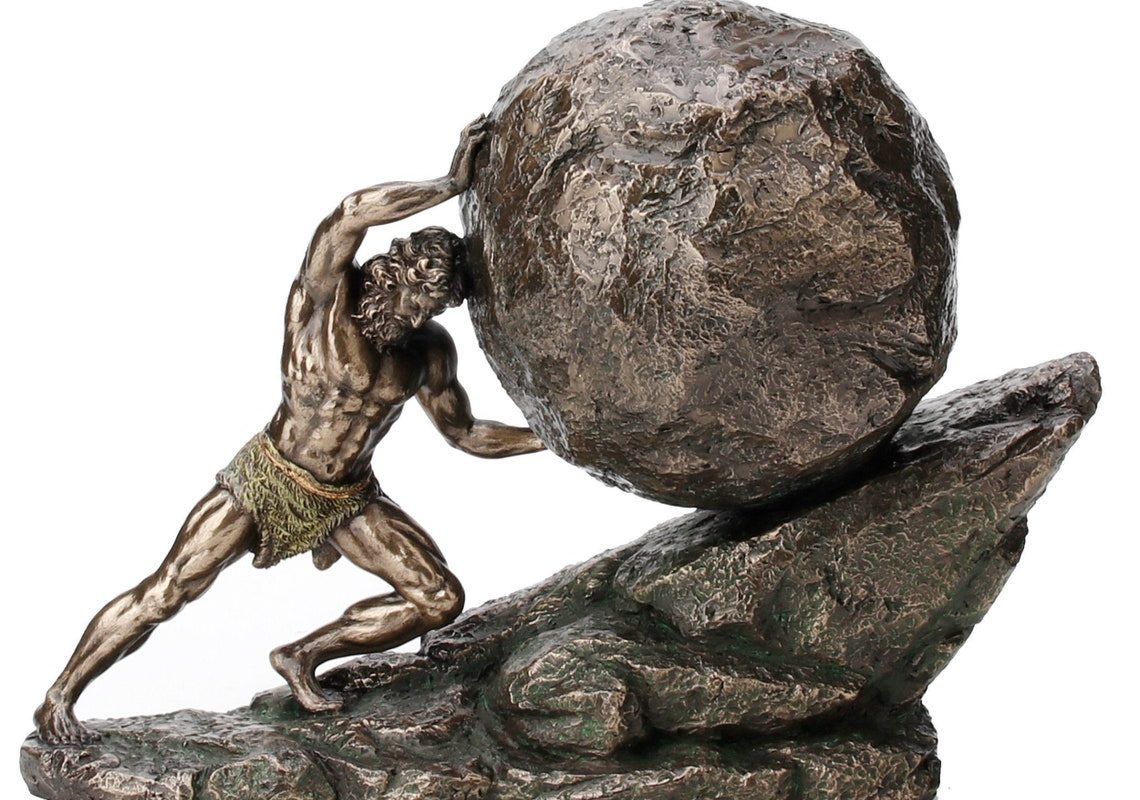
The story of Sisyphus finds the namesake character, fated by the gods to each day push a stone up a hill only for it to roll back down for him to push it back up every day ad infinitum. Camus leaves us with the prompt, ‘One must imagine Sisyphus happy’. But must we.?
As Taylor puts it,
Sisyphus, it will be remembered, betrayed divine secrets to mortals, and for this he was condemned by the gods to roll a stone to the top of a hill, the stone then immediately to roll back down, again to be pushed to the top by Sisyphus, to roll down once more, and so on again and again, forever. Now in this we have the picture of meaningless, pointless toil, of a meaningless existence that is absolutely never redeemed.
Taylor wants us to consider an amended Sisyphus. He writes,
Let us suppose that the gods, while condemning Sisyphus to the fate just described, at the same time, as an afterthought, waxed perversely merciful by implanting in him a strange and irrational impulse; namely, a compulsive impulse to roll stones.
This significantly alters the dynamic. In the scenario, Sisyphus is not toiling; rather, he is pursuing his passion—following his heart. This is the athlete, artist, politician, or mass murderer following their passion. In fact, one might say that he is being his authenticself. He has no control over his self or his desire to roll stones, but he is in his element.
Taylor’s ultimate point is that in either case, the life of Sisyphus is just as devoid of meaning. Ostensibly, nothing can provide meaning. The best one can do is to have the perception of meaning. He writes,
Sisyphus’ existence would have meaning if there were some point to his labors, if his efforts ever culminated in something that was not just an occasion for fresh labors of the same kind. But that is precisely the meaning it lacks.
Although we cannot control what is within, contentment and happiness derive from perception. As we might be reminded by the quip attributed to Schopenhauer,
We can want what we will, but we can’t will what we will.
In the end, Taylor wants us to know that nothing out there can make us happy.
The meaning of life is from within us, it is not bestowed from without, and it far exceeds in both its beauty and permanence any heaven of which men have ever dreamed or yearned for.
I’ve subsequently read some critiques of Taylor’s position, but I don’t want to take the time to rejoin them. Suffice it to say that I find them to be weak and wanting.
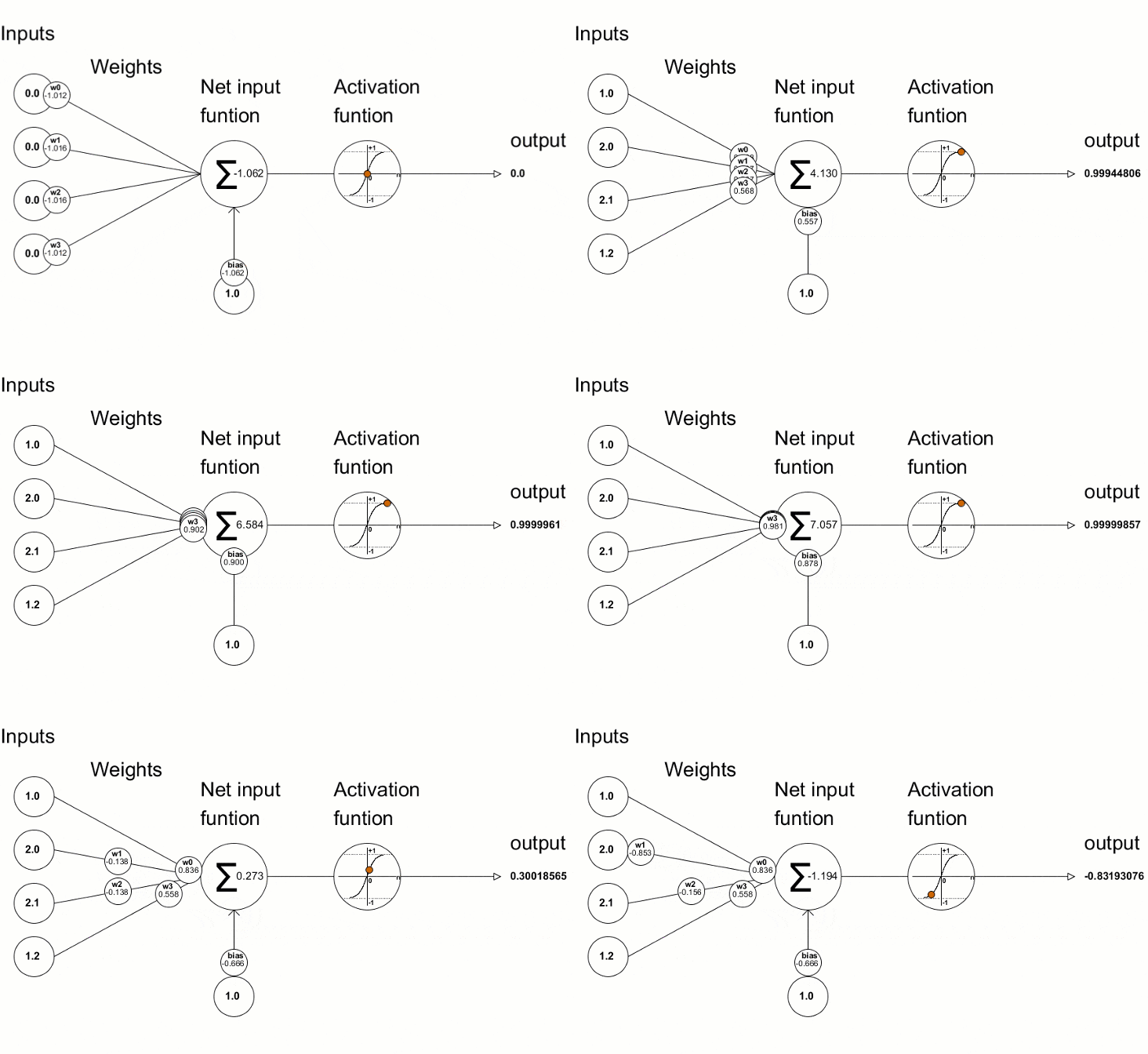
Human-designed systems seem to need a central orchestration mechanism—similar to the cognitive homunculus-observer construct substance dualists can’t seem to escape—, where consciousness (for want of a better name) is more likely the result of an asynchronous web with the brain operating as a predictive difference and categorisation engine rather than the perceived cognitive coalescence we attempt to model. Until we unblock our binary fixedness, we’ll continue to fall short. Not even quantum computing will get us there if we can’t escape our own cognitive limitations in this regard. Until then, this error-correcting mechanism will be as close to an approximation of an approximation that we can hope for.
The net-input function of this machine learning algorithm operates as a heuristic for human cognition. Human-created processes can’t seem to create this decoupled, asynchronous heuristic process, instead ending up with something that looks more like a railway switching terminal.
Cover photo: Railroad tracks stretch toward Chicago’s skyline at Metra’s A2 switching station on March 29, 2019. (Antonio Perez/Chicago Tribune); story
In my quest for background depth, I’m not only reading books, essays, blogs, and researched content, I’m viewing YouTube content, including the videos linked below that were reading and discussion groups. Perhaps I am interpreting it incorrectly, but these participants seem to invariably conflate the concept of determinism with an applied version of it.
In my mind, the concept is meant as a modal abstraction, which is to say if determinism were true, what degrees of freedom might one have? The idea is to accept this as a true premise, whether or not you accept or agree with it.
It’s like introductory physics—pretend there is no gravity; pretend there is no friction. I don’t believe any of these people would argue, “I can’t accept this environment. The world doesn’t work like that”. Except that’s exactly what they do when faced with determinism. It’s a mental model. Just work it as it’s presented.
Determinism: The world is governed by (or is under the sway of) determinism if and only if, given a specified way things are at a time t, the way things go thereafter is fixed as a matter of natural law.
Stanford Encyclopedia of Philosophy, Causal Determinism
By this definition, every event has an antecedent cause, the (future) result of which is one and only one outcome. It’s like viewing a film for the first time; you may not know the ending, but the ending is inevitable. If you rewind the film and replay it, the ending will remain the same at every viewing. Nothing anyone can do will alter the inevitability.
Free Will
Free will is a muddled notion that basically declares at some level humans make free choices based on their own agency; that they have control over how the future is written; that the future is yet unwritten, so the film analogy doesn’t hold water.
Compatibilism
Compatibilism is the belief that even in a fully deterministic universe. i.e., one in which everything is determined by some initial state as captured by the natural laws of physics still affords at least some limited notion of free will or at least proximate agency.
Adopting this belief in a deterministic universe necessitates relying on either metaphysical magic or semantic word games. Of course, there is nothing to say that you have to adopt a deterministic position, but if you do, you need to also explain how free will fits into the equation.
Incompatibilism
If one adopts the position of an incompatibilist this squaring up is no longer a problem, but then you are left to choose one or the other of the options as the two are mutually exclusive and collectively exhaustive.
Indeterminism
Although it is not necessary for any of the aforementioned monologue, indeterminism allows to some extent or another randomness to be introduced into the deterministic world. Effectively, this means that everything still operates in a causal chain or web, but stochastic or chaotic events perturb the future that might have otherwise happened.
This poses no challenges to the free will issue, as these are exogenous events and to the subject, they act the same as a deterministic event. In any case, if the source and behaviour of the indeterminacy were known, it would fold into the deterministic model. The same goes for luck and chance.
Third-Party Video Content
Whilst I found these videos engaging and useful, that the participants were not subject authorities was distracting and confusing. It was nice hearing them attempt to resolve their positions, but in the end, it turned out to reinforce Latour’s point in We Have Never Been Modern: consensus is more common than facts.
This bloke gives a crackup job explaining why compatibility is bollox.
Bonus
Whilst searching for cover art for this post, I happened upon a blog entry that makes my point with the author running off on tangents and non-sequiturs.
When I was writing my review of Elbow Room, this categorical syllogism came to mind:
P1: All agents are responsible
P2: I am an agent
C: Therefore, I am responsible
Now I want to unpack it.
Podcast: Audio rendition of this page content
The first premise is that all agents are responsible. Of course, this hinges on how one defines agent and responsibility. It also depends on the scope, especially of the agent but to some extent also the scope of responsibility.
Leveraging the Causa Sui argument, the agent is a social construct and can only be responsible to what extent s/he has been programmed as well as the ability to maintain and process the programming effectively—so without bugs to continue with the parlance.
If the agent is immature or defective, expectations of responsibility are diminished.
If certain inputs were not given, there is no reason to assume a related command would be executed. This is why so much time and energy is spent on programming and evaluating children.
This first premise is predicated on the pathological need to blame. Unwritten behind the responsibility claim is that I feel compelled to blame. Blame requires responsibility, so if I want to blame someone, they must be responsible. In any given circumstances, I may feel the urge to blame anyone, so all agents [eligible people] are worthy of blame. There is no particular reason to exclude myself, so I too am blameworthy. What’s good for the goose is good for the gander, eh?
Goose and Gander. Strike that pose.
As PF Strawson said, even if moral responsibility couldn’t possibly exist, it would be invented because people need to blame. This is in line with Voltaire’s commentary on God.
Si Dieu n’existait pas, il faudrait l’inventer. If God did not exist, it would be necessary to invent him.
Voltaire
We can all look around and see how pervasive the god delusion is. Moral responsibility is even more insidious. In principle, moral gods were invented for just this purpose. An omnipresent judge was needed to keep the big house in check.
Where I Stand
From my perspective, I do feel that a person in the space of Dennett’s elbow room can have responsibility. Being a non-cognitivist, I have more difficulty accepting the arbitrary imposition of morality, but I understand the motivation behind it.
The problem I have is that mechanisms to ensure that the inputs and processes are all in order and there are no superseding instructions are not in place. Moreover, if the superseding instruction does not comport with the will of the power structure, it will be marginalised or ignored. This is a limitation of morality being a social construct, and none of this gets past the ex nihilo problem causa sui invokes, so we end up cursing the computer we’ve invented. O! monster of Frankenstein. O! Pygmalion.
Morality is a social construct, but so are notions of identity and self. Upon reflection, psychology, a discipline I already hold in the lowest regard, is only the minutest subset of sociology. Without society, psychology would have nothing to study.
Sociology is more focused on structure and interrelationships whilst psychology concerns itself with the individual agent’s psyche. Sigmund Freud did recognise this by the taxonomy of id, ego and superego. It seems that by Freud’s reckoning, the id is a stand-in for volition, rather unconscious reactions, whereby the ego is more reflexive and tempered by the external world. Employing this model, in at least one way of thinking, the id represents the bare and authentic self whilst the ego is the accumulation of inputs.
Put in causa sui terms, the id is the result of inherited genetic temperament and the ego is the result of societal forces as interpreted by the id and any antecedent ego.
Remember, one function of the brain is as a Bayesian prediction engine that evaluates new inputs and forms a new sense of perceptual reality and fitness to operate in this universe.
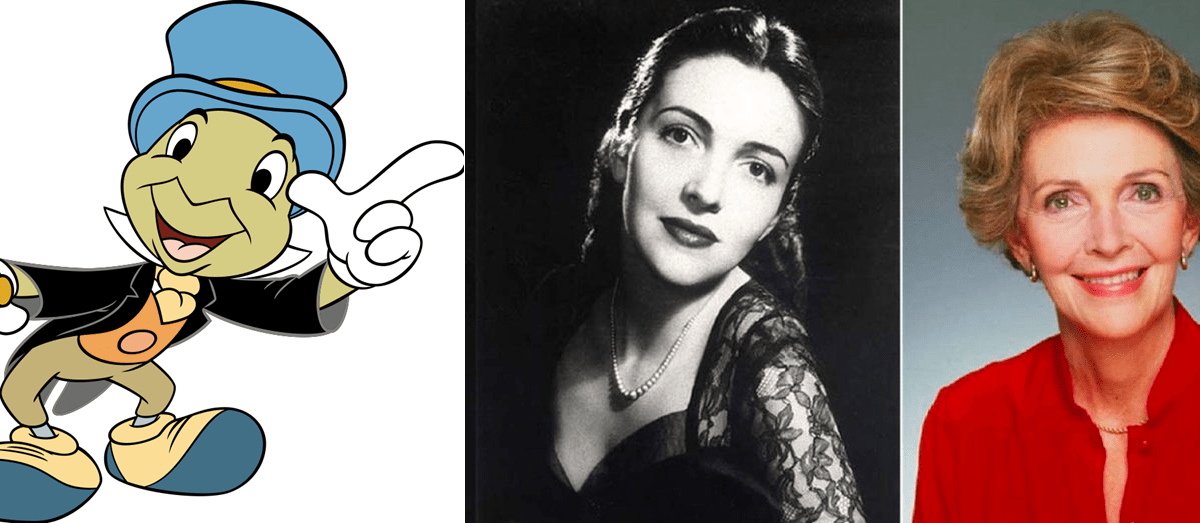
Freud’s superego is ostensibly a part of the ego gone underground—, most of it operating beneath the surface. It’s what I’ll consider being the Nancy Reagan of the psyche—just say no*. It’s Jiminy Cricket. Apologies for not having more contemporary conscience references. I suppose my age is showing.
According to Freud, most of who we are is a social construct, save for the kernel of the id, the proto-self. The ego is the part almost—but not all—above the surface, manifest in consciousness. Conversely, the superego has the reverse configuration, existing almost entirely below the surface. One might even be tempted to argue that the portion of the superego above the surface has actually already been assimilated into the ego.
So, we’re animated sausages, skins stuffed with social cues. Some of these social cues are also moral codes, but many moral codes are inherently unstable and vary by context. And there are local and global morality sources. For example, most religious doctrine is local, so a text authored by a venerated leader in one area may not be venerated outside of that context. In some cases, the directive contains no moral content—don’t eat pork or shellfish or take Saturdays off—whilst others do—love thy neighbour as thyself. Still, they are all social constructs.
If one has no interactions with the other culture, these societies can coexist without challenge, but when a ‘take off on Saturday’ group intersects with a ‘take off Sunday group’, there may be friction, each chiding the other for their nonsensical belief in the manner of Dr Seuss’ Sneetches.
Given this, when discussing morality, we are forced into a structure built on shifting sand. The challenge is that some people believe this ground is bedrock, and power structures insist it is in order to leverage a more solid foundation to maintain power and control.
If we are in some milieu, we are then forced to comply with their norms and morés or be cast out or marginalised, perhaps even scapegoated as Girard might suggest.
Meantime, just take morality with a grain of salt and remember that as will all things human, there are flaws in the logic and outcomes. Also understand that even if these outcomes are flawed and you need to participate in that society, you probably need to remain under the radar—easier for some than others—, conform, play the eccentric, or perish.
* Apparently, Nancy could say no to just about anything except for giving blowjobs. Perhaps this is what saved Ron from the same fate as Bill Clinton, but who am I to say? No shame in that is my position.













 Philosophics