Absurdism: Myth of Sisyphus

I am re-reading Albert Camus‘ The Myth of Sisyphus, but it’s not as I remember all those years ago. My first comment is that it is a product of its time. Even though some people still believe that without some inherent ‘higher’ meaning, chaos would ensue—the same who believe that atheists will behave this way and that anarchists will smash windows and resort to hedonism.

I think that Camus chose suicide because people at that time would have a ‘natural’ propensity to feel that a life without meaning would necessarily result in suicide. It’s especially humorous given that ostensibly there is no meaning. Of course, the larger question is why people appear to be hard-wired to search for meaning. Secondarily, even if there were some higher meaning, as Camus suggests, there would be no objective way to confirm it.


« If the only significant history of human thought were to be written, it would have to be the history of its successive regrets and its impotences. »


Back to reading… (less typing and more reading)


« The absurd depends as much on man as on the world. For the moment it is all that links them together. »


« I don’ t know whether this world has a meaning that transcends it. But I know that I do not know that meaning and that it is impossible for me just now to know it. »


When Camus cites Nietzsche,

“It clearly seems that the chief thing in heaven and on earth is to obey at length and in a single direction: in the long run there results something for which it is worth the trouble of living on this earth as, for example, virtue, art, music, the dance, reason, the mind—something that transfigures, something delicate, mad, or divine“,

he also nods to the reader his accord with Nietzsche’s adherence to virtue ethics praising how he ‘elucidates the rule of a really distinguished code of ethics‘, and therein lies the rub. Why should any of these be any better than any other thing?

Nietzsche and Camus were both products of their age, and as Descartes was before them, as brilliant as they each were in their own rights, they were blinded by their age: Descartes by God, and Nietzsche and Camus by virtue.

The Myth of Sisyphus is an interesting exposition, but, try as it may, it falls short.
On Camus and Sartre

The post,  How Camus and Sartre split up over the question of how to be free, got me wondering.

Albert Camus and Jean-Paul Sartre had a falling out over the philosophical implications of Camus’ The Rebel, but the question I have is how can two Nihilists come to loggerheads when each understood the lack of inherent meaning and purpose in the universe. Camus felt one needed to embrace the Absurd, but not resort to violence except as a last resort, but Sartre felt Communism—even if formed through violent means—was the right way forward. On what objective moral basis could either of these positions be defended?

Oh, and here’s a vid…

Image

So What?

Morality is a human construct. More specifically, it is a normative construct of language. It is used as a tool to maintain power and promote normalcy, but so what?

People are indoctrinated with this normative perspective, but accept it as some self-evident truth. But there is no absolute truth. This, too, is a contextual function of language.

Since the dawn of civilisation—and perhaps longer—, humans have been constructing moral codes of behaviour. From attributing moral origins to supernatural gods, they’ve attempted to move to a secular humanist vantage, ascribing these powers attributed to nature, but this is little more than a metaphysical euphemism in order to appear to be more scientific as a result of Enlightenment.

Clinging to absolute morality is like clinging to religion and gods.

As Marx said, ‘religion is the opiate of the masses.’ Clinging to a sense of absolute morality is not much different to clinging onto religion and gods. There’s a sense of security. It’s comforting and weaved into the fabric of most societies.

Still, so what? As long as the masses prefer to believe that morals somehow exist in the wild, and people, being story-lovers, are exploited by persuasive storytellers, we are resigned to this situation.

Neoclassical Morality


Episode 8 of The Moral Foundations of Politics with Ian Shapiro was another difficult lesson to watch—rather to listen to—the student responses. Evident is the degree of indoctrination or brainwashing these students have been through. I want to document some pieces I feel are relevant to my position.

  1. The fact that morality is perniciously imposed and infused on the unsuspecting
  2. The fact that property rights change over time
  3. The fact that legal interpretation changes over time

The responses were primarily knee-jerk responses anchored on institutional indoctrination. Whilst it makes sense to indoctrinate a group, I am opposed to imposing an obvious relative morality but passing it off as absolute.

Asking how prostitution could be illegal when sex and commerce are both legal, the responses—to be fair, only a couple people responded—were about how it might somehow ‘harms’ women or society as a sort of negative externality, be violent, have been coercive or a form of slavery, have involved a married or otherwise committed spouse, or have involved an under-aged person. These were poor man’s strawman arguments at best, each potentially with merit, but each a separate issue from the question.

In fact, we can likely find evidence of each of these in a ‘typical’ employment situation: coercion, under-age, a threat of violence, implied or expressed; the spousal issue doesn’t fit these situations, but even if we want to legislate keeping people safe from their own actions, it is as illegal for unmarried persons, so the rationale is insufficient.

The point I hold is that prostitution in and of itself is no more exploitative than any other source of employment, a source income. Given that Western society imposes income as the primary means to support one’s self, the wrong here is that artificial barrier. Were income not a veritable necessity, prostitution to earn money (or use as a barter) would also be unnecessary. This is not to say that the other aforementioned objections would be resolved; this because, as I mentioned, they are different issues.

Next, we are told that marital rape originally not considered a crime because a woman was considered to be chattel property transferred patriarchally from her father to her husband. As I’ve written previously, I do not subscribe to the notion of property in the first place, but taken that as given, it is obvious that property is determined through whimsy. Property rights change over time, whether receding as just noted or expanding to include intellectual property and the expanse of patentable ideas. It’s disconcerting that application of the law can be so arbitrary and, though perhaps not capricious, frivolous. And given it is all open to interpretation, the pendulum can swing in the other direction, as the women of Iran and other fundamentalist theocracies has experienced.

Apparently, I’m done ranting. Basic income has been mentioned as a solution to some prostitution, as some women participate out of desperation. Though I feel that this might kerb some prostitution, some women would still seek to supplement this base income, if only to advance their personal standard of living.

Property Rights — Possession

Who else loses sleep over how property rights can be derived legitimately?

I don’t need to argue the existence of God or gods or goddesses—not here anyway—, but I am willing to posit that if there were these deities, no human in privy to their word or desires in a sort of biblical way. Therefore any basis for scriptural law is illegitimate.

In the beginning…

I think it is useful to distinguish between the concepts of possession and property, so I’ll begin there. In the beginning, there was the earth—the land—; and there were people. (I’m taking liberties here, and skipping leaps and bounds.)

In the beginning, there was the earth—the land—; and there were people. (I’m taking liberties here, and skipping leaps and bounds.)  Nature, which is to say ‘bounties of the earth’, ‘produces’ natural resources, raw materials:  rocks, trees, chemicals, what have you. These belong to the earth and are inherently social goods.

The first people sustained themselves with these goods. Taking, say, a stick, I might fashion a makeshift club, and I might then possess this club. I have no inherent right to keep this stick. I may discard it of my own volition (or lose it) or it may be taken from me.

I understand the desire to claim ownership. Territorial animals lay claim to, well, territory; but this claim is defended through violence or the threat thereof and, to some extent, agency, for other allied animals to defend the claim (for myriad reasons). And territorial claims extend only to what one can actively monitor, so if I am a lion, I might possess a territory on the Savannah, but I do not coincidently also possess territory in London. Property rights attempt to extend this relationship, to possess something at arm’s length.

What is missing is the right to possess something. We can go back to Locke and—ignoring that nature and other living entities cannot participate in this system—enter into an accord, a social contract, one where if I possess a good not otherwise claimed by another, it’s mine to possess. As all potential parties have no say, one could argue that there is no legitimate manner to transfer from nature to person. The only defence is one of violence, as noted previously. We can define this transfer as legitimate, but simply saying something does not make it necessarily so. Nonetheless, let’s go from here, from a Hobbesian state of nature, where I can defend myself and possessions through a mechanism described by Rousseau: a social compact: I found it first—and it is useful and potentially this use or utility may be desired by others—, so I get to keep it—in exchange to ceding this privilege to others in my group. To extend this privilege is to extend the accord to other groups.

This is all well and good, but if one’s ability to maintain use of an item is limited by, say, distance or quantity, do I still have a right to possess it? If I possess 20 clubs and my clan has none, what is my claim? The claim of primacy—that I was there first—is weak. It would likely be in my interest (if not in communal interest) to share and give up possession, but having not established a right to that possession as property, how do I lay claim to these? Should I be able to? Should it be a right?

Let’s use a less simple example: a plot of land to farm. I’ve cleared the land, tilled the soil, sowed and tended seeds, and I plan to harvest the fruits of my labour. Many people might say that I am entitled to the fruits. This is debatable, but what if I possess more land than I can cultivate? Do I have a right to let the land lay fallow or otherwise uncultivated?

So current paradigms contest that, having applied labour to modify this natural good, I can hold it, possess it. Presuming that no one else has claimed ownership—a concept not yet introduced—, how does one extend possession? This should also address whether one can possess something at arm’s length.

Bedtime. Posting an incomplete, unedited draft with no citations or links…because it’s past 4 AM. Updates and extensions to follow. Hopefully, I’ll fall asleep and get some rest.

Fais dodo.

Completed Anarchy

I finished the first section of Nozick‘s book—the Anarchy section—, and I am not in a better position than my past two posts. Nozick and Libertarians are obsessed with a normative, teleological world, where there is some objective, absolute truth and reality. I can’t argue whether there is some absolute truth, but I feel I can argue, like the God argument,  there is no reason to believe that we can know what that truth is, absolutely.

<EOF>

Classical Utilitarianism and Distributive Justice

I watched this vid in the excellent video series, Moral Foundations of Politics.


Professor Shapiro seems to misunderstand or misstate (I’ll go with misstate) the concept of diminishing marginal utility when he describes the utility of beer and aspirin, as he misses the point that under the theory of diminishing marginal utility, the marginal utility will decrease to zero and continue into negative space. The scenario to get more beer to sell doesn’t make sense.

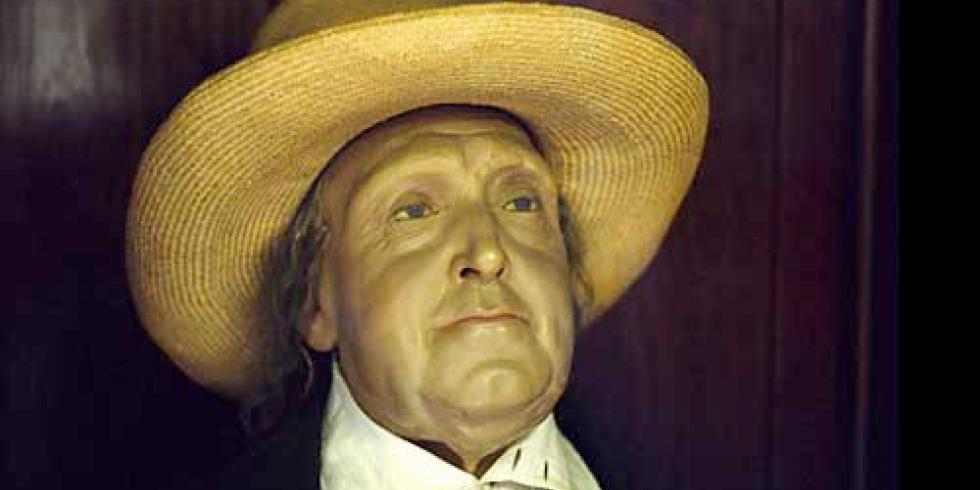
Image: Jeremy Bentham

M0Я3 Anarky

I am still reading, having just finished chapter 5 of Nozick‘s Anarchy, State, and Utopia, and I am still concerned that he invokes normative morality and the invisible hand (even ignoring the religious implications of this) as de facto premises and without justification. He eviscerates so much, parsing so much finely, and he hamfistedly adopts these concepts without pause or discussion.

Still reading…

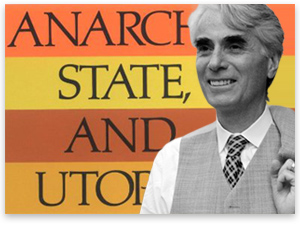
Anarchy, State, and Utopia

I’ve been reading Robert Nozick‘s Anarchy, State, and Utopia because it was recommended by Ian Shapiro. Although I am only about a quarter way through, and he seems to have tried to hit all the angles; unless I missed it, perhaps hits these bits later on.

He thoroughly raises issues and works to resolve them, but, as with Descartes with his Discourse, Nozick seems to exogenously accept certain aspects in an appeal to tradition sort of way. With Descartes, he stripped all belief in the truth of his senses, but then he injects God into the equation from out of nowhere. For Nozick, he just takes property and value as given.

I understand that the Western Enlightenment tradition has a thing for life, liberty, and property—especially Libertarians—, but these are just philosophical notions derived from nowhere. (Wittgenstein, stage left) That he uses utility theory instead of prospect theory as a foundation can be forgiven, but that is shaky ground, too.

And so it goes…