
Robert Kane’s chapter in Four Views on Free Will is titled Libertarianism, and I’ve just finished it. I’ve been writing in the margins, and I’ll summarise my thoughts here.
TL;DR
As I wrote in my last post, I don’t find the Libertarian position on free will and agency compelling. Kane made some interesting points, but none persuaded me to buy what he was selling. The biggest challenge I had was to maintain focus because I think he was chasing red herrings—at least given my focus on agency. He spent a lot of time tearing down determinism and indeterminism instead of building up his own position. I feel the debate centres around agency. I waited for him to explain how this agency operated, but he just assumes agency—or at least a self to possess agency—from the start. I am not convinced. If you are interested, my more detailed commentary follows.
The Rest of the Story
My intent at the start is to approach this chronologically as I retrace my marginalia, hoping to recall whatever prompted my notes in the first place. I’ll be quoting or paraphrasing Kane’s positions to serve as a reference in the event you don’t have access to the book.
1, Determinism and the Garden of Forking Paths
Kane starts off by mentioning that determinism implies that ‘given the past and the laws of nature at any given time, there is only one possible future‘. Within this unvarying environment, he writes, ‘We believe we have free will when we view ourselves as agents‘. I don’t disagree with either of these points, and, as agents, we are ‘capable of influencing the world in various ways‘.
Kane introduces a garden of forking paths illustration, which I’ve recreated here.

He uses this as a visual decision tree, where an actor traverses the branches and makes decisions at the various vertices. To breathe life into this tree, he gives us one of several forthcoming examples. He introduces us to Jane.
In his scenario, Jane is faced with a decision with one of two possible outcomes, and ‘she believes there is more than one possible path into the future available to her and it is “up to her” which of these paths will be taken‘. He continues, ‘This picture of different possible paths into the future is also essential, I believe, to what it means to be a person and to live a human life‘.
And herein lies the rub. Jane is not making these decisions in a vacuum. She is a puppet to forces beyond her control. I shouldn’t be so hard on psychology and Freud, but as Luke 23:34 of the Christian Bible relates, ‘Forgive them, for they know not what they do’.
Then Kane reinforces that if determinism were true that Jane would not have free will before bringing up the idea of responsibility, that ‘free will is … intimately related to notions of accountability, blameworthiness, and praiseworthiness for actions‘. I agree with Kane here.
Next, he invokes an emotional appeal-to-nature argument, asking us to imagine a ‘young man [who] is on trial for an assault and robbery in which his victim was beaten to death.’ He suggests that our tendency to blame this man is natural, but that we might search for mitigating circumstances that might account for his actions. He leaves us with a question, Did these influences entirely determine his actions, or did they “leave anything over” for him to be responsible for?
I have this question, too, but as I said, this is an appeal to emotion in the way Westerners have been conditioned to believe. There is little reason to accept this as some sort of universal law or principle.
2. Modern Challenges to Libertarian Free Will
He starts this section as follows, ‘I will be defending the libertarian view of free will in this volume. We libertarians typically believe that a free will that is incompatible with determinism is required for us to be truly morally responsible for our actions, so that genuine moral responsibility, as well as free will, is incompatible with determinism.’
He continues his setup, ‘A goal of this essay is therefore to consider this modern attack on the traditional libertarian view of free will and to ask how, and whether, it can be answered. Much is at stake, it seems to me, in knowing whether we do or do not have a freedom of the will of the ultimate kind that libertarians defend. The modern attack on it has two parts‘.
‘Part 1: The first prong of the modern attack on libertarian free will comes from compatibilists, who argue that, despite appearances to the contrary, determinism does not really conflict with free will at all.‘
‘[A]ccording to compatibilists, esoteric questions about whether determinism is true or not – in the physical or psychological sciences – are irrelevant to the freedoms we really care about in everyday life. All the varieties of free will “worth wanting” (as a modern compatibilist, Daniel Dennett, has put it) do not require the falsity of determinism for us to possess them, as the traditional libertarian view of free will suggests.‘
He informs the reader, ‘Influential philosophers of the modern era, such as Thomas Hobbes, John Locke, David Hume and John Stuart Mill, were all compatibilists‘.
Kane ends part 1 with, ‘If compatibilists are right, we can have both free will and determinism; and we need not worry that increasing scientific knowledge about nature and human beings will somehow undermine our ordinary convictions that we are free and responsible agents.’
I agree with this statement. It’s also why I consider agency to be the pivotal target, not determinism.
In part 2, he writes ‘The second prong goes further, arguing that libertarian free will itself is impossible or unintelligible and has no place in the modern scientific picture of the world.‘
He conveys that ‘modern defenders of libertarianism, such as Immanuel Kant, have argued that we need to believe in libertarian free will to make sense of morality and genuine responsibility, but we can never completely understand such a free will in theoretical and scientific terms.’
This is a good point, and Kant is correct. As a moral non-cognitivist, I feel that morality is a non-sensical human social construct. Inventing free will to make sense of another invention doesn’t get much sympathy from me. Kant finishes with an appeal to noumenism, yet another concept I’ve got no time for.
Next, Kane introduces us to another foe of free will, indeterminism. ‘Events that are undetermined, such as quantum jumps in atoms, happen merely by chance. So if free actions were undetermined, as libertarians claim, it seems that they too would happen by chance.’
He ends this section with two issues a libertarian must address:
- The Compatibility Problem: free will really is incompatible with determinism
- The Intelligibility Problem: indeterminism can be made intelligible and how, if at all, such a free will can be reconciled with modern scientific views
3. Is Free Will Incompatible with Determinism?: The Consequence Argument
Kane opens with a plea, ‘[L]ibertarians who believe free will is incompatible with determinism can no longer merely rely on intuitions about “forking paths” into the future to support their view that determinism conflicts with free will. These intuitions must be backed up with arguments that show why free will must be incompatible with determinism.‘
If determinism is true, then our acts are the consequences of the laws of nature and events in the remote past. But it is not up to us what went on before we were born; and neither is it up to us what the laws of nature are. Therefore the consequences of these things (including our own acts) are not up to us.
Peter van Inwagen, An Essay on Free Will, Oxford: Clarendon Press, 1983, p. 16
Then he sets up The Consequence Argument:
- There is nothing we can now do to change the past.
- There is nothing we can now do to change the laws of nature.
- There is nothing we can now do to change the past and the laws of nature.
- If determinism is true, our present actions are necessary consequences of the past and the laws of nature.
- Therefore, there is nothing we can now do to change the fact that our present actions occur.
In other words, we cannot now do otherwise than we actually do.
Indeed, I agree in principle with the logic, but I’ll reiterate that I feel that the entire determinism angle is a red herring. Next, Kane goes into a discussion about the Transfer of Powerlessness Principle.
In essence, TP ‘says in effect that if you are powerless to change something X, and something else Y is necessarily going to occur if X does, then you are also powerless to change Y.‘
As I don’t think it’s’ important to my ends and I agree with Kane’s critique of this tailing logic, if you are powerless to change something X, and something else Y is necessarily going to occur if X does, then you are also powerless to change Y.
Finally, he argues that there is a likely insurmountable semantic challenge that accepting one meaning of ‘can’ and ‘power’ (and some other terms) will determine [pun intended] if one is a compatibilist or not.
4. Ultimate Responsibility
Carrying over from the previous section, Kane reminds us that ‘as a result of this impasse, philosophical debates have multiplied about just what “can” and “power” (and related expressions, such as “could have done otherwise”) really mean‘. But he also concedes that ‘The problem is that focusing on “alternative possibilities” (or “forking paths” into the future) or the “power to do otherwise” alone, as the Consequence Argument does, is too thin a basis on which to rest the case for the incompatibility of free will and determinism.’
He sets up his position.
- Free will seems to require that open alternatives or alternative possibilities [AP] lie before us – a garden of forking paths – and it is “up to us” which of these alternatives we choose.
- Free will also seems to require that the sources or origins of our actions lie “in us” rather than in something else.
This second point he terms ultimate responsibility [UR].
‘The basic idea of UR is this: To be ultimately responsible for an action, an agent must be responsible for anything that is a sufficient cause or motive for the action’s occurring.‘
‘To be ultimately responsible for the choice, the agent must be at least in part responsible by virtue of choices or actions voluntarily performed in the past for having the character and motives he or she now has.‘
This is what I am waiting for him to resolve. A red flag that has me on alert is the term character. This is on my list of weasel words. He also cites Aristotle as a reference—also relative to character—, so that’s a double red flag in my book.
He returns to his post that free will ‘does require that we could have done otherwise with respect to some acts in our past life histories by which we formed our present characters. I call these earlier acts by which we formed our present characters “self-forming actions,” or SFAs‘.
My causa sui post already illustrates that Kane doesn’t actually answer the question of how the self forms the so-called self-forming actions. He just invents the term, appeals to idiomatic notions of self and declares victory. I recent post discussed the challenges with self.
In the sense that the enemy of my enemy is my friend, he name-drops Daniel Dennett and a story Dennett had cited involving Martin Luther initiation of the Protestant Reformation. Luther said, “Here I stand, I can do no other.”
Kane then argues that Dennett’s deterministic interpretation is incorrect, but given that Dennett is a compatibilist, he doesn’t care if Luther was free or determined in a deterministic universe.
So the ability to do otherwise (“could have done otherwise”) or AP, says Dennett, is not required for moral responsibility or free will.
In the end, we are back into a language game—a semantic pissing match.
Continuing with Luther, Kane concedes, ‘We can grant that Luther could have been responsible for this act, even though he could not have done otherwise then and there and even if his act was determined. But this would be so, if UR is required, only to the extent that Luther was responsible for his present motives and character by virtue of some earlier struggles and self-forming actions.‘
I’m still left wondering how and when Kane is going to prove this argument.
Kane provides more context by telling us that an agent requires sufficient cause of motive, but he never does define sufficient. He is also aware that a causal chain can lead us back to the dawn of time, so he’s devised an angle:
‘The only way to stop this regress is to suppose that some acts in our life histories must lack sufficient causes altogether.’
Perfect. Let’s see how this works.
Now he’s bringing in his SFAs and character. No thank you, please.
‘UR makes explicit something that is often hidden in free will debates, namely that free will – as opposed to mere freedom of action – is about the forming and shaping of character and motives which are the sources or origins of praiseworthy or blameworthy, virtuous or vicious, actions.’
This is where the psychobabble word salad comes in full force. It feels that Kane is employing circular reasoning and claiming that free will is necessary to shape the character necessary to have free will. Perhaps I am missing something.
‘If persons are responsible for the wicked (or noble, shameful, heroic, generous, treacherous, kind or cruel) acts that flow from their wills (characters and motives), they must at some point be responsible for forming the wills from which these acts flow
This ‘forming’ argument feels like a non-sequitur. Let’s keep going.
5. Ultimate Responsibility and Alternative Possibilities
‘When one argues about the incompatibility of free will and determinism from alternative possibilities or AP (as in the Consequence Argument), the focus is on notions of “necessity,” “possibility,” “power,” “ability,” “can,” and “could have done otherwise.” By contrast, the argument from UR focuses on a different set of concerns about the “sources,” “grounds,” “reasons,” and “explanations” of our wills, characters, and purposes. Where did our motives and purposes come from, who produced them, who is responsible for them?’
These are my questions as well. He provides his answers to his own question:
‘To understand the connection between AP and UR, alternative possibilities and ultimate responsibility, we must first note that having alternative possibilities for one’s action – though it may be necessary for free will – is not sufficient for free will, even if the alternative possibilities should also be un-determined. This can be shown by noting that there are examples in which agents may have alternative possibilities and their actions are undetermined, and yet the agents lack free will.’
I can’t wait.
Next, he witters on about God and determinism and leaves us with the conclusion that ‘persons in such a world lack free will‘. Whew! Good thing.
I haven’t really addressed the issue here, but the very concept of will doesn’t sit right with me. It feels a bit magical, but let’s just leave that here.
This assertion relies on volition, cause, and motive—volition and motive feeling pretty weaselly.
Around here, he conveys a story about an assassin that I feel totally misses the mark. Pun intended because in this story, the assassin intent on shooting the Prime Minister gets an involuntary twitch and kills the aide instead.
‘UR captures this additional requirement of being the ultimate source of one’s will that is lacking in this imagined world. For UR says that we must be responsible by virtue of our voluntary actions for anything that is a sufficient cause or a sufficient motive (or reason) for our acting as we do.’
Kane says that the will of the assassin is sufficient motive and reason. I disagree. I’ll circle back to this in a moment with a robot assassin analogy. Kane goes on to say ‘Anything else he might do (miss the prime minister, kill the aide) would be done only by accident or mistake, unintentionally or unwillingly‘.
This second part is particularly interesting to me. If his intent was to kill the Prime Minister and failed but killed the aide without intention, does this mean he’s not culpable?
Kane tells us that ‘we are interested in whether they could have acted in more than one way voluntarily, intentionally, and rationally, rather than only in one way voluntarily, intentionally, and rationally and in other ways merely by accident or mistake, unintentionally or irrationally.‘
Kane revisits UR: If (i) free will requires (ii) ultimate responsibility for our wills as well as for our actions, then it requires (iii) will-setting actions at some points in our lives; and will-setting actions require (iv) the plurality conditions, the ability to act in more than one way voluntarily, intentionally and rationally.
I’m feeling strongly that a person agreeing with this line of argumentation has to already agree with the underlying conditions. In fact, one cannot will oneself to believe in free will if one doesn’t and vice versa. I’m not inclined to agree.
Kane injects pangs of conscience into the equation. I’ll ignore it, as conscience in this context is wholly constructed. I understand that Kane wants to say that conscience is an impetus for free. I’ll disagree and level it at that.
‘If we are to be ultimately responsible for our own wills, some of our actions must be such that we could have done otherwise, because some of them must have been such that we could have done otherwise voluntarily, intentionally, and rationally.‘
We are still in agreement. Now what?
He closes with a dual regress of free will. We need to be ultimate sources of our actions and ultimate sources of our actions wills.
6. The Intelligibility Problem: Is Libertarian Free Will Possible?
‘Can we make sense of a free will that requires Ultimate Responsibility of the kind described in the previous section? Can we really be the ultimate designers of our own ends and purposes? There are many skeptics about free will who think not. They argue that being the ultimate source of one’s will and actions is an incoherent and impossible ideal…‘
Please. Are we there yet?
The “Intelligibility Problem” says that incompatibilist free will requires that ultimate responsibility is intelligible or possible and can be reconciled with modern scientific views of human beings.
Kane articulates how indeterminism and probability might affect free will and how, given the ‘exactly same past’, can possibly arrive at different outcomes on our forking paths. He provides an example. I’ll relate it, but mostly to critique his narrative.
Recalling the forking paths we have two scenarios. The premise is that, in the first scenario, John has to decide whether to travel to Hawaii or Colorado. Based on the state of his person, he chose Hawaii.
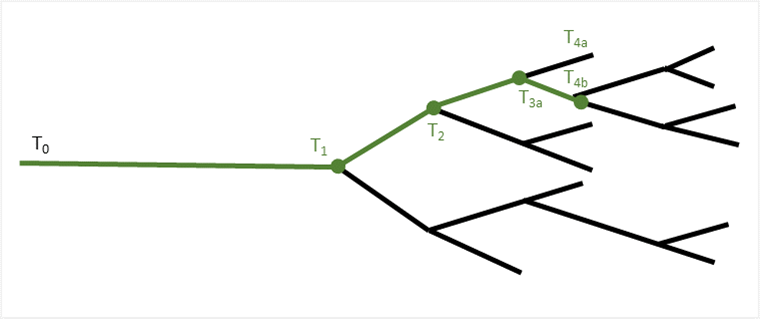
This can be illustrated about be following the green line from point T0 to T4b. At decision point T3a, John had to choose between Hawaii and Colorado. T4a represents his Hawaii preference.
Still looking at the same chart (above), under the second scenario, something ever so slightly changed and John could have chosen the top branch rather than the lower branch, thus choosing Colorado instead.
‘“If the past had been just a tiny bit different, then John might have sensibly and rationally chosen differently (chosen Colorado instead).” Determinists and compatibilists can say this.’
The problem (referring to the chart below) is that a different choice at T2, no matter how small or seemingly insignificant, would have put him on a different path, choosing T3b on the lower branch over T3a on the upper branch. Therefore, the T4b option stemming from the upper T3a branch is not the same T4c option on the lower branch. Instead of a choice of travelling to Hawaii or Colorado, the choice may have between chicken or steak for dinner.
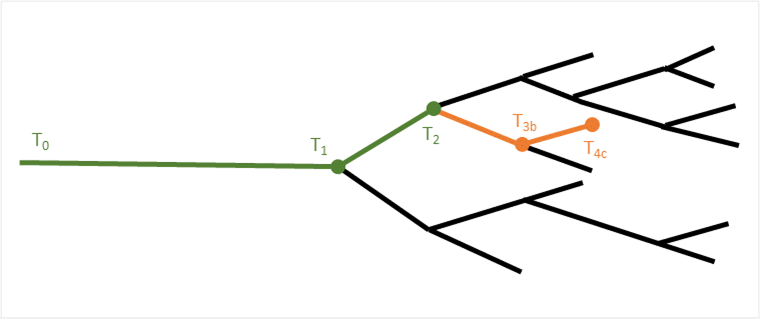
Whilst it is conceivable that the Colorado versus Hawaii decision might still occur, the person at T3 is not the same person.
Kane reintroduces Kant’s noumenal self by name, but he quickly discounts it on the grounds of obscurantism or mystery or “panicky metaphysics”. He’s right in doing so.
As Kane also admits creating the external actors tend to render supporters of these notions as nutters. Besides, if the external actor is the agent, it’s no different than a god doing it.
Before we move to the next section, I want to return to the assassin. My argument is that anyone, including the assassin, is a product of their environment. Full stop. Therefore, one cannot be responsible for anything. To illustrate this, let’s replace the human assassin with a robot assassin. We want to be sure the robot doesn’t twitch and miss.
The robot gets into place and does the assassination task as designed without a hitch (or a twitch). Is the robot in any way responsible for its actions? Not many would argue that it was. It was a victim of its own circumstances. Here, one might argue that the robot has no conscience, and so has no ability to do otherwise. The robot has been programmed. Even if this robot could acquire new information, it could only interpret it relative to the information and processes it already had. The human is no different. The human cannot transcend itself to invoke a different outcome. And any new input would. by definition, be an external influence.
7. Indeterminism and Responsibility
Kane wants to set the stage, so he conveys that ‘The first step in this rethinking about the Intelligibility Problem is to note that indeterminism does not have to be involved in all acts done “of our own free wills” for which we are ultimately responsible … only those acts by which we made ourselves into the kinds of persons we are, namely the “will-setting” or “self-forming actions” (SFAs) that are required for ultimate responsibility.’
Kane believes that ‘believe these undetermined self-forming actions or SFAs occur at those difficult times of life when we are torn between competing visions of what we should do or become.’ Thus, he reintroduces character.
Next, he makes an assertion that I disagree with: ‘The uncertainty and inner tension we feel at such soul-searching moments of self-formation is thus reflected in the indeterminacy of our neural processes themselves.’ It should be obvious that I object to the notion of soul-searching from the start.
Kane advances another assertion: ‘Just as indeterminism need not undermine rationality and voluntariness of choices, so indeterminism in and of itself need not undermine control and responsibility.’ I suppose it may ‘need not’, but let’s see if it does.
Then he introduces an example from communications theory, suggesting that a person can willfully concentrate on the signal to overcome noise: ‘Whether you are going to succeed in solving the problem is uncertain and undetermined because of the distracting neural noise. Yet, if you concentrate and solve the problem nonetheless, we have reason to say you did it and are responsible for it, even though it was undetermined whether you would succeed. The indeterministic noise would have been an obstacle that you overcame by your effort’. My margin note reads ‘silly’. I’ll just leave it at that.
8. Parallel Processing
I’ll admit at the start, that this section was just an annoyance, adding little to Kane’s position. My commentary will be brief.
Kane brings in his SFAs and suggests that if we are at a decision point with two (or multiple) options, each option is processed on its own thread. Reflecting on a woman faced with a decision, he tells us that ‘the choice the woman might make either way will not be “inadvertent,” “accidental,” “capricious,” or “merely random” (as critics of indeterminism say) because the choice will be willed by the woman either way when it is made, and it will be done for reasons either way – reasons that she then and there endorses.‘
NB: Underlined words in the paragraph above represent Kane’s italicised words in the chapter text.
Here, Kane continues down a rabbit hole wintering on about SFAs. I’m not convinced. It’s getting late. I’m getting cranky. I’ll will myself to continue. [Yes, that’s a joke.]
9. Responsibility, Luck, and Chance
Kane now wants to remind us that although one might ‘still find it hard to shake the intuition that if choices are undetermined, they must happen merely by chance – and so must be “random,” “capricious,” “uncontrolled,” “irrational,” and all the other things usually charged‘, and that ‘such intuitions are deeply ingrained‘.
Fair enough. Also interesting is how ingrained the sense of self and soul is, but never mind that for now.
Kane continues to unwind the bias he notes. His punchline is this:
‘(Imagine the assassin’s lawyer arguing in the courtroom that his client is not guilty because his killing the prime minister was undetermined and might therefore have failed by chance. Would such a defense succeed?)’
The ‘law’ is not seeking this truth. it is seeking blame and will go to great lengths to do so. Law is about closure. This feels like a strawman on a non-sequitur. Nothing to see here. Let’s keep on.
Kane’s final blow is that if ‘they endorsed the outcomes as something they were trying and wanting to do all along, knowingly and purposefully, not by mistake or accident‘, then they are responsible.
This reminds me of something that may or may not have been uttered by the Dalai Lama explaining the mechanics or scoring system that karma operates by. There are effectively three dimensions of karma:
- Intent
- Action
- Reaction
Intent is the desire to do something, whether to give a gift or assassinate a Prime Minister.
Action is the activity itself: giving a gift or killing a Prime Minister.
Reaction is your emotional response: giving a gift or killing a Prime Minister.
Exploring this, say a person gains or loses a karmic point for each good or bad thing and receives no point where an event did not happen.
Let’s start with the assassin.
If your intent is to kill someone, you lose a karma point. Sort of a thought crime, I guess. [-1]
If you do kill the Prime Minister, you’ve lost another point. [-1]
Now, if you feel good about your success in this case, you lose yet another point [-1], netting you with minus 3 [-3] all tolled. However, if you feel remorse, you gain a point [+1], netting you with a minus 2 [-2].
Let’s say you have no intent to kill the Prime Minister, yet you lose control of your vehicle and smash into them. S/he dies instantly.
You get no intent point—positive or negative. [0]
You lose a point for the action. Sorry, Charlie. [-1]
Now, if you feel remorse about this event, you gain another point [+1], netting you with zero [0] all tolled. However, if you didn’t really like the Prime Minister and start singing—even in your head—Ding, Dong, the witch is dead, you lose another point [-1], netting you with a minus 2 [-2].
Let’s try gift-giving.
If you want to give a gift, you gain a karma point. [+1]
If you don’t follow through, you lose a karma point [-1], leaving you with zero [0]. There is no cause for reaction, so you remain at zero.
Let’s up the game a bit and instead of just wanting to buy a gift, you promise to buy one.
If you promise to give a gift, you gain a karma point. [+1]
If you don’t follow through, you lose a point [-1], leaving you with zero [0].
If you feel good about the ensuing disappointment, you lose another point. [-1]
If you feel bad about it, you regain a karma point [+1], so you are ahead of the game. And this, boys and girls, is how you game karma. But karma is ahead of your sorry ass, and it takes back the point. And then it takes away a penalty point if you don’t feel sorry about being a jerk.
But I digress. What were we talking about? Oh yeah, I do not endorse Kane’s endorsement idea.
10. Choice, Agency, Efforts, and Causes: Further Objections Considered
‘If indeterminism is involved in a process (such as the woman’s deliberation) so that its outcome is undetermined, one might argue that the outcome must merely happen and therefore cannot be somebody’s choice. But there is no reason to assume such a claim is true‘, Kane relates. More subterfuge.
‘Self-forming choices are undetermined, but not uncaused‘, Kane says. Tell me more.
‘They are caused by the agent’s efforts.’ Them’s fighting words.
He continues, ‘Perhaps indeterminism does not undermine the idea that something is a choice simply, but rather that it is the agent’s choice. This objection raises important questions about agency. What makes the woman’s choice her own on the above account is that it results from her efforts and deliberation, which in turn are causally influenced by her reasons and her intentions (for example, her intention to resolve indecision in one way or another). And what makes these efforts, deliberation, reasons, and intentions hers is that they are embedded in a larger motivational system realized in her brain…
‘A choice is the agent’s when it is produced intentionally by efforts, by deliberation and by reasons that are part of this self-defining motivational system and when, in addition, the agent endorses the new intention or purpose created by the choice into that motivational system as a further purpose to guide future practical reasoning and action.’
My reaction is that this so-called agent is just an invention.
‘Since those causally relevant features of the agent, which can be counted among the causes of the woman’s choice, are her reasons or motives, her conscious awareness and her deliberative efforts, we can also say that she is the cause of the choice by virtue of making the efforts for the reasons and succeeding.’
Just no.
Next, Kane conveys a situation where a guy smashes a glass table and blames it on chance events, ending with this argument.
‘We tend to reason that if an outcome (breaking a table or making a choice) depends on whether certain neurons fire or not (in the arm or in the brain), then the agent must be able to make those neurons fire or not, if the agent is to be responsible for the outcome.’
Let’s see if he comes up from this rabbit hole in the next section.
11. Responsibility and Control: Three Assassins
Watch out. Kane is doubling down—nay, tripling down—on the assassins. His primary argument appeals to emotion and indoctrination—the social programming of the reader.
‘Is the assassin less guilty of killing the prime minister, if he did not have complete control over whether he would succeed because of the indeterminism in his neural processes?’
Robert Kane, Four views on Free Will
Kane recalls the dilemma that I discussed in my Citizen Kane post of a woman to continue to the office or to help someone being mugged, and asserts (without evidence) that this is volitional and ‘is coming from her own will‘.
‘There must be hindrances and obstacles to our choices and resistance in our own wills to be overcome, if we are to be capable of genuine self-formation and free will. Compare Evodius’s question to St Augustine (in Augustine’s classic work On the Free Choice of the Will).‘
This seems like plausible logic, I suppose. But it doesn’t follow from this definition that self-formation—genuine or otherwise—or free will exists.
I tuned out at the God talk.
12 Conclusion: Complexity and “Being an Author of One’s Own Story”
Finally. The last section of this chapter before I turn to John Martin Fischer’s chapter on Compatibilism.
Kane introduces the complexity of chaotic systems next.
‘Agents, according to this modern conception with ancient roots, are to be conceived as information-responsive complex dynamical systems. Complex dynamical systems are the subject of “dynamical systems theory” and also of what is sometimes popularly called “complexity theory.” They are systems (which are now known to be ubiquitous in nature) in which new emergent capacities arise as a result of greater complexity or as the result of movement away from thermodynamic equilibrium toward the edge of chaos.’
‘Only when creatures attain the kind of inner complexity capable of giving rise to conflicts in their wills, or motivational systems, between incommensurable values does the capacity for self-formation characteristic of free will arise.’
Supposing a reaction by critics, he asks himself, ‘Even if one granted that persons, such as the businesswoman, could make genuine self-forming choices that were undetermined, isn’t there something to the charge that such choices would be arbitrary?‘
His response is that we can’t really answer this question and tries to redirect the reader’s attention to the semantics of the word arbitrary. In the end, his final position is that this is the right approach because he can feel it in his bones.
I’m not buying what he’s selling.
I’m not buying what he’s selling.










 Philosophics