The Truth about Truth

The notion of Truth is not as cut-and-dry as it might appear at first glance. As a non-cognitivist, I don’t believe in the notion of objective Truth, so I am not entirely sure why it matters enough to me to continue to talk about it. I suppose I’m an Emotivist and Prescriptivist, if these terms capture the essence of my feelings. The Emotivism is what attracts me to an issue whilst Prescriptivism is why I feel the urge to transmit my beliefs. I’ll also suppose, if I adopt an evolutionary survival framework, that people do this to enhance probability of survival by minimising otherness. It also identifies me to those with a similar perspective. The inherent risk is that this attempt at community-building also broadcasts my potential—and let’s be real here, actual—otherness.

In practice, I’d venture that most people simply take the notion of truth for granted, and given an inquiry would defend it with an ‘of course it’s true‘ response with no need for additional justification. But as with human language more generally, Truth is an approximation of a notion. I like to categorise it as Archetypal.

The issue with Truth and other virtues (and pretty much everything else not analytically tautological), is that people don’t seem to believe that they operate asymptotically. They believe there is a truth, it’s objective and accessible, with enough inquiry, can be discovered.

I am self-aware that employing the language of maths and science is a problem adopted for many in philosophy, as they attempt to legitimatise a position by explaining it relative to the currently adopted metanarrative framework. I also know that by adopting this frame, I (or anyone in a similar position) am (is) twisted into convoluted knots. This is how science had been forced into retrograde motion models to explain a geocentric model of the universe, but when the paradigm was shifted to a heliocentric model, these off behaviours fell by the wayside. I suppose a superior approach would be to redefine the language and deposition the frame, but that’s easier said than done.

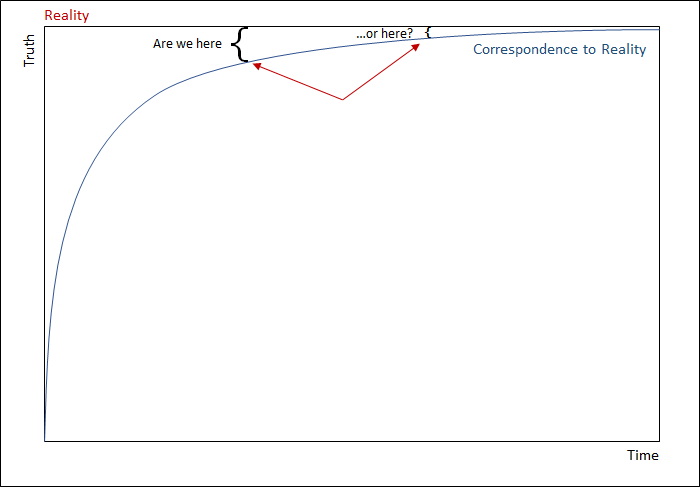
Graph: Correspondence of Truth to Reality (Asymptotic Curve)

The common assumption is that, over time, scientific inquiry will lead us closer to the truth. Correspondence theory supports the notion that more observations and perspectives will lead to a closer approximation, and eventually tools at our disposal will lead to more granular definitions, until we reach a point that and differences in the tangency to reality will be insignificant, a veritable rounding error. But there are several problems with these assumptions.

FIRST

We have no idea how close or far we are from Reality on the Y-axis, representing Truth.
This image has an empty alt attribute; its file name is truth-correspondence-1.png
Graph: Correspondence of Truth to Reality (Asymptotic Curve)

Assuming for the time being that there is an approachable truth, we have no reference to understand how close to reality we might be. In practice, we seem to operate on a basis of always being within some level of statistical significance of where Truth = Reality, and when new information is introduced, we say, “Hooray for Science!” Aren’t we glad that science is self-correcting. Empiricism has its own issues.

Historically, we’ve had ‘wrong’ correspondence between Truth and Reality, but then we got it ‘right’—until we didn’t. Rinse and repeat.

We may all be familiar with the story of how Einstein progressed and refined Newtonian physics. What Einstein did is to create a new narrative—a synchronous shift of paradigm and rhetoric—, which has been accepted into a revised orthodoxy. In our mind, this feels like progress. But how close are we to the real truth?

Taking our understanding of gravity as the fabric of space-time, we still have no idea what’s going on or how it operates, but this doesn’t prevent us from accepting it as a black box and making pragmatic predictions from there. So, for all intents and purposes, the ‘truth’ mechanism is less important than the functional relationship, just as I can tell time on a watch I have no idea how it operates.

SECOND

We have no idea if any changes to our perception move us closer to or further from Reality.

Rather than being asymptotic, perhaps the relationship to is polynomial (or the result of some stochastic function). See the graph above. As we move into the future (in red) and look back, we may perceive that we’ve reversed against some notion of progress. Common wisdom is that progress is directly, positively related to time. But is it?

In my first amendment, I reference how Einstein progressed and refined Newtonian physics, but in the future, this could be shown to be wrong. In our minds, what had seemed like progress may in retrospect turn out to have been a false assertion.* Moreover, we’ll dutifully accept this updated notion of truth if the rhetoric is sufficient to fit our concept of evidence, especially given humans’ propensity for pareidolia.

I am no true Sceptic, but neither do I accept the prevailing meta-narrative whole cloth. Unfortunately, I am in no better position than the next person to discern proximity to the underlying structure of reality.

THIRD

Rhetoric is a primary driver to fashion our sense of how close or distant we are from reality. Rhetoric shapes and focuses the frame.

War Is Peace, Freedom Is Slavery, and Ignorance Is Strength

1984, George Orwell

I’ve already commented at length about the primacy of rhetoric. To recap for the purpose of this disquisition, the only meaningful arbiter of truth is rhetoric—the ability to persuade the larger populace to accept something as true.

Here, I’d expect someone to counter with, ‘Just because people are convinced that something is true doesn’t make it so’, and they’d be right. However, as we cannot access the underlying reality accept through our admittedly fallible senses, who’s to argue?

Moreover—departing on a tangent—, we know that other lifeforms—let’s stick with the animal kingdom—have different senses than humans, and some humans perceive things differently to the normie (if I may adopt a spectrum term) .

Sharks have electroreception (re: The Ampullae of Lorenzini), which allows them to perceive small changes in electrical fields as well as what’s termed a lateral line ( mechanoreceptor function), which allows them to recognise changes in environmental pressure. Other known sensory adaptations are echolocation in bats and dolphins and chemoreceptors (notably in insects and snails).

We are probably also aware that different animals have differing degrees of sense acuity compared to humans. Dogs hear frequencies above the human threshold and have better olfactory discrimination. Birds of prey have superior vision. Women typically have a broader colour vocabulary.

Bees see in ultraviolet; snakes can ‘see’ in infrared; owls have night-vision.

And then there’s synesthesia, a condition in which one sense is simultaneously perceived as if by one or more additional senses. A person with synesthesia may perceive sound as colour (chromesthesia) or perhaps taste.

Given concepts of normality, we presume we are synesthesia are normal and these other people are somehow not, but for all we know, we normies are evolutionary dead ends, soon to be displaced by synesthesiacs. (Is that even a word? It is now.)

But I digress.

Perception is reality. If one can convince you of something, e.g. Donald Trump is a good president, then it’s ostensibly true to you. If one can convince an entire population that something is true, e.g. the plot of Orwell’s 1984, or The Matrix, then who’s to say otherwise.

FOURTH

Intent in communicating perception does not get one closer to some corresponding reality. It merely converges perception.

This fourth entry is a response to this comment by Landzek from The Philosophical Hack regarding the notion of intended truth in communication.

Extending the simple asymptotic function from the first section, we might see (in Graph 4a) a slight variation in interpretation due to the insufficiencies of language—providing us with a close enough for the government approximation to some shared perception. People in this group will tend to agree on some perception, say, that the earth is spherical.** The average distance from perception to reality is the same for all in-group members, give or take some small variance that I’ll dismiss as an insignificant rounding error.

Graph 4a: Correspondence of Truth to Reality (Simplified in-group concurrence)

Graph 4b, however, illustrates two opposing perceptions of reality. In this example, I show proponents of orthodoxy (group O), who claim the earth to be roughly spherical, arbitrarily closer to reality than proponents of an alternative theory (group A), who claim that the earth is flat.

Each in-group has some variance from the mean notion, but ex-group members are orders of magnitude apart, as measured by the blue and red bars to the right of the chart. If we assume some binary condition that the earth is either spherical or flat with no other options, one of these might be considered to be right whilst the other would be wrong. We can establish this situation relative to the ex-groups, but, still, neither of these is comparable to Reality™ .
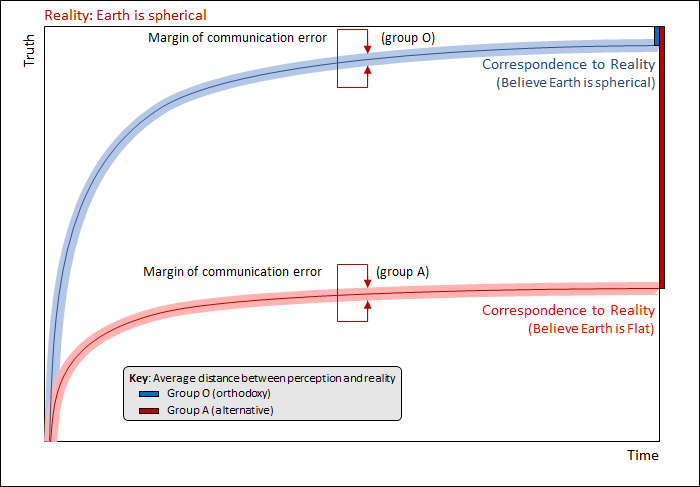

Graph 4b: Correspondence of Truth to Reality (Simplified ex-group concurrence)

The intent of each group may be to promote the perspective of the group—each claiming to be closer to the truth than the other. It is easy to imagine a situation where both claimants are equally distant from the truth:

Imagine two groups, each making opposing claims:

  • Tarot is superior to Astrology in predicting the future.
  • Astrology is superior to Tarot in predicting the future.

I’ll go out on a limb here and create a reality where the future is not predictable by either measure, irrespective of what each in-group believes.


* I am not versed well enough in the history of science, but I’d be interested to know which, if any, scientific advances have been a step ‘backward’, that a belief had overtaken a prior belief only to have reverted to the former.

I am aware of the slow march of science and the ignorance of possibly valid assertions simply because the rhetoric was not strong enough or the PR just wasn’t adequate. An example might be the debate of theoretical Democracy versus Communism: which is better than the other. Of course, there are too many dimensions to consider, and the adoption or exclusion of one dimension over another might be enough to tilt the outcome.

In the real world—see what I did there—, the US spend billions upon billions of dollars to interfere with Communism—and I am not taking a position whether it would have succeeded or failed on its own terms—, just to be able to knock down the strawman some century later though propagandising and disinformation campaigns.


** I understand that the earth being an oblate spheroid is primarily an analytical distinction, so is tautologically true, but I am using a simplification of a commonly accepted fact.


DISCLAIMER: In order to keep generating new content (or even content) on this blog, I will occasionally adopt a new approach of publishing unfinished thoughts instead of waiting to complete the thought. This means, I may be editing pages in place to correct my position and alter narrative flow, of not the narrative itself.

EDIT: I’ve included my amendments in line above, though I’ve retained links to the original content.

Character Arc

The US government are a crime syndicate, a veritable mafioso family. The current Don, quite literally, Donald Trump, The Don, is a conman at all levels. Some forget that conman is short for confidence man. About a quarter of the eligible voters had confidence in him–or at the least had more confidence in him than in his rival.

The US don’t have a vote of no confidence, but the impeachment process may serve as a worst case proxy. Watching the news, much f the political theatre and grandstanding revolves around the issue of character. It all sounds so tidy. A particular legal defence tactic is to impugn character. He’s got character; she doesn’t. One can’t trust that bloke even though he’s in a position presumably predicated on this character thing.

Character is a quaint notion, remnant of specious Virtue Ethics. The warring families–let’s call them Republicans and Democrats–attempt to secure the moral high ground by making a claim on the impeccability of their character pedigree. But what is character?

Character is another weasel word mired in cultural relativism. Essentially, it’s an asymptotic function wherein a person approaches some archetypal ‘good life’, as in eudaimonia. In the end, it suffers the fate of a no true Scotsman logical fallacy.

Humanism is Speciesism

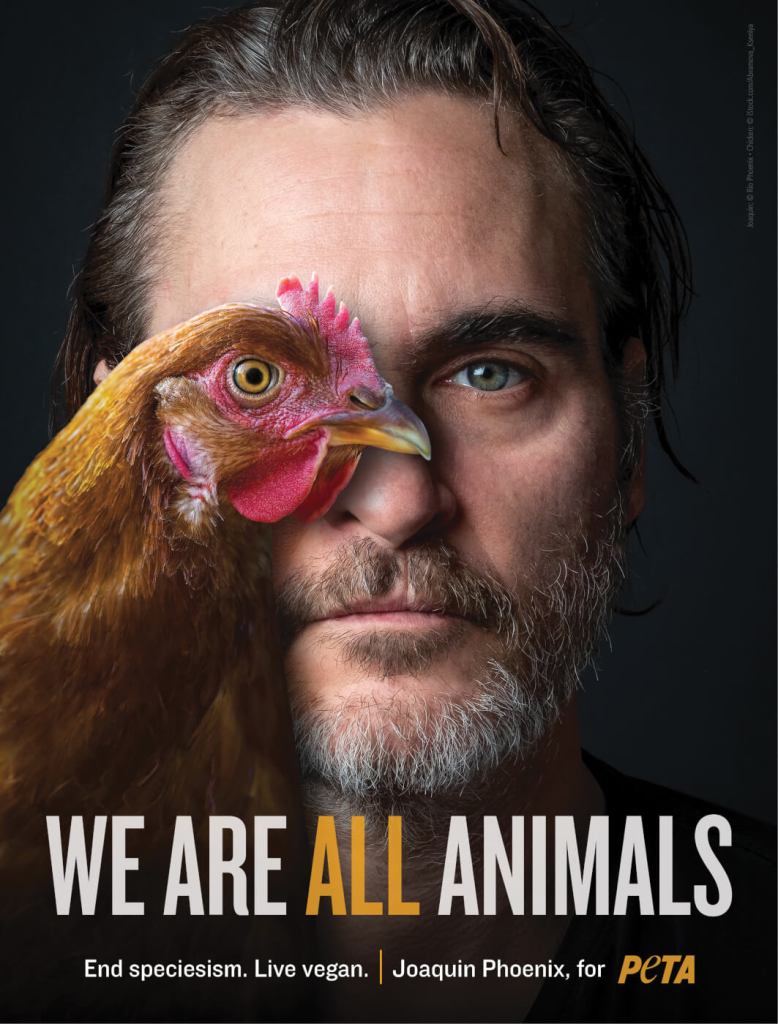
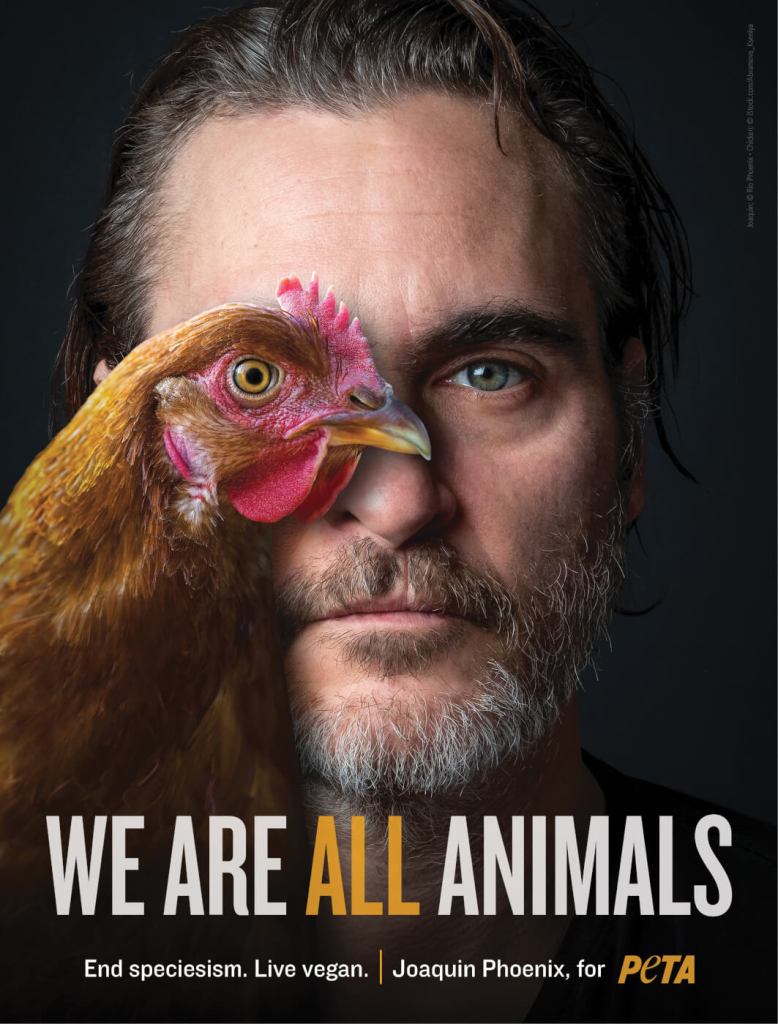
Why is racism wrong but speciesism OK? Primarily, other species have no voice, and to have no voice is to have no say. This advert got my attention.

Joaquin Phoenix Advert

Humanism is part and parcel specious Enlightenment tripe, where ‘coincidentally‘ humans put themselves at the forefront. Copernicus removed Earth from the centre — though to be fair, even Christians had elevated gender-non-specific-Man above other animals — , but Humanism makes it more poignant that it’s Man at centre not God. Gods be damned. In fact, it’s often an afterthought that humans are animals at all, despite only the slightest veneer of consciousness and, more to the point, language to separate us from them.

Otherness has proven itself to be an evolutionary survival aspect, one that has brought me to a point where I can write this, so one can call it natural, another term fraught with connotational baggage. To be able to differentiate and discriminate appear to be valuable attributes, but how much is enough, and how much is too much.

Buddhism teaches that we are all one with the cosmos and that any distinction is an illusion. Buddhist Enlightenment — not to be confused with Western Enlightenment — is to understand this, to not be bound to the illusion.

But, if racism is wrong, why is speciesism OK? Humans do give some animals some rights, and some places give different animals different rights, whilst others give animals categorically more and fewer rights. Some places ascribe divinity upon animals, elevating them above humans.

Racism seems to be more wrong because humans are more genetically homogeneous — at least phenotypically. Other mammals and herptiles don’t look so much like us. In observation, when they do, we have an additional layer of empathy, so chimps and canines with expressive eyes gain sympathy not afforded crustaceans and pinnipeds.

I don’t have an answer save to say that it’s just convenient and someday we may see a world as portrayed by science fiction where some — mostly bipedal species — live quasi-harmoniously with humans. But even there, humans are always the start, front and centre to provide to moral POV.

Identity Management

Identity is a human construct, but, more specifically, it’s a social construct. If you were abandoned in a place without human contact and with no prospects for contact, your current perception of yourself would wither away. If you are born in this place (and managed to survive and somehow have language to self-articulate), you would have little of what one might term identity. Whether the ability to discriminate yourself from other species and objects may not qualify for identity.

Identity is not a solo sport. One needs at least two to play.

For every identity, i, the relationship must always be

i  ≥  i + 1

Where by ≥ , I mean at least equal to. In fact, for each i, one may be able to argue that one should multiply the number of identities by the number of nodes, which is to say the number of participants in forming the identities. This accounts for developed personae.

i  ≥  n(i + 1)

Today, this was on my mind (as it were) as I was grocery shopping. I identify as an urbanite. I’ve lived in cities and in near suburbs, but I’ve recently moved from a rural setting to a more rural setting.

Sidenote in the middle:

It’s easy to see why the US are so politically fractured. Fundamentally, I do not see the world as do my rural neighbours. I am already predisposed to be an introvert, but this gives my more reason to segregate. These neighbours just view different things as fundamentally important. And the people create a veritable monoculture. I could pretend to fit it. Instead, I remain at the margin and watch.

Thankfully, my profession allows me to work remotely, but I have the opportunity to visit cities when working closely with my clientele. To be even more honest, in my reckoning the US have only 2 cities, New York and Los Angeles. I’ve lived in Chicago, have worked in Houston, and live south of Philadelphia at the moment–the 3rd, 4th, and 5th largest cities in the US, all of which pale in comparison to numbers 1 and 2. And my heart, as it were, resides in LA.

And we’re back…

Where other people are concerned, they have a vision of our identity, and we have our own. And this doesn’t exist in a vacuum, as we somewhat adjust our identity if we wish to be accepted into the group, but we don’t typically lose our self-identity, even if we can’t fully express it.

Some identities are easier to hide than others. If I am a gay female, I can just not discuss the matter or deny it if the situation would otherwise be hostile, but it doesn’t make me less gay. And to the other party, the may see me as a nubile woman.

Fairly obviously, my mum sees me differently to my coworkers or even my spouse, and most people I’ve seen interact with their parents differently than other people. This is about the identity of the persona. This is how a 30- or 40-something can still feel like a child when interacting with a parent but would never demur to, say, a peer.

In isolation, there is no need for identity in this way. If I am a trans-male who in society identifies with wearing clothes traditionally reserved for women of the same culture, there are no other women to model myself after. If I have these clothes available, I’ll wear them. Perhaps I have left my favourite dress behind, and I remember it fondly. This was a part of my former identity.

But would I spend time dressing well and applying cosmetics if the chance of meeting another human was nil to none? Unlikely.

And what if two heterosexual males were to find themselves abandoned with little hope for rescue? Would this be Brokeback Mountain revisited? This is stereotypical prison behaviour. Of course, in this case, this is a temporary identity override, and perhaps not something to ever admit once reinserted into polite company.

So What?

Whilst shopping, I was hypercritical (though quiet) about how I did not feel I fit into the environment. I questioned whether I might be considered to be a misanthrope. Not that I hated these people, but I just did not identify with them. And though I could be civil in short doses, it was not my preference to interact.

Truth be told, there may have been plenty of other people thinking the same thing, but how would one tell? At times, I’ll wear identifying clothing, like a tee-shirt that reads ‘Jesus Saves Sinners… and redeems them for valuable cash and prizes‘. These tend to attract the like-minded people with senses of humour, and the people baited into the headline but offended by the punchline.

So, now I identify this as the end of my post…

Political Path

People can change.

Although I have changed my opinion and perspective over the years, I feel that most people settle into their ways, fixing their positions with an unhealthy dose of confirmation bias. I’d like to think that I could change my position materially from where I am now given the introduction of new evidence, but I don’t think it’s likely. First off: because I am coming from a vantage where I feel I am ‘right’.

Don’t believe everything you think.

— Various

Of course, there is no absolute right, but from the perspective of the times and place and some triangulation, I’ll say ‘relatively right’.

Rewinding…

When I left high school in 1979, I considered myself to be generally Conservative — at least as I understood the word to mean and without dimension or nuance. I’m not sure I had a great grasp of the definition.

Upon graduation, I entered the military. I remember in conversation with a mate that I was a Conservative. He laughed, and said I was the least Conservative person he’d ever come across. I was perplexed, but I had to reorient my self-perspective.

New Definition

I decided that I was a Conservative — a Fiscal Conservative —, but I was a Social Liberal. I’d pretty much been a Social Justice Warrior (SJW), concerned with the underdogs, but it wouldn’t be on my dime — or the prospect I had for future nickels and dimes.

I held this position for years — until I realised that the two positions were untenable. You can’t simultaneously offer full social equality for free, and these were rights we were discussing. Fundamental rights. If money was the friction between a right and its realisation, then it needed to be spent. Fiscal Conservatism be damned!

Politicus Interruptus

Somewhere in the fray, I had dabbled with Libertarianism. Again, I dismissed this as an untenable fantasy. There had never been even close to an instance of this working, and it goes against the grain of all social concepts. It’s built on a dream — somehow anarchy without the anarchy, so anarchy + magic.

Progress

At some point, I didn’t like the PR of the Liberal tag, so I opted for Progressive. In the real world, I tend to side pragmatically with Progressives — the Bernie Sanders crowd in the US — , though I understand the illusion of progress and of politics in general.

Searching further to find a political identity, I settle on anarcho-syndicalism, the system I most identify with today, though there are only slightly more examples of this as there are Libertarian instances, a problem being that when some people see a leaderless group, they see it as a vacuum, and history repeats itself, so I’m not sure how sustainable this system could be.

This is now…

I am under no delusion that there is a right way for society to exist. I do believe there are plenty of wrong ways, but there are too many dimensions and complexities to have a single way. After all, how are you optimising the system? Trade-offs exist, and making a choice to maximise X might (and does) mean that Y is no longer maximised. Do you make X = 10 and Y = 8, or do you settle for X = 9 and Y = 9? And there are decidedly more than just X and Y.

There is no real reason to believe that society or even humans should exists, but given consciousness and self-preservation urges, I’ll take that as a given. That’s an inviolable metanarrative element.

The Problem of Rape

Last week, Motherboard published the full email thread in which Stallman wrote that the “most plausible scenario” is that Epstein’s underage victims in his campaign of trafficking were “entirely willing.” Stallman also argued about the definition of “rape” and whether the term applies to the victims.

When someone else in the email thread pointed out that victim Virginia Giuffre, who was 17 when she was forced to have sex with AI pioneer Marvin Minsky, Stallman said “it is morally absurd to define ‘rape’ in a way that depends on minor details such as which country it was in or whether the victim was 18 years old or 17.”

Vice.com

Richard Stallman resigned from several positions after these comments were surfaced.

The United States have a communication problem that transcends their petty polar politics, and this issue extends to the West.

The conversation around rape and Julian Assange became an issue based on Sweden’s characterisation of the crime as they see it, but this is different.

As with many jurisdictions, the United States creates age-based legal boundaries. This is expedient, to to sure, but we also know, rape aside, that people mature at different paces–not to mention the concept that the brain is not fully developed (whatever than means) until around age 30.

Age is used to delimit majority for contracts, marriage, sex (consent), alcohol, voting, military service, and so on, but it’s a weak tea proxy.

As a legal/social subject, rape is fairly categorically reviled, but it is hardly cut and dry, especially when one confounds the issue with the concept of statutory rape, which is where the systems strips the concept of consent from the equation, so that at 6,569 days a woman (because this is predominately applied to females over males) has no right to consent but at 6,570 does. This is further exacerbated because different jurisdictions have different ages of consent and loopholes, that are beyond the scope of my commentary and misses the point of communication.

Hot Button

Rape, race, and gender are hot button topics used to curtail and derail legitimate discourse and conversation. Whether Stallman’s comments exceeded the bounds of my argument does not invalidate the argument. Perhaps, he did overstep the bounds of civility, but that’s not my concern here.

To me, the question is, given I feel that the sole purpose of jurisprudence systems is to consolidate power to the status quo, how do we create a fair but ‘knowable’ boundary around things for which we currently rely on age, one where both sides of the consent equation understand the limit ex ante. But given legal systems are not designed for precision but for simplicity and expedience (albeit in a Rube Goldberg sort of way) and given that most people don’t question systems themselves, I don’t expect it change any time soon.

Neither do I expect the broader population not to be distracted by these same hot button topics. Distraction is a standard rhetorical device.

Moral Pragmatism

It appears you are interested in the workings of morality from a practical perspective.

This statement occurred in a discussion thread on The Philosophical Hack.

I don’t feel there is another perspective. It is a human construct of language, but, in particular, it’s a social construct. By definition, language is arbitrary (though not capricious), any anything within language is necessarily arbitrary, too.

Morality and its cousin, ethics, are essentially normative rules of conduct, so they are, foundationally speaking, pragmatic: what is the best system for a society to flourish. This implies some goal or goals. In essence, this becomes an optimisation problem that involves systems thinking, and humans are particularly poor at systems thinking especially when faced with complexity. Along our evolutionary path, managing complexity was not a huge survival factor. Kahneman and Tversky identified two systems: System I is the sort of automatic reflexive system and System II is for advanced functions. System II requires a lot of energy and upkeep. For most humans, it’s not well-developed or maintained,and System I appears to be the arbiter and has right of first refusal, so it attempts to solve heuristically something that should be assessed analytically.

Why the ramble? Morality is a complex system with boundary conditions and dynamics: precisely what humans are poor at. Just defining the boundaries is a challenge. Perhaps this is why some people simply attempt to define the boundary as universal, but this creates its own challenges. And many reject universal morality, opting for smaller moral domains—nations, states, municipalities, communities, schools, churches, families, peer groups, couples. To Hegel and Nietzsche, the main concern is authenticity for the individual. And Nietzsche didn’t feel that there was any one-size-fits-all morality to begin with. I could operate with different moral imperatives than you. This was most evident in his Master-Herd distinction.

But since I reject the notion of objective morality, it is necessarily normative or relative or subjective. Here, we end up trying to optimise an equilibrium model, but the trick is what to optimise.

In the modern age, the consensus is to maximise happiness or utility, but, as I’ve mentioned before, we are still left in a quandary: do we optimise personal happiness or group happiness, and what group? A nationalist might choose to draw a boundary around the nation. This will maximise happiness within the borders without concern of whether ‘people are starving in Africa’.

Of course, there are multiple dimensions to any morality. If there are two people and one has $100 and the other would feel happier to take it, in a utility optimisation model, there is nothing to defend not taking it. Prospect theory within behavioural economics provides some rational insomuch as humans tend to value loss over gain, so the $100 received is perceived as having less value than the person losing it. This is further complicated if the person receiving it is poor—perhaps s/he has no money—and the person relinquishing it is Jeff Bezos, to whom it is nothing more than a rounding error.

I mention these because we could have a positive sum game (borrowing from game theory)—the gain to the poor person would outweigh the loss leading to a net positive gain—, and yet Pareto optimisation disallows this. Of course, happiness and utility cannot be measured in the first place and they are not persistent in the second place.

My point in all this is to argue that humans are woefully ill-equipped to grasp these topics, and so most of this is not much more substantial than mental masturbation. And this leads me full circle to me original contention that morality and so-called moral truths are nothing more that rhetoric, the ability to persuade that your position is the truest truth.

Emotion-Reason Scaling

I’ve been engaging in an online dialogue on the topic of a scale or continuum of emotion and reason with Landzek through comments on his blog. Since, I am unable of posting images in his comments (AFAIK), I am posting them with commentary here.

He’s got 4 parts of this topic (so far), but, for reference sake, it starts here. Without retreading context you can get on his site, the essence is the notion of a scale, a spectrum between emotion and reason. In part 4, he conveys something I interpret as a time series graphically as image A.

Emotion and reason are a dimension represented on the Y axis, and time is on the X axis.

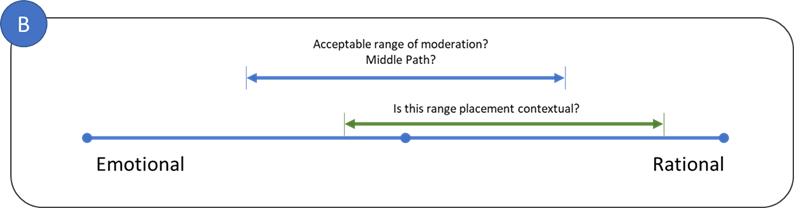
Prior to this, time was not a factor, so I had been constructing this as a simple continuum as shown in image B.

Here, there is only a X axis, running from emotional to rational, representing reason. Ignoring for the time of the index of the scale and not being concerned if the relationship is even-tempered linear or something else.

Secondarily, is there a quality perspective to the placement? My initial questions are embedded on the graph.

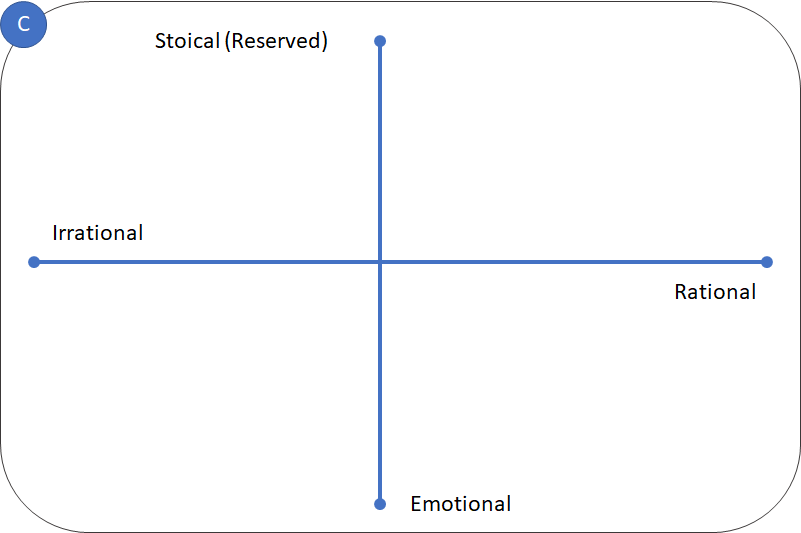
As I don’t feel that the Emotional-Rational scale are opposites, I’ve been thinking through how this scale might work. My first take was along these lines, creating a Cartesian plane.

In this, Irrational and Rational create an X-axis scale and Reserved and Emotional create the Y axis. I’m not sure what the nomenclature opposite of Emotional is, but stoical or reserved are placeholders for now.

Upon further thought, I am not sure irrational is the extreme opposite to rational. I am also not sure what the interplay of rational versus irrational versus non-rational should be, but I created a fourth chart as a basis for discussion.

I am not making a claim that any of these are correct. I am just trying to think this through visually. As I’ve got a day job, I need to get back to, I at least wanted to provide this foundation for conversation.

The Mystery of the Good

I happened upon a video where three philosophers engage in friendly debate over the nature of absolute goodness. The three each in turn give their positions, and then they debate three themes. This post captures their positions—until about 12.5 minutes—, and I’ll reserve the themes for future posts.

Video: The Mystery of the Good:
Is morality relative or absolute?
 
Naomi Goulder

The swapping an evaluative good over a moral goodness is a slight of hand or a head fake. As Naomi Goulder states, citing Nietzsche,

“Our weak, unmanly social concepts of good and evil and their tremendous ascendancy over body and soul have finally weakened all bodies and souls and snapped the self-reliant, independent, unprejudiced men, the pillars of a strong civilization.”

—Daybreak, Friedrich Nietzsche

I won’t call Nietzsche on his facile belief in ‘self-reliant, independent, unprejudiced men‘.

The problem is as much one of mathematics as well as of language. Good is a weasel word, so it is easy to equivocate over its meaning. I’ve commented on this before, so I’ll leave it here at the moment and focus on the maths. No matter what bogey we are attempting to maximise, we are left optimising across to dimensions: individual versus some group, such as society; and present verses future.

I’ll start there. Without regard to which normative function to optimise, we should recognise that what provides the most what I’d deem benefit now not also be optimised in the future.

If I have enough money for either an ice cream cone or bus fare home on a hot day—so even on a relatively short time scale—,and I choose an ice cream, my near-term satisfaction quickly fades when I realise I now have to find alternative means to get home.

In fact, I am not simply optimising across now and a few minutes from now. I am optimising across all possible future times across my lifespan. Plus, taking some choices are necessarily going to eliminate the possibility of others. Rational choice theory be damned.

Beyond the time dimension, we’ve got the individual versus group dimension. This is just as silly. Not only is the group undefined, we are likely to constrain it to our perceived in-group. As a citizen of the UK, I may not consider the effects of my choice on, say, Germany or Myanmar.

In effect, this becomes a system boundary definition problem. Just because I adopt a nationalistic boundary does not mean that I’ve chosen this correctly. The Germans who made this calculaus circa World War II learnt that being on the losing side of a conflict yields outcoems divergent from original expectations. Had Germany and the Axis prevailed, who knows how this might have changed?

My point is that, even divorced from the language problem, the bulk of this topic is mental masturbation. It is unresolvable because it’s not much more than academic sophistry.

Paul Boghossian

Paul Boghossian conveys three possible interpretations.

In the first he posits a strawman statement, ‘It is morally good to educate girls and young women’, a topic sure to get an emotional reaction from Western-indoctrinated people, assuming a moral high ground over fundamentalist Muslim beliefs. Proponents of this view claim that this can be assessed as simply true or false.

More fundamentally, he defends this approach in proxy by asserting that, ‘ultimately, there will be some normative claim at the bottom of that chain of reasoning which will either be true or false‘. It hinges on the expected role of the human, in particular the female of the species. Again, this is only true or false within some context, a context which is neither objective nor universal.

In the second, which he labels as relativistic, acknowledges the social contextual interpretation.

His last interpretation is nihilistic, wherein, ‘normative vocabulary is fundamentally confused; there is nothing in the world it answers to; if you really want to do things ‘right’, you just have to drop this vocabulary and find some other vocabulary—not itself normative; not itself evaluative—in which to describe these things that we call moral convictions or moral beliefs‘.

I subscribe to this last school, though I do not feel that language is fundamentally capable of this level of precision and even more fundamentally is not truth-apt.

He adds a fourth category, where preferences rule, which is weaker still, as preferences are not only normative but emotional and, I might argue, are somewhat arbitrary and capricious and subject to all of the weaknesses inherhent in preference theory.

Michael Ruse

Michael Ruse begins by downplaying the absolute notion of the good but then backtracks and defending something close to absolute by ‘taking it very seriously’.

He defends the believers in the quasi-absolute morality of good gods, ignoring the relative nature of that belief (and not to mention how to validate the objectivity). He goes on the defend Platonism but comes up short trying to assert the positive analytic notion of maths and a normative vantage where morality is objective.

I was pleasantly amused with his case where he highlights the inherent problem with a sexual morality formulated around a binary sex world if we imagine intergalactically a world with a ternary sex arrangement. We can observe this locally, as not all species are restricted by human sexual dimorphism.

For reference, the three themes discussed are as follows:

Theme One: Is there an absolute good?

Theme Two: Does morality apply to the act or the consequences

Theme Three: Should we strive for absolute truth

The Colour of Justice

Sort of interesting topic, but I’ve been too busy to post much or respond lately.

Think about the concepts of “red” and “justice” and you’ll notice a key difference. If you’re sighted, you’ll associate “red” most strongly with the sensory experience, which relates to signals from cone cells in your eyes. “Justice”, in contrast, doesn’t have any associated sensory qualities – as an abstract concept, you’ll think about its meaning, which you learnt via language, understanding it to be related to other abstract concepts like “fairness” or “accountability”, perhaps. But what about blind people – how do they think about “red”?

A brain-imaging study of 12 people who had been blind from birth, and 14 sighted people, published recently in Nature Communications, shows that while for sighted people, sensory and abstract concepts like “red” and “justice” are represented in different brain regions, for blind people, they’re represented in the same “abstract concept” region.