I’ve been following Philosophy Tube since Abigail was Ollie. Always top-notch material. Their content has gotten longer over time, so I’ve found myself skipping over in favour of shorter presentations. I am so glad to have decided to watch this one.
As anyone who follows me knows, I am a big advocate of social construct theory, yet I learned so much in this vid, which is proper well-cited AF. Lot’s of new content to add to my backlog, so I’ve got more than enough reading material for my next few incarnations at least.
The biggest takeaway for me is the notion that not only is gender a social construct, but so is sex itself. Previously, I have defended the sex-gender distinction, but in fact, scientific taxonomies are still social constructs—only in the scientific community rather than the greater community at large.
Abigail’s platypus drives home the point. Not that it’s some big reveal. Another less poignient analogy is fruit and vegetable classification. Tomatoes are fruits. Mellons—watermellons, pumpkins, and so on—are fruits. Say it ain’t so.
Give it a viewing and like or comment here and/or there.
Many racists, closeted and otherwise, cite The Bell Curve as proof that blacks are dumber than white people. Published in 1994, it’s controversial and bollocks. The first problem is with the notion of IQ testing itself, and then there’s the construction of the tests and relevance to aptitude. Anyone who’s read more than a handful of my posts know that I have long labelled the entire discipline of psychology a pseudoscience, so it would come as no surprise that a product of psychology is principally pseudoscience, too.
I’ve already moving on to new topics, so my parting point is that ordinary people find interpreting statistics to be an almost insurmountable challenge. Mark Twain recognised this in his quip, lies, damn lies, and statistics.
lies, damn lies, and statistics
Mark Twain
The problem is many professionals don’t understand statistics—even those whose function requires it. I was a professional statistician decades ago, so I have a certain fondness for it. I was even working on another post on the subject of the Simpson’s Paradox, but not quite yet—though it’s been weeks in the works. I am thinking about a post related to René Girard’s conflict theory as a lens and framework to understand the ‘insurrection’ at the US Capitol. I also want to react to the notion of metamodernism as a reaction to the conflict between modernism and postmodernism.
One if the biggest foci of postmodern philosophy is the metanarrative. Employment diversity is a place that the metanarratives go unquestioned by most. The most predominant aspect is the frame. Don’t accept it.
Inside this frame, some uncritically adopted narratives are as follows:
Work is good
Work builds character (proportionately to the effort exerted)
Work defines your value or worth as a human
Work signifies your place in society
Work is its own reward (except for monetary payment and recognition)
Value is defined by monetary achievement
Worth is defined by your place in an enterprise
And so on…
In this HBR article*, the frame has been established as a corporation and the diversity within this context. What this say by omission is that money and power is the measure of a meaningful existence. If only women were afforded a seat at this table—proportional to their population in society—, things will be even.
Women should start their own successful companies. Women should rise to the top of existing companies. Especially if they buy into the aforementioned narratives. Many women and men buy into this story lock, stock, and barrel (whatever that means), but only is you accept this as a frame is this relevant.
It’s easy to imagine a world where money is unnecessary, where labouring is unnecessary.
It’s easy to imagine a world where money is unnecessary, where labouring is unnecessary. Some have imagined a world without work, where people could instead pursue artistic endeavours, but this is just adopting a different set of narratives—like the person who exchanges drugs or alcohol for Jesus or some such. Out of the frying pan into the fire. This is the lie.
Interestingly, the HBR article makes these points:
Quantify gender equity in terms of economic gains for the company.
Hold leaders accountable for change by tying DEI metrics to performance reviews.
Offer development opportunities to increase gender intelligence, empathy, and self-efficacy.
Pull back the curtain on misperceived social norms.
Establish cross-gender professional relationships.
Frame, focus, and integrate interventions into core business outcomes and mission.
Notice that each of these operates from the perspective of the company. Granted, this is HBR, where the B is for Business, but still. Here’s the low down.
Gender equity will at some point increase your bottom line.
Create diversity metrics (and incentives) and tie them to performance review—presumably tied to the economic performance expected in bullet 1.
Educate your executives and staff to the misconceptions—so long as you don’t question the deeper metanarratives.
Essentially, the ask here is to establish male-female protégé-mentor relationships. Of course, this could be expanded to break binary gender stereotypes, too.
Back to business, frame the frame. But to tell the truth, I don’t even know how to interpret and summarise the provided example. It seems this is an admixture of points 1 and 2, given metrics should ladder up to stated objectives and outcomes.
asking for this equity in diversity is a short-term fix
In any case, asking for this equity in diversity is a short-term fix, but it’s unimaginative and buys into the worldview of the patriarchy. There is no reason to accept this prima facie. As with the notion of Democracy, I’d be willing to argue that the system itself is the problem and that any tinkering within the system is limited by the system itself.
* Apologies in advance if HBR has a paywall. Typically, the first 3 articles are free, but if you are like me that exhausts on day one.
Je m’accuse. I’m such a bad blogger. I haven’t been focusing much lately, but given the recent events around #BlackLivesMatter, I’ve been doing some thinking. A lot has been said about diversity and inclusion—whether for black lives, females, LGBTQ+, or some other class—, but the issue is more complex and dimensional than a problem with intersectionality.
There is something to be said for experiential diversity, and the benefits of virtual cross-pollination may have some advantages, but much of this is superficial diversity-washing, enough to claim a public relations participation award.
I keep Simone de Beauvoir’s The Second Sex close to the top of my mind much of the time, but this is more than just about feminism. It’s about otherism—the otherness that creates outgroups.
In Beauvoir’s parlance, there are men and there are not-men—others. This is similar to Baudrillard’s dog/not-dog distinction but with more intention, so we arrive at an orthodox/not-orthodox pairing.
Taking workplace diversity as a frame, that they accept blacks, or women, or disabled, or some other identified class is superficial because the common thread is an acceptance of the prevailing meta-narratives, not only of Capitalism, Democracy, meritocracy, authority structures, and the like. As long as you comply with this mindset, sex and gender, the colour of one’s skin, or disability is cosmetic.
To some extent, there will be some diversity of thought. There will be some cultural perspectives, some generational perspectives, and some gender perspectives, but all of these are aligned to the overarching narrative.
In the world—in the United States anyway—, it’s OK to be black or Hispanic as long as you act ‘white’ or ‘American’. Speak with a neutral accent. Listen to mainstream pop. Don’t wear culturally identifiable clothing. This will ensure acceptance. In a way, this is a faux pas of Donald Trump. He comes across as vulgar to those who hold this perspective.
The diversity that’s missing is one that would do things differently. When a woman ascends to a CEO position, she has done so by more or less mimicking the path a man would probably have taken, making similar decisions. Ditto for a black. Double ditto for a black woman.
People outside of this narrow path will not ascend. I’ll ignore the question of whether this is even a worthwhile aim, A woman who takes this path may have to break through a glass ceiling, but for those of us with a more diverse mindset, the ceiling is stainless steel—a meter thick.
But this is for more than CEOs. I am a self-aware eccentric, and although I colour within the lines my thought is typically outside of accepted boundaries. Luckily, I’ve had the good fortune to work with the right people in the right environments to capitalise rather than be hampered by this difference. I’ve been lucky enough to operate with relative autonomy because over the years I’ve generally met or exceeded expectations on my own path.
During a review—or at least a conversation—about a decade ago, a manager told me that he had no idea how I operated but that he didn’t want to interfere for fear of breaking the goose laying the golden eggs. I know this was difficult for him to do and to admit because he is a very structured thinker and felt compelled to create repeatable structures (despite ignoring the structure when it came to him—and, thankfully, me).
This same person—whom I admire despite our having different worldviews—also noted that I operate as a director or orchestrator rather than a typical leader. I feel this is spot on. Even as early as high school, I articulated that I did not consider myself to be either a leader or a follower. I was a self-professed adviser, so it’s no surprise that I find myself in consulting and advisory roles. I realise that in the United States, the world is constructed to be more diametrically than it would otherwise need to be, so I end up being a veritable unicorn in most settings.
As those who know me, my first career was in the entertainment field, where diversity is more part of the rule than the exception—though there are still many normies there, too. My ex-wife asked me countless time why I left the music industry, or didn’t stick to academics or activism, each with their own level of interest to me.
The problem is that this diverse perspective is not something a resume can convey very well as there needs to be a great deal of trust, which is not typically in place for new hires, so many, let’s say, organic and creative thinkers, get left out of the equation to the detriment of cultural diversity.
Why is racism wrong but speciesism OK? Primarily, other species have no voice, and to have no voice is to have no say. This advert got my attention.
Joaquin Phoenix Advert
Humanism is part and parcel specious Enlightenment tripe, where ‘coincidentally‘ humans put themselves at the forefront. Copernicus removed Earth from the centre — though to be fair, even Christians had elevated gender-non-specific-Man above other animals — , but Humanism makes it more poignant that it’s Man at centre not God. Gods be damned. In fact, it’s often an afterthought that humans are animals at all, despite only the slightest veneer of consciousness and, more to the point, language to separate us from them.
Otherness has proven itself to be an evolutionary survival aspect, one that has brought me to a point where I can write this, so one can call it natural, another term fraught with connotational baggage. To be able to differentiate and discriminate appear to be valuable attributes, but how much is enough, and how much is too much.
Buddhism teaches that we are all one with the cosmos and that any distinction is an illusion. Buddhist Enlightenment — not to be confused with Western Enlightenment — is to understand this, to not be bound to the illusion.
But, if racism is wrong, why is speciesism OK? Humans do give some animals some rights, and some places give different animals different rights, whilst others give animals categorically more and fewer rights. Some places ascribe divinity upon animals, elevating them above humans.
Racism seems to be more wrong because humans are more genetically homogeneous — at least phenotypically. Other mammals and herptiles don’t look so much like us. In observation, when they do, we have an additional layer of empathy, so chimps and canines with expressive eyes gain sympathy not afforded crustaceans and pinnipeds.
I don’t have an answer save to say that it’s just convenient and someday we may see a world as portrayed by science fiction where some — mostly bipedal species — live quasi-harmoniously with humans. But even there, humans are always the start, front and centre to provide to moral POV.
Jordan Peterson was interviewed by Joe Rogan, where he discussed gender and competition. I am not going to address his gender issues, but I’ll say something about competition. I’ll also ignore his stance that the world is ‘functioning unbelievably well, even though it has its problems’. He gets to competition through some comments on equality.
[Focus] on winning the largest number of games across the span of a lifetime.
Jordan Peterson
Firstly, Peterson differentiates equal playing fields from equal outcomes, a favoured Conservative talking point slash whipping boy. He then sets up a strawman argument relating to people favouring the ‘best of the best’ (which is to say, their personal favourites, I suppose) in lieu of exploring the vast universe of music available on the myriad streaming services, the result being that in the aggregate, the preferred acts make more money through this competition. Of course, this is the result of preference theory, which produces different outcomes based on inputs such a time and place, fads and trends, and the ‘winner’ is the one who attains the most listens.
There’s no accounting for taste.
Having had worked in Entertainment for years, I realised early on that the correlation between talent and financial success was fairly weak. In fact, I had several conversations with artists who felt ‘guilty’ for their commercial success over people they deemed more talented. This is a fundamental problem with market systems, the value calculus is influenced by what Keynes termed ‘animal spirits‘. As the saying goes, there’s no accounting for taste.
Peterson and Rogan both agree that competition is healthy and necessary, but they don’t define the scale and scope, so they sacrifice a participation trophy red herring on the altar.
Peterson does come back to discuss scope within a timeline of a lifespan, that a single game is less important than a championship—and, apparently, there is more than one championship. What never happens is a definition of what the rules of the game are or how you know you’ve won. I suppose, that’s a relative concern. They also don’t provide any guidance on where to set the dial between competition and cooperation.
If you are trying to get a job versus even some anonymous pool of applicants, then you’ve won this match. I see this as an evolutionary game. I remember a story by Clarissa Pinkola Estes where she tells about a guy who had been climbing the corporate ladder for decades, and when he got near the top, he came to the realisation that he had it up against the wrong building. Perhaps what he thought was a worthy goal (say acquisition of money) was in conflict with some higher ethical goals or deeper friendships.
It doesn’t matter whether you win or lose, it’s how you play the game.
From what I can tell, Peterson is guided by a sense the virtue ethics are the way to go, and, judging from this interview, he’s more than just a bit of a Consequentialist. But it’s clear he is no Deontologist. Case in point, he claims that the adage, ‘it doesn’t matter whether you win or lose, it’s how you play the game’ is a ‘sentiment confuses children’.
Play well with others.
He ends by saying that if you learn the kindergarten lesson to play well with others, you’ll temper your winning or redefine winning within the context, and somehow your goal should be ‘focusing on winning the largest number of games across the span of a lifetime’.
At the end of all of this—given Peterson’s pathological worldview—, it’s no wonder he’s so defensive, combative, and irascible: he is driven to win, and he thinks it matters. And it’s abundantly clear that he hasn’t learnt his own kindergarten lesson: Play well with others.
As I read his Utilitarianism, I want to like John Stuart Mill. He seems like such a clever man, but he is a victim of his Enlightenment Age. Attempting to fabricate order created by science’s encroachment on the absolutes of religion and the shifting sentiments toward monarchies, Mill tries to replace this moral compass with Jeremy Bentham‘s utility.
£1 ≠ £1
The problem is that despite (sort of) dispensing of religious doctrine, Mill was still fettered by the dogma of virtue ethics of dignity and duty. To this, he adds happiness. Not to go full-on Foucault, but these are concepts leveraged, like religion, to maintain power—take an elevated system in a constructed society, and the duty becomes a burden to the bottom, save for pretence of duty and dignity at the top.
I’ve had an issue with the concept of virtue and all of its offspring: duty, justice, and so on. I’ll likely write about this later. I expect that I’ll be reading Mill’s On Liberty next, so stay tuned.
Ignoring my contention that Utilitarianism is baseless, I have two other issues, using economic examples, each related to prospect theory (pdf):
Regressivity: A person with less money values an incremental dollar more than a person with more money.
Loss to gain asymmetry due to risk aversion: A person values losing a dollar more than earning a dollar, ceteris paribus.
Pareto efficiency, a cornerstone of Classical economics, does not take this into account. For this theory, all dollars are created (or perceived to be) equal, so it doesn’t matter whether person A, who earns £10,000 p.a., or person B, who earns £100.000 p.a., gets £100, but in the real world, person A would give it a higher value, so a transfer from A to B would be an inferior transaction to a B to A transaction.
This said, person B values the £100 more than having gained the amount, but it is not clear how to reconcile (in order to reach perceived parity) what the fair equilibrium would be, allowing that equality of outcome might not be the desired outcome.
I’ve created a video on tautological equality, briefly summarising why this type of inequality is not relevant in the discussion on socio-political equality.
This video is part of a larger series asking: Are all equalities equal?
I have long been interested in notions of social justice and equality, but somehow it all felt a bit loosey-goosey and amorphic. To be honest, I feel this way about the entire composition of government, politics, and jurisprudence, and other power structures, but those are topics for some other days. Also, I won’t endeavour to speak to the artificial income-market construct, so for the purposes of this post, I’ll take this as given, as anachronistic and quaint as it might otherwise be. Nor will I discuss whether the system itself, apart from the equality question, is optimal or even makes any sense from a broader vantage, or whether competition has a role in an otherwise coöperative society.
Along with empty virtue notions as freedom, liberty, and justice, (topics for another day) equality is a post-Enlightenment Age catchphrase. As with its counterparts, it sounds nice; it has a nice ring to it, but it is just as specious. These are words invoked to raise emotions, but as with a pointillist’s painting, if you attempt to scrutinise them too closely, they become unintelligible.
A Sunday on La Grande Jatte, Georges Seurat
Aside from maths, equality is an issue for sociology as well as political philosophy. In maths, the concept is tautological.
“In sociology, the study of the causes and consequences of inequality in its various forms – class, race, gender, power, status, knowledge, wealth, income – is one of the most pervasive themes of the discipline. In philosophy, theories of justice and rights are centrally concerned with the problem of justifying and criticising different kinds of inequality.” [1]
Sociologist, Bryan Turner, identified four flavours of equality:
Ontological Equality
Equality of Condition
Equality of Opportunity
Equality of Outcome
Political Philosophy is more concerned with accepting the sociological definition as given and discussing it in the negative sense of inequality.
Tautological Equality
In maths, we have likely been made accustomed with equalities since grade school. In fact, that’s what makes the other notions so compelling. It all appears to be so tidy and scientific.
1 = 1
2 = 2
1 + 1 = 2
Amazing, right? Two values balanced on either side of an equals sign. The problem is that these equations—these equalities—are logical tautologies. They are equal because this is in fact how they are defined, defined in the same manner as we define a red lorry as red. Equal in this context is not useful for us, save as a familiar reference.
Ontological Equality
The Declaration of Independence of the United States of America employs ontological equality, where ontological is defined as “relating to the branch of metaphysics dealing with the nature of being”.
“We hold these truths to be self-evident, that all men are created equal, that they are endowed by their Creator with certain unalienable Rights, that among these are Life, Liberty and the pursuit of Happiness.”
Aside from an unsubstantiable claim that these so-called “truths” are somehow “self-evident”, this weakest form of equality is a claim “that all men (read: people) are created equal” at birth because “their Creator” (read: God, an obvious metaphysical nod) “endowed” them with this aspect.
Translating this into common parlance, this states that we are all equal in the eyes of God [sic]. In essence, to commence a racing metaphor, this means that we all get to participate in the race, and that sounds good, right?
The problem with ontological equality is that it outright ignores existing inequalities, so whilst you may be equal in God’s eyes, that’s where it ends. Essentially, you get an empty promise. If you’ve got something to say about, say a prayer; God’s got operators standing by. At least you get to play the game.
Manchester United football club players
Equality of Condition
Where ontological equality leaves off, equality of condition steps up. Beyond the metaphysical promise, it claims that all people get to start at the same position, that we each get to start at the same starting line. That sounds fair, right?
The problem with equality of condition is that whilst you may get a place at the starting line, you still face any systematic or structural adversity in play, whether that be discrimination, wealth disparities, access to quality education or other public services, and so on, at least you get to play the start at the same place.
High school girls at a starting line
Equality of Opportunity
My Libertarian associates seem to love this one. In fact, in their world, the only conversation is about equality of opportunity (also known as formal equality of opportunity) versus opportunity of outcome. It’s a cage match to the death, and opportunity is their champion.
Cage Match Fight
This flavour of equality doesn’t claim that a person has the right to start in the same place—only that the rules will be the same.
The problem with equality of opportunity is that it makes a specious claim. Besides ignoring the condition and situation and any past infractions—letting bygones be bygones (especially when they have given you the advantage that you wish to retain).
A parallel would be to allow a steroid-pumping athlete to compete by rationalising that, well, the race has started, so let’s just keep playing. Afterall, we’re playing by the same rules, so that makes it fair. Forgive and forget, right?.
The privileged live in better neighbourhoods, have access to better schools, can afford tutors and summer programmes. Many live in more stable family environments growing up, and they have access to networking benefits. This is further reinforced in university, and, like compound interest, the earlier one starts, the greater the effects of compounding.
Again, equality of opportunity might sound good on the surface, but, yet again, it disintegrates on scrutiny. Its main purpose is a feel-good head fake to keep one’s eyes off the prize.
Substantive Equality of Opportunity
A subset of equality of opportunity is substantive equality or fair equality of opportunity. Under this model, additional remediation is asserted to the disadvantaged person. This might be a familiar concept to golfers, who have handicaps. The goal is to—whilst also enforcing a similar rule set—accomodate those with some head start advantage. In the everyday context, it could be providing additional funding or resources to underprivileged children.
The problem with substantive equality of opportunity is that the deficiencies are multifaceted, the system itself is too complex to account for all material dimensions and measures, and most assessments are normative in nature.
Equality of Outcome
Equality of outcome is particularly pernicious. It claims that in the end, everybody wins, and everyone gets the same prizes.
‘At last the Dodo said, everybody has won, and all must have prizes.’
This is a potential result of Communism, that is if the definition is taken to the absurd. This is a common criticism by some when every participant receives a participation prize—a manifestation of the notion that everybody is special.
The problem with equality of outcome is that, among other things, not everybody wants the same thing, so this logic basically boils down to I want what I want if what you have is what I want as long as everyone else who also wants what I want has it, too. Of course, we could reduce this down from actual equality—apples for apples and oranges for oranges—into value equality, where everyone has access to some comparably equivalent value (whatever that might mean, especially insomuch as different people assign different values to the same goods and services).
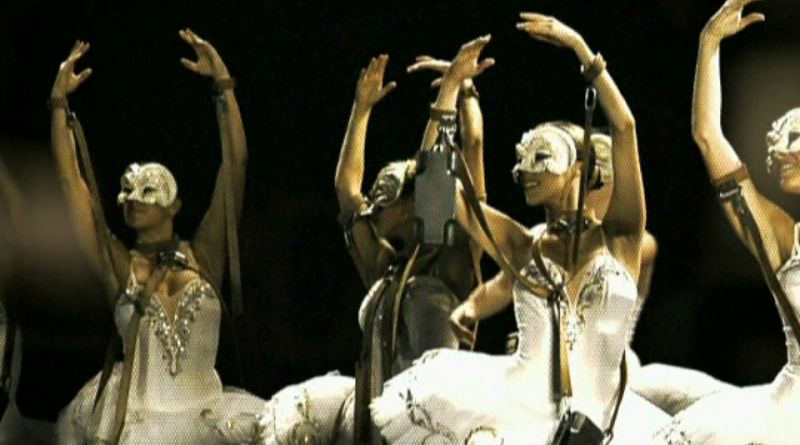
Kurt Vonnegut depicted this in his short story, Harrison Bergeron (PDF), where, not being able to raise certain persons, people were instead reduced to the lowest common denominator, so rather than elevate the cognitive ability of low IQ people, the solution was to diminish the capacity of higher IQ people, so as to produce the same—albeit lower—results.
Dancers represented in Harrison Bergeron
Closure
In the end, ontological equality is nothing more than vapour; equality of condition fails to account for material differences among people and their situations; equality of opportunity also fails to account for disparities of condition; and equality of outcome is an unrealistic pipe dream that would be too complicated and complex to implement.
In order to further communication, if that is indeed even the purpose (rather than obfuscation, which I feel may be the prime motive), we need to use different concepts, to find new terminology.
Also note, that I reserve the right to make inline edits to this post in an attempt to extend, clarify, and otherwise elucidate this topic on equality.







![hb_51.112.6[1]](https://philosophics.blog/wp-content/uploads/2017/09/hb_51-112-61.jpg)


![Future-value-of-a-present-value-or-principal-using-compound-interest-(given-nominal-annual-interest-rate)-234[1]](https://philosophics.blog/wp-content/uploads/2017/09/future-value-of-a-present-value-or-principal-using-compound-interest-given-nominal-annual-interest-rate-2341.png)

 Philosophics