Human Agency is an Illusion

I just published a video on YouTube—just over 7 minutes long. I’ll be publishing the audio as a podcast and will share the script here as well.

Human Agency is an illusion. This is the end of the story. If you listen for a while, you’ll hear as I rewind and pull back the curtains.

[Redacted]

Let’s get started.

Human Agency is an illusion.

Think of life as a motion picture that’s already been filmed. The ending is already known. The script has been written and performed by actors already chosen and hired.

I like this visual, but it’s not quite right. The end is not known in the same sense as that of the movie. It’s just as inevitable, just unknown.

Some might prefer to use the metaphor of cascading dominos. And this might even play better into the illusion. Some unforeseen force might intervene and stop the otherwise inevitable. But even this is beyond our control. Like an action-adventure story, we’re strapped into a runaway train and just along for the ride. This train might someday stop, but we’ll have had nothing to do with it. Enough of metaphors. What am I saying? Why am I saying it? And what does it mean?

Allow me to set up the scene. From there, I’ll elaborate.

For millennia, there’s been a debate over free will and determinism. These terms have been defined in different ways in an attempt to sway the argument for or against, one way or another. It turns out that for the human agency illusion, it doesn’t much matter, but it might still help to set the stage, so let’s establish some foundation. I like to consider free will and determinism as bookends.

free will is the ability to make a choice
and have had the ability to have chosen otherwise

Commonly, free will is the ability to make a choice and have had the ability to have chosen otherwise. That one can make this choice of their own accord or volition, is typically added for good measure. On the other hand, determinism says that everything that happens is determined by everything that has happened prior in a chain of cause and effect. Like dominoes falling one after another, so some event has caused another event since the dawn of time. Perhaps before time.

Some have argued that random events occur in our universe. Quantum theory suggests this. But that these events happen, doesn’t mean that we as humans have any say in the matter. This is what is known as indeterminism. Causes and effects are not so cut and dry. Some stochastic event serving as an exogenous factor manifesting as a pigeon, can swoop down and break the causal domino chain, but that doesn’t afford us human agency. A little more background. Some hold that free will and these alternatives are either mutually exclusive, or they’re compatible with each other. Not surprisingly, those who believe that these can coexist are called compatibilists, whilst the others are incompatibilists.

What I am saying is that if we allow that this wide shot might have validity, we can zoom in for a tight shot on the agent and notice that it doesn’t really matter. Some have said that the freewill versus alternatives challenge is a pseudo-problem. I am going to agree for the time being, if only for expedience.
Before getting to the illusion of agency, let’s see why this situation creates problems.

Without getting too deep, humans seem to be wired to view their reality in a manner of cause and effect. Moreover, they seem wired to attribute blame based on this presumed causal relationship. Oksana hit a homerun. We should praise her. Raj robbed a store. We should blame him. Western society is constructed with this worldview, so we create rules and laws. We may even choose to codify how to rehabilitate or punish him. Or to reward her.

Without agency, there is no cause to praise or blame

Without agency, there is no cause to praise or blame. Whilst I consider it a pathology, for better or for worse, given the human propensity to blame concomitant with the agency illusion, I don’t see this changing any time soon.

There are arguments around quarantining bad actors independent of their agency or lack thereof on the grounds of public safety. Even this logic has serious holes, but we’ll save that for another time.
And now the big reveal. With a reminder that my intent is to not go deep, how can I say that human agency is an illusion? Let’s start with the science.

As a lifeform, humans are a product of heredity, genetics, and epigenetics. Essentially, DNA passes information from generation to generation. Besides determining our physical attributes—head, shoulders, knees, and toes, potential height and weight, pigmentation, sex, and so on, it also establishes our temperament—our base attitude and way we perceive and interpret the world. This doesn’t make us clones or robots or automatons, but it does comprise some percentage of what we are. Identity politics aside, we don’t have much control of our sex, finger count, or eye colour. Clearly, we aren’t talking about trans-humans and cyborgs here.

Genetics and so on aren’t the only factor. Behaviourists will remind us that the environment and circumstances mould us, too. Each of us is taught mores and moral codes; how to behave and act. We are raised in a structure comprised of family, school, church, peers, larger society, authority figures, and whatever else—ostensibly like a sausage being stuffed into a skin.

Beyond the genetics that we have no control over,
we are products of our environment

Beyond the genetics that we have no control over, we are products of our environment. These things interact, but there is nothing of us that we are responsible for creating. Despite the motivational tripe, we cannot create ourselves. This, too, is an illusion—delusion if I am being less charitable.

I’ll reserve elaboration for future content. In a nutshell, you’ve got no agency. Every choice you make is based on prior events. Even something as simple as choosing to order a chocolate or vanilla ice cream in a cup or a cone, sugar cone or waffle cone is predicated on some prior events, and you had nothing to do with them. You were a passive vessel.

I’ll leave with two relevant quotes.

A man can do what he wants, but not want what he wants.

Arthur Schopenhauer

And as Galen Strawson puts it,

  1. You do what you do, in any given situation, because of the way you are.
  2. So in order to be ultimately responsible for what you do, you have to be ultimately responsible for the way you are—at least in certain crucial mental respects.
  3. But you cannot be ultimately responsible for the way you are in any respect at all.
  4. So you cannot be ultimately responsible for what you do.

So there you have it. I hope you found this cursory treatment interesting and informative if not provocative.

[Redacted]

I’m interested in hearing what you think. Do you think you have agency? Do we have free will, or is everything determined at the start? I didn’t even mention religion. Does that throw a spanner in the works? Let me know.

Subjectification of Foucault

My love affair with Foucault goes way back. Joseph Campbell is said to have spent five years (1929–1934) living in a shack, engaged in intensive and rigorous independent study. In my dreams, I’d spend five years with Foucault, Galen Strawson, and David Guignion.

Michel Foucault is likely the most well-known of these three, and I’ve written a few Galen Strawson-related posts lately, but who the hell is David Guignion? I’ll tell you. David is a PhD philosophy student studying conspiracy theories if his bio is up to date and otherwise relevant. I’ve shared some of his content and insights over the years.

The reason I love David is that he introduces me to contemporary philosophers I had not been aware of as well as material or perspectives on classical philosophers to broaden my horizons. I think it’s safe to say that David and I are both Foucault fanboys. Hell, I don’t even have a tee shirt with Foucault’s likeness, so he’s even ahead of me in that game.

So, where’s this all leading, you ask. And I’m glad you did. A couple of days ago David posted a clip on YouTube called Michel Foucault’s “The Subject and Power”. I was drawn to the mention of Foucault, but I decided not to visit. I get so many distractions on my anti-agency endeavour—and that’s not even accounting for the sheer quantity of research—, and I didn’t need yet another. But the synchronicity was determined.

Last night, as I was getting ready for bed, I decided that I’d just let the video play as I fell into slumber. Spoiler Alert: That never happened. Topic after topic caught my ear, and it took all of my will to not get out of bed and start reading and writing. But it was almost 4 am, so that worked in favour of remaining supine—though alternately prostrate.

Kumi Yamashita, Building Blocks (2014)

My thesis is that the free will versus determinism or indeterminism debate is not inherently critical to the agency versus structure debate. My position is that agency has little breathing room and no material degrees of freedom to matter. Foucault’s subjectification or subjectivation makes the same argument. In effect, this is an argument about structure over agency. It’s about conscious and unconscious forces to conform. Full disclosure, I identify most as an indeterminist, but in the end, I don’t think it much matters. I disclose this being it may provide a clue as to how I ended up here—of my own free will, it goes without saying.

I’m not going to summarise David’s summary because you can just watch his clip for yourself. But the gist of it is that we are all subjectivised or moulded. Foucault tries to convince us that this is the crux of his decades of teaching, but to me, it still comes down to power—to the pressure that creates these diamonds. Diamonds have no free will; they just become diamonds. And so it goes for humans cum subjects.

Not to come across like Rousseau, but I am still interested in understanding what happens to those outside of this sphere of influence.


Cover Image Credit

Kumi Yamashita

BUILDING BLOCKS  2014
H200, W300, D10 cm
Carved wood, single light source, shadow
Permanent Collection Otsuma Women’s University, Tokyo, Japan

Daunting in More Ways Than One

The more I document my journey, the more it distracts my focus, so this is a short post. At this point in my life, I am convinced that the notion of human agency related to free will is wholly constructed. So much so, that I have been surveying the current landscape. I fully recognise that I am guilty of confirmation bias. Even though I am attempting to compensate for selection bias by reading opposing views, much of my attention is spent picking apart counterarguments and fanboying supporting arguments. This is an easy way to end up off the road and into a ditch, but I suppose awareness is the first step to contravene the effects.

I say this is daunting not only because of how much there is to absorb I am finding that dozens of books have already been published and echo my sentiments. Perhaps not exactly; perhaps not clearly. But this is not a novel concept. So what is daunting is to have the incentive to follow through, to not be entirely or substantially derivative if I do.

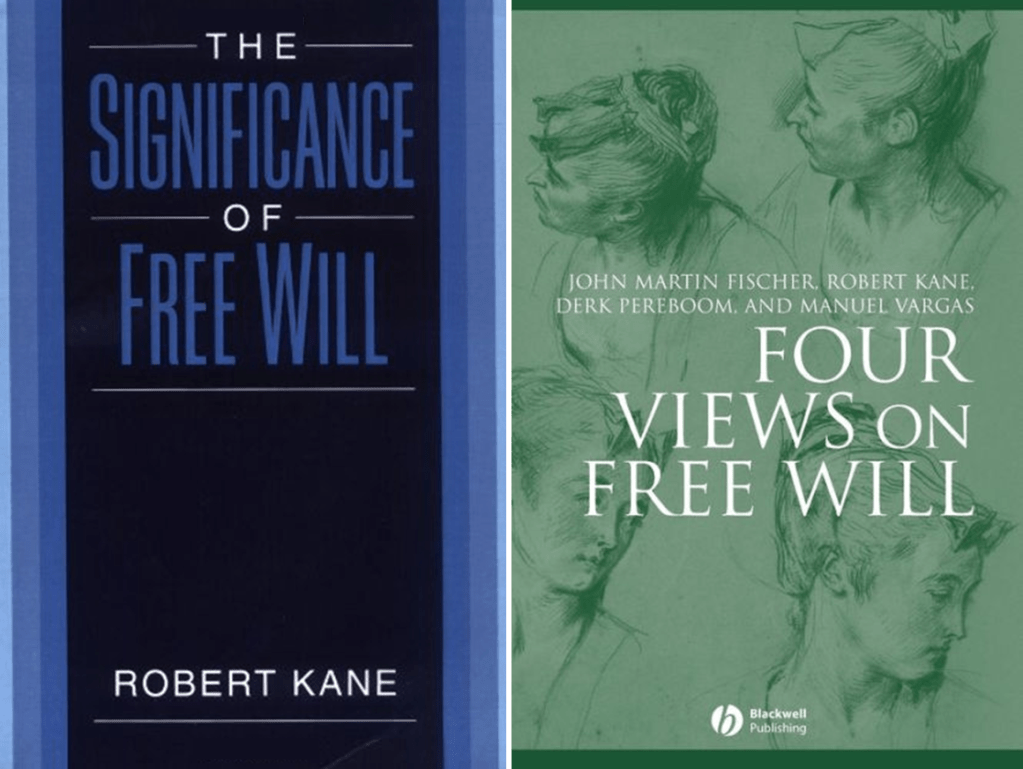
I’m two-thirds through Robert Kane’s initial chapter of Four Views on Free Will. He makes some good points. I am already familiar with his Libertarian position, but he dives deeper in his essay, which was my hope. He and the other three authors have time to present counterarguments to each other after all of the positions have been articulated.

As I expect to respond to each position, in turn, I won’t say much now, but I find I still disagree with Kane and for the same reasons I disagreed before I started reading.

Please stand by…

Cows Are Suey*

As I research the agency/free will quandary, I am finding a lot of common minds, as it were. On the free will versus determinism spectrum, I can’t say without reservation that I accept determinism or indeterminism, for that matter, but I can say that free will is weak tea. Causa Sui comes into play, but I’ll get to that.

Audio: NotebookLM podcast on this topic of Causa Sui.

As an aside, similar to the theism versus atheism debate, keep in mind that this debate hinges on free will taking the privileged position occupied by theism. When discussing compatibility versus incompatibilism, it’s whether determinism is compatible or incompatible with free will. I feel that the privilege of free will in this debate is telling insomuch as it reveals a bias on preferred perspective.

If you’ve been reading, I like what Derk Pereboom has to say, but I feel we have a bit of a gap in our accord. But I’m very partial to Galen Strawson’s line of argumentation that doesn’t rely on determinism to declare the free will argument pointless. I believe that there is space to fill in some gaps in his position regarding social responsibility, and maybe there are no gaps; I just am not yet familiar enough with his position. From a strictly deterministic position, I find Robert Sapolsky’s position appealing, but it still ends up being a pissing match. To be fair, I think any position will be a pissing match. I’ll elaborate on this next before I touch on causa sui.

Losing My Religion

In my book, free will is an anachronistic vestige of religion. Not to go too far down a Foucauldian path, religion is a power play. As religion constructs gods, it also constructs notions of free will. Power structures like to leverage these concepts for their own ends.

Interestingly, religion first gave us determinism—at least the Abrahamic monotheistic varieties—, but it needed to construct free will or it would have undermined its ability to cast blame and guilt. When science matured, it said, ‘Hey, hold on there. There’s no room for gods in physics. Everything has a cause and was determined at the start. Your intuition was right at the start. Free will is bollocks.’

Causa Sui

Finally. Causa Sui is the Latin name for a self-caused cause, one that is not the result of prior events. Here is where I really like Galen Strawson’s account. His argument is premised on 4 factors, the first of which is what you do flows from the way you are.

What you do flows from the way you are.

Galen Strawson

In essence, you’ve somehow got to get to be responsible for being the way you are, but you can’t you can’t get back behind yourself in such a way as to be responsible for the kind of person you are. You’ve got to somehow have chosen it, but you can’t choose it unless you already exist as a creature who has preferences.

No Causa Sui

You’d somehow have to get to be the cause of yourself to take fundamental ultimate responsibility for yourself and therefore for your actions that flow from the way you are and therefore free will—indeed more responsibility and free will, and therefore we do not have free will.

In the diagramme, we see you, and the influence of external forces, but at no point are you ever responsible for your own actions. Even if you did make a so-called conscious effort to do something else, it would still be the result of one of these other sources.

Perhaps an inapt example would be for a homosexual person to ‘decide‘ to be a heterosexual person. This is not to say just to act like a heterosexual person, but to actually be attracted to the opposite sex. It should be obvious that this can’t be done, but if you are having difficulty, imagine the mirror example where you are a heterosexual person and you ‘decide‘ to be attracted to people of your own sex. Of course, this is akin to deciding that you like cilantro when you don’t, deciding you like Justin Beiber when you don’t, or deciding that you don’t actually enjoy chateaubriand when you do. Even if you manage to act the opposite of your sexual orientation, it is still not you who is responsible for the apparent change. It’s a response to social forces and external conditioning. You are the way you are because of the way you are. You’ve had absolutely no say in the matter.

You are the way you are because of the way you are.

So what’s the big deal? you might still be asking yourself. If you’ve just done something morally or legally “wrong” —emphasised by big bold scare quotes, you need to be punished or at least blamed irrespective of how you became you, right? Let’s ignore that I am a moral non-cognitivist at the start and pretend that this moral indignation is otherwise meaningful.

Quarantine Justification Theory

Let’s say that someone has done something outside the bounds of social acceptance in some milieu. To make it even easier to consider, let’s imagine for a moment, instead, an autonomous robot that was designed to seek glass and smash it. This robot has no conscience and no free will. It is just a robot programmed to break windows.

This robot has been unleashed on our community. In one sense, some might blame the robot for breaking the windows, but we know that whoever programmed this robot is to blame. But we don’t know who programmed it. What we do know is that we want to stop the robot from breaking more windows.

So we track down the robot and we disable it—or perhaps it’s designed in such a way that it can’t be turned off. Even though the robot is not to blame, it is a menace and we’ve collectively decided to disarm it or quarantine it. We build a glassless room and sequester it away so it can do no more damage.

Some people find this scenario a reasonable justification to quarantine the actor, but I think that this has at least one problem, I’ll mention two considerations I have.

Not a Robot

So, let’s revisit quarantine justification theory with a human actor, and let’s presume no causa sui. As we can’t blame the robot actor, neither can we blame the person actor. As with the robot, the goal is not to punish but to quarantine.

Not to Blame

Now let’s add a dose of reality. This human is not on a window-breaking rampage. Instead, s/he vandalised the window of a shop for some reason; let’s say that s/he was short-changed and wanted to exact damage equal to the shorted change. A police officer witnesses the act and takes the perpetrator into custody. What should the judge do? Remember, the person did not create themself, but s/he did the act s/he was accused of.

The image below shows two scenarios. In scenario A, you are integrated with society; in scenario B, you are quarantined. The question is what is the justification for quarantining you.

Quarantine Justification Model

It’s difficult to argue that this person should be quarantined because this was a tit-for-tat response, not a rampage. It’s unlikely to happen again. One might try to argue that this person should be fined or, in line with quarantine, incarcerated to be made an example, thus acting as a scapegoat to serve as an external social pressure mechanism to disincentivise this retributive action. But this would ostensibly be punishing this person for something beyond their control.

We can even loosen the scenario to consider a person who has robbed a liquor store or kidnapped a child. These events are all too common, but there is nothing to suggest that a person will repeat this activity, so quarantine cum incarceration is hard to justify.

I can envision someone reading this thinking that we need to do something. We can’t let this person get away with it, but if you find yourself drifting in this direction, it’s your programming. You can’t help yourself. You don’t even have this degree of agency.

I haven’t given it enough thought, but it feels like this is similar to the dissonance when one grasps something intellectually, but instinctually or emotionally something just doesn’t sit right. Whilst you try to get outside of yourself, your programming doesn’t allow it.


* If you haven’t sussed it out quite yet, ‘cows are suey’ is how Google’s auto-generated transcript heard causa sui in an interview with Galen Strawson on this topic, and the rest is history.

Conspiracy Theory

This may end up being a shorter post, but in the realm of free will and agency, ask yourself about conspiracy theorists. Not a particular theory—or maybe some safe target like flat earthers. I think one would be hard-pressed to say that these people choose to believe this. They are convinced for whatever reasons. In principle, people who tend to believe in conspiracies have other determining factors—not the sort of ‘determined’ as Determinism suggests, but still beyond their conscious choices. We can agree with them or mock them, but they’ve got a predisposition toward these beliefs.

Social psychologists often argue that beliefs in conspiracy theories are connected with broader social and intergroup conflicts where conspiracy theories are used to justify and maintain conflict or to attribute blame to an unjust social system (Crocker et al., 1999). Other research has sought to explain the appeal of conspiracy theories by focusing on personality characteristics of conspiracy theorists. Among other factors, a sense of powerlessness and anomie—an inability to affect change and feelings of insignificance within society—have been found to correlate positively with high levels of beliefs in conspiracy theories (Hamsher et al., 1968Whitson and Galinsky, 2008Bruder et al., 2013).

Patrick J. Leman* and Marco Cinnirella, Beliefs in conspiracy theories and the need for cognitive closure, Department of Psychology, Royal Holloway, University of London, London, UK

Of course, people truly guilty of the conspiracy being accused tend to push the notion that their accusers are nutters, and this redirect tends to work on those not prone to conspiracies. This is problematic relative to getting to the facts of the matter, but for our purposes, yet again agency has been subverted.

“When people feel threatened and out of control, it’s natural to want to feel more control and bring order to the randomness by resorting to conspiracy theories,” says John Cook, PhD, founder of the website Skeptical Science and co-author of “The Conspiracy Theory Handbook.”

The Psychology Behind Conspiracy Theories

This is pretty much the same cognitive deficit behind the blaming that agency serves as an unwitting proxy.

Americans are a particularly gullible lot, with some 80 per cent of them believing in at least one unsubstantiated conspiracy theory. Of course, it could prove that at least one of these becomes substantiated. In fact, perhaps it already has. I don’t know if the United States government is particularly mendacious or if that is a conspiracy belief in its own right.

Ultimate Responsibility

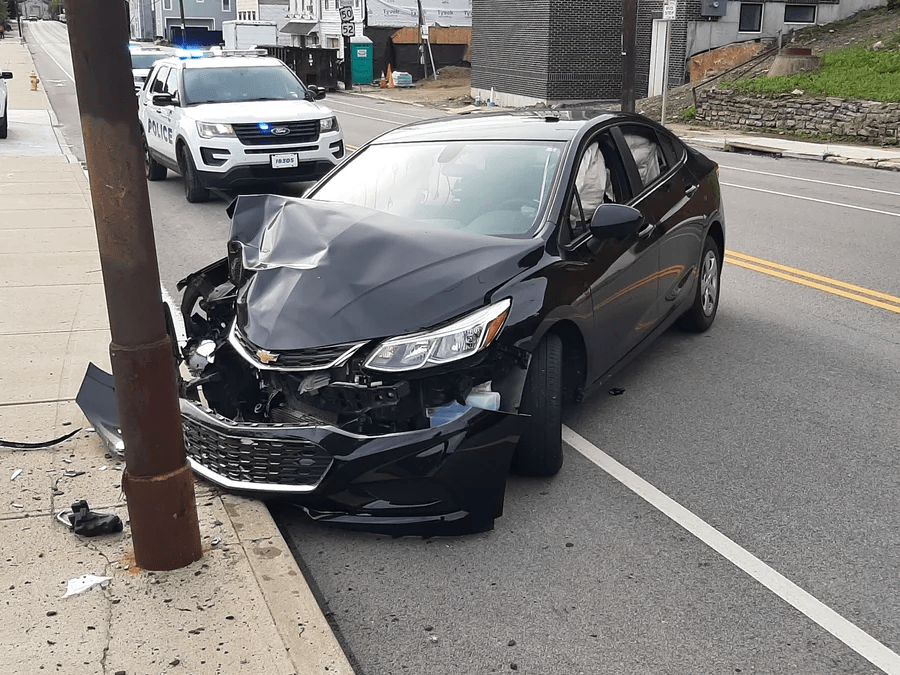
Robert Kane argues that ultimate responsibility (UR) should guide us in determining whether someone is responsible for their actions. He gives the example of a drunk driver who gets into an automobile accident. If the actor tries to skirt responsibility because s/he was intoxicated, hence incapacitated, then [1] we can still rewind to an action taken that caused this intoxicated state and then [2] choosing to drive—a causal relationship articulated by Aristotle. This seems fine, but it’s a specious defence.

According to Kane

According to Kane—noting an issue raised by some—, it doesn’t require an assessment that a person could have done otherwise. This condition has numerous implications for free will.

For example, it doesn’t require that we could have done otherwise for every act done of our own will. But it does require that we could have done otherwise with respect to some acts in our past life histories by which we formed our present characters. Kane calls these self-forming actions (SFAs). According to Kane, [3] we act from a will that’s already formed, but [4] it’s our own free will by virtue of the fact that [5] we formed it by other choices or actions in the past—self-forming actions—, [6] for which we could have done otherwise.

Consider the drunk driver. If this were not the case, there’s nothing we could have ever done differently in our entire lifetimes to make ourselves different than we are—a consequence that’s incompatible with our being, at least to some degree, ultimately responsible for what we are. And that’s what I think free will requires.

Kane’s Challenge

I marked passages in brackets [n], to serve as a reference for my commentary here. Some of my responses may be repetitive, so I’ll try to make any redundancies recursive.

[1] Kane suggests that even if the person is incapacitated at the time of the accident—hence not responsible in the moment—, we can trace events back through time and pinpoint an event that caused the incapacitation. In fact, we can trace it back to the decision to imbibe in the first place. I have two objections here, but I’ll defer the second one to my next reaction.

Kane says we can rewind to some causal event. We are in agreement on this point, but I have a question: why stop there?

In engineering, there exists a concept called root cause analysis, and there is a concomitant heuristic called the 5 Whys. Essentially, using the DUI example as a discussion point, we can refer to the accident as event T0. Then we can trace back.

For the sake of brevity, I’ll ignore trivial or immaterial events such as s/he encountered a detour and so took an unfamiliar route or s/he fell asleep at the wheel, missing a green light, which caused a delay, which meant that she was in a place to happen to hit another vehicle—presuming that if s/he had been a minute ahead of her fateful schedule, there would have been no other vehicle to hit. This might be a logical line of inquiry, but let’s shelf it.

So, tracing back, at T-1, we find our actor already intoxicated and starting the car. At T-2, we find our actor drinking the last of multiple rounds of alcohol. We could trace back all the way back to, say, T-5, where our actor made the decision to take the first drink.

We may have difficulty pinning down where the impairment kicked in. Was it the drink at event T-2 or was it earlier, say, ay T-4, where all subsequent drinks were not assessed rationally? In any case, even if we stop at the last lucid state, T-5, then everything that follows can be said to be related to that event. But I have a problem.

[2] Firstly, if s/he was mentally incapacitated, how could s/he make a rational decision to drive or not? Secondly, even if we say that s/he became mentally incapacitated at event T-4, then the decision at that juncture was not rationally deliberated.

We could introduce a twist here, which is to assign culpability to the drink server. Some local statutes exploit this by making the barkeep culpable for serving a drink to an already intoxicated patron. Of course, this has the same issue noted above because we can’t say with any reliability whether the actor was intoxicated at T-2 or T-4. Let’s not get mired in this. This is not my biggest concern.

My key concern is in stopping there at T-5. Why not go back to why s/he even had the first drink? Why not go back to why she drinks in the first place? Why not keep going back. More on this ahead. Let’s continue.

[3] Kane says that the actor, the decider, already has a formed will. In this, he is introducing another concept—one of the self or the individual. Let’s continue, and I’ll get to that, too.

[4] Echoing the self, Kane doubles down and says that this self has a will, and the actor owns it. As such s/he is responsible for these willed actions, these caused actions. So, let’s dig in.

[5] Kane asserts that we formed this self by other choices or actions in the past that he calls self-forming actions. This is where in my mind this skein of logic unwinds.

Ignoring whether the self is anything but narrative convenience, why should one accept that the actor has any agency in this so-called self-forming? What proof do we have that this actor is just a victim of circumstances—from geworfen until event T0? Even without invoking determinism, I think it’s safe to assume that this actor is a consequence of, at least, hereditary and (monomorphic and polymorphic) genetic traits including temperament. Then we have structural influences, such as family, peers, institutions, and authority figures, societies and cultural norms.

It might be difficult to determine what percentage of the self are formed by this, but it would be disingenuous to defend this as self-forming rather than formed by some crucible.

[6] Kane’s final point is about whether one might have done otherwise. He downplays this point, and so shall I. If someone insists that this is important, I’ll address it at that time.

Enfin

I left out some key points that I’ll likely return to in future. Essentially, Kane is a traditionalist who pines for virtue and character, two concepts I feel of figments intended to act as tools of power maintenance. I feel this will get us down a rabbit hole, and I am rabbitted out, so let’s end here.

Cicada-caused

Citizen Kane

Among my newfound acquaintances, I can now add Robert Kane. I have yet to read him directly, but I have on queue two publications:

I’ll probably read the Four Views on Free Will content first. Meantime, Derk Pereboom, who also contributed to Four Views, presents Kane’s position in a video, so I’ll illustrate Perebooms perspective as well as how my own thoughts might dovetail.

Meaning in Life & the Illusion of Free Will (Derk Pereboom)

…a lot of prominent advocates perhaps most notably Immanuel Kant didn’t think that he could show that we have libertarian freedom, but he did think that we should believe that we have it for the sake of morality…

The libertarian perspective is that we look at all causation in terms is events, and some people believe that all causation is by way of events so, in the case of agents, they can be the cause of events.

Freedom consists in the fact that when decisions are caused, they’re caused indeterministically by other events.

Pereboom coveying Kane’s libertarian concept of freedom

This is the idea of indeterministic causation. Not all causations in deterministic, but yet all causation is by way of events so events indeterministically cause decisions, and this is what allows them to be free.

Pereboom explaining indeterministic causation

Borrowing Pereboom’s rendition of Kane’s account, Anne is on her way to work, and she sees a woman being accosted.

Choices

At this moment, she has a choice of taking one of two possible options:

  1. Prudential Choice: Continue going to her office (desire to please her boss) [p = 50%]
  2. Moral Choice: Intervene in the molestation (desire to help the victim) [p = 50%]

Pereboom’s Critique

What settles whether Anne stops to help or continues to the office?

the agent can’t have enough control for freedom in the event-causal picture

Derk Pereboom

Whether she stops or not is not up to these agent-involving events to settle whether she stops or not; after all the agent involving events render the two decisions equally probable, fifty-fifty, in our simplified example. So the answer, Pereboom thinks, has to be nothing; there isn’t anything that settles which way the decision goes because the only causation involving the agent consists in events evolving the involving the agent. and by hypothesis, all the events involving the agent conspire to render each of the two possible decisions equally probable. So, Pereboom wants to say that in the event-causal picture nothing settles which decision occurs—and in particular, the agent doesn’t settle which of the decisions occurs,
so he believes that the agent can’t have enough control for freedom in the event-causal picture. There’s not any event-causal picture that solves this problem.

The problem with this event-causal libertarian view is that the agent disappears at the crucial time. We want the agent to settle which way the decision goes, but the event causal picture doesn’t allow this. So, we should reintroduce the agent in a different guise. And as agent—or as agent cause—we’re gonna say look not all causation is by way of events some causation is by way of agent, so as a substance not just as involved in events causes the decision. So, we’re going to give Anne, as agent-cause, the power to settle which way this decision goes; and we’re going to give her this power in the following guise: we’re going to say she’s got the power to settle which way the agent—which way the decision—goes. By what? By causing a decision; and by causing a decision without being causally determined to cause it. This is what Immanuel Kant calls transcendental freedom, and he thinks that this is the only kind of freedom that’s going to get us moral responsibility. It’s giving to the agent qua agent—not as involved in events but giving the agent qua agent—the power to cause an action without being causally determined to cause it. Now this is a very special sort of power.

Do we have this kind of power? Kant said, ‘Well, we have no evidence that we have this kind of power. We can’t even show that it’s possible that we have this kind of power, but we can show that it doesn’t contradict anything we believe, so we should believe it for moral reasons.’ He thought, It’s really important for us to believe that we’re morally responsible. And he also thought that the moral law kind of falls away unless we’re free in this sense. Kant thinks we have ample practical reason to believe that we’re agent-causes.

Pereboom (simplified), op. sit. ( cue @ 21:30 )

But there are certain kind of empirical worries that Kant was well aware of for the hypothesis that we’re agent-causes.

Kant says the physical world is governed by deterministic laws. So, suppose we believe that we as agents have this power of transcendental freedom— the power to cause an action without being causally determined to cause it. At some point there’s going to be an interaction between the agent as cause and the deterministic world—maybe at the juncture between the agent and the agent’s brain. Maybe you can think of agent-causes as non-physical things that can affect the physical world. Suppose we think of it that way. Kant says the physical world is governed by deterministic laws.

Suppose this free agent causes the decision to raise her hand without being causally determined to cause it. Kant says it has to be reconciled with the following fact that we know from Newtonian physics—the physical world is governed by deterministic laws. How can this be? It would seem that if the free agent freely, in Kant’s sense, causes the decision to raise their hand that the hand raising isn’t going to be causally determined. But Kant said that physics shows that the laws are deterministic and that all physical events are governed by deterministic laws.

Pereboom (simplified), op. sit.

One thing you can say is that it just so happens that every free decision ever made just happens to dovetail nicely with a determined physical world so each of the how many free decisions have been made in human history according to, say, 17 trillion. Each of the 17 trillion decisions happens to dovetail with the way that physical bodies have been causally determined since the beginning of the universe

Pereboom (simplified), op. sit.

Pereboom says this involves coincidences too wild to be believed. It’s not really credible. Kant at a certain point says well this problem can be solved because when an agent—a free agent—makes a decision, that free agent changes the universe back to the beginning of time. Kant says that in his The Critique of Practical Reason. I say that’s a pretty high price to pay for a belief in transcendental freedom. It seems implausible.

Quantum Physics

At 26:26 Pereboom turns his attention to indeterminism and quantum physics—the main premise being that quantum mechanics replaced the mechanistic certainty of determinism with probability.

If I don’t expand this copy past here, you’ll just have to watch the vid.

Next, I want to pick up on criminal punishment and retributive justification. Pereboom suggests that we can adopt a sort of quarantine approach to criminals even if we can’t assert that they deserve it, but I have serious concerns of the lack of justification here. (cued for me @ 30:15)

Wrong-doing, indignatio, and emotion. Emotion: Non-reactive. Problem with Love.

Where to Start?

At the beginning, of course. As I’ve embarked on this anti-agency (working title) endeavour, I am uncovering people and ideas previously unknown. In a way, this is good because people have been here before. In another way, I am left wondering what’s left unsaid.

For one thing, some of these people are highly credentialled scholars, more well-read with substantial head starts. And intelligent, qualified experts stake out their own respective turf. The more I read, the more I see the path has already been cut. Untamed areas still exist—at least for now. My goal from the start is to ignore the larger pseudo-problem anyway, so let them have their territory.

As I see it, my obstacle is one of rhetoric. My foundation is hardly a crowd-pleaser.

As I shared in my Agency Be Damned post,

  1. Humans have no material agency
  2. Power structures require the presumption of agency

Not too bad, but as I’ve shared even earlier,

  1. people are intellectually pretty unremarkable and
  2. predictably irrational

This isn’t going to be attractive to the warm and fuzzy crowd, and it comes across as a pretentious elitist and condescending irrespective of the validity of the observation. And people don’t like to be told that their baby is ugly—let alone themselves.

Ostensibly, my claim is that humans are veritable automatons too dim to be bounded to any moral code. We’re all just pawns, and any semblance of autonomy is either an illusion or not materially significant.

You are 0.00001% responsible for your actions,
so you deserve 100% of the blame or credit

You are 0.00001% responsible for your actions, so you deserve 100% of the blame or credit. Maybe this has no legs and will go nowhere. Time will tell. Meantime, I need to focus on the rhetoric and packaging and position it like a Trojan horse.

What Is Enlightenment?

I like David Guignion’s channel, and I’ve been taking in several perspectives on Kant’s article, ‘What is Enlightenment?

Feel free to watch from the start, but I’ve cued it to the place where David shares my thoughts around Agency. He brings up the point that absent official authority such as a political or religious structure, we are still influenced—subconsciously—to some degree by mass media and culture. These are the embodied norms and customs that most people just take for granted without question.

As David suggests, we can’t just slough off this inherited skin. First, because we do not even question it, and, two, it’s ingrained, one would likely deny the influence or be subject to escalating commitment under so-called critical inspection.

This is akin to asking a person of a certain religious persuasion if they would have the same religious beliefs if they had not been indoctrinated with them. I feel that a vast majority would defend their religion and the underlying or resultant morality as being obvious, so at the very least they are kept in the lane with guide rails. The extent of this influence and the degree it subtracts from autonomy is my question. I believe if pressed, the individual would defend the prescribed morality to be self-evident and they would have acted the same way even without religious instruction.

Two Maxims of Liberalism

The maxims are, first, that the individual is not accountable to society for his actions, in so far as these concern the interests of no person but himself.

Secondly, that for such actions as are prejudicial to the interests of others, the individual is accountable, and may be subjected either to social or to legal punishment, if society is of opinion that the one or the other is requisite for its protection.

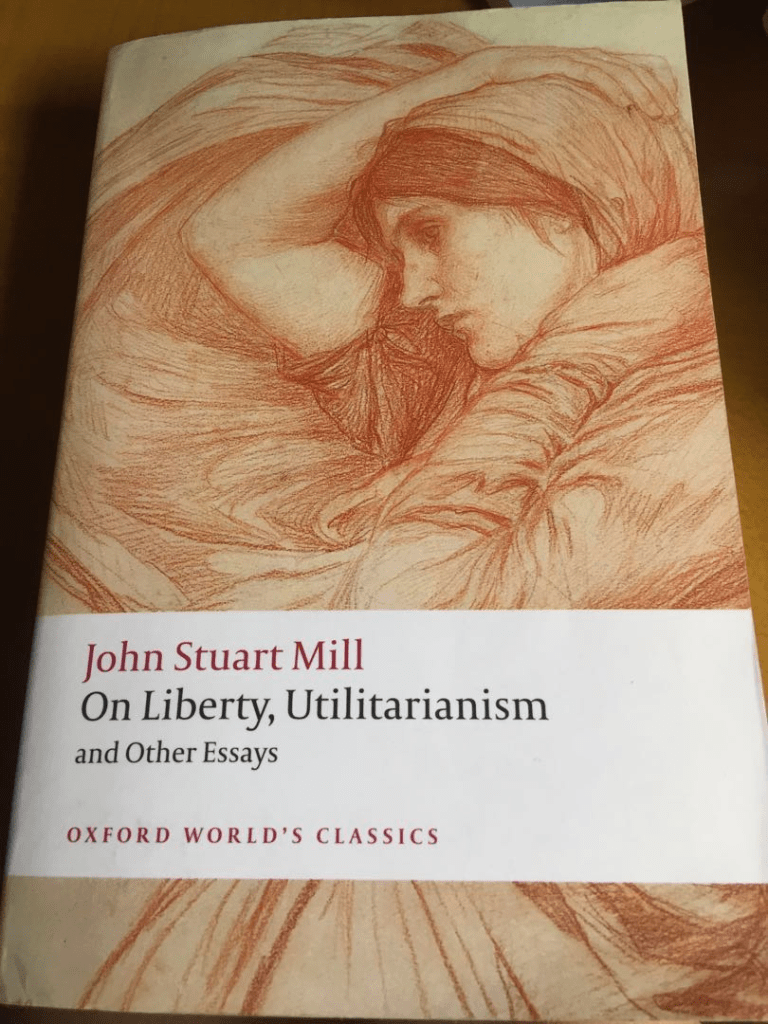
John Stuart Mill, On Liberty, Utilitarianism, and Other Essays (Oxford University Press, 2015, p. 91)
John Stuart Mill, On Liberty, Utilitarianism, and Other Essays (Oxford University Press, 2015)