Video: Causa Sui

This Causa Sui video has been a month in the making. To be fair, I took holiday for a week and a half, but it was still a lot of work. After some editorial commentary, the transcript is available below.

Commentary

The cows are back. Making videos on a budget is hard enough. With no budget, it’s harder still.

This started with a written transcript that was fed into Amazon’s Polly AI text-to-speech engine that’s seen many improvements lately. The results were output and saved as MP3 files that were imported into Movie Studio, a video editing application. I still use version 17, as I have been unhappy with the functionality of the newer versions. Even though they have been adding features and streamlining the interfaces, they seem to retire as many features as they add new ones, and the net result has not worked in my favour.

With an audio foundation in place, I scour the internet (and my hard drives) for visual content. Although I have purchased content in the past, this project contains all free assets. Admittedly, it would look better with paid-for assets as I forwent many nice visuals, it’s hard to justify on an unmonetised site.

Taking this approach, it’s a bit like patchwork with found objects. Having no creative team and possessing limited creative skills of my own, the original content is somewhat primitive. Even this could be improved, but that takes time.

I use a Bitmoji avatar to represent myself. This provides me with a quick way to capture poses and clothing options. When I feel like it, I’ll make small animations like eye blinks, but even this takes time.

I use Microsoft PowerPoint and Paint Shop Pro for image creation and editing. That’s pretty much it.

For this Causa Sui video, I feel it goes long in some areas and short in others. There are several points that I don;t resolve the way I expected, as I was distracted by other life events, and as I was compositing the final video, I noticed that I had started narrative treads and not closed them. In other cases, I had intended to focus intently on a point, and I just didn’t. But after all of the time—and this distracts from everything else I am trying to accomplish—, I just wanted to get this over the finish line. Perhaps I’ll create some shorter content to resolve these points.

In the end, I feel it still conveys the points I want to make, even if not as sharply. Give it a gander, and let me know what you think.

Transcription

In this segment of free will scepticism, we’ll discuss the causa sui argument of why a person cannot have the human agency necessary to be held ultimately responsible for their actions. We’ll also touch on counterarguments and possible social responses to persons exhibiting behaviours not in line with socially acceptable norms.

This is part of a series shining a light on the plausible scepticism if not impossibility of free will. If you are not already familiar with this space, I suggest you review some of the foundational content discussing Determinism, Indeterminism, and Luck; would-be agency and luck, and no-self, self, and selves. Of course, feel free to watch this and review the supporting content if you want to learn more details.
Let’s get started.

Before we define causa sui and the argument underlying it, it’s important to note that it is agnostic as to whether the universe is deterministic or indeterministic. My position is that the universe is at least weakly deterministic, even if we do not and cannot determine what the mechanism is. Any perceived indeterminism is simply an absence of knowledge. Were we to gain this knowledge, the indeterminate intermediate process would become determinate.

As the question of determinacy or indeterminacy is irrelevant, so is the question of compatibility or incompatibility. In an incompatible deterministic model, luck might be an interesting side trip, but my position isn’t concerned with luck and would fold it into determinism with the rest of indeterminacy.

Full disclosure: Humans are susceptible to pareidolia, and my contention is that free will is an illusion in this vein. I have adopted the position of Daniel Dennett that consciousness is an emergent property of the brain in a similar manner that wet is an emergent property of water. Water itself being an emergent property of the admixture of hydrogen and oxygen. This is not to argue that consciousness is somehow not real, but I do argue that consciousness has no mystical metaphysical properties that the discipline of psychology seems to subscribe to it. Consciousness is real. Free will is a figment.

So, what is causa sui, and what’s the big deal.

Spinosa may have been the philosopher to have introduced or at least elevated the notion of causa sui to us in its current context. Galen Strawson’s perspective is heavily influenced by Nietzsche. We’ll come back to both of these blokes presently.

Causa sui is Latin. It means self-caused.

Causa means cause. Sui means self. Most of us are aware of the notion of suicide—slaying one’s self. Let’s assume there is no etymological connexion to its homophone in chop suey, though I’m taking dibs on an erudite punk rock band name, Chop Sui.

Now that we’ve defined causa sui as self-caused—, or at least translated it from Latin to English, sa cause, en français—we can look at how this is problematic.

The causa sui argument against human agency and free will is not new. In his book Beyond Good and Evil, Nietzsche writes,

The CAUSA SUI is the best self-contradiction that has yet been conceived, it is a sort of logical violation and unnaturalness; but the extravagant pride of man has managed to entangle itself profoundly and frightfully with this very folly. The desire for “freedom of will” in the superlative, metaphysical sense, such as still holds sway, unfortunately, in the minds of the half-educated, the desire to bear the entire and ultimate responsibility for one’s actions oneself, and to absolve God, the world, ancestors, chance, and society therefrom, involves nothing less than to be precisely this CAUSA SUI, and, with more than Munchausen daring, to pull oneself up into existence by the hair, out of the slough of nothingness.

Freidrich Nietzsche, Beyond Good and Evil

Note that Nietzsche invokes God. Keep in mind that even if you believe in gods and divine intervention, that doesn’t yield human agency; that would be divine will.

Quickly reviewing the backstory, a self—or sui in this parlance—is the product of nature and nurture. Nature manifests in the form of heredity, genetics, and epigenetics; nurture is parents, peers, society, and authority.

As people like Steven Pinker and Jonathan Haidt tell us, we come into this world with the operating system installed and a basic bootstrap programme. After this, we are autodidactic automatons. Of course, Pinker and Haidt would posit that humans are more than mere meat puppets, but that’s part and parcel of the causa sui point.

Elaborating further on this, at time-zero, the moment we take our first breath, we have not yet taken in any direct experiences from which to expand our base genetics.
For the sake of illustration, let’s divide our universe into self and not-self. At the start our self has been given to us through no effort of our own. We’re the result of generations on generations of chromosomal exchange from some initial single-celled organism.

Then there’s nurture. One may argue that we have some experiences in utero, but these are substantially filtered. Once we see the light of the world, it’s showtime for real.

All that you touch
All that you see
All that you taste
All you feel.
— Eclipse, Dark Side of the Moon, Pink Floyd

Humans are input acquisition and storage machines. The brain is at once a difference and synthesis engine. Any outputs are a result of this process. Ostensibly, we are functions.

What humans are not are creation machines. Any so-called creation is just more synthesis. Even as we procreate to generate more humans, our dimorphism facilitates the progenerative blending of ova and spermatozoa. No creation, per se. In An Enquiry Concerning Human Understanding, Hume suggested that the idea of a unicorn was just a recomposition of the idea of a horse with that of a horn. That’s as far as human creativity goes.

The challenge with causa sui is that we cannot cause our ‘self’. Let’s explore some examples.

Let’s take as an example a successful physician. This physician was raised by someone, attended school, progressing to medical school, passed any necessary praxis, exams, and certifications, fulfilled whatever internships and residencies, and acquired some office space. Some years later, this physician bought a home, got a dog, and had some kids. I’ll stop here. You render your own mental picture.

Perhaps, instead, we look at a music virtuoso. A child prodigy, s/he attends Berklee and graduates before reaching 10 years of age. S/he starts YouTube, Insta, and TikTok channels with millions of followers, and earns millions. You take it from here. One more.

This last person is raised by a good family, but she ends up on the wrong side of the law and in prison. All friends say she’s kind, caring, and generous, but she was in the wrong place at the wrong time. At 20 she’s got a 20-year sentence to think it through. You can work this one through as well.

Let’s look into these scenarios and unpack these self-made individuals—or self-unmade if that’s how you’d prefer to characterise the last one.

Is our physician self-made? If so, how so? Let’s ignore the genetics and focus on the rest of the story. This person was sent to school. Local laws and parental concern all but ensured this. A certain teacher or teachers sparked an interest in medicine. Or perhaps it was from a book or television programme.

Perhaps a relative was ill and s/he became determined to help others.

This person was blessed with the appropriate cognitive abilities and their interest was fostered. The desire to succeed was instilled as was the drive and motivation. Nothing about this situation suggests causa sui action. Instead, everything is causa alii—caused by others, if I may misappropriate some Latin.

Any motivation was either genetically and physiologically inherent or acculturated or both. As the saying goes, you can’t get blood from a stone (or a turnip).

Of course, the second scenario plays out the same. Born with some natural ability. Could the parents not have nurtured this talent? Imagine this person was born with the propensity to be a virtuoso pianist yet never had come in contact with a piano? If a tree falls in the woods and no one was there to hear? How many people are in an analogous position?

Let’s turn to the dilemma of the prisoner. This person was instilled with whatever social cues she got. Perhaps they were exposed to bad influences. Perhaps their ‘processing unit’ is defective. Neither of these constitute causa sui events. As the saying goes, ‘she didn’t raise herself’.

Even if she did raise herself, she’d be excused as well. Some person raised by wolves in Avignon—or Tarzan of the Apes—is not expected to have acquired the rules of society.

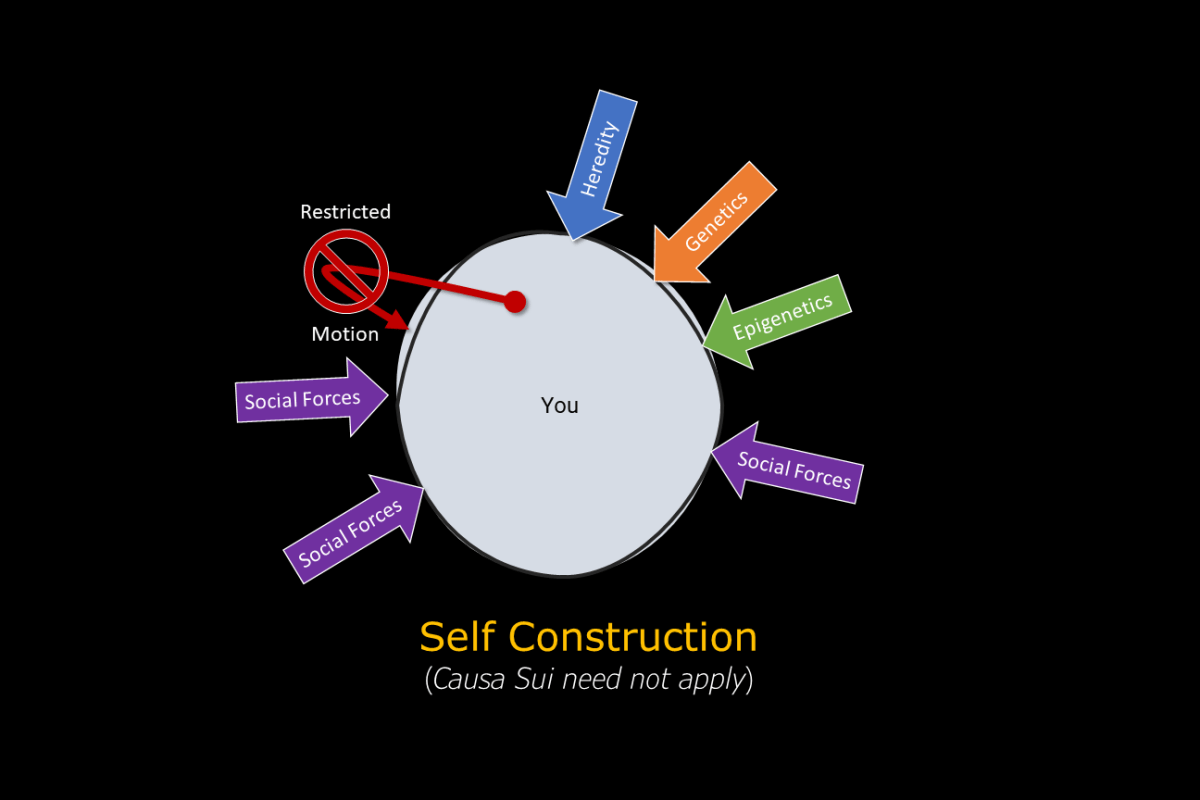
Here’s an illustration:

First, there’s ‘sui’. That’s you.

But before you, there are the reagents. Ingredients.

Heredity.

Genetics.

Epigenetics.

Stuff.

The building blocks that make your physical ‘you’. And perhaps there are pre-natal environmental factors such as nutrition.

Once you are born, you begin to become a product of your environment as you absorb external forces. These might be the influence of your parents or siblings or other kit and kin.

Then you are exposed to teachers and peers. And society at large. And then there are perspectives formed by authority relationships.

We don’t even need to discuss the possible complexities and interactions between nature and nurture. These are interactive.

Perhaps you were genetically predisposed to grow no more than 168 centimetres, but you had poor nourishment, so this limit was never fully realised. Perhaps you have a blemish that makes you self-conscious. Perhaps, you’ve got a lisp or a limp. Perhaps you were in hospital due to an accident, and you lost a year at primary school. Perhaps a parent abandoned you and you were raised in a single-parent household. Perhaps as an infant both of your parents were killed by gunfire whilst watching an Independence Day parade in Highland Park Illinois in the United States of America.

Any of this might be true. But something that cannot be true is that you had any say in any of this. Causa sui. You cannot be a cause of yourself.

How did you become a virtuoso pianist?

Were you genetically predispositioned to have this talent? Probably. What if you weren’t driven to play? Again, what if you had never been introduced to piano but has this otherwise latent talent?
Let’s say you are faced with a food choice for dinner. You’ve got pork chops, dog, or monkey brains. Personally, I’d forego all of these. If I were from some Asian countries, I may have a tough time deciding but only because they all seem delicious.

In economics, we discuss diminishing marginal utility for preferences. Faced with a choice, my preferences may differ depending on the situation. But given a situation where one has to make a choice repeatedly, each subsequent choice yields less utility or ‘happiness’.

You’re at a pub, and you mention that you’re a bit peckish. Your mate orders a pizza and offers you some slices. You haven’t eaten pizza in a while, so perhaps you eat a slice and are offered another when it’s gone. Your utility diminishes with each slice. The first one really hit the spot. The second one was pretty good too. You think twice about eating a third piece. And you forego the fourth piece altogether.
Later in the evening, your mate with the hollow legs orders another pizza and offers to split it. You’re ever so slightly hungry, but you opt for pudding instead. This is your choice. But it’s not. It’s just that you’ve just eaten your fill of pizza and want something different.

Now the question is can you go against a craving? You are on a diet and are offered some dessert. You are craving it, but you exercise your free will and decline. Surely, this is free will, right? Not really. If you go for the dessert, your body is willing your action. But if you decline, it’s only because you have information that counters your craving. You need to look thin in a swimming suit at the weekend. Your choice will be guided by your assessment of prior and prospective considerations. You cannot make a choice absent these. Even if you decide to pick randomly or flip a coin. Firstly, the choice to flip is based on prior information. Secondly, the resultant choice is due to the coin rather than your free will.

Let’s summon Schopenhauer for a moment. He reminds us that whilst we can want what we will, we can’t will what we will.

This craving is not us. We aren’t in control. We only have control over whether we submit to the urge or not.

But that’s not correct either.

Picture this. You are at an ice cream vendor.

Chocolate or Vanilla

You always get chocolate, so you order chocolate. This is habit, not choice.

The vendor remembers they just got a shipment of passionfruit ice cream. Would you prefer that?
It depends, but it doesn’t depend on you, save to say it depends on your experiences until now.
If you’ve never had it before, it depends on your palate and whether you are open to new experiences. This is not something you have control over.

Let’s say your mates invite you to go skydiving. Again, you may seemingly be faced with a choice between declining the invitation and disappointing your mates. Whichever emotional response is stronger will guide your decision. This is based on experience. And this is important: even if you overrule your initial consideration, it’s because of the way you are that you are able to do that, but you had no say in the way you are. Each experience either leads you to a new experience or you experience something new and either like or dislike it.

Perhaps reading a certain book led you to enjoy reading. Given the decision to watch television or read, you may prefer to read. Some people do not enjoy reading, so given the choice, they’ll switch on the telly.

Galen Strawson formalised this by relating his so-called basic argument.

  1. You do what you do, in any given situation, because of the way you are.
  2. So in order to be ultimately responsible for what you do, you have to be ultimately responsible for the way you are—at least in certain crucial mental respects.
  3. But you cannot be ultimately responsible for the way you are in any respect at all.
  4. So you cannot be ultimately responsible for what you do.

What this is saying is that anything about you already influences what you do next and your choices. So, you as an entity may do something, engage in an activity, but it’s only because you’ve been programmed to do so on hardware you had no say in receiving.

To equate humans to computers is a little facile, but for our purposes, we can think of humans as analogous to processors or a mathematical function.

We are hardware with an onboard self-updating operating system. And we have software routines, all processed in our brains. In addition to capturing, processing, and storing data, this operating system and some of its software are also updated with experience, so we are getting updates and upgrades. Each of these might affect our next decision.

Sometimes input devices are faulty. Perhaps we are blind or colourblind. Perhaps we can’t hear or taste or smell. Each of these will affect in some manner what information we have to process.

In some cases, the processing unit itself is broken. With synaesthesia, we may see sounds, or smell colours.

But we may also just not process things correctly. Perhaps we can’t interpret social cues. Perhaps we can’t remember things. Or we have some other cognitive deficits. In these cases, we may have actually been exposed to socially accepted behaviours—don’t steal; don’t harm; obey traffic regulations, or whatever—, but we have difficulty processing these when the time comes. Or maybe our induction and deduction skills are diminished.

But my intent is not to make this about mental illness. The point is that persons considered to have full mental capacity and competency still have no ability to get outside of themselves to influence themselves. Full stop.

You may want to check out the video on agency that addresses what options society has in light of this situation. Keep in mind that I am not saying that you are stuck on a fateful path. We are not Oedipus.
If you had not been exposed to the rules, then rehabilitation may be in order. If you may be a danger to yourself or the public, you may be sequestered or quarantined until such time you are no longer a risk. This introduces its own quandaries relating to retributive justice and challenges in policing the watchers, but these are beyond the scope of this segment.

The only escape from the idea of each human being the result of a closed system of nature and nurture is the notion of emergence that would say that the admixture of these ingredients would result in something new, that perhaps consciousness contains a sui somehow transcendent of the source elements, and this is where your human agency resides—sort of an emergent soul if you will. In the world of chemistry, the combination of sodium and chloride brings about table salt, having different emergent properties than the base ingredients, yet none of these properties is consciousness nor agency. Does this emergence work differently in the brain? This doesn’t sound plausible, but it is an idea to explore if you really feel compelled to argue agency exists in some form or fashion.

So, there you have it. You are you, but you don’t have any inherent agency. Or do you? Do you think there is any place for ‘sui’ to exist autonomously from your genetic and environmental makeup? If so, where is it, and how does it gain its independence.

Nota Bene

The causa sui cows. I had intended to work the cows into the video. In fact, I spend a decent amount of time trying to clean them up, but as I left on holiday and returned, I realised near the end that they got left on the cutting room floor—even though they are still used as cover art. Perhaps I’ll consider a feature-length production for these characters in future.
Against Moral Responsibility

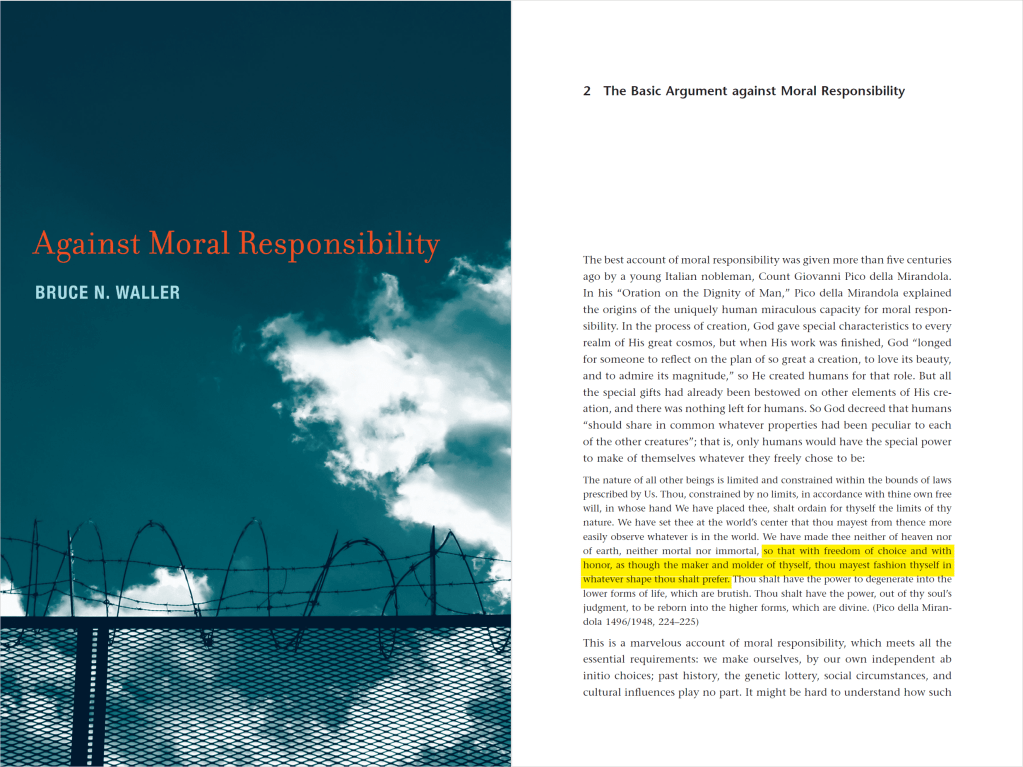
We have made thee neither of heaven nor of earth, neither mortal nor immortal, so that with freedom of choice and with honor, as though the maker and molder of thyself, thou mayest fashion thyself in whatever shape thou shalt prefer.

Bruce Waller
Bruce Waller, Against Moral Responsibility

Nothing really to add here now, but more on the way. Meantine, sharing this for reference.

Can We Just Stop Talking About Free Will

The problem with free will is that we keep dwelling on it. Really, this has to stop.

— Owen D. Jones, The End of (Discussing) Free Will, 18 March 2012

This quote was made by Owen Jones in an article published in 2012. I share it because I feel the author is not only being cavalier but wrongly so. According to the bio at the end of the article, Owen D. Jones is a professor of law and biological sciences at Vanderbilt University. As I see it, the problem is not some theoretical—What is the sound of one hand clapping?—pseudo-problem. Human agency is the basis of our legal and jurisprudence systems.

Like good magicians, people like Owen want to redirect your focus to neuroscience and consciousness rather than have to explain how the causal engine that is the brain manifests itself ex nihilo.

Doubling down on my causa sui position, humans may be able to make constrained solutions, and yet they never have control over the constrained system they inherit. I discuss this at length elsewhere, but I wanted to address this comment forthright.

I’ll leave with a quote I tend to trot out a lot.

It is difficult to get a man to understand something when his salary depends on his not understanding it.

— Upton Sinclair, prepared speech, I, Candidate for Governor (1935)

Free will is a necessary illusion for power structures to propagate or they will lose a cornerstone of their control mechanisms. And since humans want to feel they are in control, they are willing to accept the downside for the illusion of an upside.

Motility, Automotion, and Agency

I just wrapped up chapter eleven of The Righteous Mind by Jonathan Haidt. I’ve got only 35 pages to go to get through chapter twelve. I’ve been tempted to stop reading. Chapter eleven—and I am tempted to inject a bankruptcy pun here—has been more frustrating than the rest thus far. And yet I am glad to have persisted.

My intellectual focus these past months has been on agency. Et voilĂ , paydirt. Chapter eleven’s title reveals the context: Religion is a Team Sport. Let’s walk through this garden together.

A goal of Haidt is to educate the reader on his third principle of moral psychology: Morality binds and blinds. He establishes parallels between sports and religion. And here’s the thing—I don’t disagree. But here’s the other thing—I feel that are equally vapid—, with no apologies to sports fans or the religious. Let’s keep moving.

“A college football game is a superb analogy for religion.”

Jonathan Haidt, The Righteous Mind, Chapter 12: Religion is a Team Sport

He talks about the organising and unifying functions of both. But here’s the thing. It unifies the like-minded. Haidt claims to be irreligious and not be into sports, and yet he cites these as somehow desirable. I find him to be an apologist for religion.

I am not a psychologist, but if I were, I’d be tempted to claim that Haidt’s conclusions follow from his personal beliefs. He believes in morals, society, order, intuition, and institutions. He is a textbook Modern and an extrovert to boot. I think he also falls into teleological fallacy traps. Was that a play on words?

His goal is to fuse the positions of Darwin and Durheim. Along the way, he reminds us of the New Atheists, their publications, and their positions: Sam Harris’ The End of Faith: Religion, Terror, and the Future of Reason; Richard Dawkins’s The God Delusion; Daniel Dennett’s Breaking the Spell: Religion as a Natural Phenomenon; and Christopher Hitchens’s God Is Not Great: How Religion Poisons Everything.

Although he views religion through rose-coloured glasses, he comes to the conclusion that religions have done a great deal of harm over the millennia, but the good outweighs the bad, especially if you consider it through a social-moral lens. But if religion creates in-groups versus out-groups, which they do, and religious in-groups outlive even non-religious ingroups, then this is a winning option. But what if you don’t like that option?

Personally, I am a collectivist, but this is not willy-nilly any collective.

Haidt contrasts the New Atheist vantage that religious belief is an evolutionary byproduct versus a position that what started as a byproduct evolved into group selection and then, perhaps, an epigenetic phenomenon.

Here’s my contention:

Borrowing from New Atheism, Haidt adopts the notion of a “hypersensitive agency detection device [that] is finely tuned to maximize survival, not accuracy”.

The first step in the New Atheist story—one that I won’t challenge—is the hypersensitive agency detection device. The idea makes a lot of sense: we see faces in the clouds, but never clouds in faces, because we have special cognitive modules for face detection. The face detector is on a hair trigger, and it makes almost all of its mistakes in one direction—false positives (seeing a face when no real face is present, e.g., ), rather than false negatives (failing to see a face that is really present). Similarly, most animals confront the challenge of distinguishing events that are caused by the presence of another animal (an agent that can move under its own power) from those that are caused by the wind, or a pinecone falling, or anything else that lacks agency.

The solution to this challenge is an agency detection module, and like the face detector, it’s on a hair trigger. It makes almost all of its mistakes in one direction—false positives (detecting an agent when none is present), rather than false negatives (failing to detect the presence of a real agent). If you want to see the hypersensitive agency detector in action, just slide your fist around under a blanket, within sight of a puppy or a kitten. If you want to know why it’s on a hair trigger, just think about which kind of error would be more costly the next time you are walking alone at night in the deep forest or a dark alley. The hypersensitive agency detection device is finely tuned to maximize survival, not accuracy.

Op Cit, p. 292

I fully agree with the assertion that the brain values fitness over truth, and I’ve commented in several posts that pareidolia and apophenia create false-positive interpretations of reality.

But now suppose that early humans, equipped with a hypersensitive agency detector, a new ability to engage in shared intentionality, and a love of stories, begin to talk about their many misperceptions. Suppose they begin attributing agency to the weather. (Thunder and lightning sure make it seem as though somebody up in the sky is angry at us.) Suppose a group of humans begins jointly creating a pantheon of invisible agents who cause the weather, and other assorted cases of good or bad fortune. Voilà—the birth of supernatural agents, not as an adaptation for anything but as a by-product of a cognitive module that is otherwise highly adaptive.

Op Cit, p. 293

For me, this supports my contention that agency is a wholly constructed fiction. The same agency we ascribe to unknown natural events, we ascribe to ourselves. And perhaps this ability served an egoistic function, which was then generalised to the larger world we inhabit.

I have an issue with his teleological bias. He feels that because we have evolved a certain way to date; this will serve as a platform for the next level as it were. I’ll counter with a statement I often repeat: It is possible to have adapted in a way that we have been forced into an evolutionary dead end. Historically, it’s been said that 99 per cent of species that ever occupied this earth are no longer extant. That’s a lot of evolutionary dead ends. I am aware that few species could have survived an asteroid strike or extended Ice Ages, but these large-scale extinction events are not the only terminal points for no longer extant species.

So finally, Haidt essentially says that it doesn’t matter that these religious and cultural narratives are wholly fictitious, if they promote group survival, we should adopt them. This seems to elevate the society over the individual, which is fine, but perhaps the larger world would be better off still without the cancer? Just because it can survive—like some virulent strain—doesn’t mean we should keep it.

Finally, given these fictions, what’s a logical reasonable person to do? I don’t buy into ‘this country is superior to that country’ or ‘this religion is better than that religion’ or even ‘this sports team is better than that’ or ‘this company is better than that’.

Haidt does idolise Jeremy Bentham, but this is more Pollyannaism. It sounds good on paper, but as an economist, I’ll reveal that it doesn’t work in the real world. No one can effectively dimensionalise and define ‘good’, and it’s a moving target at that.

No thank you, Jonathan. I don’t want to buy what you are selling.

News Flash: From the time I started this content, I’ve since read the final chapter. Where I categorically reject a lot of what Haidt proposes in this chapter, I tend to find chapter twelve to fit more amicably with my worldview. Perhaps I’ll share my thoughts on that next.

If you’ve reached this far, apologies for the disjointed presentment. I completed this over the course of a day through workaday interruptions and distractions. I wish I had an editor who could assert some continuity, but I am on to the next thing, so…

Bonus: I happened upon this journal article, and it somehow ended up here. I haven’t even read it yet, so I’ve got no commentary. Perhaps someday.

Rai, T. S., and A. P. Fiske. 2011. “Moral Psychology Is Relationship Regulation: Moral Motives
for Unity, Hierarchy, Equality, and Proportionality.” Psychological Review 118:57–75

Cover art source

Quarantine and Social Justice

Gregg Caruso is interested in the notion of Agency from the perspective of justice, desert, and sentencing. This is applied philosophy.

My main argument against the possibility of free will is Nietzsche-Strawson’s causa sui argument, which I’ve touched on a few times by now, but I haven’t yet fully articulated my position. I’ll get to that another day. I’d also like to create another video, as I would like to do for this as I explore in more detail.

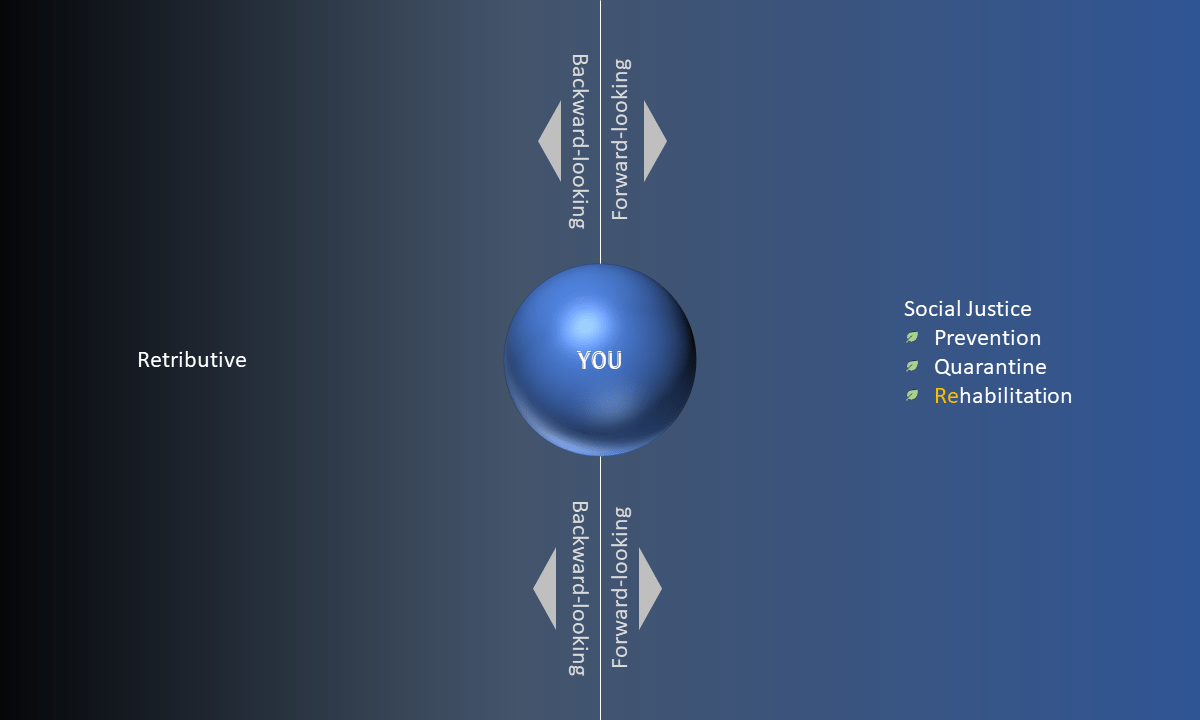
Ostensibly, this is a compatibilist view that leaves a modicum of free will, even with causa sui in place. I hope this illustration will be helpful.

In the centre of the illustration is you, the self of some arbitrary person who shall act as our subject. Let’s assume a couple of basic premises:

  1. We either live in a relaxed causal, deterministic or indeterministic universe.
  2. Causa sui is in full force and effect: one cannot cause any aspect of one’s self.

I include the term relaxed in the first premise, so I don’t have to deal with a fully deterministic universe governed entirely by the notion captured by SchrĂśdinger’s equation. The second premise is in place to serve as a limitation: even if consciousness is an emergent property, its emergence doesn’t grant some insuperable metaphysical powers. One cannot reach outside of one’s self.

The scenario plays out as follows. You have been apprehended for violating some statute. Let’s say that you’ve taken an item from a retail store. As you are leaving the store, the police stop you. When asked if you took the item, you answer in the affirmative. This is a very efficient municipality, so you are taken immediately to a magistrate to make a plea.

In this scenario, Caruso is your attorney at law. His argument is that, given causa sui, you cannot be responsible for who you are. We’ve been here before. Since you can’t be responsible for who you are, any sentence to punish you would be unethical, as you’ve done nothing to deserve it. This is the notion of desert in the realm of retributive justice.

The judge buys this argument, but s/he counters with three possible courses of action. You may not be responsible for who you are, but we are a community of laws. You are a victim of your circumstances, so we cannot look backwards. For whatever reason—and through no fault of your own, by definition—, you were broken relative to complying with community norms.

Social Justice

Firstly, we may wish to make an example of you, to signal the community that we will incarcerate people who break the laws. This is more a public service purpose than a punishment.

Secondly, if you had contracted a communicable disease—we’re looking at you Covid—, you can be quarantined under the consideration of the common good. Framed this way, it is not a punishment, we just don’t want it to happen again.

Lastly, we may also be justified on the grounds of rehabilitation. I highlight the ‘re‘ in rehabilitation because some people may not have been ‘habilitated’ in the first place. Perhaps think of them as feral. In any case, a computer programming analogy might make sense here.

So what’s this all about? Remember, causa sui says that you cannot be held responsible for creating yourself. The claim is that you are a product of your nature and nurture. Genetically speaking, perhaps there was some reason that you could not incorporate inputs into factors that allowed you to appropriately interpret this law—or any law, more generally. Or maybe, you were never exposed to this law or category of law before.

In the preventative vein, we could be signalling, ‘We caught You taking an item from a shop without paying. Now you know this, and we may make an example of you since you are caught as well’.

Quarantine may be a bit of a stretch in this scenario, so feel free to substitute a more serious offence if it helps you to remember this. Perhaps You killed someone. Even without punishment, we may want to get You off the streets before another killing is perpetrated. I’ll come back to this one.

Rehabilitation makes sense even if one is not responsible for one’s self. Presuming that you are a product of programming—family, culture, peers, and so on—, perhaps you just need to be rewired. Perhaps a particular subroutine was not implemented or activated correctly. This rationality could be used as a non-punitive justification.

Counterarguments

The public prevention case may be why offenders were pilloried in by-gone days. Display in a public square may inform some who may have missed the lesson the first time around, hence dissuading taking similar actions. But unless this ‘public service message’ reached enough people, it would probably not be the best rationale.

Quarantine may sound OK on the surface, but it’s actually rather specious. Firstly, that You knicked a trinket. What exactly is the risk of contagion? Petty theft is not known to be particularly communicable. Secondly, just because you’ve done something once is little measure of whether you’ll do it again. In fact, if this were true, then one might have assumed that you could never have committed the offence because of your history.

Rehabilitation may likely be the best option among these. If you missed that particular lesson or had forgotten or diminished the calculus, remediation may do just the trick. However, if your ‘operating system’ is not up to snuff, it’s not a matter of inputs. It’s a matter of processing capability.

Psychological intervention is in its infancy, so the probability of remediating this is low, if not a crap shoot. And not all such processes can be remediated. This could lead one to fall back on the quarantine option, but who is the competent assessor in this case?

It’s easy enough to assess if You is Hannibal Lecter or tells you straight out that s/he intends to repeat the offence. Some cognitive deficiencies are simple enough to recognise. But what about the grey areas—all of that space in between?

And who is making sure that the judges are not being punitive simply because they haven’t yet eaten lunch?

Enfin

Bringing this to a close, if we have no free will, it makes no sense to punish. Sadly, most justice systems promote retributive justice and punishment in sentencing. I’ll spare you my diatribe on how I believe most people attracted to jurisprudence, law, and law enforcement have been conditioned. And whilst Caruso feels justified in foreword action, I am more sceptical. This said, I’ll take what I can get.

This post is pretty much a stream of consciousness. I hope to give it better treatment in a future video.

Physics of Free Will

Physicist, Sean Carroll, gives Robert Lawrence Kuhn his take on free will. I was notified about this when it was posted, and given the topical subject matter, I took the 8-odd minutes to listen to it straight away.

I wish I had been there to pose a follow-up question because, although he provided a nice answer, I feel there was more meat on the table.

Like me, Sean is a Determinist who feels that the question of determinism versus indeterminism is beside the point, so we’ve got that in common. Where I feel we may diverge is that I am an incompatibilist and Sean is a compatibilist. I could be interpreting his position wrong, which is what the follow-up question would be.

I say that Sean is a compatibilist because he puts forth the standard emergence argument, but that’s where my confusion starts. Just to set up my position for those who don’t prefer to watch the short clip, as a physicist, Sean believes that the laws of physics, SchrĂśdinger’s equation in particular.

We have an absolutely good equation that tells us what’s going to happen there’s no room for anything that is changing the predictions of SchrĂśdinger’s equation.

— Sean Carroll
SchrĂśdinger’s Equation

This equation articulates everything that will occur in the future and fully accounts for quantum theory. Some have argued that quantum theory tosses a spanner into the works of Determinism and leaves us in an Indeterministic universe, but Sean explains that this is not the case. Any so-called probability or indeterminacy is captured by this equation. There is no explanatory power of anything outside of this equation—no souls, no spirits, and no hocus pocus. So far, so good.

But Sean doesn’t stop talking. He then sets up an analogy in the domain of thermodynamics and statistical mechanics and the ‘fundamental theory of atoms and molecules bumping into each other and [the] emergent theory of temperature and pressure and viscosity‘. I’ve explained emergence in terms of adding two hydrogen and one oxygen atom to create water, which is an emergent molecule with emergent properties of wetness.

My position is that one can view the atomic collection of matter at a moment as an emergent property and give it a name to facilitate conversation. In this case, the label we are applying is free will. But there is a difference between labelling this collection “free will” as having an analogous function to what we mean by free will. That’s a logical leap I am not ready to take. Others have equated this same emergence to producing consciousness, which is of course a precursor to free will in any case.

Perhaps the argument would be that since one now has emergent consciousness—I am not saying that I accept this argument—that one can now accept free will, agency, and responsibility. I don’t believe that there is anything more than rhetoric to prove or disprove this point. As Sean says, this is not an illusion, per se, but it is a construction. I just think that Sean gives it more weight than I am willing to.

No Agent, No Agency

There is no spoon” is a classic line from The Matrix. Reality is a construct. I agree, but I’m not sure I believe that we can get under this reality to experience it differently. And this might hinge on a distinction between experience and perception.

Losing Ourselves is a book just published in the US and forthcoming (July 2022) in the UK promoting the Buddhist notion of no-self or selflessness. I’ve been partial to Buddhism since, when I lived outside of Tokyo, I was exposed to it in 1980.

Book Cover: Losing Ourselves

For me, this intersects with my anti-Agency endeavour. If the Self is a construct, there is no Agent, and without an agent, there is no Agency. I realise that this is a meta-position and not uncontroversial, but I do like to collect ideas and perspectives in my quiver.

Obviously, there seems to be a strong drive (at least in the West) to construct selves, not the least of which serves the purpose of an object to confer praise or blame. Interestingly, I’ve heard much about objectification, but not many seem to care about this form. It’s more about sub-objectification.

It’s OK to parse the person from the fabric of the universe, but don’t further disintegrate that person.

Moral Responsibility

Can we be held morally responsible for our actions? Yes, says Daniel Dennett. No, says Gregg Caruso. Reader, you decide

Aeon Article, 4 October 2018

Caruso: [Dan,] you have famously argued that freedom evolves and that humans, alone among the animals, have evolved minds that give us free will and moral responsibility. I, on the other hand, have argued that what we do and the way we are is ultimately the result of factors beyond our control, and that because of this we are never morally responsible for our actions, in a particular but pervasive sense – the sense that would make us truly deserving of blame and praise, punishment and reward. While these two views appear to be at odds with each other, one of the things I would like to explore in this conversation is how far apart we actually are. I suspect that we may have more in common than some think – but I could be wrong. To begin, can you explain what you mean by ‘free will’ and why you think humans alone have it?

Gregg Caruso

Dennett: A key word in understanding our differences is ‘control’. [Gregg,] you say ‘the way we are is ultimately the result of factors beyond our control’ and that is true of only those unfortunates who have not been able to become autonomous agents during their childhood upbringing. There really are people, with mental disabilities, who are not able to control themselves, but normal people can manage under all but the most extreme circumstances, and this difference is both morally important and obvious, once you divorce the idea of control from the idea of causation. Your past does not control you; for it to control you, it would have to be able to monitor feedback about your behaviour and adjust its interventions – which is nonsense.

In fact, if your past is roughly normal, it contains the causal chains that turned you into an autonomous, self-controlling agent. Lucky you. You weren’t responsible for becoming an autonomous agent, but since you are one, it is entirely appropriate for the rest of us to hold you responsible for your deeds under all but the most dire circumstances. 

Daniel Dennett

if your past is roughly normal, it contains the causal chains that turned you into an autonomous, self-controlling agent

Dan Dennett

So commences this debate. The argument unfolds largely on semantic grounds. Even here, one can see the debate over the distinction between control and causation. I understand what Dennett is attempting to parse here, but I object on the grounds of causa sui.

I recommend reading the Aeon article as there is much more than this distinction, but it does remain a semantic issue. I started a post on backwards- and forward-looking perspectives, that better articulate Caruso’s perspective, but I am also working on other things. This was quicker to post and I wanted to keep a bookmark anyway, so it’s a win-win.

Agency Is Dead

Agency is going through the same fits as religion. When Nietzsche regarded society around him at the time, he declared that God is dead and asked now what? This is precisely the same challenge in different clothes.

Preserving “law and order” without a concept of real responsibility is a daunting task.

Dan Dennett

Without a God to use as a bully pulpit and mechanism of fear, how could we keep people in line in cohesive societies? Without the notion of human agency to allow for responsibility and blame, how can we keep people in line in cohesive societies? Only the predicate has changed, but the question remains, do we persist in lying for the so-called greater good? This is similar to the Santa Claus myth to keep young children in line.

If nobody is responsible, not really, then not only should the prisons be emptied, but no contract is valid, mortgages should be abolished, and we can never hold anybody to account for anything they do.  Preserving “law and order” without a concept of real responsibility is a daunting task.

—Dan Dennett, “Reflections on Free Will” (naturalism.org)

One might like to think that lying is psychologically pathological, but it seems to be a significant part of the human condition. The fundamental question doesn’t appear to be ‘should I tell the truth’, but rather ‘Can I get away with lying?’ Despite all the talk of Truth and integrity, this seems to be the default state of humans. This renders integrity just another lie. But you knew that already, but let’s not fall into another Foucauldian rabbit hole.

We no longer have any sympathy today with the concept of ‘free will’: we know only too well what is is — the most infamous of all the arts of the theologian for making mankind ‘accountable’. . . Everywhere accountability is sought, it is usually the instinct         for punishing and judging which seeks it… the doctrine of will has been invented essentially for the purpose of punishment, that is of finding guilty.

— Twilight of the Idols: ‘The Four Great Errors’, 7
Appropriate Graphic