Moral Pragmatism

It appears you are interested in the workings of morality from a practical perspective.

This statement occurred in a discussion thread on The Philosophical Hack.

I don’t feel there is another perspective. It is a human construct of language, but, in particular, it’s a social construct. By definition, language is arbitrary (though not capricious), any anything within language is necessarily arbitrary, too.

Morality and its cousin, ethics, are essentially normative rules of conduct, so they are, foundationally speaking, pragmatic: what is the best system for a society to flourish. This implies some goal or goals. In essence, this becomes an optimisation problem that involves systems thinking, and humans are particularly poor at systems thinking especially when faced with complexity. Along our evolutionary path, managing complexity was not a huge survival factor. Kahneman and Tversky identified two systems: System I is the sort of automatic reflexive system and System II is for advanced functions. System II requires a lot of energy and upkeep. For most humans, it’s not well-developed or maintained,and System I appears to be the arbiter and has right of first refusal, so it attempts to solve heuristically something that should be assessed analytically.

Why the ramble? Morality is a complex system with boundary conditions and dynamics: precisely what humans are poor at. Just defining the boundaries is a challenge. Perhaps this is why some people simply attempt to define the boundary as universal, but this creates its own challenges. And many reject universal morality, opting for smaller moral domains—nations, states, municipalities, communities, schools, churches, families, peer groups, couples. To Hegel and Nietzsche, the main concern is authenticity for the individual. And Nietzsche didn’t feel that there was any one-size-fits-all morality to begin with. I could operate with different moral imperatives than you. This was most evident in his Master-Herd distinction.

But since I reject the notion of objective morality, it is necessarily normative or relative or subjective. Here, we end up trying to optimise an equilibrium model, but the trick is what to optimise.

In the modern age, the consensus is to maximise happiness or utility, but, as I’ve mentioned before, we are still left in a quandary: do we optimise personal happiness or group happiness, and what group? A nationalist might choose to draw a boundary around the nation. This will maximise happiness within the borders without concern of whether ‘people are starving in Africa’.

Of course, there are multiple dimensions to any morality. If there are two people and one has $100 and the other would feel happier to take it, in a utility optimisation model, there is nothing to defend not taking it. Prospect theory within behavioural economics provides some rational insomuch as humans tend to value loss over gain, so the $100 received is perceived as having less value than the person losing it. This is further complicated if the person receiving it is poor—perhaps s/he has no money—and the person relinquishing it is Jeff Bezos, to whom it is nothing more than a rounding error.

I mention these because we could have a positive sum game (borrowing from game theory)—the gain to the poor person would outweigh the loss leading to a net positive gain—, and yet Pareto optimisation disallows this. Of course, happiness and utility cannot be measured in the first place and they are not persistent in the second place.

My point in all this is to argue that humans are woefully ill-equipped to grasp these topics, and so most of this is not much more substantial than mental masturbation. And this leads me full circle to me original contention that morality and so-called moral truths are nothing more that rhetoric, the ability to persuade that your position is the truest truth.

Emotion-Reason Scaling

I’ve been engaging in an online dialogue on the topic of a scale or continuum of emotion and reason with Landzek through comments on his blog. Since, I am unable of posting images in his comments (AFAIK), I am posting them with commentary here.

He’s got 4 parts of this topic (so far), but, for reference sake, it starts here. Without retreading context you can get on his site, the essence is the notion of a scale, a spectrum between emotion and reason. In part 4, he conveys something I interpret as a time series graphically as image A.

Emotion and reason are a dimension represented on the Y axis, and time is on the X axis.

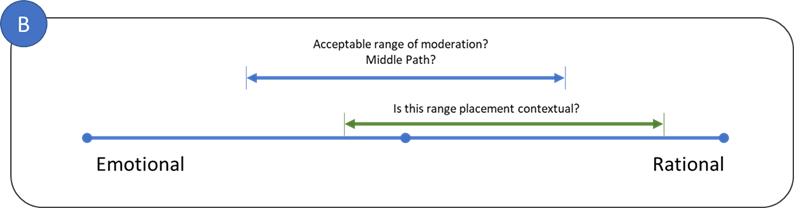
Prior to this, time was not a factor, so I had been constructing this as a simple continuum as shown in image B.

Here, there is only a X axis, running from emotional to rational, representing reason. Ignoring for the time of the index of the scale and not being concerned if the relationship is even-tempered linear or something else.

Secondarily, is there a quality perspective to the placement? My initial questions are embedded on the graph.

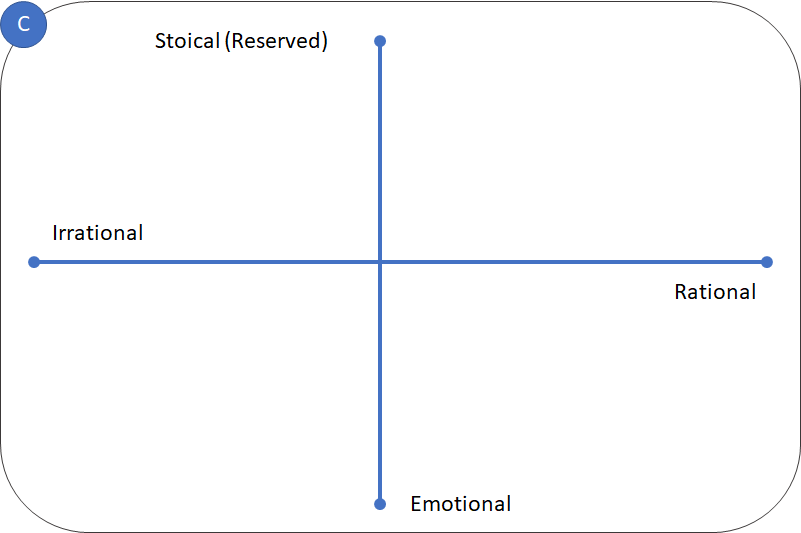
As I don’t feel that the Emotional-Rational scale are opposites, I’ve been thinking through how this scale might work. My first take was along these lines, creating a Cartesian plane.

In this, Irrational and Rational create an X-axis scale and Reserved and Emotional create the Y axis. I’m not sure what the nomenclature opposite of Emotional is, but stoical or reserved are placeholders for now.

Upon further thought, I am not sure irrational is the extreme opposite to rational. I am also not sure what the interplay of rational versus irrational versus non-rational should be, but I created a fourth chart as a basis for discussion.

I am not making a claim that any of these are correct. I am just trying to think this through visually. As I’ve got a day job, I need to get back to, I at least wanted to provide this foundation for conversation.

The Mystery of the Good

I happened upon a video where three philosophers engage in friendly debate over the nature of absolute goodness. The three each in turn give their positions, and then they debate three themes. This post captures their positions—until about 12.5 minutes—, and I’ll reserve the themes for future posts.

Video: The Mystery of the Good:
Is morality relative or absolute?
 
Naomi Goulder

The swapping an evaluative good over a moral goodness is a slight of hand or a head fake. As Naomi Goulder states, citing Nietzsche,

“Our weak, unmanly social concepts of good and evil and their tremendous ascendancy over body and soul have finally weakened all bodies and souls and snapped the self-reliant, independent, unprejudiced men, the pillars of a strong civilization.”

—Daybreak, Friedrich Nietzsche

I won’t call Nietzsche on his facile belief in ‘self-reliant, independent, unprejudiced men‘.

The problem is as much one of mathematics as well as of language. Good is a weasel word, so it is easy to equivocate over its meaning. I’ve commented on this before, so I’ll leave it here at the moment and focus on the maths. No matter what bogey we are attempting to maximise, we are left optimising across to dimensions: individual versus some group, such as society; and present verses future.

I’ll start there. Without regard to which normative function to optimise, we should recognise that what provides the most what I’d deem benefit now not also be optimised in the future.

If I have enough money for either an ice cream cone or bus fare home on a hot day—so even on a relatively short time scale—,and I choose an ice cream, my near-term satisfaction quickly fades when I realise I now have to find alternative means to get home.

In fact, I am not simply optimising across now and a few minutes from now. I am optimising across all possible future times across my lifespan. Plus, taking some choices are necessarily going to eliminate the possibility of others. Rational choice theory be damned.

Beyond the time dimension, we’ve got the individual versus group dimension. This is just as silly. Not only is the group undefined, we are likely to constrain it to our perceived in-group. As a citizen of the UK, I may not consider the effects of my choice on, say, Germany or Myanmar.

In effect, this becomes a system boundary definition problem. Just because I adopt a nationalistic boundary does not mean that I’ve chosen this correctly. The Germans who made this calculaus circa World War II learnt that being on the losing side of a conflict yields outcoems divergent from original expectations. Had Germany and the Axis prevailed, who knows how this might have changed?

My point is that, even divorced from the language problem, the bulk of this topic is mental masturbation. It is unresolvable because it’s not much more than academic sophistry.

Paul Boghossian

Paul Boghossian conveys three possible interpretations.

In the first he posits a strawman statement, ‘It is morally good to educate girls and young women’, a topic sure to get an emotional reaction from Western-indoctrinated people, assuming a moral high ground over fundamentalist Muslim beliefs. Proponents of this view claim that this can be assessed as simply true or false.

More fundamentally, he defends this approach in proxy by asserting that, ‘ultimately, there will be some normative claim at the bottom of that chain of reasoning which will either be true or false‘. It hinges on the expected role of the human, in particular the female of the species. Again, this is only true or false within some context, a context which is neither objective nor universal.

In the second, which he labels as relativistic, acknowledges the social contextual interpretation.

His last interpretation is nihilistic, wherein, ‘normative vocabulary is fundamentally confused; there is nothing in the world it answers to; if you really want to do things ‘right’, you just have to drop this vocabulary and find some other vocabulary—not itself normative; not itself evaluative—in which to describe these things that we call moral convictions or moral beliefs‘.

I subscribe to this last school, though I do not feel that language is fundamentally capable of this level of precision and even more fundamentally is not truth-apt.

He adds a fourth category, where preferences rule, which is weaker still, as preferences are not only normative but emotional and, I might argue, are somewhat arbitrary and capricious and subject to all of the weaknesses inherhent in preference theory.

Michael Ruse

Michael Ruse begins by downplaying the absolute notion of the good but then backtracks and defending something close to absolute by ‘taking it very seriously’.

He defends the believers in the quasi-absolute morality of good gods, ignoring the relative nature of that belief (and not to mention how to validate the objectivity). He goes on the defend Platonism but comes up short trying to assert the positive analytic notion of maths and a normative vantage where morality is objective.

I was pleasantly amused with his case where he highlights the inherent problem with a sexual morality formulated around a binary sex world if we imagine intergalactically a world with a ternary sex arrangement. We can observe this locally, as not all species are restricted by human sexual dimorphism.

For reference, the three themes discussed are as follows:

Theme One: Is there an absolute good?

Theme Two: Does morality apply to the act or the consequences

Theme Three: Should we strive for absolute truth

Why Facts Don’t Change Our Minds

New discoveries about the human mind show the limitations of reason.

As everyone who’s followed the research—or even occasionally picked up a copy of Psychology Today—knows, any graduate student with a clipboard can demonstrate that reasonable-seeming people are often totally irrational. Rarely has this insight seemed more relevant than it does right now. Still, an essential puzzle remains: How did we come to be this way?

The New Yorker

This is not the essential question to puzzle. The question is the mental tricks we torture ourselves to convince ourselves we are rational beings and when lengths we go to defend this view.

Systems of government, jurisprudence, and law are predicated on the notion of rationality. In reality, this is the elephant in the room. In law, there are the notions of truth and of right and wrong, each fraught with their own problems, but there are also issues of the ability to reason between right and wrong as well as the problem of intent. We read time and again people rationalising why this person should be found guilty. Of course s/he knew the difference between right and wrong. Like an economic model, the nuance is stripped away, and we are left with a mechanistic 8-bit sense of reality laid bare, but the details lay in the details left on the cutting room floor. This is the modern justice system.

I’ve participated on three sides of this ridiculous justice system:
jury member, defendant, and plaintiff. As a jury member, one is really exposed to how the attempt to appear to be objective is merely being primed to rig the game. Jurisprudence is 90% showmanship and 10% of je ne sais quoi. It’s a smoke and mirrors legerdemain spectacle to illustrate the reason inherent in the system. And there is reason. And there are reasons. And it’s all for show. Trust me: like the medical system in the US, you don’t want to have to be any part of the legal system if you can avoid it. It’s not for the poor or faint of heart.

In one case, I served on a jury in Beverly Hills. A young man of Mexican descent was on trial for armed robber of a liquor store. He was found not guilty—not innocent, so an interesting twist—, but it was obvious from the start that the police officers testifying against him were lying—outright lying. So in one sense, his being found not guilty was a sort of vindication and perhaps a sign that reason prevailed, but maybe things would have gone differently if these police officers were more convincing liars.

All’s well that ends well? Not exactly. How is it that a system allows false accusations without repercussions? Wouldn’t it be a fairer game if the police officers were held accountable? Wouldn’t that be a better incentive not to lie—or at least not misrepresent truth? But that’s not the goal. Like a casino, the goal is to present the appearance of a fair game, but the odds remain in favour of the house.

People defend these rationality-based systems with reckless abandon. I don’t hesitate to point out the deficiencies. I’ve been cited the misattributed Churchill so many times I’ve lost count:

Democracy is the worst form of Government except for all those other forms that have been tried from time to time…

Winston Churchill (Sort of)

Aside from the source of the quote and the veracity of the claim, the defence of Democracy is up there with the defence of Capitalism. So many reasons. So little Reason.

I’m asked if this is so broken, what better option might I suggest, as if my pointing out that you leg is broken somehow commits me to know how to fix it. But since you’re asking. I suggest an approach other than reason.

Irrationality

1–2 minutes

I’ve not read nearly at a pace as I’ve done in prior years, and I’ve got a million excuses. I did recently start and stop Quine’s Pursuit of Truth, but I’ve just picked up Irrationality: A History of the Dark Side of Reason.

EDIT: I’ve since finished this book and posted a review on Goodreads.

As a former behavioural economist, it’s good to see the expansion of the position that the Enlightenment brought the Western world an Age of Reason, but it failed to see how little capacity most humans have for reason even regarding mundane affairs.

Have you ever stopped to consider that literally half of the population has less than average intelligence?

Some guy

Fundamental attribution bias is clearly at play, as the authors of these Enlightenment works were high-intellect individuals. I respect greatly the likes of Locke, Hume, Montesquieu, Rousseau, and their near contemporaries, but the world they envisaged was based on an invalid premise.

In the realm of governance, one might try to argue that Plato was trying to address this in his admonishment of democracy in favour of The Republic, but he, too, was incorrect, essentially not seeing principle-agent problems as well as predicating a system on the notion of virtue—naive, to say the least.

I’ve been tremendously busy in my day job, so I haven’t been able to contribute here as much as I’d like, but I’ve taken time to jot down this.

The Colour of Justice

Sort of interesting topic, but I’ve been too busy to post much or respond lately.

Think about the concepts of “red” and “justice” and you’ll notice a key difference. If you’re sighted, you’ll associate “red” most strongly with the sensory experience, which relates to signals from cone cells in your eyes. “Justice”, in contrast, doesn’t have any associated sensory qualities – as an abstract concept, you’ll think about its meaning, which you learnt via language, understanding it to be related to other abstract concepts like “fairness” or “accountability”, perhaps. But what about blind people – how do they think about “red”?

A brain-imaging study of 12 people who had been blind from birth, and 14 sighted people, published recently in Nature Communications, shows that while for sighted people, sensory and abstract concepts like “red” and “justice” are represented in different brain regions, for blind people, they’re represented in the same “abstract concept” region.


Competition and Jordan Peterson

Jordan Peterson was interviewed by Joe Rogan, where he discussed gender and competition. I am not going to address his gender issues, but I’ll say something about competition. I’ll also ignore his stance that the world is ‘functioning unbelievably well, even though it has its problems’. He gets to competition through some comments on equality.


[Focus] on winning the largest number of games across the span of a lifetime.

Jordan Peterson

Firstly, Peterson differentiates equal playing fields from equal outcomes, a favoured Conservative talking point slash whipping boy. He then sets up a strawman argument relating to people favouring the ‘best of the best’ (which is to say, their personal favourites, I suppose) in lieu of exploring the vast universe of music available on the myriad streaming services, the result being that in the aggregate, the preferred acts make more money through this competition. Of course, this is the result of preference theory, which produces different outcomes based on inputs such a time and place, fads and trends, and the ‘winner’ is the one who attains the most listens.

There’s no accounting for taste.

Having had worked in Entertainment for years, I realised early on that the correlation between talent and financial success was fairly weak. In fact, I had several conversations with artists who felt ‘guilty’ for their commercial success over people they deemed more talented. This is a fundamental problem with market systems, the value calculus is influenced by what Keynes termed ‘animal spirits‘. As the saying goes, there’s no accounting for taste.

Peterson and Rogan both agree that competition is healthy and necessary, but they don’t define the scale and scope, so they sacrifice a participation trophy red herring on the altar.

Peterson does come back to discuss scope within a timeline of a lifespan, that a single game is less important than a championship—and, apparently, there is more than one championship. What never happens is a definition of what the rules of the game are or how you know you’ve won. I suppose, that’s a relative concern. They also don’t provide any guidance on where to set the dial between competition and cooperation.

If you are trying to get a job versus even some anonymous pool of applicants, then you’ve won this match. I see this as an evolutionary game. I remember a story by Clarissa Pinkola Estes where she tells about a guy who had been climbing the corporate ladder for decades, and when he got near the top, he came to the realisation that he had it up against the wrong building. Perhaps what he thought was a worthy goal (say acquisition of money) was in conflict with some higher ethical goals or deeper friendships.


It doesn’t matter whether you win or lose, it’s how you play the game.

From what I can tell, Peterson is guided by a sense the virtue ethics are the way to go, and, judging from this interview, he’s more than just a bit of a Consequentialist. But it’s clear he is no Deontologist. Case in point, he claims that the adage, ‘it doesn’t matter whether you win or lose, it’s how you play the game’ is a ‘sentiment confuses children’.

Play well with others.

He ends by saying that if you learn the kindergarten lesson to play well with others, you’ll temper your winning or redefine winning within the context, and somehow your goal should be ‘focusing on winning the largest number of games across the span of a lifetime’.

At the end of all of this—given Peterson’s pathological worldview—, it’s no wonder he’s so defensive, combative, and irascible: he is driven to win, and he thinks it matters. And it’s abundantly clear that he hasn’t learnt his own kindergarten lesson: Play well with others.

And now for something completely different…

I chose the cover image of this post on the merits of the upcoming competition between Peterson and Žižek on 19 April.

Good to Coöperate: Property

2–3 minutes

I happened upon an entry in Current Anthropology: Is It Good to Cooperate? [PDF] (Volume 60, Number 1, February 2019), wherein the authors claim there are 7 universal moral codes. The universality is suspect insomuch as they found a preponderance of observations, so unanimity was not always found. I am also concerned with the specificity of the definition of property.

The group studied ethnographic accounts of ethics from 60 societies, across over 600 sources. The universal rules of morality are:

  1. Help your family
  2. Help your group
  3. Return favours
  4. Be brave
  5. Defer to superiors
  6. Divide resources fairly
  7. Respect others’ property

It’s well past my bedtime, and I should be sleeping, so I just want to pick out one of these universals: property rights.


La propriété, c’est le vol!

What is Property? — PIERRE-JOSEPH PROUDHON

Property can mean several things: In the description of methodology, it appears that these authors are referring to property rather than possession, as a key identifier is the ability to transfer property intergenerationally. What is the scope of the definition of property. There is a difference between passing along a family home and passing along vacant property a world away. Is rent-seeking property ownership universal? Would all societies subscribe to the notion held by Western Capitalism, wherein one can own property that, theoretically, one may never have seen? In the United States, they have concepts like intellectual property, which is at best a subversion of the notion.


»» »» »» »» »» »» EDIT »» »» »» »» »» »»

There may be a problem with reading (or at least posting) at 2AM—and property is a hot button item for me. I may have been hyper-focused on the intergenerational wealth transfer. I’d like to read more about how other societies view this as well as which ones do and don’t. Of course, I’d like to understand how the interviewers couched the questions.

In the end, the summary was about possession and not property:

Private property, in some form or other, appears to be a cross-cultural universal (Herskovits 1952). Morality-as-cooperation leads us to expect that this type of cooperative behavior—deferring to prior possession—will be regarded as morally good .

Op. cit.

As an anti-Capitalist, I notice that no claims are being made into the morality of competition. I may may a few posts on my observations of the remaining 6 list items.

Natural Causes

2–4 minutes

Some of us are concerned with the metanarratives underlying society, but and given society is apt to have many competing metanarratives. Logical Positivists tapped into the narrative of science, which is a primary theme of Enlightenment thinking. This was supposed to have supplanted the narrative of superstition, except it didn’t. And a sort of empirical, scientific Nature was supposed to have supplanted the metaphysical gods, except it didn’t.

Illuminati Eye Symbol

Apart from the problem that a supernatural God was replaced with a sort of animated Nature, some people just didn’t buy into the new narrative. Today, in the 21st Century Western world, some people still subscribe to these pre-Enlightenment notions, but that’s not the root of the issue. Neither is necessarily right or wrong. And in a Hegelian synthesis, some people assuage the ensuing cognitive dissonance by merging the two and cherry-picking the ones that work for them. These people usually have little difficulty finding people who believe that the earth is 4.5 billion or 6 thousand years old, that Ayurvedic medicine is superior or inferior to Allopathic medicine, that vaccines cause or don’t cause autism, that homeopathy is effective or ineffective, that the Illuminati are some secret society that rules the world or not.

Many people still can’t get past an appeal to nature, whence the Organic and traditional medicine movements. This is not to say that some or all of these claims might have validity; it’s just to say that ‘because it’s natural’ is not a suitable defence. Even a stopped clock is right twice a day—unless it’s set to a 24-hour display, in which case it’s only right once a day.

Without rehashing the argument whole hog, we know that poison ivy and uranium, arsenic, and cyanide are all natural. Not many attempt to defend this with an appeal to nature, so this suffers from selection bias from the start.

you cannot go against nature
because if you do
go against nature
it's part of nature, too

— Love and Rockets, No New Tale to Tell

The larger issue is about how we define nature. I don’t recall if this was Lyotard or Lacan (and I don’t feel like looking for the cross-reference at the moment), but by definition everything observed is natural, whether physical or behaviour.

Love and Rockets – No New Tell to Tell

Some humans—notably the Enlightened ones—like to view themselves as somehow above nature, but the veneer is nanometers thin and threadbare at that. And these people extend this concept to behaviour. As the song goes, you can’t go against nature because when you do, when you observe it, it is by definition part of nature, too.

Oftentimes, this becomes a moral argument: this or that is unnatural. Certain sexual activities are usually held up as examples, and yet many of these activities are not only practised by many humans, they are also practised by members of other species. The argument is that we need to elevate about nature, an so they are making some appeal to meta-nature or some such.

In any case, the complaint shouldn’t be whether it’s natural anyway. It might rather be couched in some instances as not ‘naturally occurring’, so plastics would not happen save for manufacture, but neither would asphalt or telephones or televisions or processed foods, so I find it to be disingenuous to rail against some items that do not occur naturally whilst ignoring the ones you happen to find useful.

Rorty on Truth

2–4 minutes

To a comment on Death of the Metanarrative, I responded about the notion of truth relative to the map and the terrain. Although my rambling response was lengthy, I thought I’d share Richard Rorty’s view on this from his Contingency, Irony and Solidarity. According to Rorty, rationalists and empiricists turn claims about the world into the world—convincing others that a map of the world is the world.


We need to make a distinction between the claim that the world is out there and the claim that truth is out there.

—Richard Rorty

“We need to make a distinction between the claim that the world is out there and the claim that truth is out there. To say that the world is out there, that is not our creation, is to say, with common sense, that most things in space and time are the effects of causes which do not include human mental states. To say that truth is not out there is simply to say that where there are no sentences there is no truth, that sentences are elements of human languages, and that human languages are human creations.


Truth cannot be out there—cannot exist independently of the human mind—because sentences cannot so exist, or be out there.

Richard Rorty

“Truth cannot be out there—cannot exist independently of the human mind—because sentences cannot so exist, or be out there. The world is out there, but descriptions of the world are not. Only descriptions of the world can be true or false. The world in its own—unaided by the describing activities of human beings—cannot…

“The world does not speak. Only we do. The world can, once we have programmed ourselves with a language, cause us to hold beliefs. But it cannot propose a language for us to speak…

“It was Nietzsche who first explicitly suggested that we drop the whole idea of ‘knowing the truth’. But in abandoning the traditional notion of truth, Nietzsche did not abandon the idea of discovering the causes of our being what we are … In his view, in achieving this sort of self-knowledge we are not coming to know a truth which was out there (or in here) all the time. Rather, he saw self-knowledge as self-creation. The process of coming to know oneself, confronting one’s contingency, tracking one’s causes home, is identical with the process of inventing a new language … So the only way to trace home the causes of one’s being as one is would be to tell a story about one’s causes in a new language…

“[O]ne can—fruitlessly, in my view—come at [the question of knowledge] by way of anthropology and the question of whether there are ‘cultural universals’, or by way of psychology and the question of whether there are psychological universals. [There is an] indefinite plurality of standpoints, [a] vast number of ways of coming at the issue sideways … It is central to the idea of a liberal society that, in respect to words as opposed to deeds, persuasion as opposed to force, anything goes. This openmindedness should not be fostered because, as Scripture teaches, Truth is great and will prevail, nor because, as Milton suggests, Truth will always win in a free and open counter. It should be fostered for its own sake. A liberal society is one which is content to call ‘true’ whatever the upshot of such encounters turns out to be.”

Husky Meme – According to this book, I can’t read.