This is a continuation of my previous post—with a touch of TMI…
I was divorced some time ago, and I was ‘accused’ of giving gifts to another woman—a woman a met after I was served papers for the divorce. After her attorney asked if I had ever given any gifts to anyone, the judge scoffed when I asked for a definition of gift so that I could respond honestly. The judge actually rolled her eyes and made a comment that my approach was not going to work. So without an established definition, I replied, ‘No. I never gave any gifts to anyone.’ She was fine with the response. In fact, she already had made up here mind in the same manner when a person pleading the Fifth in the US is automatically seen as having something to hide and therefore guilty of something. It’s a fanciful notion that taking the Fifth somehow eliminates the concern in question, but the entire jurisprudence system is arbitrary and virtually capricious—despite supposedly being a deontological endeavour. In practice, the goal of organised Law is to elevate process over justice so as to at least give the appearance that it is fair and otherwise meaningful.
Lady Justice
So, is it possible to give a gift? Is it possible to know this? Is it possible to know the intent of anything?
Gift (n): a thing given willingly to someone without payment
If gift is defined as a something given willingly and without payment, what is the scope of without payment, and what constitutes payment? Is altruism even possible? Is this possible to know? Again, can anyone know the intent of another? Can anyone truly know the intent of their own actions? Does the unconscious or past experience obviate intent?
In my case, I gave a woman some—what might colloquially be called—gifts. There were no strings explicitly attached? Does this mean there were no strings attached? I had a romantic interest in this woman. Clearly, this courting game involved gift-given in return for some expected payoff at some time in the future.
What if I had given one of these gifts to a stranger on the street—perhaps a homeless person? Would that now be a gift? What if I was in a foreign place with a nil probability of encountering this person ever again and nobody witnessed the transaction and I would never tell another soul about it? Would this be a gift?
I suppose if I had no notion of karma, whether the Eastern variety or the Western Heaven-oriented variety, and it gave me no hormonal benefits relative to dopamine, serotonin, and oxytocin, I’d buy it.
So, accuse me of being pedantic, and you’ve made my point. We only want to employ language until the point it complies with our notion of our sense of truth. But it’s nothing more than this.
The language of sex is a horse of a different colour. Language is ambiguous, and sex terms take this a step further.
My main thrust is neither the power-structure angle of Foucault or Beauvoir nor the penetration politics of, perhaps, Butler, Dworkin, or Paglia. Instead, I’ll start with ex-US-President Bill Clinton.
“I did not have sexual relations with that woman.”
Of course, Clinton was a lawyer, and he understood the ambiguity inherent in language. The problem is that despite this recognition by the legal profession, they arrive at a point where language specificity is good enough. It’s not, but Upton Sinclar got it right when he pointed out, “It is difficult to get a man to understand something when his salary depends upon his not understanding it!” But that’s a topic for another day.
“It is difficult to get a man to understand something when his salary depends upon his not understanding it!”
Upton Sinclair
Clinton was attempting to employ the word sex, simultaneously distancing himself from the act. By his logic, he was defining sex as vaginal intercourse. It seems that many people share this definition—it’s convenient in the Christian sense—, so his comment was not unfounded.
To Christians, there is only one legitimate sex act: intercourse between a penis and a vagina—and only in missionary position. Anything else is basically sodomy. So, by this definition, Clinton did not have sex with Lewinski because all he got was a blowjob—and so he’s a sodomite.
To the uninitiated, a blowjob is oral sex. Note the modifier: this was not sex but oral sex. Of course, if you see sex as a class of activities, vaginal, oral, anal, or whatever, then you can conclude that his actions fell within this classification; but if you see sex as the more limited definition, then no sex occurred (in this particular blue-dress moment).
Sex workers have their own nomenclature for sex—and their own acronyms and abbreviations. They make a similar distinction. To them, sexual intercourse is full service, FS, for short. Anything less doesn’t qualify. In practice, lesser activities are discounted, and other activities come at a premium, as they are considered to be fetishes. Again, that’s a topic for a different day and, most likely, a different blog.
A larger question that I will avoid is what should qualify as sex? This question is not simply rhetorical because, say, in the case of rape, where is the delineation? Rape, it seems, is more about penetration than of sex, though, it further seems, that not all penetration is created equal. What qualifies as rape changes over time and place—again, an issue with language and objective truth.
It is not that language and words are meaningless, but it does mean that it is contextual. Heuristically, this is adequate for incidental communication, but technically, things don’t hold together. There is no there there.
I’ve been reading and listening to Conservative Stephen Hicks’ Explaining Postmodernism. He’s made it free on YouTube and as PDF. It’s important to note that the book is a decent read, but Hicks makes little attempt to remain in a neutral voice. It’s clear that he is critical of it, so his explaining is not to articulate to the generally interested; rather, it’s to impose his worldview on the topic matter. Read or listen, but keep this in mind. If you lean Conservative, you’ll eye-roll in unison with him; if you lean to the Left, the eye-rolls will have a different significance, as he mows down one strawman after another.
In this clip (bookmarked from the full audiobook), he attempts to make the case that postmodernists—which is as motley a crew as a group of atheists—eschew the notion of rationality for the comfort of feelings. Sure, I suppose some postmodernists do make this argument, but it is hardly a universal position. Taking myself as an example, I have no illusion that most people can register let alone understand their feelings.
I recall being in a corporate-sponsored (human resource-sponsored) interpersonal communications class where the instructor made the claim that one should defend your position by invoking feelings:
Your loud voice frightened me.
I feel sad when you shout at me.
I feel anxious when…
My reaction then is about the same as it is as I write: Whilst I may not understand what the other person may be feeling, there is little reason for me to believe that this person has identified and named this feeling. There is also little reason to presume this person is conveying to me a correctly-interpreted feeling in lieu of a more hyperbolic version for maximum effect. Moreover, some people seem to be offended by pretty much anything. And there’s one thing I’ve learnt along the way:
A person looking to be offended is pretty much guaranteed to be offended.
So, absent context, I have no reason to take this person at their word. Call me a curmudgeon, if you please.
Like Jordan Peterson, a personality who promotes Hicks, standing up and knocking down strawmen seems to be their raisons d’être, but this is sloppy philosophy and lacks the integrity these people claim to admire. In any case, forewarned is forearmed. Caveat emptor.
EDIT: The more I read of Hicks, the less I like it. He misunderstands or at least misrepresents postmodernism in a big way. I am not sure whether it is intentional or through ignorance, but a certain expected academic neutrality is absent to the brink of malpractice.
Here is a fuller critique of Hicks’ misrepresentation of Postmodernism.
Whether in English or in French, I don’t believe Foucault ever uttered the words, ‘It is meaningless to speak in the name of – or against – Reason, Truth, or Knowledge‘*, but I don’t think he’d disagree with the sentiment.
“All my analyses are against the idea of universal necessities in human existence.”
Michel Foucault
Foucault was a postmodernist, and on balance, political Conservatives (Rightists?) dislike the notion of postmodernism. Evidently, a lot of Postmodernists are also Leftists (Progressives or Liberals in the US), so somehow critics such as Jordan Peterson conflate the two clearly distinct concepts.
A basis for Conservatism is the notion of an objective truth, and despite recent sociopolitical trends, they at least say they are guardians or truth and purveyors of knowledge. Conservatives (OK, so I am broad-brushing here) are staunch individualists who believe strongly in possession and property, of material, of an objective reality. Fundamentally, the are aligned to a monotheistic god or at least some discernible (and objective) moral compass.
On the Left, especially post-Enlightenment, they’ve substituted God with some anthropomorphic Nature. In fact, they find comfort in natural laws and human nature. Science is often their respite because science is objective. Isn’t it? Leftists are friends or Reason, and one can’t acquire enough knowledge. Moderation need not apply here; the more the merrier.
This being said, evidently, many on the Left seem to have abandoned this comfort zone. Of course, this may be because the Left-Right dichotomy doesn’t capture the inherent nuance, and so they were miscategorised—perhaps, much in the same manner as persons are miscategorised in a binary gender system. No. It must be something else.
In any case, both side claim to the parties of knowledge, reason, and truth because the opposing parties are clearly abject morons. There is no hint of irony in the situation where each side claims some objective notion of truth—whether divinely granted or self-evidently reasoned—, yet they can’t resolve what the true truth is. If only the other side were more rational.
By now, we are well aware of the demise of homo economicus, the hyper-rational actor foundational to modern economic theory. In reality, humans are only rational given the loosest definitions, say, to (in most cases) know enough to get in the shade on a 37.2°C day. However, as behavioural economist Dan Ariely noted by the title of his book, people are Predictably Irrational. Ariely is just standing on the shoulders of Kahneman and Tversky and Richard Thaler. My point is that humans are only marginally rational.
As I’ve written elsewhere, truth is nothing more than a rhetorical endpoint. It is hardly objective. It’s a matter of opinion. Unfortunately, systems of government and jurisprudence require this objective truth. In truth—see what I did there?—, social fabric requires a shared notion of truth.
A shared notion doesn’t imply that this notion is objective, but if it’s not objective, how does one resolve differences of opinion as to which is the better truth. Without establishing a frame and a lens, this is impossible. The problem is that frames and lenses are also relative. Whether the members accept a given frame or lens is also a matter of rhetoric. It’s turtles all the way down.
Turtles all the way down
Even if all members agree on all parameters of truth at day 0, there is nothing to prevent opinion changes or from new members not to share these parameters. Such is always the problem with social contract theory. [How does one commit to a contract s/he is born into with little recourse to rescind the contract, renegotiate terms, or choose a different contract option. The world is already carved up, and the best one can do is to jump from the frying pan into the fire.]
In the end, the notion of truth is necessary, but it doesn’t exist. Playing Devil’s advocate, let’s say that there is a single purveyor of Truth; let’s just say that it’s the monotheistic Abrahamic God of Judeo-Christian beliefs. There is no (known) way to ascertain that a human would have the privilege to know such a truth nor, if s/he were to encounter, say, a burning bush of some sort, that this entity would be conveying truth; so, we aren’t really in a better place. Of course, we could exercise faith and just believe, but this is a subjective action. We could also take Descarte’s line of logic and declare that a good God would not deceive us—sidestepping that this ethereal being was good, as advertised. I’m afraid it’s all dead ends here, too.
And so, we are back to where we started: no objective truth, limited ability to reason, and some fleeting notion of knowledge. We are still left with nothing.
Enter the likes of Jordan Peterson, he with his fanciful notion of metaphysics and morality—a channeller of Carl Jung. His tactic is to loud dog the listener and outshout them indignantly. His followers, already primed with a shared worldview, are adept (or inept) cheerleaders ready to uncritically echo his refrain. To them, his virtue-ethical base, steeped in consequentialism awash in deontology, Peterson speaks the truth.
He also potentiates the selfish anti-collective germ and rage of the declining white man. He’s sort of a less entertaining Howard Stern for the cleverer by half crowd. He gives a voice to the voiceless—or perhaps the thoughtless. He uses ‘reason’ to back his emotional pleas. He finds a voice in the wilderness where white Western males are the oppressed. If only they hadn’t been born centuries earlier—albeit with iPhones and microwaves.
Those would be the days.
* I believe this phrase attributed to Foucault was a paraphrase by philosopher Todd May.
I’ve shared a new video on YouTube discussing the rhetorical nature of truth.
Before the Classical Hellenes, Mesopotamians recognised the power of rhetoric as the art of using language to convince or persuade. The term itself derives from the Greek ῥητορικός, rhētorikós.
As with any human construct such as language, truth and rhetoric are confined by limitations of the system and its logical structure.
In “Gorgias”, one of his Socratic Dialogues, Plato defines rhetoric as the persuasion of ignorant masses within the courts and assemblies.
Rhetoric, in Plato’s opinion, is merely a form of flattery and functions similarly to cookery, which masks the undesirability of unhealthy food by making it taste good.
Rhetoric typically provides heuristics for understanding, discovering, and developing arguments for particular situations, such as Aristotle’s three persuasive audience appeals: logos, pathos, and ethos.
But it’s more insidious than all of this. The notion of truth—or whatever we believe to be true—is nothing more than rhetoric.
If one is aptly convinced that something is true, it is. The physical world—the world of objects—contains facts—attributes of these objects, but these facts are tautological descriptors: a red car, une voiture rouge, ou quelque chose. In the conceptual domain of abstractions such as truth, justice, gods, and love, all bets are off.
As Geuss aptly suggests, most of society and civilisation don’t care about philosophical thought at this level. This is privileged activity. It’s not about level of intellect, per se; rather, it’s the privilege of free time to devote to abstract thinking.
Most people are more concerned with getting to the next day to earn a paycheque, and they accept sloganeering for any deeper meaning.
Humans are said to be rational beings. In fact, this predicates entire disciplines such as economics…
…and jurisprudence. Legal systems are founded on the concept that humans are at least rational enough to make fundamental decisions about right and wrong—and this, of course, presumes that the notions of right and wrong in and of themselves are meaningful.
For the sake of argument, let’s presume that humans are at least rational enough for our purposes, and whilst right and wrong may not be objectively validated, that within the context of a society—presuming that not to be mired in its own identity problem—, it can be defined in the manner of a social compact envisaged by the likes of Hobbes, Locke, Rousseau, et alii. As the saying goes, ‘if it’s good enough for the government… well.
Language is a human construct, yet it’s an apparition. Like a physical object, it appears solid, but there’s more space than not. What’s there is exiguous. Echoing Heisenberg’s observations at the atomic level, one cannot be fully certain of a particular meaning. This is what Derrida (via Barthes) meant by ‘the death of the author’, though there is nothing to guarantee that the author could fully articulate the meaning or intent even if they were present to defend it.
About the same time, Saussure was finding promise in the structure of language, Russell was creating a new language of logic to obviate its deficiencies. Structuralists and logical positivists were a natural extension of the scientism of the 20th Century, the prevailing wave since the Enlightenment, but as with the demise of gods, religious belief, and other things metaphysical, this faith in structure was also specious.
Historically speaking, there is progress (another illusion), and there are paradigm shifts. When a paradigm shifts, an old truth is replaced by a new one. This is typically credited to a progression of knowledge, but it’s actually just that, on balance, people have accepted a new frame, chalking it up to scientific method rather than some rhetorical sleight of hand.
Even so, scientific discovery is different to archetypal notions such as truth or justice. At least we can empirically test and verify a scientific notion, even if what we are observing is later revised because of some previously unknown factor or removed constraint. For example, until Einstein’s day, Newton would not have known that his theory of gravity would break down as it approached the speed of light. But truth is just an opinion—even if widely held. Enter the ‘appeal to tradition’ flavour of logical fallacy—I’ll not dwell on the fact that systems of government are based on this quaint notion of precedents. #JustSaying
“Truth is simply a culmination of the rhetorical power to persuade the ignorant masses.”
Plato
I’ve arrived at my philosophical position as an autodidact. I am not a conventional scholar, and my exposure to philosophy derives from books, videos, and online sources including Wikipedia, blogs, Reddit, and the such.
I consider myself to be a non-cognitivist in the realm of Ayers’ Emotivism, and I fully realise that society as we know it relies on some notion of ascertainable truth. Of course, Nietzsche was vilified for observing that ‘God is dead’ and unceremoniously subjected to the ad hominem attacks afforded to the likes of Marx.
I’ve got a certain amount of respect for Existentialists (and Absurdists), but I find the teleological component a bit at odds with the central tenet. To that extent, I am more of a Nihilist.
I am more comfortable with what’s been called ‘Post-Modernism’, despite admiring the effort of some Structuralists and Logical Positivists. Where this love affair ends is where the permeation of science fetishists begin. Scientific Method and Logic are the gods of the New Age.
As a post-Enlightenment child, I’ve been steeped in all of its unfound glory, and it’s harder still for me to escape the pull of my Western indoctrination. So, to argue, one is forced to comply with the rules of logic within the limitations of human language—even the limitations of Russell’s language of Logic. And like arguing with a proponent of religion who points out that you can’t disprove his Ethereal Unicorn, one is forced into positions of arguing against Quixotic figments introduced as metaphysical elements.
This Christmas/holiday season, a social media row rages in the shadows of the #MeToo movement, and a holiday classic penned in 1944 is reinterpreted for #today. The central claim is that the content stems directly from a rape culture in the United States. I am not going to argue whether the US have a rape culture or are forged from and tempered by violence—they do; they are.
My contention is about the reinterpretation of language, vilifying an author who is quite literally dead, deceased, demised, expired, no more—unable to defend himself.
The song is about a man and a woman playing a courting game. In my interpretation, she is being coy so as not to be slut-shamed, seeking plausible deniability as she worries about what her mother and father, the neighbours, her brother and sister, and even her aunt, might think.
The kicker for the revisionists is ‘Say, what’s in this drink’ as if it’s been spiked; she’s been roofied; he’s plying her with some date rate drug. This interpretation is preferred to the more period-probable scenario that she’s conveying a signal that she’s feeling a bit tipsy and giving him the go-ahead with a wink and a nod. The decorum of the day suggests that she ‘ought to say no, no, no’, but she wants to say yes and stretches the encounter with another cigarette.
Crispin Sartwell authored an Opinion piece about how to render history, and he presented several alternative perspectives.
The problem is that history is none of these or at least it doesn’t much matter. History is a narrative; it’s rhetoric; it’s a map, and an apparent goal is to simplify trends, but in fact, real history is a complexity of events and simplification is as often as reductio absurdum that not. Sure, facts are sprinkled in so people can latch on to them and say, ‘that happened’. But history is durative. It’s not just a locus of trivia and factoids. Some say that hindsight is 20/20, but even this is untrue. Humans are not very well equipped to perform analysis and even less so when the analysis is complex. We have all sorts of cognitive biases and backwards-form noise into signal or presume some weak link is as a strong link, moreover, a causal link. Humans love the simplistic notion of cause and effect. We rarefyNewton’s Third Law and even adopt this concept into morality vis-a-vis karma: what comes around, goes around. And we apply this to history. But what if history is more like music? What if, as Debussy said, regarding music, that history is the spaces between the notes, between the events?
“Music is the space between the notes.”
— Claude Debussy
In the world of mass market investment, it’s claiming the stock market declined because of some single factor. It’s a nod to facile humans and their limited capacity to grasp complexity and to settle for some heuristic that assuages cognitive dissonance.
On a smaller scale or considering grander themes, Hegel’s Dialectics is functionally decent, but it misses the Butterfly Effect of interrelated events and forces.
Some colleagues suggested that I watch The Good Place because it deals with philosophical issues and philosophers head on. I had my reservations for two main reasons:
Philosophy tends to be cast in a facile normative ethical framework
The colleagues are ordinary people with a typical (so minimal) exposure to the academics of philosophy, so when I voiced my reservations, they responded that it started slow but got better—especially the final episode of the first season. This seemed like an odd recipe for success, but I gave it a go anyway, watching the first two episodes on a flight from Houston to Philadephia.
I learnt three things:
Why I don’t tend to watch TV
Why I don’t tend to like what I watch on TV
Philosophy tends to be cast in a facile normative ethical framework
Evidently, there’s a twist at the end, but I am not sure I’ll be able to endure.
Rewinding a bit, the show clearly pushes a consequentialist worldview, and given the references to Nicomachean ethics and Club SPA, I presume at least a hint of virtue ethics and deontology.
Perhaps, they’ll get to the likes of Foucault and Derrida, though I’m not betting on it. Perhaps someone can fill me in on the details. I won’t tell.
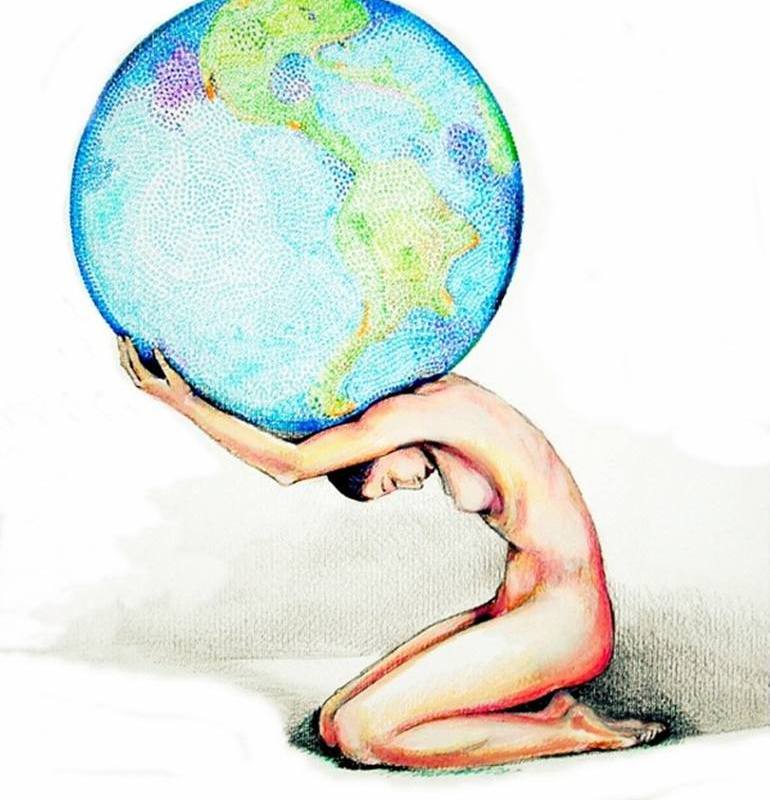
According to this article, The Fate of the Earth Depends on Women, women are our species’ last hope. The survival of the human species depends on wresting power from men, or so it says. But it’s more than that.
“The survival of the human species depends on women wresting power from men.”
To Michel Foucault, the crux of everything is power. Adopting his worldview, then, the problem isn’t whether men or women hold power; it’s power itself. For example, Margaret Thatcher may be single-handedly responsible for taking the Western World down into the abyss that is Conservativism or Neoliberalism, if you like. This, a woman, did this. I am not playing the Eve or Lileth blame game here, trying to vilify a woman. Sure, Ronald Reagan was the mouthpiece for putting her agenda on steroids, but it was she who primed the pump, though it was he who amplified the message.
And we’ve got warmongers like Hillary Clinton. Having a vagina doesn’t make you more responsible with power.
Absolute power corrupts absolutely.
Besides, absolute power corrupts absolutely. A woman would be fine, but there are at least three things at play in today’s world:
The system is designed to select a certain type of participant.
The system is designed to mould participants who somehow make it past the initial vetting.
By and large, the women who participate play the power game similarly to the men.
Sure, there are some women who might do better, but there are also some men. This is not apologist rhetoric or mansplaining. This is to say that the solution is not in sex or gender; it’s in temperament. And it bears repeating: the system digests persons with this temperament and spits them out; at least it marginalises them. The game is rigged.
Elephants in the wild are being poached by their tusks by inveterate assclowns, and the ones without tusks are becoming more prevalent. This trend is broader than the result of the tusked elephant population being depleted. The elephants with the tuskless genetic profile are reproducing offspring with this tuskless trait.













 Philosophics