Just a brief post today. I had forgotten about this Steven Pinker quote I shared elsewhere a few years back.
“Judges are not very good linguists. For better or worse, they try to find a way around the most natural interpretation of a sentence if it would stand in the way of the outcome they feel is just.”
The fact is that they do not care about the lack of specificity of language. Politicos revel in the fact that they can torture language into submission to meet their own objectives. This is the power of rhetoric.
As I have reviewed my posts over the past couple of years, it seems I repeat myself, repeat myself, repeat myself, repeat… I get a sudden urge to capture a notion, and it turns out that I had already written about it before. I’d just forgotten.
What I need to do is to formulate a cogent distilled version, but I can’t quite seem to get there. For now, I’ll just share this.
I’ve been accused of being hyper-logical and aloof, and I self-identify as a logical intellectual. This noted, for humans—myself included—emotion precedes logic. Every time. Logic is applied to rationalise our emotional response. This ‘logic’ is based somewhat on classical logic and otherwise on environmental factors. This is one reason that rhetorical persuasion is so effective. It doesn’t loose sight of the emotional element—pathos—whilst retaining logical and ethical notions—logos and ethos.
Stoic dude, Marcus Aurelius
I’ve been accused of being a stoic and Star Trek’s Mr Spock—devoid of emotion—, and on one level I don’t feel that I am run by emotions’ but on the other hand, I likely am. It’s just I can rhetorically convince myself to the contrary.
I find that highly illogical
Epistemologically, how can I know this? I can’t. But I think that this fits into Daniel Kahneman’s 2-system approach, and system 1, the heuristic element, is the first responder to all incidences. System 2, the analytical element often isn’t even alerted. For people of my persuasion, we intentionally invoke system 2, but this is always after system 1 has evaluated the situation. I highly recommend Kahneman’s Thinking Fast & Slow as an introduction to these systems and how they deal (and don’t deal) with cognitive biases.
If I had a dollar
This may be why Emotivism makes sense categorically, as Truth is just another notion wrought from emotion. It is also how humans convince themselves that things like justice and fairness can exist.
And, so, does this post have another point to make? Am I going to elaborate? It seems a bit short. By my own admission, nope.
Experience is more important than material wealth because you can’t take it with you.
This is silly on so many levels.
Firstly, you can’t take experiences with you any more than you can take material, so the entire logic is faulty.
Secondly, although unsaid, this is typically uttered by those who equate experience with travel to other places, and so one needs some notion of material wealth to do so.
Thirdly, just being alive and somewhat aware is an experience, but I understand the notion implies a diversity of experience.
Fourthly, you still can’t take it with you.
Personally, I love aphorisms, those near-phatic quips that no one really thinks about, yet they feel that these are somehow guiding principles.
Opposites attract.
versus
Like attracts like.
Which of these is correct?
In fact, each of these statements may be correct; it simply depends on context. The issue is that people spout these off to make a point.
Opposites attract is how we justify when two unexpected people, for example, are together. It is also the basis behind the Jungian anima-animus concept.
Like attracts like may be either to justify why person A is with person B, but it sometimes further is meant to imply a sort of guilt by association.
The other issue is one of dimension. When applied to people, they are multidimensional. So which dimension is opposite and which is like. Of course, we’ll choose the dimension that fits our purposes.
Perhaps a 172 cm brunette woman is a police officer has a life partner who is a 172 cm blonde man, who is a criminal, and who both enjoy art museums.
Without specifying what percentage the likeness needs to be to qualify, if like truly attracted like, wouldn’t the 172 cm brunette policewoman be attracted to another 172 cm brunette policewoman? Or would just another taller policewoman be good enough?
Anyway, nothing earth-shattering here. This is simply another example of the imprecision of language. That, and I couldn’t sleep.
TRIGGER WARNING: This post is about sex and prostitution and includes words and images not necessarily appropriate for the self-righteous.
If this describes you, avert your eyes.
The Holy Water, It Burns
I stumbled across another blog site advocating the Nordic (anti-prostitution) Model, which in a nutshell makes it illegal to buy but not ‘sell’ sex.
On the positive side, the advocates of this model pretty much all adhere to the same talking points. On the negative side, there are only weak strawman arguments , moralising, and anecdotes. Any studies referenced are limited in scope and with dubious rigour.
In this case, I (again) pointed out that the core of the argument was one against Capitalism, and (again) the response was that it is (somehow) more than this—because, well, things…moral things.
Interestingly, the site is named Your Social Construct Is Showing, but it seems her complaint is not about social constructs in general; rather, she doesn’t appear to like any social construct she doesn’t agree with—and without recognising the irony in claiming to understand the constructed nature of society whilst also claiming that her construction is somehow better—because, well, things…just things. She’s got some subcultural metanarrative running through her head, and, by God, it’s got to be the only valid one.
I’ve written on this before, but the primary argument is that sex work is not work—otherwise, they wouldn’t have to label it as work. It sort of employs the same logic that oral sex is not sex for the same reason—because reasons.
The next angle is to conflate prostitution with sex trafficking, just hoping no one will notice the redirection. Then they try to muddy the waters with other issues such as exploited, underage subjects as if there is some parallel between these cohorts and women who choose this line of work.
Example of an advertisement by a sex worker
So, to be fair and not fight strawmen like Cammy, I’ll comment on a Logos blog she posted in a response to me. She seemed to be impressed with it. After a rambling preamble, the post gets to its points:
Worker safety: Sex Work does not comply with OSHA rules.
Sexual Harassment: ‘unwelcome sexual conduct that is a term or condition of employment’
Civil Rights: Slavery used to be illegal, and now it isn’t. Prostitution is like slavery.
Without devoting more than a passing moment to remind the reader that workplace safety and sexual harassment rules are social constructs that vary by place and time. OSHA is relevant in the United States of America and nowhere else. Let’s address these in turn:
The Logos post cites various OSHA rules and attempts to rationalise how sex work would be non-compliant.
1
Worker Safety
Mouth pipetting/suctioning of blood or other potentially infectious materials is prohibited
The author (attributed as Lori Watson) points out that ‘this doesn’t say is permitted with protective gear. It says prohibited.’ The line of argumentation here is seemingly that semen is a potentially infectious material and so is prohibited. What she fails to note is that suctioning is not the purpose of oral sex, and with a condom, no suctioning could happen anyway.
Gloves shall be worn when it can be reasonably anticipated that the employee may have hand contact with blood, other potentially infectious materials…
If the punter is wearing a condom, it cannot be reasonably anticipated that the employee would be in contact with [semen].
Masks, Eye Protection, and Face Shields. Masks in combination with eye protection devices, such as goggles or glasses with solid side shields, or chin-length face shields, shall be worn whenever splashes, spray, spatter, or droplets of blood or other potentially infectious materials may be generated…
Again: Condoms obviate this need.
Gowns, Aprons, and Other Protective Body Clothing. Appropriate protective clothing such as, but not limited to, gowns, aprons, lab coats, clinic jackets, or similar outer garments shall be worn in occupational exposure situations. The type and characteristics will depend upon the task and degree of exposure anticipated.
Ditto: Condoms
In the event of exposure, OHSA requires: “The source individual’s blood shall be tested as soon as feasible…
OK
This part of the post closes with a comment that many [note: weasel word] punters do not prefer condoms.
2
Sexual HARASSMENT
Since the definition and expressed purpose of prostitution is ultimately an exchange of sexual services for remuneration, it seems that a person waives this protection. There is much precedence of this occurrence.
Case in point. In the United States, citizens are protected by the Constitution and its Amendments. These documents contain inalienable rights (as established by the Declaration of Independence), yet these rights are abridged (waived) in many instances—military service being the most notable, where members do not have the right to free speech, peaceable assembly, to carry a weapon (except as specifically allowed), due process, and on and on.
3
Civil Rights
The response here is a deluxe word salad, so I’ll break it down slowly.
If sexual autonomy is to mean anything, it has to mean the right to refuse sex with anyone, at any time, for any reason.
Indeed. And the woman can refuse service and refund the fee. If I am a fast food worker, I can forego my wages and my job if I no longer wish to do it. Try to do that in the military. Indentured servitude, you ask? Why, yes. I do believe you’d be correct.
[As] a regulated commercial exchange, the “providers” are cannot be legally free to refuse clients in protected classes on grounds of their membership in the protected class.
Indeed. If I were a lawyer and refused to service a member of a protected class, I would likely be disbarred. This said, the sex worker could choose another profession. In my experience, many sex workers exclude various classes of people they do not prefer to service.
Below are some images I found whilst performing a Google search. Notice that the provider advertises her boundaries and limitations.
This one makes it clear that she does not provide unprotected services or anal sex and does not accept African-American (AA) customers under 35 years of age.
No BB – No Greek – No AA
This ad makes it clear that she only practices safe sex (No BB (bareback), including no BB oral sex) and will not provide Girl Friend Experience (GFE).
No BBBJ
Again, this provider does not service African American men of any age and does not require protection for oral sex, but she only services from her own location.
BBBJ Friendly – No AA
So at the end of all this, I stand by my original position that there is no argument to have beyond ‘boo hoo. I don’t like prostitution and neither should you. I can’t come up with a cogent argument, so I’ll shout into an echo chamber where my friends and allies will cheer me on, but critical thinking need not apply because reasons and things…lots of them.
Destiny or free will is a question only as old as religion, and it’s a silly question. In my opinion, this is one of the ways that religion and religious thought sullies the world. Some dead bloke way back when had some seeming epiphany, and it was entered into the doctrinal record.
The concept of destiny is the silliest part. This is a throwback to the teleological notion of progress. I wonder if the whole concept of progress isn’t an offshoot of religion.
I’ve written elsewhere about the folly of progress. Destiny fails on the same level. Moreover, destiny in this context is first about individual destiny—what is my personal fate—and then we devolve further into some group notion, whether by race or nationality or some other social construct. It’s the same logic that led to Manifest Destiny and the slaughter of millions upon millions of people worldwide over the course of history1.
Progress Sign
Neither is free will sensible. Humans—living beings, categorically—have some autonomy over themselves. This, of course, presumes self and identity to actually mean anything. But, they are subject to the influences of genetics and environmental factors—including social indoctrination—, so how would one extricate these from some notion of sovereign free will?
One does not even need to be a strict materialist to see that one does not have free will. Not even Sartre’s no excusesExistentialism fully accounts for this. An Existentialist might argue the despite whatever historical baggage yo carry with you to any given point, you can always decide on what your next point might be. But this misses the point that any decision one makes can only be made in context to the experiences you’ve already had.
One can’t one day decide to speak Russian if one had never before learnt the Russian language.
So, as I said at the start, the question of destiny and free will are for juveniles. There is no reason to adopt the religious frame that makes them appear to be more than the specious notions they happen to be.
In the end, you just are. Enjoy the moment or at least just live it. It may be your last.
1. Please note the I am using the course of history in the idiomatic sense as one might employ corners of the earth. There is no course; there are no corners.
One primary function of language is to convey stories. As Yuval Noah Harari notes in his Sapiens, one reason humans have evolved to be seemingly above other species is the ability to construct narratives—particularly narratives about some vision of the future as well as metanarratives about the past and how we got here. His other two factors were money and religion; rather, these are merely special instances of story-telling, and so it’s all about stories.
The human brain responds to narratives, but it does not seem
so concerned with the truth element. We are often deceived. In fact, there are
notions like cognitive dissonance and escalating commitment where we fabricate
rationale around some implausible story or we entrench our thinking when
counter-knowledge might otherwise alter our perspective.
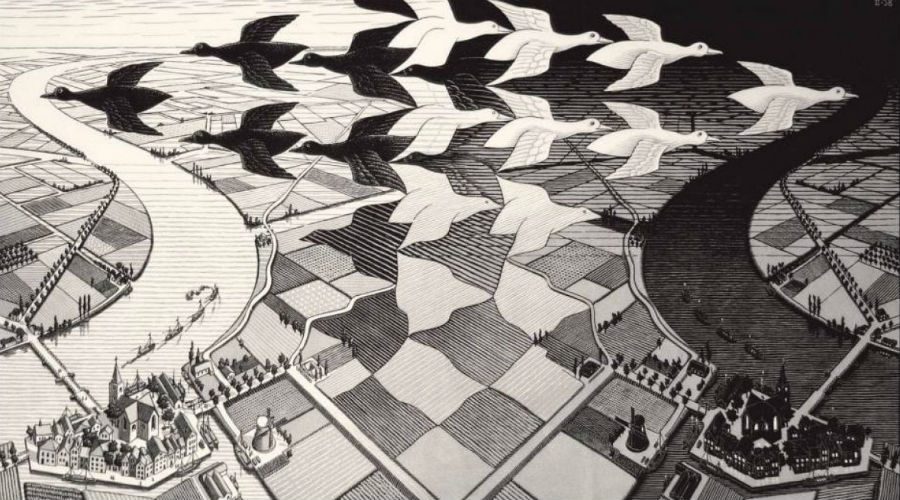
MC Escher
In fact, truth is merely another narrative we’ve been fed—rhetorical legerdemain. But it’s just a story: cognitive dissonance envelopes the notion and we build some heuristic defences around it; escalating commitment kicks in when someone attacks the notion.
The concept of Truth underlies entire societies, governments,
and legal systems. Idiomatically, we employ small-t truth to represent a sort
of relative proximity to match our senses to some observation. If I am asked if
a book is on a table when a book is on a table—ignoring semantics of what
constitutes a book, a table, or the concept of on—, and I say that it is, this is
considered to be a true statement. Of course, this statement is concerned with
the correspondence of observation and some shared reality. But this is
tautological or analytical. In the end, it’s petty.
Capital-T Truth is more universal (or multiversal), is so
much as it would be inviolable. Besides, the Truth of Truth, there are the
notions of Trust of Justice or Truth of Duty or Truth of Integrity. Truth of
any archetypes, really. Yet these are unobtainable—because there are imaginary
concepts.
Classically, archetypes are forms from which physical
objects sort of spawn. A table to an instantiation of some archetypal table.
Archetypes follow from Ancient Greek pathological notions of perfections—perfect
forms, shapes, harmonies, relationships, virtues, gods, and on and on. The
notion of perfect itself is an archetype in this sense.
But the causal relationship has been inverted. Empirical observations taken to imaginary extremes generate a notion of the archetype. Mother is an archetype—the perfect mother—, but it’s not that mothers are formed by some archetypical mould; it’s that the aggregation of mothers and how a perfect mother might be is the definitive. In Jungian psychology, all mothers are compared by their children against this archetypal form. In the Greek tradition, the virtuous mother would attempt to live up to this expectation.
Christian religion plays this up, too. Jesus and God are archetypes. Humans are fallible, but the virtuous strive to be like them; WWJD. Buddhists have their own archetypes of Buddha and Enlightenment, the realization of perfection in nirvana. Again, this is just a story.
Language itself is a human construct, and so anything within it is also constructed. It doesn’t matter whether language acquisition comes a priori or a posteriori. The language itself remains a fabrication.
Post Truth has been a popular topic recently. But what is post is the belief by many in the concept of truth. Although couched this way by detractors, no one is claiming that all truths are equally valid. The claim is rather that many truths are. To claim that women are equal to men and women are inferior to men cannot be evaluated because it would require a complete set of dimensions. Besides, even with this complete set of dimensions, a couple of dimensions are place and time, both of which are subject to change. Beauvoir pointed this out in Second Sex, where she noted that in hunter-gatherer societies physical size and strength may have made males ‘superior’ in matters of protection (a specific context), but that industrialization and automation have rendered this factor insignificant.
So why is any of this important? Well, it’s not. As I’ve
said, evidently truth was not necessary to become evolved to this point. And
since it’s a figment, there is little reason to believe that it will ever
become necessary. My point is merely to
point out that the emperor of truth is wearing no clothes.
Foucault (or Dworkin or Butler) may have had something to say about penetration politics—not the measure of electability in the professional political arena, rather the type that occurs in interpersonal sexual (or protosexual) relationships.
Although different cultures treat this differently, at least in the West, there is a certain polarity between the penetrator and the penetrated, with the penetrator presumed to be dominant and the penetrated to be passive or submissive. I’ve not done any deep research—especially cross-culturally—but I’ll guess that this is more prevalent in patriarchal settings. Religion adds the element of shame and fetishises sex in the first place.
Before Greece
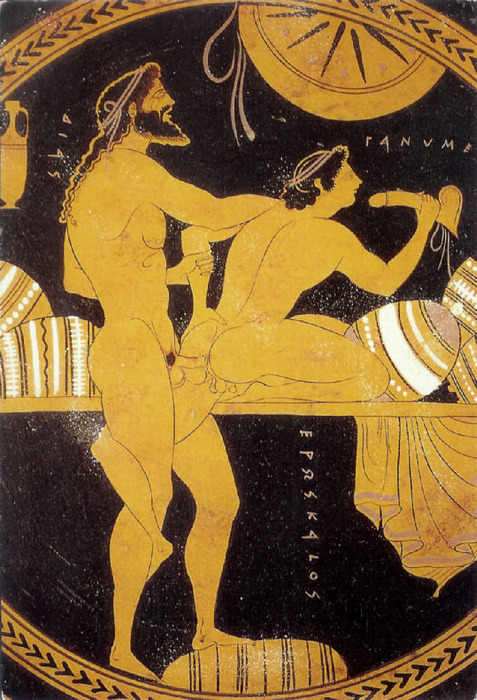
Even in Ancient Greece and some African cultures, same-sex penetration is allowed, but only when the penetrated is of a lower station, whether by age or class standing.
Greek Art
Anecdotally, female same-sex interaction is less of an issue than the male counterpart. I suggest that this is because of the penetration involved. It is also statistically speaking, the least risky. In BDSM parlance, there is a top and a bottom. The choice of these terms is not merely coincidental. And whilst they could represent the actors in physical space, they also relate to the power hierarchy.
Greek Pottery
We can also visit idiomatic speech—at least in English. Penetrative notions are most typically negative. I can’t think of any that are positive, so correct me if I am wrong.
‘I got fucked’ and ‘He fucked me’ are both terms of being taken advantage of. ‘I got screwed’ is the lighter version. ‘I got fucked in the ass’ ratchets it up a notch, perhaps. ‘Fuck you’ is not a term of endearment. I suppose I’ve heard people exclaim ‘fuck me’, but I don’t think one is supposed to reconcile that literally.
Boys will be boys
People we don’t like are cocksuckers. This one has always been a bit curious to me. It represents cocksuckers as some negative actor, but—as a fairly typical male—who doesn’t like a cock-sucker? How could this possibly be a negative? It’s because of the penetration. It’s yet another double standard. Most guys I know want to get their cock sucked and even enjoy it, but the sucker—that person is of a lower order; clearly a loathed order. Myself, I can’t use the term—at least not as a pejorative.
Sex seems to be a power play. Some people use sex as a weapon, either through teasing or withholding, which as I think about it are one and the same. If the receptor (allow me to stay with a heterosexual model for a while) gives in, the penetrator; if she doesn’t, she’s got the upper hand.
Greek Pederasty
Don’t get me wrong. In a functioning relationship, this is an activity of equals, but many relationships are dysfunctional on one level or another, and so it becomes a power struggle. He or she wants it less. One or the other party ‘gives in’ in order to remain in the relationship for some other reason, and so we are back to politics.
In the spirit of TMI (but hopefully not too too much ‘I’), my first wife hated doing dishes. Though I would have preferred not to wash them, I didn’t really care either way, so we alternated turns every other day. On her days, she’d offer a blowjob in exchange for my taking her turn. To me, it was a win-win proposition. Although I might have, I never viewed it as a power thing, though I did view it as transactional. Firstly, it was her idea; secondly, it seemed so consensual.
Unlearn Sexism
But where is the shame in sex? There is even shame in being seen nude in most circles. How did this happen? And why does there appear to be more shame in being penetrated? I’ll blame religion. It seems to be like a cancer that ruins everything it touches—like a reverse Midas touch.
Slut-shaming
I understand that in the past, sex could lead to death in childbirth or sexually transmitted diseases or infections, but with the widespread availability of barrier protection, this risk is substantially reduced. Think about this. What is the difference between a wife having (protected) sex with her husband each day for a year and a woman who has (consensual, protected) sex with different men each day of the same year? Ostensibly, nothing.
It’s not so much that the wife would advertise to the world that she had had sex each night—because sex is somehow shameful—, but if she let it slip that she and her husband had shagged the night before—or the past trend of nightly sex for a week—, there would be likely little more than a blush. For the unattached woman, there would likely be judgment and scorn. But this would be for no other reason than the taint of religious dogma.
John Lennon wrote this song in 1968 and released it as a solo artist, post-Beatles breakup, but he clearly was no post-modern. He embraced truth. He searched for it. To many, he had found it; following Heidegger’s logic, Lennon was authentic; not living the life someone else designed for him; living up to his potential.
This is quaint. I’d always loved John. He was my favourite Beatle. Paul was always too saccharine for me. I liked George, but his mysticism went off the rails. And Ringo—well, Ringo was Ringo. What’s not to like about the guy?—as long as you’re not talking about his prowess as a drummer.
I watched a YouTube video, and felt compelled to write a response—one I’ve recast and embellished here.
What is Postmodernism – Armored Skeptic
To a postmodernist, there is no objective truth. End of story. There is no further discussion. To postmodernists, a claim that there is some objective truth is parallel to hearing a proponent of religion who claims there is a God just because s/he says so. Truth is like God: it doesn’t exist. Period. End of story. And so like the religious who will ramble on for days about their God, so the modernist do the same.
Like the notion of God, Truth is a construct of human language, and they’re both fictions. People often confuse facts with truth. Facts are descriptive attributes about things or ideas whereas truth is about some inviolable, absolute notion. But facts are analytic or tautological: the car is red. Sure, we’ve constructed a term ‘car’ and a term ‘red’. If a thing exists that is both a car and red, then the statement is factually correct, but there is nothing true about it. It provides no additional information than ‘all bachelors are unmarried’.
The problem with truth is that we are attempting to make some universal claim, so let me pick an easy one: Thou shalt not kill: killing is bad. As an emotivist (post-modern philosopher AJ Ayer’s term), this translates to ‘Boo, murder’ or ‘I don’t like murder’, but there is no truth component to be found. Moreover, when it is brought to my attention that I abide with killing very frequently—by means of eating meat or vegetables—, I can attempt to limit the scope: Thou shalt not kill people. Of course, there are all sorts of escape clauses from this, whether wars, police action, capital punishment, euthanasia, abortion, and what have you. Each of these is differently good or bad subject to the observer. Why? Because there is no objective truth behind the claim. It was fabricated in the same manner Gods, governments, and other human institutions were fabricated.
So, the claim is that there is no basis for the status quo, which clearly jeopardises the standing of the status quo, so they pull a yellow card and argue that you are not allowed to argue without accepting their notion of truth. Otherwise, how can they win the argument? This is akin to arguing when you are stranded in the desert without fuel in your vehicle that there has to be fuel or else you can’t progress. And so the status quo has no fuel, and so it whines that the postmodernists just aren’t fair. In fact, they are accused of speaking nonsense, which sounds a lot like what the church claimed about heretics all those years ago. Only now, the modernists are the church holding onto a past that never was.
Finally, grouping all of these different postmodern disciplines together is like lumping all atheists together—they may have little in common save for the disbelief in God and gods, but their rationale and path may be orders of magnitude apart.
I haven’t done any film reviews, and I’m not about to start now. I’ve just watched What Still Remains on Netflix.
People become their own kind of monster.
What Still Remains Film Trailer
This is decent post-apocalyptic fare, some catalyst, societies, competing factions, good versus evil, at least in the eyes of the devout. But that’s not what I am going to be writing about.
What still remains contains good writing and strong character development. It does over-employ tropes, but this seems to be the norm these days: modular writing; rearranging the Lego pieces to make something that appears fresh. So what do I have to say?
Spoiler Alert: Proceed with caution…
This is a perfect depiction of the problems with property rights and social contract theory. There are apparently 3 factions—4 if you count independents.
Anna
Initially, there were the Changed, never seen on screen and perhaps not even contemporaneous to the current period, though they may reside in the unseen cities. Anna, the protagonist, and her family are among the independent. Peter, a preacher from the ordained, holier than thou faction. In the realm of ‘if you’re not with me (and our God), you’re against me, thence evil’, they are the arbiters of all that is good. And then there are the Berserkers, as named by the Ordained. To the Ordained, Berserkers aspire to be Changed, but the Berserkers view themselves more along the line of Spartans: Pain is good.
Peter
All scenes are shot in the wilderness, but the various factions have staked property claims with wide perimeters. The penalty for trespass appears to usually involve death of the offending party—or at least a hefty fee. This is Hobbes’ ‘solitary, poor, nasty, brutish, and short’ life outside of society quip, though he didn’t exactly account for a class of societies despite this being common in his day.
Berserker
So, these factions don’t actually have property rights; what they have is a notion of property, and they defend it with violence, as is a necessary condition for all property. In so-called modern societies, the violence is obfuscated much in the same manner that supermarkets obscure the carnage behind the meat. It’s still there; it’s just at arm’s length. Violate one of these ‘rights’, and you’ll see the violence inherent in the system.
And then there’s social contract theory—or the gaping flaw in the logic. Anna is an independent, but one can only be as independent as the ability to defend their independence. It’s sort of like contract law. If you can afford to defend a contract, you are entitled to having it enforced.
Redact intellectual property rant.
Anna doesn’t particularly want to belong to either faction, who have divided their world into two pieces in the same manner that, say, Britain and Scotland might have. If you happen to be born there through some loin lottery, you pretty much have to choose a side. Given Sartre’s no excuses policy, you can choose neither; it just won’t bode well for you. You’ve got no real choice.
Social Choice Theory
In Anna’s eyes, upon the death of her mother and brother, she is persuaded with reluctance to return with Peter to his community, a God-fearing bunch. Her mum had indoctrinated her into this cult of God through bible readings, so she was primed for the eventuality. Some independent interlopers attempted to block their return journey by claiming trespass, so Peter summarily offed them rather than paying their ransom—a fee Anna has been willing to tender.
When the two finally reached the sanctuary, Anna quickly realised that she had no say in the matter: she was either a (good) member or (an evil) dead. To reiterate, this is an underlying problem with social contract theory. There is no exit clause.
Side Bar: Some have argued that the cost of coerced—though they’d never use this term—participation and compliance is owed to the greater good. There is no reason given why this is preferred or across which dimensions better is being assessed—or good for that matter—, so don’t ask. Long live Jeremy Bentham and John Stuart Mill with a hat tip to David Hume.
“The first man who, having fenced in a piece of land, said “This is mine,” and found people naïve enough to believe him, that man was the true founder of civil society.
From how many crimes, wars, and murders, from how many horrors and misfortunes might not any one have saved mankind, by pulling up the stakes, or filling up the ditch, and crying to his fellows: Beware of listening to this impostor; you are undone if you once forget that the fruits of the earth belong to us all, and the earth itself to nobody.”
Hobbes, Locke, and Rousseau each approached social contracts from their own perspectives, but it may be interesting to note that each was a privileged white male of his day. Sure, Hobbes was a monarchist, and Rousseau was the Thoreau of his day, a nostalgist, but he like the others were beneficiaries of the status quo, save perhaps at the margins.
Anna thought she had sovereignty over her choices. In the end, the plot line prevailed, but then again, this was just a movie, so even her choices were scripted.
This is a continuation of my previous post—with a touch of TMI…
I was divorced some time ago, and I was ‘accused’ of giving gifts to another woman—a woman a met after I was served papers for the divorce. After her attorney asked if I had ever given any gifts to anyone, the judge scoffed when I asked for a definition of gift so that I could respond honestly. The judge actually rolled her eyes and made a comment that my approach was not going to work. So without an established definition, I replied, ‘No. I never gave any gifts to anyone.’ She was fine with the response. In fact, she already had made up here mind in the same manner when a person pleading the Fifth in the US is automatically seen as having something to hide and therefore guilty of something. It’s a fanciful notion that taking the Fifth somehow eliminates the concern in question, but the entire jurisprudence system is arbitrary and virtually capricious—despite supposedly being a deontological endeavour. In practice, the goal of organised Law is to elevate process over justice so as to at least give the appearance that it is fair and otherwise meaningful.
Lady Justice
So, is it possible to give a gift? Is it possible to know this? Is it possible to know the intent of anything?
Gift (n): a thing given willingly to someone without payment
If gift is defined as a something given willingly and without payment, what is the scope of without payment, and what constitutes payment? Is altruism even possible? Is this possible to know? Again, can anyone know the intent of another? Can anyone truly know the intent of their own actions? Does the unconscious or past experience obviate intent?
In my case, I gave a woman some—what might colloquially be called—gifts. There were no strings explicitly attached? Does this mean there were no strings attached? I had a romantic interest in this woman. Clearly, this courting game involved gift-given in return for some expected payoff at some time in the future.
What if I had given one of these gifts to a stranger on the street—perhaps a homeless person? Would that now be a gift? What if I was in a foreign place with a nil probability of encountering this person ever again and nobody witnessed the transaction and I would never tell another soul about it? Would this be a gift?
I suppose if I had no notion of karma, whether the Eastern variety or the Western Heaven-oriented variety, and it gave me no hormonal benefits relative to dopamine, serotonin, and oxytocin, I’d buy it.
So, accuse me of being pedantic, and you’ve made my point. We only want to employ language until the point it complies with our notion of our sense of truth. But it’s nothing more than this.






















 Philosophics