Political Path

People can change.

Although I have changed my opinion and perspective over the years, I feel that most people settle into their ways, fixing their positions with an unhealthy dose of confirmation bias. I’d like to think that I could change my position materially from where I am now given the introduction of new evidence, but I don’t think it’s likely. First off: because I am coming from a vantage where I feel I am ‘right’.

Don’t believe everything you think.

— Various

Of course, there is no absolute right, but from the perspective of the times and place and some triangulation, I’ll say ‘relatively right’.

Rewinding…

When I left high school in 1979, I considered myself to be generally Conservative — at least as I understood the word to mean and without dimension or nuance. I’m not sure I had a great grasp of the definition.

Upon graduation, I entered the military. I remember in conversation with a mate that I was a Conservative. He laughed, and said I was the least Conservative person he’d ever come across. I was perplexed, but I had to reorient my self-perspective.

New Definition

I decided that I was a Conservative — a Fiscal Conservative —, but I was a Social Liberal. I’d pretty much been a Social Justice Warrior (SJW), concerned with the underdogs, but it wouldn’t be on my dime — or the prospect I had for future nickels and dimes.

I held this position for years — until I realised that the two positions were untenable. You can’t simultaneously offer full social equality for free, and these were rights we were discussing. Fundamental rights. If money was the friction between a right and its realisation, then it needed to be spent. Fiscal Conservatism be damned!

Politicus Interruptus

Somewhere in the fray, I had dabbled with Libertarianism. Again, I dismissed this as an untenable fantasy. There had never been even close to an instance of this working, and it goes against the grain of all social concepts. It’s built on a dream — somehow anarchy without the anarchy, so anarchy + magic.

Progress

At some point, I didn’t like the PR of the Liberal tag, so I opted for Progressive. In the real world, I tend to side pragmatically with Progressives — the Bernie Sanders crowd in the US — , though I understand the illusion of progress and of politics in general.

Searching further to find a political identity, I settle on anarcho-syndicalism, the system I most identify with today, though there are only slightly more examples of this as there are Libertarian instances, a problem being that when some people see a leaderless group, they see it as a vacuum, and history repeats itself, so I’m not sure how sustainable this system could be.

This is now…

I am under no delusion that there is a right way for society to exist. I do believe there are plenty of wrong ways, but there are too many dimensions and complexities to have a single way. After all, how are you optimising the system? Trade-offs exist, and making a choice to maximise X might (and does) mean that Y is no longer maximised. Do you make X = 10 and Y = 8, or do you settle for X = 9 and Y = 9? And there are decidedly more than just X and Y.

There is no real reason to believe that society or even humans should exists, but given consciousness and self-preservation urges, I’ll take that as a given. That’s an inviolable metanarrative element.

Criminal Conservatism

A few years ago, I shared with a colleague that I had noticed that my high school classmates who seemed to be the most non-conformist (or perhaps the most anti-authoritarian), the ones most likely to have abused drugs and alcohol and most likely to criticise the Man, have by and large become extremely conservative on the political spectrum. Most are card-carrying Republicans, and dreaded low-information voters, continuing the trend of low-information acquisition and processing. He said that he had noticed a similar trend.

I still keep in contact with some some old mates who are Conservative Republicans, but who were high-information consumers then and still, so I am not saying that all Conservatives are low-information people.

A man who is not a Liberal at sixteen has no heart; a man who is not a Conservative at sixty has no head.

—Benjamin Disraeli (Misattributed)

The past couple of years, in a sort of nod to Bukowski, I’ve been researching or circulating among the underbelly of the United States, the veritable dalit-class comprised of drug dealers and users, pimps, prostitutes, and thieves. And I’ve noticed the same trend. These people might fear or hate the police and the system, and they may not vote or even be high-information seekers, but they seem to have a marked propensity to Conservatism. I admit that this is anecdotal and rife with confirmation bias, but this is my observation.

To broad brush any group into some monolith is always a fools errand and missing dimensional nuance, but the general direction holds. In my observation, these people are very black & white, and they want to see law & order (as much as they want to avoid its glance). They are interested in fairness, and call out being beat, as in being shorted in a drug deal or overpay at the grocery store–the same grocery store from which they just shoplifted.

When they see a news story, ‘That bank robber deserved to get caught’ would not be an unexpected response. Even if they got caught, they might voice that they deserved it. The received sentence might be a different story.

I am not sure why this shift from anti-establishment to hyper establishment happens. I’ve also noticed that even if they dislike the particular people serving government roles, they still feel that the abstract concepts of government, democracy, capitalism, and market systems make sense, if only the particular instance is not great.

One reaction I had is that some of these people feel that the transgressions of their youth might have been avoided only if there were more discipline, and so they support this construct for the benefit of future generations, who, as embodied in Millennials, are soft and lack respect for authority.

I’d recently re-discovered a Bill Moyers interview with moral psychologist Jonathan Haidt, and there is some relationship. And whilst I could critique some of Haidt’s accepted metanarrative relative to society, his points are valid within the constraints of this narrative.

The video is almost an hour long and was produced in 2012, it is a worthwhile endeavour to watch.

I am wondering if anyone else has seen this trend or who has experienced a contrary trend. Extra points for an explanation or supporting research.

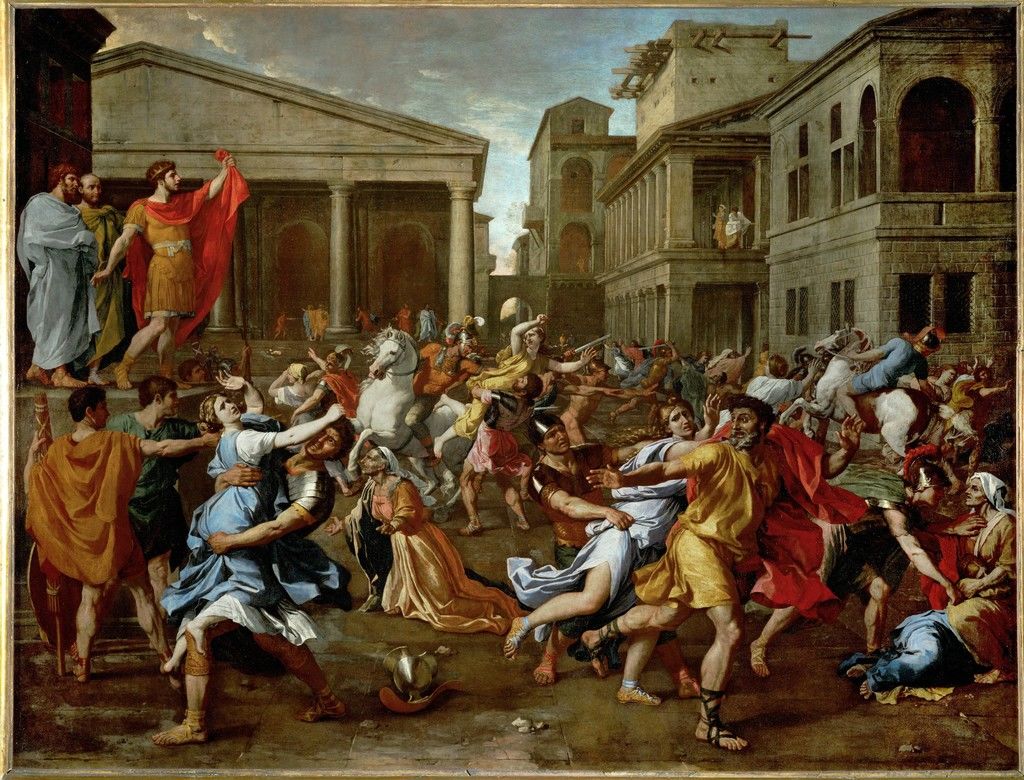
Cover image: Sean Penn, excerpt from Fast Times at Ridgemont High, and Brett Cavanaugh, SCOTUS and posterboy Conservative hack

Hopeless Hubris

There’s a dangerous arrogance to hopelessness… Total hopelessness assumes that we know everything there is to know.…
When we think we know everything, we preclude opportunity.

James McCarthy

In a recent panel discussion on Climate Change, James McCarthy played Enlightenment standard bearer as he derided the hopeless. Steven Pinker, whom I’ve mentioned in this vein plays to the same tune.

Whether realistic, simply optimistic, or Pollyannas remain to be seen. Future history will be the final arbiter, but I want to touch on the relationship of arrogance to hopelessness.

McCarthy is right to make the equation, but what’s left unsaid is the hubris on the other side, of the Scientists, who put more faith in possible solutions than is, perhaps, warranted. This, too, is arrogance:

We gotten here from there, so we must be able to continue from here to the next there… along our next journey to progress.

It reminds me of the one about the person falling to their death from a tall building. At the fifth floor, in response to the question, ‘How’s in going?’ says, ‘So far, so good‘.

This is missing the perspective that we could already have situated ourselves into some evolutionary dead end, just awaiting the inevitable ground splat.

I’m not a pessimist. I am merely pointing out the arrogance of both vantages. In fact, I see it as a line curved so as to bend back upon itself.

Hubris Circle

Whilst one said may be correct, it is not through knowledge but through ignorance and emotion they arrive at their position. It’s primarily temperament and opinion. It’s certainly not science, save the blind faith variety.

I don’t really have much to say on the subject at this moment. I just wanted to share my reaction.

The Problem of Rape

Last week, Motherboard published the full email thread in which Stallman wrote that the “most plausible scenario” is that Epstein’s underage victims in his campaign of trafficking were “entirely willing.” Stallman also argued about the definition of “rape” and whether the term applies to the victims.

When someone else in the email thread pointed out that victim Virginia Giuffre, who was 17 when she was forced to have sex with AI pioneer Marvin Minsky, Stallman said “it is morally absurd to define ‘rape’ in a way that depends on minor details such as which country it was in or whether the victim was 18 years old or 17.”

Vice.com

Richard Stallman resigned from several positions after these comments were surfaced.

The United States have a communication problem that transcends their petty polar politics, and this issue extends to the West.

The conversation around rape and Julian Assange became an issue based on Sweden’s characterisation of the crime as they see it, but this is different.

As with many jurisdictions, the United States creates age-based legal boundaries. This is expedient, to to sure, but we also know, rape aside, that people mature at different paces–not to mention the concept that the brain is not fully developed (whatever than means) until around age 30.

Age is used to delimit majority for contracts, marriage, sex (consent), alcohol, voting, military service, and so on, but it’s a weak tea proxy.

As a legal/social subject, rape is fairly categorically reviled, but it is hardly cut and dry, especially when one confounds the issue with the concept of statutory rape, which is where the systems strips the concept of consent from the equation, so that at 6,569 days a woman (because this is predominately applied to females over males) has no right to consent but at 6,570 does. This is further exacerbated because different jurisdictions have different ages of consent and loopholes, that are beyond the scope of my commentary and misses the point of communication.

Hot Button

Rape, race, and gender are hot button topics used to curtail and derail legitimate discourse and conversation. Whether Stallman’s comments exceeded the bounds of my argument does not invalidate the argument. Perhaps, he did overstep the bounds of civility, but that’s not my concern here.

To me, the question is, given I feel that the sole purpose of jurisprudence systems is to consolidate power to the status quo, how do we create a fair but ‘knowable’ boundary around things for which we currently rely on age, one where both sides of the consent equation understand the limit ex ante. But given legal systems are not designed for precision but for simplicity and expedience (albeit in a Rube Goldberg sort of way) and given that most people don’t question systems themselves, I don’t expect it change any time soon.

Neither do I expect the broader population not to be distracted by these same hot button topics. Distraction is a standard rhetorical device.

Gay Genes

I’ve been so busy attending to other things, that my blogging here has gone by the wayside. Philosophy is an activity meant for those with spare time.

Besides philosophy, genetics is an interest of mine. An article I was reading, Genetics may explain up to 25% of same-sex behavior, giant analysis reveals, prompted me to react and respond. This article by the Economist came out ,too.

As the article states, there is no one gene, and we can’t even predict ‘gayness’ based on some configuration of genes. That humans’ knowledge of genetics is so nascent is one reason, and over-imagining the impact of genes on behaviours may be a problem. Just because you want to find a relationship doesn’t mean one exists.

My take is that genetics establish a predisposition. Genes may limit your height to 180 cm, but environmental factors may not allow you to reach this limit, and anything short of genetic modification will not allow you to surpass this limit.

I don’t see a reason for sexual orientation to be different. One may have a propensity to same sex attraction, let’s say 70%, but if environmental factors fail to catalyse this predilection, it may never manifest. Even this is too simplistic.

Being ‘gay’ is an identity marker. Just because a person has same-sex relationships does not mean the person identifies as gay. Moreover, one can be ‘virginal’ or celibate and otherwise have had unexpressed same-sex tendencies. More-moreover, ‘gay’ is not about activity; it’s an emotional attraction. A ‘gay’ person might have sex outside of their identity orientation for myriad reasons, for example, access to a partner of the preferred orientation (say, prisoners) or for survival (say, prostitutes).

On balance, I’d argue that this is a quixotic venture into finding the underpinning of a human social construct. Once again, humans obsessed with categorisation, as if finding a category provides special meaning to the thing in it.

What’s wrong with anarcho-syndicalism?

What’s an anarcho-syndicalist supposed to do in the advent of artificial intelligence, process automation, and robots?

Wikipedia relates anarcho-Syndicalism as follows:

Anarcho-syndicalism (also referred to as revolutionary syndicalism)[1] is a theory of anarchism that views revolutionary industrial unionism or syndicalism as a method for workers in capitalist society to gain control of an economy and thus control influence in broader society. Syndicalists consider their economic theories a strategy for facilitating worker self-activity and as an alternative co-operative economic system with democratic values and production centered on meeting human needs.

The basic principles of anarcho-syndicalism are solidaritydirect action (action undertaken without the intervention of third parties such as politicians, bureaucrats and arbitrators) and direct democracy, or workers’ self-management. The end goal of syndicalism is to abolish the wage system, regarding it as wage slavery. Anarcho-syndicalist theory therefore generally focuses on the labour movement.[2]

Anarcho-syndicalists view the primary purpose of the state as being the defense of private property, and therefore of economic, social and political privilege, denying most of its citizens the ability to enjoy material independence and the social autonomy that springs from it.[3] Reflecting the anarchist philosophy from which it draws its primary inspiration, anarcho-syndicalism is centred on the idea that power corrupts and that any hierarchy that cannot be ethically justified must either be dismantled or replaced by decentralized egalitarian control.[3]

As a matter of preference, I’ve leaned toward anarcho-syndicalism. I don’t have a lot of faith in humans or humanity to govern or self-govern. The arguments for this, whether monarchies, democracies, plutocracies, or even anarchies are each rife with its own sets of problems. Still, I favour a system where there is no class of governors, though I am more of a fan of Proudhon over Marx.

Mind you, I don’t think humans make very good judgements and are as bad in groups as individuals but for different reasons—and especially where complexity or too many choices are available. That we’ve survived this long is, quite frankly, a miracle.

This said, it isn’t my problem. My contention is with the syndicalist aspect. If all of this human as worker displacement occurs as some are forecasting, there will be precious few workers. I am not saying that this is inevitable or will ever happen. My concern is merely conditional. If this were to happen, the idea of a worker-centric system is daft.

Do we just defer to people categorically, where we arrive at simple anarchism? Without delving, there are different flavours of, and I have neither the time nor the inclination to debate, for example, the merits of anarco-capitalism (an oxymoron if there ever was one) versus anarcho-communism or anarcho-transhumanism for that matter.

Although, I like how Kant identified four kinds of government…

  • Law and freedom without force (anarchy)
  • Law and force without freedom (despotism)
  • Force without freedom and law (barbarism)
  • Force with freedom and law (republic)

…the whole notion of freedom is another weasel word, and laws without force are unenforceable—pun intended. At least the syndicalism felt like it was intentional or purposeful. I understand why Plato despised the rabble, but as with the sorites paradox in the heap-hill distinction, where to the rabble distil down to something meaningful?

Fashionable Fascism

So, it started with this video.

Video: The fascist philosopher behind Vladimir Putin’s information warfare — Tim Snyder

I’d never heard of Ivan Ilyin, so the entirety of my knowledge derives from whatever Tim Snyder conveys in this clip. The risk is that he may misrepresent Ilyin’s message, much like Stephen Hicks misrepresents Postmodernism in his work. So, if you’ve got a deeper understanding of Ilyin, apologies in advance, but I am only reacting to this clip without much intention of reading his published work not performing additional second-hand research. Sue me.

Snyder raises three ‘important ideas’ from Ilyin:

/1/ Social advancement is impossible

Each person is like a cell in a body, each having it’s defined function or purpose. So, freedom means knowing one’s place, which function to perform.

/2/ Democracy is a ritual

People vote, but they only vote to affirm their collective support for a leader. The leader is not legitimated or chosen by votes. Voting is just a ritual by which people people endorse a leader every few years.

/3/ The factual world doesn’t count

The manifest world is not real. It’s a mishmash of facts, which have no intrinsic value, but these facts cannot be unified into some larger whole.

Nothing is real, or what is real isn’t important. The only things that really matter are preferences and biases.

Through this, Ilyin surmises that the only true thing is Russian Nationalism and its role as saviour to bring order back to the world.

Of course, this conclusion is precisely the one to which the US arrived except that its American Nationalism is the correct version.

. . .

As to points 1 and 2, I can’t disagree with the base statements. Social advancement is impossible because we’ve got nothing to measure it against. As I’ve said before, we move recognise change and a sense of movement, but movement is not progress.

As I’ve already admitted, I don’t enough about Ilyid, so I am taking Snyder’s statement at face-value, but it does not follow that because social advancement is impossible, we need to adopt some deontological position that freedom means knowing one’s place. It’s a bit of a forced non sequitur.

Democracy is a ritual. It’s a failed experiment, and the only thing that remains is the shell of an empty promise. I do think that the voting serves to legitimise the representative figurehead. There are persons who debate the legitimacy of, say, Bush-43 or Trump-45—or perhaps just their competencies—but this is a twenty-first century phenomenon, as US politics have become more and more divisive.

That the factual world doesn’t count is difficult for me to buy into. In many ways, it is easy enough to manipulate people with non-facts masquerading as facts, but I am not convinced that this contingent is large enough to gain critical mass in the long run. I understand history well enough that these anti-fact forces have run roughshod over entire civilisations, whether the Inquisitions or witch-burning or current religious organisations and other snake oil hawkers.

Don’t let the bastards grind you down.

Like the characters in Orwell’s 1984 or Atwood’s The Handmaid’s Tale, there is still resistance. I’m not even trying to make the claim that my vision of a world absent of superstition is the true world or the right vision. I am only claiming that my vision of a world without it is more pleasant to me.

But, then again, that just confirm’s Ilyid’s point that the only thing that matters is preference, and there is no separating bias from preference.

Emotion Trumps Reason

“Reason is, and ought only to be, the slave of the passions, and can never pretend to any other office than to serve and obey them,” said David Hume said in his Treatise of Human Nature.

Reason is, and ought only to be, the slave of the passions, and can never pretend to any other office than to serve and obey them.

David Hume, A Treatise of Human Nature

Hume claims that “reason alone can never be a motive to any action of the will,” and that reason alone “can never oppose passion in the direction of the will.”

In the United States, forces on the Left have still not learnt this lesson. They are still trying to fight emotion and irrationality with reason. It’s like trying to coöpt the insane with rationality. It’s not going to happen.

And despite protestations, even the most supposedly logical of us are still motivated by some emotion or passion, as much as we can try to deny it. One can claim to have become an accountant or an engineer or a physicist because it was a calculated, logical thing to do, but in the end, even the brightest of these are driven by passion, by emotion.

As long as we are fighting emotion with reason, the battle is already over before it starts. We need to fight emotion with empathy. This is where the story of the oak and the willow comes in handy. Reason is the oak. Reason is the hare, but emotion is the supple willow of the tenacious tortoise.

Wage this fight and escalating commitment will prevail, as the emotional response will trigger a sort of fight or flight, but your opponent’s reason will form a hard shell to fend off any attacks.

But don’t feel too smug. It’s only your emotions that give you the passion to fight the good fight. Reason has convinced you that this is the logical route.

Moral Pragmatism

It appears you are interested in the workings of morality from a practical perspective.

This statement occurred in a discussion thread on The Philosophical Hack.

I don’t feel there is another perspective. It is a human construct of language, but, in particular, it’s a social construct. By definition, language is arbitrary (though not capricious), any anything within language is necessarily arbitrary, too.

Morality and its cousin, ethics, are essentially normative rules of conduct, so they are, foundationally speaking, pragmatic: what is the best system for a society to flourish. This implies some goal or goals. In essence, this becomes an optimisation problem that involves systems thinking, and humans are particularly poor at systems thinking especially when faced with complexity. Along our evolutionary path, managing complexity was not a huge survival factor. Kahneman and Tversky identified two systems: System I is the sort of automatic reflexive system and System II is for advanced functions. System II requires a lot of energy and upkeep. For most humans, it’s not well-developed or maintained,and System I appears to be the arbiter and has right of first refusal, so it attempts to solve heuristically something that should be assessed analytically.

Why the ramble? Morality is a complex system with boundary conditions and dynamics: precisely what humans are poor at. Just defining the boundaries is a challenge. Perhaps this is why some people simply attempt to define the boundary as universal, but this creates its own challenges. And many reject universal morality, opting for smaller moral domains—nations, states, municipalities, communities, schools, churches, families, peer groups, couples. To Hegel and Nietzsche, the main concern is authenticity for the individual. And Nietzsche didn’t feel that there was any one-size-fits-all morality to begin with. I could operate with different moral imperatives than you. This was most evident in his Master-Herd distinction.

But since I reject the notion of objective morality, it is necessarily normative or relative or subjective. Here, we end up trying to optimise an equilibrium model, but the trick is what to optimise.

In the modern age, the consensus is to maximise happiness or utility, but, as I’ve mentioned before, we are still left in a quandary: do we optimise personal happiness or group happiness, and what group? A nationalist might choose to draw a boundary around the nation. This will maximise happiness within the borders without concern of whether ‘people are starving in Africa’.

Of course, there are multiple dimensions to any morality. If there are two people and one has $100 and the other would feel happier to take it, in a utility optimisation model, there is nothing to defend not taking it. Prospect theory within behavioural economics provides some rational insomuch as humans tend to value loss over gain, so the $100 received is perceived as having less value than the person losing it. This is further complicated if the person receiving it is poor—perhaps s/he has no money—and the person relinquishing it is Jeff Bezos, to whom it is nothing more than a rounding error.

I mention these because we could have a positive sum game (borrowing from game theory)—the gain to the poor person would outweigh the loss leading to a net positive gain—, and yet Pareto optimisation disallows this. Of course, happiness and utility cannot be measured in the first place and they are not persistent in the second place.

My point in all this is to argue that humans are woefully ill-equipped to grasp these topics, and so most of this is not much more substantial than mental masturbation. And this leads me full circle to me original contention that morality and so-called moral truths are nothing more that rhetoric, the ability to persuade that your position is the truest truth.

Emotion-Reason Scaling

I’ve been engaging in an online dialogue on the topic of a scale or continuum of emotion and reason with Landzek through comments on his blog. Since, I am unable of posting images in his comments (AFAIK), I am posting them with commentary here.

He’s got 4 parts of this topic (so far), but, for reference sake, it starts here. Without retreading context you can get on his site, the essence is the notion of a scale, a spectrum between emotion and reason. In part 4, he conveys something I interpret as a time series graphically as image A.

Emotion and reason are a dimension represented on the Y axis, and time is on the X axis.

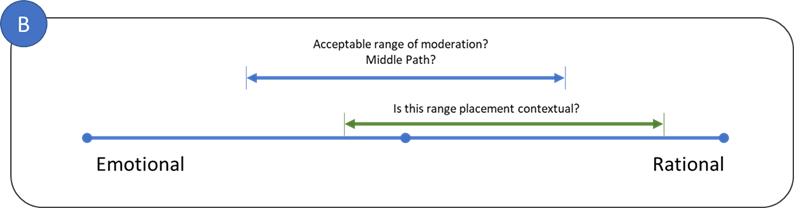
Prior to this, time was not a factor, so I had been constructing this as a simple continuum as shown in image B.

Here, there is only a X axis, running from emotional to rational, representing reason. Ignoring for the time of the index of the scale and not being concerned if the relationship is even-tempered linear or something else.

Secondarily, is there a quality perspective to the placement? My initial questions are embedded on the graph.

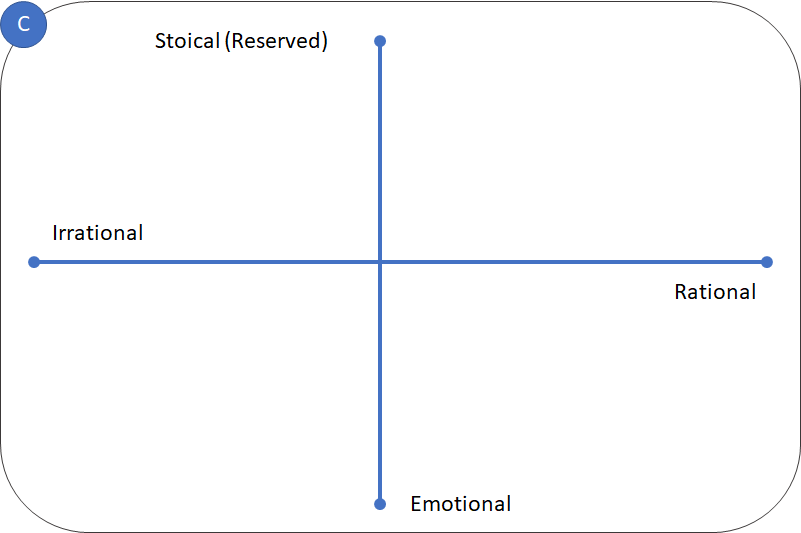
As I don’t feel that the Emotional-Rational scale are opposites, I’ve been thinking through how this scale might work. My first take was along these lines, creating a Cartesian plane.

In this, Irrational and Rational create an X-axis scale and Reserved and Emotional create the Y axis. I’m not sure what the nomenclature opposite of Emotional is, but stoical or reserved are placeholders for now.

Upon further thought, I am not sure irrational is the extreme opposite to rational. I am also not sure what the interplay of rational versus irrational versus non-rational should be, but I created a fourth chart as a basis for discussion.

I am not making a claim that any of these are correct. I am just trying to think this through visually. As I’ve got a day job, I need to get back to, I at least wanted to provide this foundation for conversation.