
I am considering a new essay. That’s nothing new, but this was born from personal experience. Whilst reading Derek Parfit’s Reasons and Persons, I reached the chapters on moral arithmetic and imperceptible harms and effects, and it caught my attention. Not in the ‘Aha!’ way, but because I felt excluded given my own experience. My mind wandered off the reservation, but I wondered if my anecdote might be generalised. After a discussion with ChatGPT, Grok, DeepSeek, Gemini, and Claude, I concluded that it can. As is my practice for academic writing, I formulate a thesis and then an abstract at the start. Then comes the real work.
Thesis Statement
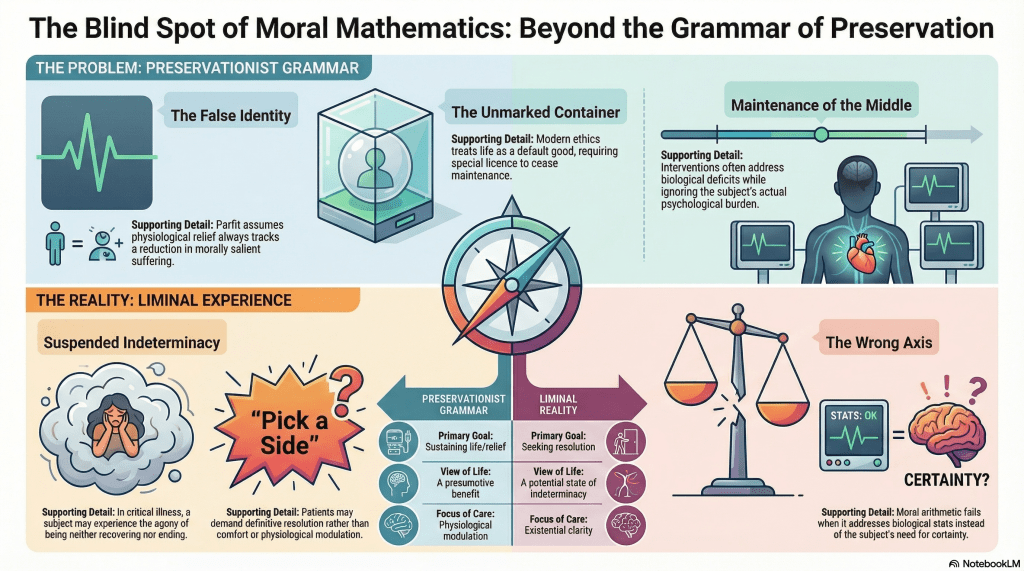
Derek Parfit’s moral mathematics relies on an undefended identification between physiological relief and suffering-reduction. Liminal experience exposes the instability of that identification at its source: what is addressed may be a bodily deficit while the suffering that matters lies elsewhere, in suspended indeterminacy itself. Because the preservationist grammar Parfit inherits treats continued life as presumptively good and bodily modulation as prima facie benefit, it cannot distinguish cases in which relief tracks morally salient suffering from cases in which it merely maintains the middle.
Abstract
This essay argues that Derek Parfit’s discussions of ‘moral mathematics’ in Reasons and Persons are not neutral exercises in moral reasoning but operations conducted within a prior ontological grammar that predetermines what can count as a benefit, a harm, and a morally salient outcome. While Parfit explicitly addresses aggregation, commensurability, and imperceptible effects, his examples presuppose an unexamined identification: that physiological relief tracks suffering-reduction, and that such reduction, however marginal, constitutes benefit within a life treated as presumptively worth preserving. This preservationist orientation is not argued for but built into the structure of the cases themselves.
The essay develops this critique through Parfit’s micro-allocation cases, particularly those involving the distribution of small amounts of water to relieve thirst. These examples appear to demonstrate that imperceptible reductions in suffering can aggregate into morally significant goods. But the argument depends on a prior identification that may fail at the point of origin. Slaking thirst addresses a physiological deficit; it does not necessarily diminish the suffering that is morally salient to the subject. The essay does not claim that physiological modulation never tracks suffering-reduction – in many cases it plainly does – but that Parfit’s grammar lacks the resources to distinguish the cases in which it does from those in which it does not. It treats all bodily modulation as benefit by default, and this default is what the essay sets out to make visible.
Drawing on a first-person account of critical illness – respiratory failure, not pain; a demand not for comfort but for determination in either direction – the essay argues that such cases function not as marginal exceptions but as diagnostics that reveal the grammar operating on the wrong dimension of the moral object. The experience of wanting not relief but resolution (‘pick a side’) is both possible and intelligible, yet the framework has no notation for it. What the intervention addressed was a physiological deficit; what it left untouched was suspended indeterminacy – the condition of being maintained in the middle, neither recovering nor ending. That the trajectory eventually resolved toward survival cannot retroactively validate the intervention on the axis that mattered during the interval itself; to argue otherwise would be to confuse post hoc survivorship with moral justification.
The essay argues further that this limitation belongs not to Parfit alone but to a broader preservationist syntax operative across Western medical ethics, legal frameworks governing end-of-life care, and liberal moral philosophy more generally. Within this grammar, life functions as the unmarked container of value; sustaining it is treated as prior to any calculation about its contents; and cessation requires special licence. The cultural entrenchment of this grammar explains why Parfit’s examples feel intuitively compelling: they inherit commitments so deeply embedded that they register as neutral premises rather than contestable positions. The point is not that preservationism is indefensible but that it remains undefended – operative yet unexamined.
Finally, the essay notes that Singer’s universalisation of moral responsibility intensifies rather than resolves the underlying difficulty, since it collapses the bounded cases on which Parfit’s arithmetic depends. What emerges is not a disagreement about consequentialism but about the grammar through which suffering, benefit, and moral salience are first made legible – and about whether that grammar can survive contact with the full range of conditions it purports to govern.
 Philosophics