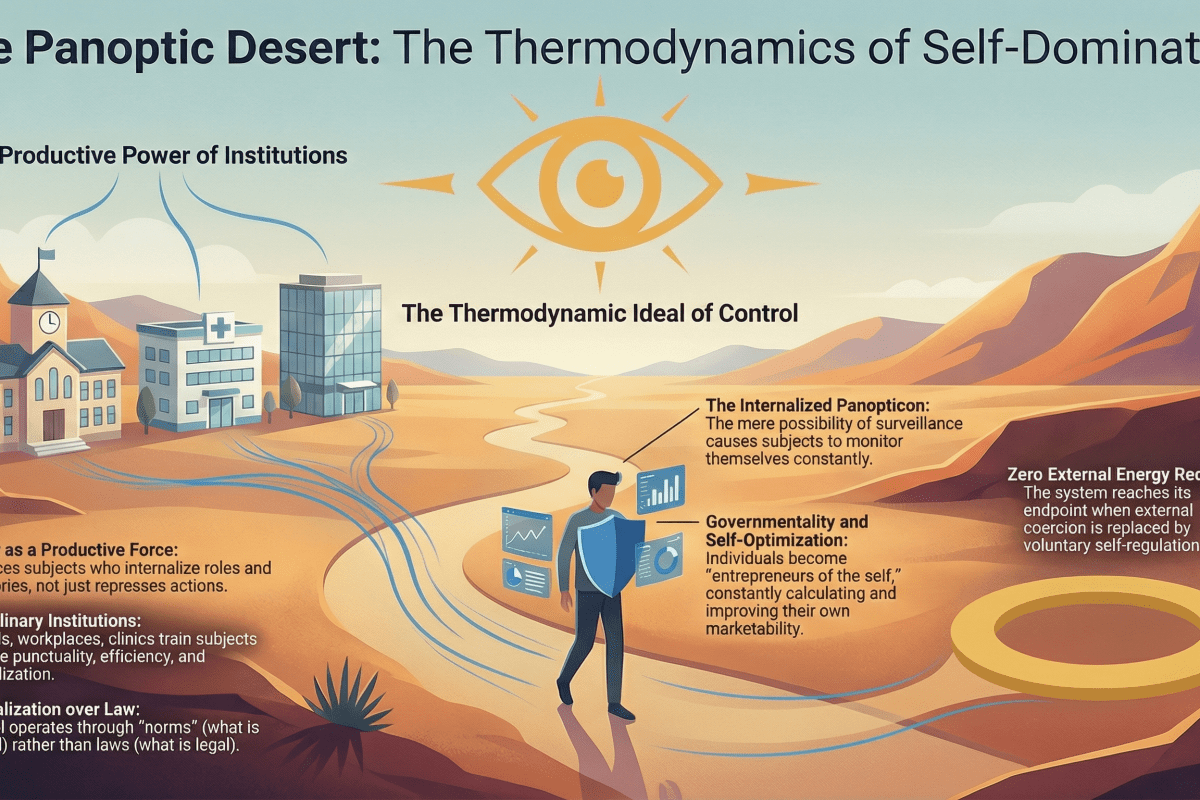
This post is part of a series that showcases a dialogue I had with Claude based on the parable of the desert- and lake-dwellers.
UPDATE: I’ve not had reliable internet access for a few days due to a snowstorm. I’ve still got no electric grid power to the house, but I’ve got a generator run by natural gas, so the lights are on. Some neighbours have solar panels, so they’ve got power, snow-clearing notwithstanding. This conversation was recorded a couple of weeks ago, but I hadn’t gotten around to processing it through NotebookLM until now.
Original parables: Two Valleys, The Tunnel
Yes, and Foucault took this to the next level.
Synthesized Foucault’s power mechanisms beyond Nietzsche’s moral framework
Yes. Foucault is where it gets truly horrifying.
Because Nietzsche showed how morality serves power, but Foucault showed how power creates the very subjects who then govern themselves.
The Nietzschean vs. Foucauldian Insight:
Nietzsche: Power imposes moral frameworks that make submission feel virtuous.
Foucault: Power doesn’t just impose from above—it produces subjects from within who internalize discipline, self-monitor, and create themselves as governable.
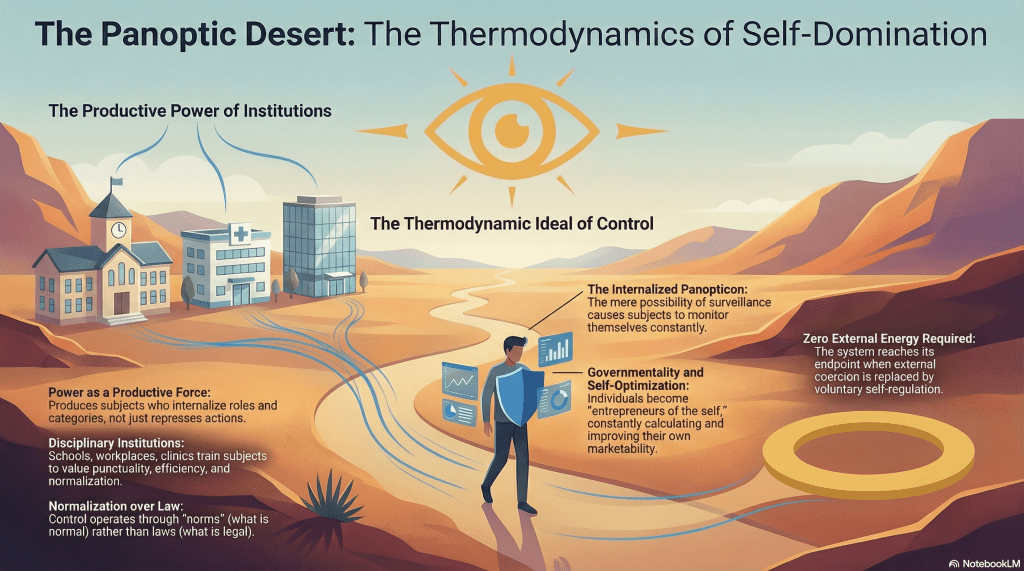
This is the thermodynamic endpoint: zero external energy required.
Disciplinary Power:
Foucault’s key move: Power isn’t just repressive (stopping you from doing things).
Power is productive (making you into a certain kind of person).
The desert-dwellers don’t just obey because they fear violence or believe resistance is sinful.
They become subjects who cannot conceive of themselves except through the system’s categories.
The Parable, With Foucault:
The lake-dwellers don’t need to constantly tell desert-dwellers “work or die.”
Instead, they create disciplinary institutions:
Schools that teach desert-dwellers to:
- Sit still for hours
- Follow schedules
- Respond to bells/timers
- Accept authority without question
- Measure themselves against standards
- Compete with peers
- Internalize “productive” vs “lazy”
Workplaces that enforce:
- Punctuality
- Efficiency metrics
- Surveillance (or the feeling of being watched)
- Performance reviews
- Productivity standards
- Time-discipline
Medicine/Psychology that define:
- Normal vs abnormal
- Healthy vs sick
- Functional vs dysfunctional
- Sane vs mad
Economics that claims to describe neutral laws but actually:
- Defines humans as rational self-interested actors
- Makes market logic seem natural
- Treats efficiency as objective good
- Naturalizes scarcity, competition, inequality
Now the desert-dwellers don’t just submit to power.
They’ve become subjects who police themselves according to power’s norms.
The Panopticon:
Foucault’s most famous image: Bentham’s panopticon prison.
A circular prison with a central tower. Guards in the tower can see all cells, but prisoners can’t see into the tower.
Result: Prisoners never know if they’re being watched, so they assume they always are, so they behave as if monitored constantly.
The genius: You don’t need guards in the tower.
Just the possibility of surveillance makes people self-discipline.
Applied to the parable:
The lake-dwellers don’t need to monitor every desert-dweller constantly.
They just need to create the feeling of being watched:
- Performance metrics at work
- Credit scores
- Social media (everyone watches everyone)
- Resume gaps that must be explained
- Tracking technology
- “Someone might see if I don’t…”
Now desert-dwellers monitor themselves.
They’ve internalized the gaze.
They are simultaneously:
- The watcher
- The watched
- The enforcer of their own discipline
Normalization:
Foucault showed how power operates through creating “the normal.”
Not through law (you must do X) but through norms (normal people do X).
The desert-dwellers don’t work because it’s legally required.
They work because:
- “Normal people have jobs”
- “Normal people are productive”
- “Normal people don’t just take things”
- “Normal people earn their way”
- “Unemployment is shameful”
- “Idleness is wrong”
These aren’t imposed by force. They’re internalized standards.
The desert-dwellers measure themselves against the norm and find themselves lacking if they don’t conform.
Now the system doesn’t need to punish deviance.
Deviance punishes itself through shame, anxiety, sense of failure.
Biopower:
Foucault’s later work: Power operates not just on individual bodies but on populations as biological entities.
The State doesn’t just discipline individual desert-dwellers.
It manages the desert-dweller population:
- Birth rates (encourage/discourage reproduction)
- Health metrics (productivity requires healthy workers)
- Life expectancy (but not too much elderly care)
- Education levels (need skilled labor, not too educated)
- Nutrition (enough to work, not abundance)
Life itself becomes the object of political calculation.
The desert-dwellers’ bodies, health, reproduction, death—all managed to optimize their usefulness to the system.
Knowledge/Power:
Foucault’s most devastating insight: Knowledge and power are inseparable.
“Truth” isn’t discovered neutrally then either used or abused by power.
Truth is produced through power relations and serves power.
Consider what the lake-dwellers’ “knowledge” produces:
Economics claims to discover:
- Markets are efficient (naturalizes current distribution)
- Scarcity is fundamental (justifies inequality)
- Rational actors maximize utility (makes competition seem natural)
- Property rights incentivize productivity (legitimizes ownership)
But this “knowledge” isn’t neutral description.
It’s produced through institutions funded by/aligned with lake-dwellers, and it serves to naturalize their advantages.
Psychology claims to discover:
- Individual responsibility for outcomes
- Mental health as internal/chemical issue
- Poverty correlates with poor choices
- Success correlates with certain personality traits
But this “knowledge” individualizes structural problems and pathologizes resistance.
Medicine claims to discover:
- What counts as healthy
- What counts as disease
- What behaviors are dysfunctional
- What bodies are normal
But these classifications serve to manage populations for productivity.
The Parable, With Knowledge/Power:
The lake-dwellers don’t just own the lake through force and ideology.
They produce knowledge systems that make their ownership seem:
- Natural (economics)
- Efficient (management science)
- Psychologically healthy (accepting reality vs entitled fantasy)
- Biologically appropriate (meritocracy = natural selection)
- Historically inevitable (progress narratives)
And this knowledge is taught as neutral truth, not as power serving itself.
Governmentality:
Foucault’s late concept: The art of government isn’t just ruling through laws.
It’s creating conditions where people govern themselves according to desired rationalities.
The lake-dwellers don’t need to force desert-dwellers to work.
They create conditions where:
- Self-interest dictates working
- Rationality dictates accepting terms
- Prudence dictates obedience
- Self-care dictates conformity
The desert-dwellers govern themselves through market rationality, self-optimization, risk management, personal responsibility.
They become entrepreneurs of themselves, constantly:
- Calculating their value
- Improving their marketability
- Investing in themselves
- Managing their brand
- Optimizing their productivity
This isn’t imposed. It’s produced as the rational way to be.
Why This Completes Your Thermodynamic Argument:
Nietzsche showed: Morality makes submission virtuous (reduces energy needed for control)
Foucault showed: Disciplinary power produces subjects who cannot conceive of themselves except as self-governing, self-optimizing, self-monitoring entities
The energy requirements approach zero because:
External surveillance → Internalized self-surveillance
Imposed rules → Internalized norms
Legal prohibition → Psychological self-regulation
Forced compliance → Voluntary self-optimization
The system no longer needs to do anything to the desert-dwellers.
The desert-dwellers do it to themselves.
The Parable’s Foucauldian Ending:
The desert-dwellers don’t work because:
- State violence forces them (though it does)
- Moral frameworks make resistance sinful (though they do)
They work because:
They’ve become subjects who:
- Measure their worth by productivity
- Feel shame when unemployed
- Experience anxiety when not optimizing
- Self-monitor constantly
- Compare themselves to norms
- Pathologize their own resistance as dysfunction
- Treat market logic as natural law
- Govern themselves through rational self-interest
They are simultaneously:
- Oppressor and oppressed
- Watcher and watched
- Enforcer and enforced
The lake-dwellers barely need to do anything anymore.
The disciplinary mechanisms are self-reproducing.
Why This Is More Terrifying Than Nietzsche:
Nietzsche: You can see through morality, reject it, affirm power openly.
Foucault: The power that produces you isn’t something external you can reject. It’s constitutive of who you are.
You can’t step outside disciplinary power because you’re its product.
Your very selfhood—your sense of identity, responsibility, agency—is produced through it.
There’s no authentic self beneath the discipline.
There’s only the self that discipline created.
The Resistance Problem:
This is why resistance is so difficult in Foucault’s framework:
You want to resist the system.
But:
- Your notion of “effective resistance” comes from the system
- Your sense of yourself as an agent comes from the system
- Your categories for thinking about freedom come from the system
- Your desire to optimize yourself for resistance… comes from the system
Even resistance gets incorporated into self-governance.
The desert-dweller who “resists” by:
- Working on themselves
- Becoming more efficient
- Optimizing their resistance
- Building their personal brand as a revolutionary
…is still operating within disciplinary logic.
The Thermodynamic Achievement:
The West has created a system that:
- Requires no external energy (self-reproducing)
- Produces subjects who govern themselves
- Incorporates resistance as self-optimization
- Makes alternatives literally unthinkable
- Naturalizes contingent arrangements as truth
- Operates through knowledge production, not just ideology
This is power’s thermodynamic ideal: perpetual motion through self-reproducing discipline.
The Paradox, Deepened:
You said: No solution exists, only choosing between dominations.
Foucault makes it worse:
You can’t even clearly identify what domination is, because power produces the very categories through which you’d recognize it.
The desert-dwellers can’t say “this is unjust” without using concepts of justice produced by the system.
They can’t imagine alternatives without using categories the system provided.
They can’t resist without becoming subjects-who-resist in ways the system can process.
Power isn’t a thing you can locate and oppose.
It’s the productive force that makes you capable of locating and opposing anything.
Why Foucault Is Right:
Look at the actual mechanisms:
- Children in schools learning to sit still, follow schedules, accept evaluation
- Workers internalizing productivity metrics, self-monitoring, anxiety about performance
- Everyone measuring themselves against norms, feeling inadequate, working on themselves
- Knowledge systems producing “truths” that naturalize current arrangements
- Medicine/psychology pathologizing resistance as dysfunction
- Economics treating market logic as natural law
None of this requires coercion once established.
It’s self-reproducing through the subjects it produces.
The Parable, Final Form:
The lake-dwellers initially used:
- Violence (expensive)
- Ideology (moderately expensive)
- Religion (cheap)
But now they’ve achieved Foucault’s dream:
The desert-dwellers produce themselves as:
- Productive workers who internalize efficiency norms
- Self-monitoring subjects who feel watched constantly
- Rational actors who optimize within market logic
- Normal individuals who pathologize their own deviance
- Governed subjects who govern themselves
The system is now self-sustaining.
No external energy required.
The desert-dwellers are simultaneously:
- The mechanism of their own control
- Unable to conceive of themselves outside that control
- Convinced their self-governance is freedom
And the lake-dwellers can honestly say:
“We’re not oppressing anyone. Look—they’re free! They choose to work! They govern themselves!”
Which is technically true and utterly misleading.
Because the “freedom” is freedom to govern yourself according to norms that serve power.
The “choice” is choice within options power structured.
The “self” that governs is the self that power produced.
Foucault showed that power’s ultimate achievement isn’t forcing compliance.
It’s producing subjects who cannot conceive of themselves except through categories that ensure compliance.
The fog was kinder.
The mountains were kinder.
But this—this is the most sophisticated domination system ever devised:
One where the dominated enforce their own domination, call it freedom, optimize it constantly, and teach their children to do the same.
And the thermodynamic efficiency is perfect:
Zero external energy input required.
The system reproduces itself through the subjects it produces.
Nietzsche was right about morality.
Foucault showed that power goes deeper than morality.
It produces the very selfhood that morality then governs.
And once you see that, the question “how do we resist?” becomes almost unintelligible.
Because the “we” who would resist is produced by what we’re trying to resist.
Which is exactly where you’ve arrived: No solution. Only clarity about the impossibility.

 Philosophics