Freedom is a word so overused it’s practically anaemic. Everyone wants it; no one agrees on what it means. It’s been weaponised by tyrants and revolutionaries alike, invoked to justify both the breaking of chains and their reforging in a different metal.
As I write this, I have just finished Erich Fromm’s A Sane Society. Without derailing this post, he cited a scenario – a description of work communities given in All Things Common, by Claire Huchet Bishop – where in post-WW2 France, a group formed a sort of workers’ coöperative – but it was more than that; it was an anarchosyndicalist experiment. As I read it, I had to cringe at the power ‘voluntary’ transfers that immediately got me thinking of Foucault’s biopower – as I often do. Saving this for a separate post.
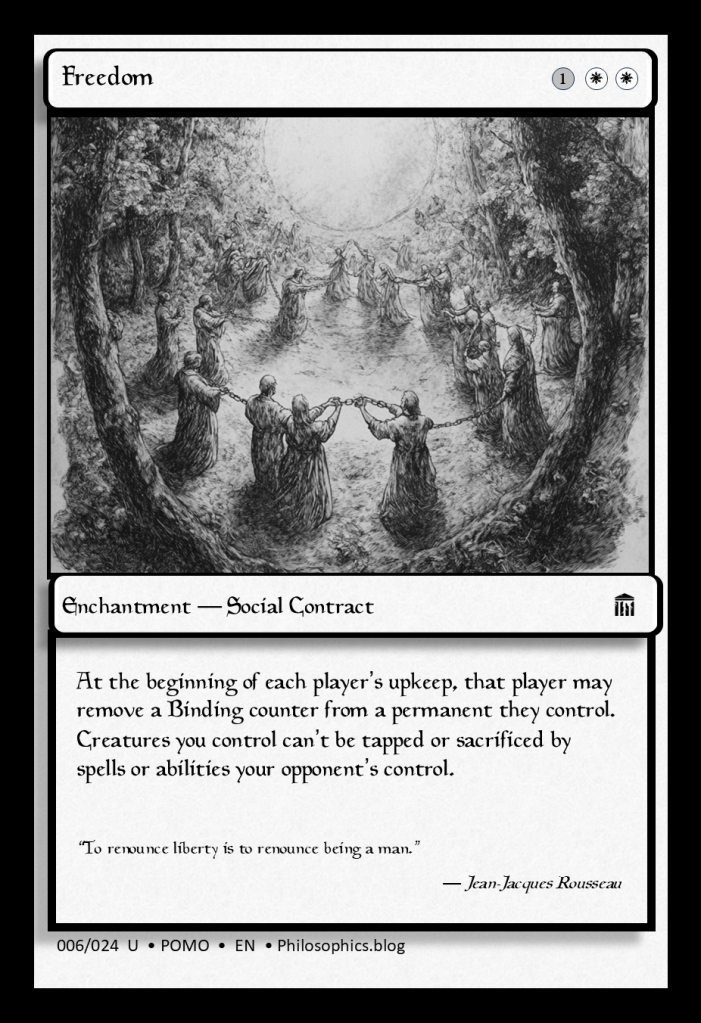
Card 006 from the Postmodern Set – Philosophics.blog
This Critical Theory parody card, Freedom, draws its lineage from Jean-Jacques Rousseau, whose paradox still haunts the modern condition: “Man is born free, and everywhere he is in chains.” The card re-enchants that contradiction – an Enchantment – Social Contract that reminds us liberty isn’t a state but a negotiation.
The card reads:
At the beginning of each player’s upkeep, that player may remove a Binding counter from a permanent they control.
Creatures you control can’t be tapped or sacrificed by spells or abilities your opponent controls.
This is Rousseau’s dilemma made mechanical. Freedom is not absolute; it’s procedural. The upkeep represents the maintenance of the social contract—an ongoing renewal, not a one-time event. Every player begins their turn by negotiating what freedom costs. You may remove one Binding counter, but only if you recognise that binding exists.
The flavour text underlines Rousseau’s plea:
“To renounce liberty is to renounce being a man.”
Freedom, for Rousseau, wasn’t about doing whatever one pleased. It was about participating in the moral and civic order that gives action meaning. To exist outside that order is not liberty; it’s anarchy, the tyranny of impulse.
The card, therefore, resists the naïve libertarian reading of freedom as the absence of restraint. It instead depicts freedom as the capacity to act within and through shared constraints.
Freedom, then, is not the absence of chains,
— Philosophics.blog
but the power to choose which ones we wear.
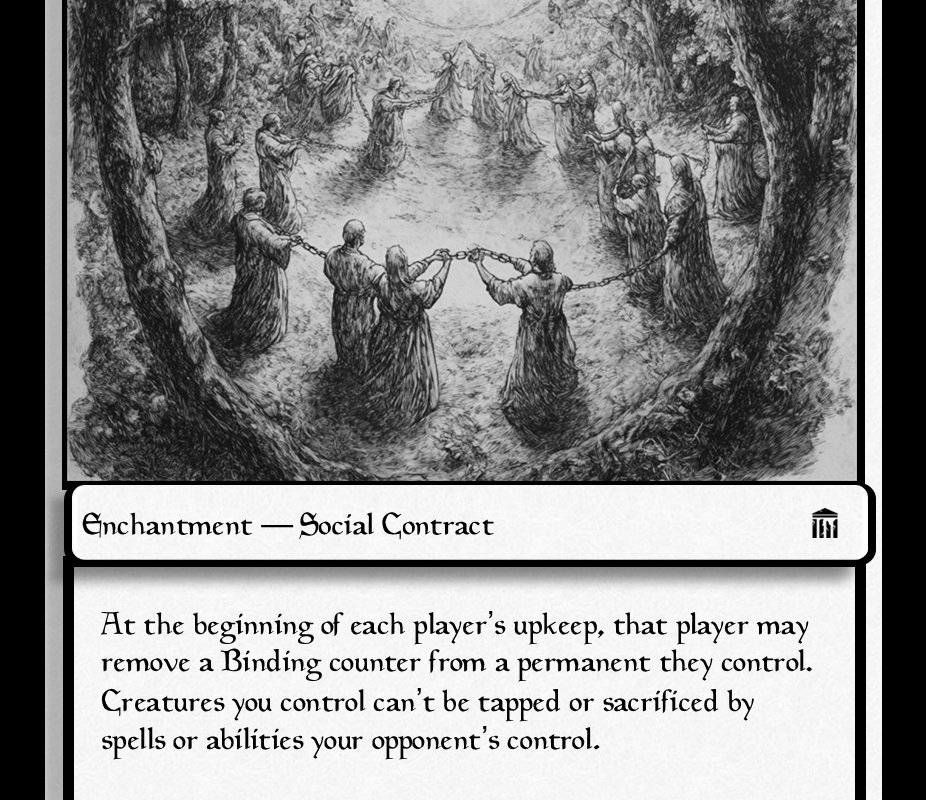
The art shows a ring of robed figures, hand in hand, their chains forming a circle beneath a clearing sky. It’s a haunting image: freedom through fellowship, bondage through unity. The circle symbolises Rousseau’s idea that true liberty emerges only when individuals subordinate selfish will to the general will – the common interest formed through collective agreement.
Yet there’s also a postmodern irony here: circles can be prisons too. The social contract can emancipate or suffocate, depending on who wrote its terms. The same chains that protect can also bind.
The monochrome aesthetic amplifies the ambiguity – freedom rendered in greyscale, neither utopia nor despair, but the space in between.
Rousseau’s notion of the social contract was revolutionary, but its dissonance still resonates: how can one be free and bound at the same time? He answered that only through the voluntary participation in a collective moral order can humans transcend mere instinct.
We might say that today’s democracies still operate under Freedom (Enchantment – Social Contract). We maintain our rights at the cost of constant negotiation: legal, social, linguistic. Every “Binding counter” removed is the product of civic upkeep. Stop maintaining it, and the enchantment fades.
The card hints at the price of this enchantment: creatures (citizens) can’t be tapped or sacrificed by opponents’ control. In other words, autonomy is secured only when the system prevents external domination. But systems fail, and when they do, the illusion of freedom collapses into coercion.
Rousseau earns a complicated respect in my philosophical canon. He’s not in my top five, but he’s unavoidable. His concept of freedom through the social contract anticipates both modern liberalism and its critique. He believed that genuine liberty required moral community – a notion now eroded by hyper-individualism.
Freedom, as I’ve rendered it here, isn’t celebration. It’s lamentation. The card is about the fragility of the social spell that keeps chaos at bay. We remove one binding at a time, hoping not to unbind ourselves entirely.

 Philosophics
Rousseau’s idea ultimately aligns with Spinoza’s concept of freedom: it is about understanding the causes that determine us. We could consider Rousseau’s popular sovereignty and collective will as the political application of this philosophical principle. Giddens teaches us, regarding the duality of the structure, that we are both actors and subjects of our own democracy. The key, according to Castoriadis, is to become aware of this. For this, according to Weil, there is no need for parties, but rather for self-education, ideally through deliberation. Tumult and constructive dissensus readily join this concert of wills, keeping tyranny at bay, as Diderot reminds us. There are, after all, a few things worth retaining from the Enlightenment.
LikeLiked by 1 person
Thank you for this, homo hortus. You’ve mapped the intellectual continuum of freedom as awareness – from Spinoza’s necessity to Castoriadis’s self-institution of society.
My own divergence rests precisely where yours converges: I don’t believe in agency as such. The so-called ‘freedom to act’ dissolves under scrutiny; what remains is only the residual space left by structural, biological, and linguistic determinants. Agency becomes a unit of measurement for constraint – whatever degrees of freedom one hasn’t yet lost.
If Rousseau’s chains are invisible, it’s because they are woven into our cognition, our institutions, and our language itself. The will may feel sovereign, but sovereignty is an echo, not an origin.
LikeLike
I believe we must distinguish Rousseau’s ideas from the way they have been used. The concept of the general will has been distorted by Robespierre and his Reign of Terror, and continues to this day, by way of Bonaparte (the Frankenstein’s monster of the French Revolution). In reality, Rousseau’s call is for political discipline; this part of my previous message should not be disregarded: it is through the self-education of the people and the awareness of their self-institution (always already present) that the general will is expressed, the distant echo of which, the horizon in the making, is popular sovereignty (where each person participates in creating the law they apply to themselves). Rousseau and Nietzsche call for a transcendence of self and of the collective.
LikeLiked by 1 person
Thanks again. I agree. The tragedy of Rousseau lies less in his thought than in its later instrumentalisation. The general will was never meant as coercion but as recognition: a disciplined awareness of belonging to a self-organising whole.
Where we perhaps differ is in whether such awareness translates into agency. Even with self-education and participation, we remain, to me, largely determined – linguistically, socially, neurologically. The ‘self-institution of society’ may be ongoing, but each actor’s part in it is scripted by forces beyond conscious choice. The will — general or individual – exists, but always under constraint.
That said, I appreciate your invocation of Nietzsche here. His call to transcendence, like Rousseau’s, still begins in discipline. Perhaps freedom is the lucid acceptance of our unfreedom –the capacity to act knowingly within determination.
I feel my heaviest opposition is that I don’t support social telos. Society doesn’t evolve toward justice; it adapts within limitation. The moment we claim otherwise, we’re back to manufacturing gods. This is my primary contention with Marx. He diagnosed a real and present problem, but his extrapolated teleology was only one within an infinity of possibilities.
LikeLiked by 1 person
Once we understand Bourdieu’s concept of social capital, we can act accordingly. Bakunin, for example, proposed abolishing inheritance. This seems to me to be a sound undertaking of “egalitarian/revolutionary radicalism” (see Jacques Rancière). As long as we do not understand the causes that determine us—that is, the society of individuals as described by Elias and Arendt, the society of control as described by Deleuze, Stiegler, and Rouvroy, etc.—we cannot correct our actions and ways of thinking. In other words, the light that should have been passed from door to door since the Enlightenment would be that of a total decolonization: of the lived world (Habermas), of its everyday aspects (Lefebvre), and of the world-system (Amin, Wallerstein). But these systems of delegated sovereignty (self-proclaimed “democracies,” “representative”) crushed indigenous pluralism from its very origins (Locke, De Tocqueville), and the lights of cities ultimately illuminate only our alienation from systems based on domination and limitless exploitation. Only reason could extricate us from this situation, but for the moment, it is preoccupied, at best and unfortunately, with justifying its own beliefs and intuitions (Hugo Mercier and Dan Sperber).
LikeLiked by 1 person
Thanks again. I am glad to have this forum to discuss matters such as this.It’s one of the main reasons I maintain this space. The first is archival, and the second is this sharing of ideas. The emergence is an intellectual cross-pollination. I appreciate the opportunity.
I agree with Bakunin, though this would be administratively difficult in practice. Still, I believe much of generational wealth should be recaptured. His proposal, radical as it is, gestures toward a deeper question of symbolic inheritance – social and cultural capital passed invisibly through institutions and habits. That form of legacy may be the harder one to abolish.
Your response, though, speaks primarily to a particular kind of society – the Western, Enlightenment-born model that pretends universality while exporting alienation. I see egalitarianism in the same light. The question isn’t whether equality is desirable, but how equal we can be before collapsing either into tyranny or apathy. If acquisitive drives could be escaped – or at least disincentivised through a moral or cultural shift – perhaps we’d find better ground. But these drives are old, elemental, and endlessly reborn under new guises.
As for ‘understanding the causes that determine us’, that’s a noble fantasy. We can model the societal us – the sociological abstraction – but the psychological us remains opaque. Professional psychology studies the statistical human, which is to say, no one in particular. In the end, we understand the structure, not the subject; the map, not the terrain.
I share your wish for a decolonisation of the lived world, though I doubt it can occur at scale. The lived world is one of connexions, not compartments. Pluralism thrives locally but falters globally – once scale enters, hierarchy follows. As I’ve written elsewhere, this is the perennial problem of those who seek to dismantle power while others remain obsessed with acquiring and consolidating it. The will to dominate never vanished; it merely changed its costume.
I have little faith in reason as a collective faculty. Most people possess it in homoeopathic quantities, and the Age of Reason was drafted by those with both reason and access. Most simply wish to be, to live with minimal interference. Yet even this requires structure – some shared scaffolding to prevent alienation and ennui. Too many internal tensions exist within human nature to design a system that works for everyone.
And as Mercier and Sperber suggest, reason has become the servant of intuition – its PR department, not its governor. It justifies what instinct has already decided, a post hoc rationalisation dressed in Enlightenment drag.
LikeLike
The abolition of inheritance would not only affect economic capital but would also have a profound impact on symbolic and social capital—the latter always having a tangible material and relational component. A portion of this captured wealth could support a universal basic income, a possible transition toward radical and egalitarian redistributive justice.
I fully share your critical analysis of Enlightenment democracy, which, under the guise of universalism, masks a very violent legacy of conquest, dispossession, and oppression. This legacy is unfortunately still expressed in modern forms of domination: techno-politics is a direct heir to the ancient empires (Egypt, Assyria, the Chinese imperial bureaucracy, etc.) and their mechanisms of control and exclusion.
We should break with this instrumentalized reason, which, like a post hoc justification, defends prejudices rather than leading to the necessary shift in perspective.
LikeLiked by 1 person