A few years ago, I shared with a colleague that I had noticed that my high school classmates who seemed to be the most non-conformist (or perhaps the most anti-authoritarian), the ones most likely to have abused drugs and alcohol and most likely to criticise the Man, have by and large become extremely conservative on the political spectrum. Most are card-carrying Republicans, and dreaded low-information voters, continuing the trend of low-information acquisition and processing. He said that he had noticed a similar trend.
I still keep in contact with some some old mates who are Conservative Republicans, but who were high-information consumers then and still, so I am not saying that all Conservatives are low-information people.
A man who is not a Liberal at sixteen has no heart; a man who is not a Conservative at sixty has no head.
—Benjamin Disraeli (Misattributed)
The past couple of years, in a sort of nod to Bukowski, I’ve been researching or circulating among the underbelly of the United States, the veritable dalit-class comprised of drug dealers and users, pimps, prostitutes, and thieves. And I’ve noticed the same trend. These people might fear or hate the police and the system, and they may not vote or even be high-information seekers, but they seem to have a marked propensity to Conservatism. I admit that this is anecdotal and rife with confirmation bias, but this is my observation.
To broad brush any group into some monolith is always a fools errand and missing dimensional nuance, but the general direction holds. In my observation, these people are very black & white, and they want to see law & order (as much as they want to avoid its glance). They are interested in fairness, and call out being beat, as in being shorted in a drug deal or overpay at the grocery store–the same grocery store from which they just shoplifted.
When they see a news story, ‘That bank robber deserved to get caught’ would not be an unexpected response. Even if they got caught, they might voice that they deserved it. The received sentence might be a different story.
I am not sure why this shift from anti-establishment to hyper establishment happens. I’ve also noticed that even if they dislike the particular people serving government roles, they still feel that the abstract concepts of government, democracy, capitalism, and market systems make sense, if only the particular instance is not great.
One reaction I had is that some of these people feel that the transgressions of their youth might have been avoided only if there were more discipline, and so they support this construct for the benefit of future generations, who, as embodied in Millennials, are soft and lack respect for authority.
I’d recently re-discovered a Bill Moyers interview with moral psychologist Jonathan Haidt, and there is some relationship. And whilst I could critique some of Haidt’s accepted metanarrative relative to society, his points are valid within the constraints of this narrative.
The video is almost an hour long and was produced in 2012, it is a worthwhile endeavour to watch.
I am wondering if anyone else has seen this trend or who has experienced a contrary trend. Extra points for an explanation or supporting research.
Cover image: Sean Penn, excerpt from Fast Times at Ridgemont High, and Brett Cavanaugh, SCOTUS and posterboy Conservative hack
Some of us are concerned with the metanarratives underlying society, but and given society is apt to have many competing metanarratives. Logical Positivists tapped into the narrative of science, which is a primary theme of Enlightenment thinking. This was supposed to have supplanted the narrative of superstition, except it didn’t. And a sort of empirical, scientific Nature was supposed to have supplanted the metaphysical gods, except it didn’t.
Illuminati Eye Symbol
Apart from the problem that a supernatural God was replaced with a sort of animated Nature, some people just didn’t buy into the new narrative. Today, in the 21st Century Western world, some people still subscribe to these pre-Enlightenment notions, but that’s not the root of the issue. Neither is necessarily right or wrong. And in a Hegelian synthesis, some people assuage the ensuing cognitive dissonance by merging the two and cherry-picking the ones that work for them. These people usually have little difficulty finding people who believe that the earth is 4.5 billion or 6 thousand years old, that Ayurvedic medicine is superior or inferior to Allopathic medicine, that vaccines cause or don’t cause autism, that homeopathy is effective or ineffective, that the Illuminati are some secret society that rules the world or not.
Many people still can’t get past an appeal to nature, whence the Organic and traditional medicine movements. This is not to say that some or all of these claims might have validity; it’s just to say that ‘because it’s natural’ is not a suitable defence. Even a stopped clock is right twice a day—unless it’s set to a 24-hour display, in which case it’s only right once a day.
Without rehashing the argument whole hog, we know that poison ivy and uranium, arsenic, and cyanide are all natural. Not many attempt to defend this with an appeal to nature, so this suffers from selection bias from the start.
you cannot go against nature
because if you do
go against nature
it's part of nature, too

                — Love and Rockets, No New Tale to Tell
The larger issue is about how we define nature. I don’t recall if this was Lyotard or Lacan (and I don’t feel like looking for the cross-reference at the moment), but by definition everything observed is natural, whether physical or behaviour.
Love and Rockets – No New Tell to Tell
Some humans—notably the Enlightened ones—like to view themselves as somehow above nature, but the veneer is nanometers thin and threadbare at that. And these people extend this concept to behaviour. As the song goes, you can’t go against nature because when you do, when you observe it, it is by definition part of nature, too.
Oftentimes, this becomes a moral argument: this or that is unnatural. Certain sexual activities are usually held up as examples, and yet many of these activities are not only practised by many humans, they are also practised by members of other species. The argument is that we need to elevate about nature, an so they are making some appeal to meta-nature or some such.
In any case, the complaint shouldn’t be whether it’s natural anyway. It might rather be couched in some instances as not ‘naturally occurring’, so plastics would not happen save for manufacture, but neither would asphalt or telephones or televisions or processed foods, so I find it to be disingenuous to rail against some items that do not occur naturally whilst ignoring the ones you happen to find useful.
I haven’t done any film reviews, and I’m not about to start now. I’ve just watched What Still Remains on Netflix.
People become their own kind of monster.
What Still Remains Film Trailer
This is decent post-apocalyptic fare, some catalyst, societies, competing factions, good versus evil, at least in the eyes of the devout. But that’s not what I am going to be writing about.
What still remains contains good writing and strong character development. It does over-employ tropes, but this seems to be the norm these days: modular writing; rearranging the Lego pieces to make something that appears fresh. So what do I have to say?
Spoiler Alert: Proceed with caution…
This is a perfect depiction of the problems with property rights and social contract theory. There are apparently 3 factions—4 if you count independents.
Anna
Initially, there were the Changed, never seen on screen and perhaps not even contemporaneous to the current period, though they may reside in the unseen cities. Anna, the protagonist, and her family are among the independent. Peter, a preacher from the ordained, holier than thou faction. In the realm of ‘if you’re not with me (and our God), you’re against me, thence evil’, they are the arbiters of all that is good. And then there are the Berserkers, as named by the Ordained. To the Ordained, Berserkers aspire to be Changed, but the Berserkers view themselves more along the line of Spartans: Pain is good.
Peter
All scenes are shot in the wilderness, but the various factions have staked property claims with wide perimeters. The penalty for trespass appears to usually involve death of the offending party—or at least a hefty fee. This is Hobbes’ ‘solitary, poor, nasty, brutish, and short’ life outside of society quip, though he didn’t exactly account for a class of societies despite this being common in his day.
Berserker
So, these factions don’t actually have property rights; what they have is a notion of property, and they defend it with violence, as is a necessary condition for all property. In so-called modern societies, the violence is obfuscated much in the same manner that supermarkets obscure the carnage behind the meat. It’s still there; it’s just at arm’s length. Violate one of these ‘rights’, and you’ll see the violence inherent in the system.
And then there’s social contract theory—or the gaping flaw in the logic. Anna is an independent, but one can only be as independent as the ability to defend their independence. It’s sort of like contract law. If you can afford to defend a contract, you are entitled to having it enforced.
Redact intellectual property rant.
Anna doesn’t particularly want to belong to either faction, who have divided their world into two pieces in the same manner that, say, Britain and Scotland might have. If you happen to be born there through some loin lottery, you pretty much have to choose a side. Given Sartre’s no excuses policy, you can choose neither; it just won’t bode well for you. You’ve got no real choice.
Social Choice Theory
In Anna’s eyes, upon the death of her mother and brother, she is persuaded with reluctance to return with Peter to his community, a God-fearing bunch. Her mum had indoctrinated her into this cult of God through bible readings, so she was primed for the eventuality. Some independent interlopers attempted to block their return journey by claiming trespass, so Peter summarily offed them rather than paying their ransom—a fee Anna has been willing to tender.
When the two finally reached the sanctuary, Anna quickly realised that she had no say in the matter: she was either a (good) member or (an evil) dead. To reiterate, this is an underlying problem with social contract theory. There is no exit clause.
Side Bar: Some have argued that the cost of coerced—though they’d never use this term—participation and compliance is owed to the greater good. There is no reason given why this is preferred or across which dimensions better is being assessed—or good for that matter—, so don’t ask. Long live Jeremy Bentham and John Stuart Mill with a hat tip to David Hume.
“The first man who, having fenced in a piece of land, said “This is mine,” and found people naïve enough to believe him, that man was the true founder of civil society.
From how many crimes, wars, and murders, from how many horrors and misfortunes might not any one have saved mankind, by pulling up the stakes, or filling up the ditch, and crying to his fellows: Beware of listening to this impostor; you are undone if you once forget that the fruits of the earth belong to us all, and the earth itself to nobody.”
Hobbes, Locke, and Rousseau each approached social contracts from their own perspectives, but it may be interesting to note that each was a privileged white male of his day. Sure, Hobbes was a monarchist, and Rousseau was the Thoreau of his day, a nostalgist, but he like the others were beneficiaries of the status quo, save perhaps at the margins.
Anna thought she had sovereignty over her choices. In the end, the plot line prevailed, but then again, this was just a movie, so even her choices were scripted.
I’ve been reading and listening to Conservative Stephen Hicks’ Explaining Postmodernism. He’s made it free on YouTube and as PDF. It’s important to note that the book is a decent read, but Hicks makes little attempt to remain in a neutral voice. It’s clear that he is critical of it, so his explaining is not to articulate to the generally interested; rather, it’s to impose his worldview on the topic matter. Read or listen, but keep this in mind. If you lean Conservative, you’ll eye-roll in unison with him; if you lean to the Left, the eye-rolls will have a different significance, as he mows down one strawman after another.
In this clip (bookmarked from the full audiobook), he attempts to make the case that postmodernists—which is as motley a crew as a group of atheists—eschew the notion of rationality for the comfort of feelings. Sure, I suppose some postmodernists do make this argument, but it is hardly a universal position. Taking myself as an example, I have no illusion that most people can register let alone understand their feelings.
I recall being in a corporate-sponsored (human resource-sponsored) interpersonal communications class where the instructor made the claim that one should defend your position by invoking feelings:
Your loud voice frightened me.
I feel sad when you shout at me.
I feel anxious when…
My reaction then is about the same as it is as I write: Whilst I may not understand what the other person may be feeling, there is little reason for me to believe that this person has identified and named this feeling. There is also little reason to presume this person is conveying to me a correctly-interpreted feeling in lieu of a more hyperbolic version for maximum effect. Moreover, some people seem to be offended by pretty much anything. And there’s one thing I’ve learnt along the way:
A person looking to be offended is pretty much guaranteed to be offended.
So, absent context, I have no reason to take this person at their word. Call me a curmudgeon, if you please.
Like Jordan Peterson, a personality who promotes Hicks, standing up and knocking down strawmen seems to be their raisons d’être, but this is sloppy philosophy and lacks the integrity these people claim to admire. In any case, forewarned is forearmed. Caveat emptor.
EDIT: The more I read of Hicks, the less I like it. He misunderstands or at least misrepresents postmodernism in a big way. I am not sure whether it is intentional or through ignorance, but a certain expected academic neutrality is absent to the brink of malpractice.
Here is a fuller critique of Hicks’ misrepresentation of Postmodernism.
This post takes a different approach than the previous two videos. First, I am reversing the video content and my response, so the video content is quoted.
As I listened to the video, I was taken aback by how rife the content was with logical fallacies. In fact, this would be perfect fodder for an introductory Logic 101 class to evaluate for these fallacies. Although I do not call out these fallacies exhaustively, I do highlight some of them.
One common factor of prostitutes is the history of surviving emotional, physical or often sexual abuse and violence.
Given that these are undefined and unqualified, I am not sure that there is any woman who has never had any violence of some degree or another. I presume this should be further qualified that it is directed toward her. I’ll be perfectly frank: I have never dated a woman who has not been raped at least once in her lifetime, some had been several times, and several others had been molested as children. Only a couple of these had any connections to sex work of any form, so it is interesting that this a raised as a vector, first for the over-expansive domain and second without contrast to other women in a sort of control group fashion.
These previous aspects have been suggested to be even stronger than the factor of poverty.
Notice again the speaking in generalities. No facts are being asserted here. We are trapped in a telephone game, where hearsay and speculation dominate the held position. Somebody anonymous person somehow somewhere suggested that some relationship might exist. There is nothing there.
Some poor women will be prostitutes, and others will take underpaid or illegal jobs…
Duly noted. And some will graduate from college and become computer programmers. And so?
…but the ones opting for prostitution will have had a history of sexual violence.
Notice that no claim is being made that this violence is more or less frequent than the cohort not opting for prostitution.
That a middle-class girl may also find herself working as a prostitute because someone taught her that she was worthless.
Wow. So much to unpack here. The narrator, Elly, is asserting a parallel between prostitution and worthlessness. The implication is a person with worth would not choose this profession because she would choose a worthy profession. I wonder where and how this worth is determined.
…and the only thing of value she could do was to give sexual access to men.
So Elly, whether she admits it or not is deprecating women who choose this profession, but she tries to shroud it in language that she feels otherwise.
Now comes the psychobabble about trauma reenactment, as if it were a thing, and in a classic misdirect, she asserts that this is not even her own judgment; in fact, it is the analysis of these women who are clearly qualified to make a professional judgment of this nature in the realm of pseudoscience.
Anecodote: Women come to the conclusion that they’ve been abused their whole lives, so why not get paid for it.
Here is where I break to discuss post hoc ergo propter hoc fallacy or anecdotal evidence. Anecdotal evidence is frequently misinterpreted via the availability heuristic, which leads to an overestimation of the prevalence of an occurrence. This is a well-documented logical fallacy. This fallacy is employed when the person arguing has no real data to support their position, so they opt for personal stories, hearsay, and anecdotes. Related to this is confirmation bias, which is the result of, having established a position, only seek out facts that support the position even if these facts are outnumbered by contrary facts by orders of magnitude.
Such thinking is the basis behind anti-vaccination groups and homoeopathy advocates. The best these people can do is to point to themselves or a friend or a friend of a friend who benefited (or was disadvantaged) by some therapy or other action.
What is the basis for this claim, and what is the scope?
Media culture promotes the message be pretty, be fuckable, or be invisible
Here, we are in full agreement. The technical fallacy here is that for every 10 girls subjected to these messages, 1 becomes a prostitute. Yet even by conservative statistics, at least 1 in 5 women have been raped, 1 in 4 have been sexually abused. So the cause and effect don’t add up. In the US, about 14% of people are officially considered to in poverty.
In statistics, there is a concept of signal and noise. The problem is that understanding statistics is not natural for humans. It involves the analytical System II, in Daniel Kahneman‘s parlance, rather than the heuristic, System I. A cognitive problem plaguing people is apophenia, where they read patterns into data that simply are not there. A form of this, called pareidolia, is how people see Jesus’ face in toast.
No body can stand beign penetrated to 10 to 30 male strangers every single day.
So the 10 to 20 customers a night I commented was unrealistic has now morphed into 10 to 30. It is somehow important to note that these are strangers, presumably as a nod to acknowledge that 30 acquaintances would be just fine because there would be enthusiastic consent and mutual arousal. Beware stranger danger.
If indeed prostitution is just a job like any other job, like, say, flipping burgers, then I would wager you would have absolutely no issue switching jobs with a prostituted person for one day and let it be your anus that’s penetrated in the state of non-arousal by 15 men during one night.
O! Europa. Firstly, I wouldn’t trade my jobs to flip burgers let alone be a prostitute. Secondly, there are scores upon scores of ‘typical’ jobs I would have no interest in switching into. Nor would I presume that many others could actually do my job in any case. Why would someone presume that the punter wouldn’t notice the old switcharoo? And what’s with the anal penetration. Some prostitutes will ‘do’ anal for an up-charge, but many—perhaps even most—prostitutes won’t even accept anal at any price. This is about boundaries.
And someone seems pretty obsessed with the prospect of being penetrated by 15 men. I’d chalk this up to a power struggle, a foray into the world of penetration politics. Even gay men discriminate between top and bottom, so it’s rather a submission thing rather than a female thing.
Prostitution is incompatible with enthusiastic sexual consent
Elly runs through a bizarre strawman scenario that is too silly to even repeat here, and then she returns to some Disney Princess fantasy world of wooing and requited love.
She (sort of) acknowledges (without saying as much) that there is a distinction between economic and social spheres. I’d suggest reviewing the Isreali daycare study, where they learned that lesson the hard way. This does not mean that some people don’t blend the two spheres. It also doesn’t mean that a woman might not put out for a hamburger but might be persuaded by steak.
Anecdotally, I am aware of some women who say they would have sex with their favourite celebrity—if only he would ask.
In the end, this has become more and more disappointing. As so much of this material are vast generalisations and practically at the level of conspiracy theories, there is not even a debate to be had. There are so many technical flaws, I feel I need to pull a yellow card. There is nothing to push against except for the lack of structure or method. It’s all so nebulous. It’s all so quixotic, tilting at windmills.
To be honest, I don’t see how this would convert someone on the fence, let alone an opponent. This material is pretty much relegated to echo-chamber choir preaching.
I think I need to get back to the topic of subjectivism and out of the weeds of activist politics.
Apparently, there was a part 0 and a part 2. I didn’t realise that, so I skipped video 1. My bad, as this is one I was particularly interested in.
In this video, Elly’s premise is to focus on the right to buy sex instead of the right to sell it. Pausing for a moment, I’d like to point out that sex is neither bought nor sold; rather access is rented or leased, in a manner similar to renting a streamed movie on Amazon or Netflix. You retain no rights to ownership or future access. You don’t get to keep it when your time is up. Rather than adopt new nomenclature, I’ll continue with the convention in place.
Rather than asking is there a right to sell sex, ask is there a right to buy it, AND ask is there a right to profit off of selling someone else for sex.
Ignoring whether a right can even exist ontologically, I’ll go along and pretend that a right can exist. We’ve been down this street before, but I am commenting in real time, and I am not yet even a minute in. Essentially, she suggests asking two questions:
Is there a right to buy sex?
Is there a right to profit off of selling someone else for sex?
Clearly, these two questions are related. The right to buy sex begs the question from whom, so even though the focus is redirected from the seller to the buyer, there cannot be a buyer without a seller. In practice, the seller is a critical piece of the equation. For example, I may have a right to buy an automobile, but you only have the right to sell it if it is your property; you can’t rightfully sell me your neighbour’s car.
Separately, is there a right to profit from selling sex [as a first party transaction] in the first place, and for selling someone else for sex [as a second party transaction] in the second place?
[SPOILER ALERT] » This video does not yield the anwers to these questions.
The next order of business is to use these talking points…
Discuss what motivates men to by prostituted women.
Discuss how they view and treat them rather than discuss statistics.
…followed by this assertion.
“There is plenty of evidence that men are motivated to buy prostituted women because prostitution at its core means the availability of sexual access with little to no boundaries to young, attractive women anywhere at any time for affordable prices.”
This is where I go off the rails and critique poor methodology and poor rhetorical form. Let’s unpack this:
There is plenty of evidence that…
First, plenty is a weasel word. It carries no rhetorical weight unless it is followed with, well, plenty of evidence. How much is plenty? Is there plenty of counter-evidence? Is the evidence more prevalent than the counter evidence or vice versa.
Second, what is the source of this unspecified, uncited, and unattributed evidence. Elly references links; perhaps they are the evidence she is references. What is the quality of this evidence?
Not to offend, but this wouldn’t even pass as a Wikipedia comment.
…men are motivated to buy prostituted women because…
Apart from the inability to actually know someone’s motivation, I am interested in seeing where this leads.
Elly uses the noun phrase prostituted women. As she employs the adjective form prostituted, I am led to wonder what the motivation was for this word choice.
My initial thought is that she is modifying the noun women because wants to differntiate buying women from buying prostituted woman, but I don’t think this is quite right.
My next thought is that her motivation to convey that these women have no agency or volition; they are passive objects who are prostituted against their will.
My third, or perhaps it was my first, thought is why not emply the plural noun prostitutes. She has already established context that her focus is women, so I am left feeling there is a deeper subtext. Perhaps I am reading too much in.
…prostitution at its core means the availability of sexual access with little to no boundaries to young, attractive women anywhere at any time for affordable prices.
This is some definition. I’ll need to unpack this one slowly:
This definition get to the heart of the matter from the perspective of the punter.
Prostitution is the availability of sexual access… Yup. Nailed it.
…with little to no boundaries… Wait, what? Where did this come from? Is there some subclass of prostitutes to which this applies? Surely does not define all prostitutes? Does this define most prostitute? As I understand it—at least the escorts of Backpage of days gone by, a victim of FOSTA—, escorts to have boundaries. Moreover, some boundaries can be expanded by an up-charge. Even reading the negative reviews on the Invisible Men Project, it is apparent that many of the complaints were that the woman refused one service or another, which is to say to enforce a boundary. This appears to be counterevidentiary.
…to young… I wonder how we are defining young. I wonder what the average age of a prostitute is. A quick Google search of ‘prostitution’ yeilds a recent arrest of 7 women. I am not saying this is a valid random sample or size, but their ages range from 27 to 55 with an average age of just under 40-years old. I suppose to a 70-year-old, these are young. Let’s move on…
…attractive women… Attractiveness is relative, but let’s just say there’s no accounting for taste. Without comment, I’ll leave it to you to decide the attraction level of these same arrested women.
…anywhere… This is a bold assertion.
…at any time… This is an another bold assertion. I am certain there is support for this claim somewhere.
…at affordable prices. Finally, the end of this parsing party. Affordabilty is another relative term. Who’s the punter and what’s the cost? I’m noticing that first guy perportedly spent £340 for 45 minutes. That’s about $450 US for the peeps reading on this side of the pond, and I am just going to go out on a limb and suggest that is beyond the affordability range of most Americans by several hundred dollars.
At the end of the day, I am left with the impression that the purpose of this definition is to incite and inflame not to objectively define anything. In the court system, this is what one would call leading the witness. As such it would be inadmissible. I concur.
Her next course of action is to determine ‘If your opponents are aware of widespread social stigma in society against prostituted people, which causes risks or disadvantages during interactions with law enforcement or social services, ask them if Johns are somehow magically exempt from this’.
Resulting from my previous search, it seems buyers not exempt. In fact, 6 of the 8 people arrested were men ‘charged with patronizing a prostitute’.
Again, an unsubstantiated claim was countered in less than a minute. It feels to me that the tactic is to throw so much word salad at the opponent that they simply can process the mis- and dis-information, and without recourse to Google, they may be overwhelmed and convert having never researched any of the false claims. Donald Trump relies heavily on this technique.
If they are unable to see the misogyny in the words and actions of punters, introduce them to punter forums…where prostitutes are rated like products.
The claim of misogyny is one of intent. It is not a claim that the words are offensive. It is a claim that the intent behind the words is fueled by some inherent hatred of women. I’m sorry but this is unadulterated psychobabble.
I did read the negative reviews on the punter forums, and to be honest at the expense of being accused of mansplaining, these don’t read much differently to bad service reviews on on Yelp or Google. And, yes, the woman are rated—albeit like services not like products: like my stylist butchered my hair; my gardner killed my dog; whatever. Linguistically, this is akin to code switching. They are employing the vernacular of the forum.
Do some of these men hate women? Sure. Who knows? Do they hate all women? Do all men who frequent prostitutes hate women? Do they hate all women or just prostitutes? Do they hate their mothers? Is their hatred of prostitutes simply a hidden hatred of their mother manifest in hatred of women? Do they hate other categories of people? Do they kick cats and beat dogs? Of course they do, and then they go home and beat their wives and children and speak poorly about their aunts and mothers.
Of course, this line of reasoning is just as inane as the line that inspired it.
She mentions men who freely admit to abusing and raping women.
Wait, what? I didn’t see that. I must have been distracted by the snuff films.
I can tell this is just turning into a rant. If there is one thing I can’t stand—and there is more than one thing I can’t stand—is sloppy academics. The rules of engagement for defending a position with integrity are simple. If the goal is to win at any expense, then, as the saying goes, all is fair in love and war. But I am not sure what the prize is here. I am not one to have much faith in the intellectual capacity of most humans, but even I am pretty sure that the majority of people can see right through this subterfuge.
Shake it off, Bry. Just shake it off. Push through it. No pain no gain.
Presumed motivators for men to pay for prostitutes are because…
A. Men want to have sex with no responsibilities with maximum control and no required effort of actually impressing and winning over the other person, and because other men are willing to provide it by pimping out others for their own lucrative profit.
Wow. Another unfounded, ungrounded assertion. Just some claim pulled from thin air. Also, I am pretty sure I heard her say A, as if to enummerate some list, but I never heard any subsequent letters.
Men want to have sex…
So far, so good…
…with no responsibilities…
I’ll presume she means with no additional strings attached. I am not sure what other responsibilities we could be talking about.
…with maximum control…
I am pretty sure we’ve already trodden this teritory. Perhaps he feels he has (or even has) more control over a prostitute than over some alternative woman. Perhaps he wife or partner won’t allow him to do something or another, but I have a feeling that this maximum control claim is a bit more hyperbole than reality justifies.
…and no required effort of actually impressing and winning over the other person…
I am fast-forwarding a bit because this feels like reading it will be like watching paint dry or grass grow. By what Romantic construct is this a thing? Someone’s watched too many Disney films. And this is a game, and the person who pays to avoid effort is a cheater? He jumped the queue. Hmmm. When I say it like that, it does seem awfully juvenile.
…and because other men are willing to provide it by pimping out others for their own lucrative profit.
Let’s just tag some barely relevent rationale on because we can.
And let’s pepper our speech with superlatives so the hyperbole doesn’t feel lonely.
Prostitution exists because of the demand not because of a subset of women who are nymphomaniacs.
I have to admit that I loved this last line.
Also [prostitution does] not [exist] because of poverty. Poverty is a supporting factor.
Rachel wins the strawman argument contest of the year. Who is asserting that poverty is the sole arbiter of prostitution? Apparently, some unnamed source in Parliament.
Prostitution exists for one reason: male demand —Rachel Moran
This logic exhibits a fundamental lack of understanding of the basic rules of transactional economics and equilibrium in context with supply and demand.
Not to be a dick about it, but I can demand a Ferrari until the cows come home, but this will not conjure a Ferrari. Believe me, I’ve been waiting for those cows to come home for ages. Also, the supply of Ferraris does me no good either because the transction price is too high; therefore, I cannot afford a Ferrari.
Rachel however is correct—In your face Jean Baptiste Say!—when she recognises that supply does not create its own demand. Sorry believers in Conservative economics dogma. But I digress.
Even if this nymphomaniac offered her services for free, there could be no transaction without demand, so the monetary exchange is a secondary factor.
Don’t sugarcoat the violence that punters and pimps commit.
Also, don’t differentiate violence that happens on the job, such as a dope dealer or a loan shark that would have occurred, perhaps even sooner, whether or not she was a prostitute. Let’s just pretend that these are related to her line of work because it helps to inflate number to make our position more sellable.
When a prostituted woman is raped or killed, the most likely rapist and/or killer is a pimp or a John. That makes prostitution the only so-called occupation which [sic] changes the most likely perpetrator of severe bodily harm from a partner or relative to your customer or employer.
And this is relavent how? Perhaps we should make associating with partners and relatives illegal. It seems that they are the biggest concern.
Why is this a so-called occupation? Is this not a job or line of work?
Lastly, make it very clear that this dynamic and this level of violence does not magically change under legalised prostitution.
OK.
The set of men buying and selling women doesn’t really change.
I disagree. Where prostitution is illegal, the good men are going to exit the system, and only bad men will remain. Of course, if you define all men who frequent prostitutes as misogynists, then I suppose you’ve created a situation where all men are bad, and so I stand corrected.
Let’s see how that renders as a categorical syllogism:
– All men who frequent prostitutes are bad.
– Joe is a man who frequents prostitutes.
∴ Joe is bad.
I see how it works. I stand corrected. All punters are evil. Burn them.
Under legalisation, too, men retain their disgust for the prostituted and their disrespect for their boundaries.
Here we go again with the broadbrushing.
Ample evidence are the punter forums of Germany, the Netherlands, and New Zealand. This contempt and the sever mistreatment does not change unless there is effective widespread social intervention that teaches children for elementary school onwards that prostituted women and men are just as human and deserving of respect as anyone else and that all sexual interaction requires enthusiastic consent, which means that it cannot be bought.
Prostituted women and men are just as human and deserving of respect as anyone else…which is why we should deprive them of their livelihoods. Nothing says “I respect you” more than kicking the chair out from under you. That’s my creed.
Not merely consent but enthusiastic consent. Not only do I have to work, I have to do so enthusiastically.
Abolitionists have an issue not with the prostitutes but in the system they are caught in and the men who operate and benefit from it.
I think I am approaching the end of this clip.
The systems they are caught up in is Capitalism and a market economy, a system that presumes to be able to put a price on anything.
A cynic is…a man who knows the price of everything, and the value of nothing. — Oscar Wilde
Hatred of a system does not equate to hatred of a person in that system.
I agree, and so…
Humans have a piss poor track record in understanding complex systems, whether weather, poitical, sociological, economic, or otherwise. The issue here is that you can hate the system and love the person, but if you disrupt the system intentionally or otherwise, the wide ranging effect may prove disaterous.
Punters love the system but hate the women. Abolistionists care about the women.
Where is all this categorical hatred coming from?
Lastly, Elly mentions that she is working on a video piece to summarise the important stats and info on who punters are, what they do, and why they do it.
And here is where I will challenge your integrity. Who here would believe—especially insomuch as by her own admission that she recommends hiding inconvenietly opposing facts—any reporting would contain an accounting of unbiased and unabridged data, metrics, or summaries or that proper methodological rigour would be applied for the study.
On the topic of studies, in the description of the video on the page, there are links, which I’ve copied here for comment.
This is a PDF of speaking notes or a transcript of Rachel’s presentation in London, based on her experience as a sex-trade survivor. Rachel’s is a sad story, but it is her story.
Yet again, a list of cherry-picked perhaps 180 quotes from some Canadian forum. This is contemptuous. I only read about a dozen and a half of them. In order to be even somewhat useful (instead of being polemic) would be to see all of the reviews, and to see what percentage of people wrote these reviews. You can’t convince me that there are no doting reviews. These are exempted because they dilute the disingenuous shock value of only negative reviews. Even a simple word cloud would be more useful than this hatchet job. (I feel like finding one of these forums and cherry-picking the rest of the story just out of spite.)
This is a full forum of resources. I have not done anything more than scan the initial page where I landed. I may return for more context. If you seek additional information, visit. I think it goes without saying that the information here is slanted, much like watching Fox News in an attempt to understand American Liberal politics.
How Porn Creates the John: Porn, Trafficking and the Social Construction of Masculinity (Youtube video from a lecture given in December 2012)
Being on the topic of social constructivism, this one should be right up my street. I haven’t watched even a moment of this video, so am probably commenting prematurely, but it is interesting to me how some people accept the concept of social constructivism when it relates to a different perspective, but rarely do they accept their own perspectives as social constructions. This is a cognitive bias.
I am not so sure I have the interest in commenting on the rest of the series. To be honest, Elly has other series as well. I’d like to take a look, but I’m afraid I’ll have a similar reaction that the position and content haven’t been well thought out. Perhaps a strong editor would help, a disinterested party who would maintain (or otherwise elevate) the integrity of the content and who would provide needed rigour.
In the end, Elly’s message would be stronger and more cogent, and she could shed the chaff whilst retaining the substance.
So, now I’ve gone and done it. I thought that my commentary on prostitution would be a one-off. However, in researching arguments against prostitution, I happened upon this blog, which led me to videos on Elly Arrow’s Youtube channel. To be fair, she self-identifies as ‘a radical feminist from Germany’, and although there are many cultural similarities between the US and Germany, I could be missing some urgency not present here in the US. Please visit her channel and decide for yourself.
At the start, it seems we have many things in common. She Elly declares, ‘I am the humanist, atheist, pro-lesbian, sex industry-abolishing, gender-critical, radical feminist Liberals and Conservatives warned you about’. Whilst, I am not a Humanist, as I feel this is too narrow of a focus on the larger system, I am an atheist, pro-lesbian, gender-critical, and radical, though perhaps not feminist, as, like the term ‘terrorist’, it’s lost all meaning because it’s been coöpted by so many different factions. . I do have to ponder how one can simultaneously be gender-critical and pro-lesbian or a feminist, as both of these rely on gender identity, but I’ll save this for a possible future topic.
Let me get the ad hominem stuff out of the way first. Perhaps she mentions on her blog or in other videos how she came to this place, but I’d like to understand her experiences and motivations that brought here to this conclusion. She says she used to feel differently, so I’d also like to know how she formulated that conclusion, too. It is apparent that she reads a script, which is distracting. Even the choice to read can be edited to sound more natural. It would also make the presentment more succinct. It would also be useful if she would upload her transcripts to the videos so we didn’t have to rely on the auto-translate feature. Pro Tip: This would also help with search indexing and findability.
How To Make The Case For Prostitution Abolition
In this video, Elly gives good advice on how to engage in a ‘debate’.
Make sure your opponent really wants to debate.
Emphatically, yes.
Don’t try convincing an opponent all at once. This is a complex issue, and it is unlikely that you will succeed in countering all facets in one conversation.
Yes. This is the basis for propaganda and marketing alike. Chip away and win small battles before you worry about the war.
Assume the other side has good intentions.
Good intentions are not necessarily relevant; rather, assume they have a reason for their convictions without recourse to good or bad intentions. What would be an example of bad intentions in this arena anyway?
Don’t antagonise your opponent.
Indeed. This is likely to lead to escalating commitment, where they dig in their heals and double down.
No ad hominem attacks: Attack the view, not the person.
Solid advice. Continue…
Change minds on the fence.
Sure. If you are in some context where you’ve got onlookers or evesdroppers, make your points, and take wins where they fall.
In the midst of this setup list, Elly slips in some irrelevant commentary about pimps. This is a related but distinctly separate side issue. Later, she tries to conflate sex trafficking and prostitution, which is again a tangential concern but can be resolved independently. In policy, this is known as scope or specificity. This is an intentional misframing of the argument. Don’t fall for this ploy and adopt this frame. You’ll lose the debate by not recognising that she’s switched domains.
Allow me to illustrate this:
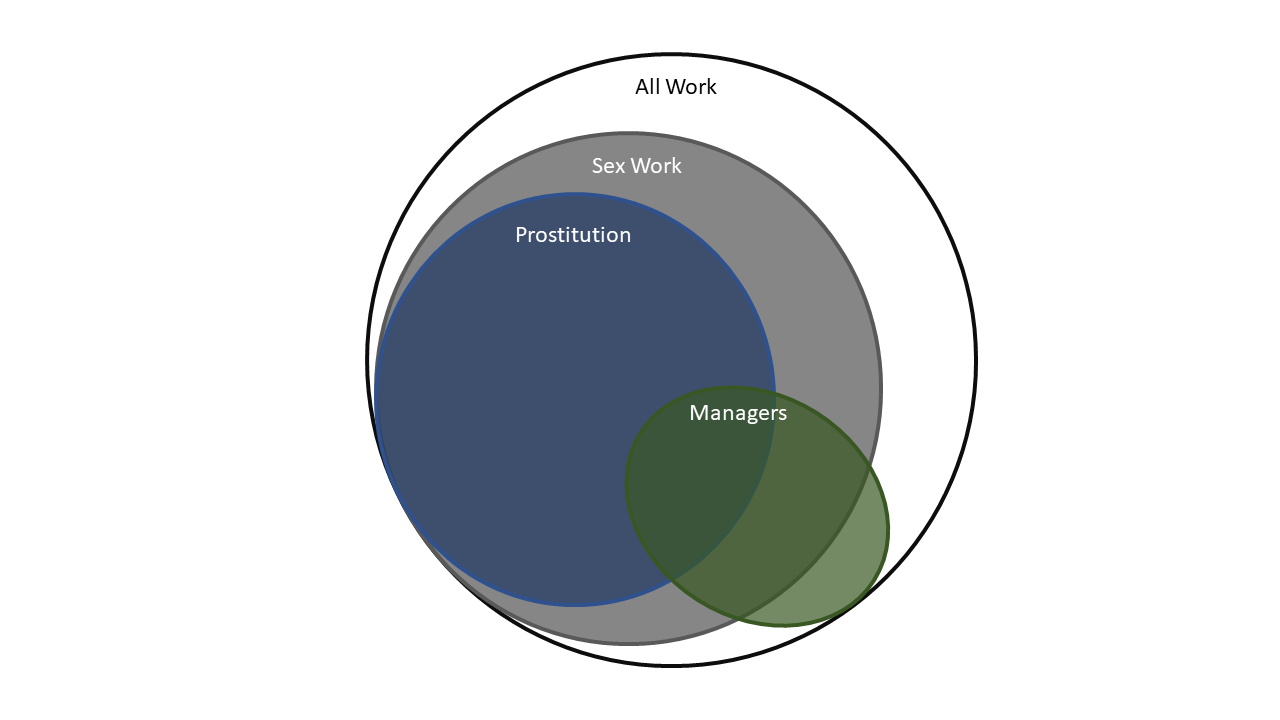
We start simply with a canvas of all work.
Venn Diagramme: All Work
Then we add ‘sex work’ as a subset of ‘all work’.
Venn Diagramme: Sex Work
Then, let’s add prostitution as a fully contained subset of sex work (and all work). Again, clearly, this is not to scale. Although sex work can be subdivided into categories besides prostitution, cam girls, phone sex operators, pornographic actors, and so on, and some women may operate in more than one of this subcategories, I will ignore them for the sake of this illustration.
Prostitution can be future subdivided into categories of streetwalkers, escorts, call girls, and so on, each sharing aspects whilst retains distinctions. Besides distinctions in services and autonomy, the ranks comprise of women from different socio-economic classes.
Venn Diagramme: Prostitution
Next come ‘pimps’, but before we get to them, let’s recognise for the moment that these people—for better and for worse—provide a supervisory or managerial function. ‘Managers’ exist outside of prostitution, inside the sex industry and out.
Venn Diagramme: Managers
Within the sex industry, and particularly within the subset of prostitution, these managers are called pimps, so we’ll focus our attention there. As depicted, not all and perhaps not most prostitutes have pimps. Presumably, there are pimps, if even by some other name, who ‘manage’ sex workers who are not otherwise considered to be prostitutes.
Venn Diagramme: Pimps
Now that we’ve established that pimps are not involved in all prostitution, let’s step back for a moment before bringing all of this together. First, let’s recognise that there exists a general category of human trafficking. These humans might be domestic workers, manual labourers, or sex workers.
Venn Diagramme: Human Trafficking
But for the sake of discussion, let’s limit the scope to the subset that is human sex trafficking, again noting that not all prostitution involves human sex trafficking.
Venn Diagramme: Human Sex Trafficking
Finally, let’s look at the final diagramme. Here we see the overlaps among the entities, and we can see that, theoretically, we can formulate a policy solution that addresses the deeper exploitation without disrupting the broader order of things.
Venn Diagramme: Complete
In the end, one cannot simply conflate either human sex trafficking or pimping with prostitution. This is an attempt to win an argument by playing slight of hand with a language shell game. But at no time does Elly create a compelling argument as to why prostitution somehow does not fall into the category of work.
I am not going to enter into debate at this time the issues that Capitalism and Colonialism introduce into the world at large, though I feel that the real debate lies there.
Moreover, looking at the length of this post, I am going to address my response to Arguing for Abolition Pt. 2 – Talk About Class in another entry, hopefully, either today or tomorrow.
Not really, but… This is a short video I hacked pulled together the last couple days. I guess I need to focus on getting them shorter. It’s a commentary on the various flavours of normative ethics.
To be fair, the first 30 seconds is a snippet of a song I am working on and felt like sharing before it’s finished.




















 Philosophics